service CHRYSLER VOYAGER 2001 Service Manual
[x] Cancel search | Manufacturer: CHRYSLER, Model Year: 2001, Model line: VOYAGER, Model: CHRYSLER VOYAGER 2001Pages: 4284, PDF Size: 83.53 MB
Page 4123 of 4284
information at the time of publication. The right is
reserved to make changes at any time without
notice.
4.2.1 TECHNICIAN SAFETY INFORMATION
WARNING: ENGINES PRODUCE CARBON
MONOXIDE THAT IS ODORLESS, CAUSES
SLOWER REACTION TIMES AND CAN LEAD
TO SERIOUS INJURY. WHEN THE ENGINE IS
OPERATING, KEEP SERVICE AREAS WELL
VENTILATED OR ATTACH THE VEHICLE
EXHAUST SYSTEM TO THE SHOP EXHAUST
REMOVAL SYSTEM.
Some operations in this manual require that
hydraulic tubes, hoses, and fittings, disconnected
for inspection or testing purposes. These systems,
when fully charged contains fluid at high pressure.
Before disconnecting any hydraulic tubes, hoses or
fittings, be sure that the system is fully depressur-
ized.
When servicing a vehicle, always wear eye pro-
tection and remove any metal jewelry such as
watchbands or bracelets that might make an inad-
vertent electrical contact.
When diagnosing a transmission system problem,
it is important to follow approved procedures where
applicable. Following these procedures is very im-
portant to the safety of individuals performing
diagnostic tests.
4.2.2 VEHICLE PREPARATION FOR
TESTING
Make sure the vehicle being tested has a fully
charged battery. If it does not, false diagnostic codes
or error messages may occur. It is extremely impor-
tant that accurate shift lever position data be avail-
able to the TCM. The accuracy of any diagnostic
trouble code found in memory is doubtful unless the
Shift Lever Test, performed on the DRBtScan Tool,
passes.
4.2.3 SERVICING SUB-ASSEMBLIES
Some components of the powertrain system are
intended to be serviced in assembly only. Attempt-
ing to remove or repair certain system subcompo-
nents may result in personal injury and/or im-
proper system operation. Only those components
with approved repair and installation procedures in
the service instructions should be serviced.
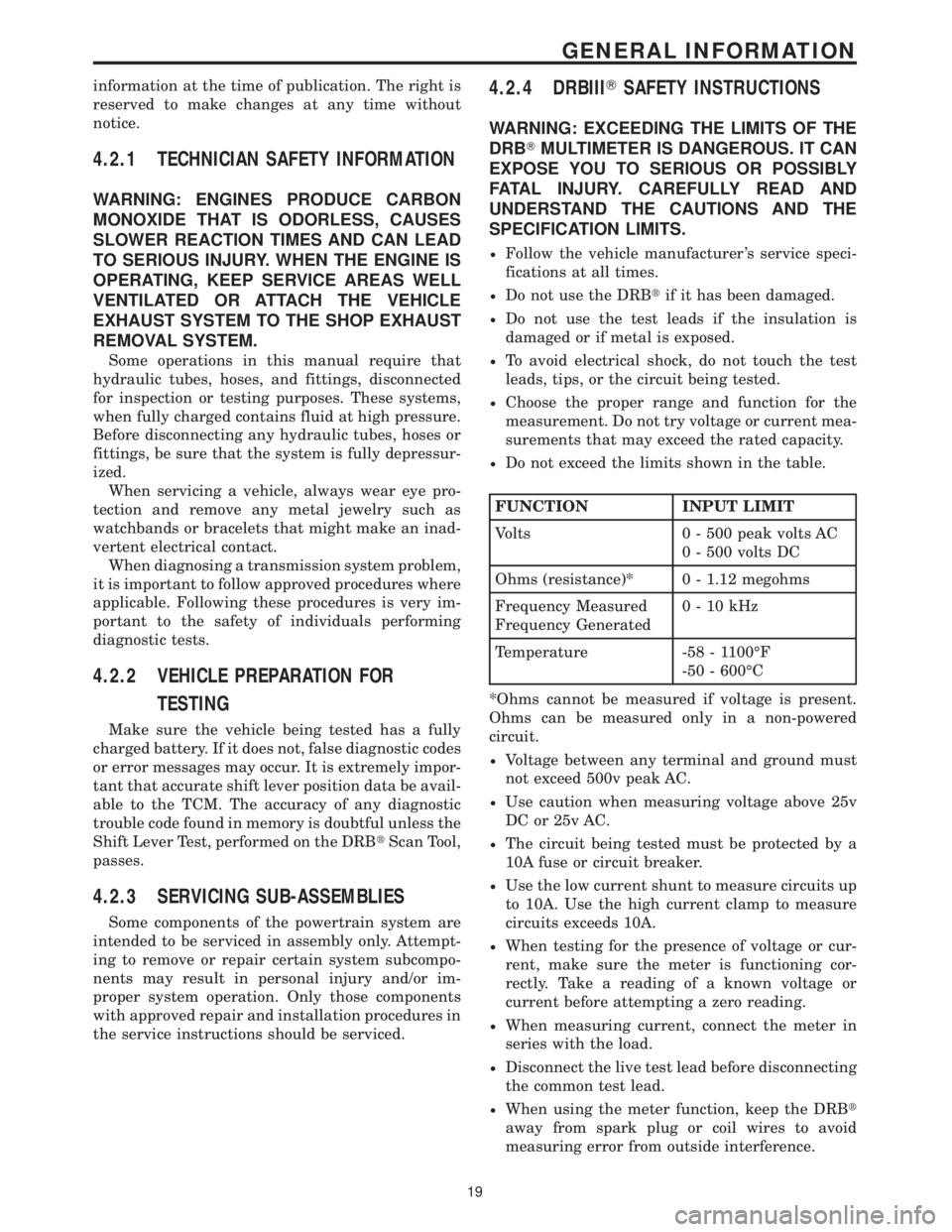
4.2.4 DRBIIITSAFETY INSTRUCTIONS
WARNING: EXCEEDING THE LIMITS OF THE
DRBTMULTIMETER IS DANGEROUS. IT CAN
EXPOSE YOU TO SERIOUS OR POSSIBLY
FATAL INJURY. CAREFULLY READ AND
UNDERSTAND THE CAUTIONS AND THE
SPECIFICATION LIMITS.
²Follow the vehicle manufacturer 's service speci-
fications at all times.
²Do not use the DRBtif it has been damaged.
²Do not use the test leads if the insulation is
damaged or if metal is exposed.
²To avoid electrical shock, do not touch the test
leads, tips, or the circuit being tested.
²Choose the proper range and function for the
measurement. Do not try voltage or current mea-
surements that may exceed the rated capacity.
²Do not exceed the limits shown in the table.
FUNCTION INPUT LIMIT
Volts 0 - 500 peak volts AC
0 - 500 volts DC
Ohms (resistance)* 0 - 1.12 megohms
Frequency Measured
Frequency Generated0-10kHz
Temperature -58 - 1100ÉF
-50 - 600ÉC
*Ohms cannot be measured if voltage is present.
Ohms can be measured only in a non-powered
circuit.
²Voltage between any terminal and ground must
not exceed 500v peak AC.
²Use caution when measuring voltage above 25v
DC or 25v AC.
²The circuit being tested must be protected by a
10A fuse or circuit breaker.
²Use the low current shunt to measure circuits up
to 10A. Use the high current clamp to measure
circuits exceeds 10A.
²When testing for the presence of voltage or cur-
rent, make sure the meter is functioning cor-
rectly. Take a reading of a known voltage or
current before attempting a zero reading.
²When measuring current, connect the meter in
series with the load.
²Disconnect the live test lead before disconnecting
the common test lead.
²When using the meter function, keep the DRBt
away from spark plug or coil wires to avoid
measuring error from outside interference.
19
GENERAL INFORMATION
Page 4124 of 4284
4.3 WARNINGS
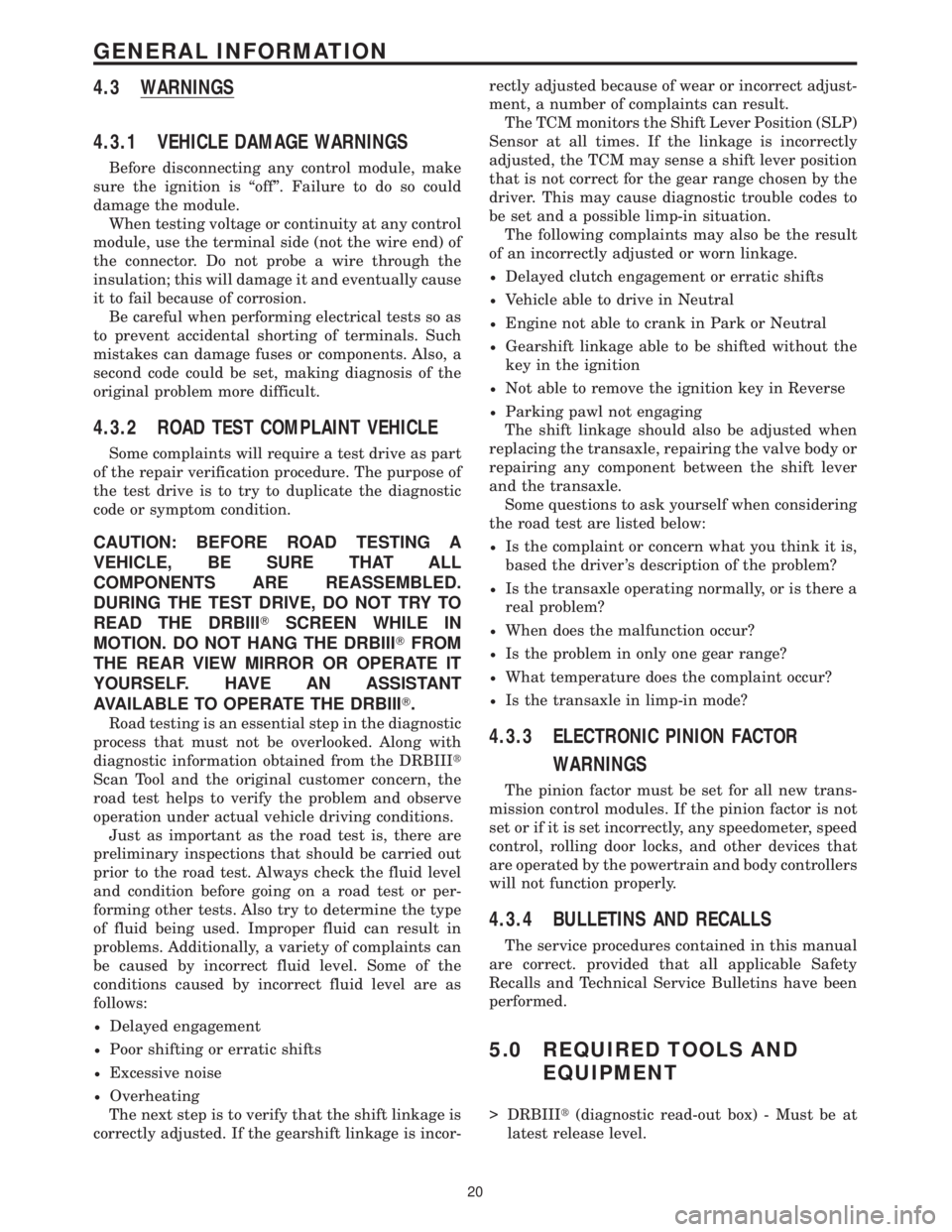
4.3.1 VEHICLE DAMAGE WARNINGS
Before disconnecting any control module, make
sure the ignition is ªoffº. Failure to do so could
damage the module.
When testing voltage or continuity at any control
module, use the terminal side (not the wire end) of
the connector. Do not probe a wire through the
insulation; this will damage it and eventually cause
it to fail because of corrosion.
Be careful when performing electrical tests so as
to prevent accidental shorting of terminals. Such
mistakes can damage fuses or components. Also, a
second code could be set, making diagnosis of the
original problem more difficult.
4.3.2 ROAD TEST COMPLAINT VEHICLE
Some complaints will require a test drive as part
of the repair verification procedure. The purpose of
the test drive is to try to duplicate the diagnostic
code or symptom condition.
CAUTION: BEFORE ROAD TESTING A
VEHICLE, BE SURE THAT ALL
COMPONENTS ARE REASSEMBLED.
DURING THE TEST DRIVE, DO NOT TRY TO
READ THE DRBIIITSCREEN WHILE IN
MOTION. DO NOT HANG THE DRBIIITFROM
THE REAR VIEW MIRROR OR OPERATE IT
YOURSELF. HAVE AN ASSISTANT
AVAILABLE TO OPERATE THE DRBIIIT.
Road testing is an essential step in the diagnostic
process that must not be overlooked. Along with
diagnostic information obtained from the DRBIIIt
Scan Tool and the original customer concern, the
road test helps to verify the problem and observe
operation under actual vehicle driving conditions.
Just as important as the road test is, there are
preliminary inspections that should be carried out
prior to the road test. Always check the fluid level
and condition before going on a road test or per-
forming other tests. Also try to determine the type
of fluid being used. Improper fluid can result in
problems. Additionally, a variety of complaints can
be caused by incorrect fluid level. Some of the
conditions caused by incorrect fluid level are as
follows:
²Delayed engagement
²Poor shifting or erratic shifts
²Excessive noise
²Overheating
The next step is to verify that the shift linkage is
correctly adjusted. If the gearshift linkage is incor-rectly adjusted because of wear or incorrect adjust-
ment, a number of complaints can result.
The TCM monitors the Shift Lever Position (SLP)
Sensor at all times. If the linkage is incorrectly
adjusted, the TCM may sense a shift lever position
that is not correct for the gear range chosen by the
driver. This may cause diagnostic trouble codes to
be set and a possible limp-in situation.
The following complaints may also be the result
of an incorrectly adjusted or worn linkage.
²Delayed clutch engagement or erratic shifts
²Vehicle able to drive in Neutral
²Engine not able to crank in Park or Neutral
²Gearshift linkage able to be shifted without the
key in the ignition
²Not able to remove the ignition key in Reverse
²Parking pawl not engaging
The shift linkage should also be adjusted when
replacing the transaxle, repairing the valve body or
repairing any component between the shift lever
and the transaxle.
Some questions to ask yourself when considering
the road test are listed below:
²Is the complaint or concern what you think it is,
based the driver 's description of the problem?
²Is the transaxle operating normally, or is there a
real problem?
²When does the malfunction occur?
²Is the problem in only one gear range?
²What temperature does the complaint occur?
²Is the transaxle in limp-in mode?
4.3.3 ELECTRONIC PINION FACTOR
WARNINGS
The pinion factor must be set for all new trans-
mission control modules. If the pinion factor is not
set or if it is set incorrectly, any speedometer, speed
control, rolling door locks, and other devices that
are operated by the powertrain and body controllers
will not function properly.
4.3.4 BULLETINS AND RECALLS
The service procedures contained in this manual
are correct. provided that all applicable Safety
Recalls and Technical Service Bulletins have been
performed.
5.0 REQUIRED TOOLS AND
EQUIPMENT
> DRBIIIt(diagnostic read-out box) - Must be at
latest release level.
20
GENERAL INFORMATION
Page 4128 of 4284
Symptom:
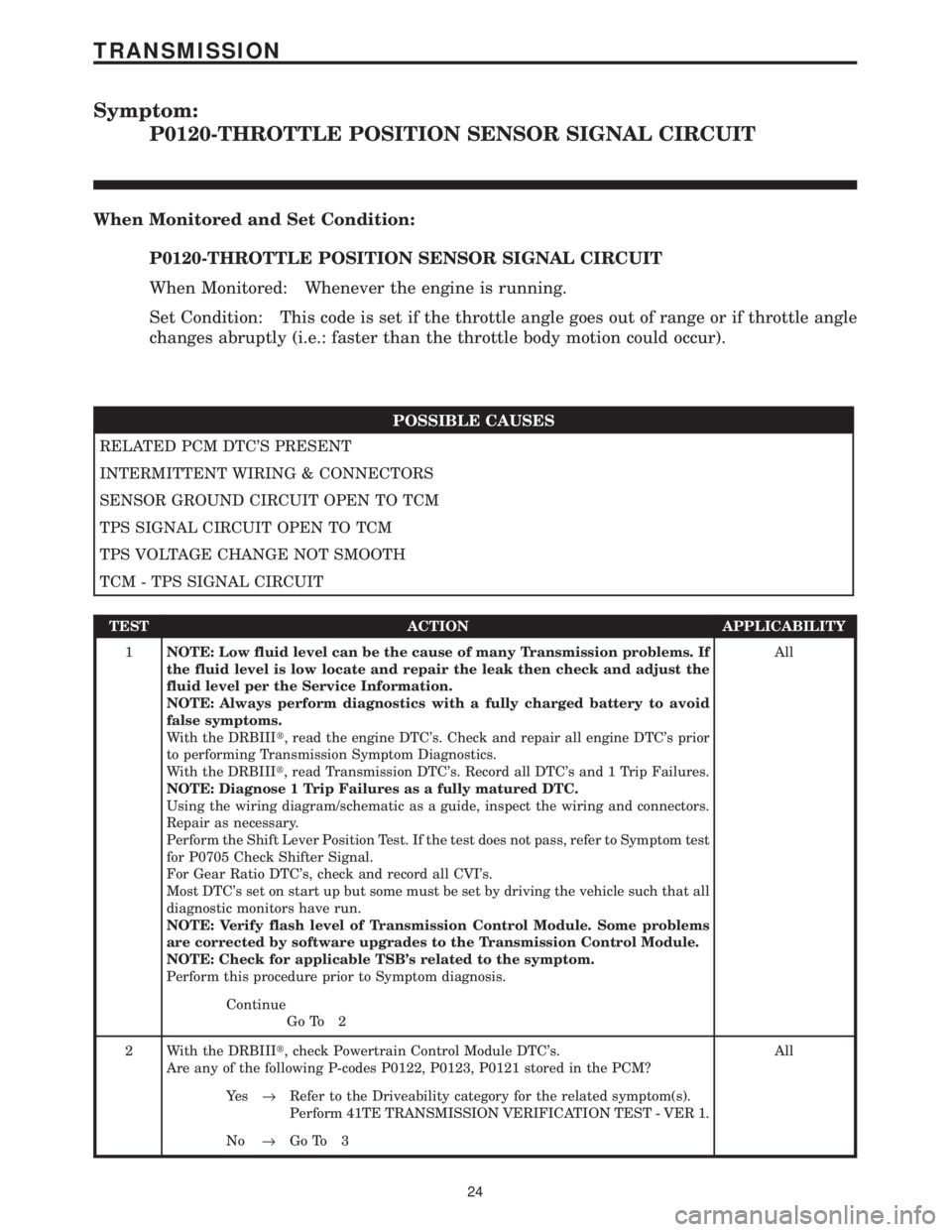
P0120-THROTTLE POSITION SENSOR SIGNAL CIRCUIT
When Monitored and Set Condition:
P0120-THROTTLE POSITION SENSOR SIGNAL CIRCUIT
When Monitored: Whenever the engine is running.
Set Condition: This code is set if the throttle angle goes out of range or if throttle angle
changes abruptly (i.e.: faster than the throttle body motion could occur).
POSSIBLE CAUSES
RELATED PCM DTC'S PRESENT
INTERMITTENT WIRING & CONNECTORS
SENSOR GROUND CIRCUIT OPEN TO TCM
TPS SIGNAL CIRCUIT OPEN TO TCM
TPS VOLTAGE CHANGE NOT SMOOTH
TCM - TPS SIGNAL CIRCUIT
TEST ACTION APPLICABILITY
1NOTE: Low fluid level can be the cause of many Transmission problems. If
the fluid level is low locate and repair the leak then check and adjust the
fluid level per the Service Information.
NOTE: Always perform diagnostics with a fully charged battery to avoid
false symptoms.
With the DRBIIIt, read the engine DTC's. Check and repair all engine DTC's prior
to performing Transmission Symptom Diagnostics.
With the DRBIIIt, read Transmission DTC's. Record all DTC's and 1 Trip Failures.
NOTE: Diagnose 1 Trip Failures as a fully matured DTC.
Using the wiring diagram/schematic as a guide, inspect the wiring and connectors.
Repair as necessary.
Perform the Shift Lever Position Test. If the test does not pass, refer to Symptom test
for P0705 Check Shifter Signal.
For Gear Ratio DTC's, check and record all CVI's.
Most DTC's set on start up but some must be set by driving the vehicle such that all
diagnostic monitors have run.
NOTE: Verify flash level of Transmission Control Module. Some problems
are corrected by software upgrades to the Transmission Control Module.
NOTE: Check for applicable TSB's related to the symptom.
Perform this procedure prior to Symptom diagnosis.All
Continue
Go To 2
2 With the DRBIIIt, check Powertrain Control Module DTC's.
Are any of the following P-codes P0122, P0123, P0121 stored in the PCM?All
Ye s®Refer to the Driveability category for the related symptom(s).
Perform 41TE TRANSMISSION VERIFICATION TEST - VER 1.
No®Go To 3
24
TRANSMISSION
Page 4136 of 4284
TEST ACTION APPLICABILITY
1NOTE: Low fluid level can be the cause of many Transmission problems. If
the fluid level is low locate and repair the leak then check and adjust the
fluid level per the Service Information.
NOTE: Always perform diagnostics with a fully charged battery to avoid
false symptoms.
With the DRBIIIt, read the engine DTC's. Check and repair all engine DTC's prior
to performing Transmission Symptom Diagnostics.
With the DRBIIIt, read Transmission DTC's. Record all DTC's and 1 Trip Failures.
NOTE: Diagnose 1 Trip Failures as a fully matured DTC.
Using the wiring diagram/schematic as a guide, inspect the wiring and connectors.
Repair as necessary.
Perform the Shift Lever Position Test. If the test does not pass, refer to Symptom test
for P0705 Check Shifter Signal.
For Gear Ratio DTC's, check and record all CVI's.
Most DTC's set on start up but some must be set by driving the vehicle such that all
diagnostic monitors have run.
NOTE: Verify flash level of Transmission Control Module. Some problems
are corrected by software upgrades to the Transmission Control Module.
NOTE: Check for applicable TSB's related to the symptom.
Perform this procedure prior to Symptom diagnosis.All
Continue
Go To 2
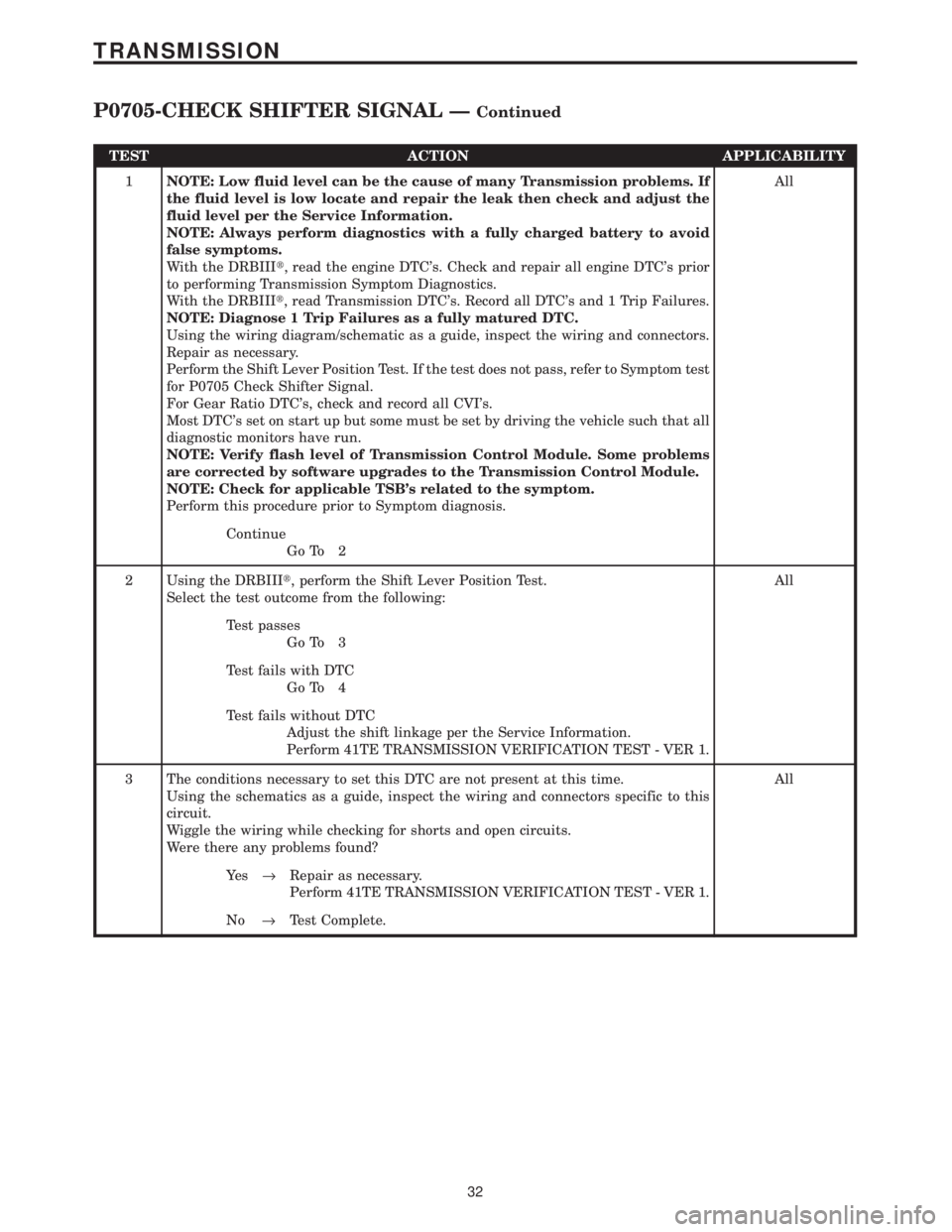
2 Using the DRBIIIt, perform the Shift Lever Position Test.
Select the test outcome from the following:All
Test passes
Go To 3
Test fails with DTC
Go To 4
Test fails without DTC
Adjust the shift linkage per the Service Information.
Perform 41TE TRANSMISSION VERIFICATION TEST - VER 1.
3 The conditions necessary to set this DTC are not present at this time.
Using the schematics as a guide, inspect the wiring and connectors specific to this
circuit.
Wiggle the wiring while checking for shorts and open circuits.
Were there any problems found?All
Ye s®Repair as necessary.
Perform 41TE TRANSMISSION VERIFICATION TEST - VER 1.
No®Test Complete.
32
TRANSMISSION
P0705-CHECK SHIFTER SIGNAL ÐContinued
Page 4142 of 4284

Symptom:
P0715-INPUT SPEED SENSOR ERROR
When Monitored and Set Condition:
P0715-INPUT SPEED SENSOR ERROR
When Monitored: The transmission gear ratio is monitored continuously while the
transmission is in gear.
Set Condition: If there is an excessive change in input RPM in any gear.
POSSIBLE CAUSES
INTERMITTENT WIRING AND CONNECTORS
INPUT SPEED SENSOR SIGNAL CIRCUIT OPEN
SPEED SENSOR GROUND CIRCUIT OPEN
INPUT SPEED SENSOR SIGNAL CIRCUIT SHORT TO GROUND
INPUT SPEED SENSOR SIGNAL CIRCUIT SHORT TO VOLTAGE
SPEED SENSOR GROUND CIRCUIT SHORT TO VOLTAGE
INPUT SPEED SENSOR ERROR
TCM - INPUT SPEED SENSOR
TEST ACTION APPLICABILITY
1NOTE: Low fluid level can be the cause of many Transmission problems. If
the fluid level is low locate and repair the leak then check and adjust the
fluid level per the Service Information.
NOTE: Always perform diagnostics with a fully charged battery to avoid
false symptoms.
With the DRBIIIt, read the engine DTC's. Check and repair all engine DTC's prior
to performing Transmission Symptom Diagnostics.
With the DRBIIIt, read Transmission DTC's. Record all DTC's and 1 Trip Failures.
NOTE: Diagnose 1 Trip Failures as a fully matured DTC.
Using the wiring diagram/schematic as a guide, inspect the wiring and connectors.
Repair as necessary.
Perform the Shift Lever Position Test. If the test does not pass, refer to Symptom test
for P0705 Check Shifter Signal.
For Gear Ratio DTC's, check and record all CVI's.
Most DTC's set on start up but some must be set by driving the vehicle such that all
diagnostic monitors have run.
NOTE: Verify flash level of Transmission Control Module. Some problems
are corrected by software upgrades to the Transmission Control Module.
NOTE: Check for applicable TSB's related to the symptom.
Perform this procedure prior to Symptom diagnosis.All
Continue
Go To 2
38
TRANSMISSION
Page 4146 of 4284

Symptom:
P0720-OUTPUT SPEED SENSOR ERROR
When Monitored and Set Condition:
P0720-OUTPUT SPEED SENSOR ERROR
When Monitored: The transmission gear ratio is monitored continuously while the
transmission is in gear.
Set Condition: If there is an excessive change in output RPM in any gear.
POSSIBLE CAUSES
INTERMITTENT WIRING AND CONNECTORS
OUTPUT SPEED SENSOR SIGNAL CIRCUIT OPEN
SPEED SENSOR GROUND CIRCUIT OPEN
OUTPUT SPEED SENSOR SIGNAL CIRCUIT SHORT TO GROUND
OUTPUT SPEED SENSOR SIGNAL CIRCUIT SHORT TO VOLTAGE
SPEED SENSOR GROUND CIRCUIT SHORT TO VOLTAGE
OUTPUT SPEED SENSOR ERROR
TCM - OUTPUT SPEED SENSOR
TEST ACTION APPLICABILITY
1NOTE: Low fluid level can be the cause of many Transmission problems. If
the fluid level is low locate and repair the leak then check and adjust the
fluid level per the Service Information.
NOTE: Always perform diagnostics with a fully charged battery to avoid
false symptoms.
With the DRBIIIt, read the engine DTC's. Check and repair all engine DTC's prior
to performing Transmission Symptom Diagnostics.
With the DRBIIIt, read Transmission DTC's. Record all DTC's and 1 Trip Failures.
NOTE: Diagnose 1 Trip Failures as a fully matured DTC.
Using the wiring diagram/schematic as a guide, inspect the wiring and connectors.
Repair as necessary.
Perform the Shift Lever Position Test. If the test does not pass, refer to Symptom test
for P0705 Check Shifter Signal.
For Gear Ratio DTC's, check and record all CVI's.
Most DTC's set on start up but some must be set by driving the vehicle such that all
diagnostic monitors have run.
NOTE: Verify flash level of Transmission Control Module. Some problems
are corrected by software upgrades to the Transmission Control Module.
NOTE: Check for applicable TSB's related to the symptom.
Perform this procedure prior to Symptom diagnosis.All
Continue
Go To 2
42
TRANSMISSION
Page 4150 of 4284

Symptom:
P0725-ENGINE SPEED SENSOR CIRCUIT (3.3L/3.8L)
When Monitored and Set Condition:
P0725-ENGINE SPEED SENSOR CIRCUIT (3.3L/3.8L)
When Monitored: Whenever the engine is running.
Set Condition: Engine RPM less than 390 or greater than 8000 for more than 2 seconds
while the engine is running.
POSSIBLE CAUSES
PCM TPS DTC'S PRESENT
INTERMITTENT WIRING & CONNECTORS
CRANK POSITION SENSOR GROUND CIRCUIT OPEN
CRANK POSITION SENSOR SIGNAL CIRCUIT OPEN
TCM - ENGINE SPEED SENSOR CIRCUIT
TEST ACTION APPLICABILITY
1NOTE: Low fluid level can be the cause of many Transmission problems. If
the fluid level is low locate and repair the leak then check and adjust the
fluid level per the Service Information.
NOTE: Always perform diagnostics with a fully charged battery to avoid
false symptoms.
With the DRBIIIt, read the engine DTC's. Check and repair all engine DTC's prior
to performing Transmission Symptom Diagnostics.
With the DRBIIIt, read Transmission DTC's. Record all DTC's and 1 Trip Failures.
NOTE: Diagnose 1 Trip Failures as a fully matured DTC.
Using the wiring diagram/schematic as a guide, inspect the wiring and connectors.
Repair as necessary.
Perform the Shift Lever Position Test. If the test does not pass, refer to Symptom test
for P0705 Check Shifter Signal.
For Gear Ratio DTC's, check and record all CVI's.
Most DTC's set on start up but some must be set by driving the vehicle such that all
diagnostic monitors have run.
NOTE: Verify flash level of Transmission Control Module. Some problems
are corrected by software upgrades to the Transmission Control Module.
NOTE: Check for applicable TSB's related to the symptom.
Perform this procedure prior to Symptom diagnosis.All
Continue
Go To 2
2 With the DRBIIIt, read PCM DTCs.
Are there any PCM Throttle Position Sensor DTC's present?All
Ye s®Repair all PCM Throttle Position Sensor DTCs before proceeding.
Refer to the driveability category for the appropriate symptom.
No®Go To 3
46
TRANSMISSION
Page 4152 of 4284

Symptom:
P0725-ENGINE SPEED SENSOR CIRCUIT (3.5L)
When Monitored and Set Condition:
P0725-ENGINE SPEED SENSOR CIRCUIT (3.5L)
When Monitored: Whenever the engine is running.
Set Condition: Engine RPM less than 390 or greater than 8000 for more than 2 seconds
while the engine is running.
POSSIBLE CAUSES
INTERMITTENT WIRING & CONNECTORS CONDITIONS
EATX RPM SIGNAL CIRCUIT OPEN
EATX RPM SIGNAL CIRCUIT SHORTED TO GROUND
EATX RPM SIGNAL CIRCUIT SHORTED TO VOLTAGE
PCM-INTERNAL CONTROLLER
TCM-INTERNAL CONTROLLER
TEST ACTION APPLICABILITY
1NOTE: Low fluid level can be the cause of many Transmission problems. If
the fluid level is low locate and repair the leak then check and adjust the
fluid level per the Service Information.
NOTE: Always perform diagnostics with a fully charged battery to avoid
false symptoms.
With the DRBIIIt, read the engine DTC's. Check and repair all engine DTC's prior
to performing Transmission Symptom Diagnostics.
With the DRBIIIt, read Transmission DTC's. Record all DTC's and 1 Trip Failures.
NOTE: Diagnose 1 Trip Failures as a fully matured DTC.
Using the wiring diagram/schematic as a guide, inspect the wiring and connectors.
Repair as necessary.
Perform the Shift Lever Position Test. If the test does not pass, refer to Symptom test
for P0705 Check Shifter Signal.
For Gear Ratio DTC's, check and record all CVI's.
Most DTC's set on start up but some must be set by driving the vehicle such that all
diagnostic monitors have run.
NOTE: Verify flash level of Transmission Control Module. Some problems
are corrected by software upgrades to the Transmission Control Module.
NOTE: Check for applicable TSB's related to the symptom.
Perform this procedure prior to Symptom diagnosis.All
Continue
Go To 2
2 With the DRBIIIt, Check the STARTS SINCE SET counter.
NOTE: This counter only applies to the last DTC set.
Is the STARTS SINCE SET counter set at 0?All
Ye s®Go To 3
No®Go To 8
48
TRANSMISSION
Page 4153 of 4284

TEST ACTION APPLICABILITY
3 Turn the ignition off to the lock position.
Disconnect the PCM harness connector(s).
Disconnect the TCM harness connector.
Note: Check connectors - Clean/repair as necessary.
Measure the resistance of the EATX RPM signal circuit between the TCM harness
connector and the PCM harness connector.
Is the resistance above 5.0 ohms?All
Ye s®Repair the EATX RPM Signal circuit for an open.
Perform 41TE TRANSMISSION VERIFICATION TEST - VER 1.
No®Go To 4
4 Turn the ignition off to the lock position.
Disconnect the PCM harness connector(s).
Disconnect the TCM harness connector.
Note: Check connectors - Clean/repair as necessary.
Measure the resistance between ground and the EATX RPM Signal circuit.
Is the resistance below 5.0 ohms?All
Ye s®Repair the EATX RPM Signal circuit for a short to ground.
Perform 41TE TRANSMISSION VERIFICATION TEST - VER 1.
No®Go To 5
5 Turn the ignition off to the lock position.
Disconnect the PCM harness connector.
Note: Check connectors - Clean/repair as necessary.
Ignition on, engine not running.
Measure the voltage of the EATX RPM Signal circuit in the PCM harness connector.
Is the voltage above 10.0 volts?All
Ye s®Repair the EATX RPM Signal circuit for a short to voltage.
Perform 41TE TRANSMISSION VERIFICATION TEST - VER 1.
No®Go To 6
6 Turn the ignition off to the lock position.
Disconnect the Powertrain Control Module-PCM harness connector.
Note: Check connectors - Clean/repair as necessary.
Ignition on, engine not running.
Measure the voltage between the EATX RPM Signal circuit and ground at the PCM
harness connector.
Is the voltage between 4.5 and 5.5 volts?All
Ye s®Replace and program the Powertrain Control Module in accor-
dance with the Service Information.
Perform 41TE TRANSMISSION VERIFICATION TEST - VER 1.
No®Go To 7
7 If there are no possible causes remaining, view repair. All
Repair
Replace the TCM. WITH THE DRBIIItPERFORM QUICK
LEARN AND REPROGRAM PINION FACTOR.
Perform 41TE TRANSMISSION VERIFICATION TEST - VER 1.
49
TRANSMISSION
P0725-ENGINE SPEED SENSOR CIRCUIT (3.5L) ÐContinued
Page 4155 of 4284
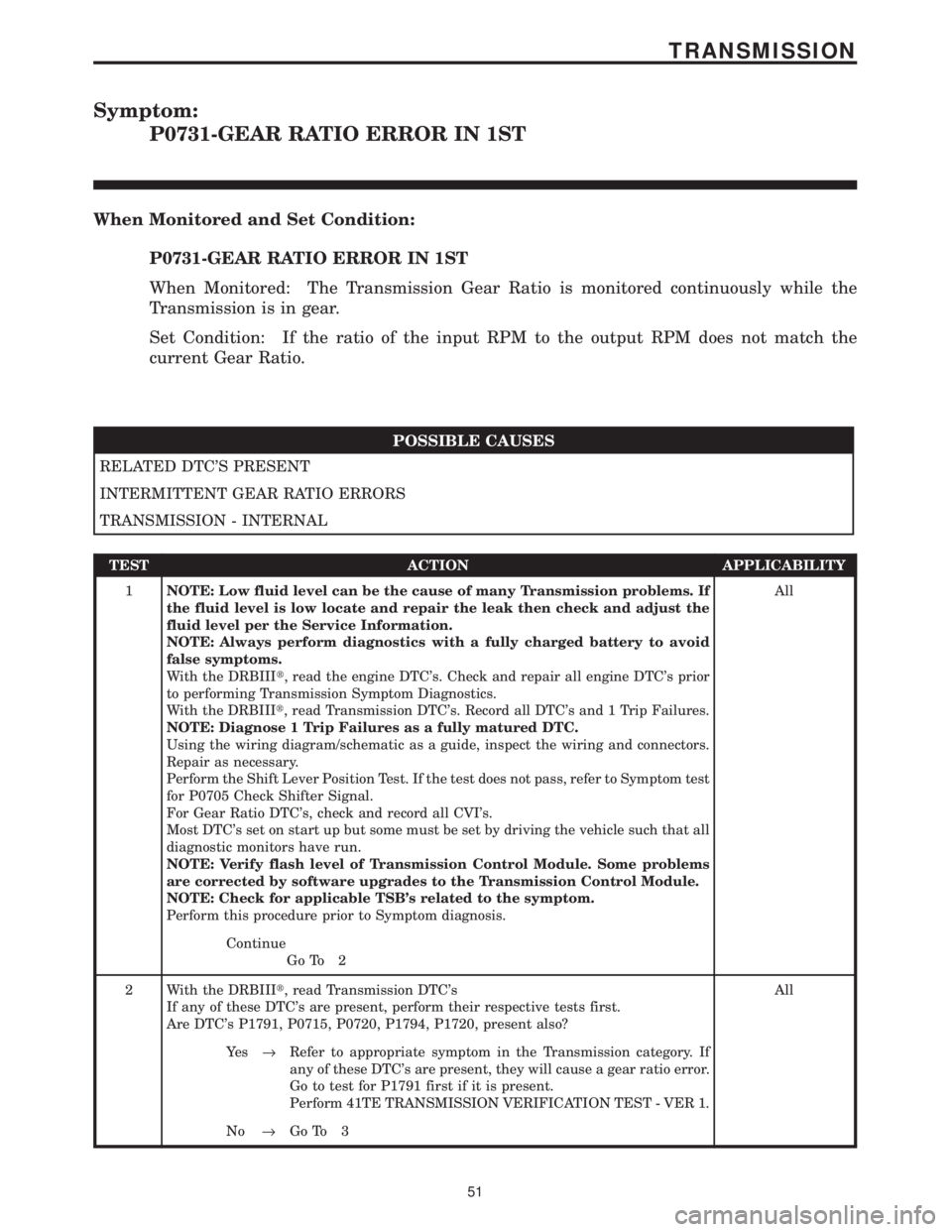
Symptom:
P0731-GEAR RATIO ERROR IN 1ST
When Monitored and Set Condition:
P0731-GEAR RATIO ERROR IN 1ST
When Monitored: The Transmission Gear Ratio is monitored continuously while the
Transmission is in gear.
Set Condition: If the ratio of the input RPM to the output RPM does not match the
current Gear Ratio.
POSSIBLE CAUSES
RELATED DTC'S PRESENT
INTERMITTENT GEAR RATIO ERRORS
TRANSMISSION - INTERNAL
TEST ACTION APPLICABILITY
1NOTE: Low fluid level can be the cause of many Transmission problems. If
the fluid level is low locate and repair the leak then check and adjust the
fluid level per the Service Information.
NOTE: Always perform diagnostics with a fully charged battery to avoid
false symptoms.
With the DRBIIIt, read the engine DTC's. Check and repair all engine DTC's prior
to performing Transmission Symptom Diagnostics.
With the DRBIIIt, read Transmission DTC's. Record all DTC's and 1 Trip Failures.
NOTE: Diagnose 1 Trip Failures as a fully matured DTC.
Using the wiring diagram/schematic as a guide, inspect the wiring and connectors.
Repair as necessary.
Perform the Shift Lever Position Test. If the test does not pass, refer to Symptom test
for P0705 Check Shifter Signal.
For Gear Ratio DTC's, check and record all CVI's.
Most DTC's set on start up but some must be set by driving the vehicle such that all
diagnostic monitors have run.
NOTE: Verify flash level of Transmission Control Module. Some problems
are corrected by software upgrades to the Transmission Control Module.
NOTE: Check for applicable TSB's related to the symptom.
Perform this procedure prior to Symptom diagnosis.All
Continue
Go To 2
2 With the DRBIIIt, read Transmission DTC's
If any of these DTC's are present, perform their respective tests first.
Are DTC's P1791, P0715, P0720, P1794, P1720, present also?All
Ye s®Refer to appropriate symptom in the Transmission category. If
any of these DTC's are present, they will cause a gear ratio error.
Go to test for P1791 first if it is present.
Perform 41TE TRANSMISSION VERIFICATION TEST - VER 1.
No®Go To 3
51
TRANSMISSION