Ignition lock CHRYSLER VOYAGER 2004 Service Manual
[x] Cancel search | Manufacturer: CHRYSLER, Model Year: 2004, Model line: VOYAGER, Model: CHRYSLER VOYAGER 2004Pages: 2585, PDF Size: 62.54 MB
Page 1830 of 2585
INSTALLATION
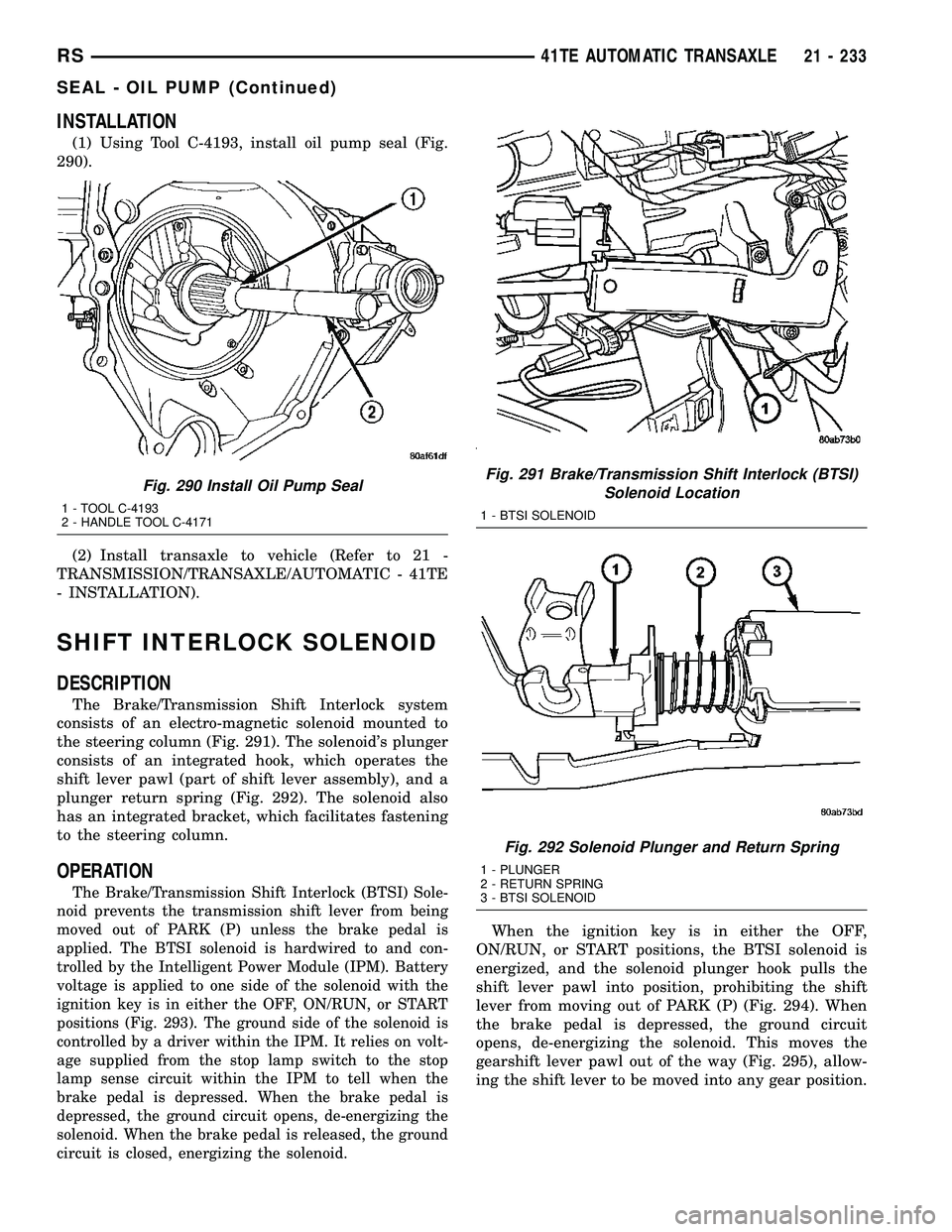
(1) Using Tool C-4193, install oil pump seal (Fig.
290).
(2) Install transaxle to vehicle (Refer to 21 -
TRANSMISSION/TRANSAXLE/AUTOMATIC - 41TE
- INSTALLATION).
SHIFT INTERLOCK SOLENOID
DESCRIPTION
The Brake/Transmission Shift Interlock system
consists of an electro-magnetic solenoid mounted to
the steering column (Fig. 291). The solenoid's plunger
consists of an integrated hook, which operates the
shift lever pawl (part of shift lever assembly), and a
plunger return spring (Fig. 292). The solenoid also
has an integrated bracket, which facilitates fastening
to the steering column.
OPERATION
The Brake/Transmission Shift Interlock (BTSI) Sole-
noid prevents the transmission shift lever from being
moved out of PARK (P) unless the brake pedal is
applied. The BTSI solenoid is hardwired to and con-
trolled by the Intelligent Power Module (IPM). Battery
voltage is applied to one side of the solenoid with the
ignition key is in either the OFF, ON/RUN, or START
positions (Fig. 293). The ground side of the solenoid is
controlled by a driver within the IPM. It relies on volt-
age supplied from the stop lamp switch to the stop
lamp sense circuit within the IPM to tell when the
brake pedal is depressed. When the brake pedal is
depressed, the ground circuit opens, de-energizing the
solenoid. When the brake pedal is released, the ground
circuit is closed, energizing the solenoid.
When the ignition key is in either the OFF,
ON/RUN, or START positions, the BTSI solenoid is
energized, and the solenoid plunger hook pulls the
shift lever pawl into position, prohibiting the shift
lever from moving out of PARK (P) (Fig. 294). When
the brake pedal is depressed, the ground circuit
opens, de-energizing the solenoid. This moves the
gearshift lever pawl out of the way (Fig. 295), allow-
ing the shift lever to be moved into any gear position.
Fig. 290 Install Oil Pump Seal
1 - TOOL C-4193
2 - HANDLE TOOL C-4171
Fig. 291 Brake/Transmission Shift Interlock (BTSI)
Solenoid Location
1 - BTSI SOLENOID
Fig. 292 Solenoid Plunger and Return Spring
1 - PLUNGER
2 - RETURN SPRING
3 - BTSI SOLENOID
RS41TE AUTOMATIC TRANSAXLE21 - 233
SEAL - OIL PUMP (Continued)
Page 1831 of 2585

A conventional mechanical interlock system is also
used. This system manually prohibits shifter move-
ment when the ignition switch is in the LOCK or
ACC positions. Solenoid operation is not required in
these key positions.
For intended BTSI system operation, refer to the
following chart:
ACTION EXPECTED RESPONSE
1. Turn key to the9OFF9
position.1. Shifter CAN be shifted
out of park with brake
pedal applied.
2. Turn key to the
9ON/RUN9position.2. Shifter CANNOT be
shifted out of park.
3. Turn key to the
9ON/RUN9position and
depress the brake pedal.3. Shifter CAN be shifted
out of park.
4. Leave shifter in any
gear and try to return key
to the9LOCK9or9ACC9
position.4. Key cannot be
returned to the9LOCK9or
9ACC9position.
5. Return shifter to
9PARK9and try to remove
the key.5. Key can be removed
(after returning to9LOCK9
position).
6. With the key removed,
try to shift out of9PARK9.6. Shifter cannot be
shifted out of9PARK9.
NOTE: Any failure to meet these expected
responses requires system adjustment or repair.
Fig. 293 Ignition Key/Switch Positions
1 - ACC
2 - LOCK
3 - OFF
4 - ON/RUN
5-START
Fig. 294 Pawl Engaged to Shift Lever
1 - GEAR SHIFT LEVER
2 - GEAR SHIFT LEVER PAWL
Fig. 295 Pawl Disengaged From Shift Lever
1 - GEAR SHIFT LEVER
2 - GEAR SHIFT LEVER PAWL
21 - 234 41TE AUTOMATIC TRANSAXLERS
SHIFT INTERLOCK SOLENOID (Continued)
Page 1846 of 2585
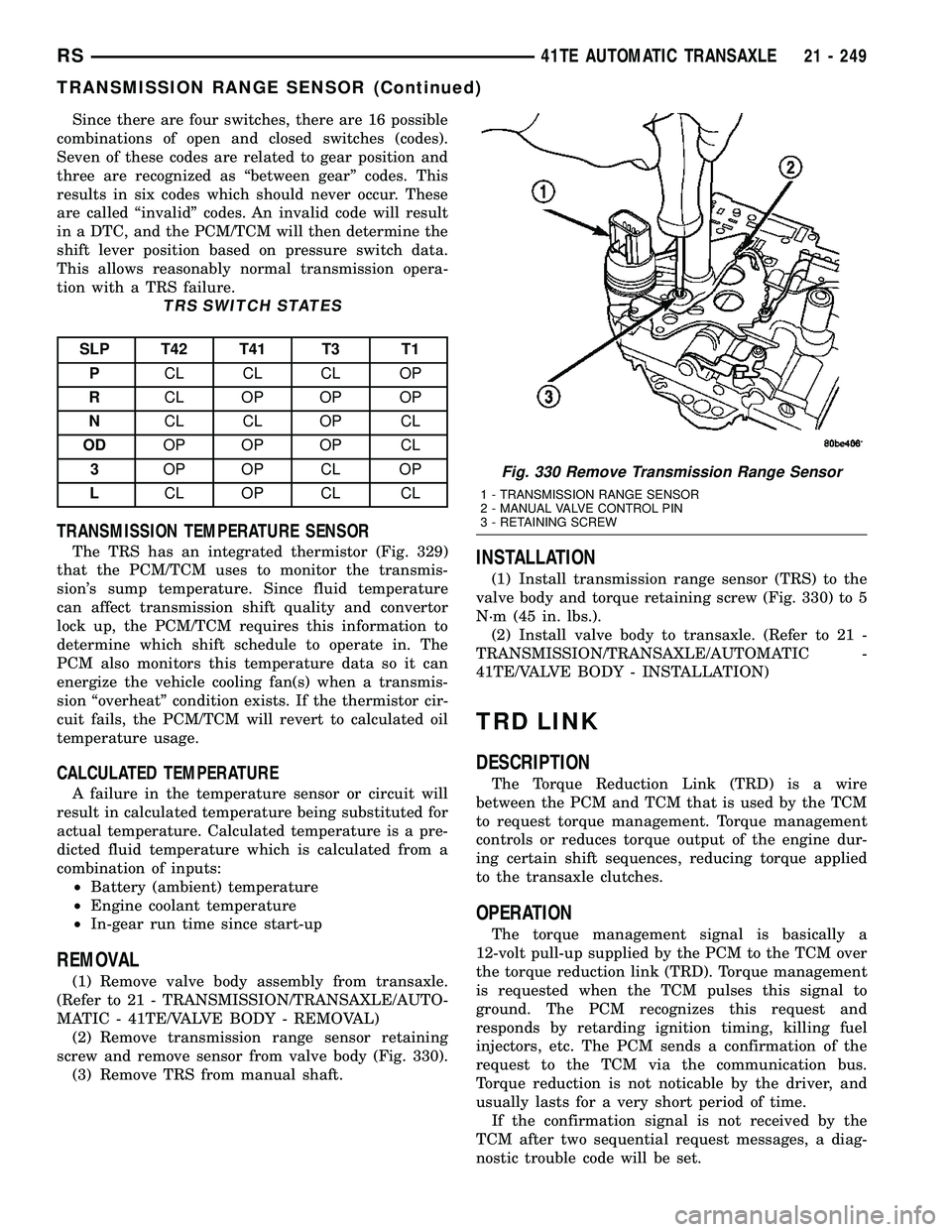
Since there are four switches, there are 16 possible
combinations of open and closed switches (codes).
Seven of these codes are related to gear position and
three are recognized as ªbetween gearº codes. This
results in six codes which should never occur. These
are called ªinvalidº codes. An invalid code will result
in a DTC, and the PCM/TCM will then determine the
shift lever position based on pressure switch data.
This allows reasonably normal transmission opera-
tion with a TRS failure.
TRS SWITCH STATES
SLP T42 T41 T3 T1
PCL CL CL OP
RCL OP OP OP
NCL CL OP CL
ODOP OP OP CL
3OP OP CL OP
LCL OP CL CL
TRANSMISSION TEMPERATURE SENSOR
The TRS has an integrated thermistor (Fig. 329)
that the PCM/TCM uses to monitor the transmis-
sion's sump temperature. Since fluid temperature
can affect transmission shift quality and convertor
lock up, the PCM/TCM requires this information to
determine which shift schedule to operate in. The
PCM also monitors this temperature data so it can
energize the vehicle cooling fan(s) when a transmis-
sion ªoverheatº condition exists. If the thermistor cir-
cuit fails, the PCM/TCM will revert to calculated oil
temperature usage.
CALCULATED TEMPERATURE
A failure in the temperature sensor or circuit will
result in calculated temperature being substituted for
actual temperature. Calculated temperature is a pre-
dicted fluid temperature which is calculated from a
combination of inputs:
²Battery (ambient) temperature
²Engine coolant temperature
²In-gear run time since start-up
REMOVAL
(1) Remove valve body assembly from transaxle.
(Refer to 21 - TRANSMISSION/TRANSAXLE/AUTO-
MATIC - 41TE/VALVE BODY - REMOVAL)
(2) Remove transmission range sensor retaining
screw and remove sensor from valve body (Fig. 330).
(3) Remove TRS from manual shaft.
INSTALLATION
(1) Install transmission range sensor (TRS) to the
valve body and torque retaining screw (Fig. 330) to 5
N´m (45 in. lbs.).
(2) Install valve body to transaxle. (Refer to 21 -
TRANSMISSION/TRANSAXLE/AUTOMATIC -
41TE/VALVE BODY - INSTALLATION)
TRD LINK
DESCRIPTION
The Torque Reduction Link (TRD) is a wire
between the PCM and TCM that is used by the TCM
to request torque management. Torque management
controls or reduces torque output of the engine dur-
ing certain shift sequences, reducing torque applied
to the transaxle clutches.
OPERATION
The torque management signal is basically a
12-volt pull-up supplied by the PCM to the TCM over
the torque reduction link (TRD). Torque management
is requested when the TCM pulses this signal to
ground. The PCM recognizes this request and
responds by retarding ignition timing, killing fuel
injectors, etc. The PCM sends a confirmation of the
request to the TCM via the communication bus.
Torque reduction is not noticable by the driver, and
usually lasts for a very short period of time.
If the confirmation signal is not received by the
TCM after two sequential request messages, a diag-
nostic trouble code will be set.
Fig. 330 Remove Transmission Range Sensor
1 - TRANSMISSION RANGE SENSOR
2 - MANUAL VALVE CONTROL PIN
3 - RETAINING SCREW
RS41TE AUTOMATIC TRANSAXLE21 - 249
TRANSMISSION RANGE SENSOR (Continued)
Page 1995 of 2585
OPERATION
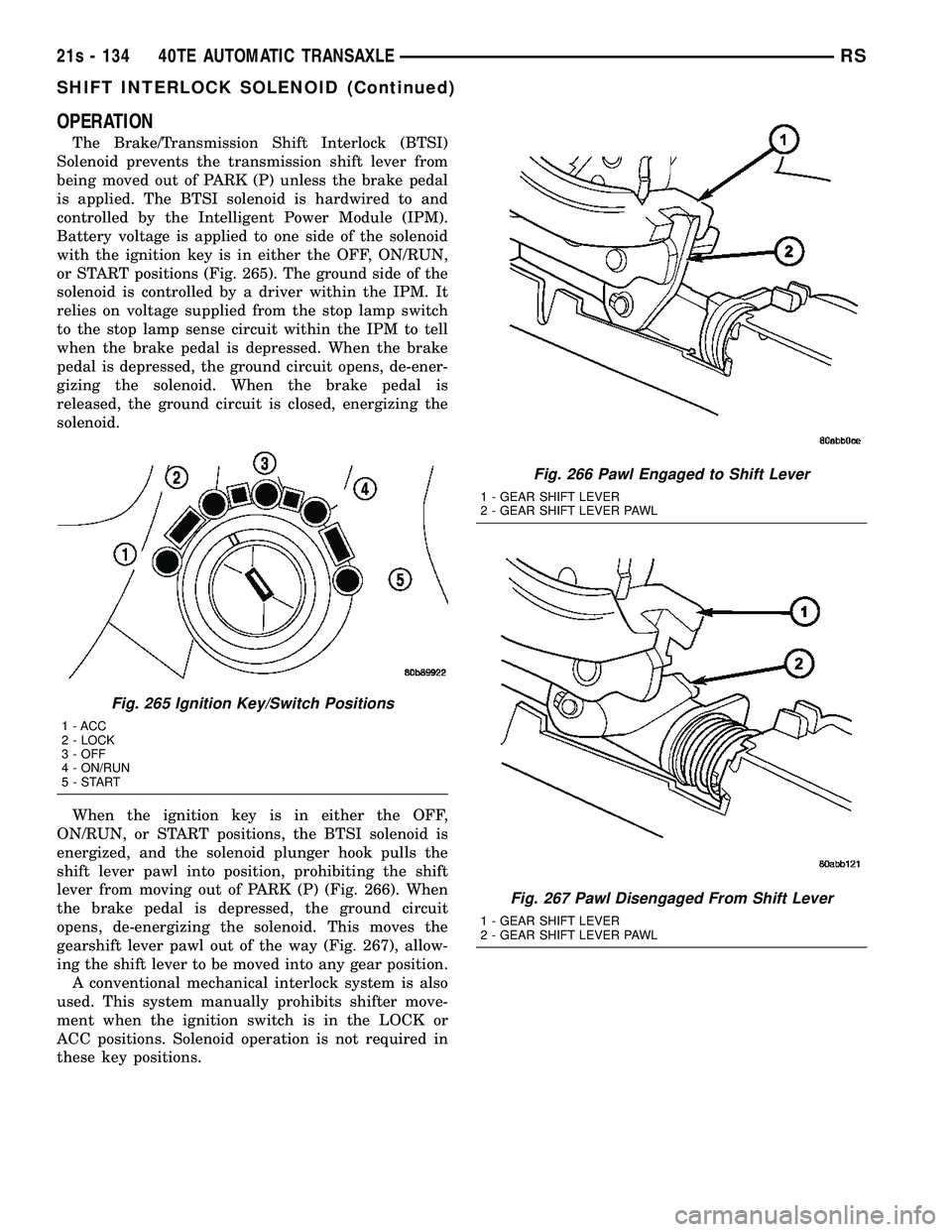
The Brake/Transmission Shift Interlock (BTSI)
Solenoid prevents the transmission shift lever from
being moved out of PARK (P) unless the brake pedal
is applied. The BTSI solenoid is hardwired to and
controlled by the Intelligent Power Module (IPM).
Battery voltage is applied to one side of the solenoid
with the ignition key is in either the OFF, ON/RUN,
or START positions (Fig. 265). The ground side of the
solenoid is controlled by a driver within the IPM. It
relies on voltage supplied from the stop lamp switch
to the stop lamp sense circuit within the IPM to tell
when the brake pedal is depressed. When the brake
pedal is depressed, the ground circuit opens, de-ener-
gizing the solenoid. When the brake pedal is
released, the ground circuit is closed, energizing the
solenoid.
When the ignition key is in either the OFF,
ON/RUN, or START positions, the BTSI solenoid is
energized, and the solenoid plunger hook pulls the
shift lever pawl into position, prohibiting the shift
lever from moving out of PARK (P) (Fig. 266). When
the brake pedal is depressed, the ground circuit
opens, de-energizing the solenoid. This moves the
gearshift lever pawl out of the way (Fig. 267), allow-
ing the shift lever to be moved into any gear position. A conventional mechanical interlock system is also
used. This system manually prohibits shifter move-
ment when the ignition switch is in the LOCK or
ACC positions. Solenoid operation is not required in
these key positions.
Fig. 265 Ignition Key/Switch Positions
1 - ACC
2 - LOCK
3 - OFF
4 - ON/RUN
5-START
Fig. 266 Pawl Engaged to Shift Lever
1 - GEAR SHIFT LEVER
2 - GEAR SHIFT LEVER PAWL
Fig. 267 Pawl Disengaged From Shift Lever
1 - GEAR SHIFT LEVER
2 - GEAR SHIFT LEVER PAWL
21s - 134 40TE AUTOMATIC TRANSAXLERS
SHIFT INTERLOCK SOLENOID (Continued)
Page 2112 of 2585

BODY
TABLE OF CONTENTS
page page
BODY
DESCRIPTION - VEHICLE IDENTIFICATION....1
WARNING
SAFETY PRECAUTIONS AND WARNINGS . . . 1
DIAGNOSIS AND TESTING
DIAGNOSIS AND TESTING - WATER LEAKS . 1
DIAGNOSIS AND TESTING - WIND NOISE . . . 2
STANDARD PROCEDURE
STANDARD PROCEDURE - PLASTIC BODY
PANEL REPAIR........................3
STANDARD PROCEDURE - HEAT STAKING . 10
SPECIFICATIONS
TORQUE............................11
BODY LUBRICATION...................12
SPECIAL TOOLS
BODY..............................13DOOR - FRONT.........................14
DOORS - SLIDING.......................24
DECKLID/HATCH/LIFTGATE/TAILGATE.......40
EXTERIOR.............................45
HOOD.................................60
INSTRUMENT PANEL.....................63
INTERIOR..............................73
PAINT.................................84
SEATS................................86
STATIONARY GLASS....................108
WEATHERSTRIP/SEALS..................113
SUNROOF.............................116
BODY STRUCTURE.....................124
BODY
DESCRIPTION - VEHICLE IDENTIFICATION
Throughout this group, references to the
DaimlerChrysler Corporation vehicle family identifi-
cation code are used when describing a procedure
that is unique to that vehicle. Refer to Introduction
Group of this manual for detailed information on
vehicle identification. If a procedure is common to all
vehicles covered in this manual, no reference will be
made to a vehicle family code.
WARNING
SAFETY PRECAUTIONS AND WARNINGS
WARNING: USE A OSHA APPROVED BREATHING
FILTER WHEN SPRAYING PAINT OR SOLVENTS IN
A CONFINED AREA. PERSONAL INJURY CAN
RESULT.
AVOID PROLONGED SKIN CONTACT WITH PETRO-
LEUM OR ALCOHOL ± BASED CLEANING SOL-
VENTS. PERSONAL INJURY CAN RESULT.
DO NOT STAND UNDER A HOISTED VEHICLE THAT
IS NOT PROPERLY SUPPORTED ON SAFETY
STANDS. PERSONAL INJURY CAN RESULT.
CAUTION: When holes must be drilled or punched
in an inner body panel, verify depth of space to the
outer body panel, electrical wiring, or other compo-nents. Damage to vehicle can result.
Do not weld exterior panels unless combustible
material on the interior of vehicle is removed from
the repair area. Fire or hazardous conditions, can
result.
Always have a fire extinguisher ready for use when
welding.
Disconnect the negative (-) cable clamp from the
battery when servicing electrical components that
are live when the ignition is OFF. Damage to electri-
cal system can result.
Do not use abrasive chemicals or compounds on
painted surfaces. Damage to finish can result.
Do not use harsh alkaline based cleaning solvents
on painted or upholstered surfaces. Damage to fin-
ish or color can result.
Do not hammer or pound on plastic trim panel
when servicing interior trim. Plastic panels can
break.
DIAGNOSIS AND TESTING
DIAGNOSIS AND TESTING - WATER LEAKS
Water leaks can be caused by poor sealing,
improper body component alignment, body seam
porosity, missing plugs, or blocked drain holes. Cen-
trifugal and gravitational force can cause water to
drip from a location away from the actual leak point,
making leak detection difficult. All body sealing
points should be water tight in normal wet-driving
conditions. Water flowing downward from the front of
RSBODY23-1
Page 2227 of 2585

SUNROOF
TABLE OF CONTENTS
page page
SUNROOF
DESCRIPTION........................116
DIAGNOSIS AND TESTING - SUNROOF.....116
DRAIN TUBE
REMOVAL............................119
INSTALLATION........................120
GLASS PANEL
REMOVAL............................120
INSTALLATION........................120
ADJUSTMENTS
SUNROOF GLASS PANEL ADJUSTMENT . . 120
SUNROOF ASSEMBLY
REMOVAL............................120
INSTALLATION........................120
SUNSHADE
REMOVAL............................120INSTALLATION........................121
WIND DEFLECTOR
REMOVAL............................121
INSTALLATION........................121
WATER CHANNEL
REMOVAL............................121
INSTALLATION........................121
SUNROOF MOTOR
REMOVAL............................121
INSTALLATION........................121
ADJUSTMENTS
ADJUSTMENT.......................122
SUNROOF SWITCH
REMOVAL............................123
INSTALLATION........................123
SUNROOF
DESCRIPTION
WARNING: Keep fingers and other body parts out
of sunroof opening at all times.
The sun roof features consists of: (Fig. 1)
²Sun roof glass
²Sun roof sun shade
The sunroof power sliding glass panel and sun-
shade can be positioned anywhere along its travel,
rearward of glass panel front edge.
The sunroof is electrically operated from a switch
located in the overhead console. To operate the sun-
roof the ignition switch must be in the Accessory or
On/Run position. Both switchs are a rocker style
design that open or close the sunroof. When pressing
and releasing the open button once, the sunroof will
express open to the comfort stop and the wind deflec-
tor will raise. If the button is pressed a second time,
the sunroof will continue to open to full travel unless
the button is released, at which time it will stop in
that position. Pressing and holding the close button
will close the sunroof. If the close button is released
before the glass fully closes, the sunroof will stop in
that position. The vent switch operates in a similar
manor. The sunroof will also operate for up to fifteenminutes after the ignition key is turned off for cus-
tomer comfort and convenance while parking.
DIAGNOSIS AND TESTING - SUNROOF
Refer to Sunroof Diagnostic Chart for possible
causes. Before beginning sunroof diagnostics verify
that all other power accessories are in proper operat-
ing condition. If not, a common electrical problem
may exist. Refer to Wiring Diagrams, in this publica-
tion for circuit, splice and component descriptions.
Check the condition of the circuit protection (20 amp
circuit breaker in the Junction Block). Inspect all
wiring connector pins for proper engagement and
continuity. Check for battery voltage at the power
sunroof controller, refer to Wiring Diagrams, for cir-
cuit information. If battery voltage of more than 10
volts is detected at the controller, proceed with the
following tests (the controller will not operate at less
than 10 volts).
Before beginning diagnosis for wind noise or water
leaks, verify that the problem was not caused by
releasing the control switch before the sunroof was
fully closed. The sunroof module has a water-man-
agement system. If however, the sunroof glass is in a
partial closed position, high pressure water may be
forced beyond the water management system bound-
aries and onto the headlining.
23 - 116 SUNROOFRS
Page 2442 of 2585
blower motor to regulate the blower motor ground
path it provides. The blower motor and wheel are
used to control the velocity of air moving through the
HVAC housing by spinning the blower wheel within
the housing at the selected speed or, in the ATC sys-
tem, at the selected or programmed speed.
DIAGNOSIS AND TESTING - BLOWER MOTOR
BLOWER MOTOR INOPERATIVE
WARNING: ON VEHICLES EQUIPPED WITH AIR-
BAGS, DISABLE THE AIRBAG SYSTEM BEFORE
ATTEMPTING ANY STEERING WHEEL, STEERING
COLUMN, OR INSTRUMENT PANEL COMPONENT
DIAGNOSIS OR SERVICE. DISCONNECT AND ISO-
LATE THE BATTERY NEGATIVE (GROUND) CABLE,
THEN WAIT TWO MINUTES FOR THE AIRBAG SYS-
TEM CAPACITOR TO DISCHARGE BEFORE PER-
FORMING FURTHER DIAGNOSIS OR SERVICE. THIS
IS THE ONLY SURE WAY TO DISABLE THE AIRBAG
SYSTEM. FAILURE TO TAKE THE PROPER PRE-
CAUTIONS COULD RESULT IN ACCIDENTAL AIR-
BAG DEPLOYMENT AND POSSIBLE PERSONAL
INJURY.
For circuit descriptions and diagrams, refer to the
appropriate wiring information. The wiring informa-
tion includes wiring, diagrams, proper wire and con-
nector repair procedures, further details on wire
harness routing and retention, as well as pin-out and
location views for the various wire harness connec-
tors, splices and grounds.
BLOWER MOTOR ELECTRICAL DIAGNOSIS
(1) Check the fuse (Fuse 10 - 40 ampere) in the
Integrated Power Module (IPM). If OK, go to Step 2.
If not OK, repair the shorted circuit or component as
required and replace the faulty fuse.
(2) Turn the ignition switch to the On position. Be
certain that the A/C-heater control power is turned
on. Check for battery voltage at the fuse (Fuse 10 -
40 ampere) in the IPM. If OK, go to Step 3. If not
OK, check the front blower motor relay.
(3) Turn the ignition switch to the Off position.
Disconnect and isolate the battery negative cable.
Disconnect the front HVAC wire harness connector
for the front blower motor resistor block (Manual
Temperature Control) or the front blower motor
power module (Automatic Temperature Control) from
the resistor or module connector receptacle. Recon-
nect the battery negative cable. Turn the ignition
switch to the On position. Be certain that the A/C-
heater control power is turned on. Check for battery
voltage at the fused front blower motor relay output
circuit cavity of the front HVAC wire harness connec-
tor for the front blower motor resistor block (MTC) orthe front blower motor power module (ATC). If OK,
go to Step 4. If not OK, repair the open fused front
blower motor relay output circuit to the IPM as
required.
(4) Turn the ignition switch to the Off position.
Disconnect and isolate the battery negative cable.
Disconnect the front blower motor pigtail wire con-
nector from the connector receptacle of the front
blower motor resistor block (MTC) or the front
blower motor power module (ATC). Use jumper wires
to connect a battery and ground feeds to the blower
motor pigtail wire connector. The blower motor
should operate. If OK with MTC, proceed to diagno-
sis of the front blower motor resistor block (Refer to
24 - HEATING & AIR CONDITIONING/CONTROLS
- FRONT/BLOWER MOTOR RESISTOR - DIAGNO-
SIS AND TESTING). If OK with ATC, use a DRBIII
scan tool to diagnose the front blower motor power
module. Refer to Body Diagnostic information. If not
OK with MTC or ATC, replace the faulty front blower
motor.
BLOWER MOTOR NOISE OR VIBRATION
Refer to the Blower Motor Noise/Vibration Diagno-
sis chart for basic checks of the blower motor when a
vibration or noise is present (Fig. 7).
REMOVAL
WARNING: ON VEHICLES EQUIPPED WITH AIR-
BAGS, DISABLE THE AIRBAG SYSTEM BEFORE
ATTEMPTING ANY STEERING WHEEL, STEERING
COLUMN, OR INSTRUMENT PANEL COMPONENT
DIAGNOSIS OR SERVICE. DISCONNECT AND ISO-
LATE THE BATTERY NEGATIVE (GROUND) CABLE,
THEN WAIT TWO MINUTES FOR THE AIRBAG SYS-
TEM CAPACITOR TO DISCHARGE BEFORE PER-
FORMING FURTHER DIAGNOSIS OR SERVICE. THIS
IS THE ONLY SURE WAY TO DISABLE THE AIRBAG
SYSTEM. FAILURE TO TAKE THE PROPER PRE-
CAUTIONS COULD RESULT IN AN ACCIDENTAL
AIRBAG DEPLOYMENT AND POSSIBLE PERSONAL
INJURY.
NOTE: The blower motor is located on the passen-
ger side of the vehicle under the instrument panel.
The blower motor can be removed from the vehicle
without having to remove the HVAC housing.
(1) Disconnect and isolate the battery negative
cable.
(2) Remove the passenger side door sill plate and
cowl panel.
(3) Pull back the carpet to access the front lower
air intake screw.
RSDISTRIBUTION - FRONT24-47
BLOWER MOTOR (Continued)
Page 2453 of 2585
DIAGNOSIS AND TESTING - REAR BLOWER
MOTOR
BLOWER MOTOR INOPERATIVE
For circuit descriptions and diagrams, refer to the
appropriate wiring information. The wiring informa-
tion includes wiring, diagrams, proper wire and con-
nector repair procedures, further details on wire
harness routing and retention, as well as pin-out and
location views for the various wire harness connec-
tors, splices and grounds.
BLOWER MOTOR ELECTRICAL DIAGNOSIS
(1) Check the fuse (Fuse 12 - 25 ampere) in the
Integrated Power Module (IPM). If OK, go to Step 2.
If not OK, repair the shorted circuit or component as
required and replace the faulty fuse.
(2) Turn the ignition switch to the On position. Be
certain that the rear A/C-heater control power is
turned on. Check for battery voltage at the fuse
(Fuse 12 - 25 ampere) in the IPM. If OK, go to Step
3. If not OK, check the rear blower motor relay.
(3) Turn the ignition switch to the Off position.
Disconnect and isolate the battery negative cable.
Disconnect the rear HVAC wire harness connector
from the rear blower motor resistor block (Manual
Temperature Control) or the rear blower motor power
module (Automatic Temperature Control). Reconnect
the battery negative cable. Turn the ignition switch
to the On position. Be certain that the rear A/C-
heater control power is turned on. Check for battery
voltage at the fused rear blower motor relay output
circuit cavity of the rear HVAC wire harness connec-
tor for the rear blower motor resistor block (MTC) or
the rear blower motor power module (ATC). If OK, go
to Step 4. If not OK, repair the open fused front
blower motor relay output circuit to the IPM as
required.
(4) Turn the ignition switch to the Off position.
Disconnect and isolate the battery negative cable.
Disconnect the rear blower motor pigtail wire connec-
tor from the rear HVAC wire harness (MTC) or the
rear blower power module (ATC). Use jumper wires
to connect a battery and ground feeds to the blower
motor pigtail wire connector. The rear blower motor
should operate. If OK with MTC, proceed to diagno-
sis of the rear blower motor resistor block (Refer to
24 - HEATING & AIR CONDITIONING/CONTROLS
- REAR/BLOWER MOTOR RESISTOR - DIAGNOSIS
AND TESTING). If OK with ATC, use a DRBIII scan
tool to diagnose the rear blower motor power module.
Refer to the appropriate diagnostic information. If
not OK with MTC or ATC, replace the faulty rear
blower motor.BLOWER MOTOR NOISE OR VIBRATION
Refer to the Blower Motor Noise/Vibration Diagno-
sis chart for basic checks of the blower motor when a
vibration or noise is present (Fig. 3).
REMOVAL
WARNING: REFER TO THE APPLICABLE WARN-
INGS AND CAUTIONS FOR THIS SYSTEM BEFORE
PERFORMING THE FOLLOWING OPERATION (Refer
to 24 - HEATING & AIR CONDITIONING/PLUMBING -
WARNING) and (Refer to 24 - HEATING & AIR CON-
DITIONING/PLUMBING - CAUTION).
(1) Remove the rear HVAC housing from the vehi-
cle (Refer to 24 - HEATING & AIR CONDITIONING/
DISTRIBUTION/HVAC HOUSING - REMOVAL).
(2) Disconnect the rear blower motor pigtail wire
connector.
NOTE: With the Manual Temperature Control sys-
tem, the blower motor pigtail wire is connected to a
take out and connector of the rear HVAC wire har-
ness. With the Automatic Temperature Control sys-
tem , the blower pigtail wire is connected to a
receptacle on the blower motor power module.
(3) Remove the three screws that secure the rear
blower motor to the outboard side of the rear HVAC
housing (Fig. 4).
(4) Remove the rear blower motor from the rear
HVAC housing.
INSTALLATION
(1) Position the rear blower motor into the rear
HVAC housing.
(2) Install the three screws that secure the blower
motor to the rear HVAC housing. Tighten the screws
to 2 N´m (17 in. lbs.).
(3) Reconnect the rear blower motor pigtail wire
connector.
NOTE: With the Manual Temperature Control system
, the blower pigtail wire is connected to a take out
and connector of the rear HVAC wire harness. With
the Automatic Temperature Control system, the
blower pigtail wire is connected to a receptacle on
the blower motor power module.
24 - 58 DISTRIBUTION - REARRS
BLOWER MOTOR (Continued)
Page 2550 of 2585

CHAIN WEAR - STANDARD PROCEDURE,
MEASURING TIMING..................9-153
CHANGE - STANDARD PROCEDURE,
DIFFERENTIAL ASSEMBLY FLUID.........3-40
CHANGE - STANDARD PROCEDURE,
ENGINE OIL AND FILTER...........9-137,9-53
CHANGE - STANDARD PROCEDURE,
OVERRUNNING CLUTCH HOUSING
FLUID..............................3-41
CHANGE - STANDARD PROCEDURE, PTU
FLUID..............................21-5
CHANGER - DESCRIPTION, CD...........8A-7
CHANGER - INSTALLATION, CD..........8A-8
CHANGER - OPERATION, CD.............8A-7
CHANGER - REMOVAL, CD..............8A-8
CHANNEL - INSTALLATION, WATER.....23-121
CHANNEL - REMOVAL, WATER.........23-121
CHARGE - STANDARD PROCEDURE,
REFRIGERANT SYSTEM...............24-72
CHARGE LEVEL TEST - 2.5L DIESEL -
DIAGNOSIS AND TESTING, SYSTEM......24-68
CHARGE LEVEL TEST - GASOLINE
ENGINES - DIAGNOSIS AND TESTING,
SYSTEM............................24-67
CHARGING - STANDARD PROCEDURE,
CONVENTIONAL BATTERY..............8F-11
CHARGING - STANDARD PROCEDURE,
SPIRAL PLATE BATTERY...............8F-10
CHARGING SYSTEM - DESCRIPTION.....8F-20
CHARGING SYSTEM - OPERATION.......8F-20
CHARTS - DIAGNOSIS AND TESTING,
STEERING SYSTEM DIAGNOSIS...........19-3
CHARTS - SPECIFICATIONS, COLOR
CODE..............................23-84
CHATTER COMPLAINTS - DIAGNOSIS
AND TESTING, CLUTCH.................6-6
CHECK - DIAGNOSIS AND TESTING,
COOLING SYSTEM FLOW................7-3
CHECK - DIAGNOSIS AND TESTING,
EXHAUST SYSTEM RESTRICTION.........11-2
CHECK - STANDARD PROCEDURE,
COOLANT LEVEL.......................7-5
CHECK - STANDARD PROCEDURE,
ENGINE OIL LEVEL...................9-137
CHECK - STANDARD PROCEDURE, FLUID
LEVEL.............................21-71
CHECK, STANDARD PROCEDURE -
ENGINE OIL LEVEL....................9-53
CHECK, STANDARD PROCEDURE - FLUID
LEVEL AND CONDITION........21-201,21s-102
CHECK STRAP - INSTALLATION.........23-15
CHECK STRAP - REMOVAL.............23-15
CHECKING - STANDARD PROCEDURE,
BRAKE FLUID LEVEL..............5-32,5s-31
CHECKING - STANDARD PROCEDURE,
POWER STEERING FLUID LEVEL........19-44
CHECKING BATTERY ELECTROLYTE
LEVEL - STANDARD PROCEDURE........8F-14
CHECKING ENGINE OIL PRESSURE -
DIAGNOSIS AND TESTING..............9-52
CHECKING POWER STEERING BELT
TENSION - STANDARD PROCEDURE.......7-8
CHILD RESTRAINT ANCHOR -
DESCRIPTION........................8O-4
CHILD RESTRAINT ANCHOR -
OPERATION..........................8O-4
CHILD SEAT - INSTALLATION, QUAD.....23-89
CHILD SEAT - REMOVAL, QUAD.........23-89
CHILD SEAT MODULE, BENCH SEAT -
REMOVAL..........................23-87
CHIME SYSTEM - DIAGNOSIS AND
TESTING
............................8B-1
CHIME/BUZZER - DESCRIPTION
..........8B-1
CHIME/BUZZER - OPERATION
............8B-1
CHIME/BUZZER - WARNING
.............8B-1
CHIME/THERMISTOR - DESCRIPTION
....8N-10
CHIME/THERMISTOR - INSTALLATION
....8N-10
CHIME/THERMISTOR - OPERATION
......8N-10
CHIME/THERMISTOR - REMOVAL
.......8N-10
CHIRP PREFERENCE - STANDARD
PROCEDURE, HORN
..............8N-42,8N-5
CIRCUIT - DIAGNOSIS AND TESTING,
AMBIENT TEMPERATURE SENSOR
......8M-12
CIRCUIT FUNCTIONS - DESCRIPTION
. . 8W-01-6
CIRCUIT INFORMATION - DESCRIPTION
. 8W-01-5
CIRCUIT RESISTANCE TEST -
DIAGNOSIS AND TESTING, FEED
. . . 8F-32,8F-34CIRCUIT TEST - DIAGNOSIS AND
TESTING, CONTROL..............8F-30,8F-32
CIRCUIT TEST - DIAGNOSIS AND
TESTING, FEED.................8F-33,8F-35
CIRCUITS - OPERATION, NON-
MONITORED.........................25-5
CIRCUITS AND VALVES - OPERATION,
HYDRAULIC..........................5-83
CLAMP - STANDARD PROCEDURE,
HOSES..............................14-7
CLAMPS - DESCRIPTION, FUEL
LINES/HOSES........................14-6
CLAMPS - DESCRIPTION, HOSE...........7-1
CLAMPS - OPERATION, HOSE.............7-2
CLEAN, CLEANING...................21-114
CLEARANCE - STANDARD PROCEDURE,
MEASURING CONNECTING ROD
BEARING...........................9-120
CLEARANCE USING PLASTIGAGE -
STANDARD PROCEDURE, MEASURING
BEARING........................9-12,9-84
CLOCK SPRING - DESCRIPTION..........8O-4
CLOCK SPRING - INSTALLATION.........8O-5
CLOCK SPRING - OPERATION...........8O-4
CLOCK SPRING - REMOVAL.............8O-5
CLOCK SPRING CENTERING -
STANDARD PROCEDURE...............8O-5
CLUSTER - DESCRIPTION, INSTRUMENT . . . 8J-1
CLUSTER - OPERATION, INSTRUMENT.....8J-1
CLUSTER BEZEL - INSTALLATION........23-63
CLUSTER BEZEL - REMOVAL.............23-63
CLUSTER DIAGNOSIS - DIAGNOSIS AND
TESTING............................8J-2
CLUSTER ILLUMINATION LAMPS -
INSTALLATION.......................8L-21
CLUSTER ILLUMINATION LAMPS -
REMOVAL..........................8L-21
CLUSTER LENS - INSTALLATION........8J-10
CLUSTER LENS - REMOVAL............8J-10
CLUTCH - DESCRIPTION.................6-1
CLUTCH - DESCRIPTION, BI-
DIRECTIONAL OVERRUNNING...........3-34
CLUTCH - OPERATION, BI-DIRECTIONAL
OVERRUNNING.......................3-36
CLUTCH AIR PRESSURE TESTS -
DIAGNOSIS AND TESTING.......21-122,21s-30
CLUTCH ASSEMBLY - ASSEMBLY,
INPUT.....................21-216,21s-116
CLUTCH ASSEMBLY - DISASSEMBLY,
INPUT.....................21-208,21s-107
CLUTCH ASSY - 2.4L GAS -
INSTALLATION, MODULAR..............6-11
CLUTCH ASSY - 2.4L GAS - REMOVAL,
MODULAR...........................6-11
CLUTCH CHATTER COMPLAINTS -
DIAGNOSIS AND TESTING...............6-6
CLUTCH COIL - DIAGNOSIS AND
TESTING, A/C COMPRESSOR...........24-15
CLUTCH COVER AND DISC RUNOUT -
DIAGNOSIS AND TESTING...............6-6
CLUTCH DISC AND PRESSURE PLATE -
2.5L TD - INSTALLATION
...............6-12
CLUTCH DISC AND PRESSURE PLATE -
2.5L TD - REMOVAL
...................6-11
CLUTCH HOUSING FLUID CHANGE -
STANDARD PROCEDURE,
OVERRUNNING
.......................3-41
CLUTCH PEDAL INTERLOCK SWITCH -
INSTALLATION
........................6-14
CLUTCH PEDAL INTERLOCK SWITCH -
REMOVAL
...........................6-13
CLUTCH PEDAL UPSTOP SWITCH -
INSTALLATION
........................6-16
CLUTCH PEDAL UPSTOP SWITCH -
REMOVAL
...........................6-15
CLUTCH RELAY - DESCRIPTION, A/C
COMPRESSOR
.......................24-19
CLUTCH RELAY - INSTALLATION, A/C
COMPRESSOR
.......................24-20
CLUTCH RELAY - OPERATION, A/C
COMPRESSOR
.......................24-19
CLUTCH RELAY - REMOVAL, A/C
COMPRESSOR
.......................24-20
CLUTCH RELEASE LEVER AND BEARING
- INSTALLATION
.......................6-7
CLUTCH RELEASE LEVER AND BEARING
- REMOVAL
...........................6-6CLUTCH SYSTEM - DIAGNOSIS AND
TESTING.............................6-3
CLUTCH/COIL - DESCRIPTION, A/C
COMPRESSOR.......................24-15
CLUTCH/COIL - INSPECTION, A/C
COMPRESSOR.......................24-17
CLUTCH/COIL - INSTALLATION, A/C
COMPRESSOR.......................24-17
CLUTCH/COIL - OPERATION, A/C
COMPRESSOR.......................24-15
CLUTCH/COIL - REMOVAL, A/C
COMPRESSOR.......................24-16
CLUTCHES - DESCRIPTION, DRIVING . . . 21-190,
21s-95
CLUTCHES - DESCRIPTION, HOLDING . . . 21-207,
21s-106
CLUTCHES - OPERATION, DRIVING.....21-190,
21s-95
CLUTCHES - OPERATION, HOLDING....21-207,
21s-106
COAT/CLEARCOAT FINISH -
DESCRIPTION, BASE..................23-85
CODE - DESCRIPTION, PAINT...........23-85
CODE CHARTS - SPECIFICATIONS,
COLOR.............................23-84
CODE PLATE - DESCRIPTION, BODY....Intro.-1
CODES - STANDARD PROCEDURE,
ERASING TRANSMITTER..............8M-11
CODES - STANDARD PROCEDURE,
OBTAINING DIAGNOSTIC TROUBLE......8E-15
CODES - STANDARD PROCEDURE,
SETTING TRANSMITTER..............8M-11
COIL - DESCRIPTION, IGNITION............8I-6
COIL - DIAGNOSIS AND TESTING, A/C
COMPRESSOR CLUTCH...............24-15
COIL - OPERATION, IGNITION............8I-7
COLLAR - INSTALLATION, STRUCTURAL . . . 9-48
COLLAR - REMOVAL, STRUCTURAL.......9-47
COLOR CODE CHARTS -
SPECIFICATIONS.....................23-84
COLUMN - DESCRIPTION, STEERING.....19-10
COLUMN - DIAGNOSIS AND TESTING,
STEERING..........................19-12
COLUMN COVER - INSTALLATION,
LOWER STEERING...................23-70
COLUMN COVER - INSTALLATION, OVER
STEERING..........................23-70
COLUMN COVER - REMOVAL, LOWER
STEERING..........................23-70
COLUMN COVER - REMOVAL, OVER
STEERING..........................23-70
COLUMN COVER BACKING PLATE -
INSTALLATION, STEERING.............23-70
COLUMN COVER BACKING PLATE -
REMOVAL, STEERING.................23-70
COLUMN TORQUE, SPECIFICATIONS.....19-14
COMBUSTION PRESSURE LEAKAGE
TEST - DIAGNOSIS AND TESTING,
CYLINDER........................9-83,9-9
COMMON PROBLEM CAUSES -
DIAGNOSIS AND TESTING.............21-30
COMMUNICATION RECEIVE - PCM INPUT
- OPERATION, DATA BUS..............8E-15
COMMUNICATIONS INTERFACE (PCI)
BUS, OPERATION - PROGRAMMABLE....14-21
COMPASS CALIBRATION - STANDARD
PROCEDURE.........................8M-3
COMPASS DEMAGNETIZING -
STANDARD PROCEDURE...............8M-4
COMPASS MINI-TRIP COMPUTER -
DIAGNOSIS AND TESTING.............8M-10
COMPASS VARIATION ADJUSTMENT -
STANDARD PROCEDURE...............8M-5
COMPASS/MINI-TRIP COMPUTER -
DESCRIPTION........................8M-9
COMPASS/MINI-TRIP COMPUTER -
INSTALLATION......................8M-10
COMPASS/MINI-TRIP COMPUTER -
OPERATION.........................8M-9
COMPASS/MINI-TRIP COMPUTER -
REMOVAL..........................8M-10
COMPLAINTS - DIAGNOSIS AND
TESTING, CLUTCH CHATTER
..............6-6
COMPRESSION PRESSURE TEST -
DIAGNOSIS AND TESTING, CYLINDER
. . 9-83,9-9
COMPRESSOR - DESCRIPTION, A/C
......24-73
COMPRESSOR - OPERATION, A/C
........24-73
COMPRESSOR - REMOVAL
.............24-74
RSINDEX7
Description Group-Page Description Group-Page Description Group-Page
Page 2554 of 2585

DISC BRAKE CALIPER GUIDE PINS (TRW
BRAKES) - INSTALLATION..............5s-30
DISC BRAKE CALIPER GUIDE PINS (TRW
BRAKES) - REMOVAL.................5s-30
DISC BRAKE CALIPER (TRW BRAKES) -
INSTALLATION, FRONT................5s-26
DISC BRAKE CALIPER (TRW BRAKES) -
REMOVAL, FRONT....................5s-23
DISC BRAKE SHOES - CLEANING....5-16,5-18,
5s-15,5s-17
DISC BRAKE SHOES - INSPECTION . . . 5-16,5-18,
5s-15,5s-17
DISC BRAKE SHOES - INSTALLATION,
REAR..........................5-19,5s-18
DISC BRAKE SHOES - REMOVAL, REAR . . . 5-17,
5s-16
DISC BRAKE SHOES (CONTINENTAL
TEVES BRAKES) - INSTALLATION,
FRONT.............................5s-15
DISC BRAKE SHOES (CONTINENTAL
TEVES BRAKES) - REMOVAL, FRONT.....5s-14
DISC BRAKE SHOES (DISC/DISC
BRAKES) - INSTALLATION, FRONT........5-16
DISC BRAKE SHOES (DISC/DISC
BRAKES) - REMOVAL, FRONT............5-14
DISC BRAKE SHOES (DISC/DRUM
BRAKES) - INSTALLATION, FRONT........5-17
DISC BRAKE SHOES (DISC/DRUM
BRAKES) - REMOVAL, FRONT............5-15
DISC BRAKE SHOES (TRW BRAKES) -
INSTALLATION, FRONT................5s-16
DISC BRAKE SHOES (TRW BRAKES) -
REMOVAL, FRONT....................5s-14
DISC BRAKES (EXPORT) - DESCRIPTION....5-13,
5s-12
DISC BRAKES (FRONT) - DESCRIPTION . . . 5-11,
5s-10
DISC BRAKES (FRONT) - OPERATION . 5-13,5s-12
DISC BRAKES (REAR) - DESCRIPTION....5-12,
5s-12
DISC BRAKES (REAR) - OPERATION . . 5-13,5s-13
DISC RUNOUT - DIAGNOSIS AND
TESTING, CLUTCH COVER...............6-6
DISCHARGE (ESD) SENSITIVE DEVICES -
STANDARD PROCEDURE,
ELECTROSTATIC...................8W-01-8
DISCHARGE LINE - INSTALLATION, A/C . . . 24-80
DISCHARGE LINE - REMOVAL, A/C.......24-79
DISPLAY TEST MODE, OPERATION - DRB
IIITSTATE ...........................25-9
DISSASEMBLY, REMOVAL..............24-51
DISTRIBUTION DUCT - INSTALLATION....24-57
DISTRIBUTION DUCT - REMOVAL........24-57
DISTRIBUTION DUCTS - INSTALLATION,
FLOOR.............................24-50
DISTRIBUTION DUCTS - REMOVAL,
FLOOR.............................24-50
DISTRIBUTION SYSTEM - DESCRIPTION,
POWER..........................8W-97-1
DISTRIBUTION SYSTEM - OPERATION,
POWER..........................8W-97-1
DISTRIBUTION SYSTEMS, SPECIAL
TOOLS - POWER...................8W-97-1
DOES NOT FILL - DIAGNOSIS AND
TESTING, VEHICLE...................25-16
DOME/CARGO LAMP - INSTALLATION....8L-22
DOME/CARGO LAMP - REMOVAL........8L-22
DOOR - INSTALLATION................23-16
DOOR - INSTALLATION, FUEL FILL.......23-52
DOOR - INSTALLATION, SLIDING........23-30
DOOR - REMOVAL....................23-15
DOOR - REMOVAL, FUEL FILL..........23-52
DOOR - REMOVAL, SLIDING............23-29
DOOR ACTUATOR - DESCRIPTION,
BLEND........................24-23,24-35
DOOR ACTUATOR - DESCRIPTION,
MODE.............................24-30
DOOR ACTUATOR - DESCRIPTION,
RECIRCULATION.....................24-32
DOOR ACTUATOR - INSTALLATION,
BLEND
........................24-23,24-36
DOOR ACTUATOR - INSTALLATION,
MODE
.............................24-31
DOOR ACTUATOR - INSTALLATION,
RECIRCULATION
.....................24-33
DOOR ACTUATOR - OPERATION, BLEND
. . 24-23,
24-35
DOOR ACTUATOR - OPERATION, MODE
. . . 24-30DOOR ACTUATOR - OPERATION,
RECIRCULATION.....................24-32
DOOR ACTUATOR - REAR -
DESCRIPTION, MODE.................24-39
DOOR ACTUATOR - REAR -
INSTALLATION, MODE.................24-40
DOOR ACTUATOR - REAR - OPERATION,
MODE.............................24-40
DOOR ACTUATOR - REAR - REMOVAL,
MODE.............................24-40
DOOR ACTUATOR - REMOVAL, BLEND . . . 24-23,
24-36
DOOR ACTUATOR - REMOVAL, MODE....24-30
DOOR ACTUATOR - REMOVAL,
RECIRCULATION.....................24-33
DOOR ADJUSTMENT - STANDARD
PROCEDURE, SLIDING................8N-28
DOOR ADJUSTMENTS, ADJUSTMENTS -
SLIDING............................23-30
DOOR BLOCKER LATCH - INSTALLATION,
FUEL FILL..........................23-53
DOOR BLOCKER LATCH - REMOVAL,
FUEL FILL..........................23-53
DOOR BLOCKER LATCH STRIKER -
INSTALLATION, FUEL FILL.............23-53
DOOR BLOCKER LATCH STRIKER -
REMOVAL, FUEL FILL.................23-53
DOOR BLOCKER LOCKOUT LINK -
INSTALLATION, FUEL FILL.............23-54
DOOR BLOCKER LOCKOUT LINK -
REMOVAL, FUEL FILL.................23-53
DOOR CONTROL MODULE -
DESCRIPTION, SLIDING...............8E-19
DOOR CONTROL MODULE -
INSTALLATION, SLIDING...............8E-20
DOOR CONTROL MODULE - OPERATION,
SLIDING............................8E-19
DOOR CONTROL MODULE - REMOVAL,
SLIDING............................8E-19
DOOR CYLINDER LOCK SWITCH -
DESCRIPTION.......................8N-40
DOOR CYLINDER LOCK SWITCH -
DIAGNOSIS AND TESTING.............8N-40
DOOR CYLINDER LOCK SWITCH -
EXPORT - DESCRIPTION................8N-3
DOOR CYLINDER LOCK SWITCH -
EXPORT - DIAGNOSIS AND TESTING......8N-3
DOOR CYLINDER LOCK SWITCH -
EXPORT - INSTALLATION...............8N-4
DOOR CYLINDER LOCK SWITCH -
EXPORT - OPERATION.................8N-3
DOOR CYLINDER LOCK SWITCH -
EXPORT - REMOVAL...................8N-3
DOOR CYLINDER LOCK SWITCH -
INSTALLATION......................8N-41
DOOR CYLINDER LOCK SWITCH -
OPERATION.........................8N-40
DOOR CYLINDER LOCK SWITCH -
REMOVAL..........................8N-41
DOOR GLASS - INSTALLATION..........23-17
DOOR GLASS - INSTALLATION, REAR . . . 23-111
DOOR GLASS - INSTALLATION, SLIDING . 23-110
DOOR GLASS - REMOVAL.............23-17
DOOR GLASS - REMOVAL, REAR.......23-111
DOOR GLASS - REMOVAL, SLIDING.....23-110
DOOR GLASS RUN WEATHERSTRIP -
INSTALLATION, FRONT...............23-113
DOOR GLASS RUN WEATHERSTRIP -
REMOVAL, FRONT...................23-113
DOOR INNER BELT MOLDING -
INSTALLATION, FRONT...............23-115
DOOR INNER BELT MOLDING -
REMOVAL, FRONT...................23-115
DOOR LEARN CYCLE - STANDARD
PROCEDURE, POWER.................8N-28
DOOR LOCK MOTOR - DIAGNOSIS AND
TESTING.......................8N-4,8N-41
DOOR LOCK MOTOR - INSTALLATION,
SLIDING.......................8N-44,8N-6
DOOR LOCK MOTOR - REMOVAL,
SLIDING.......................8N-44,8N-6
DOOR LOCK SWITCH - DIAGNOSIS AND
TESTING
.......................8N-4,8N-41
DOOR LOCK SWITCH - INSTALLATION
....8N-4,
8N-42
DOOR LOCK SWITCH - REMOVAL
. . . 8N-4,8N-42
DOOR MOTOR - DESCRIPTION, SLIDING
. . 8N-30
DOOR MOTOR - INSTALLATION, SLIDING
. 8N-31DOOR MOTOR - OPERATION, SLIDING . . . 8N-30
DOOR MOTOR - REMOVAL, SLIDING.....8N-30
DOOR OUTER BELT MOLDING -
INSTALLATION, FRONT...............23-113
DOOR OUTER BELT MOLDING -
REMOVAL, FRONT...................23-113
DOOR SILL PLATE - INSTALLATION,
SLIDING............................23-82
DOOR SILL PLATE - REMOVAL, SLIDING . . 23-82
DOOR SILL TRIM PLATE -
INSTALLATION.......................23-77
DOOR SILL TRIM PLATE - REMOVAL.....23-77
DOOR STOP BUMPER BEZEL -
INSTALLATION, SLIDING...............23-25
DOOR STOP BUMPER BEZEL -
REMOVAL, SLIDING..................23-25
DOOR SYSTEM - DESCRIPTION, POWER
SLIDING...........................8N-19
DOOR SYSTEM - DIAGNOSIS AND
TESTING, POWER SLIDING.............8N-22
DOOR SYSTEM - OPERATION, POWER
SLIDING...........................8N-21
DOOR WEATHERSTRIP - INSTALLATION,
FRONT............................23-114
DOOR WEATHERSTRIP - INSTALLATION,
SLIDING...........................23-115
DOOR WEATHERSTRIP - REMOVAL,
FRONT............................23-114
DOOR WEATHERSTRIP - REMOVAL,
SLIDING...........................23-115
DOSING PUMP - DESCRIPTION, FUEL . . . 24-115
DOSING PUMP - INSTALLATION, FUEL....24-116
DOSING PUMP - OPERATION, FUEL.....24-115
DOSING PUMP - REMOVAL, FUEL......24-115
DOWNSTREAM 1/2 - 2.4/3.3/3.8L -
REMOVAL..........................14-34
DOWNSTREAM 2/1, 2.4/3.3/3.8L -
INSTALLATION.......................14-34
D-PILLAR TRIM PANEL - INSTALLATION,
LEFT..............................23-78
D-PILLAR TRIM PANEL - INSTALLATION,
RIGHT.............................23-82
D-PILLAR TRIM PANEL - REMOVAL,
LEFT..............................23-78
D-PILLAR TRIM PANEL - REMOVAL,
RIGHT.............................23-81
DRAIN AND FILL - STANDARD
PROCEDURE, FLUID..................21-71
DRAIN TUBE - INSTALLATION..........23-120
DRAIN TUBE - REMOVAL.............23-119
DRAINCOCK - INSTALLATION, RADIATOR . . . 7-26
DRAINCOCK - REMOVAL, RADIATOR......7-26
DRAINING - STANDARD PROCEDURE,
COOLING SYSTEM.....................7-4
DRAINING FUEL TANK - STANDARD
PROCEDURE.........................14-2
DRAW TEST - STANDARD PROCEDURE,
IGNITION-OFF.......................8F-13
DRB IIITSTATE DISPLAY TEST MODE,
OPERATION..........................25-9
DRIER - DESCRIPTION, RECEIVER.......24-91
DRIER - INSTALLATION, RECEIVER......24-92
DRIER - OPERATION, RECEIVER.........24-91
DRIER - REMOVAL, RECEIVER..........24-91
DRIVE - ASSEMBLY, FINAL......21-195,21s-99
DRIVE - DESCRIPTION, FINAL..........21s-95
DRIVE - DESCRIPTION, FLEX...........8N-36
DRIVE - DISASSEMBLY, FINAL . . . 21-190,21s-96
DRIVE - INSTALLATION, FLEX..........8N-37
DRIVE - OPERATION, FINAL...........21s-96
DRIVE - OPERATION, FLEX.............8N-36
DRIVE - REMOVAL, FLEX..............8N-37
DRIVE BELT - DIAGNOSIS AND TESTING,
ACCESSORY..........................7-7
DRIVE BELT TENSION, SPECIFICATIONS -
ACCESSORY..........................7-5
DRIVE BELTS - 2.4L - ADJUSTMENTS.....7-10
DRIVE BELTS - 2.4L - CLEANING..........7-9
DRIVE BELTS - 2.4L - INSPECTION........7-9
DRIVE BELTS - 2.4L - INSTALLATION......7-10
DRIVE BELTS - 2.4L - REMOVAL..........7-8
DRIVE BELTS - 3.3/3.8L - CLEANING......7-11
DRIVE BELTS - 3.3/3.8L - INSPECTION
....7-11
DRIVE BELTS - 3.3/3.8L - INSTALLATION
. . . 7-12
DRIVE BELTS - 3.3/3.8L - REMOVAL
......7-11
DRIVE PLATE MISALIGNMENT -
DIAGNOSIS AND TESTING
...............6-6
DRIVE UNIT - DESCRIPTION, LOWER
....8N-32
RSINDEX11
Description Group-Page Description Group-Page Description Group-Page