brake fluid CHRYSLER VOYAGER 2004 Repair Manual
[x] Cancel search | Manufacturer: CHRYSLER, Model Year: 2004, Model line: VOYAGER, Model: CHRYSLER VOYAGER 2004Pages: 2585, PDF Size: 62.54 MB
Page 231 of 2585

ABS PRIMARY HYDRAULIC CIRCUIT AND
SOLENOID VALVE FUNCTION (ABS WITHOUT
TRACTION CONTROL)
The hydraulic diagram (Fig. 7) shows the vehicle in
the ABS braking mode. The diagram shows one
wheel is slipping because the driver is attempting to
stop the vehicle at a faster rate than is allowed by
the surface on which the tires are riding.²The normally open and normally closed valves
modulate (build/decay) the brake hydraulic pressure
as required.
²The pump/motor is switched on so that the
brake fluid from the low pressure accumulators is
returned to the master cylinder circuits.
²The brake fluid is routed to either the master
cylinder or the wheel brake depending on the posi-
tion of the normally open valve.
Fig. 7 ABS Without Traction Control - Primary Hydraulic Circuit
1 - OUTLET VALVE
2 - PUMP PISTON
3 - PUMP MOTOR (ON)
4 - LOW PRESSURE ACCUMULATOR PRESSURE
5 - LOW PRESSURE ACCUMULATOR
6 - NORMALLY CLOSED VALVE (MODULATING)
7 - TO RIGHT FRONT WHEEL8 - NORMALLY OPEN VALVE (MODULATING)
9 - FROM MASTER CYLINDER
10 - MASTER CYLINDER PRESSURE
11 - CONTROLLED WHEEL PRESSURE
12 - PUMP INTERSTAGE PRESSURE
13 - NOISE DAMPER CHAMBER
5 - 84 BRAKES - ABSRS
HYDRAULIC/MECHANICAL (Continued)
Page 232 of 2585

ABS SECONDARY HYDRAULIC CIRCUIT AND
SOLENOID VALVE FUNCTION (ABS WITHOUT
TRACTION CONTROL)
The hydraulic diagram (Fig. 8) shows the vehicle in
the ABS braking mode. The diagram shows one
wheel is slipping because the driver is attempting to
stop the vehicle at a faster rate than is allowed by
the surface on which the tires are riding.
²The normally open and normally closed valves
modulate (build/decay) the brake hydraulic pressure
as required.²The pump/motor is switched on so that the
brake fluid from the low pressure accumulators is
returned to the master cylinder circuits.
²The brake fluid will then be routed to either the
master cylinder or the wheel brake depending on the
position of the normally open valve.
²In the secondary circuit, 1.2 cc brake fluid is
taken in by the lip seal saver to protect the lip seals
on the master cylinder piston.
Fig. 8 ABS Without Traction Control - Secondary Hydraulic Circuit
1 - OUTLET VALVE
2 - PUMP PISTON
3 - LOW PRESSURE ACCUMULATOR PRESSURE
4 - TO RIGHT FRONT WHEEL
5 - FROM MASTER CYLINDER6 - MASTER CYLINDER PRESSURE
7 - CONTROLLED WHEEL PRESSURE
8 - PUMP INTERSTAGE PRESSURE
9 - LIP SEAL SAVER (SECONDARY CIRCUIT ONLY)
RSBRAKES - ABS5-85
HYDRAULIC/MECHANICAL (Continued)
Page 234 of 2585

ABS BRAKING HYDRAULIC CIRCUIT, SOLENOID
VALVE, AND SHUTTLE VALVE FUNCTION (ABS
WITH TRACTION CONTROL)
The hydraulic diagram (Fig. 10) shows the vehicle
in the ABS braking mode. The diagram shows one
wheel is slipping because the driver is attempting to
stop the vehicle at a faster rate than is allowed by
the surface on which the tires are riding.
²The hydraulic shuttle valve closes upon brake
application so that the pump/motor cannot siphon
brake fluid from the master cylinder.²The normally open and normally closed valves
modulate (build/decay) the brake hydraulic pressure
as required.
²The pump/motor is switched on so that the
brake fluid from the low pressure accumulators is
returned to the master cylinder circuits.
²The brake fluid is routed to either the master
cylinder or the wheel brake depending on the posi-
tion of the normally open valve.
Fig. 10 ABS With Traction Control - ABS Braking Hydraulic Circuit
1 - OUTLET VALVE
2 - PUMP PISTON
3 - PUMP MOTOR (ON)
4 - SUCTION VALVE
5 - LOW PRESSURE ACCUMULATOR
6 - NORMALLY CLOSED VALVE (MODULATING)
7 - TO RIGHT FRONT WHEEL
8 - NORMALLY OPEN VALVE (MODULATING)9 - NORMALLY OPEN ASR VALVE (OFF)
10 - FROM MASTER CYLINDER
11 - HYDRAULIC SHUTTLE VALVE
12 - MASTER CYLINDER PRESSURE
13 - CONTROLLED WHEEL PRESSURE
14 - LOW PRESSURE ACCUMULATOR PRESSURE
15 - PUMP INTERSTAGE PRESSURE
16 - NOISE DAMPER CHAMBER
RSBRAKES - ABS5-87
HYDRAULIC/MECHANICAL (Continued)
Page 235 of 2585

ABS TRACTION CONTROL HYDRAULIC CIRCUIT,
SOLENOID VALVE, AND SHUTTLE VALVE
FUNCTION (ABS WITH TRACTION CONTROL)
The hydraulic diagram (Fig. 11) shows the vehicle
in the ABS braking mode. The diagram shows a drive
wheel is spinning and brake pressure is required to
reduce its speed.²The normally open ASR valve is energized to iso-
late the brake fluid being pumped from the master
cylinder and to isolate the driven wheel.
²The normally open ASR valve bypasses the
pump output back to the master cylinder at a fixed
pressure setting.
²The normally open and normally closed valves
modulate (build/decay) the brake pressure as
required to the spinning wheel.
Fig. 11 Traction Control Hydraulic Circuit
1 - OUTLET VALVE
2 - PUMP PISTON
3 - PUMP MOTOR (ON)
4 - LOW PRESSURE ACCUMULATOR PRESSURE
5 - LOW PRESSURE ACCUMULATOR
6 - NORMALLY CLOSED VALVE (MODULATING)
7 - TO RIGHT FRONT WHEEL (SPINNING)
8 - NORMALLY OPEN VALVE (MODULATING)
9 - NORMALLY OPEN ASR VALVE ON (REGULATING)10 - FROM MASTER CYLINDER
11 - HYDRAULIC SHUTTLE VALVE
12 - CONTROLLED WHEEL PRESSURE
13 - SUCTION VALVE
14 - PUMP INTERSTAGE PRESSURE
15 - NOISE DAMPER CHAMBER
16 - MASTER CYLINDER PRESSURE
17 - PUMP PRESSURE
5 - 88 BRAKES - ABSRS
HYDRAULIC/MECHANICAL (Continued)
Page 236 of 2585
HCU (HYDRAULIC CONTROL
UNIT)
DESCRIPTION
The hydraulic control unit (HCU) is mounted to
the CAB as part of the ICU (Fig. 22). The HCU con-
trols the flow of brake fluid to the brakes using a
series of valves and accumulators. A pump/motor is
mounted on the HCU to supply build pressure to the
brakes during an ABS stop.
The HCU on a vehicle equipped with ABS and
traction control has a valve block housing that is
approximately 1 inch longer on the low pressure fluid
accumulators side than a HCU on a vehicle that is
equipped with only ABS.
For more information, (Refer to 5 - BRAKES/HY-
DRAULIC/MECHANICAL/ICU (INTEGRATED CON-
TROL UNIT) - DESCRIPTION)
OPERATION
For information on the operation of the HCU as a
whole, refer to Hydraulic Circuits And Valve Opera-
tion which can be found elsewhere in this section.
For information on the operation of the components
within the HCU, refer to the following three topics.
VALVES AND SOLENOIDS
The valve block contains four inlet valves and four
outlet valves. The inlet valves are spring-loaded in
the open position and the outlet valves are spring-
loaded in the closed position during normal braking.
The fluid is allowed to flow from the master cylinder
to the wheel brakes.
During an ABS stop, these valves cycle to maintain
the proper slip ratio for each wheel. The inlet valve
closes preventing further pressure increase and the
outlet valve opens to provide a path from the wheel
brake to the HCU accumulators and pump/motor.
This releases (decays) pressure from the wheel brake,
thus releasing the wheel from excessive slippage.
Once the wheel is no longer slipping, the outlet valve
is closed and the inlet valve is opened to reapply
(build) pressure.
On vehicles with traction control, there is an extra
set of valves and solenoids. The ASR valves, mounted
in the HCU valve block, are normally in the open
position and close only when the traction control is
applied.
These isolator valves are used to isolate the rear
(non-driving) wheels of the vehicle from the hydraulic
pressure that the HCU pump/motor is sending to the
front (driving) wheels when traction control is being
applied. The rear brakes need to be isolated from the
master cylinder when traction control is being
applied so the rear wheels do not drag. For moreinformation, refer to Traction Control System in this
section.
BRAKE FLUID ACCUMULATORS
There are two fluid accumulators in the HCU±one
for the primary hydraulic circuit and one for the sec-
ondary hydraulic circuit. Each hydraulic circuit uses
a 5 cc accumulator.
The fluid accumulators temporarily store brake
fluid that is removed from the wheel brakes during
an ABS cycle. This stored fluid is used by the pump/
motor to provide build pressure for the brake hydrau-
lic system. When the antilock stop is complete, the
accumulators are drained by the pump/motor.
On ABS-only vehicles, there is a mini-accumulator
on the secondary hydraulic circuit that protects the
master cylinder seals during an ABS stop, and there
is a noise dampening chamber on the primary circuit.
On ABS with traction control vehicles, there are
two noise dampening chambers in the HCU.
PUMP/MOTOR
There are two pump assemblies in the HCUÐone
for the primary hydraulic circuit and one for the sec-
ondary hydraulic circuit. Both pumps are driven by a
common electric motor. This DC-type motor is inte-
gral to the HCU and is controlled by the CAB.
The pump/motor provides the extra amount of
brake fluid needed during antilock braking. Brake
fluid is released to the accumulators when the outlet
valve is opened during an antilock stop. The pump
mechanism consists of two opposing pistons operated
by an eccentric camshaft. In operation, one piston
draws fluid from the accumulators, and the opposing
piston pumps fluid to the master cylinder circuits.
When the antilock stop is complete, the pump/motor
drains the accumulators.
The CAB may turn on the pump/motor when an
antilock stop is detected. The pump/motor continues
to run during the antilock stop and is turned off after
the stop is complete. Under some conditions, the
pump/motor runs to drain the accumulators during
the next drive-off.
The pump/motor is not a serviceable item; if it
requires replacement, the HCU must be replaced.
ICU (INTEGRATED CONTROL
UNIT)
DESCRIPTION
The hydraulic control unit (HCU) and the control-
ler antilock brake (CAB) used with this antilock
brake system are combined (integrated) into one
unit, which is called the integrated control unit (ICU)
RSBRAKES - ABS5-89
Page 237 of 2585
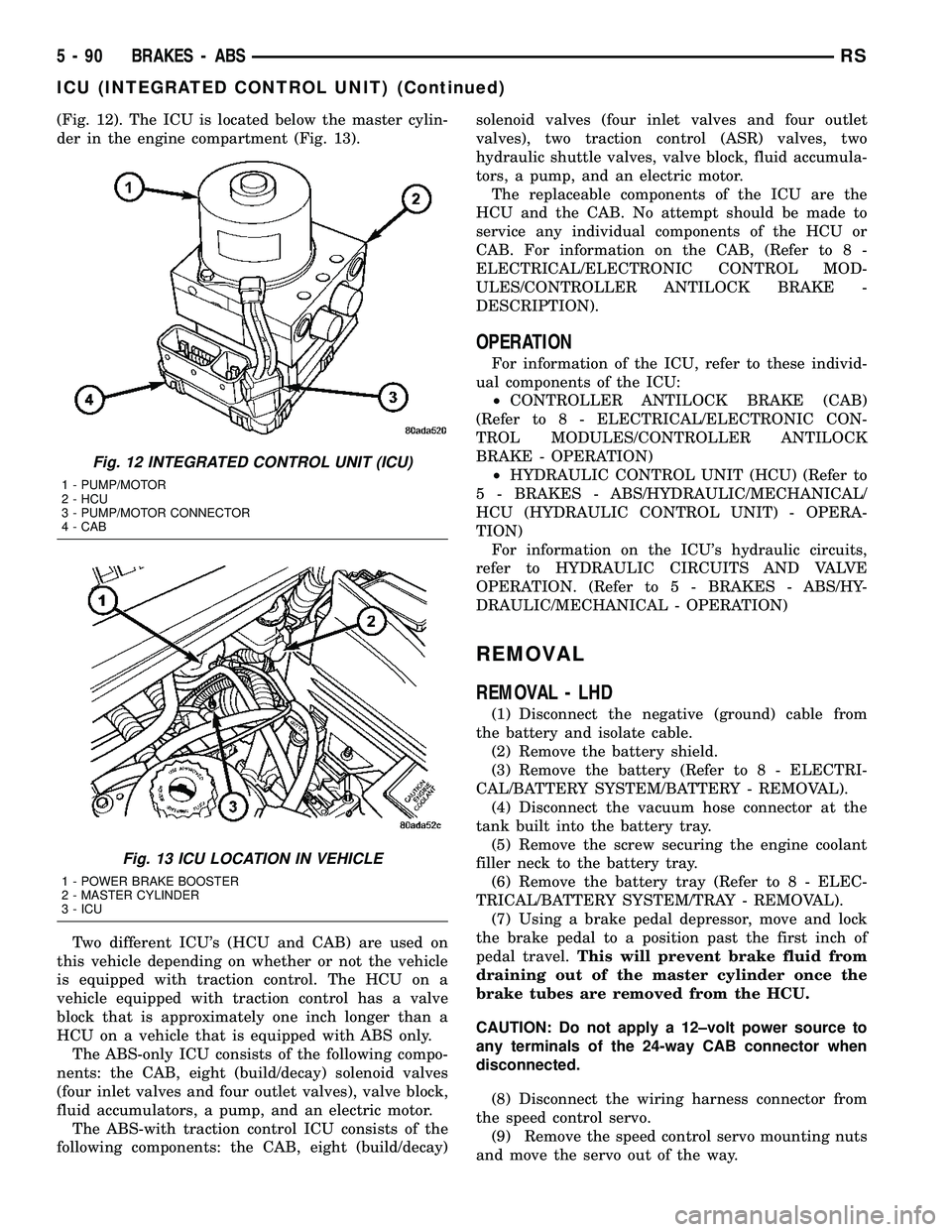
(Fig. 12). The ICU is located below the master cylin-
der in the engine compartment (Fig. 13).
Two different ICU's (HCU and CAB) are used on
this vehicle depending on whether or not the vehicle
is equipped with traction control. The HCU on a
vehicle equipped with traction control has a valve
block that is approximately one inch longer than a
HCU on a vehicle that is equipped with ABS only.
The ABS-only ICU consists of the following compo-
nents: the CAB, eight (build/decay) solenoid valves
(four inlet valves and four outlet valves), valve block,
fluid accumulators, a pump, and an electric motor.
The ABS-with traction control ICU consists of the
following components: the CAB, eight (build/decay)solenoid valves (four inlet valves and four outlet
valves), two traction control (ASR) valves, two
hydraulic shuttle valves, valve block, fluid accumula-
tors, a pump, and an electric motor.
The replaceable components of the ICU are the
HCU and the CAB. No attempt should be made to
service any individual components of the HCU or
CAB. For information on the CAB, (Refer to 8 -
ELECTRICAL/ELECTRONIC CONTROL MOD-
ULES/CONTROLLER ANTILOCK BRAKE -
DESCRIPTION).
OPERATION
For information of the ICU, refer to these individ-
ual components of the ICU:
²CONTROLLER ANTILOCK BRAKE (CAB)
(Refer to 8 - ELECTRICAL/ELECTRONIC CON-
TROL MODULES/CONTROLLER ANTILOCK
BRAKE - OPERATION)
²HYDRAULIC CONTROL UNIT (HCU) (Refer to
5 - BRAKES - ABS/HYDRAULIC/MECHANICAL/
HCU (HYDRAULIC CONTROL UNIT) - OPERA-
TION)
For information on the ICU's hydraulic circuits,
refer to HYDRAULIC CIRCUITS AND VALVE
OPERATION. (Refer to 5 - BRAKES - ABS/HY-
DRAULIC/MECHANICAL - OPERATION)
REMOVAL
REMOVAL - LHD
(1) Disconnect the negative (ground) cable from
the battery and isolate cable.
(2) Remove the battery shield.
(3) Remove the battery (Refer to 8 - ELECTRI-
CAL/BATTERY SYSTEM/BATTERY - REMOVAL).
(4) Disconnect the vacuum hose connector at the
tank built into the battery tray.
(5) Remove the screw securing the engine coolant
filler neck to the battery tray.
(6) Remove the battery tray (Refer to 8 - ELEC-
TRICAL/BATTERY SYSTEM/TRAY - REMOVAL).
(7) Using a brake pedal depressor, move and lock
the brake pedal to a position past the first inch of
pedal travel.This will prevent brake fluid from
draining out of the master cylinder once the
brake tubes are removed from the HCU.
CAUTION: Do not apply a 12±volt power source to
any terminals of the 24-way CAB connector when
disconnected.
(8) Disconnect the wiring harness connector from
the speed control servo.
(9) Remove the speed control servo mounting nuts
and move the servo out of the way.
Fig. 12 INTEGRATED CONTROL UNIT (ICU)
1 - PUMP/MOTOR
2 - HCU
3 - PUMP/MOTOR CONNECTOR
4 - CAB
Fig. 13 ICU LOCATION IN VEHICLE
1 - POWER BRAKE BOOSTER
2 - MASTER CYLINDER
3 - ICU
5 - 90 BRAKES - ABSRS
ICU (INTEGRATED CONTROL UNIT) (Continued)
Page 239 of 2585
(2) Using a brake pedal depressor, move and lock
the brake pedal to a position past the first inch of
pedal travel.This will prevent brake fluid from
draining out of the master cylinder when the
brake tubes are removed from the HCU.
(3) Raise vehicle. (Refer to LUBRICATION &
MAINTENANCE/HOISTING - STANDARD PROCE-
DURE)
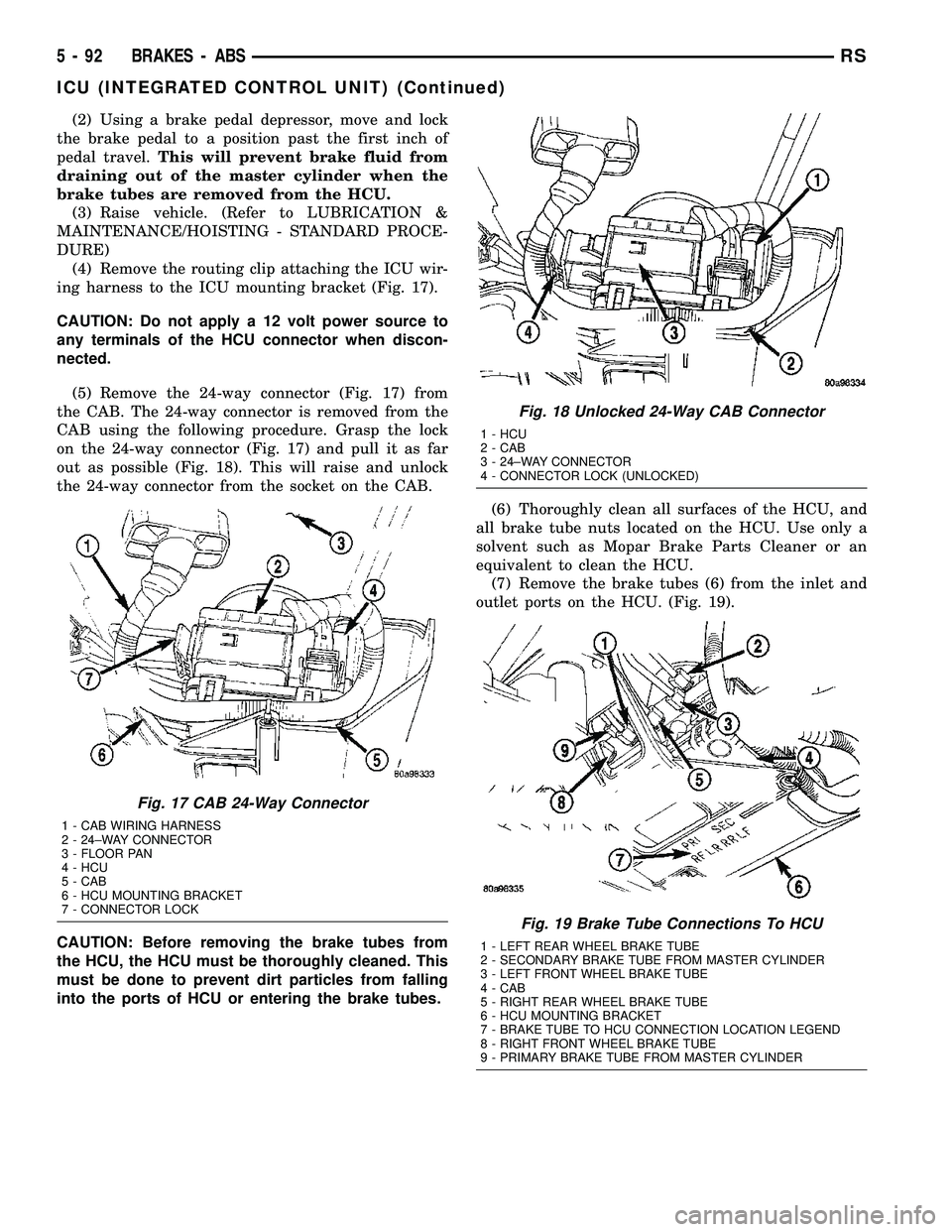
(4) Remove the routing clip attaching the ICU wir-
ing harness to the ICU mounting bracket (Fig. 17).
CAUTION: Do not apply a 12 volt power source to
any terminals of the HCU connector when discon-
nected.
(5) Remove the 24-way connector (Fig. 17) from
the CAB. The 24-way connector is removed from the
CAB using the following procedure. Grasp the lock
on the 24-way connector (Fig. 17) and pull it as far
out as possible (Fig. 18). This will raise and unlock
the 24-way connector from the socket on the CAB.
CAUTION: Before removing the brake tubes from
the HCU, the HCU must be thoroughly cleaned. This
must be done to prevent dirt particles from falling
into the ports of HCU or entering the brake tubes.(6) Thoroughly clean all surfaces of the HCU, and
all brake tube nuts located on the HCU. Use only a
solvent such as Mopar Brake Parts Cleaner or an
equivalent to clean the HCU.
(7) Remove the brake tubes (6) from the inlet and
outlet ports on the HCU. (Fig. 19).
Fig. 17 CAB 24-Way Connector
1 - CAB WIRING HARNESS
2 - 24±WAY CONNECTOR
3 - FLOOR PAN
4 - HCU
5 - CAB
6 - HCU MOUNTING BRACKET
7 - CONNECTOR LOCK
Fig. 18 Unlocked 24-Way CAB Connector
1 - HCU
2 - CAB
3 - 24±WAY CONNECTOR
4 - CONNECTOR LOCK (UNLOCKED)
Fig. 19 Brake Tube Connections To HCU
1 - LEFT REAR WHEEL BRAKE TUBE
2 - SECONDARY BRAKE TUBE FROM MASTER CYLINDER
3 - LEFT FRONT WHEEL BRAKE TUBE
4 - CAB
5 - RIGHT REAR WHEEL BRAKE TUBE
6 - HCU MOUNTING BRACKET
7 - BRAKE TUBE TO HCU CONNECTION LOCATION LEGEND
8 - RIGHT FRONT WHEEL BRAKE TUBE
9 - PRIMARY BRAKE TUBE FROM MASTER CYLINDER
5 - 92 BRAKES - ABSRS
ICU (INTEGRATED CONTROL UNIT) (Continued)
Page 244 of 2585
BRAKES
TABLE OF CONTENTS
page page
BRAKES - BASE DESCRIPTION DESCRIPTION - BASE BRAKES ...........3
DESCRIPTION - BASE BRAKES (EXPORT) . . . 3
OPERATION - BASE BRAKES ..............3
WARNING .............................3
CAUTION ..............................4
DIAGNOSIS AND TESTING - BASE BRAKE SYSTEM .............................4
STANDARD PROCEDURE - BASE BRAKE BLEEDING ............................7
SPECIFICATIONS BRAKE FASTENER TORQUE .............8
SPECIAL TOOLS BASE BRAKE SYSTEM ..................9
BRAKE FLUID LEVEL SWITCH DESCRIPTION ..........................9
OPERATION ............................9
REMOVAL .............................10
INSTALLATION .........................10
ADJUSTABLE PEDALS SWITCH REMOVAL .............................10
INSTALLATION .........................10
HYDRAULIC/MECHANICAL DESCRIPTION DESCRIPTION - DISC BRAKES (FRONT) . . . 10
DESCRIPTION - DISC BRAKES (REAR) ....12
DESCRIPTION - DISC BRAKES (EXPORT) . . 12
DESCRIPTION - DRUM BRAKES (REAR) . . . 12
OPERATION OPERATION - DISC BRAKES (FRONT) .....12
OPERATION - DISC BRAKES (REAR) ......13
DIAGNOSIS AND TESTING - DRUM BRAKE AUTOMATIC ADJUSTER ................13
BRAKE LINES DESCRIPTION - BRAKE TUBES AND HOSES . 13
OPERATION - BRAKE TUBES AND HOSES . . . 13
INSPECTION - BRAKE TUBES AND HOSES . . . 13
BRAKE PADS/SHOES - FRONT REMOVAL REMOVAL - FRONT DISC BRAKE SHOES(CONTINENTAL TEVES BRAKES) .........14
REMOVAL - FRONT DISC BRAKE SHOES (TRW BRAKES) .......................14
CLEANING - DISC BRAKE SHOES ..........15
INSPECTION - DISC BRAKE SHOES ........15
INSTALLATION INSTALLATION - FRONT DISC BRAKESHOES (CONTINENTAL TEVES BRAKES) . . . 15 INSTALLATION - FRONT DISC BRAKE
SHOES (TRW BRAKES) ................16
BRAKE PADS/SHOES - REAR DISC REMOVAL - REAR DISC BRAKE SHOES .....16
CLEANING - DISC BRAKE SHOES ..........17
INSPECTION - DISC BRAKE SHOES ........17
INSTALLATION - REAR DISC BRAKE SHOES . . 18
BRAKE PADS/SHOES - REAR DRUM REMOVAL - REAR DRUM BRAKE SHOES ....18
INSPECTION - REAR DRUM BRAKE SHOE LINING ..............................21
INSTALLATION - REAR DRUM BRAKE SHOES . 21
ADJUSTMENTS ADJUSTMENT - REAR DRUM BRAKESHOES .............................22
DISC BRAKE CALIPER - FRONT REMOVAL REMOVAL - FRONT DISC BRAKE CALIPER(CONTINENTAL TEVES BRAKES) .........23
REMOVAL - FRONT DISC BRAKE CALIPER (TRW BRAKES) .......................23
DISASSEMBLY DISASSEMBLY - CALIPER GUIDE PINBUSHINGS (CONTINENTAL TEVES
BRAKES) ............................23
DISASSEMBLY - CALIPER PISTON AND SEAL ...............................23
CLEANING - CALIPER ...................24
INSPECTION - CALIPER ..................24
ASSEMBLY ASSEMBLY - CALIPER GUIDE PINBUSHINGS (CONTINENTAL TEVES
BRAKES) ............................24
ASSEMBLY - CALIPER PISTON AND SEAL . . 25
INSTALLATION INSTALLATION - FRONT DISC BRAKECALIPER (CONTINENTAL TEVES
BRAKES) ............................26
INSTALLATION - FRONT DISC BRAKE CALIPER (TRW BRAKES) ...............26
DISC BRAKE CALIPER - REAR REMOVAL - REAR DISC BRAKE CALIPER ....26
DISASSEMBLY - CALIPER PISTON AND SEAL . 27
CLEANING - CALIPER ...................28
INSPECTION - CALIPER ..................28
ASSEMBLY - CALIPER PISTON AND SEAL . . . 28
INSTALLATION - REAR DISC BRAKE CALIPER ............................29
RS BRAKES5s-1
Page 245 of 2585
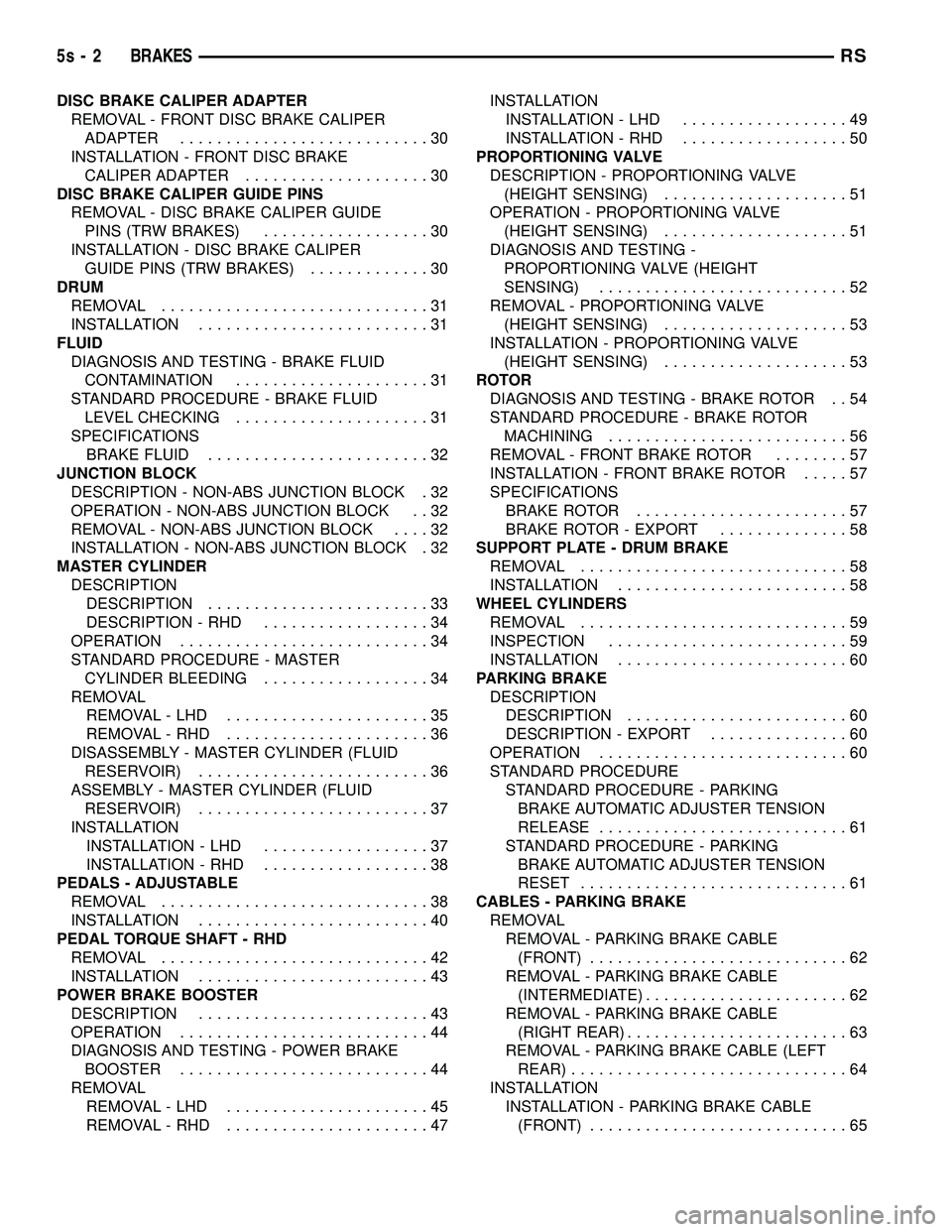
DISC BRAKE CALIPER ADAPTERREMOVAL - FRONT DISC BRAKE CALIPERADAPTER ...........................30
INSTALLATION - FRONT DISC BRAKE CALIPER ADAPTER ....................30
DISC BRAKE CALIPER GUIDE PINS REMOVAL - DISC BRAKE CALIPER GUIDEPINS (TRW BRAKES) ..................30
INSTALLATION - DISC BRAKE CALIPER GUIDE PINS (TRW BRAKES) .............30
DRUM REMOVAL .............................31
INSTALLATION .........................31
FLUID DIAGNOSIS AND TESTING - BRAKE FLUIDCONTAMINATION .....................31
STANDARD PROCEDURE - BRAKE FLUID LEVEL CHECKING .....................31
SPECIFICATIONS BRAKE FLUID ........................32
JUNCTION BLOCK DESCRIPTION - NON-ABS JUNCTION BLOCK . 32
OPERATION - NON-ABS JUNCTION BLOCK . . 32
REMOVAL - NON-ABS JUNCTION BLOCK ....32
INSTALLATION - NON-ABS JUNCTION BLOCK . 32
MASTER CYLINDER DESCRIPTION DESCRIPTION ........................33
DESCRIPTION - RHD ..................34
OPERATION ...........................34
STANDARD PROCEDURE - MASTER CYLINDER BLEEDING ..................34
REMOVAL REMOVAL - LHD ......................35
REMOVAL - RHD ......................36
DISASSEMBLY - MASTER CYLINDER (FLUID RESERVOIR) .........................36
ASSEMBLY - MASTER CYLINDER (FLUID RESERVOIR) .........................37
INSTALLATION INSTALLATION - LHD ..................37
INSTALLATION - RHD ..................38
PEDALS - ADJUSTABLE REMOVAL .............................38
INSTALLATION .........................40
PEDAL TORQUE SHAFT - RHD REMOVAL .............................42
INSTALLATION .........................43
POWER BRAKE BOOSTER DESCRIPTION .........................43
OPERATION ...........................44
DIAGNOSIS AND TESTING - POWER BRAKE BOOSTER ...........................44
REMOVAL REMOVAL - LHD ......................45
REMOVAL - RHD ......................47 INSTALLATION
INSTALLATION - LHD ..................49
INSTALLATION - RHD ..................50
PROPORTIONING VALVE DESCRIPTION - PROPORTIONING VALVE(HEIGHT SENSING) ....................51
OPERATION - PROPORTIONING VALVE (HEIGHT SENSING) ....................51
DIAGNOSIS AND TESTING - PROPORTIONING VALVE (HEIGHT
SENSING) ...........................52
REMOVAL - PROPORTIONING VALVE (HEIGHT SENSING) ....................53
INSTALLATION - PROPORTIONING VALVE (HEIGHT SENSING) ....................53
ROTOR DIAGNOSIS AND TESTING - BRAKE ROTOR . . 54
STANDARD PROCEDURE - BRAKE ROTORMACHINING ..........................56
REMOVAL - FRONT BRAKE ROTOR ........57
INSTALLATION - FRONT BRAKE ROTOR .....57
SPECIFICATIONS BRAKE ROTOR .......................57
BRAKE ROTOR - EXPORT ..............58
SUPPORT PLATE - DRUM BRAKE REMOVAL .............................58
INSTALLATION .........................58
WHEEL CYLINDERS REMOVAL .............................59
INSPECTION ..........................59
INSTALLATION .........................60
PARKING BRAKE DESCRIPTION DESCRIPTION ........................60
DESCRIPTION - EXPORT ...............60
OPERATION ...........................60
STANDARD PROCEDURE STANDARD PROCEDURE - PARKINGBRAKE AUTOMATIC ADJUSTER TENSION
RELEASE ...........................61
STANDARD PROCEDURE - PARKING BRAKE AUTOMATIC ADJUSTER TENSION
RESET .............................61
CABLES - PARKING BRAKE REMOVAL REMOVAL - PARKING BRAKE CABLE(FRONT) ............................62
REMOVAL - PARKING BRAKE CABLE (INTERMEDIATE) ......................62
REMOVAL - PARKING BRAKE CABLE (RIGHT REAR) ........................63
REMOVAL - PARKING BRAKE CABLE (LEFT REAR )..............................64
INSTALLATION INSTALLATION - PARKING BRAKE CABLE(FRONT) ............................65
5s - 2 BRAKESRS
Page 246 of 2585

INSTALLATION - PARKING BRAKE CABLE(INTERMEDIATE) ......................66
INSTALLATION - PARKING BRAKE CABLE (RIGHT REAR) ........................66
INSTALLATION - PARKING BRAKE CABLE (LEFT REAR) .........................66
ADJUSTMENTS ADJUSTMENT - PARKING BRAKE CABLES . 66
CABLES - PARKING BRAKE (EXPORT) REMOVAL - FRONT CABLE ...............67
INSTALLATION - FRONT CABLE ............67
LEVER - PARKING BRAKE REMOVAL .............................67 INSTALLATION
.........................67
LEVER - PARKING BRAKE (EXPORT) REMOVAL - PARKING BRAKE LEVER ANDFRONT CABLE .......................68
INSTALLATION - PARKING BRAKE LEVER AND FRONT CABLE ...................69
SHOES - PARKING BRAKE REMOVAL .............................69
INSTALLATION .........................75
ADJUSTMENTS ADJUSTMENT - PARKING BRAKE SHOES . . 76
BRAKES - BASE
DESCRIPTION
DESCRIPTION - BASE BRAKES
The base brake system consists of the following
components: ² Brake pedal
² Power brake booster
² Master cylinder
² Brake tubes and hoses
² Proportioning valve (non-ABS vehicles only)
² Disc brakes
² Drum brakes
² Brake lamp switch
² Brake fluid level switch
² Parking brakes
Front disc brakes control the braking of the front
wheels; rear braking is controlled by rear drum
brakes or rear disc brakes depending on options. The hydraulic brake system is diagonally split on
both the non-antilock braking systems and antilock
braking systems. That means the left front and right
rear brakes are on one hydraulic circuit and the right
front and left rear are on the other. For information on the brake lamp switch, (Refer
to 8 - ELECTRICAL/LAMPS/LIGHTING - EXTERI-
OR/BRAKE LAMP SWITCH - DESCRIPTION) Vehicles equipped with the optional antilock brake
system (ABS) use a system designated Mark 20e. It
is available with or without traction control. This
system shares most base brake hardware used on
vehicles without ABS. ABS components are described
in detail in ANTILOCK BRAKE SYSTEM.
DESCRIPTION - BASE BRAKES (EXPORT)
Four-Wheel Disc Antilock Brakes are standard on
all models.
OPERATION - BASE BRAKES
When a vehicle needs to be stopped, the driver
applies the brake pedal. The brake pedal pushes the
input rod of the power brake booster into the booster.
The booster uses vacuum to ease pedal effort as force
is transferred through the booster to the master cyl-
inder. The booster's output rod pushes in the master
cylinder's primary and secondary pistons applying
hydraulic pressure through the chassis brake tubes
to the brakes at each tire and wheel assembly. The parking brakes are foot-operated. When
applied, the parking brake lever pulls on cables that
actuate brake shoes at each rear wheel. These shoes
come in contact with a hub mounted drum (drum for
disc/drum brakes or drum-in-hat for disc/disc brakes)
and hold it in place.
WARNING
WARNING: DUST AND DIRT ACCUMULATING ON
BRAKE PARTS DURING NORMAL USE MAY CON-
TAIN ASBESTOS FIBERS FROM PRODUCTION OR
AFTERMARKET BRAKE LININGS. BREATHING
EXCESSIVE CONCENTRATIONS OF ASBESTOS
FIBERS CAN CAUSE SERIOUS BODILY HARM.
EXERCISE CARE WHEN SERVICING BRAKE
PARTS. DO NOT SAND OR GRIND BRAKE LINING
UNLESS EQUIPMENT USED IS DESIGNED TO CON-
TAIN THE DUST RESIDUE. DO NOT CLEAN BRAKE
PARTS WITH COMPRESSED AIR OR BY DRY
BRUSHING. CLEANING SHOULD BE DONE BY
DAMPENING THE BRAKE COMPONENTS WITH A
FINE MIST OF WATER, THEN WIPING THE BRAKE
COMPONENTS CLEAN WITH A DAMPENED CLOTH.
DISPOSE OF CLOTH AND ALL RESIDUE CONTAIN-
ING ASBESTOS FIBERS IN AN IMPERMEABLE
CONTAINER WITH THE APPROPRIATE LABEL. FOL-
LOW PRACTICES PRESCRIBED BY THE OCCUPA-
TIONAL SAFETY AND HEALTH ADMINISTRATION
(OSHA) AND THE ENVIRONMENTAL PROTECTION
AGENCY (EPA) FOR THE HANDLING, PROCESSING,
AND DISPOSING OF DUST OR DEBRIS THAT MAY
CONTAIN ASBESTOS FIBERS.
RS BRAKES5s-3