wheel torque CHRYSLER VOYAGER 2004 Repair Manual
[x] Cancel search | Manufacturer: CHRYSLER, Model Year: 2004, Model line: VOYAGER, Model: CHRYSLER VOYAGER 2004Pages: 2585, PDF Size: 62.54 MB
Page 241 of 2585
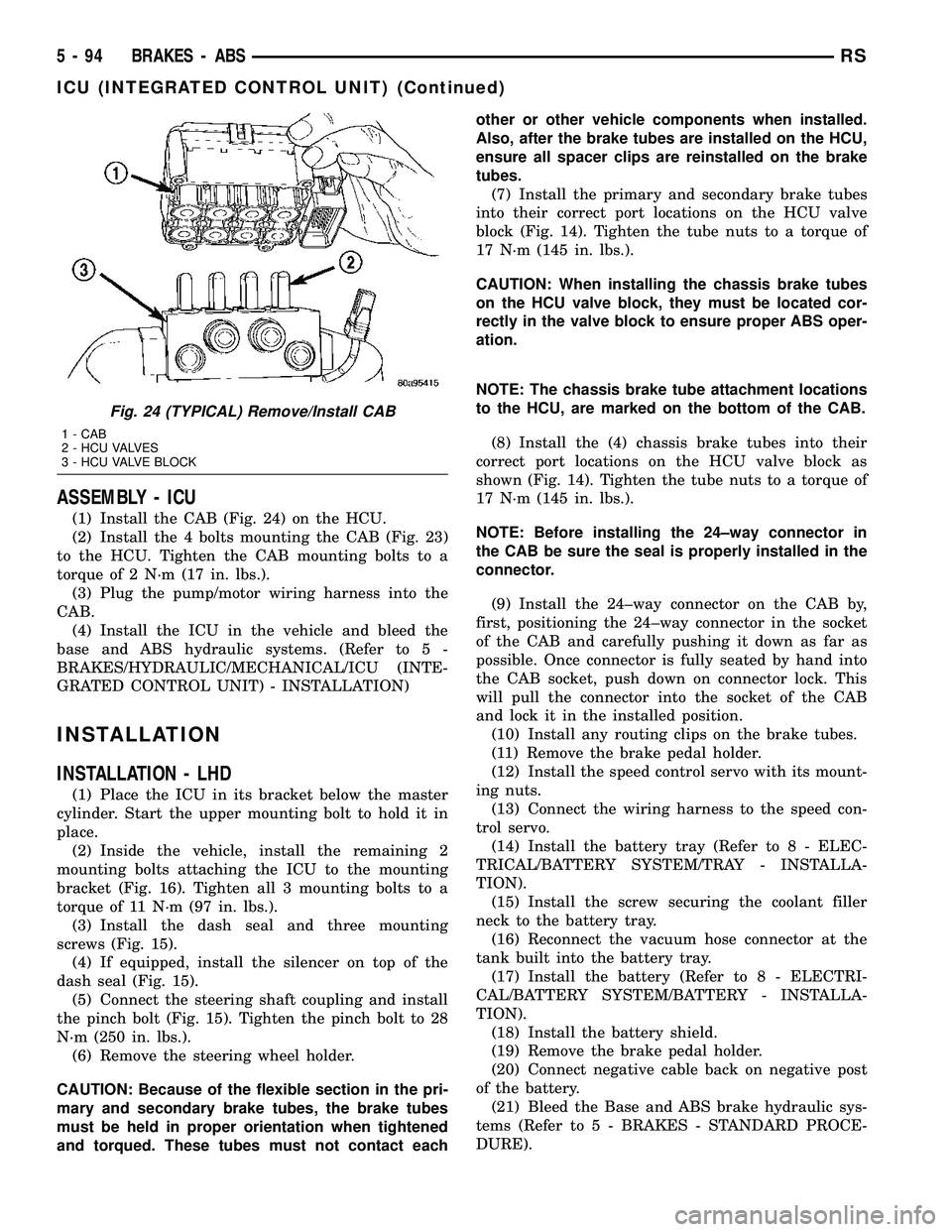
ASSEMBLY - ICU
(1) Install the CAB (Fig. 24) on the HCU.
(2) Install the 4 bolts mounting the CAB (Fig. 23)
to the HCU. Tighten the CAB mounting bolts to a
torque of 2 N´m (17 in. lbs.).
(3) Plug the pump/motor wiring harness into the
CAB.
(4) Install the ICU in the vehicle and bleed the
base and ABS hydraulic systems. (Refer to 5 -
BRAKES/HYDRAULIC/MECHANICAL/ICU (INTE-
GRATED CONTROL UNIT) - INSTALLATION)
INSTALLATION
INSTALLATION - LHD
(1) Place the ICU in its bracket below the master
cylinder. Start the upper mounting bolt to hold it in
place.
(2) Inside the vehicle, install the remaining 2
mounting bolts attaching the ICU to the mounting
bracket (Fig. 16). Tighten all 3 mounting bolts to a
torque of 11 N´m (97 in. lbs.).
(3) Install the dash seal and three mounting
screws (Fig. 15).
(4) If equipped, install the silencer on top of the
dash seal (Fig. 15).
(5) Connect the steering shaft coupling and install
the pinch bolt (Fig. 15). Tighten the pinch bolt to 28
N´m (250 in. lbs.).
(6) Remove the steering wheel holder.
CAUTION: Because of the flexible section in the pri-
mary and secondary brake tubes, the brake tubes
must be held in proper orientation when tightened
and torqued. These tubes must not contact eachother or other vehicle components when installed.
Also, after the brake tubes are installed on the HCU,
ensure all spacer clips are reinstalled on the brake
tubes.
(7) Install the primary and secondary brake tubes
into their correct port locations on the HCU valve
block (Fig. 14). Tighten the tube nuts to a torque of
17 N´m (145 in. lbs.).
CAUTION: When installing the chassis brake tubes
on the HCU valve block, they must be located cor-
rectly in the valve block to ensure proper ABS oper-
ation.
NOTE: The chassis brake tube attachment locations
to the HCU, are marked on the bottom of the CAB.
(8) Install the (4) chassis brake tubes into their
correct port locations on the HCU valve block as
shown (Fig. 14). Tighten the tube nuts to a torque of
17 N´m (145 in. lbs.).
NOTE: Before installing the 24±way connector in
the CAB be sure the seal is properly installed in the
connector.
(9) Install the 24±way connector on the CAB by,
first, positioning the 24±way connector in the socket
of the CAB and carefully pushing it down as far as
possible. Once connector is fully seated by hand into
the CAB socket, push down on connector lock. This
will pull the connector into the socket of the CAB
and lock it in the installed position.
(10) Install any routing clips on the brake tubes.
(11) Remove the brake pedal holder.
(12) Install the speed control servo with its mount-
ing nuts.
(13) Connect the wiring harness to the speed con-
trol servo.
(14) Install the battery tray (Refer to 8 - ELEC-
TRICAL/BATTERY SYSTEM/TRAY - INSTALLA-
TION).
(15) Install the screw securing the coolant filler
neck to the battery tray.
(16) Reconnect the vacuum hose connector at the
tank built into the battery tray.
(17) Install the battery (Refer to 8 - ELECTRI-
CAL/BATTERY SYSTEM/BATTERY - INSTALLA-
TION).
(18) Install the battery shield.
(19) Remove the brake pedal holder.
(20) Connect negative cable back on negative post
of the battery.
(21) Bleed the Base and ABS brake hydraulic sys-
tems (Refer to 5 - BRAKES - STANDARD PROCE-
DURE).
Fig. 24 (TYPICAL) Remove/Install CAB
1 - CAB
2 - HCU VALVES
3 - HCU VALVE BLOCK
5 - 94 BRAKES - ABSRS
ICU (INTEGRATED CONTROL UNIT) (Continued)
Page 245 of 2585
DISC BRAKE CALIPER ADAPTERREMOVAL - FRONT DISC BRAKE CALIPERADAPTER ...........................30
INSTALLATION - FRONT DISC BRAKE CALIPER ADAPTER ....................30
DISC BRAKE CALIPER GUIDE PINS REMOVAL - DISC BRAKE CALIPER GUIDEPINS (TRW BRAKES) ..................30
INSTALLATION - DISC BRAKE CALIPER GUIDE PINS (TRW BRAKES) .............30
DRUM REMOVAL .............................31
INSTALLATION .........................31
FLUID DIAGNOSIS AND TESTING - BRAKE FLUIDCONTAMINATION .....................31
STANDARD PROCEDURE - BRAKE FLUID LEVEL CHECKING .....................31
SPECIFICATIONS BRAKE FLUID ........................32
JUNCTION BLOCK DESCRIPTION - NON-ABS JUNCTION BLOCK . 32
OPERATION - NON-ABS JUNCTION BLOCK . . 32
REMOVAL - NON-ABS JUNCTION BLOCK ....32
INSTALLATION - NON-ABS JUNCTION BLOCK . 32
MASTER CYLINDER DESCRIPTION DESCRIPTION ........................33
DESCRIPTION - RHD ..................34
OPERATION ...........................34
STANDARD PROCEDURE - MASTER CYLINDER BLEEDING ..................34
REMOVAL REMOVAL - LHD ......................35
REMOVAL - RHD ......................36
DISASSEMBLY - MASTER CYLINDER (FLUID RESERVOIR) .........................36
ASSEMBLY - MASTER CYLINDER (FLUID RESERVOIR) .........................37
INSTALLATION INSTALLATION - LHD ..................37
INSTALLATION - RHD ..................38
PEDALS - ADJUSTABLE REMOVAL .............................38
INSTALLATION .........................40
PEDAL TORQUE SHAFT - RHD REMOVAL .............................42
INSTALLATION .........................43
POWER BRAKE BOOSTER DESCRIPTION .........................43
OPERATION ...........................44
DIAGNOSIS AND TESTING - POWER BRAKE BOOSTER ...........................44
REMOVAL REMOVAL - LHD ......................45
REMOVAL - RHD ......................47 INSTALLATION
INSTALLATION - LHD ..................49
INSTALLATION - RHD ..................50
PROPORTIONING VALVE DESCRIPTION - PROPORTIONING VALVE(HEIGHT SENSING) ....................51
OPERATION - PROPORTIONING VALVE (HEIGHT SENSING) ....................51
DIAGNOSIS AND TESTING - PROPORTIONING VALVE (HEIGHT
SENSING) ...........................52
REMOVAL - PROPORTIONING VALVE (HEIGHT SENSING) ....................53
INSTALLATION - PROPORTIONING VALVE (HEIGHT SENSING) ....................53
ROTOR DIAGNOSIS AND TESTING - BRAKE ROTOR . . 54
STANDARD PROCEDURE - BRAKE ROTORMACHINING ..........................56
REMOVAL - FRONT BRAKE ROTOR ........57
INSTALLATION - FRONT BRAKE ROTOR .....57
SPECIFICATIONS BRAKE ROTOR .......................57
BRAKE ROTOR - EXPORT ..............58
SUPPORT PLATE - DRUM BRAKE REMOVAL .............................58
INSTALLATION .........................58
WHEEL CYLINDERS REMOVAL .............................59
INSPECTION ..........................59
INSTALLATION .........................60
PARKING BRAKE DESCRIPTION DESCRIPTION ........................60
DESCRIPTION - EXPORT ...............60
OPERATION ...........................60
STANDARD PROCEDURE STANDARD PROCEDURE - PARKINGBRAKE AUTOMATIC ADJUSTER TENSION
RELEASE ...........................61
STANDARD PROCEDURE - PARKING BRAKE AUTOMATIC ADJUSTER TENSION
RESET .............................61
CABLES - PARKING BRAKE REMOVAL REMOVAL - PARKING BRAKE CABLE(FRONT) ............................62
REMOVAL - PARKING BRAKE CABLE (INTERMEDIATE) ......................62
REMOVAL - PARKING BRAKE CABLE (RIGHT REAR) ........................63
REMOVAL - PARKING BRAKE CABLE (LEFT REAR )..............................64
INSTALLATION INSTALLATION - PARKING BRAKE CABLE(FRONT) ............................65
5s - 2 BRAKESRS
Page 251 of 2585

PRESSURE BLEEDING PROCEDURE
CAUTION: Use bleeder tank Special Tool C-3496-B
or equivalent with Adapter, Special Tool 6921, to
pressurize the hydraulic system for bleeding.Follow pressure bleeder manufacturer's instruc-
tions for use of pressure bleeding equipment. (1) Install the Adapter Master Cylinder Pressure
Bleed Cap, Special Tool 6921 on the fluid reservoir of
the master cylinder (Fig. 2). Attach the fluid hose
from the pressure bleeder to the fitting on Special
Tool 6921.
(2) Attach a clear plastic hose to the bleeder screw
at one wheel and feed the hose into a clear jar con-
taining fresh brake fluid. (3) Open the left rear wheel bleeder screw at least
one full turn or more to obtain an adequate flow of
brake fluid.
CAUTION: ªJust crackingº the bleeder screw often
restricts fluid flow, allowing only a slow, weak fluid
discharge of fluid. This practice will NOT get all the
air out. Make sure the bleeder is opened at least 1
full turn when bleeding.
(4) After 4 to 8 ounces of brake fluid has been bled
through the hydraulic system, and an air-free flow is
maintained in the hose and jar, this will indicate a
good bleed of the hydraulic system has been
obtained. (5) Repeat the procedure at all the other remain-
ing bleeder screws. (6) Check pedal travel. If pedal travel is excessive
or has not been improved, enough fluid has not
passed through the system to expel all the trapped
air. Be sure to monitor the fluid level in the pressure bleeder, so it stays at a proper level so air will not
enter the brake system through the master cylinder.
(7) Perform a final adjustment of the rear brake
shoes (when applicable), then test drive vehicle to be
sure brakes are operating correctly and that pedal is
solid.
SPECIFICATIONS
BRAKE FASTENER TORQUE
DESCRIPTION N´m Ft.
Lbs. In.
Lbs.
ABS ICU Mounting Bolts To
Bracket 11 Ð 9 7
ABS ICU Mounting
Bracket-To-Cradle Bolts 28 21 250
ABS CAB-To-HCU Mounting
Screws 2Ð17
ABS Wheel Speed Sensor
Head Mounting Bolt - Front 13 Ð 115
ABS Wheel Speed Sensor
Head Mounting Bolt - Rear 10 Ð 90
Adjustable Pedal Position
Sensor Mounting Screws 7.5 66 Ð
Adjustable Pedal Module
Mounting Screws 2.0 15 Ð
Brake Tube Nuts 17 Ð 145
Brake Hose Intermediate
Bracket Bolt 12 Ð 105
Brake Hose-To-Caliper
Mounting Bolt 47 35 Ð
Disc Brake Caliper Guide
Pin Bolts 35 26 Ð
Disc Brake Caliper Bleeder
Screw 15 Ð 125
Drum Brake Wheel Cylinder
Mounting Bolts 8Ð75
Drum Brake Wheel Cylinder
Mounting Bleeder screw 10 Ð 80
Drum Brake Support Plate
Mounting Bolts 130 95 Ð
Junction Block (Non-ABS
Brakes) Mounting Bolts 28 21 250
Master Cylinder Mounting
Nuts 25 19 225
Power Brake Booster
Mounting Nuts 28 21 250
Fig. 2 Tool 6921 Installed On Master Cylinder
1 - SPECIAL TOOL 6921
2 - FLUID RESERVOIR
5s - 8 BRAKESRS
BRAKES - BASE (Continued)
Page 259 of 2585

(12) Install the wheel and tire assemblies. Tighten
the wheel mounting nuts in proper sequence until all
nuts are torqued to half specification, then repeat the
tightening sequence to the full specified torque of 135
N´m (100 ft. lbs.). (13) Lower vehicle.
(14) Pump the brake pedal several times. This will
set the shoes to the brake rotor. (15) Check and adjust brake fluid level as neces-
sary. (16) Road test the vehicle and make several stops
to wear off any foreign material on the brakes and to
seat the brake shoes.
INSTALLATION - FRONT DISC BRAKE SHOES
(TRW BRAKES)
NOTE: Perform steps Step 1 through Step 5on each
side of the vehicle.
(1) Place the brake shoes in the adapter anti-rattle
clips. (2) Completely retract the caliper piston back into
the bore of the caliper.
CAUTION: Use care when installing the caliper onto
the disc brake adapter to avoid damaging the boots
on the caliper guide pins.
(3) Install the disc brake caliper over the brake
shoes on the brake caliper adapter. (4) Align the caliper guide pin bolt holes with the
guide pins. Install the caliper guide pin bolts and
tighten them to a torque of 35 N´m (26 ft. lbs.) (Fig.
13). (5) Install the tire and wheel assembly. Tighten
the wheel mounting nuts to a torque of 135 N´m (100
ft. lbs.). (6) Lower the vehicle.
(7) Pump the brake pedal several times. This will
set the shoes to the brake rotor. (8) Check and adjust the brake fluid level as nec-
essary. (9) Road test the vehicle and make several stops to
wear off any foreign material on the brakes and to
seat the brake shoes.
BRAKE PADS/SHOES - REAR
DISC
REMOVAL - REAR DISC BRAKE SHOES
(1) Raise vehicle. (Refer to LUBRICATION &
MAINTENANCE/HOISTING - STANDARD PROCE-
DURE). (2) Remove rear wheel and tire assemblies from
vehicle. (3) Remove the caliper to adapter guide pin bolts
(Fig. 14).
(4) Remove rear caliper from adapter using the fol-
lowing procedure. First rotate front of caliper up
from the adapter. Then pull the rear of the caliper
and the outboard brake shoe anti-rattle clip out from
under the rear abutment on the adapter (Fig. 15).
Fig. 14 Caliper Guide Pin Bolts
1 - DISC BRAKE CALIPER
2 - ADAPTER
3 - AXLE
4 - GUIDE PIN BOLTS
5 - DRIVESHAFT (AWD MODELS ONLY)
Fig. 15 Removing/Installing Caliper
1 - LIFT THIS END OF CALIPER AWAY FROM ADAPTER FIRST
2 - DISC BRAKE CALIPER
3 - ADAPTER ABUTMENT
4 - OUTBOARD BRAKE SHOE HOLD DOWN CLIP
5 - OUTBOARD BRAKE SHOE
6 - ROTOR
7 - ADAPTER
5s - 16 BRAKESRS
BRAKE PADS/SHOES - FRONT (Continued)
Page 261 of 2585
Replacebothdisc brake shoes (inboard and out-
board) on each caliper. It is necessary to replace the
shoes on the opposite side of the vehicle as well as
the shoes failing inspection. If the brake shoe assemblies do not require
replacement, be sure to reinstall the brake shoes in
the original position they were removed from.
INSTALLATION - REAR DISC BRAKE SHOES
(1) Completely retract caliper piston back into pis-
ton bore of caliper assembly. (2) Lubricate both adapter abutments where the
shoes contact with a liberal amount of Mopar tMul-
tipurpose Lubricant, or equivalent. (3) If removed, install the brake rotor on the hub,
making sure it is squarely seated on the face of the
hub. (4) Install the inboard brake shoe into the caliper
piston by firmly pressing it into the piston bore using
your thumbs. Be sure inboard brake shoe is posi-
tioned squarely against the face of the caliper piston.
NOTE: The outboard shoes are different left to
right. They can be identified by a L or R stamped on
the clip.
(5) Install the outboard brake shoe on the disc
brake caliper. Be sure the outboard shoe is positioned
squarely against the outboard fingers of the caliper.
CAUTION: Use care when installing the caliper
assembly onto the adapter, so the caliper guide pin
bushings do not get damaged by the mounting
bosses.
(6) Carefully lower caliper and brake shoes over
rotor and onto adapter, reversing the removal proce-
dure (Fig. 15).
CAUTION: When installing the caliper guide pin
bolts extreme caution should be taken not to
crossthread the guide pin bolts.
(7) Install the caliper guide pin bolts. Tighten the
guide pin bolts to a torque of 35 N´m (26 ft. lbs.). (8) Install the wheel and tire assembly. Tighten
the wheel mounting nuts in proper sequence until all
nuts are torqued to half specification. Then repeat
the tightening sequence to the full specified torque of
135 N´m (100 ft. lbs.). (9) Lower vehicle.
CAUTION: Before moving vehicle, pump the brake
pedal several times to insure the vehicle has a firm
brake pedal to adequately stop the vehicle. (10) Pump brake pedal several times to set brake
shoes to rotors. (11) Check fluid level in reservoir.
(12) Road test the vehicle and make several stops
to wear off any foreign material on the brakes and to
seat the brake shoe linings.
BRAKE PADS/SHOES - REAR
DRUM
REMOVAL - REAR DRUM BRAKE SHOES
(1) Raise vehicle. (Refer to LUBRICATION &
MAINTENANCE/HOISTING - STANDARD PROCE-
DURE). (2) Remove the rear wheel and tire assemblies
from the vehicle. (3) Remove rear brake drum to hub retaining clips
(if equipped), then remove rear brake drums. (Refer
to 5 - BRAKES/HYDRAULIC/MECHANICAL/DRUM
- REMOVAL)
NOTE: When creating slack in the park brake cables
by locking out the automatic adjuster, (Fig. 18) be
sure that the park brake pedal is in the released
(most upward) position.
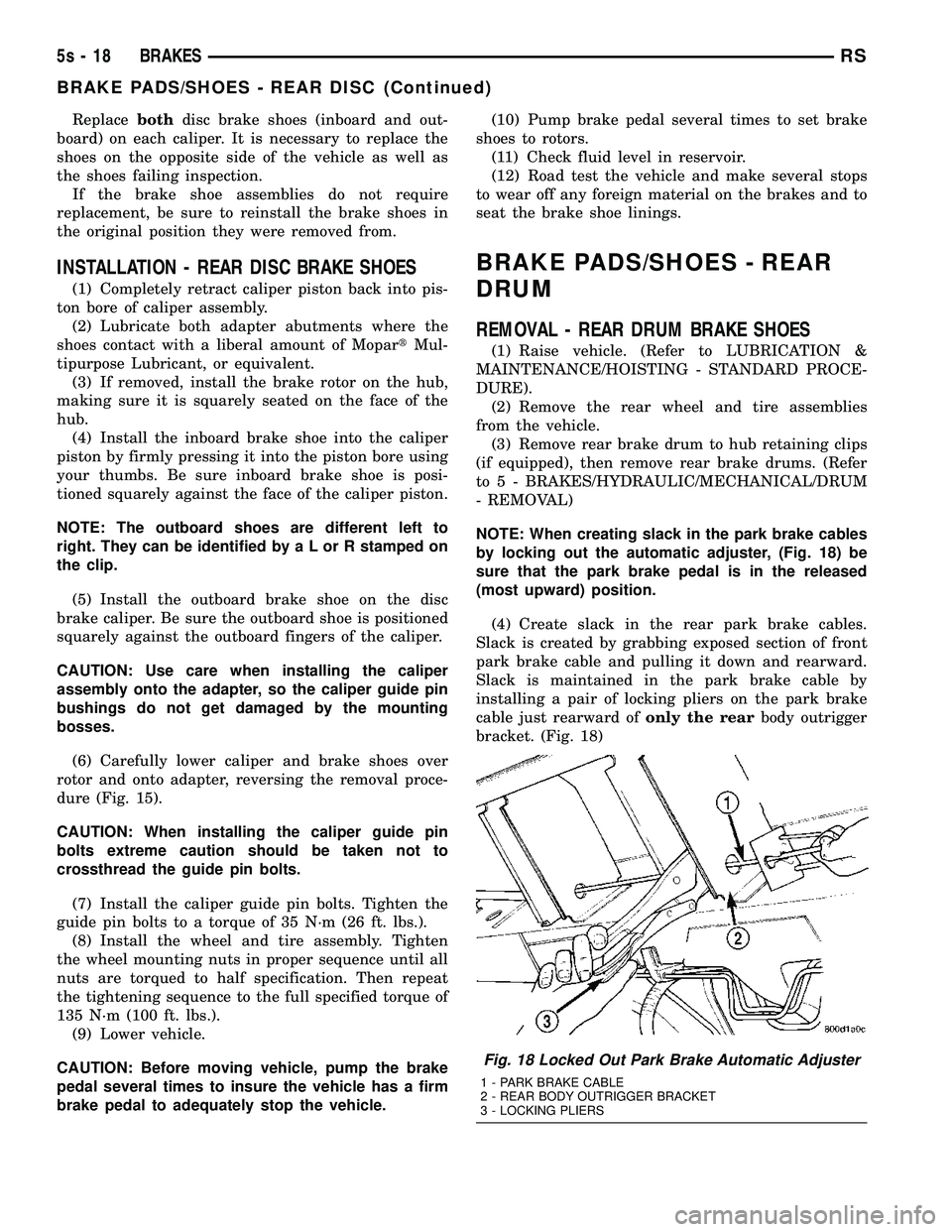
(4) Create slack in the rear park brake cables.
Slack is created by grabbing exposed section of front
park brake cable and pulling it down and rearward.
Slack is maintained in the park brake cable by
installing a pair of locking pliers on the park brake
cable just rearward of only the rearbody outrigger
bracket. (Fig. 18)
Fig. 18 Locked Out Park Brake Automatic Adjuster
1 - PARK BRAKE CABLE
2 - REAR BODY OUTRIGGER BRACKET
3 - LOCKING PLIERS
5s - 18 BRAKESRS
BRAKE PADS/SHOES - REAR DISC (Continued)
Page 265 of 2585
(4) Install the automatic adjuster screw on the
leading brake shoe. Then install the trailing brake
shoe on the park brake actuating lever and park
brake actuating strut (Fig. 26). Position trailing
brake shoe on brake support plate. (5) Install the brake shoe hold down pin and
spring on the trailing brake shoe (Fig. 25). (6) Install the brake shoe to brake shoe upper
return spring (Fig. 24).
CAUTION: When installing the tension clip on the
automatic adjuster, it must be located on only the
threaded area of the adjuster assembly (Fig. 23). If
it is located on a non-threaded area of the adjuster,
the function of the automatic adjuster will be
affected.
(7) Install the tension clip (Fig. 23) attaching the
upper return spring to the automatic adjuster assem-
bly. (8) Install the brake shoe to brake shoe lower
return springs on the brake shoes (Fig. 21) and (Fig.
22). (9) Install automatic adjustment lever on the lead-
ing brake shoe of the rear brake assembly (Fig. 20). (10) Install the actuating spring on the automatic
adjustment lever and leading brake shoe assembly
(Fig. 19). (11) Verify that the automatic adjuster lever has
positive contact with the star wheel on the automatic
adjuster assembly. (12) When all components of both rear brake
assemblies are correctly and fully installed, remove
the locking pliers from the front park brake cable. (13) Adjust brake shoes assemblies so as not to
interfere with brake drum installation. (14) Install the rear brake drums on the hubs.
(15) Adjust rear brake shoes.
(16) Install the wheel and tire assembly.
(17) Tighten the wheel mounting stud nuts in
proper sequence until all nuts are torqued to half
specification. Then repeat the tightening sequence to
the full specified torque of 135 N´m (100 ft. lbs.). (18) Lower the vehicle.
(19) Push the parking brake lever (pedal) to the
floor once and release pedal. This will automatically
remove the slack from and correctly adjust the park-
ing brake cables. (20) Road test vehicle. The automatic adjuster will
continue the brake adjustment during the road test
of the vehicle.
ADJUSTMENTS
ADJUSTMENT - REAR DRUM BRAKE SHOES
NOTE: Normally, self-adjusting drum brakes do not
require manual brake shoe adjustment. Although, in
the event of a brake shoe replacement, it is advis-
able to make the initial adjustment manually to
speed up the adjusting time.
NOTE: Before raising the vehicle, verify the parking
brake lever is fully released.
(1) Raise the vehicle. (Refer to LUBRICATION &
MAINTENANCE/HOISTING - STANDARD PROCE-
DURE). (2) Remove rubber plug from rear brake adjusting
hole in the rear brake support plate. (3) Insert a thin screwdriver through the adjusting
hole in the support plate and against the star wheel
of the adjusting screw. Move handle of the tool down-
ward, rotating the star wheel until a slight drag is
felt when tire and wheel assembly is rotated. (4) Insert a second thin screwdriver or piece of
welding rod into brake adjusting hole and push the
adjusting lever out of engagement with the star
wheel. Care should be taken so as not to bend
adjusting lever or distort lever spring. (5) While holding the adjusting lever out of
engagement, back off the star wheel just enough to
ensure a free wheel with no brake shoe drag. (6) Repeat the above adjustment at the other rear
wheel. (7) Install the adjusting hole rubber plugs back in
the rear brake support plates. (8) Lower the vehicle.
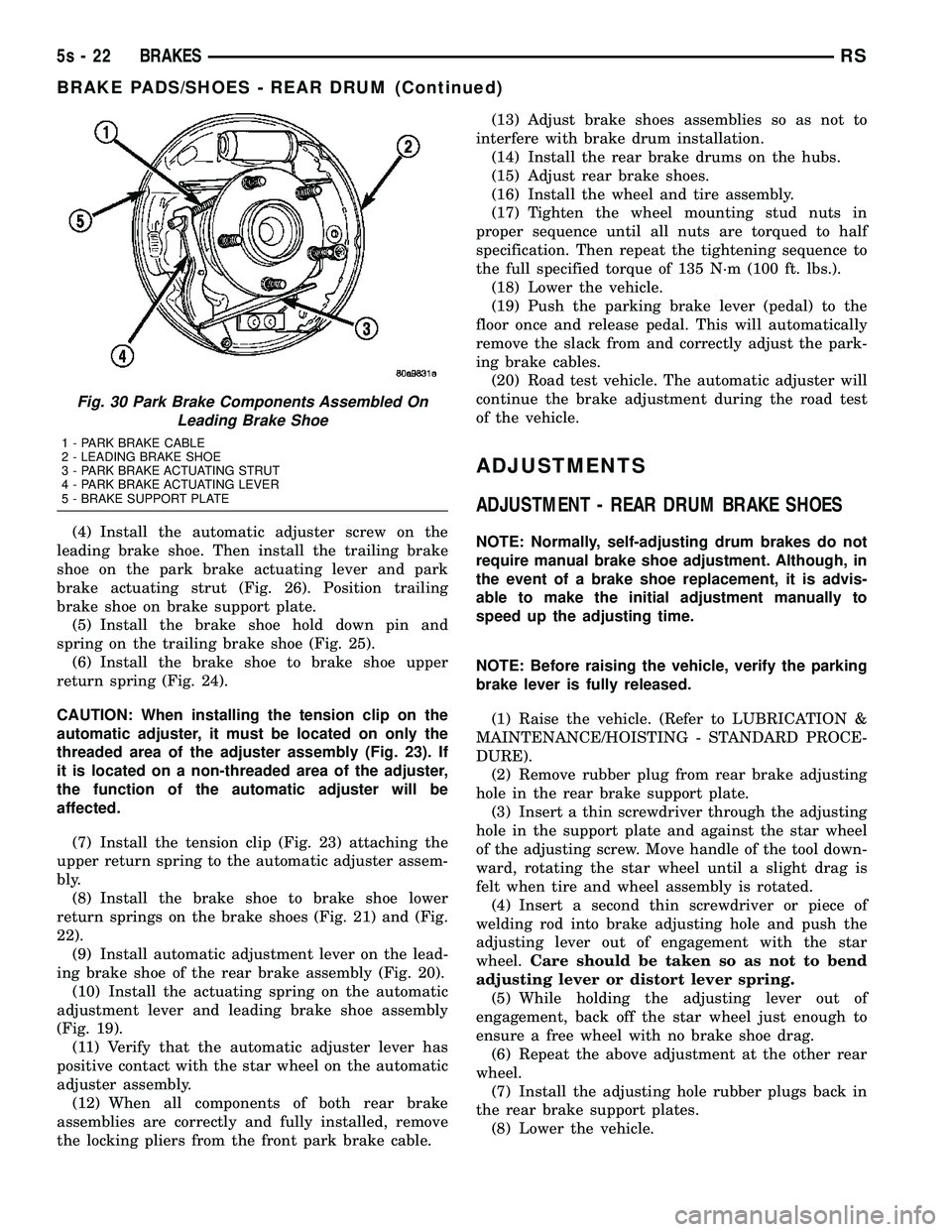
Fig. 30 Park Brake Components Assembled On Leading Brake Shoe
1 - PARK BRAKE CABLE
2 - LEADING BRAKE SHOE
3 - PARK BRAKE ACTUATING STRUT
4 - PARK BRAKE ACTUATING LEVER
5 - BRAKE SUPPORT PLATE
5s - 22 BRAKESRS
BRAKE PADS/SHOES - REAR DRUM (Continued)
Page 269 of 2585

INSTALLATION
INSTALLATION - FRONT DISC BRAKE CALIPER
(CONTINENTAL TEVES BRAKES)
CAUTION: TRW and Continental Teves brake cali-
pers are not interchangeable. Each caliper is specif-
ically designed for the unique brake system. If
calipers are interchanged, improper performance,
noise and increased stopping distance can occur.
(Refer to 5 - BRAKES/HYDRAULIC/MECHANICAL -
DESCRIPTION)
(1) Completely retract the caliper piston back into
piston bore of the caliper. Use a C-clamp to retract
the piston if necessary. Place a wood block over the
piston before installing the C-clamp to avoid damag-
ing the piston.
CAUTION: Use care when installing the brake cali-
per assembly onto the steering knuckle, so that the
seals on the caliper guide pin bushings do not get
damaged by the steering knuckle bosses.
(2) Carefully position the brake caliper and shoes
over the brake rotor and adapter. (3) Install the caliper guide pin bolts and tighten
to a torque of 35 N´m (26 ft. lbs.). Extreme caution
should be taken not to cross thread the caliper
guide pin bolts. (4) Install the anti-rattle clip on the outboard side
of the caliper. Start the clip into the holes on the cal-
iper, then stretch the clip legs past the abutments on
the caliper adapter.
CAUTION: When connecting the brake hose to the
caliper, install new brake hose to caliper special
copper washers.
(5) Install the brake hose on the caliper. To do
this, first place one NEW special fitting washer on
each side of the hose fitting, then slide the banjo bolt
through the fitting. Next, thread the banjo bolt into
the threaded port on the rear of the brake caliper.
Tighten the banjo bolt to a torque of 47 N´m (35 ft.
lbs.). (6) Install the wheel and tire assembly. Tighten
the wheel mounting stud nuts in proper sequence
until all nuts are torqued to half specification, then
repeat the tightening sequence to the full specified
torque of 135 N´m (100 ft. lbs.). (7) Lower the vehicle.
(8) Remove the brake pedal depressor (holding)
tool. (9) Bleed the hydraulic brake circuit to the brake
caliper. (Refer t o 5 - BRAKES - STANDARD PROCE-
DURE) (10) Road test the vehicle and make several stops
to wear off any foreign material on the brakes and to
seat the brake shoe linings.
INSTALLATION - FRONT DISC BRAKE CALIPER
(TRW BRAKES)
CAUTION: TRW and Continental Teves brake cali-
pers are not interchangeable. Each caliper is specif-
ically designed for the unique brake system. If
calipers are interchanged, improper performance,
noise and increased stopping distance can occur.
(Refer t o 5 - BRAKES/HYDRAULIC/MECHANICAL -
DESCRIPTION)
(1) Completely retract the caliper piston back into
the bore of the caliper. Use a C-clamp to retract the
piston if necessary. Place a wood block over the pis-
ton before installing the C-clamp to avoid damaging
the piston.
CAUTION: Use care when installing the caliper onto
the disc brake adapter to avoid damaging the boots
on the caliper guide pins.
(2) Install the disc brake caliper over the brake
shoes on the brake caliper adapter. (3) Align the caliper guide pin bolt holes with the
guide pins. Install the caliper guide pin bolts and
tighten them to a torque of 35 N´m (26 ft. lbs.) (Fig.
31). (4) Install the banjo bolt connecting the brake hose
to the brake caliper (Fig. 31). Install NEW copper
washers on each side of the hose fitting as the banjo
bolt is guided through the fitting. Thread the banjo
bolt into the caliper and tighten it to a torque of 47
N´m (35 ft. lbs.). (5) Install the tire and wheel assembly. Tighten
the wheel mounting nuts to a torque of 135 N´m (100
ft. lbs.). (6) Lower the vehicle.
(7) Remove the brake pedal holding tool.
(8) Bleed the caliper as necessary. (Refer to 5 -
BRAKES - BASE - STANDARD PROCEDURE). (9) Road test the vehicle and make several stops to
wear off any foreign material on the brakes and to
seat the brake shoes.
DISC BRAKE CALIPER - REAR
REMOVAL - REAR DISC BRAKE CALIPER
NOTE: Handling of the rotor and caliper, must be
done in such a way as to avoid damage to the rotor
and scratching or nicking of lining on the brake
shoes.
5s - 26 BRAKESRS
DISC BRAKE CALIPER - FRONT (Continued)
Page 272 of 2585

(7) Reinstall the caliper on the vehicle and bleed
the brakes as necessary. Refer to Installation in this
section.
INSTALLATION - REAR DISC BRAKE CALIPER
(1) Completely retract caliper piston back into pis-
ton bore of the caliper. (2) If removed, install the brake rotor on the hub,
making sure it is squarely seated on the face of the
hub. CAUTION: Use care when installing the caliper
assembly onto the adapter, so the caliper guide pin
bushings do not get damaged by the mounting
bosses.
(3) Carefully lower caliper and brake shoes over
rotor and onto the adapter using the reverse proce-
dure for removal (Fig. 37).
CAUTION: When installing guide pin bolts extreme
caution should be taken not to cross-thread the cal-
iper guide pin bolts.
(4) Install the caliper guide pin bolts. Tighten the
guide pin bolts to a torque of 35 N´m (26 ft. lbs.).
CAUTION: When connecting the brake hose to the
caliper, install new brake hose to caliper special
washers.
(5) Install the brake hose on the caliper. To do
this, first place one NEW special copper washer on
each side of the hose fitting, then slide the banjo bolt
through the fitting. Next, thread the banjo bolt into
the threaded port on the rear of the brake caliper.
Tighten the banjo bolt to a torque of 47 N´m (35 ft.
lbs.). (6) Install the wheel and tire assembly.
(7) Tighten the wheel mounting stud nuts in
proper sequence until all nuts are torqued to half
Fig. 39 Installing New Piston Seal
1 - CALIPER
2 - PISTON SEAL
3 - SEAL GROOVE
Fig. 40 Installing Piston Into Caliper Bore
1 - BOOT
2 - PISTON
3 - CALIPER
Fig. 41 Installing Dust Boot
1 - HAMMER
2 - SPECIAL TOOL C-4171
3 - SPECIAL TOOL C-4689 or C-4842
4 - CALIPER
RS BRAKES5s-29
DISC BRAKE CALIPER - REAR (Continued)
Page 273 of 2585

specification. Then repeat the tightening sequence to
the full specified torque of 135 N´m (100 ft. lbs.).(8) Lower the vehicle.
(9) Remove the brake pedal depressor (holding)
tool. (10) Bleed the hydraulic brake circuit to the brake
caliper. (Refer t o 5 - BRAKES - STANDARD PROCE-
DURE) (11) Road test the vehicle and make several stops
to wear off any foreign material on the brakes and to
seat the brake shoe linings.
DISC BRAKE CALIPER
ADAPTER
REMOVAL - FRONT DISC BRAKE CALIPER
ADAPTER
(1) Raise vehicle. (Refer to LUBRICATION &
MAINTENANCE/HOISTING - STANDARD PROCE-
DURE) (2) Remove front wheel and tire assembly, disc
brake caliper and brake shoes. (Refer t o 5 - BRAKES/
HYDRAULIC/MECHANICAL/BRAKE PADS/SHOES
- REMOVAL) (3) Remove two bolts fastening adapter to steering
knuckle, then remove disc brake caliper adapter.
INSTALLATION - FRONT DISC BRAKE CALIPER
ADAPTER
(1) Place adapter over brake rotor and align
adapter mounting holes to knuckle.
CAUTION: Adapter mounting bolts have a special
Dacromet Tcoating applied to resist corrosion. If
mounting bolts need to be replaced, use only
Mopar Treplacement parts.
(2) Install adapter mounting bolts and tighten to
169 N´m (125 ft. lbs.) torque. (3) Install brake shoes, disc brake caliper and
wheel and tire assembly. (Refer t o 5 - BRAKES/HY-
DRAULIC/MECHANICAL/BRAKE PADS/SHOES -
INSTALLATION) (4) Lower vehicle.
(5) Pump the brake pedal several times to set the
pads to the brake rotor. (6) Check and adjust brake fluid level as neces-
sary.
DISC BRAKE CALIPER GUIDE
PINS
REMOVAL - DISC BRAKE CALIPER GUIDE PINS
(TRW BRAKES)
(1) Raise the vehicle. Refer to HOISTING in
LUBRICATION AND MAINTENANCE. (2) Remove the front tire and wheel assembly.
(3) Remove the two brake caliper guide pin bolts
(Fig. 42).
(4) Remove the disc brake caliper from the disc
brake caliper adapter and hang it out of the way
using wire or a bungee cord. Use care not to overex-
tend the brake hose when doing this. (5) Remove the guide pins and boots from the
adapter as shown (Fig. 43).
INSTALLATION - DISC BRAKE CALIPER GUIDE
PINS (TRW BRAKES)
(1) Lubricate the guide pins and inside the boots
with the packet supplied with the service kit, Syth-
eso GLK-1 lubricant or equivalent. (2) Install the guide pins and boots in the adapter
as shown (Fig. 43). The boots have grooves built into
their inner lips to fit onto the pins and adapter.
CAUTION: Use care when installing the caliper onto
the disc brake adapter to avoid damaging the boots
on the caliper guide pins.
Fig. 42 Brake Caliper Mounting
1 - BRAKE HOSE
2 - ADAPTER MOUNTING BOLTS
3 - BANJO BOLT
4 - CALIPER GUIDE PIN BOLTS
5s - 30 BRAKESRS
DISC BRAKE CALIPER - REAR (Continued)
Page 274 of 2585

(3) Install the disc brake caliper over the brake
shoes on the brake caliper adapter. (4) Align the caliper guide pin bolt holes with the
guide pins. Install the caliper guide pin bolts and
tighten them to a torque of 35 N´m (26 ft. lbs.) (Fig.
42). (5) Install the tire and wheel assembly. Tighten
the wheel mounting nuts to a torque of 135 N´m (100
ft. lbs.). (6) Lower the vehicle.
(7) Pump the brake pedal several times before
moving the vehicle to set the shoes to the brake
rotor.
DRUM
REMOVAL
(1) Raise the vehicle. (Refer to LUBRICATION &
MAINTENANCE/HOISTING - STANDARD PROCE-
DURE). (2) Remove the tire and wheel assembly from the
vehicle (3) Remove the rear brake shoe adjusting hole
cover plug. (4) Insert a thin screwdriver into brake adjusting
hole and hold adjusting lever away from notches of
adjusting screw star wheel. (5) Insert another thin screwdriver into brake
adjusting hole and engage notches of brake adjusting
screw star wheel. Release brake adjustment by pry-
ing upward with adjusting tool. (6) Remove rear brake drum from rear hub/bear-
ing assembly. NOTE: It may be necessary to insert M8 X 1.25 MM
bolts into the two removal holes on the drum to
force the drum off the hub.
INSTALLATION
(1) Adjust brake shoe assemblies so as not to inter-
fere with brake drum installation. (2) Install the rear brake drums on the hubs.
(3)
Adjust drum brake shoes as necessary per proce-
dure found in the Adjustment section of this service
manual group (Refer t o 5 - BRAKES/HYDRAULIC/
MECHANICAL/DRUM - ADJUSTMENTS).
(4) Install wheel and tire assembly.
(5) Tighten the wheel mounting stud nuts in
proper sequence until all nuts are torqued to half
specification. Then repeat the tightening sequence to
the full specified torque of 135 N´m (100 ft. lbs.). (6) Lower the vehicle.
FLUID
DIAGNOSIS AND TESTING - BRAKE FLUID
CONTAMINATION
Indications of fluid contamination are swollen or
deteriorated rubber parts. Swollen rubber parts indicate the presence of
petroleum in the brake fluid. To test for contamination, put a small amount of
drained brake fluid in clear glass jar. If fluid sepa-
rates into layers, there is mineral oil or other fluid
contamination of the brake fluid. If brake fluid is contaminated, drain and thor-
oughly flush system. Replace master cylinder, propor-
tioning valve, caliper seals, wheel cylinder seals,
Antilock Brake hydraulic unit and all hydraulic fluid
hoses.
STANDARD PROCEDURE - BRAKE FLUID
LEVEL CHECKING
Check master cylinder reservoir fluid level a mini-
mum of twice annually. Fluid reservoirs are marked with the words FULL
and ADD to indicate proper brake fluid fill level of
the master cylinder. If necessary, add brake fluid to bring the level to
the bottom of the FULL mark on the side of the mas-
ter cylinder fluid reservoir. Use only Mopar tbrake fluid or equivalent from a
sealed container. Brake fluid must conform to DOT 3
specifications (DOT 4 or DOT 4+ are acceptable). DO NOT use brake fluid with a lower boiling
point, as brake failure could result during prolonged
hard braking.
Fig. 43 Guide Pins And Boots
1 - PINS
2 - BOOTS
RS BRAKES5s-31
DISC BRAKE CALIPER GUIDE PINS (Continued)