Servo CHRYSLER VOYAGER 2005 Service Manual
[x] Cancel search | Manufacturer: CHRYSLER, Model Year: 2005, Model line: VOYAGER, Model: CHRYSLER VOYAGER 2005Pages: 2339, PDF Size: 59.69 MB
Page 1545 of 2339

(6) Start engine and allow to idle for at least one
minute. Then, with parking and service brakes
applied, move selector lever momentarily to each
position, ending in the park or neutral position.
(7) Check the transaxle fluid level and add an
appropriate amount to bring the transaxle fluid level
to 3mm (1/8 in.) below the lowest mark on the dip-
stick (Fig. 190).
(8) Recheck the fluid level after the transaxle has
reached normal operating temperature (180ÉF.). Refer
to Fluid Level and Condition Check for the proper
fluid fill procedure.
(9) To prevent dirt from entering transaxle, make
certain that dipstick is fully seated into the dipstick
opening.
DIPSTICK TUBE FLUID SUCTION METHOD
(ALTERNATIVE)
(1) When performing the fluid suction method,
make sure the transaxle is at full operating temper-
ature.
(2) To perform the dipstick tube fluid suction
method, use a suitable fluid suction device (VaculaŸ
or equivalent).
(3) Insert the fluid suction line into the dipstick
tube.
NOTE: Verify that the suction line is inserted to the
lowest point of the transaxle oil pan. This will
ensure complete evacuation of the fluid in the pan.
(4) Follow the manufacturers recommended proce-
dure and evacuate the fluid from the transaxle.
(5) Remove the suction line from the dipstick tube.
(6) Pour four quarts of MopartATF+4 (Automatic
Transmission Fluid) through the dipstick opening.(7) Start engine and allow to idle for at least one
minute. Then, with parking and service brakes
applied, move selector lever momentarily to each
position, ending in the park or neutral position.
(8) Check the transaxle fluid level and add an
appropriate amount to bring the transaxle fluid level
to 3mm (1/8 in.) below the lowest mark on the dip-
stick (Fig. 190).
(9) Recheck the fluid level after the transaxle has
reached normal operating temperature (180ÉF.).
(Refer to 21 - TRANSMISSION/TRANSAXLE/AUTO-
MATIC - 41TE/FLUID - STANDARD PROCEDURE)
(10) To prevent dirt from entering transaxle, make
certain that dipstick is fully seated into the dipstick
opening.
GEAR SHIFT CABLE
REMOVAL
(1) Disconnect battery cables.
(2) Remove battery shield.
(3) Remove battery.
(4) Remove speed control servo and position out of
way.
(5) Disconnect gear shift cable at manual valve
lever (Fig. 191).
(6) Disconnect gear shift cable from upper mount
bracket (Fig. 191).
Fig. 190 Fluid Level Indicator
1 - FLUID LEVEL INDICATOR
Fig. 191 Gearshift Cable at Transaxle - Typical
1 - MANUAL VALVE LEVER
2 - GEAR SHIFT CABLE
3 - UPPER MOUNT BRACKET
21 - 84 40TE AUTOMATIC TRANSAXLERS
FLUID (Continued)
Page 1694 of 2339
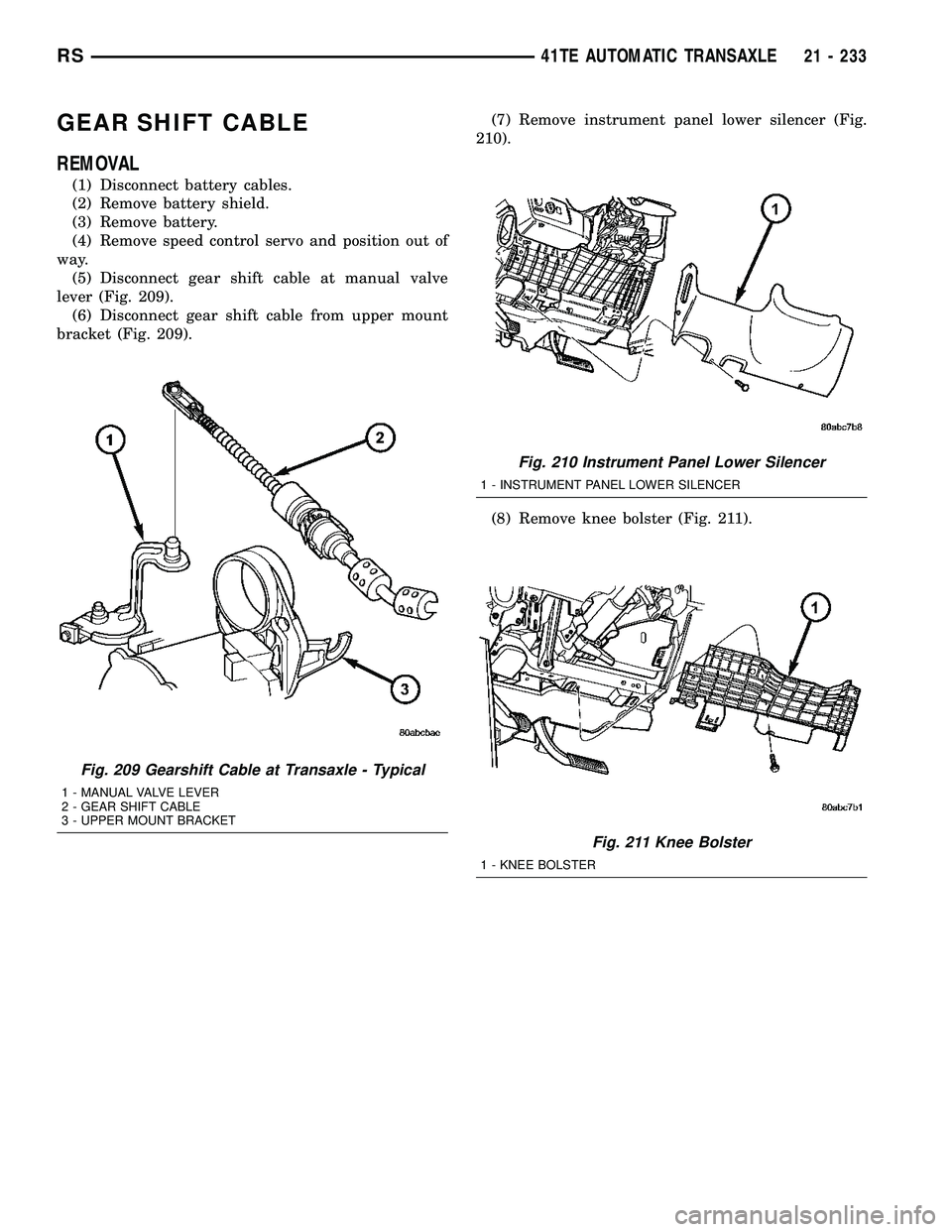
GEAR SHIFT CABLE
REMOVAL
(1) Disconnect battery cables.
(2) Remove battery shield.
(3) Remove battery.
(4) Remove speed control servo and position out of
way.
(5) Disconnect gear shift cable at manual valve
lever (Fig. 209).
(6) Disconnect gear shift cable from upper mount
bracket (Fig. 209).(7) Remove instrument panel lower silencer (Fig.
210).
(8) Remove knee bolster (Fig. 211).
Fig. 209 Gearshift Cable at Transaxle - Typical
1 - MANUAL VALVE LEVER
2 - GEAR SHIFT CABLE
3 - UPPER MOUNT BRACKET
Fig. 210 Instrument Panel Lower Silencer
1 - INSTRUMENT PANEL LOWER SILENCER
Fig. 211 Knee Bolster
1 - KNEE BOLSTER
RS41TE AUTOMATIC TRANSAXLE21 - 233
Page 1696 of 2339

(4) Install knee bolster (Fig. 216).
(5) Install instrument panel lower silencer (Fig.
217).
(6) Install gear shift cable to transaxle upper
mount bracket (Fig. 218). An audible ªclickº should
be heard.
(7) Connect gear shift cable end to transaxle man-
ual valve lever (Fig. 218).
(8) Adjust gearshift cable. (Refer to 21 - TRANS-
MISSION/TRANSAXLE/AUTOMATIC - 41TE/GEAR
SHIFT CABLE - ADJUSTMENTS)
(9) Install speed control servo into position.
(10) Install battery.
(11) Install battery shield.
(12) Connect battery cables.
ADJUSTMENTS
GEARSHIFT CABLE ADJUSTMENT
VERIFICATION
(1) Place gearshift lever in gated park (P).
(2) Attempt to move vehicle by rocking back and
forth on level ground. If vehicle does not move,
attempt to start engine. If engine starts, the park
position is correct.
(3) Set parking brake.
(4) Turn key to on/run and depress brake pedal.
Place gearshift lever in neutral (N).
(5) Attempt to start engine. If engine starts in
both neutral (N) or park (P), gearshift cable is
adjusted properly. No adjustment is required.
(6) If engine does not start in either park (P) or
neutral (N), perform adjustment procedure.
ADJUSTMENT
(1) Park the vehicle on level ground and set the
parking brake.
(2) Place the gearshift lever in gated park (P) and
remove ignition key.
(3) Loosen the cable adjustment screw at the
transaxle manual valve lever (Fig. 219).
(4) Pull the gearshift lever fully forward to the
park detent position.
(5) Release the park brake, then rock the vehicle
to assure it is in park. Reset the park brake.
Fig. 216 Knee Bolster
1 - KNEE BOLSTER
Fig. 217 Instrument Panel Lower Silencer
1 - INSTRUMENT PANEL LOWER SILENCER
Fig. 218 Gearshift Cable at Transaxle
1 - MANUAL VALVE LEVER
2 - GEAR SHIFT CABLE
3 - UPPER MOUNT BRACKET
RS41TE AUTOMATIC TRANSAXLE21 - 235
GEAR SHIFT CABLE (Continued)
Page 2173 of 2339
BLEND DOOR ACTUATOR
DESCRIPTION
The blend door actuators are reversible, 12-volt
Direct Current (DC), servo motors. Models with the
single zone heater and air conditioner system have a
single blend air door, which is controlled by a single
blend door actuator. Models with the optional dual
zone front heater and air conditioner system have
dual blend air doors, which are controlled by two
blend door actuators. The single zone blend door
actuator is located on the driver's side end of the
HVAC housing, close to the middle of the distribution
housing. In the dual zone system, the same blend
door actuator used for the single zone system
becomes the passenger blend door actuator, and is
mechanically connected to only the passenger side
blend air door. In the dual zone system, a second sep-
arate blend door actuator is also located on the
driver side end of the HVAC housing, close to the
middle of the distribution housing, and is mechani-
cally connected to only the driver's side blend air
door.
The blend door actuators are interchangeable with
each other, as well as with the actuators for the
mode door and the recirculation air door. Each actua-
tor is contained within an identical black molded
plastic housing with an integral wire connector
receptacle. Two integral mounting tabs allow the
actuator to be secured with two screws to the distri-
bution housing. Each actuator also has an identical
output shaft with splines that connects it to the link-
age that drives the proper blend air door. The blend
door actuators do not require mechanical indexing to
the blend door linkage, as they are electronically cal-
ibrated by the heater-A/C control module.
OPERATION
The blend door actuators are connected to the A/C-
heater control through the vehicle electrical system
by a dedicated two-wire lead and connector of the
HVAC wire harness. The blend door actuator(s) can
move the blend-air door(s) in two directions. When
the A/C-heater control pulls the voltage on one side
of the motor connection high and the other connec-
tion low, the blend-air door will move in one direc-
tion. When the A/C-heater control reverses the
polarity of the voltage to the motor, the blend-air
door moves in the opposite direction.
When the A/C-heater control makes the voltage to
both connections high or both connections low, the
blend-air door stops and will not move. The A/C-
heater control uses a feedback signal positioning sys-
tem to monitor the operation and relative position of
the blend door actuator(s) and the blend-air door(s).
The A/C-heater control learns the blend-air door stoppositions during the calibration procedure and will
store a diagnostic trouble code (DTC) for any prob-
lems it detects in the blend door actuator circuits.
The blend door actuators are diagnosed using a
scan tool (Refer to 24 - HEATING & AIR CONDI-
TIONING - DIAGNOSIS AND TESTING and to 24 -
HVAC Electrical Diagnostics for more information).
The blend door actuators cannot be adjusted or
repaired and, if faulty or damaged, they must be
replaced.
REMOVAL
WARNING: ON VEHICLES EQUIPPED WITH AIR-
BAGS, DISABLE THE AIRBAG SYSTEM BEFORE
ATTEMPTING ANY STEERING WHEEL, STEERING
COLUMN, OR INSTRUMENT PANEL COMPONENT
DIAGNOSIS OR SERVICE. DISCONNECT AND ISO-
LATE THE BATTERY NEGATIVE (GROUND) CABLE,
THEN WAIT TWO MINUTES FOR THE AIRBAG SYS-
TEM CAPACITOR TO DISCHARGE BEFORE PER-
FORMING FURTHER DIAGNOSIS OR SERVICE. THIS
IS THE ONLY SURE WAY TO DISABLE THE AIRBAG
SYSTEM. FAILURE TO TAKE THE PROPER PRE-
CAUTIONS COULD RESULT IN ACCIDENTAL AIR-
BAG DEPLOYMENT AND POSSIBLE PERSONAL
INJURY.
NOTE: The single zone heating and air conditioning
system is equipped with a single blend door actua-
tor. The dual zone system has two blend door
actuators, one for the driver side blend air door and
one for the passenger side blend air door. The
same service procedures can be used for each of
these actuators.
(1) Disconnect and isolate the battery negative
cable.
(2) Remove the silencer from beneath the driver
side end of the instrument panel. (Refer to 23 -
BODY/INSTRUMENT PANEL/INSTRUMENT
PANEL SILENCER - REMOVAL).
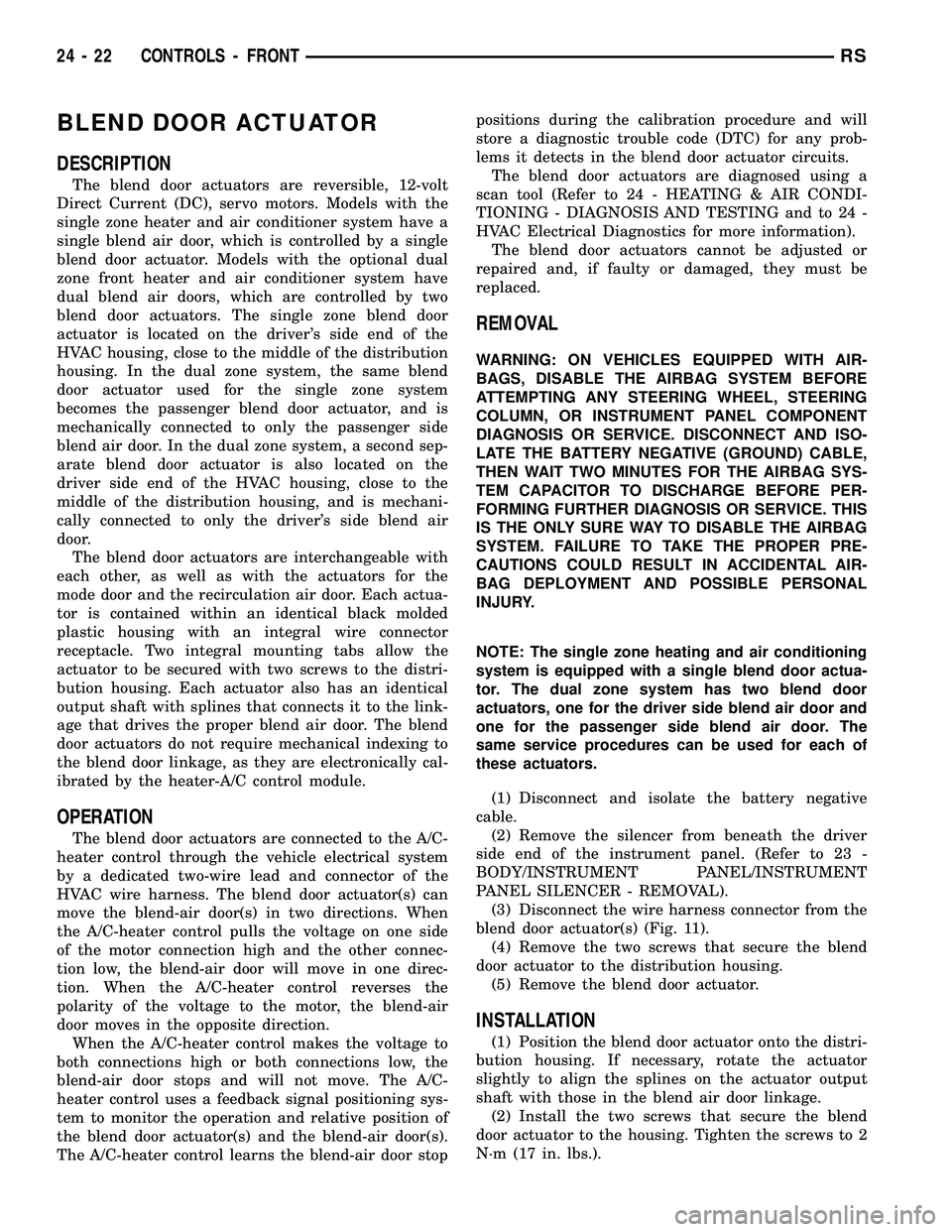
(3) Disconnect the wire harness connector from the
blend door actuator(s) (Fig. 11).
(4) Remove the two screws that secure the blend
door actuator to the distribution housing.
(5) Remove the blend door actuator.
INSTALLATION
(1) Position the blend door actuator onto the distri-
bution housing. If necessary, rotate the actuator
slightly to align the splines on the actuator output
shaft with those in the blend air door linkage.
(2) Install the two screws that secure the blend
door actuator to the housing. Tighten the screws to 2
N´m (17 in. lbs.).
24 - 22 CONTROLS - FRONTRS
Page 2180 of 2339
MODE DOOR ACTUATOR
DESCRIPTION
The mode door actuator is a reversible, 12-volt
Direct Current (DC), servo motor. The single mode
door actuator is located on the driver's side end of
the HVAC housing, close to the top of the distribution
housing. The mode door actuator is mechanically con-
nected to the mode door.
The mode door actuator is interchangeable with
the actuators for the blend air door(s) and the recir-
culation air door. Each actuator is contained within
an identical black molded plastic housing with an
integral wire connector receptacle. Two integral
mounting tabs allow the actuator to be secured with
two screws to the distribution housing. Each actuator
also has an identical output shaft with splines that
connects it to the linkage that drives the mode door.
The mode door actuator does not require mechanical
indexing to the mode door linkage, as it is electroni-
cally calibrated by the heater-A/C control module.
OPERATION
The mode door actuator is connected to the A/C-
heater control through the vehicle electrical system
by a dedicated two-wire lead and connector from the
HVAC wire harness. The mode door actuator can
move the mode door in two directions. When the A/C-
heater control pulls the voltage on one side of the
motor connection high and the other connection low,
the mode door will move in one direction. When the
A/C-heater control reverses the polarity of the volt-
age to the motor, the mode door moves in the oppo-
site direction. When the A/C-heater control makes
the voltage to both connections high or both connec-
tions low, the mode door stops and will not move.
These same motor connections also provide a feed-
back signal to the A/C-heater control. This feedback
signal allows the A/C-heater control to monitor the
operation and relative position of the mode door
actuator and the mode door. The A/C-heater control
learns the mode door stop positions during the cali-
bration procedure and will store a diagnostic trouble
code (DTC) for any problems it detects in the mode
door actuator circuits.
The mode door actuator can be diagnosed using a
DRBIIItscan tool. Refer to Body Diagnostic Proce-
dures for more information. The mode door actuator
cannot be adjusted or repaired and, if damaged or
faulty, it must be replaced.
REMOVAL
WARNING: ON VEHICLES EQUIPPED WITH AIR-
BAGS, DISABLE THE AIRBAG SYSTEM BEFORE
ATTEMPTING ANY STEERING WHEEL, STEERING
COLUMN, OR INSTRUMENT PANEL COMPONENT
DIAGNOSIS OR SERVICE. DISCONNECT AND ISO-
LATE THE BATTERY NEGATIVE (GROUND) CABLE,
THEN WAIT TWO MINUTES FOR THE AIRBAG SYS-
TEM CAPACITOR TO DISCHARGE BEFORE PER-
FORMING FURTHER DIAGNOSIS OR SERVICE. THIS
IS THE ONLY SURE WAY TO DISABLE THE AIRBAG
SYSTEM. FAILURE TO TAKE THE PROPER PRE-
CAUTIONS COULD RESULT IN ACCIDENTAL AIR-
BAG DEPLOYMENT AND POSSIBLE PERSONAL
INJURY.
(1) Disconnect and isolate the battery negative
cable.
(2) Remove the silencer from beneath the driver
side end of the instrument panel (Refer to 23 -
BODY/INSTRUMENT PANEL/INSTRUMENT
PANEL SILENCER - REMOVAL).
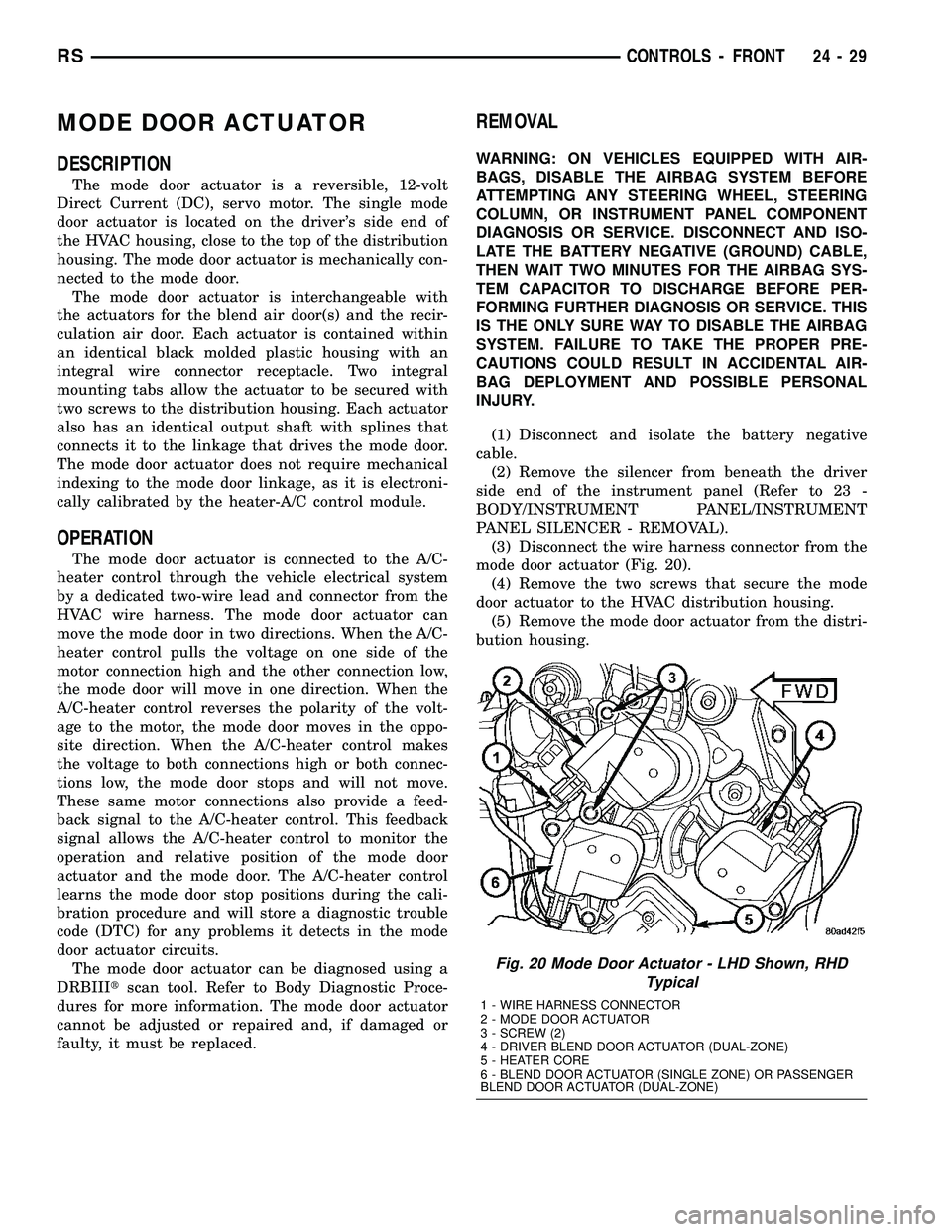
(3) Disconnect the wire harness connector from the
mode door actuator (Fig. 20).
(4) Remove the two screws that secure the mode
door actuator to the HVAC distribution housing.
(5) Remove the mode door actuator from the distri-
bution housing.
Fig. 20 Mode Door Actuator - LHD Shown, RHD
Typical
1 - WIRE HARNESS CONNECTOR
2 - MODE DOOR ACTUATOR
3 - SCREW (2)
4 - DRIVER BLEND DOOR ACTUATOR (DUAL-ZONE)
5 - HEATER CORE
6 - BLEND DOOR ACTUATOR (SINGLE ZONE) OR PASSENGER
BLEND DOOR ACTUATOR (DUAL-ZONE)
RSCONTROLS - FRONT24-29
Page 2182 of 2339

(1) Disconnect and isolate the negative battery
cable.
(2) Remove the glove box from the instrument
panel (Refer to 23 - BODY/INSTRUMENT PANEL/
GLOVE BOX - REMOVAL).
(3) Disconnect the two wire harness connectors
from the blower motor power module (Fig. 21).
(4) Remove the two screws that secure the blower
motor power module to the HVAC housing.
(5) Remove the blower motor power module from
the HVAC housing.
INSTALLATION
(1) Position the blower motor power module into
the HVAC housing.
(2) Install the two screws that secure the blower
motor power module to the HVAC housing. Tighten
the screws to 2 N´m (17 in. lbs.).
(3) Connect the two wire connectors to the blower
motor power module.
(4) Install the glove box (Refer to 23 - BODY/IN-
STRUMENT PANEL/GLOVE BOX - INSTALLA-
TION).
(5) Reconnect the negative battery cable.
RECIRCULATION DOOR
ACTUATOR
DESCRIPTION
The recirculation door actuator is a reversible,
12-volt direct current (DC), servo motor. The single
recirculation door actuator is located on the passen-
ger side end of the HVAC housing, on the air inlet
housing. The recirculation door actuator is mechani-
cally connected to the recirculation-air door. The
recirculation door actuator is interchangeable with
the actuators for the blend-air door(s) and the mode
door. Each actuator is contained within an identical
black molded plastic housing with an integral wire
connector receptacle. Two integral mounting tabs
allow the actuator to be secured with two screws to
the air inlet housing. Each actuator also has an iden-
tical output shaft with splines that connects it to the
linkage that drives the recirculation-air door. The
recirculation door actuator does not require mechan-
ical indexing to the recirculation-air door, as it is
electronically calibrated by the A/C-heater control.
OPERATION
The recirculation door actuator is connected to the
heater-A/C control module through the vehicle elec-
trical system by a dedicated two-wire lead and con-
nector of the HVAC wire harness. The recirculation
door actuator can move the recirculation-air door in
two directions. When the A/C-heater control pulls the
voltage on one side of the motor connection high and
the other connection low, the recirculation-air door
will move in one direction.
When the A/C-heater control makes the voltage to
both connections high or both connections low, the
recirculation-air door stops and will not move. The
A/C-heater control uses a feedback signal positioning
system to monitor the operation and relative position
of the recirculation door actuator and the recircula-
tion-air door. The A/C-heater control learns the recir-
culation-air door stop positions during the calibration
procedure and will store a diagnostic trouble code
(DTC) for any problems it detects in the recirculation
door actuator circuits.
The recirculation door actuator is diagnosed using
a scan tool (Refer to 24 - HEATING & AIR CONDI-
TIONING - DIAGNOSIS AND TESTING and to 24 -
HVAC Electrical Diagnostics for more information).
The recirculation door actuator cannot be adjusted
or repaired and, if faulty or damaged, it must be
replaced.
Fig. 21 Blower Motor Power Module - Typical
1 - POWER MODULE
2 - LOWER GLOVE BOX OPENING REINFORCEMENT
3 - HVAC HOUSING
RSCONTROLS - FRONT24-31
POWER MODULE - BLOWER MOTOR (Continued)
Page 2185 of 2339
INSTALLATION
(1) Position the rear A/C-heater control onto the
bezel or video screen housing, depending on applica-
tion.
(2) Install the three screws that secure the rear
A/C-heater control to the bezel or video screen hous-
ing. Tighten the screws to 2 N´m (17 in. lbs.).(3) If the rear A/C-heater control is to be mounted
into the headliner, position the rear A/C-heater con-
trol near the headliner and connect the wire harness
connector to the rear of the control.
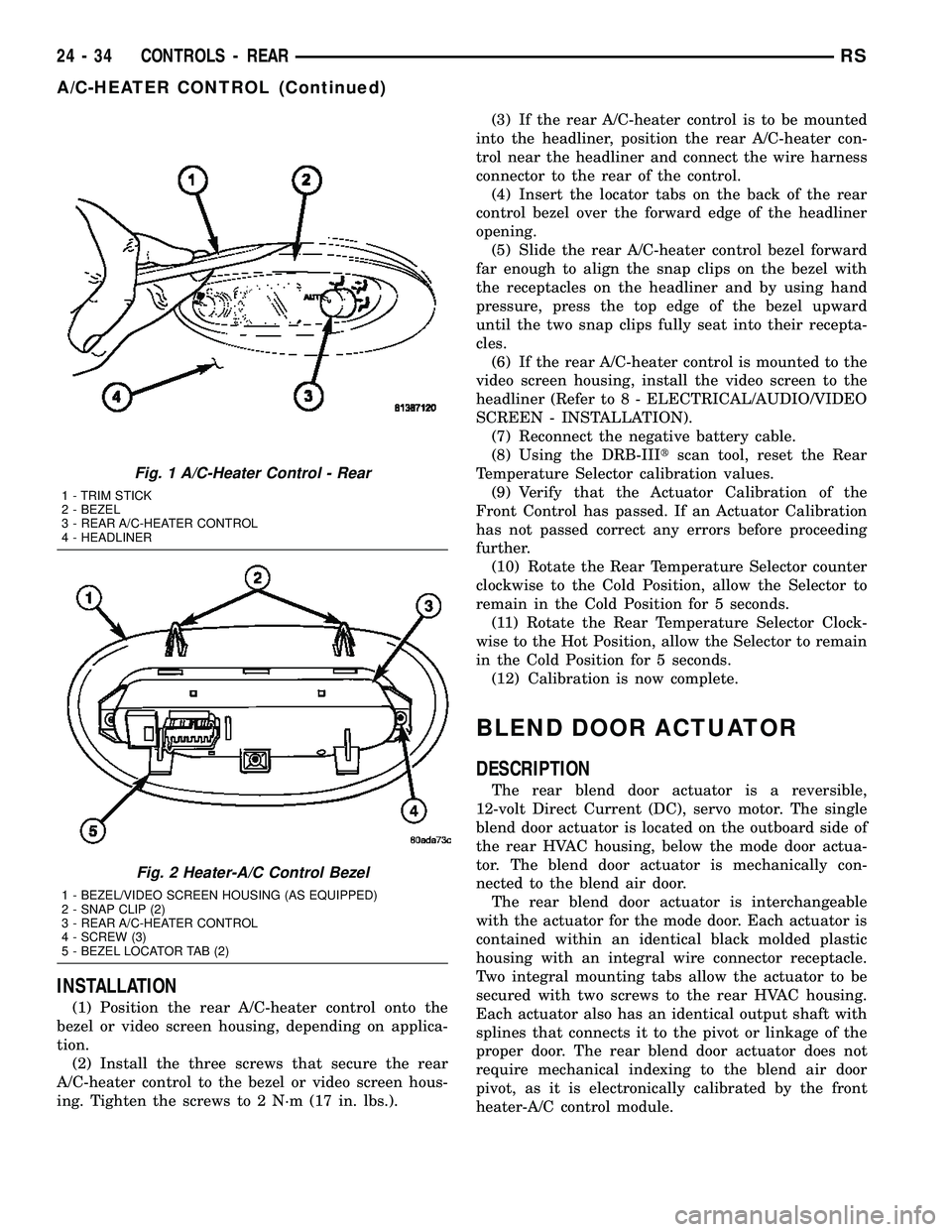
(4) Insert the locator tabs on the back of the rear
control bezel over the forward edge of the headliner
opening.
(5) Slide the rear A/C-heater control bezel forward
far enough to align the snap clips on the bezel with
the receptacles on the headliner and by using hand
pressure, press the top edge of the bezel upward
until the two snap clips fully seat into their recepta-
cles.
(6) If the rear A/C-heater control is mounted to the
video screen housing, install the video screen to the
headliner (Refer to 8 - ELECTRICAL/AUDIO/VIDEO
SCREEN - INSTALLATION).
(7) Reconnect the negative battery cable.
(8) Using the DRB-IIItscan tool, reset the Rear
Temperature Selector calibration values.
(9) Verify that the Actuator Calibration of the
Front Control has passed. If an Actuator Calibration
has not passed correct any errors before proceeding
further.
(10) Rotate the Rear Temperature Selector counter
clockwise to the Cold Position, allow the Selector to
remain in the Cold Position for 5 seconds.
(11) Rotate the Rear Temperature Selector Clock-
wise to the Hot Position, allow the Selector to remain
in the Cold Position for 5 seconds.
(12) Calibration is now complete.
BLEND DOOR ACTUATOR
DESCRIPTION
The rear blend door actuator is a reversible,
12-volt Direct Current (DC), servo motor. The single
blend door actuator is located on the outboard side of
the rear HVAC housing, below the mode door actua-
tor. The blend door actuator is mechanically con-
nected to the blend air door.
The rear blend door actuator is interchangeable
with the actuator for the mode door. Each actuator is
contained within an identical black molded plastic
housing with an integral wire connector receptacle.
Two integral mounting tabs allow the actuator to be
secured with two screws to the rear HVAC housing.
Each actuator also has an identical output shaft with
splines that connects it to the pivot or linkage of the
proper door. The rear blend door actuator does not
require mechanical indexing to the blend air door
pivot, as it is electronically calibrated by the front
heater-A/C control module.
Fig. 1 A/C-Heater Control - Rear
1 - TRIM STICK
2 - BEZEL
3 - REAR A/C-HEATER CONTROL
4 - HEADLINER
Fig. 2 Heater-A/C Control Bezel
1 - BEZEL/VIDEO SCREEN HOUSING (AS EQUIPPED)
2 - SNAP CLIP (2)
3 - REAR A/C-HEATER CONTROL
4 - SCREW (3)
5 - BEZEL LOCATOR TAB (2)
24 - 34 CONTROLS - REARRS
A/C-HEATER CONTROL (Continued)
Page 2190 of 2339

INSTALLATION
(1) Position the rear blower motor resistor block
into the rear HVAC housing.
(2) Install the two screws that secure the rear
blower motor resistor block to the rear HVAC hous-
ing. Tighten the screws to 2 N´m (17 in. lbs.).
(3) Connect the rear HVAC wire harness connector
to the rear blower motor resistor block.
(4) Reinstall the right quarter trim panel and
right D-pillar trim panel onto the quarter inner
panel (Refer to 23 - BODY/INTERIOR/QUARTER
TRIM PANEL - INSTALLATION).
(5) Reconnect the battery negative cable.
MODE DOOR ACTUATOR -
REAR
DESCRIPTION
The rear mode door actuator is a reversible, 12-volt
Direct Current (DC), servo motor. The mode door
actuator is located on the outboard side of the rear
HVAC housing, above the blend door actuator. The
mode door actuator is mechanically connected to the
mode door.
The rear mode door actuator is interchangeable
with the actuator for the blend door. Each actuator is
contained within an identical black molded plastic
housing with an integral wire connector receptacle.
Two integral mounting tabs allow the actuator to be
secured with two screws to the rear HVAC housing.
Each actuator also has an identical output shaft with
splines that connects it to the pivot or linkage of the
proper door. The rear mode door actuator does not
require mechanical indexing to the mode door pivot,
as it is electronically calibrated by the front heater-
A/C control module.
OPERATION
The rear mode door actuator is connected to the
front heater-A/C control module through the vehicle
electrical system by a dedicated two-wire take out
and connector of the rear HVAC wire harness. The
rear mode door actuator can move the mode door in
two directions. When the front heater-A/C control
module pulls the voltage on one side of the motor
connection high and the other connection low, the
rear mode door will move in one direction. When themodule reverses the polarity of the voltage to the
motor, the rear mode door moves in the opposite
direction. When the module makes the voltage to
both connections high or both connections low, the
mode door stops and will not move. These same
motor connections also provide a feedback signal to
the front heater-A/C control module. This feedback
signal allows the module to monitor the operation
and relative positions of the rear mode door actuator
and the mode door. The front heater-A/C control mod-
ule learns the rear mode door stop positions during
the calibration procedure and will store a Diagnostic
Trouble Code (DTC) for any problems it detects in
the mode door actuator circuits.
The rear mode door actuator can be diagnosed
using a DRBIIItscan tool. Refer to Body Diagnostic
Procedures for more information. The rear mode door
actuator cannot be adjusted or repaired and, if dam-
aged or faulty, it must be replaced.
REMOVAL
(1) Disconnect and isolate the battery negative
cable.
(2) Remove the right quarter trim panel and right
D-pillar trim panel from the quarter inner panel
(Refer to 23 - BODY/INTERIOR/QUARTER TRIM
PANEL - REMOVAL).
(3) Remove the two screws that secure the top of
the quarter trim panel attaching bracket to the quar-
ter inner panel.
(4) Remove the screw that secures the back of the
rear HVAC housing to the right D-pillar.
(5) Remove the screw that secures the front of the
rear HVAC housing to the right quarter inner panel.
(6) Carefully pull the top of the rear HVAC hous-
ing away from the right quarter inner panel far
enough to reach between the rear HVAC housing and
the quarter inner panel to access the rear mode door
actuator (Fig. 7).
(7) Remove the two screws that secure the mode
door actuator to the rear HVAC housing.
(8) Pull the mode door actuator away from the
rear HVAC housing far enough to disengage the
actuator output shaft from the mode door linkage.
(9) Raise the mode door actuator far enough to
access and disconnect the rear HVAC wire harness
connector from the actuator
RSCONTROLS - REAR24-39
BLOWER MOTOR RESISTOR BLOCK (Continued)
Page 2243 of 2339

(7) Lubricate a new rubber O-ring seal with clean
refrigerant oil and install it on the liquid line fitting.
(8) Reconnect the A/C liquid line to the receiver/
drier.
(9) Install the bolt that secures the A/C liquid line
to the receiver/drier. Tighten the bolt to 11 N´m (97
in. lbs.).
(10) If equipped, reinstall the A/C ground strap
eyelet terminal connector onto the weld stud on the
top of the right front strut tower (if equipped).
(11) If equipped, install the nut that secures the
A/C ground strap to the weld stud. Tighten the nut
to 12 N´m (106 in. lbs.)
(12) Install the A/C pressure transducer (Refer to
24 - HEATING & AIR CONDITIONING/CONTROLS
- FRONT/A/C PRESSURE TRANSDUCER - INSTAL-
LATION).
(13) Connect the drain tube to the wiper module
drain on the right side of the engine compartment.
(14) Install the air cleaner housing into the right
side of the engine compartment.
(15) On RHD models, install the liquid line into
the retaining bracket located at the top of the dash
panel.
(16) If the vehicle is equipped with the optional
rear heating-A/C system, go to Step 17. If the vehicle
does not have the optional rear heating-A/C system,
go to Step 23.
(17) Raise and support the vehicle.
(18) Remove the tape or plugs from the A/C liquid
line extension fitting and the underbody liquid line
fitting.
(19) Lubricate a new rubber O-ring seal with clean
refrigerant oil and install it on the underbody liquid
line fitting.
(20) Connect the A/C liquid line extension fitting
to the underbody liquid line fitting. Tighten the fit-
tings to 23 N´m (17 ft. lbs.).
(21) Install a new tie strap just forward of the con-
nections between the underbody plumbing and the
engine compartment plumbing for the rear heating-
A/C system.
(22) Lower the vehicle.
(23) Reconnect the negative battery cable.
(24) Evacuate the refrigerant system (Refer to 24 -
HEATING & AIR CONDITIONING/PLUMBING -
FRONT/REFRIGERANT - STANDARD PROCE-
DURE - REFRIGERANT SYSTEM EVACUATE).
(25) Charge the refrigerant system (Refer to 24 -
HEATING & AIR CONDITIONING/PLUMBING -
FRONT/REFRIGERANT - STANDARD PROCE-
DURE - REFRIGERANT SYSTEM CHARGE).RECEIVER / DRIER
DESCRIPTION
The receiver/drier is mounted in a bracket secured
to the right front strut tower in the engine compart-
ment. The receiver/drier is connected between the
front and rear sections of the liquid line between the
condenser outlet and the evaporator inlet. The receiv-
er/drier cannot be repaired. If the receiver/drier is
faulty or damaged, or if the refrigerant system has
been contaminated or left open to the atmosphere for
an indeterminable period or if the A/C compressor
has failed, it must be replaced.
OPERATION
The receiver/drier performs a filtering action to
prevent foreign material in the refrigerant from con-
taminating the expansion valve. Desiccant inside the
receiver/drier canister absorbs any moisture which
may have entered and become trapped within the
refrigerant system. In addition, during periods of
high demand air conditioner operation, the receiver/
drier acts as a reservoir to store surplus refrigerant.
Refrigerant enters the receiver/drier as a high-pres-
sure, low temperature liquid.
REMOVAL
WARNING: REFER TO THE APPLICABLE WARN-
INGS AND CAUTIONS FOR THIS SYSTEM BEFORE
PERFORMING THE FOLLOWING OPERATION (Refer
to 24 - HEATING & AIR CONDITIONING/PLUMBING -
FRONT - WARNING - A/C PLUMBING) and (Refer to
24 - HEATING & AIR CONDITIONING/PLUMBING -
FRONT - CAUTION - A/C PLUMBING).
(1) Recover the refrigerant from the refrigerant
system (Refer to 24 - HEATING & AIR CONDITION-
ING/PLUMBING - FRONT/REFRIGERANT - STAN-
DARD PROCEDURE - REFRIGERANT
RECOVERY).
(2) Remove the air cleaner housing from the right
side of the engine compartment.
(3) Remove the bolt that secures the liquid line
front section fitting to the top of the receiver/drier
(Fig. 30).
(4) Disconnect the liquid line fitting from the
receiver/drier inlet port.
(5) Remove the O-ring seal from the liquid line fit-
ting and discard.
(6) Install plugs in, or tape over the opened liquid
line fitting and the receiver/drier inlet port.
24 - 92 PLUMBING - FRONTRS
LIQUID LINE (Continued)
Page 2310 of 2339

COVER - RIGHT - INSTALLATION,CYLINDER HEAD ..................... 9-106
COVER - RIGHT - REMOVAL, CYLINDER HEAD .............................. 9-106
COVER/FOAM - SECOND ROW - FOLD-IN-FLOOR - INSTALLATION, SEAT
BACK ............................. 23-133
COVER/FOAM - SECOND ROW - FOLD-IN-FLOOR - REMOVAL, SEAT
BACK ............................. 23-133
COVER/FOAM - THIRD ROW - FOLD-IN-FLOOR - INSTALLATION, SEAT
BACK ............................. 23-156
COVER/FOAM - THIRD ROW - FOLD-IN-FLOOR - INSTALLATION, SEAT
CUSHION .......................... 23-159
COVER/FOAM - THIRD ROW - FOLD-IN-FLOOR - REMOVAL, SEAT
BACK ............................. 23-155
COVER/FOAM - THIRD ROW - FOLD-IN-FLOOR - REMOVAL, SEAT
CUSHION .......................... 23-159
COVER/FOAM -SECOND ROW - FOLD-IN-FLOOR - INSTALLATION, SEAT
CUSHION .......................... 23-136
COVER/FOAM -SECOND ROW - FOLD-IN-FLOOR - REMOVAL, SEAT
CUSHION .......................... 23-136
COVER(S) - DESCRIPTION, CYLINDER HEAD .............................. 9-105
COVER(S) - INSTALLATION, TIMING BELT ............................... 9-64
COVERS - QUAD BUCKET, 50/50 SPLIT, BENCH - INSTALLATION, SEAT BACK
HINGE ............................ 23-146
COVERS - QUAD BUCKET, 50/50 SPLIT, BENCH - REMOVAL, SEAT BACK HINGE. . . 23-146
COVER(S) - REMOVAL, TIMING BELT ......9-63
COWL GRILLE - INSTALLATION .........23-50
COWL GRILLE - REMOVAL .............23-50
COWL TRIM - INSTALLATION ...........23-88
COWL TRIM - REMOVAL ...............23-88
C-PILLAR - INSTALLATION, SEAT BELT HEIGHT ADJUSTE R-BOR............. 8O-38
C-PILLAR - REMOVAL, SEAT BELT HEIGHT ADJUSTE R-BOR............. 8O-38
C-PILLAR TRIM - INSTALLATION ........23-88
C-PILLAR TRIM - REMOVAL ............23-88
CRADLE CROSSMEMBER - DESCRIPTION, FRONT .................13-14
CRADLE CROSSMEMBER THREAD REPAIR - DESCRIPTION, FRONT .........13-14
CRANK - INSTALLATION, WINDOW .......23-21
CRANK - REMOVAL, WINDOW ..........23-21
CRANKSHAFT - INSPECTION .............9-38
CRANKSHAFT - INSTALLATION ...........9-39
CRANKSHAFT - REMOVAL ..............9-37
CRANKSHAFT END PLAY - STANDARD PROCEDURE ......................... 9-37
CRANKSHAFT END PLAY - STANDARD PROCEDURE, MEASURING .............9-128
CRANKSHAFT MAIN BEARINGS - INSTALLATION ....................... 9-127
CRANKSHAFT MAIN BEARINGS - REMOVAL .......................... 9-127
CRANKSHAFT OIL SEAL - FRONT - INSTALLATION ................... 9-130,9-42
CRANKSHAFT OIL SEAL - FRONT - REMOVAL ...................... 9-130,9-41
CRANKSHAFT OIL SEAL - REAR - INSTALLATION ................... 9-131,9-42
CRANKSHAFT OIL SEAL - REAR - REMOVAL ...................... 9-131,9-42
CRANKSHAFT POSITION SENSOR - DESCRIPTION ....................... 14-29
CRANKSHAFT POSITION SENSOR - OPERATION ......................... 14-29
CRANKSHAFT POSITION SENSOR - REMOVAL .......................... 14-30
CRANKSHAFT REAR OIL SEAL RETAINER - INSTALLATION ..................... 9-132
CRANKSHAFT REAR OIL SEAL RETAINER - REMOVAL ......................... 9-132
CRANKSHAFT SPROCKET - INSTALLATION ................... 9-160,9-67
CRANKSHAFT SPROCKET - REMOVAL ....9-159,
9-66 CROSSBAR - INSTALLATION, LUGGAGE
RACK .............................. 23-59
CROSSBAR - REMOVAL, LUGGAGE RACK . 23-58
CROSSMEMBER - DESCRIPTION, FRONT CRADLE ............................ 13-14
CROSSMEMBER - INSTALLATION, UPPER RADIATOR .................... 23-56
CROSSMEMBER - REMOVAL, UPPER RADIATOR .......................... 23-56
CROSSMEMBER MOUNT BUSHINGS - INSTALLATION, FRONT ................13-17
CROSSMEMBER MOUNT BUSHINGS - REMOVAL, FRONT .................... 13-17
CROSSMEMBER THREAD REPAIR - DESCRIPTION, FRONT CRADLE .........13-14
CROSS-OVER PIPE - 3.3/3.8L - INSTALLATION ........................ 11-6
CROSS-OVER PIPE - 3.3/3.8L - REMOVAL ........................... 11-6
CUP HOLDER - FOLD-IN-FLOOR - INSTALLATION, SIDE SHIELD ..........23-160
CUP HOLDER - FOLD-IN-FLOOR - REMOVAL, SIDE SHIELD ..............23-160
CUP HOLDER - INSTALLATION ..........23-65
CUP HOLDER - INSTALLATION, QUAD BUCKET SEAT SIDE SHIELD - NO .......23-143
CUP HOLDER - REMOVAL ..............23-65
CUP HOLDER - REMOVAL, QUAD BUCKET SEAT SIDE SHIELD - NO .......23-143
CURB HEIGHT MEASUREMENT - STANDARD PROCEDURE ................2-55
CURTAIN AIRBAG - DESCRIPTION .......8O-12
CURTAIN AIRBAG - INSTALLATION .......8O-16
CURTAIN AIRBAG - OPERATION .........8O-13
CURTAIN AIRBAG - REMOVAL ..........8O-14
CUSHION - INSTALLATION, FRONT SEAT . 23-118
CUSHION - INSTALLATION, QUAD SEAT . . 23-141
CUSHION - INSTALLATION, STABILIZER BAR.................................2-4
CUSHION - OCS - INSTALLATION, FRONT SEAT ............................. 23-120
CUSHION - OCS - REMOVAL, FRONT SEAT ............................. 23-119
CUSHION - REMOVAL, FRONT SEAT .....23-117
CUSHION - REMOVAL, QUAD SEAT .....23-141
CUSHION - REMOVAL, STABILIZER BAR ....2-4
CUSHION COVER - QUAD BUCKET, 50/50 SPLIT, BENCH - INSTALLATION, SEAT . . . 23-144
CUSHION COVER - QUAD BUCKET, 50/50 SPLIT, BENCH - REMOVAL, SEAT .......23-144
CUSHION COVER/FOAM - THIRD ROW - FOLD-IN-FLOOR - INSTALLATION, SEAT . . 23-159
CUSHION COVER/FOAM - THIRD ROW - FOLD-IN-FLOOR - REMOVAL, SEAT ......23-159
CUSHION COVER/FOAM -SECOND ROW - FOLD-IN-FLOOR - INSTALLATION, SEAT . . 23-136
CUSHION COVER/FOAM -SECOND ROW - FOLD-IN-FLOOR - REMOVAL, SEAT ......23-136
CUSHION PAN PANEL-THIRD ROW - FOLD-IN-FLOOR - INSTALLATION,
BOTTOM OF SEAT ................... 23-152
CUSHION PAN PANEL-THIRD ROW - FOLD-IN-FLOOR - REMOVAL, BOTTOM
OF SEAT........................... 23-152
CUSHION SIDE COVER - INSTALLATION, FRONT SEAT ....................... 23-121
CUSHION SIDE COVER - OCS - INSTALLATION, FRONT SEAT ..........23-122
CUSHION SIDE COVER - OCS - REMOVAL, FRONT SEAT ..............23-121
CUSHION SIDE COVER - REMOVAL, FRONT SEAT ....................... 23-120
CUSHION SIDE SHIELD - SECOND ROW - FOLD-IN-FLOOR - INSTALLATION,
SEAT ............................. 23-138
CUSHION SIDE SHIELD - SECOND ROW - FOLD-IN-FLOOR - REMOVAL, SEAT ....23-138
CV BOOT - INNER - INSTALLATION ........3-7
CV BOOT - INNER - REMOVAL ............3-6
CV BOOT - OUTER - INSTALLATION .......3-11
CV BOOT - OUTER - REMOVAL ...........3-10
CYCLE, STANDARD PROCEDURE - POWER LIFTGATE LEARN ...............8N-8
CYCLE, STANDARD PROCEDURE - POWER SLIDING DOOR LEARN .........8N-48
CYLINDER - DESCRIPTION, KEY/LOCK ....19-20
CYLINDER - DESCRIPTION, STANDARD 4 . . . 8I-9
CYLINDER - INSTALLATION, KEY/LOCK . . . 19-20CYLINDER - INSTALLATION, LOCK . . 23-19,23-42
CYLINDER - INSTALLATION, SUPPORT
....23-43
CYLINDER - OPERATION, KEY/LOCK ......19-20
CYLINDER - REMOVAL, KEY/LOCK .......19-20
CYLINDER - REMOVAL, LOCK ......23-19,23-42
CYLINDER - REMOVAL, SUPPORT .......23-42
CYLINDER BLEEDING - STANDARD PROCEDURE, MASTER .................5-36
CYLINDER BORE FITTING - STANDARD PROCEDURE, PISTON TO ...............9-44
CYLINDER BORE HONING - STANDARD PROCEDURE .................... 9-115,9-36
CYLINDER COMBUSTION PRESSURE LEAKAGE TEST - DIAGNOSIS AND
TESTING ......................... 9-85,9-9
CYLINDER COMPRESSION PRESSURE TEST - DIAGNOSIS AND TESTING .....9-85,9-9
CYLINDER (FLUID RESERVOIR) - ASSEMBLY, MASTER ................... 5-39
CYLINDER (FLUID RESERVOIR) - DISASSEMBLY, MASTER ................5-38
CYLINDER HEAD - CLEANING .......9-103,9-26
CYLINDER HEAD - DESCRIPTION ....9-102,9-25
CYLINDER HEAD - INSPECTION .....9-104,9-27
CYLINDER HEAD - INSTALLATION . . . 9-104,9-27
CYLINDER HEAD - REMOVAL .......9-103,9-26
CYLINDER HEAD COVER - CLEANING ......9-31
CYLINDER HEAD COVER - INSPECTION ....9-31
CYLINDER HEAD COVER - INSTALLATION ......................... 9-32
CYLINDER HEAD COVER - LEFT - INSTALLATION ....................... 9-107
CYLINDER HEAD COVER - LEFT - REMOVAL .......................... 9-107
CYLINDER HEAD COVER - REMOVAL ......9-31
CYLINDER HEAD COVER - RIGHT - INSTALLATION ....................... 9-106
CYLINDER HEAD COVER - RIGHT - REMOVAL .......................... 9-106
CYLINDER HEAD COVER(S) - DESCRIPTION ....................... 9-105
CYLINDER HEAD GASKET - DIAGNOSIS AND TESTING ................... 9-102,9-25
CYLINDER HEAD OFF - INSTALLATION . . . 9-111, 9-33
CYLINDER HEAD OFF - REMOVAL . . . 9-109,9-33
CYLINDER HEAD ON - INSTALLATION ....9-111,
9-33
CYLINDER HEAD ON - REMOVAL ....9-111,9-33
CYLINDER LOCK SWITCH - EXPORT - DESCRIPTION, DOOR .................8N-22
CYLINDER LOCK SWITCH - EXPORT - OPERATION, DOOR ................... 8N-22
CYLINDER LOCK SWITCH, EXPORT - DOOR ............................. 8N-22
CYLINDERS - INSPECTION, WHEEL .......5-62
CYLINDERS - INSTALLATION, WHEEL .....5-62
CYLINDERS - REMOVAL, WHEEL .........5-62
DAMAGED OR WORN THREADS - STANDARD PROCEDURE, REPAIR OF . . 9-10,9-88
DAMPER - INSTALLATION, VIBRATION . . . 9-132, 9-49
DAMPER - REMOVAL, VIBRATION . . . 9-132,9-48
DATA BUS COMMUNICATION RECEIVE - PCM INPUT - OPERATION ..............8E-14
DATA LINK CONNECTOR - DESCRIPTION . . . 8E-6
DATA LINK CONNECTOR - OPERATION .....8E-6
DAY / NIGHT MIRROR - DESCRIPTION, AUTOMATIC ........................ 8N-28
DAY / NIGHT MIRROR - OPERATION, AUTOMATIC ........................ 8N-28
DAY / NIGHT MIRROR, DIAGNOSIS AND TESTING - AUTOMATIC ................8N-28
DEAERATION - DIAGNOSIS AND TESTING, COOLING SYSTEM .............7-4
DECOUPLER PULLEY - DESCRIPTION, GENERATOR ........................ 8F-28
DECOUPLER PULLEY - DIAGNOSIS AND TESTING, GENERATOR ................8F-28
DECOUPLER PULLEY - INSTALLATION, GENERATOR ........................ 8F-29
DECOUPLER PULLEY - OPERATION, GENERATOR ........................ 8F-28
DECOUPLER PULLEY - REMOVAL, GENERATOR ........................ 8F-29
DEFINITION, DESCRIPTION - TRIP ........25-1
DEFLECTOR - INSTALLATION, WIND .....23-174
DEFLECTOR - REMOVAL, WIND ........23-174
RS INDEX9
Description Group-Page Description Group-Page Description Group-Page