power modul CHRYSLER VOYAGER 2005 Service Manual
[x] Cancel search | Manufacturer: CHRYSLER, Model Year: 2005, Model line: VOYAGER, Model: CHRYSLER VOYAGER 2005Pages: 2339, PDF Size: 59.69 MB
Page 469 of 2339
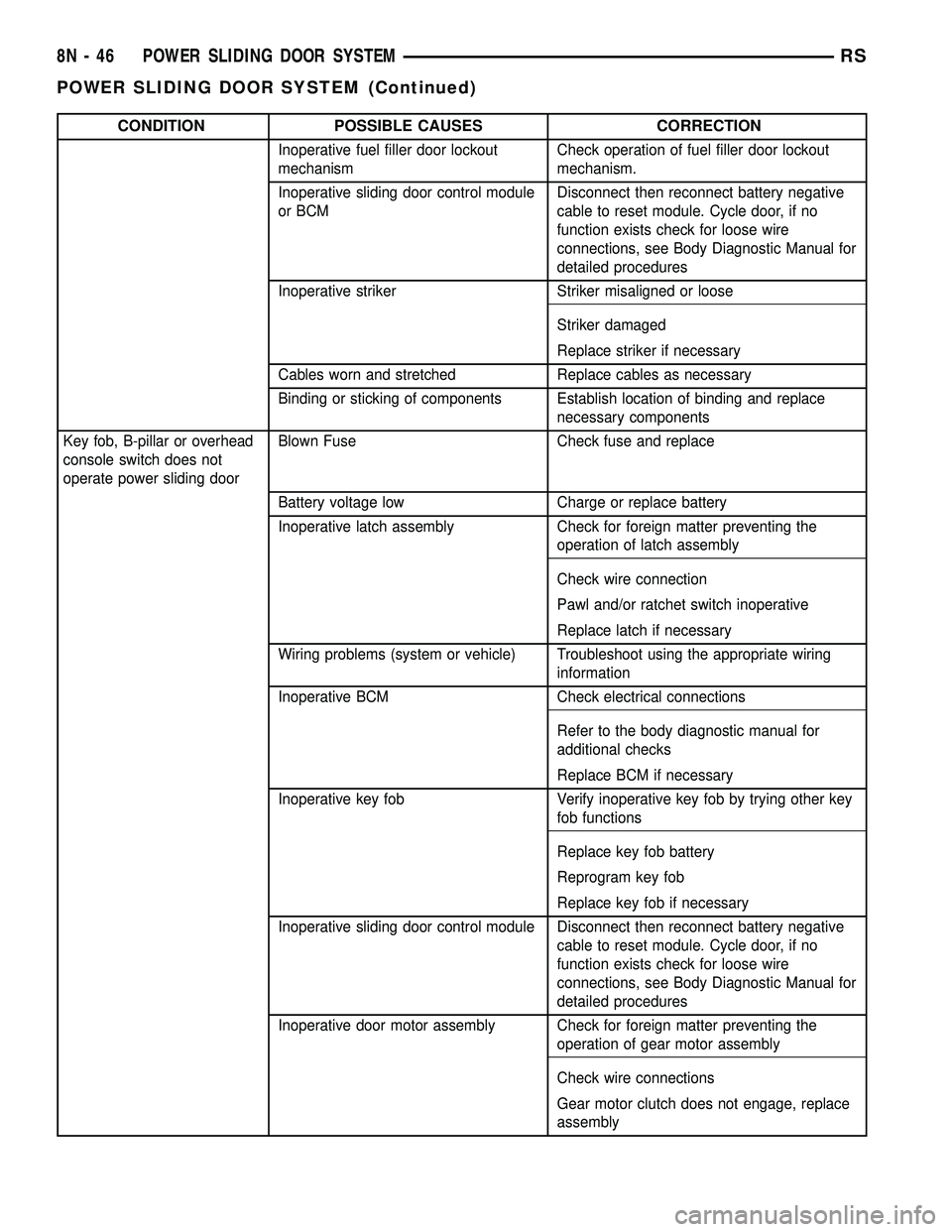
CONDITION POSSIBLE CAUSES CORRECTION
Inoperative fuel filler door lockout
mechanismCheck operation of fuel filler door lockout
mechanism.
Inoperative sliding door control module
or BCMDisconnect then reconnect battery negative
cable to reset module. Cycle door, if no
function exists check for loose wire
connections, see Body Diagnostic Manual for
detailed procedures
Inoperative striker Striker misaligned or loose
Striker damaged
Replace striker if necessary
Cables worn and stretched Replace cables as necessary
Binding or sticking of components Establish location of binding and replace
necessary components
Key fob, B-pillar or overhead
console switch does not
operate power sliding doorBlown Fuse Check fuse and replace
Battery voltage low Charge or replace battery
Inoperative latch assembly Check for foreign matter preventing the
operation of latch assembly
Check wire connection
Pawl and/or ratchet switch inoperative
Replace latch if necessary
Wiring problems (system or vehicle) Troubleshoot using the appropriate wiring
information
Inoperative BCM Check electrical connections
Refer to the body diagnostic manual for
additional checks
Replace BCM if necessary
Inoperative key fob Verify inoperative key fob by trying other key
fob functions
Replace key fob battery
Reprogram key fob
Replace key fob if necessary
Inoperative sliding door control module Disconnect then reconnect battery negative
cable to reset module. Cycle door, if no
function exists check for loose wire
connections, see Body Diagnostic Manual for
detailed procedures
Inoperative door motor assembly Check for foreign matter preventing the
operation of gear motor assembly
Check wire connections
Gear motor clutch does not engage, replace
assembly
8N - 46 POWER SLIDING DOOR SYSTEMRS
POWER SLIDING DOOR SYSTEM (Continued)
Page 470 of 2339
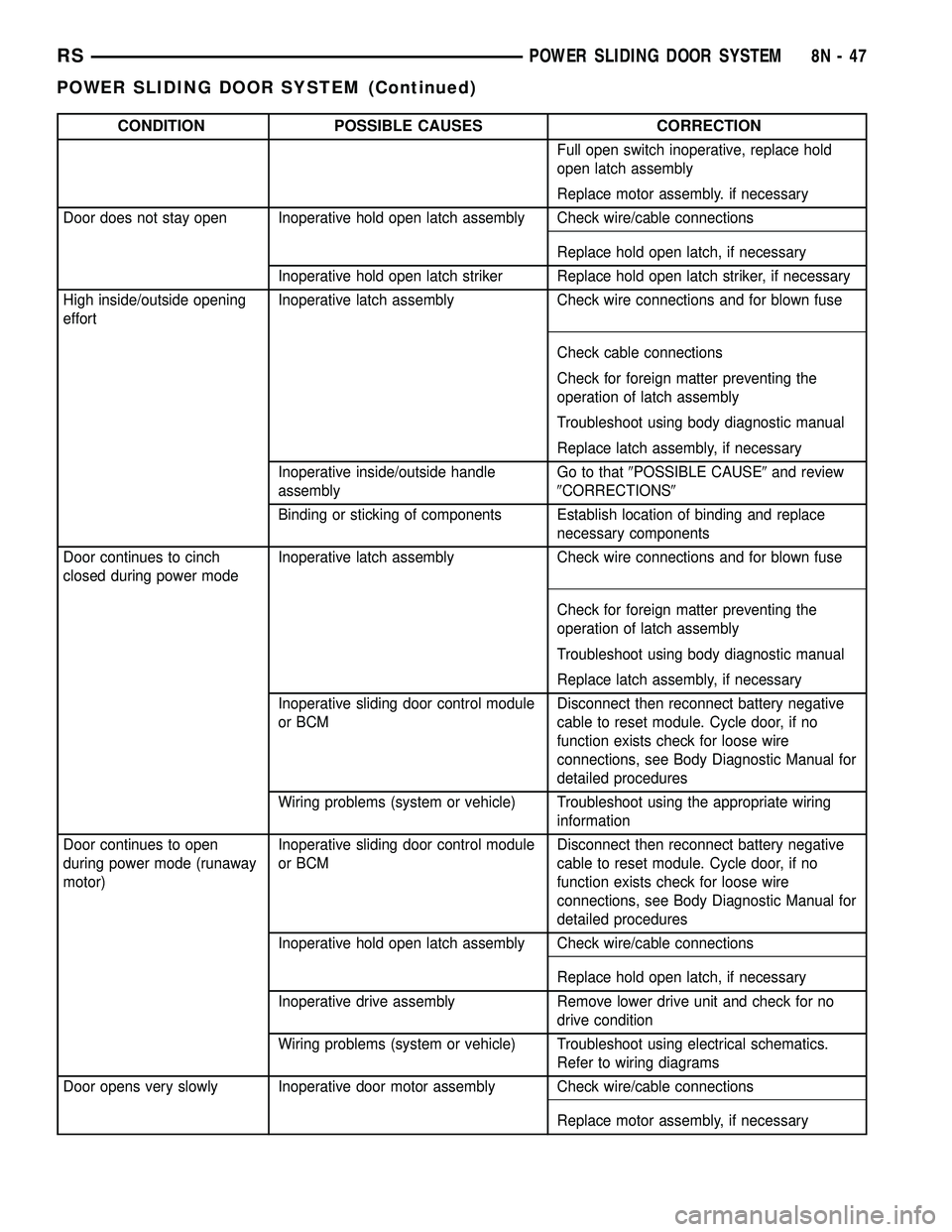
CONDITION POSSIBLE CAUSES CORRECTION
Full open switch inoperative, replace hold
open latch assembly
Replace motor assembly. if necessary
Door does not stay open Inoperative hold open latch assembly Check wire/cable connections
Replace hold open latch, if necessary
Inoperative hold open latch striker Replace hold open latch striker, if necessary
High inside/outside opening
effortInoperative latch assembly Check wire connections and for blown fuse
Check cable connections
Check for foreign matter preventing the
operation of latch assembly
Troubleshoot using body diagnostic manual
Replace latch assembly, if necessary
Inoperative inside/outside handle
assemblyGo to that9POSSIBLE CAUSE9and review
9CORRECTIONS9
Binding or sticking of components Establish location of binding and replace
necessary components
Door continues to cinch
closed during power modeInoperative latch assembly Check wire connections and for blown fuse
Check for foreign matter preventing the
operation of latch assembly
Troubleshoot using body diagnostic manual
Replace latch assembly, if necessary
Inoperative sliding door control module
or BCMDisconnect then reconnect battery negative
cable to reset module. Cycle door, if no
function exists check for loose wire
connections, see Body Diagnostic Manual for
detailed procedures
Wiring problems (system or vehicle) Troubleshoot using the appropriate wiring
information
Door continues to open
during power mode (runaway
motor)Inoperative sliding door control module
or BCMDisconnect then reconnect battery negative
cable to reset module. Cycle door, if no
function exists check for loose wire
connections, see Body Diagnostic Manual for
detailed procedures
Inoperative hold open latch assembly Check wire/cable connections
Replace hold open latch, if necessary
Inoperative drive assembly Remove lower drive unit and check for no
drive condition
Wiring problems (system or vehicle) Troubleshoot using electrical schematics.
Refer to wiring diagrams
Door opens very slowly Inoperative door motor assembly Check wire/cable connections
Replace motor assembly, if necessary
RSPOWER SLIDING DOOR SYSTEM8N-47
POWER SLIDING DOOR SYSTEM (Continued)
Page 471 of 2339

CONDITION POSSIBLE CAUSES CORRECTION
Binding or sticking of components Establish location of binding and replace
necessary components
Squeaks, Noises and rattles Foreign material in door compartment Remove foreign material
Loose components Check and tighten loose components
Missing stabilizers, bumpers or
anti-rattle componentsCheck to ensure components are present.
Replace as necessary
Misadjusted stabilizers, bumpers or
anti-rattle componentsAdjust components as necessary
Poor door track lubrication Lubricate the front portions of the side door
tracks with9Door EaseT9or equivalent
STANDARD PROCEDURE
POWER SLIDING DOOR LEARN CYCLE
Any time a power sliding door component is removed,
replaced, door adjustment is performed or diagnostic
trouble codes are addressed and erased, a learn cycle
mustbe performed. This learn cycle enables the power
sliding door control module to learn or relearn its critical
information (travel limits, resistance to door travel, etc.)
which allows it to perform properly and safely. To per-
form a power sliding door learn cycle do the following:
(1)Obtain a DRB IIIt, or equivalent scan tool.
Connect the scan tool to the vehicle and check for
any power sliding door system stored diagnostic trou-
ble codes, erase any stored codes. Operate the system
and check to see if any trouble codes return. If any
diagnostic trouble codes return, diagnose, correct and
erase the codes before performing the learn cycle. If a
DRB IIIt, or equivalent scan tool is not available, the
learn cycle can be performed by opening and closing
the power sliding door using any of the normal open/
close command switches. Be certain to cycle the
power sliding door through a complete openand
close cycle or the procedure will not be complete.
(2) Using the scan tool, Go into Test Routine Menu
and select a power open command.
(3) Select a power close command.
(4) The power side door learn cycle is complete.
NOTE: If the power sliding door will not complete a
full cycle, a problem exists with the power sliding door
system. (Refer to 8 - ELECTRICAL/POWER DOORS -
DIAGNOSIS AND TESTING) for additional information.
PUSH-PIN GROMMET REPLACEMENT
Push-pin grommets are used to hold and isolate
the power sliding door motor to and from the door
inner panel. This secures the door motor assembly to
the inner panel and keeps the audible motor vibra-
tions to a minimum. If a push-pin grommet showssigns of wear, it must be replaced. Follow the proce-
dure below if replacement is necessary.
(1) Remove the door motor from the door inner
panel. (Refer to 8 - ELECTRICAL/POWER DOORS/
MOTOR - REMOVAL).
(2) Using a trim panel tool (special tool #C-4755)
or equivalent, remove the push-pin grommets from
the inner panel by pulling them straight out (Fig. 2).
(3) Install the replacement push-pin grommets in
the inner panel and install the door motor(Refer to 8
- ELECTRICAL/POWER DOORS/MOTOR - INSTAL-
LATION).
Fig. 2 SIDE DOOR MOTOR PUSH-PIN GROMMETS
1 - PUSH-PIN GROMMETS
2 - SIDE DOOR INNER PANEL
8N - 48 POWER SLIDING DOOR SYSTEMRS
POWER SLIDING DOOR SYSTEM (Continued)
Page 472 of 2339
POWER SLIDING DOOR ADJUSTMENT
In order for the power sliding door system to func-
tion properly the door must move freely and
smoothly. The power sliding door system can accom-
modate for some minor changes in the effort required
to move the door. However, in extreme conditions the
door may need to be mechanically adjusted for proper
fit. (Refer to 23 - BODY/DOORS - SLIDING/SLID-
ING DOOR - ADJUSTMENTS).
If a problem exists with the power sliding door and
it is suspected to be extreme effort, check for proper
door alignment and adjustment first, then check the
door tracks and drive unit for free manual operation.
(Refer to 23 - BODY/DOORS - SLIDING/SLIDING
DOOR - ADJUSTMENTS) for detailed instructions.
LATCH
DESCRIPTION
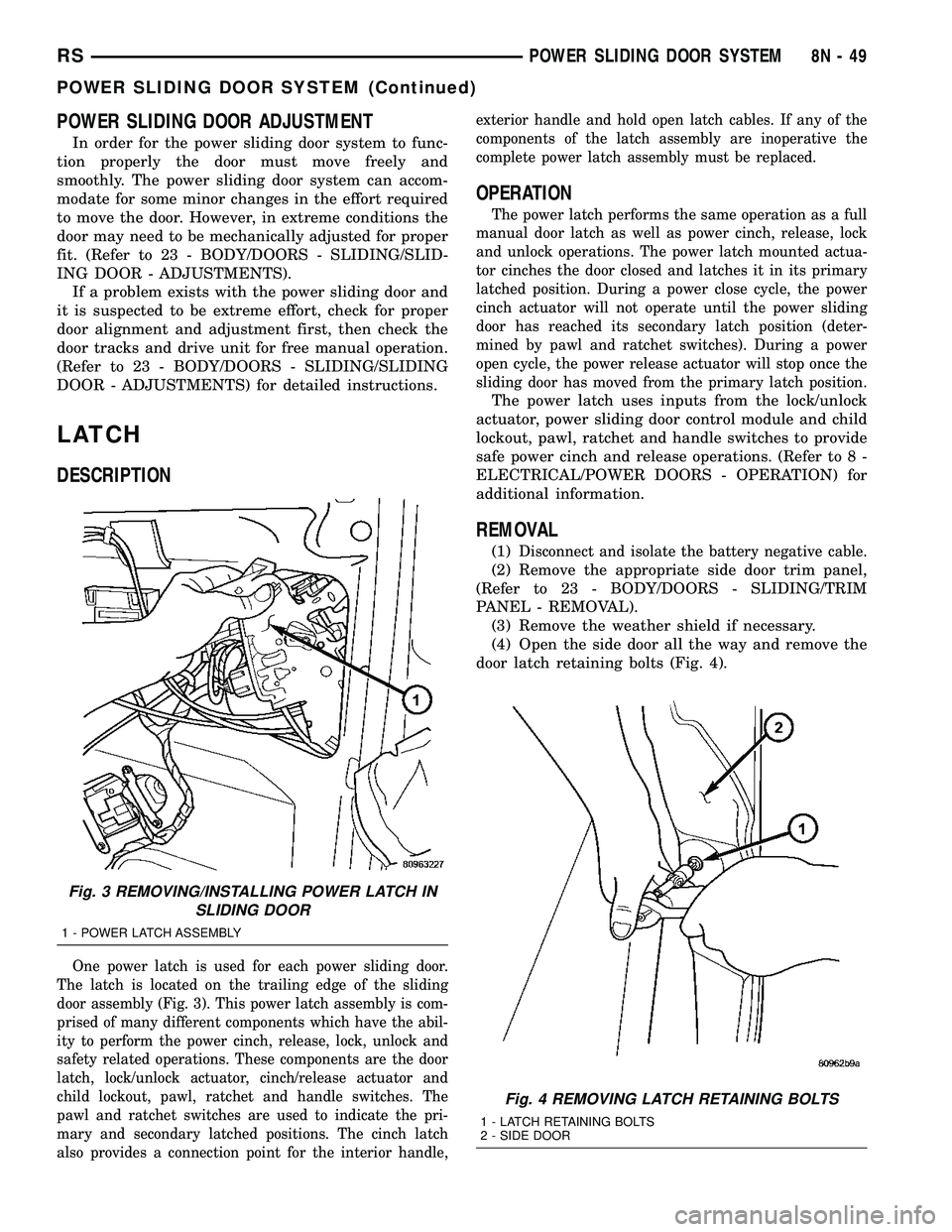
One power latch is used for each power sliding door.
The latch is located on the trailing edge of the sliding
door assembly (Fig. 3). This power latch assembly is com-
prised of many different components which have the abil-
ity to perform the power cinch, release, lock, unlock and
safety related operations. These components are the door
latch, lock/unlock actuator, cinch/release actuator and
child lockout, pawl, ratchet and handle switches. The
pawl and ratchet switches are used to indicate the pri-
mary and secondary latched positions. The cinch latch
also provides a connection point for the interior handle,exterior handle and hold open latch cables. If any of the
components of the latch assembly are inoperative the
complete power latch assembly must be replaced.
OPERATION
The power latch performs the same operation as a full
manual door latch as well as power cinch, release, lock
and unlock operations. The power latch mounted actua-
tor cinches the door closed and latches it in its primary
latched position. During a power close cycle, the power
cinch actuator will not operate until the power sliding
door has reached its secondary latch position (deter-
mined by pawl and ratchet switches). During a power
open cycle, the power release actuator will stop once the
sliding door has moved from the primary latch position.
The power latch uses inputs from the lock/unlock
actuator, power sliding door control module and child
lockout, pawl, ratchet and handle switches to provide
safe power cinch and release operations. (Refer to 8 -
ELECTRICAL/POWER DOORS - OPERATION) for
additional information.
REMOVAL
(1)Disconnect and isolate the battery negative cable.
(2) Remove the appropriate side door trim panel,
(Refer to 23 - BODY/DOORS - SLIDING/TRIM
PANEL - REMOVAL).
(3) Remove the weather shield if necessary.
(4) Open the side door all the way and remove the
door latch retaining bolts (Fig. 4).
Fig. 3 REMOVING/INSTALLING POWER LATCH IN
SLIDING DOOR
1 - POWER LATCH ASSEMBLY
Fig. 4 REMOVING LATCH RETAINING BOLTS
1 - LATCH RETAINING BOLTS
2 - SIDE DOOR
RSPOWER SLIDING DOOR SYSTEM8N-49
POWER SLIDING DOOR SYSTEM (Continued)
Page 474 of 2339

SLIDING DOOR MOTOR
DESCRIPTION
The door motor is located in the center of the
power sliding door (Fig. 8) and is comprised of three
parts. The three parts of the door motor assembly are
the motor, gear reduction and clutch assembly. The
door motor assembly provides the power and torque
to move the sliding door from the open/closed posi-
tion to full closed/open position, after the power
latching mechanism has released.
The door motor is replaced as a complete assembly,
which includes the DC motor, gear reduction and
clutch assemblies.
OPERATION
With the push of a power sliding door command
switch, the power sliding door control module will
signal the latch assembly to release the door from its
primary locked position. The door motor will then
take over to provide the power to open the door to its
full open or closed position. The gear reduction por-
tion of the motor assembly reduces the speed of the
motor from 5800 to 260 rpm and also increases the
torque to the lower drive unit. The clutch portion of
the motor assembly engages the motor to drive thedoor under power and disengages it so the door can
be moved easily under manual operation.
REMOVAL
(1) Disconnect and isolate the battery negative
cable.
(2) Remove the door trim panel from the appropri-
ate door, (Refer to 23 - BODY/DOORS - SLIDING/
TRIM PANEL - REMOVAL).
(3) Remove the water shield as necessary to gain
access to motor assembly.
(4) Remove retaining clip holding flex drive assem-
bly to the motor (Fig. 9). Pull flex drive cable straight
out of the motor assembly.
(5) Disconnect door motor electrical connector.
(6) Using a trim stick (special tool #C-4755) or
equivalent, gently pry out push-pin fasteners retain-
ing the door motor.
(7) Remove the door motor assembly from the
vehicle.
INSTALLATION
(1) Position the door motor assembly on the door
inner panel.
(2) Install the push-pin fasteners retaining the
motor assembly to the power sliding door.
Fig. 8 POWER SLIDING DOOR COMPONENTS
1 - POWER SLIDING DOOR CONTROL MODULE
2 - MODULE RETAINING SCREW
3 - MODULE ELECTRICAL CONNECTORS
4 - DOOR MOTOR ASSEMBLY
5 - FLEX DRIVE ASSEMBLY
6 - DOOR MOTOR RETAINING FASTENERS
7 - DOOR MOTOR ELECTRICAL CONNECTOR
Fig. 9 FLEX DRIVE RETAINING CLIP
1 - FLEX DRIVE CABLE RETAINING CLIP
2 - FLEX DRIVE CABLE
3 - DOOR MOTOR ASSEMBLY
RSPOWER SLIDING DOOR SYSTEM8N-51
Page 475 of 2339
NOTE: Push in on the push-pins at the clutch hous-
ing (plastic side) until you hear one click. Push in
on the push-pin fasteners at the motor mount
(sheet metal side) until you hear two clicks. This
assures proper installation/attachment of the motor
to the sliding door.
(3) Install the flex shaft by lining up the square
shaped drive shaft with the corresponding hole in the
door motor drive unit and push straight in.
(4) Install the E-clip to secure flex-shaft.
(5) Install the weather shield as necessary.
(6) Install the door trim panel on the sliding door,
(Refer to 23 - BODY/DOORS - SLIDING/TRIM
PANEL - INSTALLATION) for the procedure.
(7) Connect the battery negative cable.
FULL OPEN SWITCH
DESCRIPTION
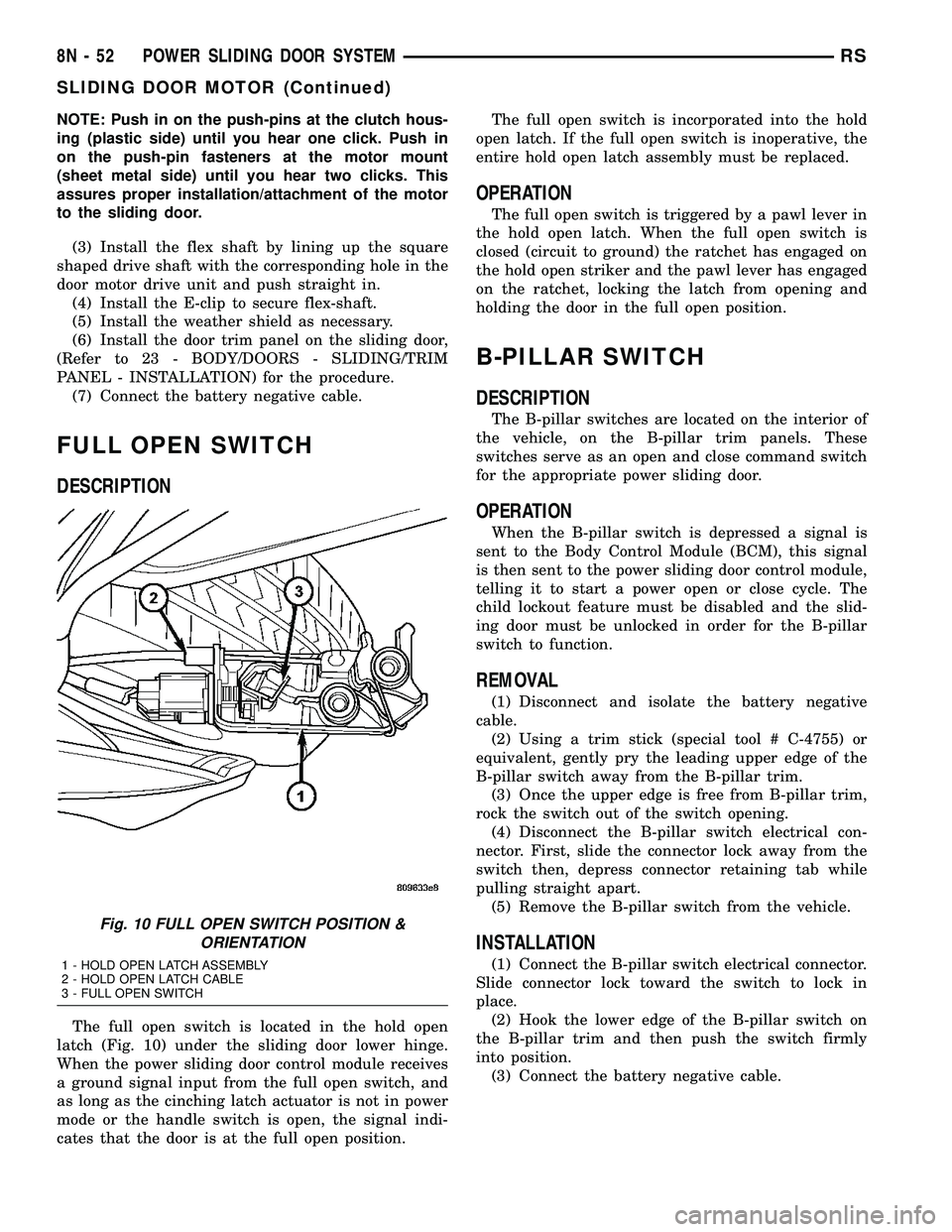
The full open switch is located in the hold open
latch (Fig. 10) under the sliding door lower hinge.
When the power sliding door control module receives
a ground signal input from the full open switch, and
as long as the cinching latch actuator is not in power
mode or the handle switch is open, the signal indi-
cates that the door is at the full open position.The full open switch is incorporated into the hold
open latch. If the full open switch is inoperative, the
entire hold open latch assembly must be replaced.
OPERATION
The full open switch is triggered by a pawl lever in
the hold open latch. When the full open switch is
closed (circuit to ground) the ratchet has engaged on
the hold open striker and the pawl lever has engaged
on the ratchet, locking the latch from opening and
holding the door in the full open position.
B-PILLAR SWITCH
DESCRIPTION
The B-pillar switches are located on the interior of
the vehicle, on the B-pillar trim panels. These
switches serve as an open and close command switch
for the appropriate power sliding door.
OPERATION
When the B-pillar switch is depressed a signal is
sent to the Body Control Module (BCM), this signal
is then sent to the power sliding door control module,
telling it to start a power open or close cycle. The
child lockout feature must be disabled and the slid-
ing door must be unlocked in order for the B-pillar
switch to function.
REMOVAL
(1) Disconnect and isolate the battery negative
cable.
(2) Using a trim stick (special tool # C-4755) or
equivalent, gently pry the leading upper edge of the
B-pillar switch away from the B-pillar trim.
(3) Once the upper edge is free from B-pillar trim,
rock the switch out of the switch opening.
(4) Disconnect the B-pillar switch electrical con-
nector. First, slide the connector lock away from the
switch then, depress connector retaining tab while
pulling straight apart.
(5) Remove the B-pillar switch from the vehicle.
INSTALLATION
(1) Connect the B-pillar switch electrical connector.
Slide connector lock toward the switch to lock in
place.
(2) Hook the lower edge of the B-pillar switch on
the B-pillar trim and then push the switch firmly
into position.
(3) Connect the battery negative cable.
Fig. 10 FULL OPEN SWITCH POSITION &
ORIENTATION
1 - HOLD OPEN LATCH ASSEMBLY
2 - HOLD OPEN LATCH CABLE
3 - FULL OPEN SWITCH
8N - 52 POWER SLIDING DOOR SYSTEMRS
SLIDING DOOR MOTOR (Continued)
Page 478 of 2339

FLEX DRIVE
DESCRIPTION
The flex drive assembly is located in the lower por-
tion of the power sliding door (Fig. 17) and is used to
connect the door motor to the lower drive unit. An
E-clip is used to secure the flex drive to the motor
assembly, while the flex drive collar is used to secure
the drive to the lower drive unit. The flex drive
assembly is basically a flexible drive shaft for the
power sliding door system. The flex drive assembly is
a replaceable component.
OPERATION
With one end of the flex drive attached to the door
motor and the other attached to the lower drive unit,the flex drive transfers the power and torque from
the motor to the drive unit. A square shaped drive
cable, inside the flex drive assembly engages the
motor drive and rotates to move the door accordingly.
REMOVAL
(1) Disconnect and isolate the battery negative
cable.
(2) Remove the appropriate sliding door trim
panel, (Refer to 23 - BODY/DOORS - SLIDING/TRIM
PANEL - REMOVAL).
(3) Position the weathershield aside to gain access
to the flex drive assembly.
(4) Remove the E-clip from the flex drive assembly
(Fig. 18).
(5) Pull the flex drive straight out of the motor
assembly.
Fig. 17 POWER SLIDING DOOR COMPONENTS
1 - POWER SLIDING DOOR CONTROL MODULE
2 - MODULE RETAINING SCREW
3 - MODULE ELECTRICAL CONNECTORS
4 - DOOR MOTOR ASSEMBLY
5 - FLEX DRIVE ASSEMBLY
6 - DOOR MOTOR RETAINING FASTENERS
7 - DOOR MOTOR ELECTRICAL CONNECTOR
Fig. 18 FLEX DRIVE E-CLIP
1 - FLEX DRIVE CABLE RETAINING CLIP
2 - FLEX DRIVE CABLE
3 - DOOR MOTOR ASSEMBLY
RSPOWER SLIDING DOOR SYSTEM8N-55
Page 485 of 2339

(3) Switch ignition ON position.
(4) Connect the clip end of a 12 volt test light to
Pin 13 in door harness connector at the window
switch. Touch the test light probe to Pin 9 and then
to Pin 11.
²If the test light illuminates, the wiring circuit
between the battery and switch is OK.
²If the lamp does not illuminate, first check the
25 amp circuit breaker attached to the electrical dis-
tribution wiring bracket. If the circuit breaker is OK,
then check the 40 amp fuse (#28) in the Integrated
Power Module (IPM). If both components are OK,
then check for a broken wire.
VENT WINDOW MOTOR
DIAGNOSIS AND TESTING
VENT WINDOW MOTOR
If the power vent window motor is receiving proper
current and ground and does not operate proceed
with motor test. Refer to the appropriate wiring
information.
(1) Remove D-pillar trim panel necessary to gain
access to power vent window motor wire connector,
(Refer to 23 - BODY/INTERIOR/LEFT D-PILLAR
TRIM PANEL - REMOVAL) or (Refer to 23 - BODY/
INTERIOR/RIGHT D-PILLAR TRIM PANEL -
REMOVAL).
(2) Disconnect power vent window motor wire con-
nector from body harness.
(3) Using two jumper wires, connect one to a bat-
tery (+) source and the other to a good ground (-).
(4) Connect the Negative (-) jumper probe to one of
the motor connector terminals.
(5) Momentarily touch the Positive (+) jumper
probe to the other motor connector terminal.
When positive probe is connected the motor should
rotate in one direction to either move window open or
closed. If window is all the way open or closed the
motor will grunt and the crank system will flex when
actuated in that one direction.
Reverse jumper probes at the motor connector ter-
minals and window should now move in opposite
direction. If window does not move or grunt, replace
the motor.
If window moved completely open or closed, reverse
the jumper probes and cycle window to the opposite
position to verify full operation.
If motor grunts and does not move, verify that
crank system is not binding.
REMOVAL
(1) Disconnect and isolate the battery negative
cable.(2) Remove D-pillar trim panel. (Refer to 23 -
BODY/INTERIOR/LEFT D-PILLAR TRIM PANEL -
REMOVAL) or (Refer to 23 - BODY/INTERIOR/
RIGHT D-PILLAR TRIM PANEL - REMOVAL).
(3) Disconnect wire connector from power vent
motor.
(4) Using a flat bladed tool, carefully lift the circu-
lar actuator link tab. Remove link from window ball
socket.
(5) Remove bolts holding power vent motor to
D-pillar (Fig. 1).
(6) Remove power vent motor.
INSTALLATION
(1) Obtain new vent window motor.
(2) Snap the actuator link socket onto the quarter
window ball socket. Using a soft rubber mallet, push
the circular link tab flush with link surface.
(3) Install bolts holding power vent motor to D-pil-
lar.
(4) Reconnect wire connector to power vent motor.
(5) Reconnect the battery negative cable.
(6) Cycle quarter window open/close to verify func-
tion.
(7) Install D-pillar trim panel.
WINDOW MOTOR
REMOVAL
The window motor is incorporated into the window
regulator assembly. If the window motor requires
replacement, the window regulator must be replaced.
(Refer to 23 - BODY/DOOR - FRONT/WINDOW
REGULATOR - REMOVAL).
Fig. 1 VENT WINDOW MOTOR
1 - VENT WINDOW MOTOR
2 - WIRE HARNESS CONNECTOR
3 - BOLT
4 - VENT WINDOW
8N - 62 POWER WINDOWSRS
POWER WINDOWS (Continued)
Page 532 of 2339
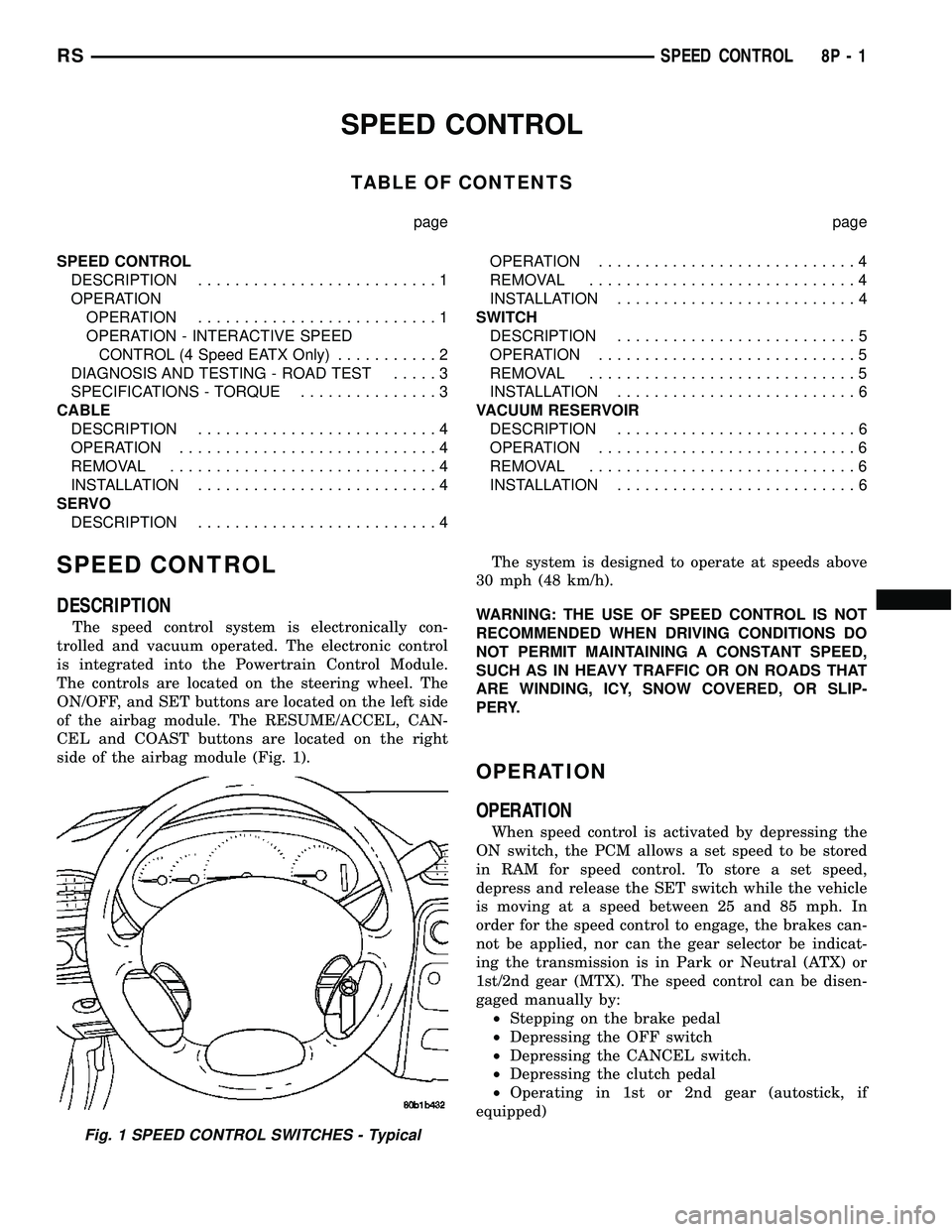
SPEED CONTROL
TABLE OF CONTENTS
page page
SPEED CONTROL
DESCRIPTION..........................1
OPERATION
OPERATION..........................1
OPERATION - INTERACTIVE SPEED
CONTROL (4 Speed EATX Only)...........2
DIAGNOSIS AND TESTING - ROAD TEST.....3
SPECIFICATIONS - TORQUE...............3
CABLE
DESCRIPTION..........................4
OPERATION............................4
REMOVAL.............................4
INSTALLATION..........................4
SERVO
DESCRIPTION..........................4OPERATION............................4
REMOVAL.............................4
INSTALLATION..........................4
SWITCH
DESCRIPTION..........................5
OPERATION............................5
REMOVAL.............................5
INSTALLATION..........................6
VACUUM RESERVOIR
DESCRIPTION..........................6
OPERATION............................6
REMOVAL.............................6
INSTALLATION..........................6
SPEED CONTROL
DESCRIPTION
The speed control system is electronically con-
trolled and vacuum operated. The electronic control
is integrated into the Powertrain Control Module.
The controls are located on the steering wheel. The
ON/OFF, and SET buttons are located on the left side
of the airbag module. The RESUME/ACCEL, CAN-
CEL and COAST buttons are located on the right
side of the airbag module (Fig. 1).The system is designed to operate at speeds above
30 mph (48 km/h).
WARNING: THE USE OF SPEED CONTROL IS NOT
RECOMMENDED WHEN DRIVING CONDITIONS DO
NOT PERMIT MAINTAINING A CONSTANT SPEED,
SUCH AS IN HEAVY TRAFFIC OR ON ROADS THAT
ARE WINDING, ICY, SNOW COVERED, OR SLIP-
PERY.
OPERATION
OPERATION
When speed control is activated by depressing the
ON switch, the PCM allows a set speed to be stored
in RAM for speed control. To store a set speed,
depress and release the SET switch while the vehicle
is moving at a speed between 25 and 85 mph. In
order for the speed control to engage, the brakes can-
not be applied, nor can the gear selector be indicat-
ing the transmission is in Park or Neutral (ATX) or
1st/2nd gear (MTX). The speed control can be disen-
gaged manually by:
²Stepping on the brake pedal
²Depressing the OFF switch
²Depressing the CANCEL switch.
²Depressing the clutch pedal
²Operating in 1st or 2nd gear (autostick, if
equipped)
Fig. 1 SPEED CONTROL SWITCHES - Typical
RSSPEED CONTROL8P-1
Page 536 of 2339
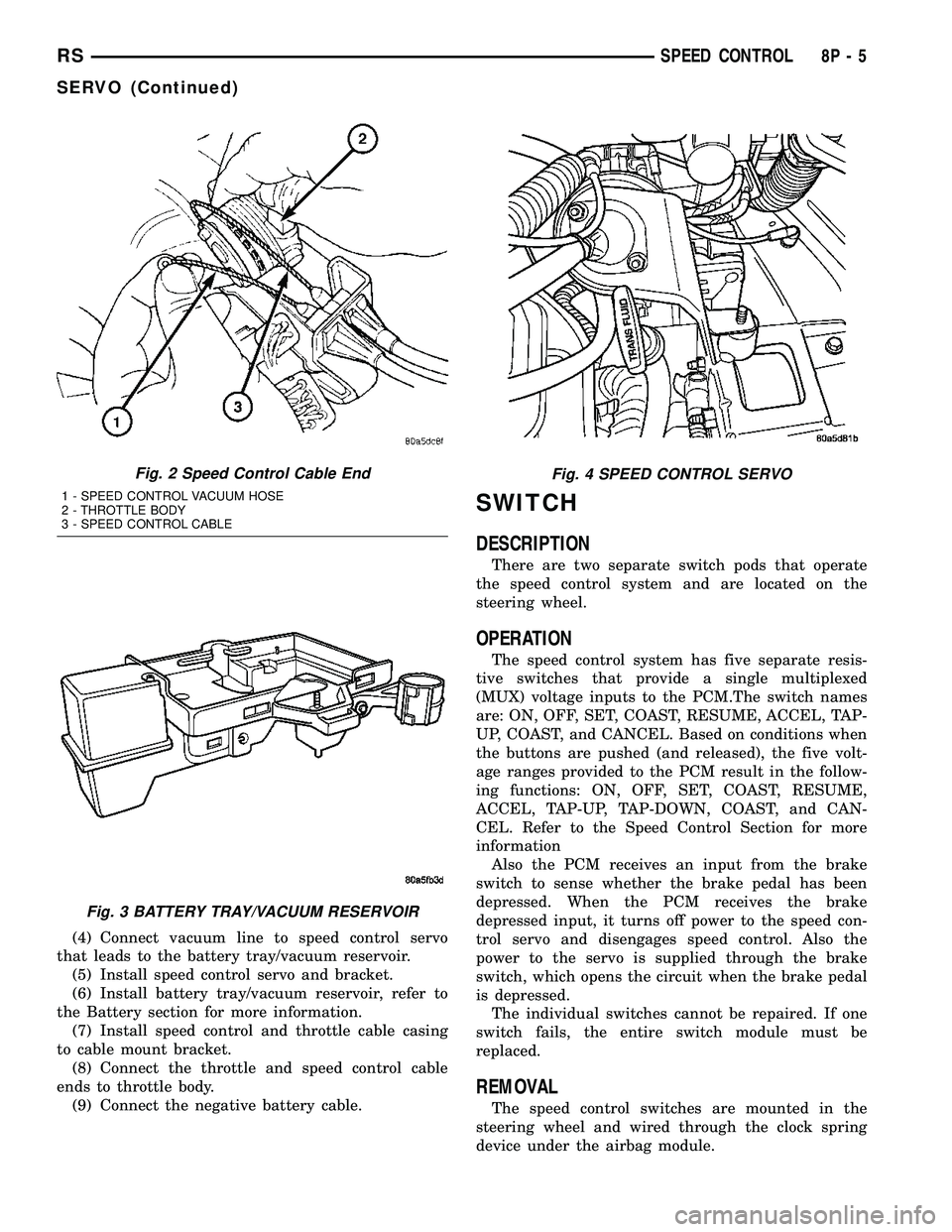
(4) Connect vacuum line to speed control servo
that leads to the battery tray/vacuum reservoir.
(5) Install speed control servo and bracket.
(6) Install battery tray/vacuum reservoir, refer to
the Battery section for more information.
(7) Install speed control and throttle cable casing
to cable mount bracket.
(8) Connect the throttle and speed control cable
ends to throttle body.
(9) Connect the negative battery cable.
SWITCH
DESCRIPTION
There are two separate switch pods that operate
the speed control system and are located on the
steering wheel.
OPERATION
The speed control system has five separate resis-
tive switches that provide a single multiplexed
(MUX) voltage inputs to the PCM.The switch names
are: ON, OFF, SET, COAST, RESUME, ACCEL, TAP-
UP, COAST, and CANCEL. Based on conditions when
the buttons are pushed (and released), the five volt-
age ranges provided to the PCM result in the follow-
ing functions: ON, OFF, SET, COAST, RESUME,
ACCEL, TAP-UP, TAP-DOWN, COAST, and CAN-
CEL. Refer to the Speed Control Section for more
information
Also the PCM receives an input from the brake
switch to sense whether the brake pedal has been
depressed. When the PCM receives the brake
depressed input, it turns off power to the speed con-
trol servo and disengages speed control. Also the
power to the servo is supplied through the brake
switch, which opens the circuit when the brake pedal
is depressed.
The individual switches cannot be repaired. If one
switch fails, the entire switch module must be
replaced.
REMOVAL
The speed control switches are mounted in the
steering wheel and wired through the clock spring
device under the airbag module.
Fig. 2 Speed Control Cable End
1 - SPEED CONTROL VACUUM HOSE
2 - THROTTLE BODY
3 - SPEED CONTROL CABLE
Fig. 3 BATTERY TRAY/VACUUM RESERVOIR
Fig. 4 SPEED CONTROL SERVO
RSSPEED CONTROL8P-5
SERVO (Continued)