Flush and replace the engine coolant CHRYSLER VOYAGER 2021 Owners Manual
[x] Cancel search | Manufacturer: CHRYSLER, Model Year: 2021, Model line: VOYAGER, Model: CHRYSLER VOYAGER 2021Pages: 348, PDF Size: 18.73 MB
Page 72 of 348
70GETTING TO KNOW YOUR VEHICLE
Manual Operation Override
This system offers a full complement of manual
override features. The AUTO symbol in the front
Automatic Temperature Control (ATC) display will
be turned off when the system is being used in the
manual mode.
CLIMATE VOICE COMMANDS
Adjust vehicle temperatures hands-free and keep
everyone comfortable while you keep moving
ahead. (If vehicle is equipped with climate control.)
Push the VR button on the steering wheel. After the
beep, say one of the following commands:
“Set driver temperature to 70 degrees”
“Set passenger temperature to 70 degrees”
Did you know: Voice Command for Climate may
only be used to adjust the interior temperature of
your vehicle. Voice Command will not work to
adjust the heated seats or steering wheel if
equipped.
OPERATING TIPS
NOTE:Refer to the chart at the end of this section for
suggested control settings for various weather
conditions.
Summer Operation
The engine cooling system must be protected with
a high-quality antifreeze coolant to provide proper
corrosion protection and to protect against engine
overheating. OAT coolant (conforming to
MS.90032) is recommended
Úpage 326.
Winter Operation
To ensure the best possible heater and defroster
performance, make sure the engine cooling
system is functioning properly and the proper
amount, type, and concentration of coolant is used
Úpage 326. Use of the air Recirculation mode
during Winter months is not recommended,
because it may cause window fogging.
Vacation/Storage
For information on maintaining the Climate Control
system when the vehicle is being stored for an
extended period of time, see
Úpage 319.
Window Fogging
Vehicle windows tend to fog on the inside in mild,
rainy, and/or humid weather. To clear the
windows, select Defrost or Mix mode and increase
the front blower speed. Do not use the
Recirculation mode without A/C (Air Conditioning)
for long periods, as fogging may occur.
Outside Air Intake
Make sure the air intake, located directly in front of
the windshield, is free of obstructions such as
leaves. Leaves collected in the air intake may
reduce airflow, and if they enter the air distribution
box, they could plug the water drains. In Winter
months, make sure the air intake is clear of ice,
slush, and snow.
Cabin Air Filter
The Climate Control system filters out dust and
pollen from the air. Contact an authorized dealer to
service your cabin air filter, and to have it replaced
when needed.
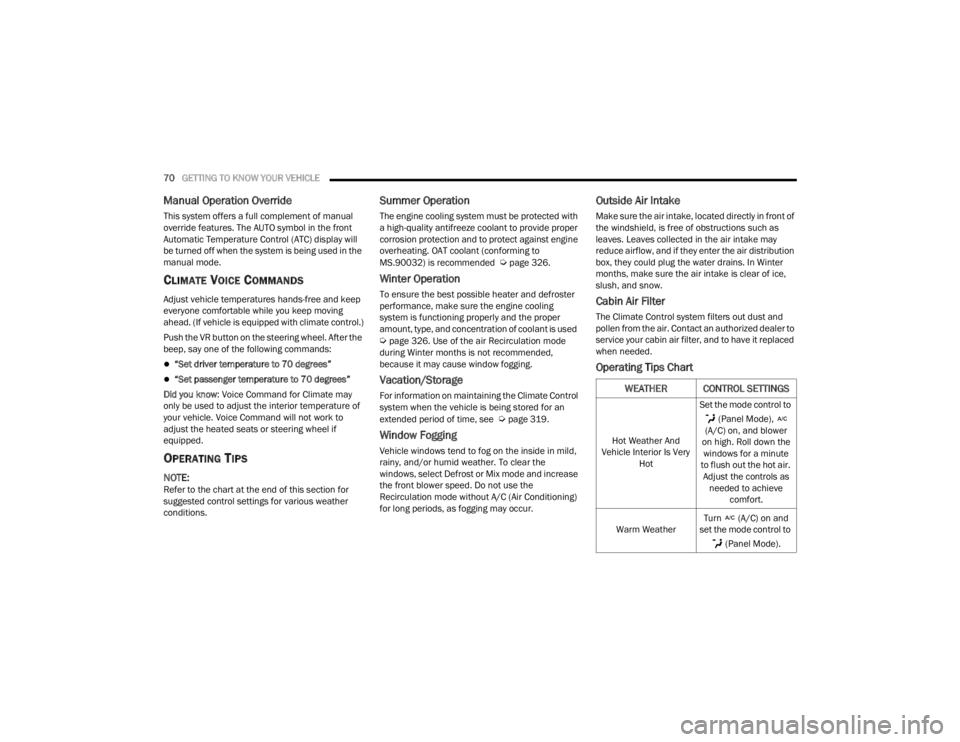
Operating Tips Chart
WEATHER CONTROL SETTINGS
Hot Weather And
Vehicle Interior Is Very Hot Set the mode control to
(Panel Mode),
(A/C) on, and blower
on high. Roll down the windows for a minute
to flush out the hot air. Adjust the controls as needed to achieve comfort.
Warm Weather Turn (A/C) on and
set the mode control to
(Panel Mode).
21_RUV_OM_EN_USC_t.book Page 70
Page 276 of 348
274SERVICING AND MAINTENANCE
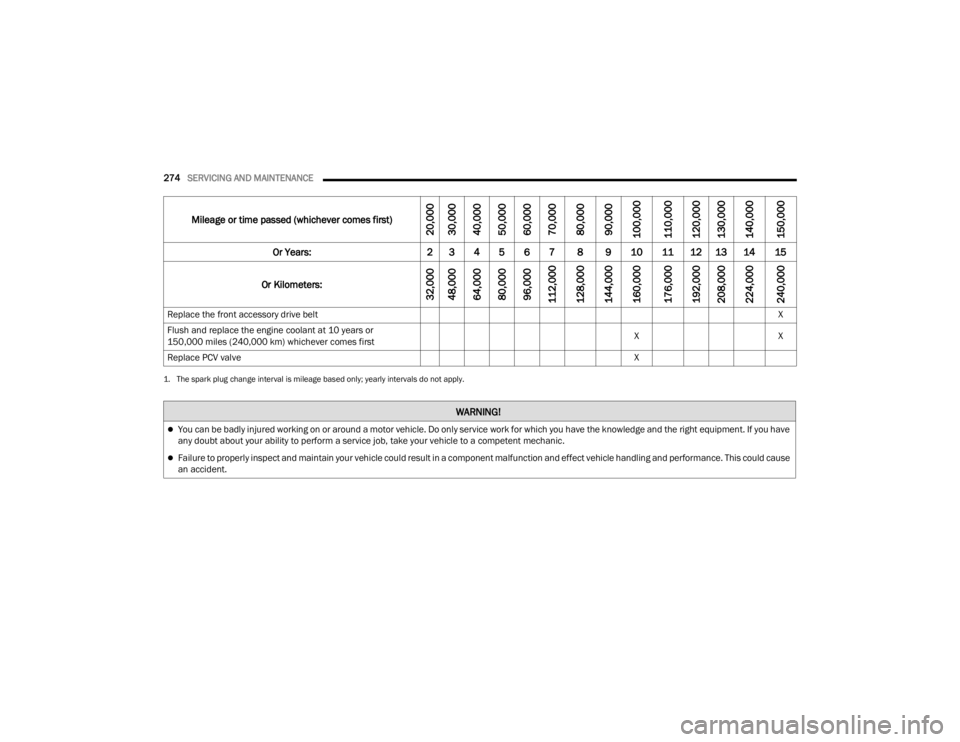
Replace the front accessory drive belt X
Flush and replace the engine coolant at 10 years or
150,000 miles (240,000 km) whichever comes first X
X
Replace PCV valve X
1. The spark plug change interval is mileage based only; yearly intervals do not apply.
Mileage or time passed (whichever comes first)
20,000
30,000
40,000
50,000
60,000
70,000
80,000
90,000
100,000
110,000
120,000
130,000
140,000
150,000
Or Years: 2 3 4 5 6 7 8 9 10 11 12 13 14 15
Or Kilometers:
32,000
48,000
64,000
80,000
96,000
112,000
128,000
144,000
160,000
176,000
192,000
208,000
224,000
240,000
WARNING!
You can be badly injured working on or around a motor vehicle. Do only service work for which you have the knowledge and the right equipment. If you have
any doubt about your ability to perform a service job, take your vehicle to a competent mechanic.
Failure to properly inspect and maintain your vehicle could result in a component malfunction and effect vehicle handling and performance. This could cause
an accident.
21_RUV_OM_EN_USC_t.book Page 274
Page 289 of 348

SERVICING AND MAINTENANCE287
Selection Of Coolant
For further information Úpage 326.
NOTE:
Mixing of engine coolant (antifreeze) other than
specified Organic Additive Technology (OAT)
engine coolant, may result in engine damage
and may decrease corrosion protection. OAT
engine coolant is different and should not be
mixed with Hybrid Organic Additive Technology
(HOAT) engine coolant or any “globally compat -
ible” coolant. If a non-OAT engine coolant is
introduced into the cooling system in an emer -
gency, the cooling system will need to be
drained, flushed, and refilled with fresh OAT
coolant (conforming to MS.90032), by an autho -
rized dealer as soon as possible.
Do not use water alone or alcohol-based engine
coolant products. Do not use additional rust
inhibitors or anti-rust products, as they may not
be compatible with the radiator engine coolant
and may plug the radiator.
This vehicle has not been designed for use with
propylene glycol-based engine coolant. Use of
propylene glycol-based engine coolant is not
recommended.
Some vehicles require special tools to add
coolant properly. Failure to fill these systems
properly could lead to severe internal engine
damage. If any coolant is needed to be added to
the system please contact an authorized dealer.
Adding Coolant
Your vehicle has been built with an improved
engine coolant (OAT coolant conforming to
MS.90032) that allows extended maintenance
intervals. This engine coolant (antifreeze)
can be used up to ten years or 150,000 miles
(240,000 km) before replacement. To prevent
reducing this extended maintenance period, it is
important that you use the same engine coolant
(OAT coolant conforming to MS.90032) throughout
the life of your vehicle.
Please review these recommendations for using
OAT engine coolant that meets the requirements of
the manufacturer Material Standard MS.90032.
When adding engine coolant:
We recommend using Mopar® Antifreeze/
Coolant 10 Year/150,000 Mile (240,000 km)
Formula OAT that meets the requirements of the
manufacturer Material Standard MS.90032.
Mix a minimum solution of 50% OAT engine
coolant that meets the requirements of the
manufacturer Material Standard MS.90032
and distilled water. Use higher concentrations
(not to exceed 70%) if temperatures below
−34°F (−37°C) are anticipated. Please contact
an authorized dealer for assistance.
Use only high purity water such as distilled or
deionized water when mixing the water/engine
coolant solution. The use of lower quality water
will reduce the amount of corrosion protection
in the engine cooling system.
NOTE:
It is the owner's responsibility to maintain the
proper level of protection against freezing
according to the temperatures occurring in the
area where the vehicle is operated.
Some vehicles require special tools to add
coolant properly. Failure to fill these systems
properly could lead to severe internal engine
damage. If any coolant is needed to be added to
the system, please contact an authorized
dealer.
Mixing engine coolant types is not recom -
mended and can result in cooling system
damage. If HOAT and OAT coolant are mixed in
an emergency, have an authorized dealer drain,
flush, and refill with OAT coolant (conforming to
MS.90032) as soon as possible.
8
21_RUV_OM_EN_USC_t.book Page 287
Page 335 of 348

333
Battery Saver Feature
...................................... 55Belts, Seat..................................................... 242Blind Spot Monitoring.................................... 192Bluetooth Connecting To A Particular MobilePhone Or Audio Device After Pairing
..... 174Body Mechanism Lubrication........................ 282B-Pillar Location............................................. 306Brake Assist System...................................... 187Brake Control System, Electronic.................. 187Brake Fluid.................................................... 327Brake System...................................... 289, 322Anti-Lock (ABS).......................................... 322Fluid Check..................................... 289, 327Master Cylinder......................................... 289Parking...................................................... 111Warning Light.............................................. 97Brake/Transmission Interlock....................... 115Brightness, Interior Lights................................ 56Bulb Replacement............................... 299, 301Bulbs, Light................................. 243, 299, 301
C
Camera.......................................................... 127Camera, Rear................................................ 127Capacities, Fluid............................................ 326Caps, FillerFuel........................................................... 129Oil (Engine)................................................ 275Radiator (Coolant Pressure)...................... 288
Car Washes................................................... 319Carbon Monoxide Warning............................ 244CargoVehicle Loading........................................... 82Cargo Area Cover............................................. 82Cargo CompartmentLuggage Carrier........................................... 83Cargo Load Floor.............................................. 82Cargo Tie-Downs.............................................. 82CD................................................................. 168Cellular Phone.............................................. 185Certification Label......................................... 129Chains, Tire................................................... 316Change Oil Indicator........................................ 90Changing A Flat Tire...................................... 249Chart, Tire Sizing........................................... 303Check Engine Light
(Malfunction Indicator Light)......................... 105Checking Your Vehicle For Safety................. 241Checks, Safety.............................................. 241Child Restraint.............................................. 225Child RestraintsBooster Seats........................................... 228Center Seat LATCH................................... 234Child Seat Installation..................... 236, 238How To Stow An unused ALR Seat Belt.... 235Infant And Child Restraints....................... 226Lower Anchors And Tethers For Children......................................... 229Older Children And Child Restraints......... 227
Seating Positions...................................... 229Using The Top Tether Anchorage.............. 239Cigar Lighter.....................................................78Clean Air Gasoline......................................... 324CleaningWheels...................................................... 315Climate Control................................................58Automatic....................................................58Manual........................................................64Rear......................................................62, 68Coat Hook........................................................74Cold Weather Operation................................ 109Compact Spare Tire...................................... 314Computer, Trip/Travel......................................96Contract, Service........................................... 329Controls........................................................ 160Cooling Pressure Cap (Radiator Cap)............ 288Cooling System............................................. 286Adding Coolant (Antifreeze)...................... 287Coolant Level............................................ 288Cooling Capacity....................................... 326Disposal Of Used Coolant......................... 288Drain, Flush, And Refill............................. 286Inspection........................................ 286, 288Points To Remember................................ 288Pressure Cap............................................ 288Radiator Cap............................................. 288Selection Of Coolant (Antifreeze)..... 287, 326Corrosion Protection..................................... 319Cruise Control............................................... 120
11
21_RUV_OM_EN_USC_t.book Page 333