climate control CHRYSLER VOYAGER 2023 User Guide
[x] Cancel search | Manufacturer: CHRYSLER, Model Year: 2023, Model line: VOYAGER, Model: CHRYSLER VOYAGER 2023Pages: 256, PDF Size: 13.97 MB
Page 51 of 256
GETTING TO KNOW YOUR VEHICLE49
Outside Air Intake
Make sure the air intake, located directly in front of the
windshield, is free of obstructions, such as leaves. Leaves
collected in the air intake may reduce airflow, and if they
enter the air distribution box, they could plug the water
drains. In Winter months, make sure the air intake is clear
of ice, slush, and snow.
Cabin Air Filter
The Climate Control system filters out dust and pollen
from the air. Contact an authorized dealer to service your
cabin air filter, and to have it replaced when needed.
Stop/Start System — If Equipped
While in an Autostop, the Climate Control system may
automatically adjust airflow to maintain cabin comfort.
Customer settings will be maintained upon return to an
engine running condition.
Operating Tips Chart
INTERIOR STORAGE AND EQUIPMENT
STORAGE
Glove Compartment
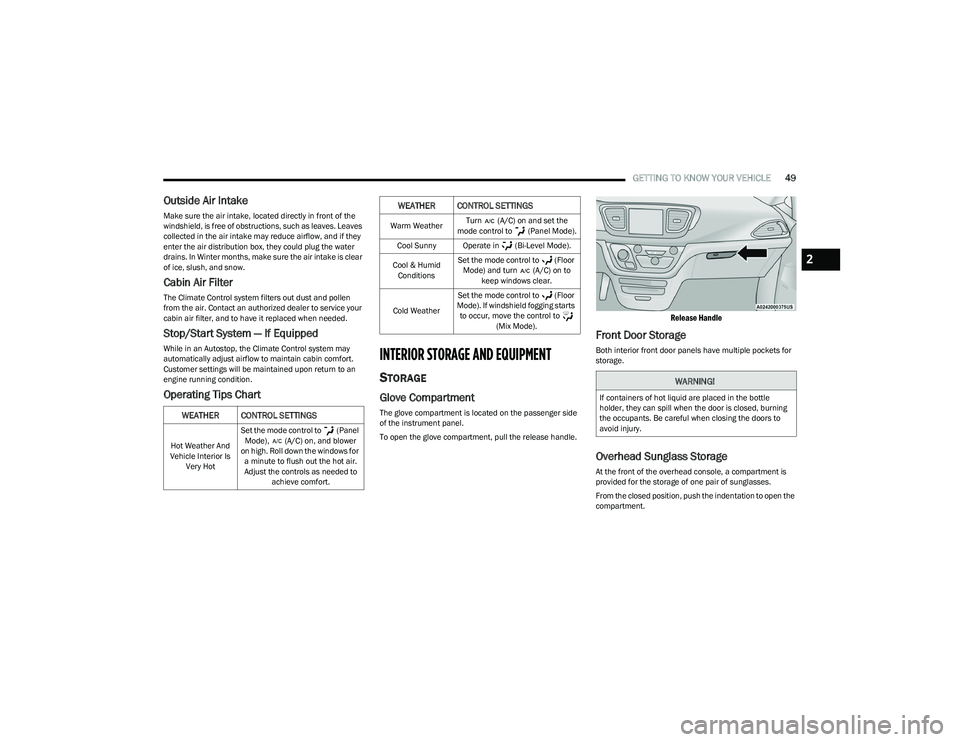
The glove compartment is located on the passenger side
of the instrument panel.
To open the glove compartment, pull the release handle.
Release Handle
Front Door Storage
Both interior front door panels have multiple pockets for
storage.
Overhead Sunglass Storage
At the front of the overhead console, a compartment is
provided for the storage of one pair of sunglasses.
From the closed position, push the indentation to open the
compartment.
WEATHER CONTROL SETTINGS
Hot Weather And
Vehicle Interior Is Very Hot Set the mode control to (Panel
Mode), (A/C) on, and blower
on high. Roll down the windows for a minute to flush out the hot air.
Adjust the controls as needed to achieve comfort.
Warm Weather Turn (A/C) on and set the
mode control to (Panel Mode).
Cool Sunny Operate in (Bi-Level Mode).
Cool & Humid Conditions Set the mode control to (Floor
Mode) and turn (A/C) on to keep windows clear.
Cold Weather Set the mode control to (Floor
Mode). If windshield fogging starts to occur, move the control to (Mix Mode).
WEATHER CONTROL SETTINGS
WARNING!
If containers of hot liquid are placed in the bottle
holder, they can spill when the door is closed, burning
the occupants. Be careful when closing the doors to
avoid injury.
2
23_RUV_OM_EN_US_t.book Page 49
Page 59 of 256
GETTING TO KNOW YOUR VEHICLE57
The key fob and the overhead console button will release
the liftgate when the liftgate is locked. The outside handle
requires the liftgate to be unlocked. If the vehicle is
equipped with Passive Entry, pulling the outside handle
will unlock and release the liftgate, with a valid Passive
Entry key fob within 5 ft (1.5 m) of the liftgate.
Electronic Liftgate Release Handle
NOTE:
When you pull the electronic liftgate release handle, either
only the liftgate will unlock, or all the doors and the liftgate
will unlock, depending on the selected setting in the
Uconnect system
Úpage 105.
TO LOCK/CLOSE THE LIFTGATE
To manually close the liftgate, grab the liftgate closing
handle and pull in a downward motion.
POWER LIFTGATE — IF EQUIPPED
The power liftgate may be opened or closed in several
ways:
Overhead console liftgate button
Key fob
Outside handle (open or reset liftgate latch)
Rear interior power liftgate switch on the upper left trim
(when liftgate is open) Using the previous ways to open or close the liftgate:
When the liftgate is fully closed, the liftgate will open
When the liftgate is fully open, the liftgate will close
When the liftgate is moving, the liftgate will reverse
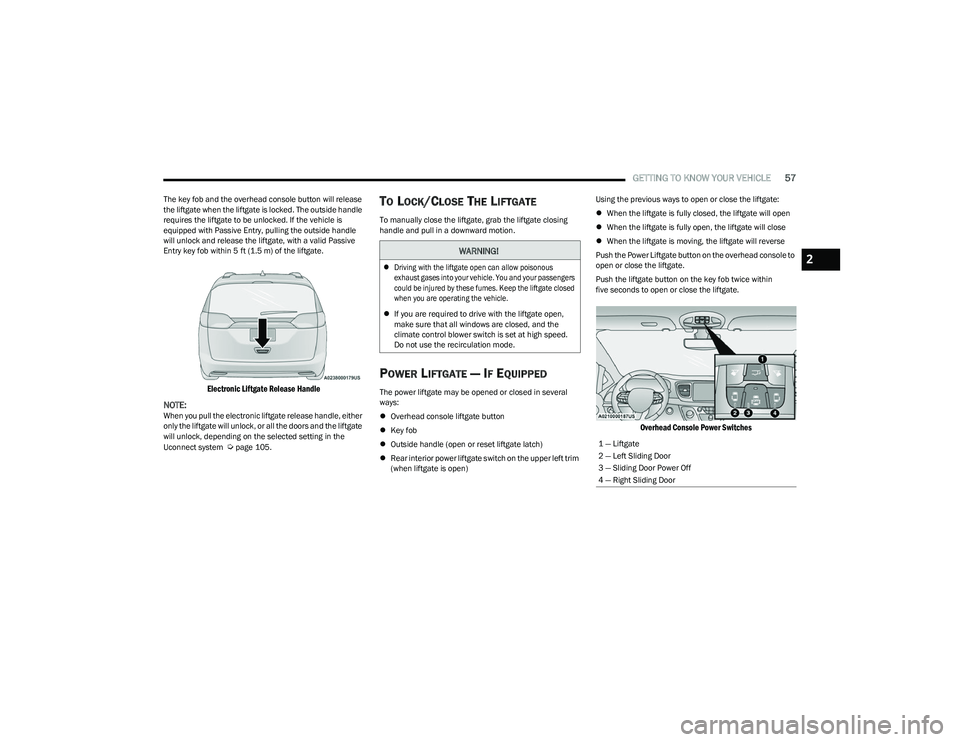
Push the Power Liftgate button on the overhead console to
open or close the liftgate.
Push the liftgate button on the key fob twice within
five seconds to open or close the liftgate.
Overhead Console Power Switches
WARNING!
Driving with the liftgate open can allow poisonous
exhaust gases into your vehicle. You and your passengers
could be injured by these fumes. Keep the liftgate closed
when you are operating the vehicle.
If you are required to drive with the liftgate open,
make sure that all windows are closed, and the
climate control blower switch is set at high speed.
Do not use the recirculation mode.
1 — Liftgate
2 — Left Sliding Door
3 — Sliding Door Power Off
4 — Right Sliding Door
2
23_RUV_OM_EN_US_t.book Page 57
Page 171 of 256
SAFETY169
EXHAUST GAS The best protection against carbon monoxide entry into
the vehicle body is a properly maintained engine exhaust
system.
Whenever a change is noticed in the sound of the exhaust
system, when exhaust fumes can be detected inside the
vehicle, or when the underside or rear of the vehicle is
damaged, have an authorized dealer inspect the complete
exhaust system and adjacent body areas for broken,
damaged, deteriorated, or mispositioned parts. Open
seams or loose connections could permit exhaust fumes
to seep into the passenger compartment. In addition,
inspect the exhaust system each time the vehicle is raised
for lubrication or oil change. Replace as required.CARBON MONOXIDE WARNINGS
WARNING!
Exhaust gases can injure or kill. They contain carbon
monoxide (CO), which is colorless and odorless.
Breathing it can make you unconscious and can
eventually poison you. To avoid breathing (CO), follow
these safety tips:
Do not run the engine in a closed garage or in
confined areas any longer than needed to move your
vehicle in or out of the area.
If you are required to drive with the trunk/liftgate/
rear doors open, make sure that all windows are
closed and the climate control BLOWER switch is set
at high speed. DO NOT use the recirculation mode.
If it is necessary to sit in a parked vehicle with the
engine running, adjust your heating or cooling
controls to force outside air into the vehicle.
Set the blower at high speed.
WARNING!
Carbon monoxide (CO) in exhaust gases is deadly.
Follow the precautions below to prevent carbon
monoxide poisoning:
Do not inhale exhaust gases. They contain carbon
monoxide, a colorless and odorless gas, which can
kill. Never run the engine in a closed area, such as a
garage, and never sit in a parked vehicle with the
engine running for an extended period. If the vehicle
is stopped in an open area with the engine running
for more than a short period, adjust the ventilation
system to force fresh, outside air into the vehicle.
Guard against carbon monoxide with proper mainte -
nance. Have the exhaust system inspected every
time the vehicle is raised. Have any abnormal condi -
tions repaired promptly. Until repaired, drive with all
side windows fully open.
6
23_RUV_OM_EN_US_t.book Page 169
Page 233 of 256
SERVICING AND MAINTENANCE231
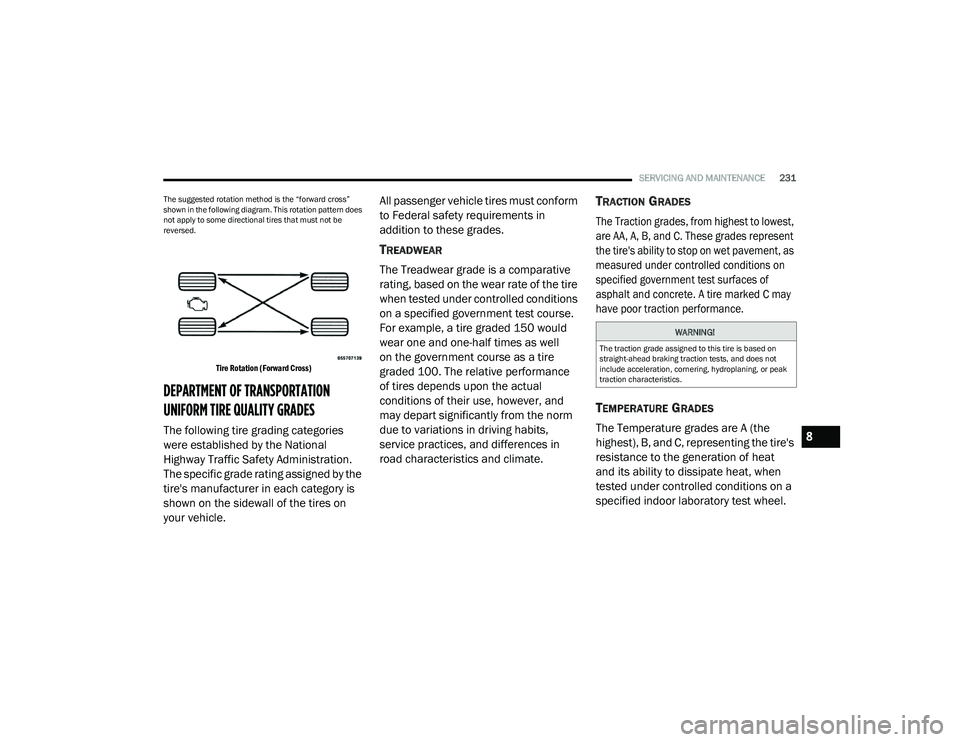
The suggested rotation method is the “forward cross”
shown in the following diagram. This rotation pattern does
not apply to some directional tires that must not be
reversed.
Tire Rotation (Forward Cross)
DEPARTMENT OF TRANSPORTATION
UNIFORM TIRE QUALITY GRADES
The following tire grading categories
were established by the National
Highway Traffic Safety Administration.
The specific grade rating assigned by the
tire's manufacturer in each category is
shown on the sidewall of the tires on
your vehicle. All passenger vehicle tires must conform
to Federal safety requirements in
addition to these grades.
TREADWEAR
The Treadwear grade is a comparative
rating, based on the wear rate of the tire
when tested under controlled conditions
on a specified government test course.
For example, a tire graded 150 would
wear one and one-half times as well
on the government course as a tire
graded 100. The relative performance
of tires depends upon the actual
conditions of their use, however, and
may depart significantly from the norm
due to variations in driving habits,
service practices, and differences in
road characteristics and climate.
TRACTION GRADES
The Traction grades, from highest to lowest,
are AA, A, B, and C. These grades represent
the tire's ability to stop on wet pavement, as
measured under controlled conditions on
specified government test surfaces of
asphalt and concrete. A tire marked C may
have poor traction performance.
TEMPERATURE GRADES
The Temperature grades are A (the
highest), B, and C, representing the tire's
resistance to the generation of heat
and its ability to dissipate heat, when
tested under controlled conditions on a
specified indoor laboratory test wheel.
WARNING!
The traction grade assigned to this tire is based on
straight-ahead braking traction tests, and does not
include acceleration, cornering, hydroplaning, or peak
traction characteristics.
8
23_RUV_OM_EN_US_t.book Page 231
Page 248 of 256
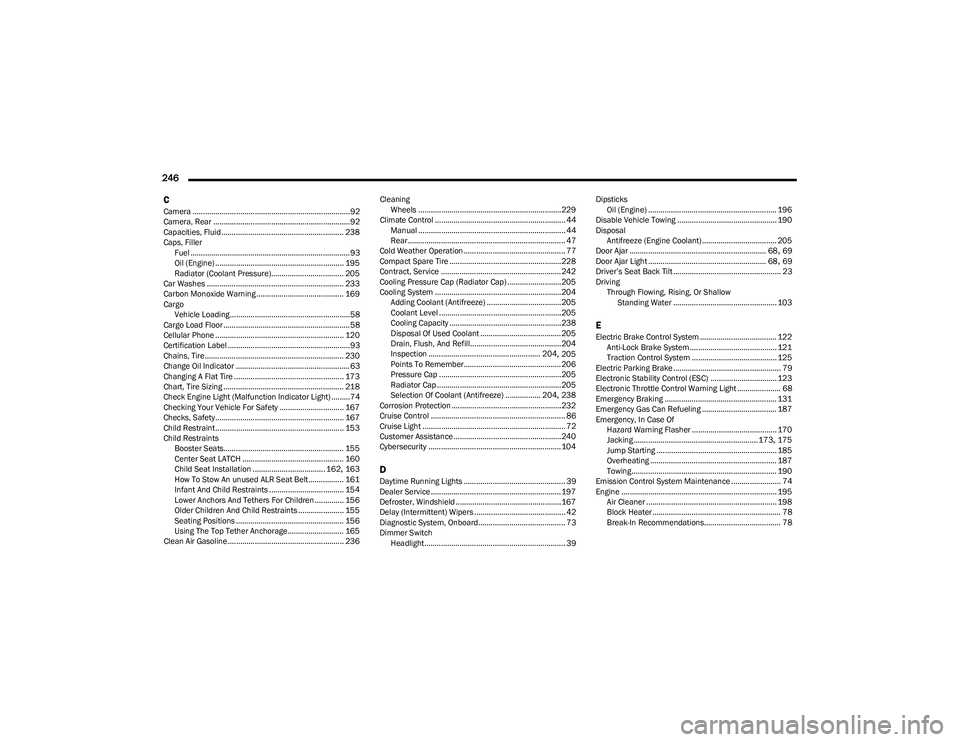
246 C
Camera ............................................................................92
Camera, Rear ..................................................................92
Capacities, Fluid ........................................................... 238
Caps, Filler Fuel .............................................................................93
Oil (Engine) .............................................................. 195
Radiator (Coolant Pressure)................................... 205
Car Washes .................................................................. 233
Carbon Monoxide Warning .......................................... 169
Cargo Vehicle Loading..........................................................58
Cargo Load Floor ............................................................. 58
Cellular Phone .............................................................. 120
Certification Label ...........................................................93
Chains, Tire................................................................... 230
Change Oil Indicator ....................................................... 63
Changing A Flat Tire ..................................................... 173
Chart, Tire Sizing .......................................................... 218
Check Engine Light (Malfunction Indicator Light) .........74
Checking Your Vehicle For Safety ............................... 167
Checks, Safety.............................................................. 167
Child Restraint.............................................................. 153
Child Restraints Booster Seats.......................................................... 155
Center Seat LATCH ................................................. 160Child Seat Installation ................................... 162
, 163
How To Stow An unused ALR Seat Belt ................. 161
Infant And Child Restraints .................................... 154 Lower Anchors And Tethers For Children .............. 156Older Children And Child Restraints ...................... 155
Seating Positions .................................................... 156
Using The Top Tether Anchorage........................... 165
Clean Air Gasoline........................................................ 236 Cleaning
Wheels .....................................................................229
Climate Control ............................................................... 44 Manual ....................................................................... 44
Rear ............................................................................ 47
Cold Weather Operation ................................................. 77
Compact Spare Tire ...................................................... 228
Contract, Service .......................................................... 242
Cooling Pressure Cap (Radiator Cap) ..........................205
Cooling System ............................................................. 204 Adding Coolant (Antifreeze) ....................................205
Coolant Level ...........................................................205
Cooling Capacity ...................................................... 238
Disposal Of Used Coolant ....................................... 205Drain, Flush, And Refill............................................204
Inspection ...................................................... 204
, 205
Points To Remember............................................... 206
Pressure Cap ...........................................................205
Radiator Cap ............................................................205 Selection Of Coolant (Antifreeze) ................. 204
, 238
Corrosion Protection ..................................................... 232
Cruise Control ................................................................. 86
Cruise Light ..................................................................... 72
Customer Assistance ....................................................240
Cybersecurity ................................................................ 104
DDaytime Running Lights ................................................. 39
Dealer Service............................................................... 197
Defroster, Windshield ...................................................167
Delay (Intermittent) Wipers ............................................ 42
Diagnostic System, Onboard.......................................... 73
Dimmer Switch Headlight .................................................................... 39 Dipsticks
Oil (Engine) .............................................................. 196
Disable Vehicle Towing ................................................ 190
Disposal Antifreeze (Engine Coolant) .................................... 205
Door Ajar .................................................................. 68
, 69
Door Ajar Light ......................................................... 68, 69
Driver’s Seat Back Tilt .................................................... 23
Driving Through Flowing, Rising, Or Shallow Standing Water .................................................. 103
EElectric Brake Control System ..................................... 122Anti-Lock Brake System .......................................... 121Traction Control System ......................................... 125
Electric Parking Brake.................................................... 79
Electronic Stability Control (ESC) ................................ 123
Electronic Throttle Control Warning Light ..................... 68
Emergency Braking ...................................................... 131
Emergency Gas Can Refueling .................................... 187
Emergency, In Case Of Hazard Warning Flasher ......................................... 170Jacking ............................................................ 173
, 175
Jump Starting .......................................................... 185
Overheating ............................................................. 187
Towing...................................................................... 190
Emission Control System Maintenance ........................ 74
Engine ........................................................................... 195 Air Cleaner ............................................................... 198Block Heater .............................................................. 78
Break-In Recommendations..................................... 78
23_RUV_OM_EN_US_t.book Page 246