light CITROEN 2CV 1975 User Guide
[x] Cancel search | Manufacturer: CITROEN, Model Year: 1975, Model line: 2CV, Model: CITROEN 2CV 1975Pages: 86, PDF Size: 2.21 MB
Page 38 of 86
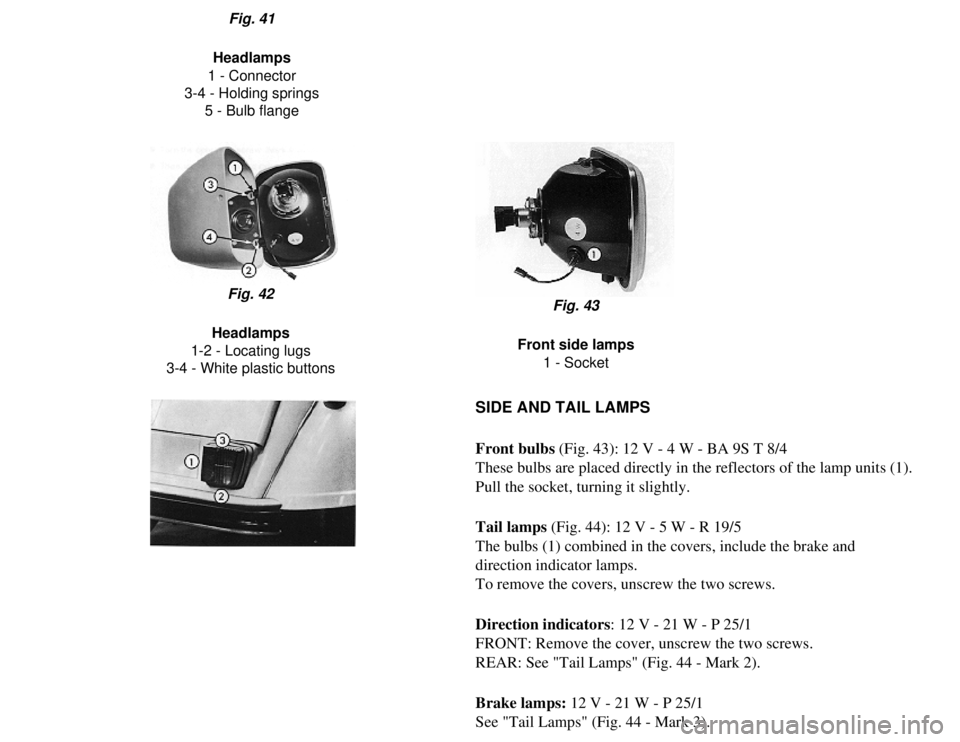
Fig. 41
Headlamps
1 - Connector
3-4 - Holding springs 5 - Bulb flange
Fig. 42
Headlamps
1-2 - Locating lugs
3-4 - White plastic buttons Fig. 43
Front side lamps 1 - Socket
SIDE AND TAIL LAMPS
Front bulbs (Fig. 43): 12 V - 4 W - BA 9S T 8/4
These bulbs are placed directly in the reflectors of the lamp units (1)\
.
Pull the socket, turning it slightly.
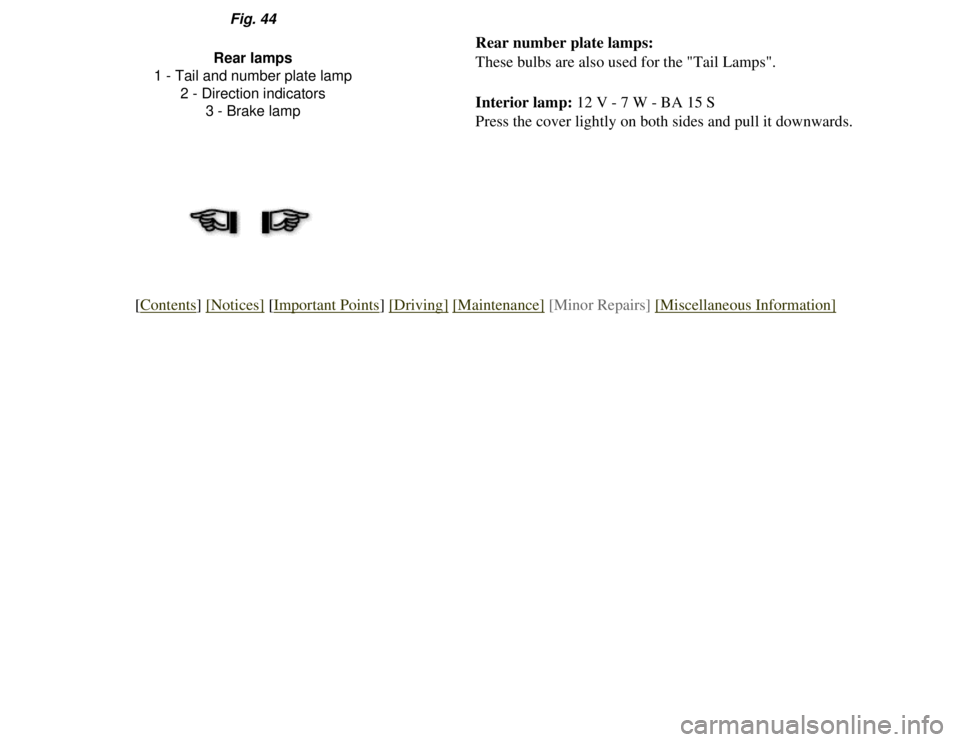
Tail lamps (Fig. 44): 12 V - 5 W - R 19/5
The bulbs (1) combined in the covers, include the brake and
direction indicator lamps.
To remove the covers, unscrew the two screws.
Direction indicators: 12 V - 21 W - P 25/1
FRONT: Remove the cover, unscrew the two screws.
REAR: See "Tail Lamps" (Fig. 44 - Mark 2).
Brake lamps: 12 V - 21 W - P 25/1
See "Tail Lamps" (Fig. 44 - Mark 3).
Page 39 of 86
Rear number plate lamps:
These bulbs are also used for the "Tail Lamps".
Interior lamp: 12 V - 7 W - BA 15 S
Press the cover lightly on both sides and pull it downwards.
Fig. 44
Rear lamps
1 - Tail and number plate lamp 2 - Direction indicators3 - Brake lamp
[Contents] [Notices] [Important Points] [Driving] [Maintenance] [Minor Repairs] [Miscellaneous Information]
Page 46 of 86
DOOR LOCKS FROZEN UP
Maintenance:
At the beginning of the cold season, insert into the door-locks a
small amount of glycerin or anti-freeze, using an oiler or a dropper.
In case of emergency:
Heat the key slightly with a match flame or lighter before inserting
it.
[Contents] [Notices] [Important Points] [Driving] [Maintenance] [Minor Repairs] [Miscellaneous Information]
Page 56 of 86
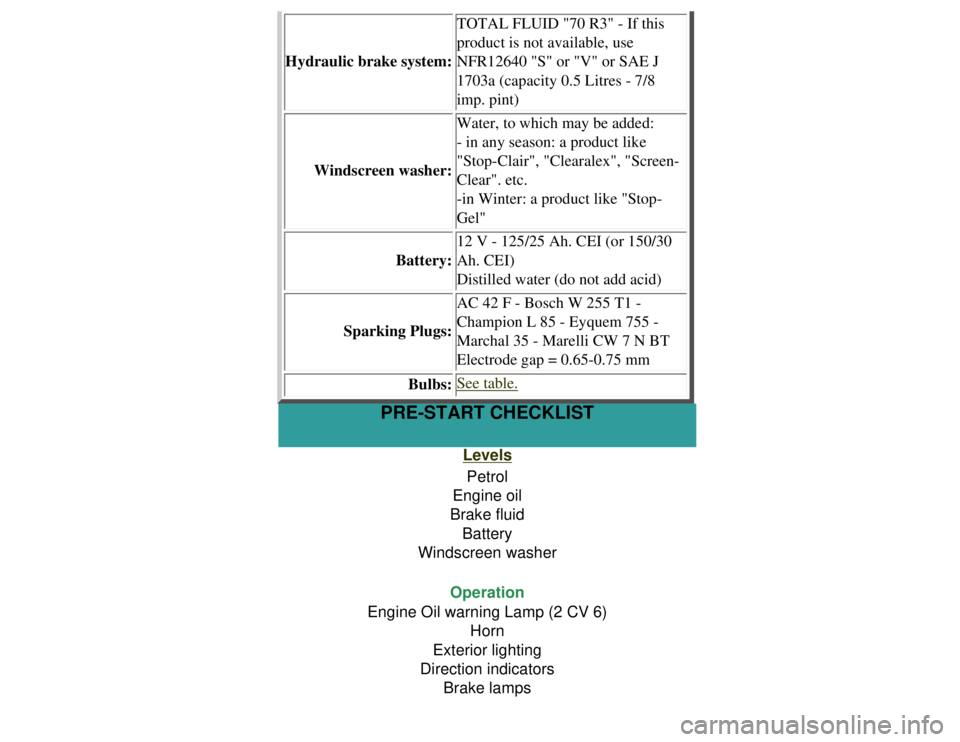
Hydraulic brake system:TOTAL FLUID "70 R3" - If this
product is not available, use
NFR12640 "S" or "V" or SAE J
1703a (capacity 0.5 Litres - 7/8
imp. pint)
Windscreen washer: Water, to which may be added:
- in any season: a product like
"Stop-Clair", "Clearalex", "Screen-
Clear". etc.
-in Winter: a product like "Stop-
Gel"
Battery: 12 V - 125/25 Ah. CEI (or 150/30
Ah. CEI)
Distilled water (do not add acid)
Sparking Plugs: AC 42 F - Bosch W 255 T1 -
Champion L 85 - Eyquem 755 -
Marchal 35 - Marelli CW 7 N BT
Electrode gap = 0.65-0.75 mm
Bulbs:
See table.
PRE-START CHECKLIST
Levels Petrol
Engine oil
Brake fluid Battery
Windscreen washer
Operation
Engine Oil warning Lamp (2 CV 6) Horn
Exterior lighting
Direction indicators Brake lamps
Page 59 of 86
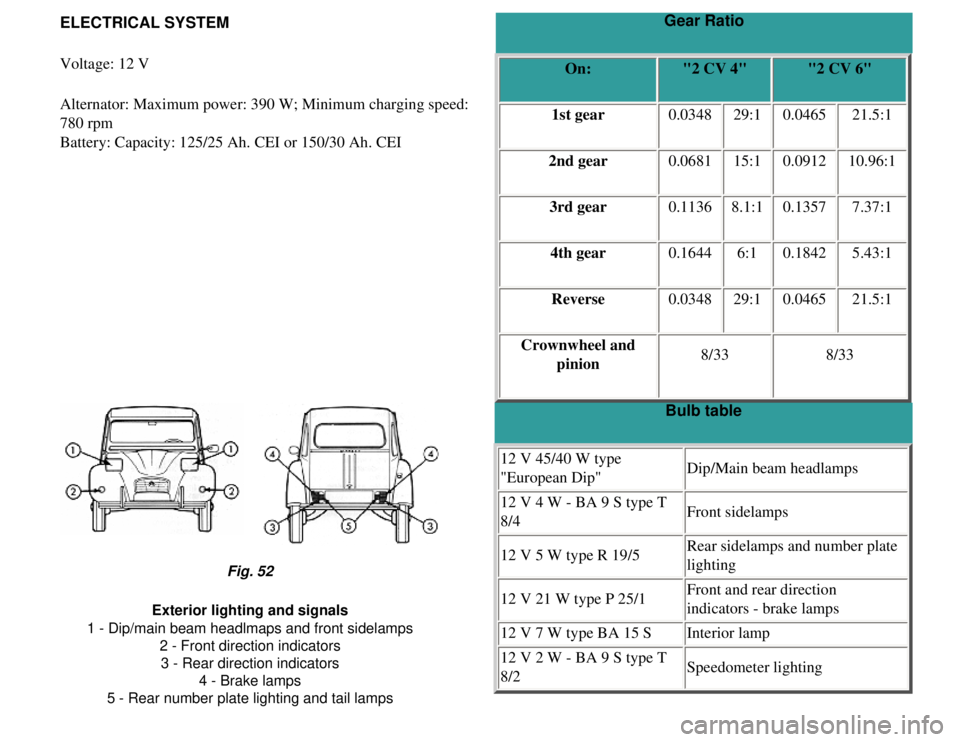
Gear Ratio
ELECTRICAL SYSTEM
Voltage: 12 V
Alternator: Maximum power: 390 W; Minimum charging speed:
780 rpm
Battery: Capacity: 125/25 Ah. CEI or 150/30 Ah. CEI On:
"2 CV 4" "2 CV 6"
1st gear 0.034829:10.0465 21.5:1
2nd gear 0.068115:10.0912 10.96:1
3rd gear 0.11368.1:10.1357 7.37:1
4th gear 0.16446:10.1842 5.43:1
Reverse 0.034829:10.0465 21.5:1
Crownwheel and pinion 8/33
8/33
Bulb table
12 V 45/40 W type
"European Dip" Dip/Main beam headlamps
12 V 4 W - BA 9 S type T
8/4 Front sidelamps
12 V 5 W type R 19/5 Rear sidelamps and number plate
lighting
12 V 21 W type P 25/1 Front and rear direction
indicators - brake lamps
12 V 7 W type BA 15 S Interior lamp
12 V 2 W - BA 9 S type T
8/2 Speedometer lighting
Fig. 52
Exterior lighting and signals
1 - Dip/main beam headlmaps and front sidelamps 2 - Front direction indicators3 - Rear direction indicators 4 - Brake lamps
5 - Rear number plate lighting and tail lamps
Page 60 of 86
Replacement parts
Every genuine CITROËN replacement part is sold only through
the company's network of dealers.
It is in the interest of the user, for his own safety and for the
guarantee, to refuse any other part.
In effect, the fitting of parts or units of different origin could
involve him in legal liability if such fitting caused a vehicle to
fail to conform to legal requirements of the country concerned,
particularly as regards SAFETY, ANTI-POLLUTION,
IGNITION INTERFERENCE SUPPRESSION, and NOISE
LEVEL.
Furthermore, such fitting would remove from the user any
possibility of recourse against the manufacturer.
In particular, items concerned are:
- components of braking systems,
- components of lighting and signalling systems,
- engine components,
- exhaust components,
- steering components,
- structural items,
- suspension components.
[Contents] [Notices] [Important Points] [Driving] [Maintenance] [Minor Repairs] [Miscellaneous Information]
Page 65 of 86
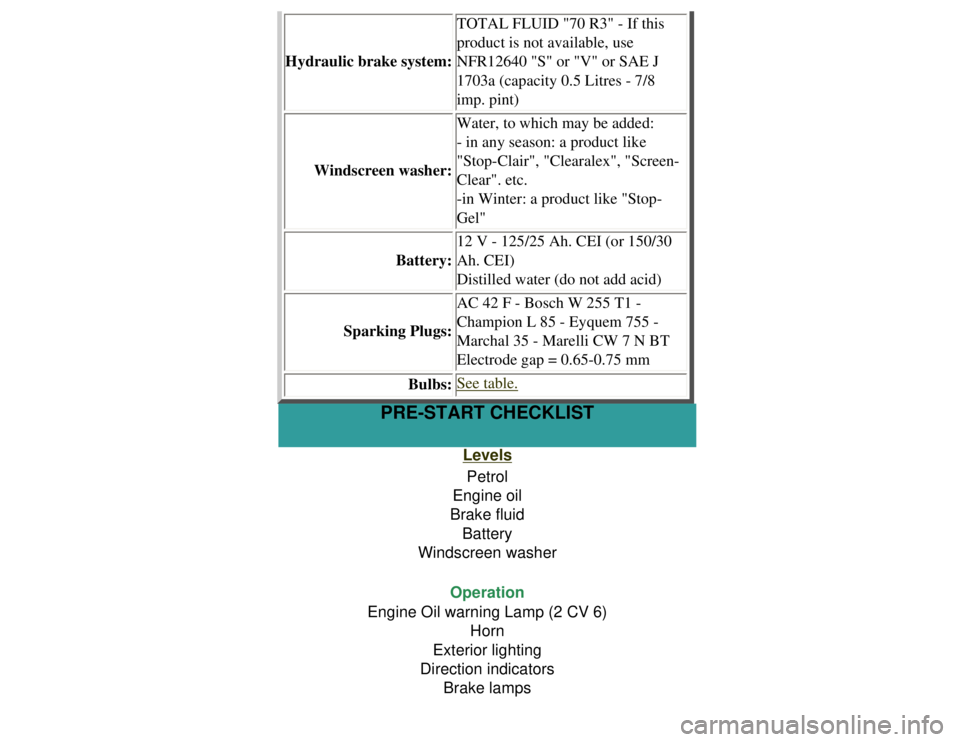
Hydraulic brake system:TOTAL FLUID "70 R3" - If this
product is not available, use
NFR12640 "S" or "V" or SAE J
1703a (capacity 0.5 Litres - 7/8
imp. pint)
Windscreen washer: Water, to which may be added:
- in any season: a product like
"Stop-Clair", "Clearalex", "Screen-
Clear". etc.
-in Winter: a product like "Stop-
Gel"
Battery: 12 V - 125/25 Ah. CEI (or 150/30
Ah. CEI)
Distilled water (do not add acid)
Sparking Plugs: AC 42 F - Bosch W 255 T1 -
Champion L 85 - Eyquem 755 -
Marchal 35 - Marelli CW 7 N BT
Electrode gap = 0.65-0.75 mm
Bulbs:
See table.
PRE-START CHECKLIST
Levels Petrol
Engine oil
Brake fluid Battery
Windscreen washer
Operation
Engine Oil warning Lamp (2 CV 6) Horn
Exterior lighting
Direction indicators Brake lamps
Page 70 of 86
DRIVING
STARTING
Anti-theft, Ignition, Starter
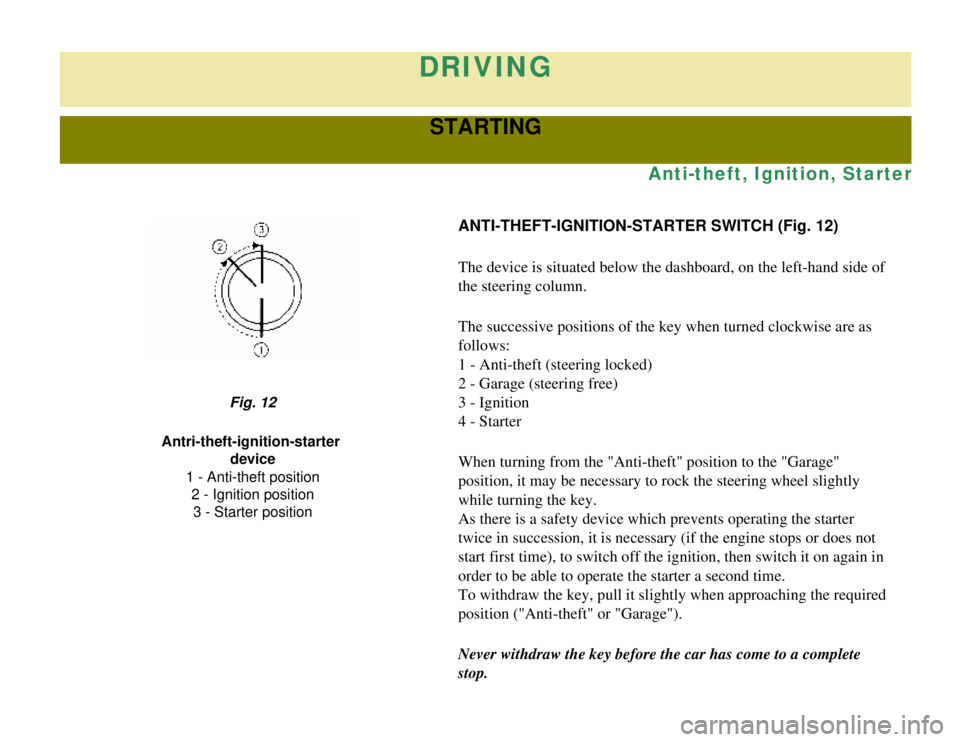
ANTI-THEFT-IGNITION-STARTER SWITCH (Fig. 12)
The device is situated below the dashboard, on the left-hand side of
the steering column.
The successive positions of the key when turned clockwise are as
follows:
1 - Anti-theft (steering locked)
2 - Garage (steering free)
3 - Ignition
4 - Starter
When turning from the "Anti-theft" position to the "Garage"
position, it may be necessary to rock the steering wheel slightly
while turning the key.
As there is a safety device which prevents operating the starter
twice in succession, it is necessary (if the engine stops or does not
start first time), to switch off the ignition, then switch it on again \
in
order to be able to operate the starter a second time.
To withdraw the key, pull it slightly when approaching the required
position ("Anti-theft" or "Garage").
Never withdraw the key before the car has come to a complete
stop.
Fig. 12
Antri-theft-ignition-starter device
1 - Anti-theft position 2 - Ignition position3 - Starter position
Page 71 of 86
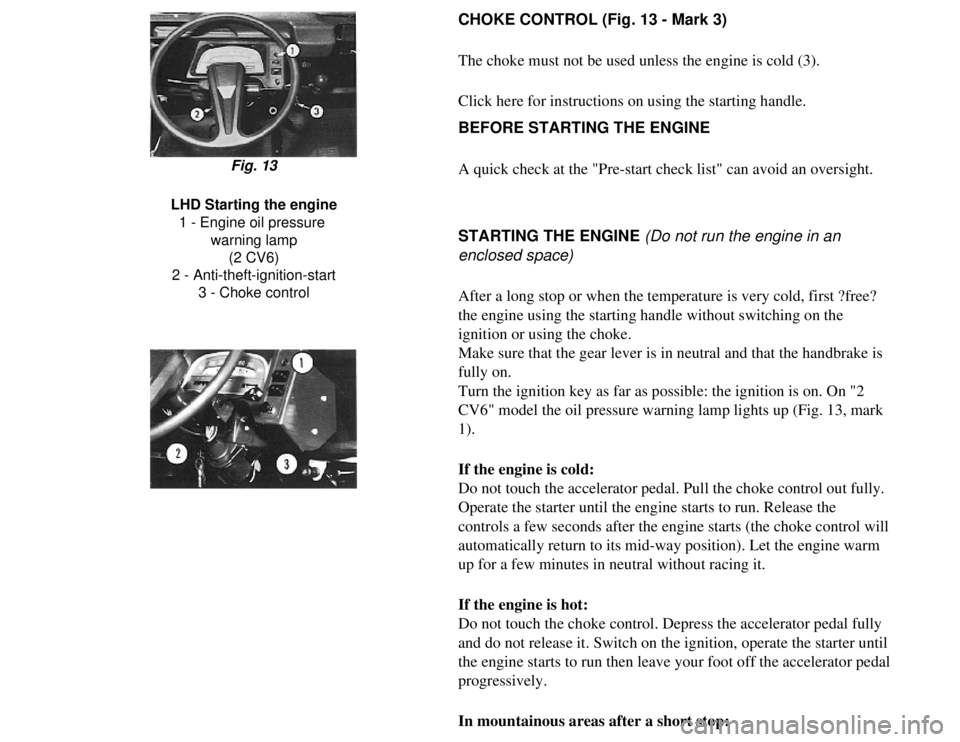
CHOKE CONTROL (Fig. 13 - Mark 3)
The choke must not be used unless the engine is cold (3).
Click here for instructions on using the starting handle.
BEFORE STARTING THE ENGINE
A quick check at the "Pre-start check list" can avoid an oversight.
Fig. 13
LHD Starting the engine 1 - Engine oil pressure warning lamp(2 CV6)
2 - Anti-theft-ignition-start 3 - Choke control
STARTING THE ENGINE (Do not run the engine in an
enclosed space)
After a long stop or when the temperature is very cold, first ?free?
the engine using the starting handle without switching on the
ignition or using the choke.
Make sure that the gear lever is in neutral and that the handbrake is
fully on.
Turn the ignition key as far as possible: the ignition is on. On "2
CV6" model the oil pressure warning lamp lights up (Fig. 13, mark
1).
If the engine is cold:
Do not touch the accelerator pedal. Pull the choke control out fully.
Operate the starter until the engine starts to run. Release the
controls a few seconds after the engine starts (the choke control will \
automatically return to its mid-way position). Let the engine warm
up for a few minutes in neutral without racing it.
If the engine is hot:
Do not touch the choke control. Depress the accelerator pedal fully
and do not release it. Switch on the ignition, operate the starter until\
the engine starts to run then leave your foot off the accelerator pedal \
progressively.
In mountainous areas after a short stop:
Page 74 of 86
At a speed of over about 1,000 rpm, the clutch behaves in the
same way as a conventional clutch. The clutch pedal must be
used to change gear.
When running downhill, slowing down abruptly may cause
the clutch to disengage. Re-engage the clutch immediately
with a light touch on the accelerator before the car gathers
speed in free-wheeling.
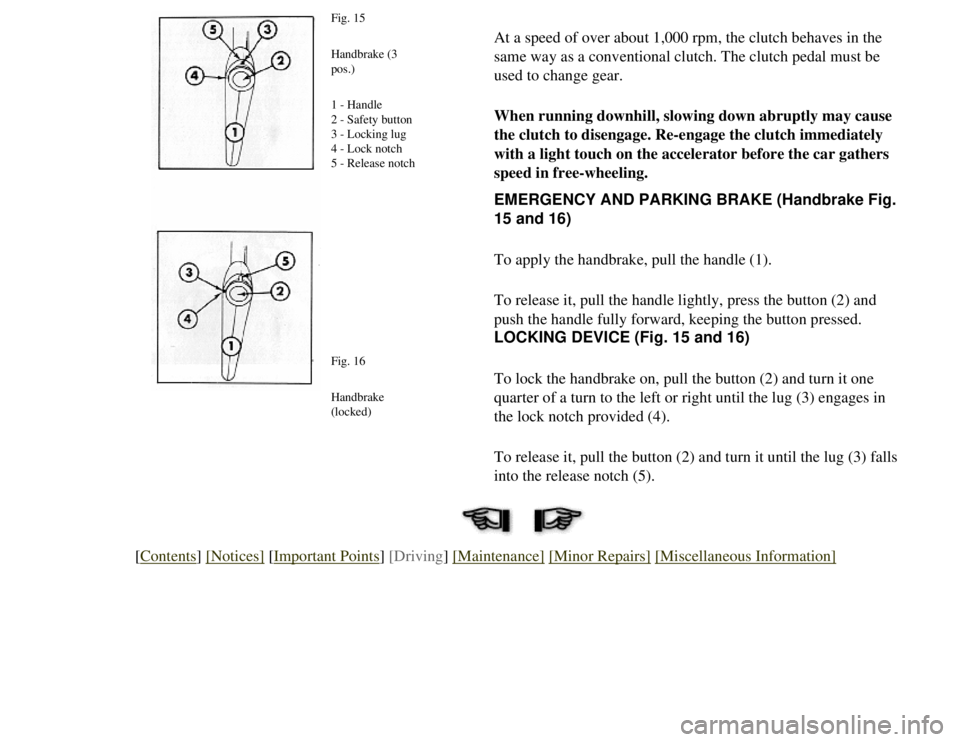
Fig. 15
Handbrake (3
pos.)
1 - Handle
2 - Safety button
3 - Locking lug
4 - Lock notch
5 - Release notch
Fig. 16
Handbrake
(locked)
EMERGENCY AND PARKING BRAKE (Handbrake Fig.
15 and 16)
To apply the handbrake, pull the handle (1).
To release it, pull the handle lightly, press the button (2) and
push the handle fully forward, keeping the button pressed.
LOCKING DEVICE (Fig. 15 and 16)
To lock the handbrake on, pull the button (2) and turn it one
quarter of a turn to the left or right until the lug (3) engages in
the lock notch provided (4).
To release it, pull the button (2) and turn it until the lug (3) fal\
ls
into the release notch (5).
[Contents] [Notices] [Important Points] [Driving] [Maintenance] [Minor Repairs] [Miscellaneous Information]