maintenance CITROEN 2CV 1975 User Guide
[x] Cancel search | Manufacturer: CITROEN, Model Year: 1975, Model line: 2CV, Model: CITROEN 2CV 1975Pages: 86, PDF Size: 2.21 MB
Page 18 of 86
MAINTENANCE
This section deals with the small
points which are essential to
ensure the good condition of your
car: checking levels, keeping and
eye on the tyres, washing the
bodywork ...
Other maintenance operations,
such as greasing, oil changes,
adjustments - which the Citroën
network will competently carry out
for you, through is special Service
Stations - form the subject of the
"Maintenance Guide", which was
supplied with the vehicle when
originally delivered.
MAINTENANCE2 CV4 - 2 CV6
Levels:
Oil, Brake Fluid - Checks and Topping
Up
Mechanical and Electrical
Bodywork
Page 19 of 86
![CITROEN 2CV 1975 User Guide
Interior07516
JULY 1975
AZ-KB AZ-KA 2 CV4 2 CV6
[Contents] [Notices] [Important Points] [Driving] [Maintenance] [Minor Repairs] [Miscellaneous Information]](/img/9/56684/w960_56684-18.png "CITROEN 2CV 1975 User Guide
Interior07516
JULY 1975
AZ-KB AZ-KA 2 CV4 2 CV6
[Contents] [Notices] [Important Points] [Driving] [Maintenance] [Minor Repairs] [Miscellaneous Information]")
Interior07516
JULY 1975
AZ-KB AZ-KA 2 CV4 2 CV6
[Contents] [Notices] [Important Points] [Driving] [Maintenance] [Minor Repairs] [Miscellaneous Information]
Page 20 of 86

MAINTENANCE
Levels
Checks and Topping up
1 Engine oil dipstick
The engine oil level, which must lie between the ends of the cut-out
on the dipstick, must be checked from time to time between oil
changes and, in particular, before any long journey.
The check should be carried out with the car as level as possible,
after the engine has been stopped for at least 10 minutes.
To top up, add oil without the level going above the top end of the
dipstick cut-out. The length of the cut-out is equivalent to 7/8 imp.
pints (0,5 litre).
2 Engine oil filler pipe
In Summer, as in Winter, use "TOTAL Altigrade GT Spéciale
Autoroute 20 W 40" or "GTS 20 W 50" oil. If "TOTAL" oils are
not available, use equivalent grades of other reputable makes.
In very cold countries (temperatures often lower than -10C (14F),
use "TOTAL Altigrade GT Spéciale Autoroute 10 W 30" or "GTS
10 W 30" oil, or equivalent grades of other reputable makes.
Never use additives
Do not forget to tightly seal the oil filler cap.
3 Brake fluid reservoir
Fig. 32
Engine Oil Dipstick 1 - Maximum2 - Minimum
3 - Oil level reading
Page 22 of 86
![CITROEN 2CV 1975 User Guide
Fig. 32b
Levels
1 - Engine oil dipstick
2 - Engine oil filler tube
3 - Brake fluid reservoir
4 - Battery
5 - Windscreen washer bottle
[Contents] [Notices] [Important Points] [Driving] [Maintenance] [](/img/9/56684/w960_56684-21.png "CITROEN 2CV 1975 User Guide
Fig. 32b
Levels
1 - Engine oil dipstick
2 - Engine oil filler tube
3 - Brake fluid reservoir
4 - Battery
5 - Windscreen washer bottle
[Contents] [Notices] [Important Points] [Driving] [Maintenance] [")
Fig. 32b
Levels
1 - Engine oil dipstick
2 - Engine oil filler tube
3 - Brake fluid reservoir
4 - Battery
5 - Windscreen washer bottle
[Contents] [Notices] [Important Points] [Driving] [Maintenance] [Minor Repairs] [Miscellaneous Information]
Page 23 of 86
MAINTENANCE
Maintenance
Mechanical and Electrical
Periodic Maintenance Operations
These are indicated in the "Maintenance Guide", which
accompanied the car when first delivered. We would recommend
you to adhere to the frequencies indicated and would remind you
that we recommend "TOTAL" lubricants.
All mixtures and experiments are forbidden, and, in particular, the
use of oil additives of any kind, as these may lead to serious trouble.
Never grease or lubricate the rubber mounted link situated under the
bonnet, above the gear change lever. Never grease or lubricate the
gear change lever.
TYRES: "MICHELIN" (Do not use tyres other than those we
recommend.)
Series fitted: 125-15 X
Authorized series: 135-15 X, 125-15 X (M+S), 135-15 X (M+S),
135-15 ZX
Pressures: 20 psi (1,4 bar) at front, 26 psi (1,8 bar) at rear, 29 psi
(2 bars) on spare wheel.
These pressures apply to laden or empty vehicles, on an ordinary
road or on a motorway, whatever the speed. On authorized series
135-15 ZX, the pressures should be modified in certain cases: on
Page 24 of 86
pebble road surfaces, 23 psi (1,6 bar) in front; in sandy area, 15 psi
(1 bar) at front and rear.
Do not forget to correct the pressure of the spare wheel as soon as
possible after fitting.
Tyre pressures must be checked at least once a month and before
any long journeys since safety depends on correct pressures; these
also have appreciable influence on the life of the tyres. The check
should be carried out when the tyres are cold, before they have been
heated by running: the pressure may in fact be increased by up to 7
psi (0,5 bar) on a loaded vehicle running at high speed.
Keep a check on wheel balancing, especially after a puncture.
Changing the wheels around, which evens out the wear on the five
tyres, should be frequent enough to prevent any appreciable
difference of wear between the two tyres on one axle.
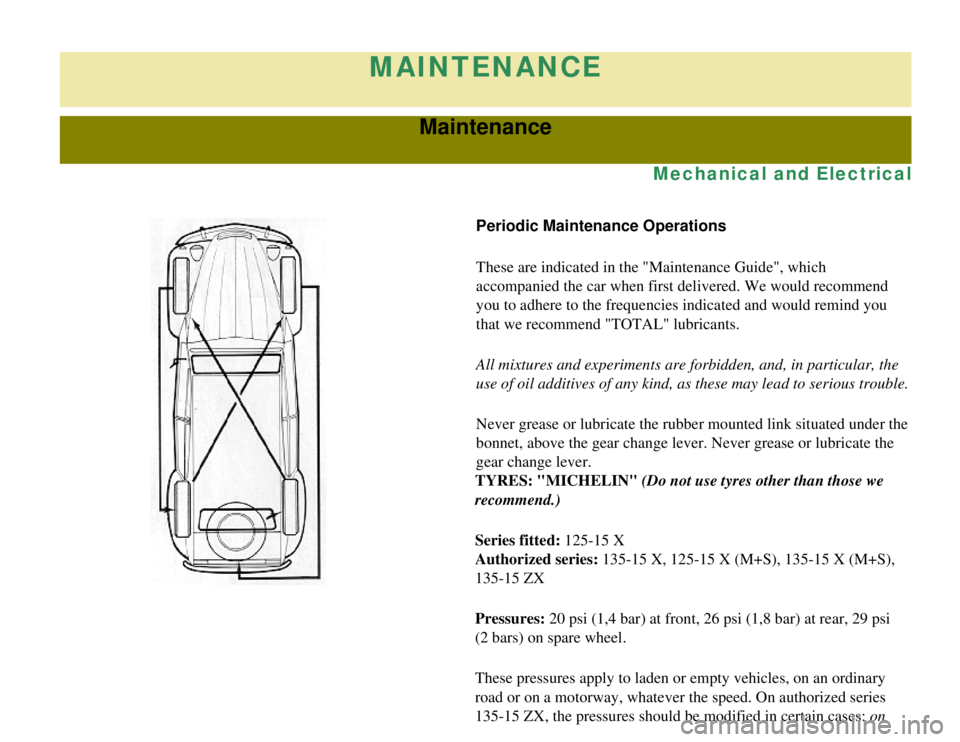
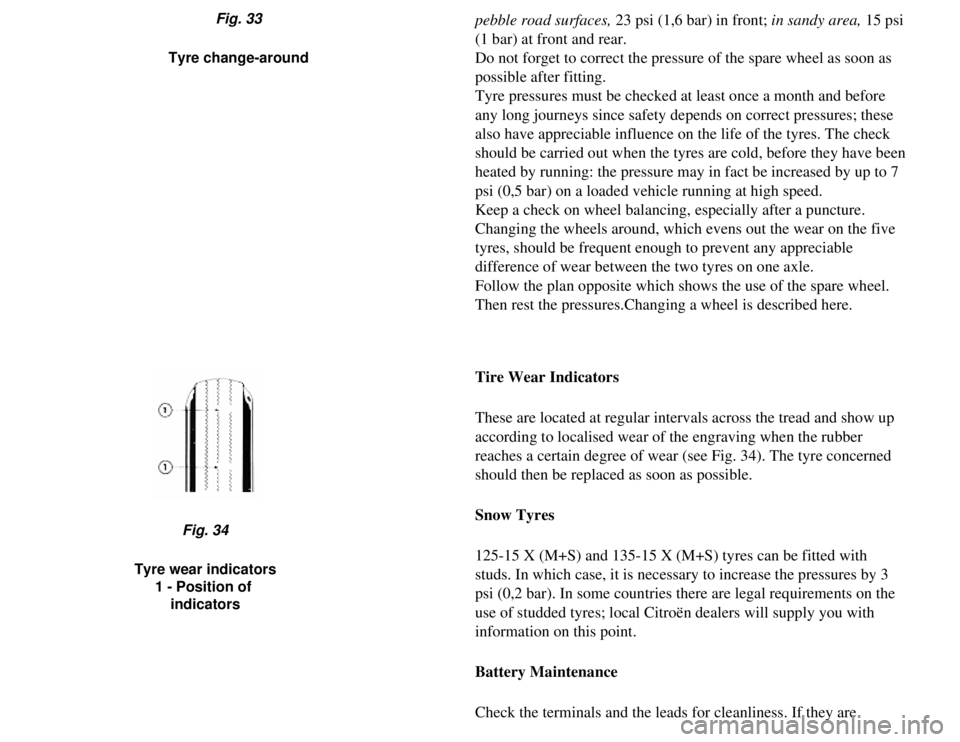
Follow the plan opposite which shows the use of the spare wheel.
Then rest the pressures.Changing a wheel is described here.Fig. 33
Tyre change-around
Tire Wear Indicators
These are located at regular intervals across the tread and show up
according to localised wear of the engraving when the rubber
reaches a certain degree of wear (see Fig. 34). The tyre concerned
should then be replaced as soon as possible.
Snow Tyres
125-15 X (M+S) and 135-15 X (M+S) tyres can be fitted with
studs. In which case, it is necessary to increase the pressures by 3
psi (0,2 bar). In some countries there are legal requirements on the
use of studded tyres; local Citroën dealers will supply you with
information on this point.
Battery Maintenance
Check the terminals and the leads for cleanliness. If they are
Fig. 34
Tyre wear indicators 1 - Position of indicators
Page 25 of 86

sulphated, unscrew them, clean them, and soak the felt insulating
washers in castor oil or in neutral vaseline oil. If the vehicle is not \
in use, recharge the battery every month.
In Winter, a correct charge protects against frost. The battery
charged normally (a density of 1.25 to 1.27) resists to -50C (-58F),\
whilst a discharged battery (density 1.07 to 1.09) may burst at -5C
(23F).
Do not disconnect the leads from the terminals when the engine
is running.
Never recharge the battery without first having disconnecting
the leads from the two terminals.
Air Filter Maintenance (Fig. 35)
Cleaning instructions are to be found on the filter cover (1).
Fig. 35
Air filter
1 - Cover
[Contents] [Notices] [Important Points] [Driving] [Maintenance] [Minor Repairs] [Miscellaneous Information]
Page 26 of 86
MAINTENANCE
Maintenance
Bodywork
The bodywork should be looked after regularly, especially in
Winter. This maintenance should not only concentrate on the
paintwork and the metal embellishers but should take in the
underside of the car as well: advice in this connection can be
obtained from any Citroën dealer.
Never wipe the car when dry since this will scratch the finish.
Petrol, trichlorethylene and alcohol harm paint and transparent
plastic such as the sidelamp covers. Do not use strong detergent
solutions either.
Cleaning the Bodywork
Frequent washing is necessary to keep the paintwork in good
condition but it is nevertheless essential that certain precautions be
observed; here are some reminders:
Never wash the car in full sunlight nor during frost. If the car has
been exposed to the sun or if the bonnet is still warm after a
journey, wait until the surfaces have cooled down.
The body should first be rinsed with copious amounts of water
applied either with a soft sponge, exerting no pressure and rinsing
the sponge often, or with a low pressure jet. If a car shampoo is
used, risne afterwards with plenty of water.
Wipe the car dry with a clean chamois leather which is rinsed and
wrung out frequently, ensure that no spots of water are left on the
paintwork.
Page 28 of 86
Use products that are only slightly abrasive, I.E. liquid polishes (e.
g. "ABELISSME") and follow the manufacturer's instructions.
Slight Damage to the Paintwork
Scratches and slight damage to the paintwork can be rectified at
little cost without necessitating extensive respraying, by using
aerosol cans which contain air-drying retouching paint. These
sprays, which are sold commercially, exist in all Citroën shades.
They are simple to use and instructions for use are given on the
packing.
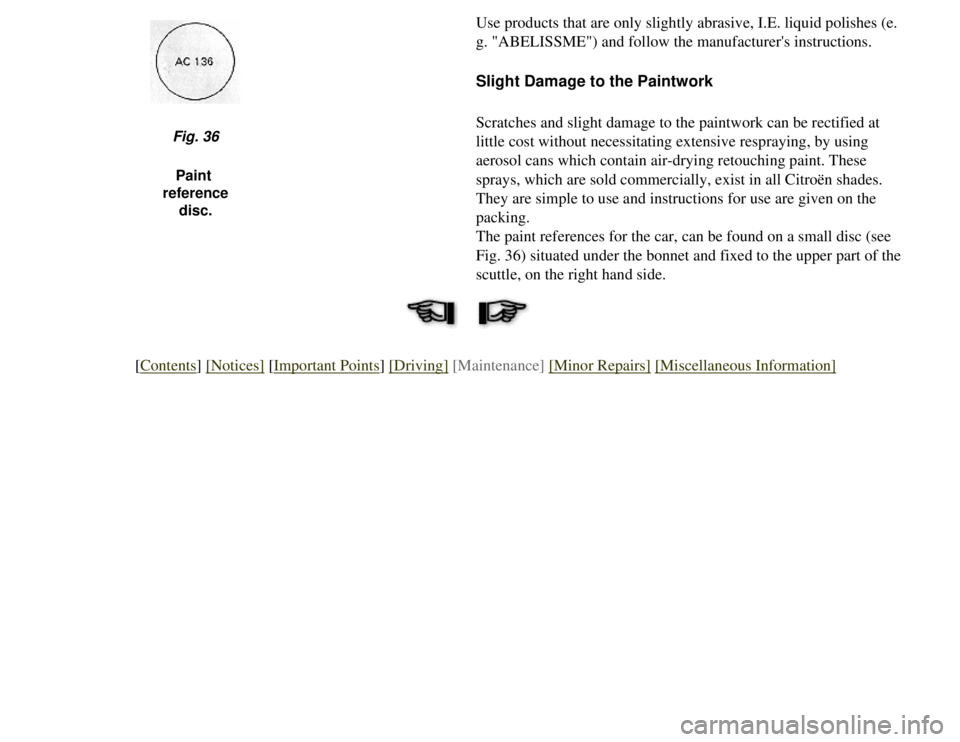
The paint references for the car, can be found on a small disc (see
Fig. 36) situated under the bonnet and fixed to the upper part of the
scuttle, on the right hand side.
Fig. 36Paint
reference disc.
[Contents] [Notices] [Important Points] [Driving] [Maintenance] [Minor Repairs] [Miscellaneous Information]
Page 29 of 86
MAINTENANCE
Maintenance
Interior
Cleaning the Upholstery
(A sample of cloth can be found stapled under the driver's
seat)
Only use mild non-caustic soaps, toilet type.
According to model:
Cloth upholstery:
This should be brushed or, preferably suction cleaned. If the
upholstery is generally very dirty, use commercial "dry foam", after
carefully removing all traces of dust.
Plastic Trim (and folding canvas hood):
This can be cleaned with a product like "SPIC" or with a little soapy
water, followed by a good rinse and wipe with a dry cloth. We do
not advise the use of products intended to make these parts shine.
Isolated Spots on Upholstery
Spots on cloth or plastic trim upholstery can be cleaned off with
water containing soap or a detergent like Teepol.
If this treatment is unsuccessful, try 90° alcohol (commercial
methylated spirit) or lead-free petrol.
Use pads well wrung-out and rub lightly.
Solvents like acetone or trichlorethylene are not recommended.