wheel CITROEN 2CV 1975 User Guide
[x] Cancel search | Manufacturer: CITROEN, Model Year: 1975, Model line: 2CV, Model: CITROEN 2CV 1975Pages: 86, PDF Size: 2.21 MB
Page 70 of 86
DRIVING
STARTING
Anti-theft, Ignition, Starter
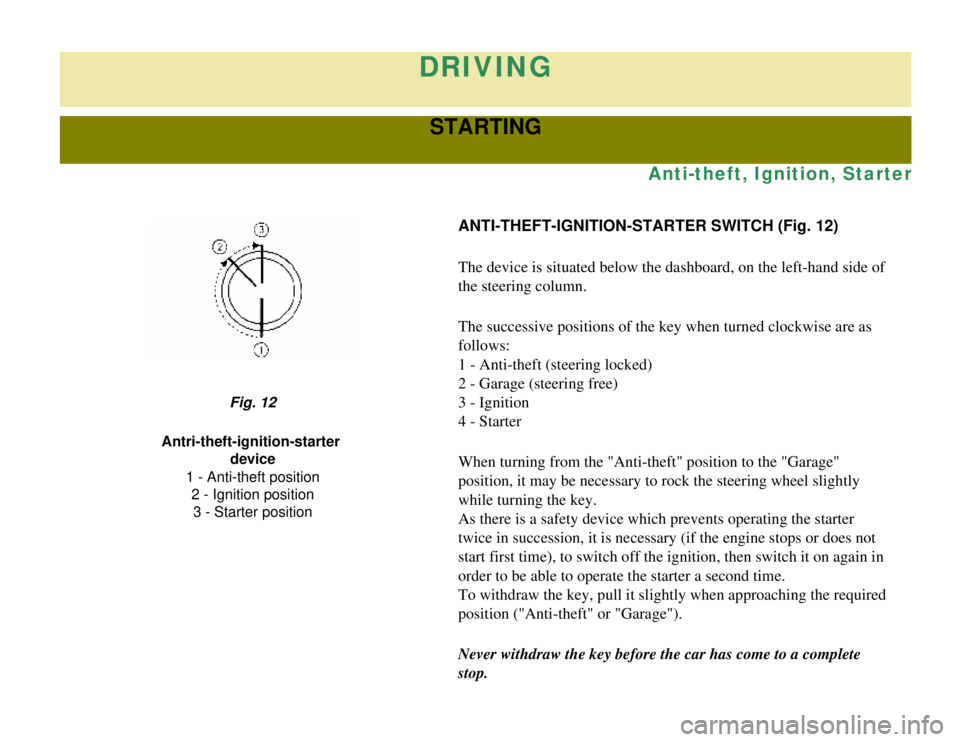
ANTI-THEFT-IGNITION-STARTER SWITCH (Fig. 12)
The device is situated below the dashboard, on the left-hand side of
the steering column.
The successive positions of the key when turned clockwise are as
follows:
1 - Anti-theft (steering locked)
2 - Garage (steering free)
3 - Ignition
4 - Starter
When turning from the "Anti-theft" position to the "Garage"
position, it may be necessary to rock the steering wheel slightly
while turning the key.
As there is a safety device which prevents operating the starter
twice in succession, it is necessary (if the engine stops or does not
start first time), to switch off the ignition, then switch it on again \
in
order to be able to operate the starter a second time.
To withdraw the key, pull it slightly when approaching the required
position ("Anti-theft" or "Garage").
Never withdraw the key before the car has come to a complete
stop.
Fig. 12
Antri-theft-ignition-starter device
1 - Anti-theft position 2 - Ignition position3 - Starter position
Page 74 of 86
At a speed of over about 1,000 rpm, the clutch behaves in the
same way as a conventional clutch. The clutch pedal must be
used to change gear.
When running downhill, slowing down abruptly may cause
the clutch to disengage. Re-engage the clutch immediately
with a light touch on the accelerator before the car gathers
speed in free-wheeling.
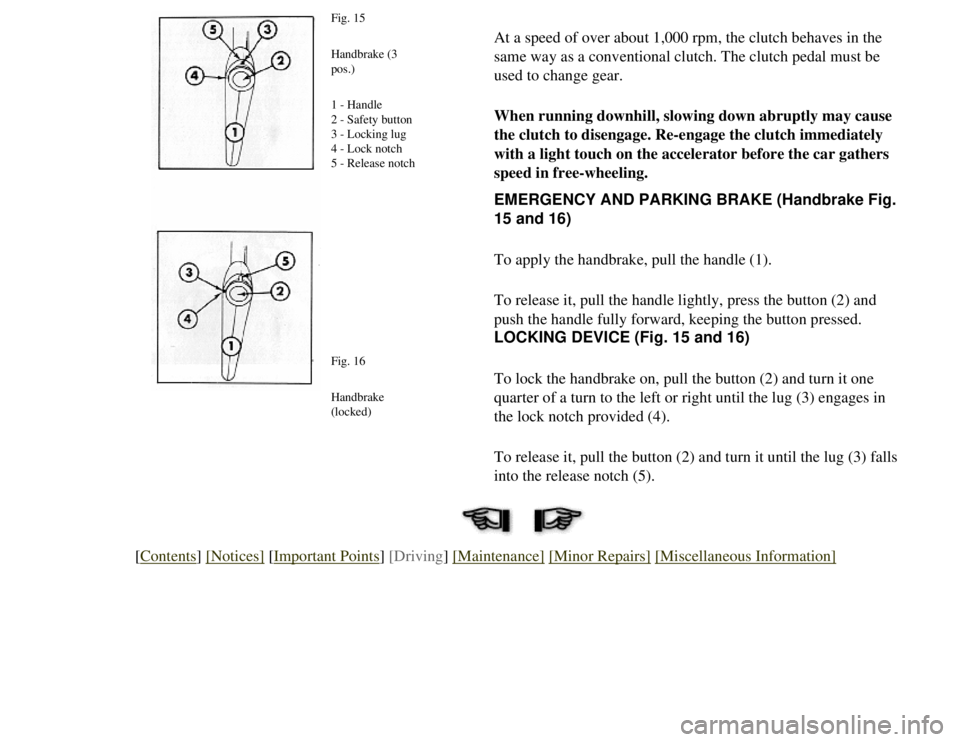
Fig. 15
Handbrake (3
pos.)
1 - Handle
2 - Safety button
3 - Locking lug
4 - Lock notch
5 - Release notch
Fig. 16
Handbrake
(locked)
EMERGENCY AND PARKING BRAKE (Handbrake Fig.
15 and 16)
To apply the handbrake, pull the handle (1).
To release it, pull the handle lightly, press the button (2) and
push the handle fully forward, keeping the button pressed.
LOCKING DEVICE (Fig. 15 and 16)
To lock the handbrake on, pull the button (2) and turn it one
quarter of a turn to the left or right until the lug (3) engages in
the lock notch provided (4).
To release it, pull the button (2) and turn it until the lug (3) fal\
ls
into the release notch (5).
[Contents] [Notices] [Important Points] [Driving] [Maintenance] [Minor Repairs] [Miscellaneous Information]
Page 75 of 86
DRIVING
Signals and Visibility
Lights, signals, windscreen wipers, windscreen washers
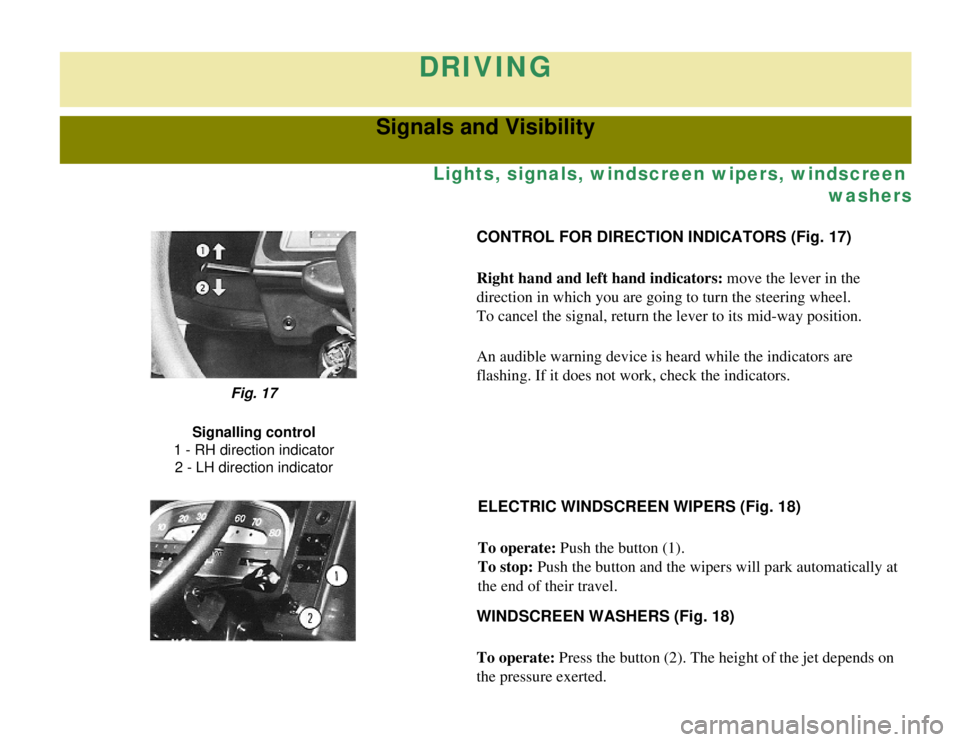
CONTROL FOR DIRECTION INDICATORS (Fig. 17)
Right hand and left hand indicators: move the lever in the
direction in which you are going to turn the steering wheel.
To cancel the signal, return the lever to its mid-way position.
An audible warning device is heard while the indicators are
flashing. If it does not work, check the indicators.
Fig. 17
Signalling control
1 - RH direction indicator 2 - LH direction indicator
ELECTRIC WINDSCREEN WIPERS (Fig. 18)
To operate: Push the button (1).
To stop: Push the button and the wipers will park automatically at
the end of their travel.
WINDSCREEN WASHERS (Fig. 18)
To operate: Press the button (2). The height of the jet depends on
the pressure exerted.
Page 76 of 86
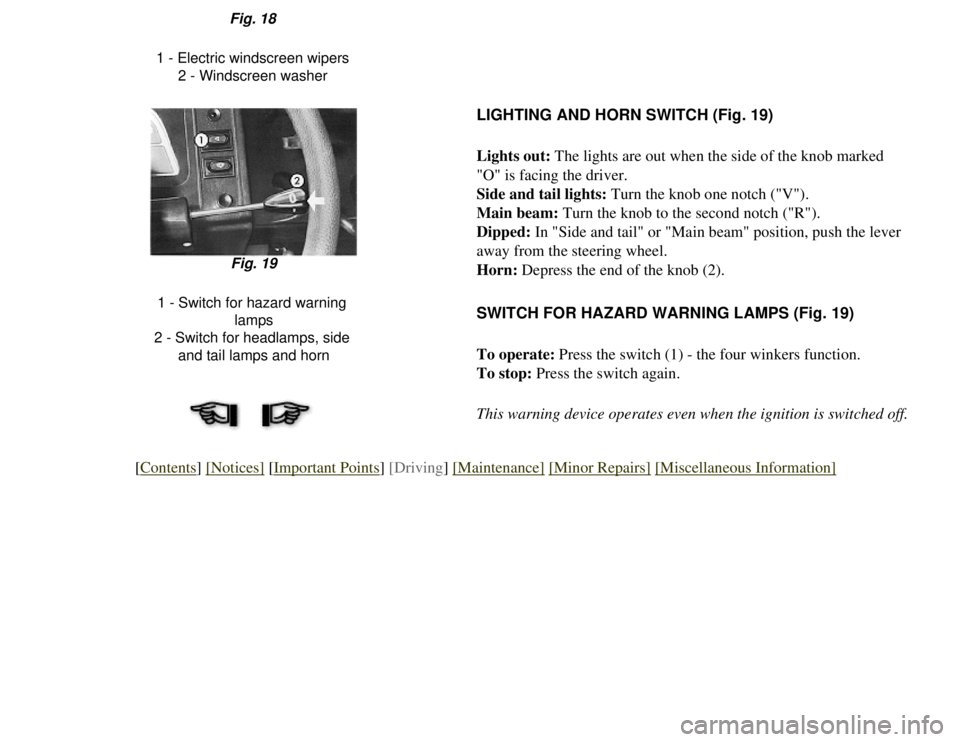
Fig. 18
1 - Electric windscreen wipers 2 - Windscreen washer
LIGHTING AND HORN SWITCH (Fig. 19)
Lights out: The lights are out when the side of the knob marked
"O" is facing the driver.
Side and tail lights: Turn the knob one notch ("V").
Main beam: Turn the knob to the second notch ("R").
Dipped: In "Side and tail" or "Main beam" position, push the lever
away from the steering wheel.
Horn: Depress the end of the knob (2).
Fig. 19
1 - Switch for hazard warning lamps
2 - Switch for headlamps, side and tail lamps and horn
SWITCH FOR HAZARD WARNING LAMPS (Fig. 19)
To operate: Press the switch (1) - the four winkers function.
To stop: Press the switch again.
This warning device operates even when the ignition is switched off.
[Contents] [Notices] [Important Points] [Driving] [Maintenance] [Minor Repairs] [Miscellaneous Information]
Page 85 of 86
l Changing a fuse
l Changing a sparking plug
l Changing a wheel
l Charge indicator
l Chassis number
l Chassis number stamping
l Choke
l Clutch
l Controls and accessories (LH) (RH)
D
l Dashboard
l Defrosting
l Demisting
l Dimensions, main
l Direction indicators
l Doors, opening
l Driving position
E
l Engine, data
l Engine, number plate
l Engine, oil level
l Engine, oil, warning lamp
F
l Fuel, filling up
l Fuel gauge
l Fuse boxes
l Fuses
l Rear floor
l Rear hammock for parcels
l Rear-view mirrors
l Reverse gear
l Replacement parts, orders
l Running-costs
l Running-in
S
l Seat belts
l Seats
l Seats, backrest adjustment
l Service at 600 miles
l Signalling
l Sparking plugs and gaps
l Speedometer
l Spots on upholstery
l Starting engine
l Starting engine with handle
l Steering wheel (cleaning)
l Stopping the engine
T
l Tar, removal
l Technical data
l Temperature, interior
l Touching-up paintwork
l Towing the car
l Towing a trailer
l Transmission
l Travelling abroad
l Tyre pressures
Page 86 of 86
G
l Gearbox
l Gear changing
l Gear lever
l Glass (plastic)
l Guarantee
H
l Hazard warning device
l Headlamps, adjustment
l Headlamps, controls
l Heating
l Horns
l Hydraulic fluid
I
l Identification of car
l Ignition
l Interior lamp
l Instruments
l Tyres
l Tyres (wear indicators)
U
l Upholstery, cleaning
V
l Ventilation
W
l Warning lamp
l Washing the car
l Water, battery, windscreen washers
l Weights
l Wheel, changing (brace)
l Wheels, changing round
l Windscreen washer, control
l Windscreen washer, filling
l Windscreen wipers
l Window, cleaning
l Winkers (Direction indicators)
[
Contents] [Notices] [Important Points] [Driving] [Maintenance] [Minor Repairs] [Miscellaneous Information]