brake CITROEN AMI 2023 User Guide
[x] Cancel search | Manufacturer: CITROEN, Model Year: 2023, Model line: AMI, Model: CITROEN AMI 2023Pages: 44, PDF Size: 1.45 MB
Page 25 of 44
23
Practical information
7The charge level increases slowly as charging
progresses.
When the charge is completed, the instrument
panel switches off.
Disconnection
► Disconnect the charging cable from the
power socket.
►
Open the passenger door.
► Store all of the charging cable inside its
housing.
►
Close the passenger door.
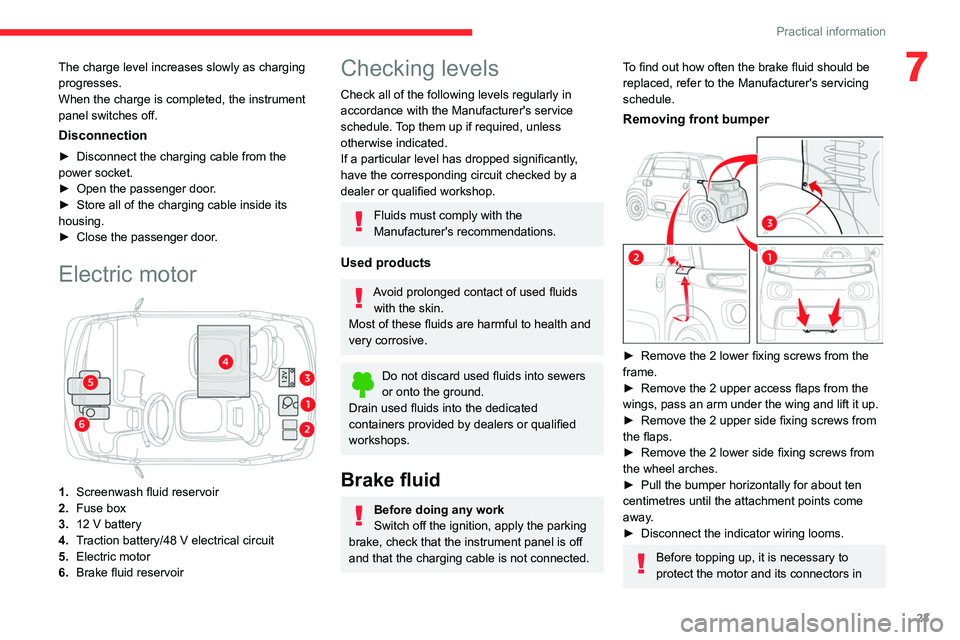
Electric motor
1. Screenwash fluid reservoir
2. Fuse box
3. 12
V battery
4. T
raction battery/48
V electrical circuit
5. Electric motor
6. Brake fluid reservoir
Checking levels
Check all of the following levels regularly in
accordance with the Manufacturer's service
schedule. Top them up if required, unless
otherwise indicated.
If a particular level has dropped significantly,
have the corresponding circuit checked by a
dealer or qualified workshop.
Fluids must comply with the
Manufacturer's recommendations.
Used products
Avoid prolonged contact of used fluids
with the skin.
Most of these fluids are harmful to health and
very corrosive.
Do not discard used fluids into sewers
or onto the ground.
Drain used fluids into the dedicated
containers provided by dealers or qualified
workshops.
Brake fluid
Before doing any work
Switch off the ignition, apply the parking
brake, check that the instrument panel is off
and that the charging cable is not connected.
To find out how often the brake fluid should be
replaced, refer to the Manufacturer's servicing
schedule.
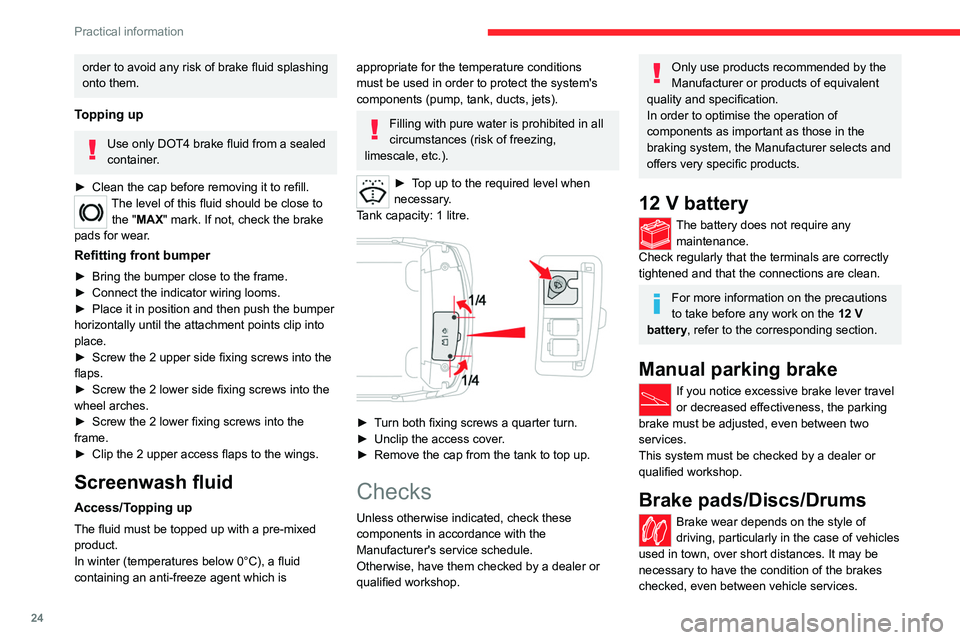
Removing front bumper
► Remove the 2 lower fixing screws from the
frame.
►
Remove the 2 upper access flaps from the
wings, pass an arm under the wing and lift it up.
►
Remove the 2 upper side fixing screws from
the flaps.
►
Remove the 2 lower side fixing screws from
the wheel arches.
►
Pull the bumper horizontally for about ten
centimetres until the attachment points come
away.
►
Disconnect the indicator wiring looms.
Before topping up, it is necessary to
protect the motor and its connectors in
Page 26 of 44
24
Practical information
order to avoid any risk of brake fluid splashing
onto them.
Topping up
Use only DOT4 brake fluid from a sealed
container.
►
Clean the cap before removing it to refill.The level of this fluid should be close to the "MAX" mark. If not, check the brake
pads for wear.
Refitting front bumper
► Bring the bumper close to the frame.
► Connect the indicator wiring looms.
► Place it in position and then push the bumper
horizontally until the attachment points clip into
place.
►
Screw the 2 upper side fixing screws into the
flaps.
►
Screw the 2 lower side fixing screws into the
wheel arches.
►
Screw the 2 lower fixing screws into the
frame.
►
Clip the 2 upper access flaps to the wings.
Screenwash fluid
Access/Topping up
The fluid must be topped up with a pre-mixed
product.
In winter (temperatures below 0°C), a fluid
containing an anti-freeze agent which is
appropriate for the temperature conditions
must be used in order to protect the system's
components (pump, tank, ducts, jets).
Filling with pure water is prohibited in all
circumstances (risk of freezing,
limescale, etc.).
► Top up to the required level when
necessary .
Tank capacity: 1 litre.
► Turn both fixing screws a quarter turn.
► Unclip the access cover.
► Remove the cap from the tank to top up.
Checks
Unless otherwise indicated, check these
components in accordance with the
Manufacturer's service schedule.
Otherwise, have them checked by a dealer or
qualified workshop.
Only use products recommended by the
Manufacturer or products of equivalent
quality and specification.
In order to optimise the operation of
components as important as those in the
braking system, the Manufacturer selects and
offers very specific products.
12 V battery
The battery does not require any maintenance.
Check regularly that the terminals are correctly
tightened and that the connections are clean.
For more information on the precautions
to take before any work on the 12 V
battery
, refer to the corresponding section.
Manual parking brake
If you notice excessive brake lever travel
or decreased effectiveness, the parking
brake must be adjusted, even between two
services.
This system must be checked by a dealer or
qualified workshop.
Brake pads/Discs/Drums
Brake wear depends on the style of
driving, particularly in the case of vehicles
used in town, over short distances. It may be
necessary to have the condition of the brakes
checked, even between vehicle services.
Page 27 of 44
25
Practical information
7Unless there is a leak in the circuit, a drop in the
brake fluid level indicates that the brake pads
are worn.
For information on checking brake disc/
drum wear, contact a dealer or a qualified
workshop.
After washing the vehicle, moisture, or in wintry conditions, ice can form on the
brake discs and pads: braking efficiency may
be reduced. Gently dab the brakes to dry and
defrost them.
Wheels and tyres
All tyre pressures must be checked when the tyres are cold.
The pressures indicated on the tyre pressure
label are valid for "cold" tyres. If you have driven
for more than 10 minutes or more than 6 miles
(10 kilometres), add 0.3 bar (30 kPa) to the
values indicated on the label.
Under-inflation increases energy
consumption. Non-compliant tyre
pressures cause tyres to wear prematurely
and have an adverse effect on the vehicle's
road holding - risk of accident!
Driving with worn or damaged tyres reduces the
braking and road holding performance of the
vehicle. We recommended regularly checking
the condition of tyres (tread and sidewalls) and
wheel rims as well as the presence of valves. When the wear indicators no longer appear set
back from the tread, the depth of the grooves is
less than 1.6 mm; it is essential to replace the
tyres.
Using different size wheels and tyres from those
specified can affect the lifetime of tyres, wheel
rotation, ground clearance, the speedometer
reading and have an adverse effect on road
holding.
Shock absorbers
It is not easy for drivers to detect when
shock absorbers are worn. Nevertheless,
shock absorbers have a major impact on road
holding and braking performance.
For your safety and driving comfort, it is
important to have them regularly checked by a
dealer or a qualified workshop.
Changing to free-wheeling
In certain situations, you must allow the vehicle
to free-wheel (when being towed, on a rolling
road, transport by rail or sea, etc.).
►
Switch the ignition off.
► Release the parking brake.
Advice on care and maintenance
General information - Exterior
Do not wash the vehicle in full sunshine
or in extremely cold conditions.
Do not use a high pressure washer or
automatic carwash to clean the vehicle.
Use a water jet (temperature between +20°C
and +40°C).
Before starting to clean your vehicle,
remember to lock the windows and
doors.
Use a sponge and soapy water or a pH
neutral product.
Move the water jet perpendicular to the
surface to be cleaned, avoiding the door
seals.
Rinse the vehicle using demineralised water,
then gently wipe the bodywork with a clean
microfibre cloth.
Promptly clean off any marks containing
corrosive chemical substances liable to
damage the vehicle's paintwork (including
tree resin, bird droppings, insect secretions,
pollen and tar).
If justified by the environment, clean the
vehicle more frequently to remove salty
deposits (in coastal areas), soot (in industrial
Page 29 of 44
27
In the event of a breakdown
8Changing a wheel
The vehicle is not equipped with on-board tools,
such as a jack or wheel brace.
In the event of a flat tyre, call a dealer or
qualified workshop.
To have winter tyres fitted or the wheels
changed, consult a dealer or qualified workshop.
Changing a bulb
Cleaning
The headlamps have polycarbonate
lenses with a protective coating:
–
Do not clean them with a dry or abrasive
cloth, nor with detergent or solvent
products.
–
Use a sponge and soapy water or a pH
neutral product.
–
When using a jet of water to clean off
persistent marks, do not keep the jet directed
towards the headlamps, lamps or their
edges for too long, so as not to damage their
protective coating and seals.
Light-emitting diodes (LEDs)
Do not touch LED headlamps/lamps.
To replace this type of bulb, you must consult
a dealer or qualified workshop.
Direction indicators
Rapid flashing of the indicator lamp for a
direction indicator
(left or right) indicates that
one of the bulbs on the corresponding side
has failed.
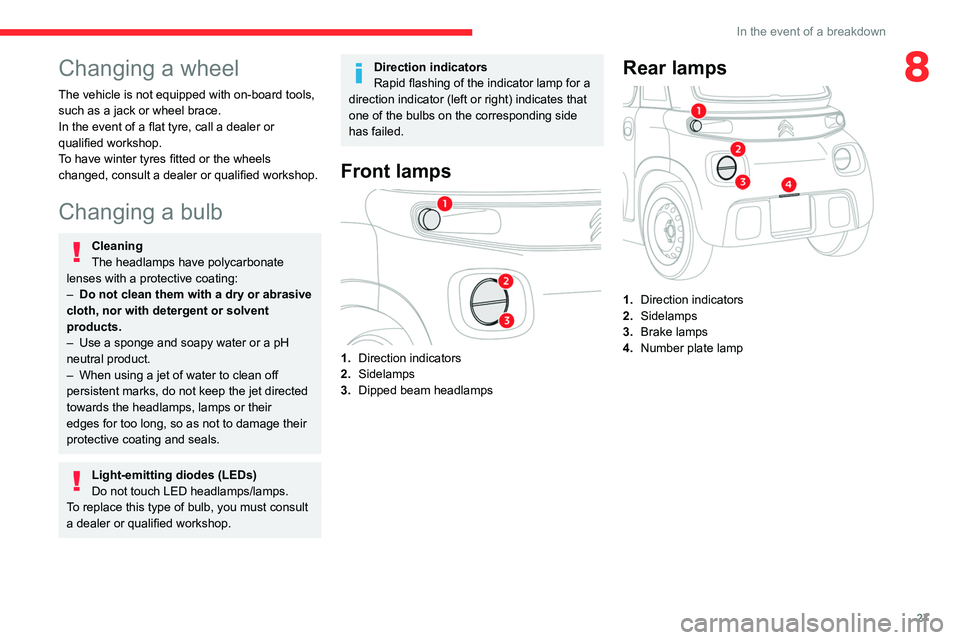
Front lamps
1. Direction indicators
2. Sidelamps
3. Dipped beam headlamps
Rear lamps
1.Direction indicators
2. Sidelamps
3. Brake lamps
4. Number plate lamp
Page 31 of 44
29
In the event of a breakdown
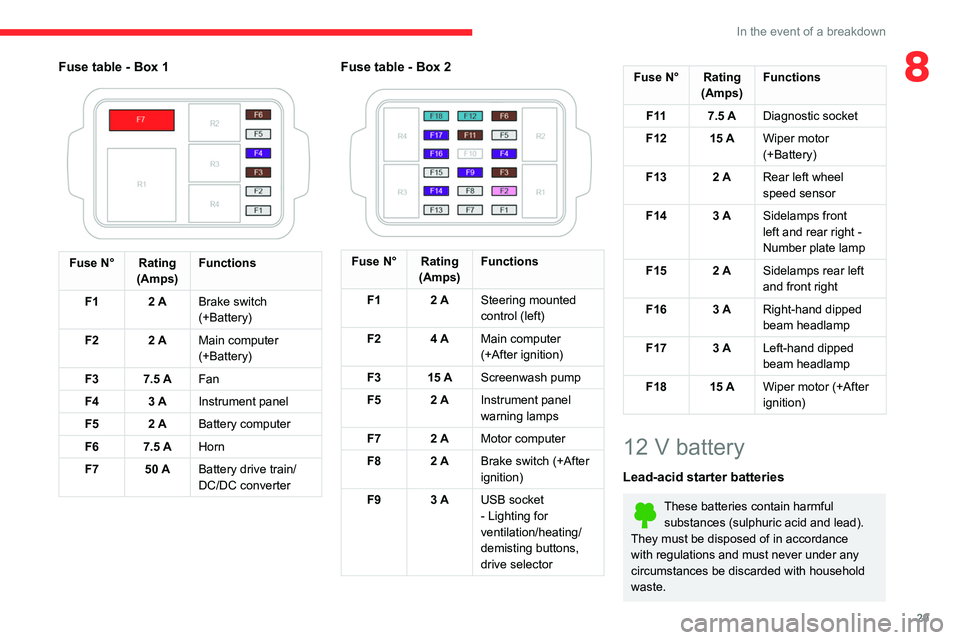
8Fuse table - Box 1
Fuse N° Rating(Amps)Functions
F1 2 ABrake switch
(+Battery)
F2 2 AMain computer
(+Battery)
F3 7.5 AFan
F4 3 AInstrument panel
F5 2 ABattery computer
F6 7.5 AHorn
F7 50 ABattery drive train/
DC/DC converter
Fuse table - Box 2
Fuse N° Rating
(Amps)Functions
F1 2 ASteering mounted
control (left)
F2 4 AMain computer
(+After ignition)
F3 15 AScreenwash pump
F5 2 AInstrument panel
warning lamps
F7 2 AMotor computer
F8 2 ABrake switch (+After
ignition)
F9 3 AUSB socket
- Lighting for
ventilation/heating/
demisting buttons,
drive selector
Fuse N° Rating
(Amps)Functions
F 11 7.5 ADiagnostic socket
F12 15 AWiper motor
(+Battery)
F13 2 ARear left wheel
speed sensor
F14 3 ASidelamps front
left and rear right -
Number plate lamp
F15 2 ASidelamps rear left
and front right
F16 3 ARight-hand dipped
beam headlamp
F17 3 ALeft-hand dipped
beam headlamp
F18 15 AWiper motor (+After
ignition)
12 V battery
Lead-acid starter batteries
These batteries contain harmful
substances (sulphuric acid and lead).
They must be disposed of in accordance
with regulations and must never under any
circumstances be discarded with household
waste.
Page 32 of 44
30
In the event of a breakdown
Take used remote control batteries and
vehicle batteries to a special collection point.
Protect your eyes and face before
handling the battery.
All operations on the battery must be carried
out in a well ventilated area and away from
naked flames and sources of sparks, to avoid
any risk of explosion or fire.
Wash your hands afterwards.
Flat 12 V battery
It is no longer possible to start the motor
or recharge the traction battery.
Before working on the 12 V battery
Switch off the ignition, apply the parking
brake, check that the instrument panel is off
and that the charging cable is not connected.
Recharging the 12 V battery
Do not recharge the battery without first
disconnecting the terminals and removing the
battery.
Do not disconnect the battery terminals while
the
READY
indicator lamp is lit, or while the
vehicle is charging.
Jump-starting another vehicle
Do not use the 12 V battery to jump-start
another vehicle or to charge another vehicle's
battery
.
Symbols
No sparks or naked flames, no smoking.
Always protect your eyes. Explosive gases can cause blindness and injury.
Keep the vehicle's battery out of the reach
of children.
The vehicle's battery contains sulphuric acid which can make you go blind or
cause severe burns.
For more information, refer to the
handbook.
Explosive gases can be present close to
the battery.
Removing/Refitting
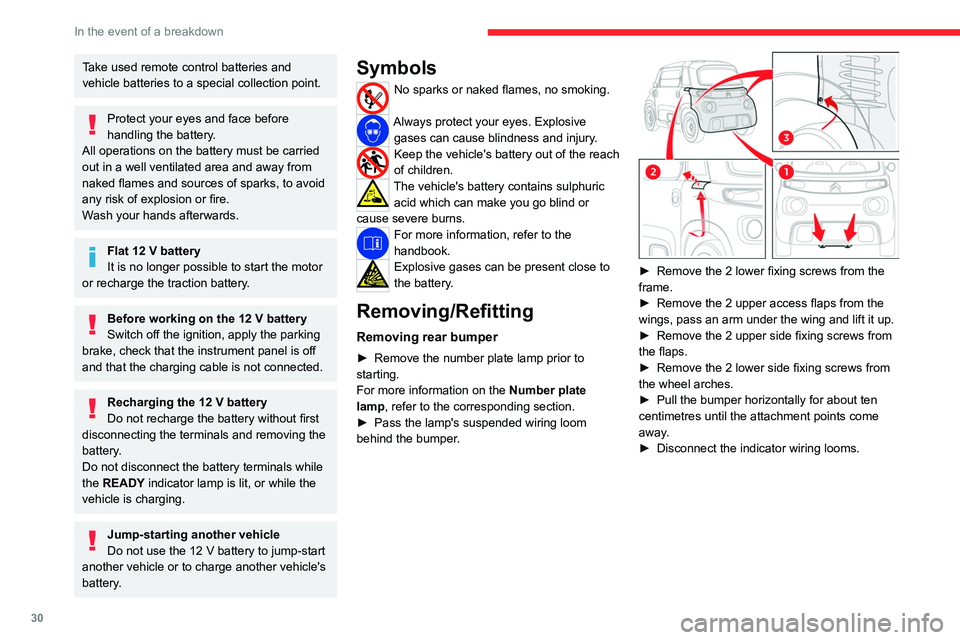
Removing rear bumper
► Remove the number plate lamp prior to
starting.
For more information on the Number plate
lamp, refer to the corresponding section.
►
Pass the lamp's suspended wiring loom
behind the bumper.
► Remove the 2 lower fixing screws from the
frame.
►
Remove the 2 upper access flaps from the
wings, pass an arm under the wing and lift it up.
►
Remove the 2 upper side fixing screws from
the flaps.
►
Remove the 2 lower side fixing screws from
the wheel arches.
►
Pull the bumper horizontally for about ten
centimetres until the attachment points come
away.
►
Disconnect the indicator wiring looms.
Page 38 of 44
36
Alphabetical index
A
Accessories 12, 15
Adjusting seat 10
Advice on care and maintenance 25
Advice on driving 18
Audible warning 15
B
Battery, 12 V 24, 29
Bodywork 25
Brake discs
24
Bulbs (changing) 27
C
Changing a bulb 27
Changing a fuse 28
Changing a wheel 27
Changing a wiper blade 14
Changing to free-wheeling 25
Charge level indicator 7
Charging cable 22
Checking the levels 23
Checks
24–25
Checks, routine 24
Children 15–17
Child seats 16–17
Cleaning (advice) 26
Closing the doors 9
Closing the windows 9
Controls, at steering 13, 15
D
Dashboard 4
Demisting 10
Dimensions 34
Direction indicators 13
Display screen 6
Distance recorder 7
Domestic charging 21–22, 34
Doors
9
Driver's seat
10
E
Eco-driving (advice) 5
Electric motor 3, 19, 23, 34
Emergency warning lamps 15
Energy recovery 19
Exterior lighting 13
F
Fittings, interior 11
Fitting the battery 30
Flashing indicators 13
Fluid, brake
23
Fuses
28
H
Hazard warning lamps 15
Heating 10
I
Ignition switch 19
Indicators, direction 13
Instrument panel 6
Instruments and controls
4
K
Key 3, 19
L
Labels, identification 35
Lamps, front 27
Lamps, rear
27–28
LED lamps
13
LEDs - Light-emitting diodes 27
Level, brake fluid 23
Levels and checks 23
Level, screenwash fluid 24
Light-emitting diodes - LEDs 27
Loading 11
Loading space 11
Page 39 of 44
37
Alphabetical index
M
Mains socket (domestic network) 22
Maintenance (advice) 25
Maintenance, routine 5, 15, 23–24
Markings, identification 35
Mirrors, door
10
Mobility
, electric
3, 18
Motor
, electric
23, 34
Multifunction control 13, 15
N
Number plate lamps 28
O
On-board tools 27
Opening the doors 9
Opening the windows 9
P
Pads, brake 24
Parking brake 18, 24
Port, USB
11
Pressures, tyres
25, 35
Protecting children 16–17
R
Range 5, 7
Recharging the battery 32
Recharging the traction battery 21–22
Recovery of the vehicle 33
Regenerative braking (deceleration
by engine braking)
19
Removing the battery 30
Removing the front bumper 23
Removing the rear bumper 30
Replacing bulbs 27
Replacing fuses 28
Reservoir
, screenwash
24
S
Safety (advice) 3, 15
Screen, monochrome 6
Screenwash 13
Screenwash fluid 24
Seat belts
15
Selector
, drive
19
Serial number
, vehicle
35
Servicing 15, 24–25
Smartphone 11
Starting/Stopping the vehicle 19
Starting using another battery 31
Stickers, customising ~ Stickers,
expressive
25–26
Storage
11
Suspension 25
T
Tables of fuses 28
T echnical data 34
Thermal comfort equipment 5
T
otal distance recorder
7
T
owing eye
33
T
raction battery
3, 21, 34
T
raction battery charge
7, 21–22
T
yres
25, 27, 35
V
Ventilation 10
W
Warning and indicator lamps 6
W arnings and indicators 6
W
ashing (advice)
26
W
eights
1
1, 34
Windows
9
Wiper blades (changing) 14
Wipers
13