Led Citroen BERLINGO 2012 2.G User Guide
[x] Cancel search | Manufacturer: CITROEN, Model Year: 2012, Model line: BERLINGO, Model: Citroen BERLINGO 2012 2.GPages: 208, PDF Size: 6.67 MB
Page 64 of 208
62
Ventilation
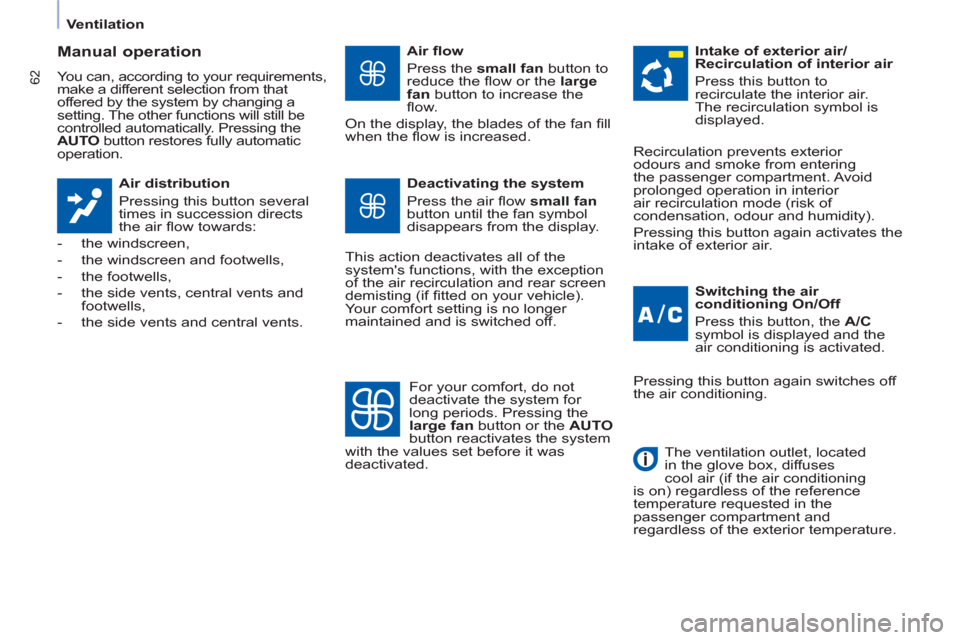
Manual operation
You can, according to your requirements,
make a different selection from that
offered by the system by changing a
setting. The other functions will still be
controlled automatically. Pressing the
AUTO
button restores fully automatic
operation.
Air distribution
Pressing this button several
times in succession directs
the air fl ow towards:
- the windscreen,
- the windscreen and footwells,
- the footwells,
- the side vents, central vents and
footwells,
- the side vents and central vents.
Air fl ow
Press the small fan
button to
reduce the fl ow or the large
fan
button to increase the
fl ow.
On the display, the blades of the fan fi ll
when the fl ow is increased.
Switching the air
conditioning On/Off
Press this button, the A/C
symbol is displayed and the
air conditioning is activated.
Deactivating the system
Press the air fl ow small fan
button until the fan symbol
disappears from the display.
This action deactivates all of the
system's functions, with the exception
of the air recirculation and rear screen
demisting (if fi tted on your vehicle).
Your comfort setting is no longer
maintained and is switched off.
Intake of exterior air/
Recirculation of interior air
Press this button to
recirculate the interior air.
The recirculation symbol is
displayed.
For your comfort, do not
deactivate the system for
long periods. Pressing the
large fan
button or the AUTO
button reactivates the system
with the values set before it was
deactivated. Recirculation prevents exterior
odours and smoke from entering
the passenger compartment. Avoid
prolonged operation in interior
air recirculation mode (risk of
condensation, odour and humidity).
Pressing this button again activates the
intake of exterior air.
Pressing this button again switches off
the air conditioning.
The ventilation outlet, located
in the glove box, diffuses
cool air (if the air conditioning
is on) regardless of the reference
temperature requested in the
passenger compartment and
regardless of the exterior temperature.
Page 65 of 208
63
EASE OF USE and COMFOR
T
33
Ventilation
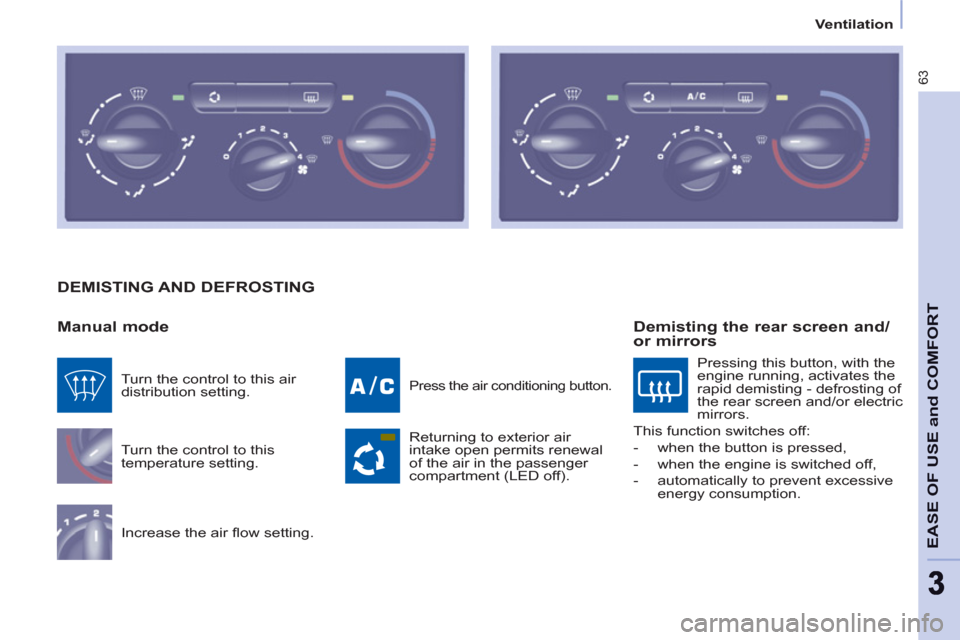
DEMISTING AND DEFROSTING
Manual mode
Turn the control to this
temperature setting.
Increase the air fl ow setting.
Press the air conditioning button.
Returning to exterior air
intake open permits renewal
of the air in the passenger
compartment (LED off). Turn the control to this air
distribution setting.
Demisting the rear screen and/
or mirrors
Pressing this button, with the
engine running, activates the
rapid demisting - defrosting of
the rear screen and/or electric
mirrors.
This function switches off:
- when the button is pressed,
- when the engine is switched off,
- automatically to prevent excessive
energy consumption.
Page 73 of 208
71
EASE OF USE and COMFOR
T
33
Practical information
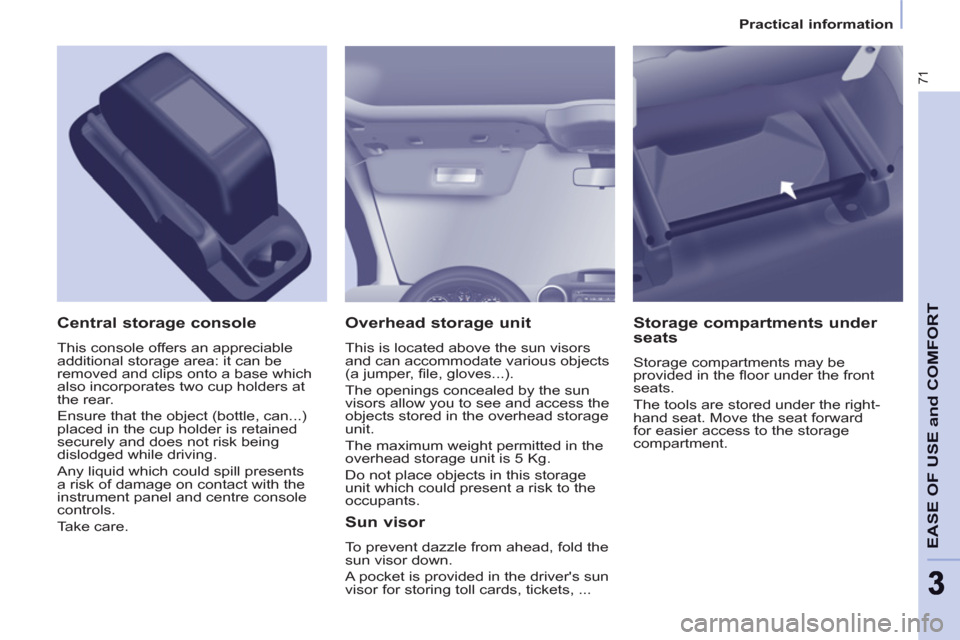
Overhead storage unit
This is located above the sun visors
and can accommodate various objects
(a jumper, fi le, gloves...).
The openings concealed by the sun
visors allow you to see and access the
objects stored in the overhead storage
unit.
The maximum weight permitted in the
overhead storage unit is 5 Kg.
Do not place objects in this storage
unit which could present a risk to the
occupants.
Central storage console
This console offers an appreciable
additional storage area: it can be
removed and clips onto a base which
also incorporates two cup holders at
the rear.
Ensure that the object (bottle, can...)
placed in the cup holder is retained
securely and does not risk being
dislodged while driving.
Any liquid which could spill presents
a risk of damage on contact with the
instrument panel and centre console
controls.
Take care.
Sun visor
To prevent dazzle from ahead, fold the
sun visor down.
A pocket is provided in the driver's sun
visor for storing toll cards, tickets, ...
Storage compartments under
seats
Storage compartments may be
provided in the fl oor under the front
seats.
The tools are stored under the right-
hand seat. Move the seat forward
for easier access to the storage
compartment.
Page 84 of 208
82
Parking sensors
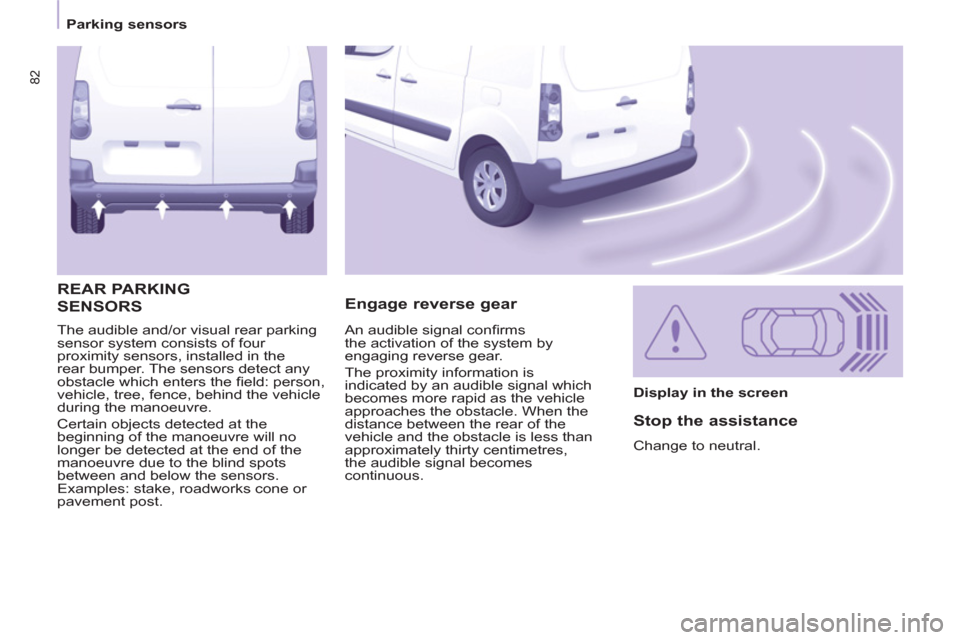
The audible and/or visual rear parking
sensor system consists of four
proximity sensors, installed in the
rear bumper. The sensors detect any
obstacle which enters the fi eld: person,
vehicle, tree, fence, behind the vehicle
during the manoeuvre.
Certain objects detected at the
beginning of the manoeuvre will no
longer be detected at the end of the
manoeuvre due to the blind spots
between and below the sensors.
Examples: stake, roadworks cone or
pavement post.
Engage reverse gear REAR PARKING
SENSORS
Display in the screen
Stop the assistance
Change to neutral. An audible signal confi rms
the activation of the system by
engaging reverse gear.
The proximity information is
indicated by an audible signal which
becomes more rapid as the vehicle
approaches the obstacle. When the
distance between the rear of the
vehicle and the obstacle is less than
approximately thirty centimetres,
the audible signal becomes
continuous.
Page 85 of 208
83
Parking sensors
SAFETY
4
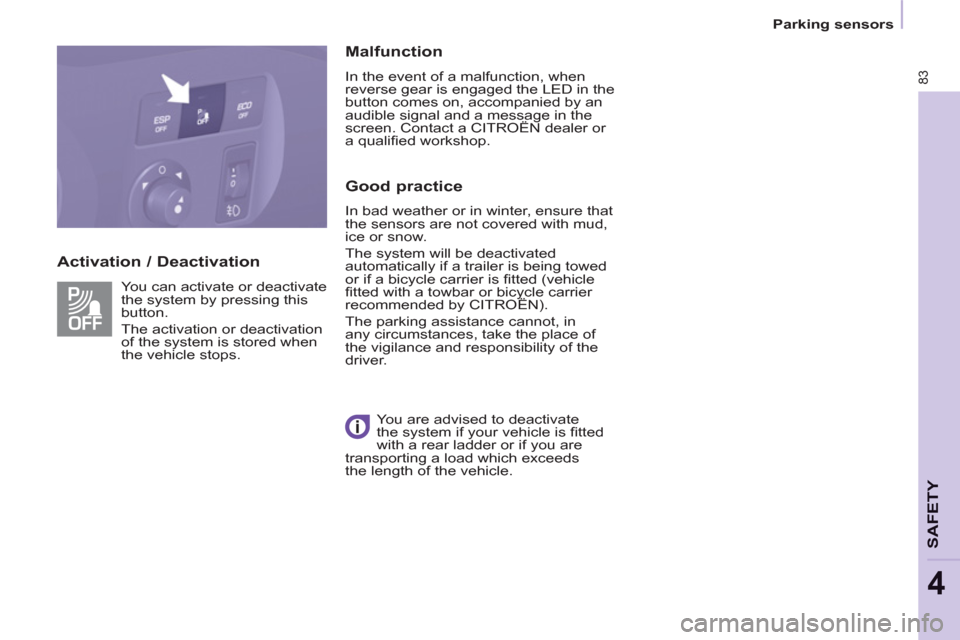
Activation / Deactivation
Malfunction
In the event of a malfunction, when
reverse gear is engaged the LED in the
button comes on, accompanied by an
audible signal and a message in the
screen. Contact a CITROËN dealer or
a qualifi ed workshop.
Good practice
In bad weather or in winter, ensure that
the sensors are not covered with mud,
ice or snow.
The system will be deactivated
automatically if a trailer is being towed
or if a bicycle carrier is fi tted (vehicle
fi tted with a towbar or bicycle carrier
recommended by CITROËN).
The parking assistance cannot, in
any circumstances, take the place of
the vigilance and responsibility of the
driver. You can activate or deactivate
the system by pressing this
button.
The activation or deactivation
of the system is stored when
the vehicle stops.
You are advised to deactivate
the system if your vehicle is fi tted
with a rear ladder or if you are
transporting a load which exceeds
the length of the vehicle.
Page 87 of 208
ESP OFF
85
SAFETY
4
Driving safely
ANTI-SLIP REGULATION (ASR)
AND ELECTRONIC STABILITY
PROGRAMME (ESP)
These systems are linked and
complement the ABS.
The ASR system is very useful for
maintaining optimum drive and
avoiding losses of control of the vehicle
on acceleration.
The system optimises drive to prevent
the wheels skidding, by acting on the
brakes of the drive wheels and on the
engine. It also allows the directional
stability of the vehicle to be improved
on acceleration.
Use the ESP to hold your course
without attempting to countersteer.
If there is a variation between the
trajectory followed by the vehicle and
that required by the driver, the ESP
system automatically acts on the
engine and the brake of one or more
wheels, in order to put the vehicle back
on course.
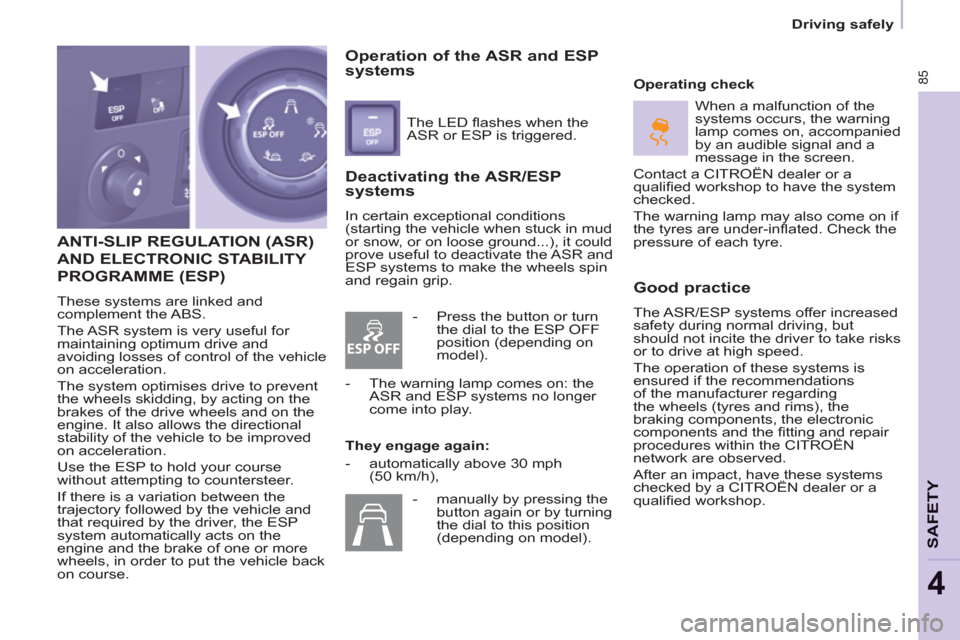
Deactivating the ASR/ESP
systems
In certain exceptional conditions
(starting the vehicle when stuck in mud
or snow, or on loose ground...), it could
prove useful to deactivate the ASR and
ESP systems to make the wheels spin
and regain grip.
Operating check
Good practice
The ASR/ESP systems offer increased
safety during normal driving, but
should not incite the driver to take risks
or to drive at high speed.
The operation of these systems is
ensured if the recommendations
of the manufacturer regarding
the wheels (tyres and rims), the
braking components, the electronic
components and the fi tting and repair
procedures within the CITROËN
network are observed.
After an impact, have these systems
checked by a CITROËN dealer or a
qualifi ed workshop.
Operation of the ASR and ESP
systems
The LED fl ashes when the
ASR or ESP is triggered.
They engage again:
- automatically above 30 mph
(50 km/h), When a malfunction of the
systems occurs, the warning
lamp comes on, accompanied
by an audible signal and a
message in the screen.
Contact a CITROËN dealer or a
qualifi ed workshop to have the system
checked.
The warning lamp may also come on if
the tyres are under-infl ated. Check the
pressure of each tyre.
- Press the button or turn
the dial to the ESP OFF
position (depending on
model).
- The warning lamp comes on: the
ASR and ESP systems no longer
come into play.
- manually by pressing the
button again or by turning
the dial to this position
(depending on model).
Page 89 of 208
ESP OFF
87
SAFETY
4
Driving safely
This snow
mode allows the
vehicle to adapts its strategy
to the conditions of grip
encountered for each of the
two front wheels, on moving off.
When moving, the system optimises
wheelspin to provide the best
acceleration possible for the grip
available.
This off-road
mode (mud,
wet grass...) allows, when
moving off, considerable
wheelspin on the wheel
with the least grip to favour
clearing of the mud and regain "grip".
At the same time, the wheel with the
most grip is controlled in such a way as
to transmit as much torque as possible.
When moving, the system optimises
wheelspin to meet the driver's
requirements as fully as possible.
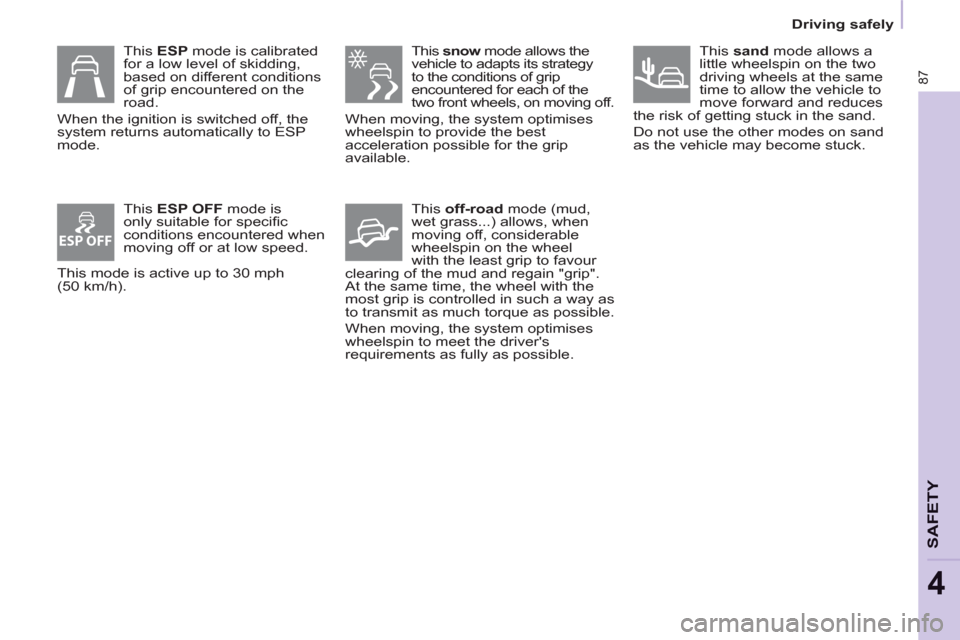
This ESP mode is calibrated
for a low level of skidding,
based on different conditions
of grip encountered on the
road.
When the ignition is switched off, the
system returns automatically to ESP
mode.
This ESP OFF
mode is
only suitable for specifi c
conditions encountered when
moving off or at low speed.
This mode is active up to 30 mph
(50 km/h).
This sand
mode allows a
little wheelspin on the two
driving wheels at the same
time to allow the vehicle to
move forward and reduces
the risk of getting stuck in the sand.
Do not use the other modes on sand
as the vehicle may become stuck.
Page 90 of 208
SEAT BELTS
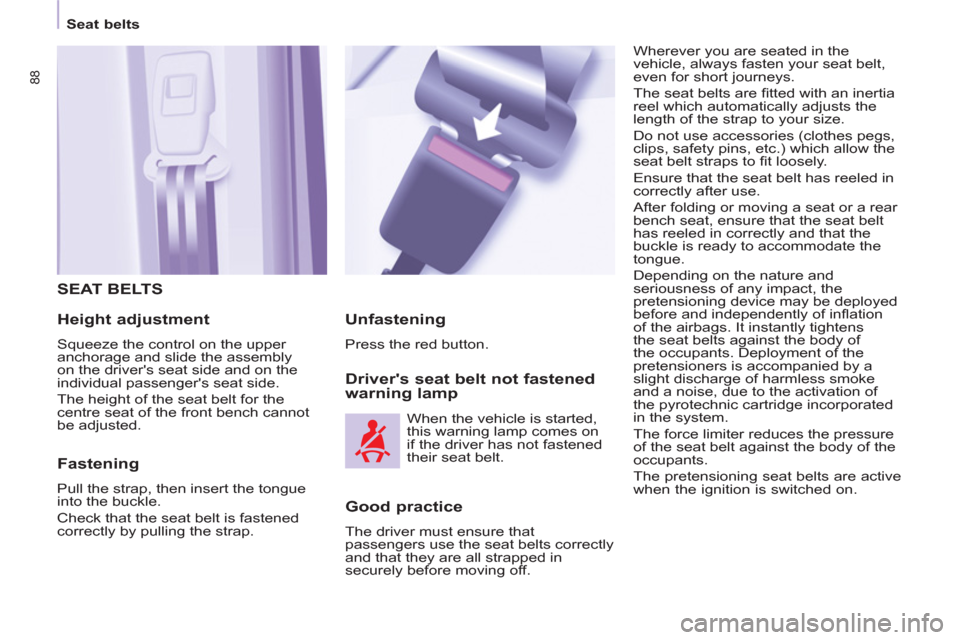
Height adjustment
Squeeze the control on the upper
anchorage and slide the assembly
on the driver's seat side and on the
individual passenger's seat side.
The height of the seat belt for the
centre seat of the front bench cannot
be adjusted.
Fastening
Pull the strap, then insert the tongue
into the buckle.
Check that the seat belt is fastened
correctly by pulling the strap.
Driver's seat belt not fastened
warning lamp
Wherever you are seated in the
vehicle, always fasten your seat belt,
even for short journeys.
The seat belts are fi tted with an inertia
reel which automatically adjusts the
length of the strap to your size.
Do not use accessories (clothes pegs,
clips, safety pins, etc.) which allow the
seat belt straps to fi t loosely.
Ensure that the seat belt has reeled in
correctly after use.
After folding or moving a seat or a rear
bench seat, ensure that the seat belt
has reeled in correctly and that the
buckle is ready to accommodate the
tongue.
Depending on the nature and
seriousness of any impact, the
pretensioning device may be deployed
before and independently of infl ation
of the airbags. It instantly tightens
the seat belts against the body of
the occupants. Deployment of the
pretensioners is accompanied by a
slight discharge of harmless smoke
and a noise, due to the activation of
the pyrotechnic cartridge incorporated
in the system.
The force limiter reduces the pressure
of the seat belt against the body of the
occupants.
The pretensioning seat belts are active
when the ignition is switched on.
Unfastening
Press the red button.
When the vehicle is started,
this warning lamp comes on
if the driver has not fastened
their seat belt.
Good practice
The driver must ensure that
passengers use the seat belts correctly
and that they are all strapped in
securely before moving off.
88
Seat belts
Page 93 of 208
Good practice
Sit in a normal upright position.
Wear a correctly adjusted seat belt.
Do not leave anything between the
occupants and the airbags (a child,
pet, object...). This could hinder the
operation of the airbags or injure the
occupants.
After an accident or if the vehicle has
been stolen or broken into, have the
airbag systems checked.
All work on the airbag system is strictly
forbidden unless it is carried out by
qualifi ed personnel at a CITROËN
dealer or a qualifi ed workshop.
Even if all of the precautions
mentioned are observed, a risk of
injury or of minor burns to the head,
chest or arms when an airbag is
deployed cannot be ruled out. In fact,
the bag infl ates almost instantly (within
a few milliseconds) then defl ates within
the same time discharging the hot gas
via openings provided for this purpose.
Lateral airbags
Only put recommended covers on
the seats. These will not hinder
infl ation of the lateral airbags. Contact
a CITROËN dealer or a qualifi ed
workshop.
Do not fi x or attach anything to the seat
backs. This could cause injury to the
chest or arms when the lateral airbag
infl ates.
Do not sit with the upper part of the
body any nearer to the door than
necessary.
Front airbags
Do not drive holding the steering wheel
by its spokes or resting your hands on
the centre part of the wheel.
Do not allow passengers to place
their feet on the dashboard, they risk
serious injury if the airbag is deployed.
Smoke as little as possible as
deployment of the airbags can cause
burns or the risk of injury from a
cigarette or pipe.
Never remove or pierce the steering
wheel or hit it violently.
Airbags
only operate when the
ignition is switched on.
This equipment only operates once.
If a second impact occurs (during the
same or a subsequent accident), the
airbag will not operate.
The deployment of an airbag or airbags
is accompanied by a slight discharge
of harmless smoke and a noise, due
to the activation of the pyrotechnic
cartridge incorporated in the system.
This smoke is not harmful, but
sensitive individuals may experience
some irritation.
The noise of the detonation may result
in a slight loss of hearing for a short
time.
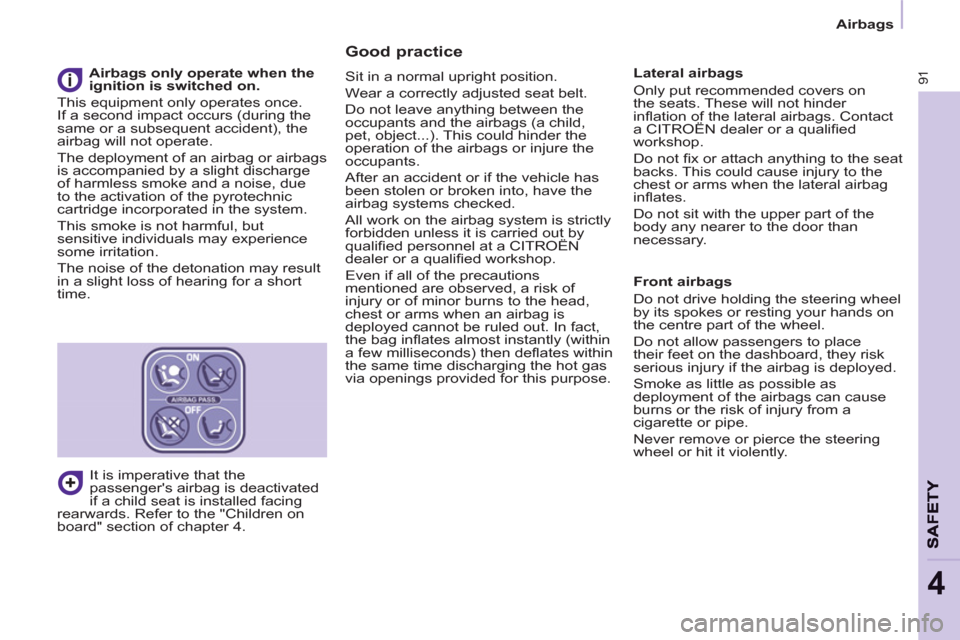
It is imperative that the
passenger's airbag is deactivated
if a child seat is installed facing
rearwards. Refer to the "Children on
board" section of chapter 4. Airbags91
4
Page 95 of 208
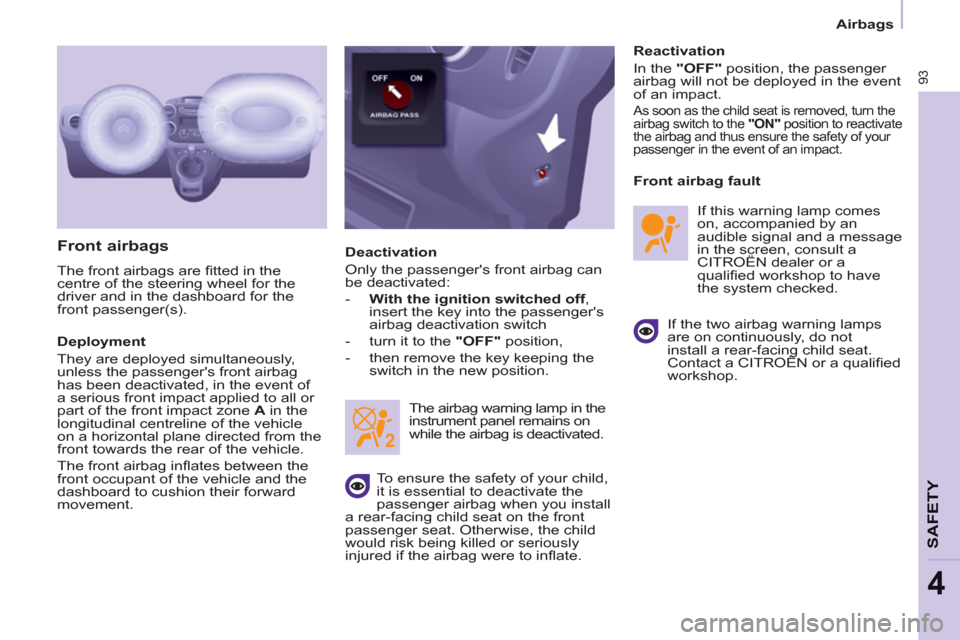
Front airbags
The front airbags are fi tted in the
centre of the steering wheel for the
driver and in the dashboard for the
front passenger(s).
Deployment
They are deployed simultaneously,
unless the passenger's front airbag
has been deactivated, in the event of
a serious front impact applied to all or
part of the front impact zone A
in the
longitudinal centreline of the vehicle
on a horizontal plane directed from the
front towards the rear of the vehicle.
The front airbag infl ates between the
front occupant of the vehicle and the
dashboard to cushion their forward
movement.
Deactivation
Only the passenger's front airbag can
be deactivated:
- With the ignition switched off
,
insert the key into the passenger's
airbag deactivation switch
- turn it to the "OFF"
position,
- then remove the key keeping the
switch in the new position.
The airbag warning lamp in the
instrument panel remains on
while the airbag is deactivated. If the two airbag warning lamps
are on continuously, do not
install a rear-facing child seat.
Contact a CITROËN or a qualifi ed
workshop.
Front airbag fault
To ensure the safety of your child,
it is essential to deactivate the
passenger airbag when you install
a rear-facing child seat on the front
passenger seat. Otherwise, the child
would risk being killed or seriously
injured if the airbag were to infl ate.
Reactivation
In the "OFF"
position, the passenger
airbag will not be deployed in the event
of an impact.
As soon as the child seat is removed, turn the
airbag switch to the "ON"
position to reactivate
the airbag and thus ensure the safety of your
passenger in the event of an impact.
If this warning lamp comes
on, accompanied by an
audible signal and a message
in the screen, consult a
CITROËN dealer or a
qualifi ed workshop to have
the system checked. Airbags
93
SAFETY
4