Table Citroen BERLINGO 2015 2.G Owner's Guide
[x] Cancel search | Manufacturer: CITROEN, Model Year: 2015, Model line: BERLINGO, Model: Citroen BERLINGO 2015 2.GPages: 266, PDF Size: 10.47 MB
Page 102 of 266
100
BERLInGO-2-VU_En_CHAP05_SECURITE_ED01-2015
Deactivation
The system is deactivated in the
vehicle configuration menu, accessible
with the ignition on.
Its state is memorised when the
ignition is switched off.When the system is deactivated, a
message is displayed every time
the ignition is switched on, to warn
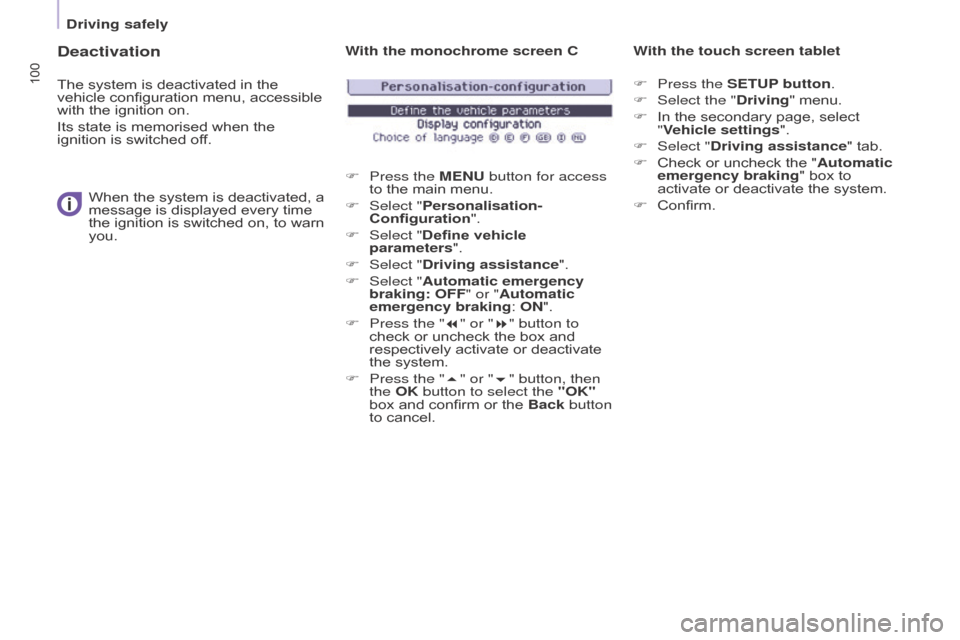
you. With the monochrome screen C
F
Press the
ME n U button for access
to the main menu.
F
Select "
Personalisation-
Configuration".
F
Select "
Define vehicle
parameters".
F
Select "
Driving assistance".
F
Select "
Automatic emergency
braking: OFF" or "Automatic
emergency braking: O
n ".
F
Press the "
7" or "8" button to
check or uncheck the box and
respectively activate or deactivate
the system.
F
Press the "
5" or "6" button, then
the OK button to select the "OK"
box and confirm or the Back button
to cancel. With the touch screen tablet
F
Press the SETUP button.
F Select the " Driving" menu.
F
In the secondary page, select
"
Vehicle settings".
F
Select "
Driving assistance" tab.
F
Check or uncheck the "
Automatic
emergency braking" box to
activate or deactivate the system.
F
Confirm.
Driving safely
Page 105 of 266
103
BERLInGO-2-VU_En_CHAP05_SECURITE_ED01-2015BERLInGO-2-VU_En_CHAP05_SECURITE_ED01-2015
The inertia reels are fitted with a device
which automatically locks the strap in
the event of a collision or emergency
braking or if the vehicle rolls over.
You can unfasten the seat belt by
pressing the red button on the buckle.
Guide the seat belt after unfastening.
The airbag warning lamp comes on
if the pretensioners are deployed.
Contact a CITROËN dealer or a
qualified workshop.Recommendations for children:
-
use a suitable child seat if the
passenger is less than 12 years old
or shorter than one metre fifty
,
-
never allow a child to travel on
your lap, even with the seat belt
fastened.For more information on child
seats, refer to the "Children on
board" section of chapter 5.
Clean the seat belt straps with
soapy water or a textile cleaning
product, sold by CITROËN
dealers.
In accordance with current safety
regulations, your CITROËN dealer can
guarantee all work or any checks, from
testing to maintenance, on your seat
belt equipment.
Have the seat belts checked regularly
(even after a minor impact) by a
CITROËN dealer or a qualified
workshop: they must not show any
signs of wear
, cutting or fraying
and they must not be converted or
modified.Front seat belts
The front seats are fitted with
pretensioners and force limiters.
The seat belt associated with the
centre seat of the front bench does not
have a pretensioner.
In order to be effective, a seat belt:
-
must restrain one person only
,
-
must not be twisted, check by
pullin
g in front of you with an even
movement,
-
must be tightened as close to the
body as possible.
The upper part of the seat belt should
be positioned in the hollow of the
shoulder
.
The lap part should be placed as low
as possible on the pelvis.
Do not interchange the seat belt
buckles as they will not fulfil their role
completely. If the seats are fitted with
armrests, the lap part of the seat belt
should always pass under the armrest.
Check that the seat belt is fastened
correctly by pulling the strap firmly.
SAFETY
5
Seat belts
Page 112 of 266
11 0
BERLInGO-2-VU_En_CHAP05_SECURITE_ED01-2015BERLInGO-2-VU_En_CHAP05_SECURITE_ED01-2015
DEACTIVATInG THE
P
ASSE n GER ' S
FRO
n T AIRBAG
Never install a rearward facing
child restraint system on a seat
protected by an active front
airbag. This could cause the death of
the child or serious injury.
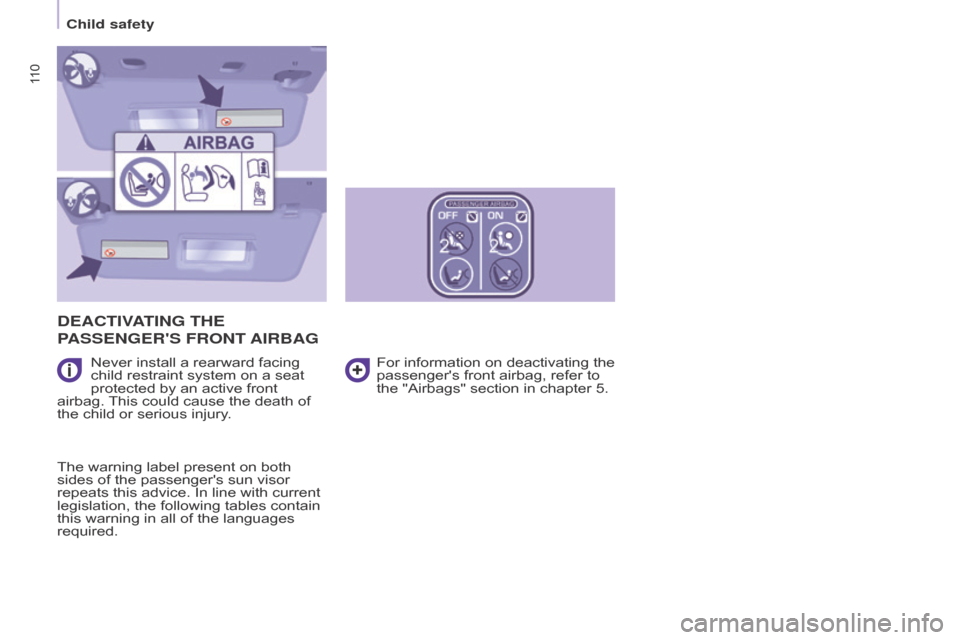
The warning label present on both
sides of the passenger's sun visor
repeats this advice. In line with current
legislation, the following tables contain
this warning in all of the languages
required. For information on deactivating the
passenger's front airbag, refer to
the "Airbags" section in chapter 5.
Child safety
Page 116 of 266
11 4
BERLInGO-2-VU_En_CHAP05_SECURITE_ED01-2015BERLInGO-2-VU_En_CHAP05_SECURITE_ED01-2015
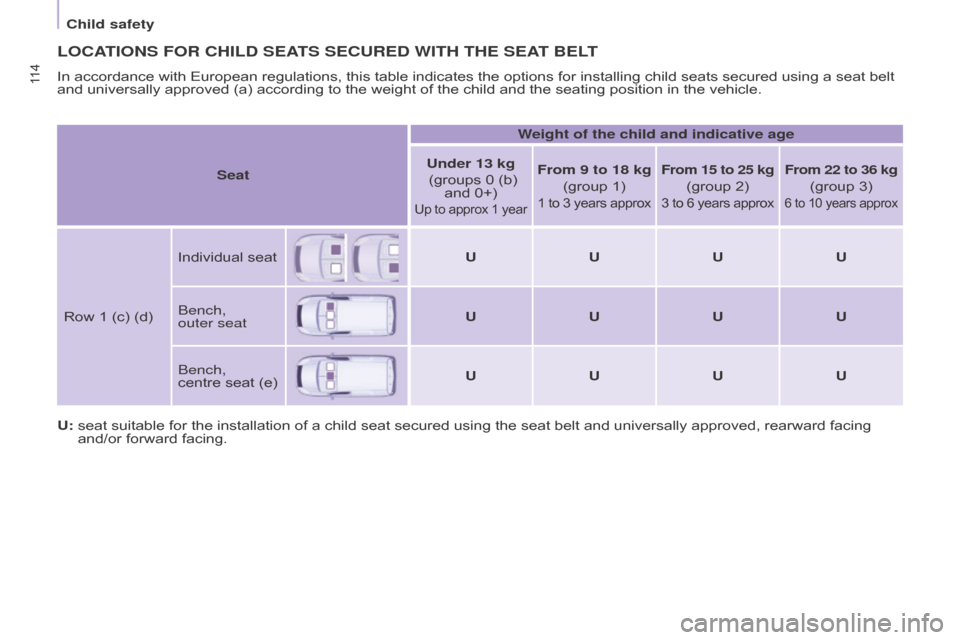
LOCATIOnS FOR CHILD SEATS SECURED WITH THE SEAT BELT
In accordance with European regulations, this table indicates the options for installing child seats secured using a seat belt
and universally approved (a) according to the weight of the child and the seating position in the vehicle.
U:
seat suitable for the installation of a child seat secured usin
g the seat belt and universally approved, rearward facing
and/or forward facing. Seat
Weight of the child and indicative age
Under 13 kg
(groups 0 (b) and 0+)
Up to approx 1 year
From 9 to 18 kg
(group 1)
1 to 3 years approx
From 15 to 25 kg
(group 2)
3 to 6 years approx
From 22 to 36 kg
(group 3)
6 to 10 years approx
Row 1 (c) (d)Individual seat
UUUUb ench,
outer seat U
UUU
b
ench,
centre seat (e) U
UUU
Child safety
Page 118 of 266
11 6
BERLInGO-2-VU_En_CHAP05_SECURITE_ED01-2015BERLInGO-2-VU_En_CHAP05_SECURITE_ED01-2015
ADVICE On CHILD SEATS
The incorrect installation of a child seat
in a vehicle compromises the child's
protection in the event of an accident.
Check that there is no seat belt or seat
belt buckle under the child seat, as this
could destabilise the seat.
Remember to fasten the seat belts or
the child seat harnesses keeping the
slack relative to the child's body to a
minimum, even for short journeys.
For the installation of a child seat using
the seat belt, ensure that the seat belt
is well tensioned on the child seat
and that it is holding the child seat
firmly against the vehicle's seat. If the
passenger seat is adjustable, move it
forward if necessary.
At the rear, always leave sufficient
space between the front seat and:
-
a rearward facing child seat,
-
the feet of a child seated in a
forward facing child seat.
For this, move the front seat forward
and, if necessary
, straighten its
backrest as well. For the optimum installation of a
forward facing child seat, ensure that
the back of the child seat is as close as
possible to the backrest of the vehicle's
seat, or in contact if possible.
The head restraint must be removed
before installing a child seat with a
backrest on the passenger seat..
Ensure that the head restraint is
stowed or attached securely so that it
is not thrown around the vehicle in the
event of sharp braking.
Refit the head restraint as soon as the
child seat is removed.
Children at the front
The legislation on carrying a child on
the front passenger seat is specific to
each country. Refer to the legislation in
force in your country.
Deactivate the passenger's airbag
when a rearward facing child seat is
installed on the front seat.
Otherwise, the child would risk being
seriously injured or killed if the airbag
were deployed.
Installing a booster seat
The chest part of the seat belt must
be positioned on the child's shoulder
without touching the neck.
Ensure that the lap part of the seat belt
passes correctly over the child's thighs.
CITROËN recommends the use of a
booster seat which has a back, fitted
with a seat belt guide at shoulder level.
As a safety precaution, never leave:
-
one or more children alone and
unsupervised in a vehicle,
-
a child or an animal in a vehicle
which is exposed to the sun, with
the windows closed,
-
the keys within reach of children
inside the vehicle.
T
o prevent accidental opening of the
doors, use the "Child Lock".
Take care not to open the rear windows
by more than one third.
To protect young children from the rays
of the sun, fit side blinds to the rear
windows.
Child safety
Page 134 of 266
DIESEL
132
Berlingo-2-VU_en_Chap07_Verification_ed01-2015Berlingo-2-VU_en_Chap07_Verification_ed01-2015
FUEL CUT- OFF
The flashing of this warning
lamp is accompanied by a
message in the screen.
Check that there is no odour or
leakage of fuel outside the vehicle and
re-establish the fuel supply:
-
switch of
f the ignition (STOP
position),
-
remove the key
,
-
put the key back in the ignition,
-
switch on the ignition and start.
DIESEL PRIMI n G PUMP
Refer to chapter 7, "Under the
bonnet" section.
Fuel used for Diesel
engines
The Diesel engines are compatible with
biofuels which conform to current and
future European standards (Diesel fuel
which complies with standard EN 590
mixed with a biofuel which complies
with standard EN 14214) available at
the pumps (containing up to 7 % Fatty
Acid Methyl Ester).
B30 biofuel can be used in certain
Diesel engines. However, this use,
even occasional, requires strict
application of the special servicing
conditions. Contact a CITROËN dealer
or a qualified workshop.
The use of any other type of (bio)
fuel (vegetable or animal oils, pure
or diluted, domestic fuel...) is strictly
prohibited (risk of damage to the
engine and fuel system). If you should run out of fuel, it is
necessary to prime the fuel circuit.
-
Fill the fuel tank with at least five
litres of Diesel.
-
Squeeze and release the manual
priming pump, under the bonnet
under the protective cover
.
-
Operate the starter until the engine
starts.
In a serious collision, a mechanism
automatically prevents fuel from
reaching the engine.
Fuel
Page 135 of 266
133
Berlingo-2-VU_en_Chap07_Verification_ed01-2015Berlingo-2-VU_en_Chap07_Verification_ed01-2015
BLUEHDI
A n D A D B LUE
® ADDITIVE
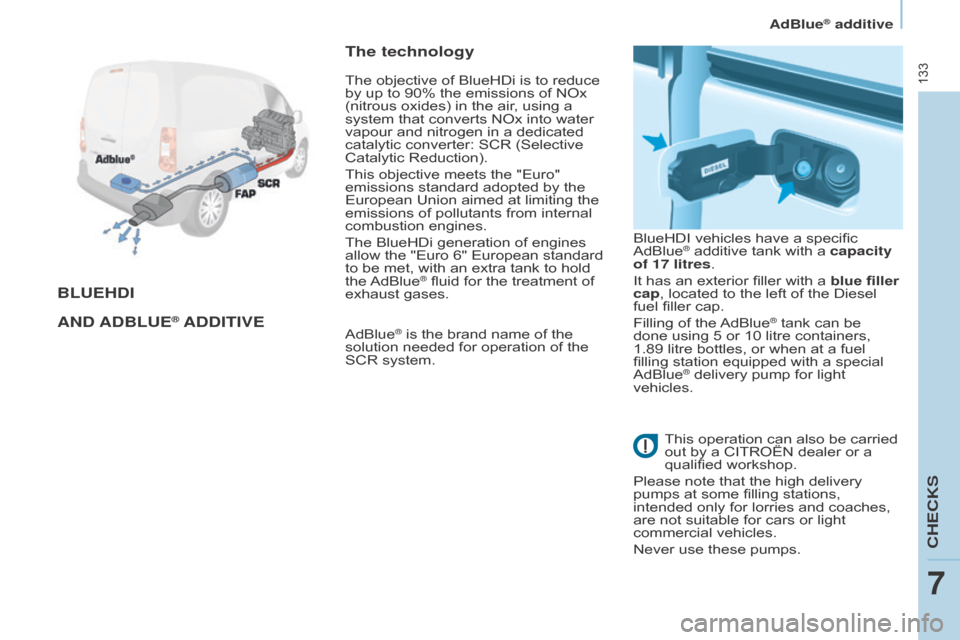
The technology
AdBlue® is the brand name of the
solution needed for operation of the
SCR system. BlueHDI vehicles have a specific
AdBlue
® additive tank with a capacity
of 17 litres.
It has an exterior filler with a blue filler
cap, located to the left of the Diesel
fuel filler cap.
Filling of the AdBlue
® tank can be
done using 5 or 10 litre containers,
1.89 litre bottles, or when at a fuel
filling station equipped with a special
AdBlue
® delivery pump for light
vehicles.
The objective of BlueHDi is to reduce
by up to 90% the emissions of NOx
(nitrous oxides) in the air
, using a
system that converts NOx into water
vapour and nitrogen in a dedicated
catalytic converter: SCR (Selective
Catalytic Reduction).
This objective meets the "Euro"
emissions standard adopted by the
European Union aimed at limiting the
emissions of pollutants from internal
combustion engines.
The BlueHDi generation of engines
allow the "Euro 6" European standard
to be met, with an extra tank to hold
the AdBlue
® fluid for the treatment of
exhaust gases.
This operation can also be carried
out by a CITROËN dealer or a
qualified workshop.
Please note that the high delivery
pumps at some filling stations,
intended only for lorries and coaches,
are not suitable for cars or light
commercial vehicles.
Never use these pumps.
CHECKS
7
AdBlue® additive
Page 136 of 266
134
Berlingo-2-VU_en_Chap07_Verification_ed01-2015Berlingo-2-VU_en_Chap07_Verification_ed01-2015
Good practice
While the quantity of AdBlue® in
the additive tank is sufficient, no
information is displayed.
On the other hand, once the additive
level drops to the quantity needed
for a range of 1 500 miles (2 400 km)
driving, you are warned by dif
ferent
temporary signals (warning lamp,
message, audible signal).
As more miles are covered, these
signals intensify and the message
becomes permanent.
When the AdBlue
® tank is empty,
restarting becomes impossible.
It is strongly recommended that you
do not wait for the successive alerts
before topping-up the AdBlue
® tank,
but do this as soon as possible.
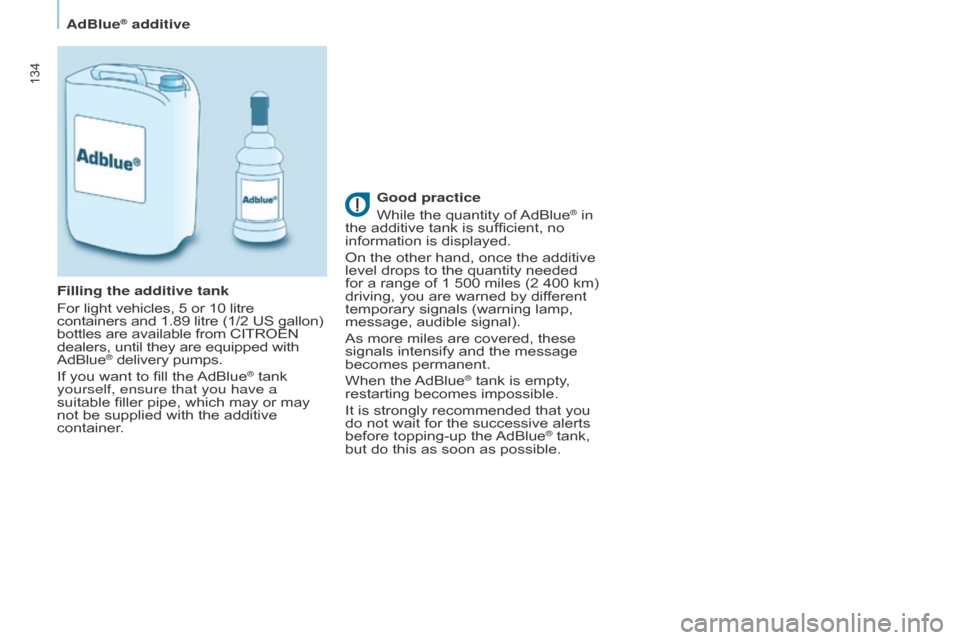
Filling the additive tank
For light vehicles, 5 or 10 litre
containers and 1.89 litre (1/2 US gallon)
bottles are available from CITROËN
dealers, until they are equipped with
AdBlue
® delivery pumps.
If you want to fill the AdBlue® tank
yourself, ensure that you have a
suitable filler pipe, which may or may
not be supplied with the additive
container.
AdBlue® additive
Page 137 of 266
135
Berlingo-2-VU_en_Chap07_Verification_ed01-2015Berlingo-2-VU_en_Chap07_Verification_ed01-2015
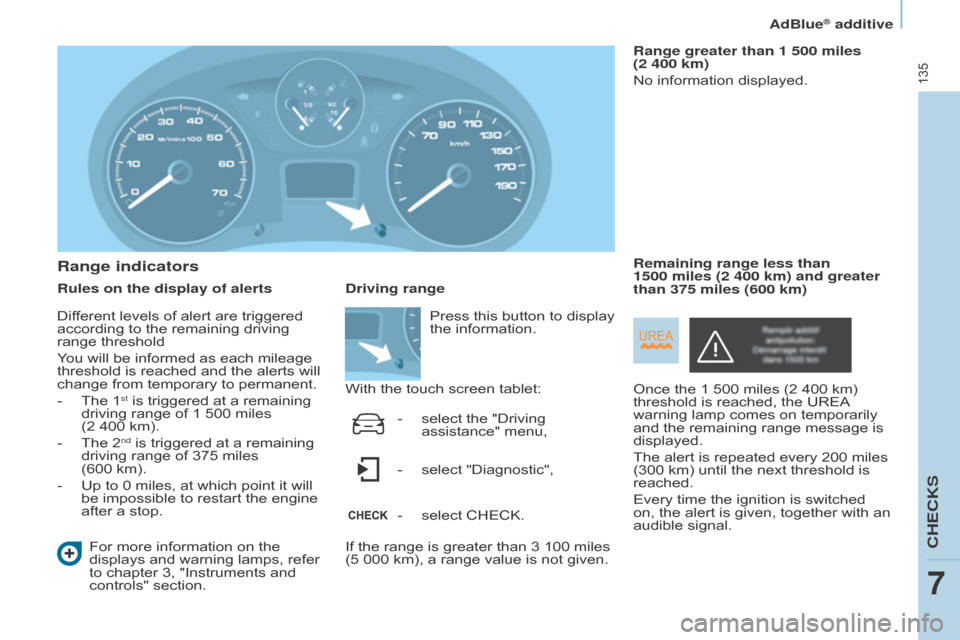
Range indicators
Rules on the display of alertsFor more information on the
displays and warning lamps, refer
to chapter 3, "Instruments and
controls" section. Range greater than 1 500 miles
(2 400 km)
No information displayed.
Once the 1 500 miles (2 400 km)
threshold is reached, the UREA
warning lamp comes on temporarily
and the remaining range message is
displayed.
The alert is repeated every 200 miles
(300 km) until the next threshold is
reached.
Every time the ignition is switched
on, the alert is given, together with an
audible signal. Remaining range less than
1500 miles (2 400 km) and greater
than 375 miles (600 km)
Driving range
With the touch screen tablet:
If the range is greater than 3 100 miles
(5 000 km), a range value is not given. Press this button to display
the information.
-
select the "Driving
assistance" menu,
-
select "Diagnostic",
-
select CHECK.
Dif
ferent levels of alert are triggered
according to the remaining driving
range threshold
You will be informed as each mileage
threshold is reached and the alerts will
change from temporary to permanent.
-
The 1st is triggered at a remaining
driving range of 1 500 miles
(2 400 km).
-
The 2nd is triggered at a remaining
driving range of 375 miles
(600 km).
-
Up to 0 miles, at which point it will
be impossible to restart the engine
after a stop.
CHECKS
7
AdBlue® additive
Page 140 of 266
138
Berlingo-2-VU_en_Chap07_Verification_ed01-2015Berlingo-2-VU_en_Chap07_Verification_ed01-2015
Refilling / Topping-up the
AdBlue® additive
Precautions to take
Use only AdBlue® additive that meets
the ISO 22241 standard.
The AdBlue
® additive is an urea-based
solution.
This liquid is non-flammable, colourless
and odourless.
To be kept in a cool area.
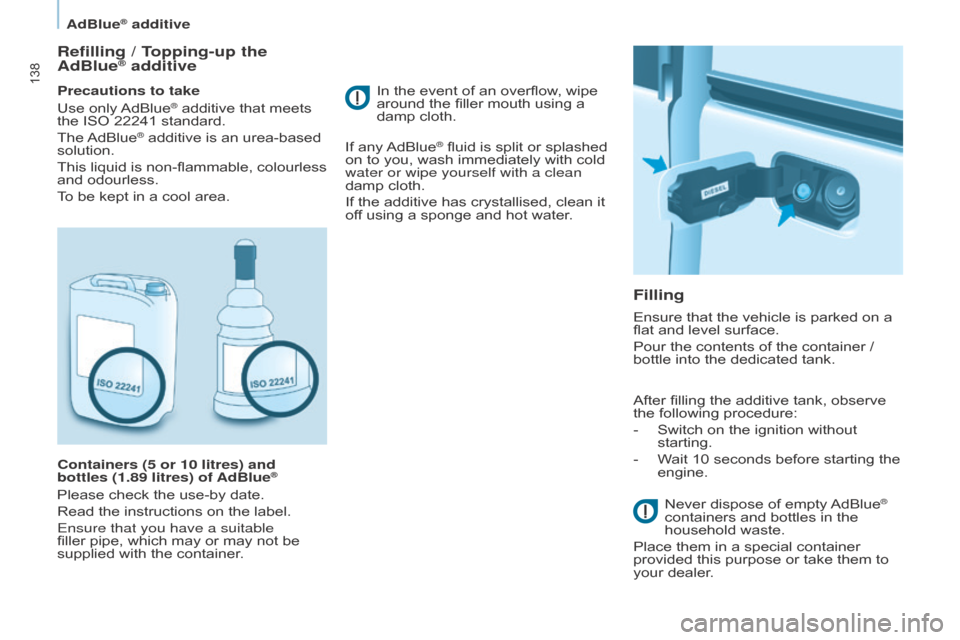
Containers (5 or 10 litres) and
bottles (1.89 litres) of AdBlue
®
Please check the use-by date.
Read the instructions on the label.
Ensure that you have a suitable
filler pipe, which may or may not be
supplied with the container.
Filling
In the event of an overflow, wipe
around the filler mouth using a
damp cloth.
If any AdBlue
® fluid is split or splashed
on to you, wash immediately with cold
water or wipe yourself with a clean
damp cloth.
If the additive has crystallised, clean it
off using a sponge and hot water.
Ensure that the vehicle is parked on a
flat and level surface.
Pour the contents of the container /
bottle into the dedicated tank.
After filling the additive tank, observe
the following procedure:
-
Switch on the ignition without
starting.
-
W
ait 10 seconds before starting the
engine.
Never dispose of empty AdBlue
®
containers and bottles in the
household waste.
Place them in a special container
provided this purpose or take them to
your dealer.
AdBlue® additive