Spare tyre Citroen BERLINGO MULTISPACE 2016 2.G Owner's Manual
[x] Cancel search | Manufacturer: CITROEN, Model Year: 2016, Model line: BERLINGO MULTISPACE, Model: Citroen BERLINGO MULTISPACE 2016 2.GPages: 296, PDF Size: 10.36 MB
Page 7 of 296
5
Location
Berlingo-2-VP_en_Chap01_vue-ensemble_ed01-2016
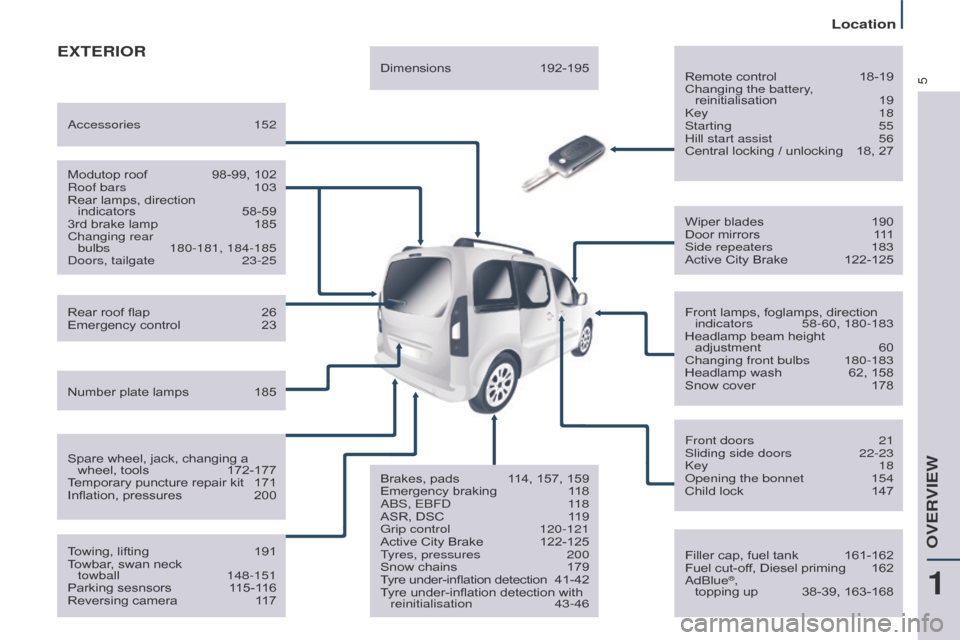
ExTERIOR
Remote control 18-19
Changing the battery ,
reinitialisation
19k
ey
18
Starting
55
Hill start assist
56
Central
locking / unlocking
18,
27
Filler
cap, fuel tank
161-162
Fuel
cut-off, Diesel priming
162a
dBlue
®,
topping up 38-39, 163-168
Wiper
blades
190
Door
mirrors
1
11
Side repeaters
183
Active
City Brake
122-125
Front
lamps, foglamps, direction
indicators
58-60, 180-183
Headlamp
beam height
adjustment
60
Changing front bulbs
180-183
Headlamp
wash
62,
158
Snow
cover
178
Front doors
21
Sliding side doors
22-23k
ey
18o
pening the bonnet
154
Child
lock
147
T
owing,
lifting
191
T
owbar,
swan
neck
towball
148-151
Parking
sesnsors
1
15-116
Reversing
camera
1
17
Rear
roof
flap
26
Emergency
control
23
Spare
wheel,
jack,
changing
a
wheel,
tools
172-177
T
emporary
puncture
repair
kit
171
Inflation,
pressures
200
Modutop
roof
98-99,
102
Roof bars
103
Rear
lamps,
direction
indicators
58-59
3rd
brake
lamp
185
Changing rear
bulbs
180-181, 184-185d
oors, tailgate
23-25
a
ccessories
152
Dimensions
192-195
Brakes,
pads
1
14,
157,
159
Emergency
braking
1
18
a
BS, EBF
d
1
18
ASR,
DSC
1
19
Grip control
120-121
Active
City
Brake
122-125
T
yres, pressures
200
Snow
chains
179
T
yre
under-inflation
detection
4
1-42
Tyre
under-inflation
detection
with
reinitialisation
43-46
Number
plate
lamps
185
1
oVERVIEW
Page 19 of 296
17
Motoring & the Environment
Berlingo-2-VP_en_Chap02_eco-conduite_ed01-2016
Limit the causes of excess
consumption
Spread loads throughout the vehicle;
place the heaviest items in the bottom
of the boot, as close as possible to
the
rear seats.
Limit
the loads carried in the
vehicle and reduce wind resistance
(roof
bars, roof rack, bicycle
carrier
, trailer...). Use a roof box in
preference.
Remove
roof bars and roof racks
after
use.
At
the end of winter, remove snow
tyres
and refit your summer tyres.
Observe the recommendations
on maintenance
Check the tyre pressures regularly, when cold, referring to the label in the
door aperture, driver's side.
Carry
out this check in particular:
-
before
a long journey,
-
at each change of season,
-
after
a long period out of use.
d
on't forget the spare wheel and the
tyres
on any trailer or caravan.
Have your vehicle serviced regularly
(engine
oil, oil filter, air filter, passenger
compartment
filter...) and observe the
schedule
of operations recommended
in
the manufacturer's service schedule.
With a BlueH
d i d iesel engine, if the
SCR
system is faulty your vehicle
becomes
polluting; go to a CITROËN
dealer
or a qualified workshop without
delay
to have the emissions of nitrous
oxides
brought back to the legal level.When refuelling, do not continue after
the third cut-off of the nozzle to avoid
any
overflow.
a
t the wheel of your new vehicle,
it
is only after the first 1 800 miles
(3 000
kilometres) that you will see
the
fuel consumption settle down to a
consistent
average.
2
ECO-DRIVING
Page 43 of 296
41
Berlingo-2-VP_en_Chap03_Pret-a-partir_ed01-2016
Instruments and controls
EMISSIONS CONTROLS
EoBd (European on Board diagnosis) is a diagnostics
system
which complies
with,
among others, the
standards on the authorised
emissions of:
-
CO
(carbon monoxide),
-
HC (unburnt hydrocarbons),
-
no
x (nitrous oxides) or particles,
detected by oxygen sensors placed
upstream
and downstream of the
catalytic
converters.
The
driver
is
warned
of
any
malfunction
of
this
emission control system by the
illu
mination of this specific warning
lamp
in
the instrument panel.
There
is
a risk of damage to the
catalytic
converter. Have it checked
by
a
CITROËN dealer or a qualified
workshop.
UNDER-INFLATION DETECTION
This system continuously monitors
the pressures of the four
tyres, as soon as the
vehicle
is moving.
a pressure sensor is located in the
valve of each tyre (except the spare
wheel).
The
system
triggers an alert if a drop
in
pressure
is
detected in one or more
tyres.The
tyre
under-inflation detection
system
is
an aid to driving which
does not replace the need for
vigilance
on the part of the driver.This
system does not avoid the need
to check the tyre pressures
regularly (including the spare
wheel)
and before a long journey.
Driving
with under-inflated tyres
adversely af
fects road holding,
extends
braking distances and causes
premature
tyre wear, particularly under
arduous conditions (vehicle loaded,
high
speed, long journey).
Driving
with under-inflated tyres
increases
fuel consumption.
The tyre pressures for your vehicle
can be found on the tyre pressure
label.
Refer
to chapter 9, "Identification
markings"
section.
The
tyre pressures must be checked
when the tyres cold (vehicle stopped
for 1 hour or after driving for less then
6
miles (10 km) at moderate speed).
Otherwise,
add 0.3 bar to the values
indicated
on the label.
REadY To Go
3
Page 44 of 296
42
Berlingo-2-VP_en_Chap03_Pret-a-partir_ed01-2016
Instruments and controlsThe alert is maintained until
the tyre or tyres concerned is
reinflated,
repaired or replaced.
The spare wheel (space-saver type or
a
steel rim) does not have a sensor.
Operating fault
Under-inflation alert
The loss of pressure detected
does not always lead to visible
deformation
of
the
tyre.
Do
not
rely
on
just a visual check.The alert is given by the fixed illumination of this warning lamp, accompanied
by an audible signal,
and
depending on equipment, the
display
of a message.The flashing and then fixed illumination of the
under-inflation
warning
lamp
accompanied by the
illu
mination of the "Service" warning
lamp,
and depending on equipment,
the
display of a message indicates a
fault
with the system.
In
this
case, monitoring of the tyre
pressures
is not assured.
In
the
event
of
a
problem
on
one
of
the
tyres,
the
symbol
or
the
message
appears,
according
to
equipment,
to
identify
it.
-
Reduce speed, avoid sudden
steering
movements
or
harsh
brake
applications.
-
Stop
as
soon
as
it
is
safe
to
do
so.
-
In the event of a puncture, use
the
temporary
puncture
repair
kit
or the spare wheel (according to
equipment),
or
-
if
you
have
a
compressor,
the
one
in
the
temporary
puncture
repair
kit
for
example,
check
the
four
tyre
pressures when cold,
or
-
if
it
is
not
possible
to
check
the
tyre
pressures
at
the
time,
drive
carefully
at
reduced
speed.
This alert is also displayed when
one
or more wheels is not fitted
with
a sensor (for example, a
space-saver
or steel spare wheel).
Go
to
a CITROËN dealer or a qualified
workshop to
have the system checked
or
, following the repair of a puncture, to
have the original wheel, equipped with
a
sensor, refitted.
Page 45 of 296
43
Berlingo-2-VP_en_Chap03_Pret-a-partir_ed01-2016
Instruments and controls
UNDER-INFLATION DETECTION WITH REINITIALISATION
System which automatically checks the pressures of the tyres while driving.
The
system monitors the pressures
in the four tyres, once the vehicle is
moving.
It
compares the information given by
the four wheel speed sensors with
reference values, which must be
reinitialised every time the tyre
pressures are adjusted or a wheel
changed
.
The
system triggers an alert as soon
as
it detects a drop in the inflation
pressure
of one or more tyres. The under-inflation detection system
does not replace the need
for vigilance on the part of the
driver
.
This
system does not avoid the need to
check
the tyre pressures (including the
spare
wheel) every month as well as
before
a long journey.
Driving
with under-inflated tyres
impairs
road holding, extends braking
distances
and causes premature
tyre wear
, particularly under arduous
condition (high loading, high speed,
long
journey).
Driving
with under-inflated tyres
increases
fuel consumption.The
inflation pressures defined for your vehicle can be found on the
tyre
pressure label.
For
more information on the
identification
markings, refer to the
corresponding
section.
Tyre
pressures should be checked
when the tyres are "cold" (vehicle
stopped
for 1 hour or after a journey of
less
than 6 miles (10 km) at moderate
speeds).
Otherwise
(when hot), add 0.3 bar to
the
pressures shown on the label.
REadY To Go
3
Page 46 of 296
44
Berlingo-2-VP_en_Chap03_Pret-a-partir_ed01-2016
Instruments and controls
Under-inflation alert
This is given by fixed illumination of this warning lamp, accompanied
by an audible signal
and,
depending on equipment,
the
display of a message.
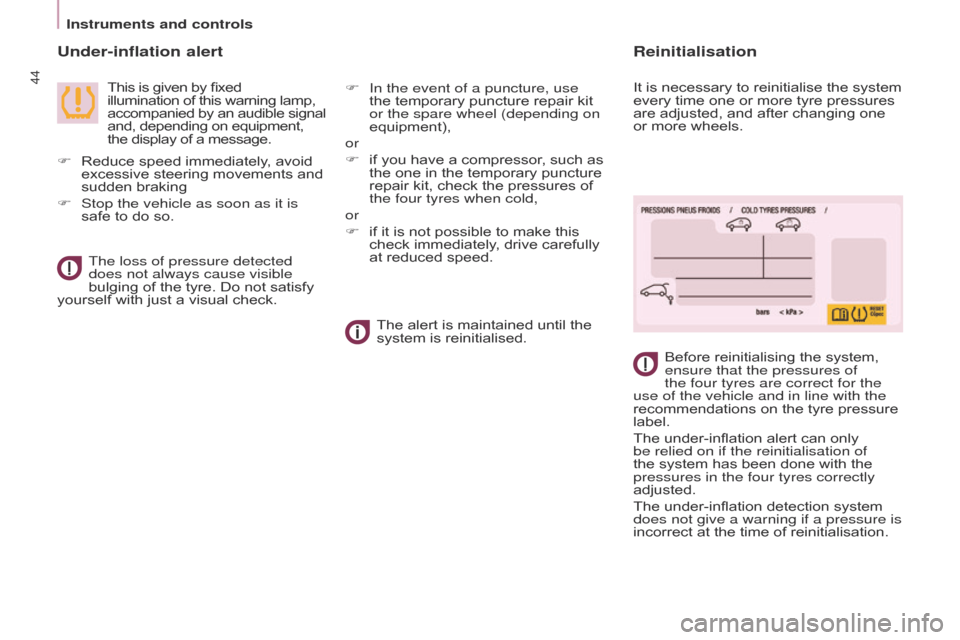
Before
reinitialising the system,
ensure that the pressures of
the four tyres are correct for the
use of the vehicle and in line with the
recommendations
on the tyre pressure
label.
The
under-inflation alert can only
be relied on if the reinitialisation of
the
system has been done with the
pressures in the four tyres correctly
adjusted.
The
under-inflation detection system
does not give a warning if a pressure is
incorrect
at the time of reinitialisation.
The loss of pressure detected
does not always cause visible
bulging
of the tyre. Do not satisfy
yourself
with just a visual check. The
alert is maintained until the
system
is reinitialised.
F
Reduce
speed immediately, avoid
excessive
steering movements and
sudden
braking
F
Stop the vehicle as soon as it is
safe
to do so. F
In the event of a puncture, use
the
temporary puncture repair kit
or the spare wheel (depending on
equipment),
or
F
if
you have a compressor, such as
the
one in the temporary puncture
repair
kit, check the pressures of
the four tyres when cold,
or
F
if
it is not possible to make this
check
immediately, drive carefully
at
reduced speed.
Reinitialisation
It is necessary to reinitialise the system every time one or more tyre pressures
are
adjusted, and after changing one
or
more wheels.
Page 173 of 296
171
Berlingo-2-VP_en_Chap08_aide-rapide_ed01-2016
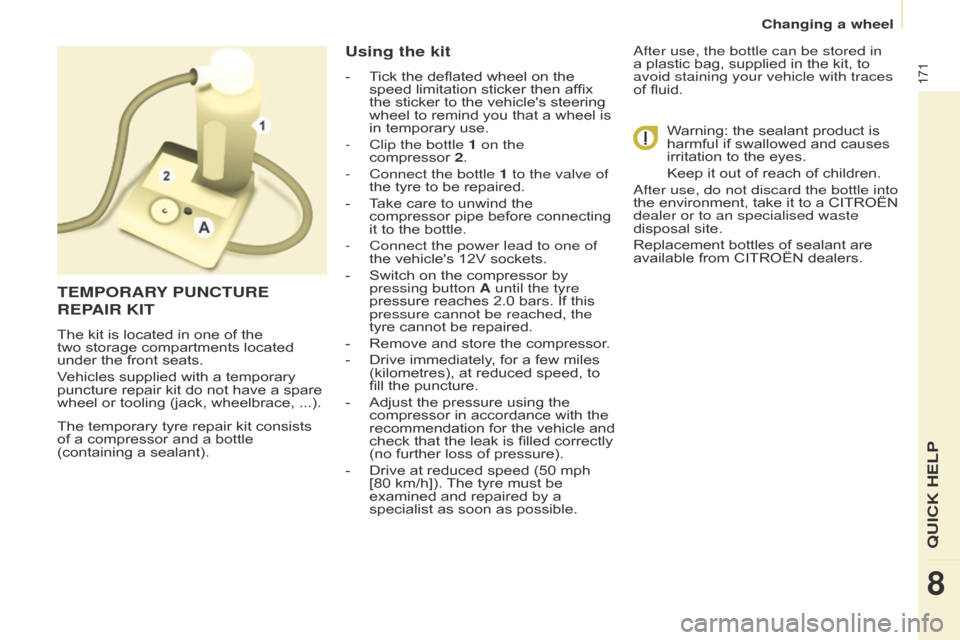
The temporary tyre repair kit consists of a compressor and a bottle
(containing
a sealant).
Using the kit
- Tick the deflated wheel on the speed
limitation sticker then affix
the
sticker to the vehicle's steering
wheel
to remind you that a wheel is
in
temporary use.
-
Clip the bottle
1 on the
compressor 2.
-
Connect the bottle
1 to the valve of
the
tyre to be repaired.
-
T
ake care to unwind the
compressor
pipe before connecting
it
to the bottle.
-
Connect the power lead to one of
the
vehicle's 12V sockets.
-
Switch
on the compressor by
pressing button
A until the tyre
pressure
reaches 2.0 bars. If this
pressure cannot be reached, the
tyre
cannot be repaired.
-
Remove
and store the compressor.
-
Drive
immediately, for a few miles
(kilometres),
at reduced speed, to
fill
the puncture.
-
Adjust
the pressure using the
compressor
in accordance with the
recommendation
for
the
vehicle
and
check
that the leak is filled correctly
(no
further loss of pressure).
-
Drive
at reduced speed (50 mph
[80
km/h]).
The
tyre must be
examined
and repaired by a
specialist
as soon as possible.
a
fter use, the bottle can be stored in
a plastic bag, supplied in the kit, to avoid staining your vehicle with traces
of
fluid.
Warning:
the sealant product is
harmful
if swallowed and causes
irritation
to the eyes.
Keep
it out of reach of children.
a
fter use, do not discard the bottle into
the
environment, take it to a CITROËN
dealer or to an specialised waste
disposal
site.
Replacement
bottles of sealant are
available
from CITROËN dealers.
TEMPORARY PUNCTURE
REP
AIR KIT
The kit is located in one of the two storage compartments located
under
the front seats.
Vehicles
supplied with a temporary
puncture
repair kit do not have a spare
wheel
or tooling (jack, wheelbrace, ...).
QUICk HELP
8
Changing a wheel
Page 176 of 296
174
Berlingo-2-VP_en_Chap08_aide-rapide_ed01-2016
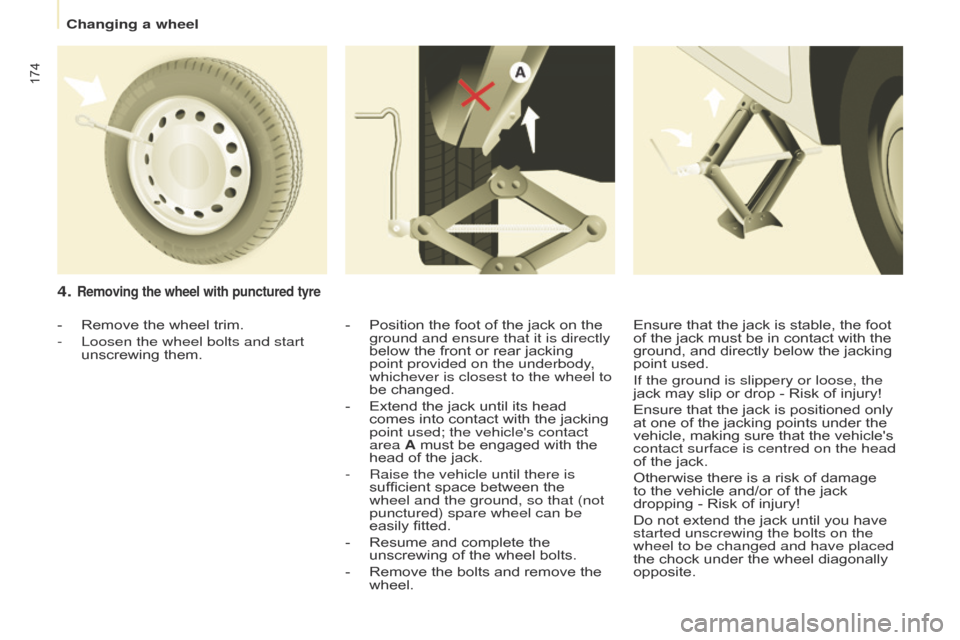
4. Removing the wheel with punctured tyre
- Position the foot of the jack on the ground and ensure that it is directly
below
the front or rear jacking
point provided on the underbody
,
whichever is closest to the wheel to
be
changed.
-
Extend
the jack until its head
comes
into contact with the jacking
point used; the vehicle's contact
area
A must be engaged with the
head
of the jack.
-
Raise the vehicle until there is
sufficient
space between the
wheel and the ground, so that (not
punctured) spare wheel can be
easily
fitted.
-
Resume
and complete the
unscrewing
of the wheel bolts.
-
Remove
the bolts and remove the
wheel.
-
Remove
the
wheel
trim.
-
Loosen the wheel bolts and start
unscrewing
them. Ensure
that the jack is stable, the foot of
the jack must be in contact with the
ground,
and directly below the jacking
point
used.
If the ground is slippery or loose, the
jack
may slip or drop - Risk of injury!
Ensure
that the jack is positioned only
at
one of the jacking points under the
vehicle,
making sure that the vehicle's
contact surface is centred on the head
of
the jack.
Otherwise
there is a risk of damage
to
the vehicle and/or of the jack
dropping -
Risk of injury!
Do
not extend the jack until you have
started unscrewing the bolts on the
wheel to be changed and have placed
the
chock under the wheel diagonally
opposite.
Changing a wheel
Page 178 of 296

176
Berlingo-2-VP_en_Chap08_aide-rapide_ed01-2016
FITTING THE WHEEL
TRIM
The tyre valve must be centred in the wheel
trim cut-out.
This
position is essential for fitting the
wheel
trim correctly on the steel wheel.
(If
the valve is not correctly aligned with
the
cut-out, the anti-rotation system
will be in contact with the heads of the
wheel
bolts and risks being damaged
if
the user persists in fitting the wheel
trim
in this incorrect position). -
Ensure that all of the clips are
engaged except the last one
(opposite
the valve hole).
-
Strike
the wheel trim with the palm
of your hand, opposite the valve
in
the area of the last fixing clip
(always
in the direction of clipping).
-
Ensure that the outer edge of
the
wheel trim is not deformed or
pushed
into the wheel:
●
Correct
position for the edge of
the
wheel trim.
●
Incorrect
position for the edge of
the
wheel trim.
6. Refitting the repaired wheel
The wheel is refitted as described in step 5, not forgetting to refit the wheel
trim.
Refer
to the "Instruments and
controls" section of chapter 3,
"T
yre under-inflation detection"
part,
for recommendations after
changing
a wheel fitted with a tyre
under-inflation
detection sensor.
Refer
to the "Identification
markings"
section of chapter 9 to
locate
the tyre label.
The spare wheel is not designed
to
be used over long distances.
Have the tightening of the bolts
and
the tyre pressure checked by
a
CITROËN dealer or a qualified
workshop
as soon as possible.
Have the original wheel repaired
and
refitted by a CITROËN dealer
or
a qualified workshop as soon as
possible.
Changing a wheel
Page 181 of 296
179
Berlingo-2-VP_en_Chap08_aide-rapide_ed01-2016
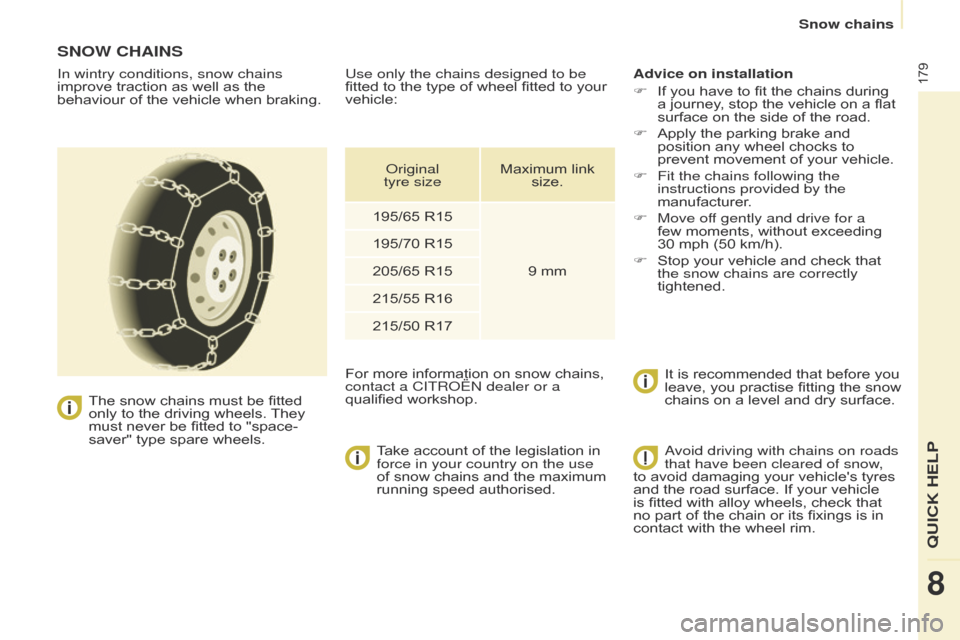
SNOW CHAINS
In wintry conditions, snow chains
improve traction as well as the
behaviour
of the vehicle when braking.
The
snow chains must be fitted
only
to the driving wheels.
They
must
never be fitted to "space-
saver"
type spare wheels.
T
ake account of the legislation in
force in your country on the use
of
snow chains and the maximum
running
speed authorised.Advice on installation
F
If
you have to fit the chains during
a
journey, stop the vehicle on a flat
surface
on the side of the road.
F
Apply
the parking brake and
position
any wheel chocks to
prevent
movement of your vehicle.
F
Fit the chains following the
instructions provided by the
manufacturer
.
F
Move of
f gently and drive for a
few
moments, without exceeding
30
mph (50 km/h).
F
Stop
your vehicle and check that
the snow chains are correctly
tightened.It
is recommended that before you
leave,
you practise fitting the snow
chains
on a level and dry surface.
Use only the chains designed to be
fitted
to the type of wheel fitted to your
vehicle:
For
more information on snow chains,
contact a CITR
o Ë n dealer or a
qualified
workshop.
o
riginal
tyre size Maximum
link
size.
195/65
R159
mm
195/70
R15
205/65
R15
215/55
R16
215/50
R17
avoid driving with chains on roads
that have been cleared of snow
,
to
avoid damaging your vehicle's tyres
and
the road surface. If your vehicle
is
fitted with alloy wheels, check that
no
part of the chain or its fixings is in
contact
with the wheel rim.
QUICk HELP
8
Snow chains