Trailer CITROEN BERLINGO VAN 2020 User Guide
[x] Cancel search | Manufacturer: CITROEN, Model Year: 2020, Model line: BERLINGO VAN, Model: CITROEN BERLINGO VAN 2020Pages: 324, PDF Size: 9.41 MB
Page 165 of 324
163
Driving
6bicycle carrier is connected to a towing device
installed in accordance with the
manufacturer's recommendations.
In this case, the outline of a trailer is displayed
at the rear of the image of the vehicle.
The parking sensors are deactivated while the
Park Assist function is measuring a space.
For more information on the Park
Assist
function, refer to the corresponding
section.
Operating limits
If the boot is heavily loaded, the vehicle may tilt,
affecting distance measurements.
Malfunction
In the event of a malfunction when
changing into reverse gear, this warning
lamp lights up on the instrument panel,
accompanied by the display of a message and
an audible signal (short beep).
Have it checked by a CITROËN dealer or a
qualified workshop.
Reversing camera
For more information, refer to the
General recommendations on the use
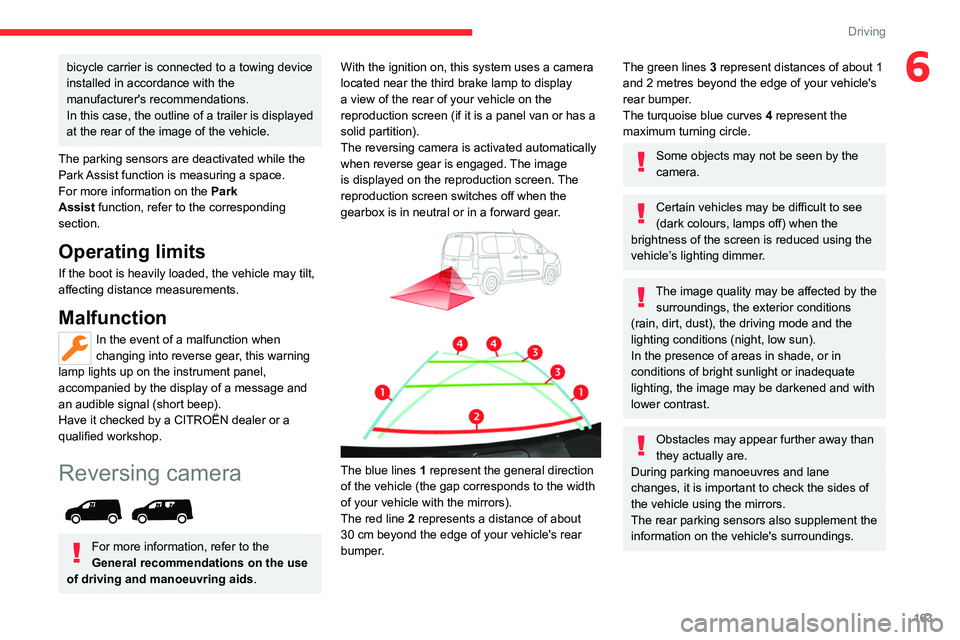
of driving and manoeuvring aids .With the ignition on, this system uses a camera
located near the third brake lamp to display
a view of the rear of your vehicle on the
reproduction screen (if it is a panel van or has a
solid partition).
The reversing camera is activated automatically
when reverse gear is engaged. The image
is displayed on the reproduction screen. The
reproduction screen switches off when the
gearbox is in neutral or in a forward gear.
The blue lines 1 represent the general direction
of the vehicle (the gap corresponds to the width
of your vehicle with the mirrors).
The red line 2 represents a distance of about
30
cm beyond the edge of your vehicle's rear
bumper.
The green lines 3 represent distances of about 1
and 2 metres beyond the edge of your vehicle's
rear bumper.
The turquoise blue curves 4 represent the
maximum turning circle.
Some objects may not be seen by the
camera.
Certain vehicles may be difficult to see
(dark colours, lamps off) when the
brightness of the screen is reduced using the
vehicle’s lighting dimmer.
The image quality may be affected by the surroundings, the exterior conditions
(rain, dirt, dust), the driving mode and the
lighting conditions (night, low sun).
In the presence of areas in shade, or in
conditions of bright sunlight or inadequate
lighting, the image may be darkened and with
lower contrast.
Obstacles may appear further away than
they actually are.
During parking manoeuvres and lane
changes, it is important to check the sides of
the vehicle using the mirrors.
The rear parking sensors also supplement the
information on the vehicle's surroundings.
Page 166 of 324
164
Driving
Operating limits
The system may be disrupted (or even
damaged) and not work in the following
situations:
–
Installation of a bicycle carrier on the tailgate
or side-hinged door (depending on version).
–
Attachment of a trailer to the towball.
–
Driving with a door open.
Please note, the camera must not be
obscured (by a sticker, a bicycle carrier,
etc.).
The field of vision of the camera may vary depending on the load in vehicle.
Maintenance
recommendations
In bad or wintry weather, ensure that the camera
is not covered by mud, frost or snow.
Check the cleanliness of the camera lens
regularly.
If necessary, clean the camera with a soft, dry
cloth.
When washing the vehicle using a high-pressure
jet, keep the spray directed at least 30
cm away
from the camera.
Surround Rear Vision
For more information, refer to the
General recommendations on the use
of driving and manoeuvring aids .
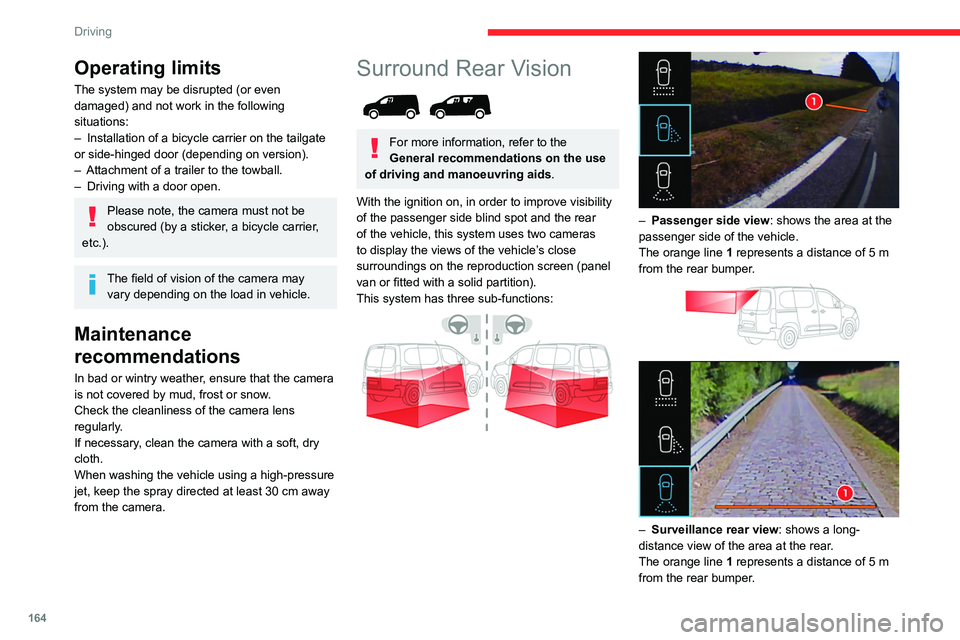
With the ignition on, in order to improve visibility
of the passenger side blind spot and the rear
of the vehicle, this system uses two cameras
to display the views of the vehicle’s close
surroundings on the reproduction screen (panel
van or fitted with a solid partition).
This system has three sub-functions:
– Passenger side view : shows the area at the
passenger side of the vehicle.
The orange line 1 represents a distance of 5
m
from the rear bumper.
– Surveillance rear view : shows a long-
distance view of the area at the rear.
The orange line 1 represents a distance of 5
m
from the rear bumper.
Page 168 of 324
166
Driving
Operation
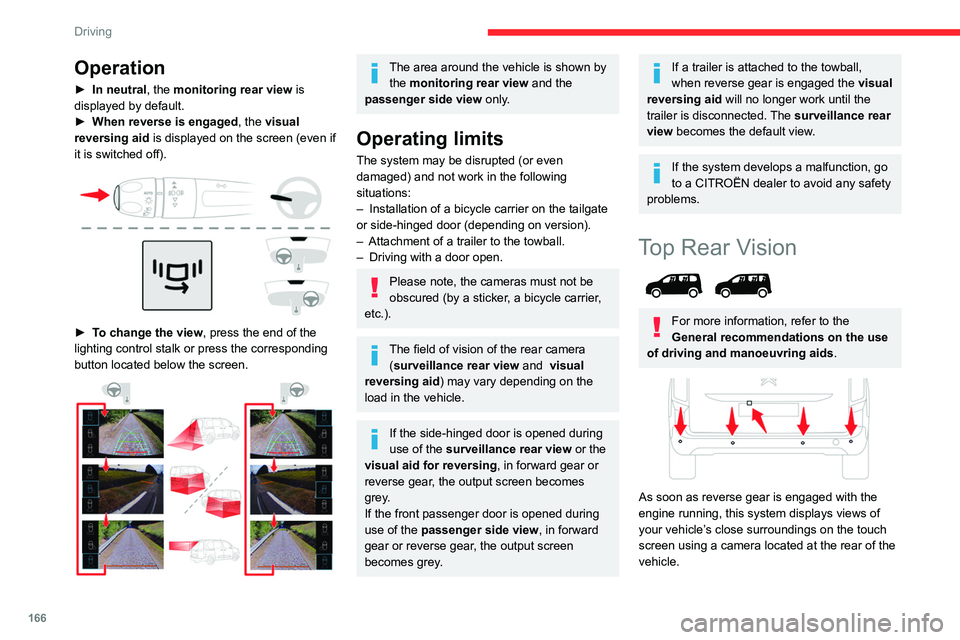
► In neutral, the monitoring rear view is
displayed by default.
►
When reverse is engaged
, the visual
reversing aid is displayed on the screen (even if
it is switched off).
► To change the view , press the end of the
lighting control stalk or press the corresponding
button located below the screen.
The area around the vehicle is shown by the monitoring rear view and the
passenger side view only.
Operating limits
The system may be disrupted (or even
damaged) and not work in the following
situations:
–
Installation of a bicycle carrier on the tailgate
or side-hinged door (depending on version).
–
Attachment of a trailer to the towball.
–
Driving with a door open.
Please note, the cameras must not be
obscured (by a sticker, a bicycle carrier,
etc.).
The field of vision of the rear camera (surveillance rear view and visual
reversing aid) may vary depending on the
load in the vehicle.
If the side-hinged door is opened during
use of the surveillance rear view or the
visual aid for reversing, in forward gear or
reverse gear, the output screen becomes
grey.
If the front passenger door is opened during
use of the passenger side view, in forward
gear or reverse gear, the output screen
becomes grey.
If a trailer is attached to the towball,
when reverse gear is engaged the visual
reversing aid will no longer work until the
trailer is disconnected. The surveillance rear
view becomes the default view.
If the system develops a malfunction, go
to a CITROËN dealer to avoid any safety
problems.
Top Rear Vision
For more information, refer to the
General recommendations on the use
of driving and manoeuvring aids .
As soon as reverse gear is engaged with the
engine running, this system displays views of
your vehicle’s close surroundings on the touch
screen using a camera located at the rear of the
vehicle.
Page 191 of 324
189
Practical information
7In case of difficulty with installation/
removal
Contact a CITROËN dealer or a qualified
workshop.
Before any operation, ensure that the
engine is off and the cooling fan has
stopped.
It is essential to remove them when:
– the outside temperature exceeds
10°C.
–
recovery is in progress.
–
the speed is above 75 mph (120
km/h).
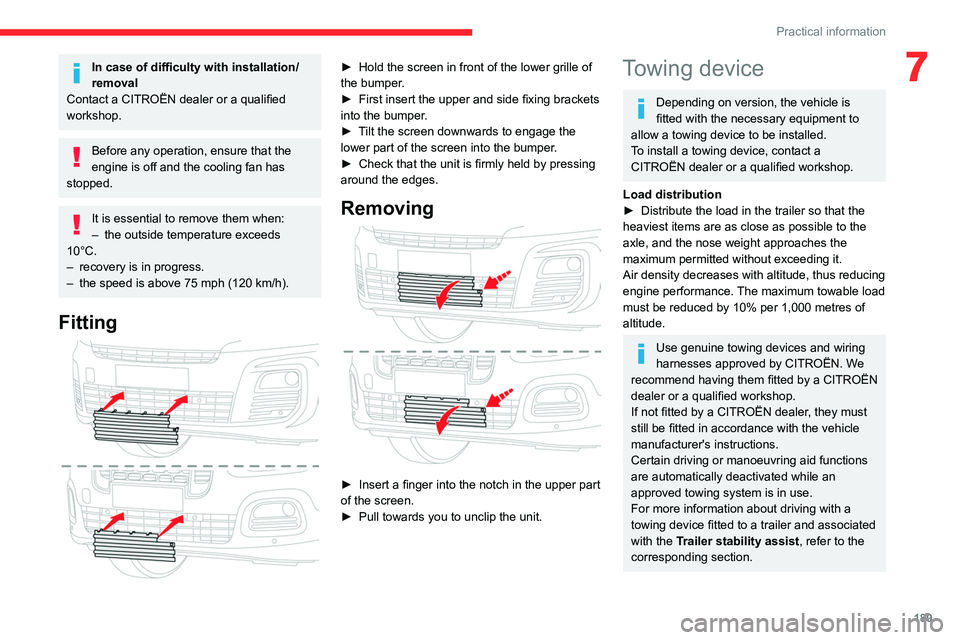
Fitting
► Hold the screen in front of the lower grille of
the bumper .
►
First insert the upper and side fixing brackets
into the bumper
.
►
T
ilt the screen downwards to engage the
lower part of the screen into the bumper.
►
Check that the unit is firmly held by pressing
around the edges.
Removing
► Insert a finger into the notch in the upper part
of the screen.
►
Pull towards you to unclip the unit.
Towing device
Depending on version, the vehicle is
fitted with the necessary equipment to
allow a towing device to be installed.
To install a towing device, contact a
CITROËN dealer or a qualified workshop.
Load distribution
►
Distribute the load in the trailer so that the
heaviest items are as close as possible to the
axle, and the nose weight approaches the
maximum permitted without exceeding it.
Air density decreases with altitude, thus reducing
engine performance.
The maximum towable load
must be reduced by 10% per 1,000
metres of
altitude.
Use genuine towing devices and wiring
harnesses approved by CITROËN. We
recommend having them fitted by a CITROËN
dealer or a qualified workshop.
If not fitted by a CITROËN dealer, they must
still be fitted in accordance with the vehicle
manufacturer's instructions.
Certain driving or manoeuvring aid functions
are automatically deactivated while an
approved towing system is in use.
For more information about driving with a
towing device fitted to a trailer and associated
with the Trailer stability assist, refer to the
corresponding section.
Page 192 of 324
190
Practical information
Comply with the maximum authorised
towable weight, as indicated on your
vehicle's registration certificate, on the
manufacturer's label and in the Technical
data section of this guide.
If using accessories attached to the
towing device (e.g. bicycle carriers, tow
boxes):
–
Comply with the maximum authorised nose
weight.
–
Do not transport more than 4 conventional
bicycles or 2 electric bicycles.
When loading bicycles onto a bicycle carrier
on a towball, be sure to place the heaviest
bicycles as close as possible to the vehicle.
Observe the legislation in force in the
country where you are driving.
Electric motor
An electric vehicle may be fitted with a
towing device.
It is therefore possible to tow a trailer or
caravan.
Contact a CITROËN dealer or qualified
workshop for more information and to obtain a
suitable towing device.
Overload indicator
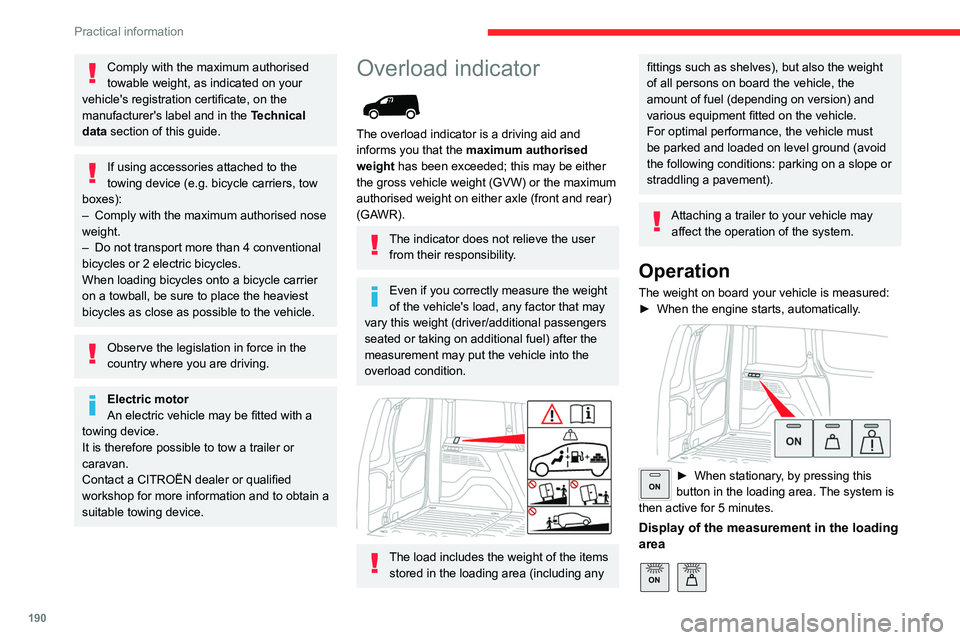
The overload indicator is a driving aid and
informs you that the maximum authorised
weight has been exceeded; this may be either
the gross vehicle weight (GVW) or the maximum
authorised weight on either axle (front and rear)
(GAWR).
The indicator does not relieve the user from their responsibility.
Even if you correctly measure the weight
of the vehicle's load, any factor that may
vary this weight (driver/additional passengers
seated or taking on additional fuel) after the
measurement may put the vehicle into the
overload condition.
The load includes the weight of the items stored in the loading area (including any
fittings such as shelves), but also the weight
of all persons on board the vehicle, the
amount of fuel (depending on version) and
various equipment fitted on the vehicle.
For optimal performance, the vehicle must
be parked and loaded on level ground (avoid
the following conditions: parking on a slope or
straddling a pavement).
Attaching a trailer to your vehicle may affect the operation of the system.
Operation
The weight on board your vehicle is measured:
► When the engine starts, automatically .
ON► When stationary, by pressing this
button in the loading area. The system is
then active for 5 minutes.
Display of the measurement in the loading
area
ON
Page 229 of 324
227
Technical data
9Engine technical data and
towed loads
Engines
The engine characteristics are given in the
vehicle's registration document, as well as in
sales brochures.
Only the values available at the time of
publication are presented in the tables.
Contact a CITROËN dealer or a qualified
workshop to obtain missing values.
The maximum power corresponds to the value type-approved on a test bed, under
conditions defined by European legislation
(Directive 1999/99/EC). For more information, contact a CITROËN dealer
or a qualified workshop.
Weights and towed loads
The weights and towed loads relating to
the vehicle are indicated on the registration
document, as well as in sales brochures.
These values are also indicated on the
manufacturer's plate or label.
For more information, contact a CITROËN dealer
or a qualified workshop.
The GTW (Gross Train Weight) and towed load
values indicated are valid up to a maximum
altitude of 1,000 metres. The towed load value
must be reduced by 10% for each additional
1,000 metres of altitude.
The maximum authorised nose weight
corresponds to the weight permitted on the
towball.
When exterior temperatures are high, the
vehicle performance may be limited in
order to protect the engine. When the exterior
temperature is higher than 37°C, reduce the
towed weight.
Towing even with a lightly loaded vehicle can adversely affect its road holding.
Braking distances are increased when towing
a trailer.
When using a vehicle to tow, never exceed
a speed of 62 mph (100
km/h) (observe the
local legislation in force).
If the exterior temperature is high, it is
recommended that the engine is allowed
to idle for 1 to 2 minutes after the vehicle
comes to a stop, to facilitate its cooling.
Engines and towed loads - PETROL
Vehicles fitted with the VTi 110 BVM5 engine are not suitable for towing.
Page 230 of 324
228
Technical data
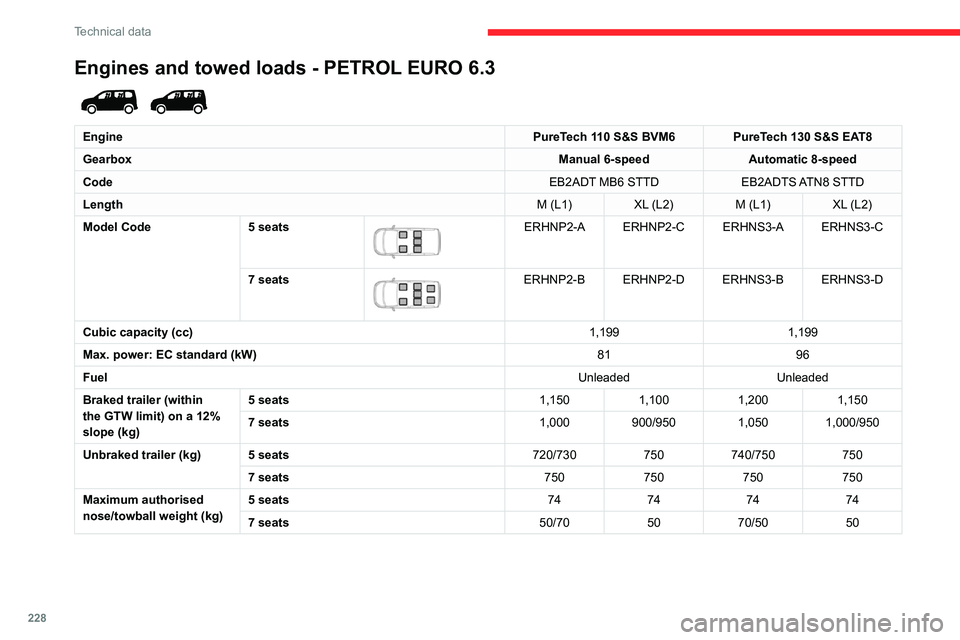
Engines and towed loads - PETROL EURO 6.3
EnginePureTech 110 S&S BVM6 PureTech 130 S&S EAT8
Gearbox Manual 6-speedAutomatic 8-speed
Code EB2ADT MB6 STTDEB2ADTS ATN8 STTD
Length M (L1)XL (L2) M (L1)XL (L2)
Model Code 5 seats
ERHNP2-A ERHNP2-C ERHNS3-A ERHNS3-C
7 seats
ERHNP2-B ERHNP2-D ERHNS3-B ERHNS3-D
Cubic capacity (cc) 1,1991,199
Max. power: EC standard (kW) 8196
Fuel UnleadedUnleaded
Braked trailer (within
the GTW limit) on a 12%
slope (kg) 5 seats
1,1501,1001,2001,150
7 seats 1,000900/950 1,0501,000/950
Unbraked trailer (kg) 5 seats 720/730750740/750 750
7 seats 750750750750
Maximum authorised
nose/towball weight (kg) 5 seats
74747474
7 seats 50/705070/50 50
Page 231 of 324
229
Technical data
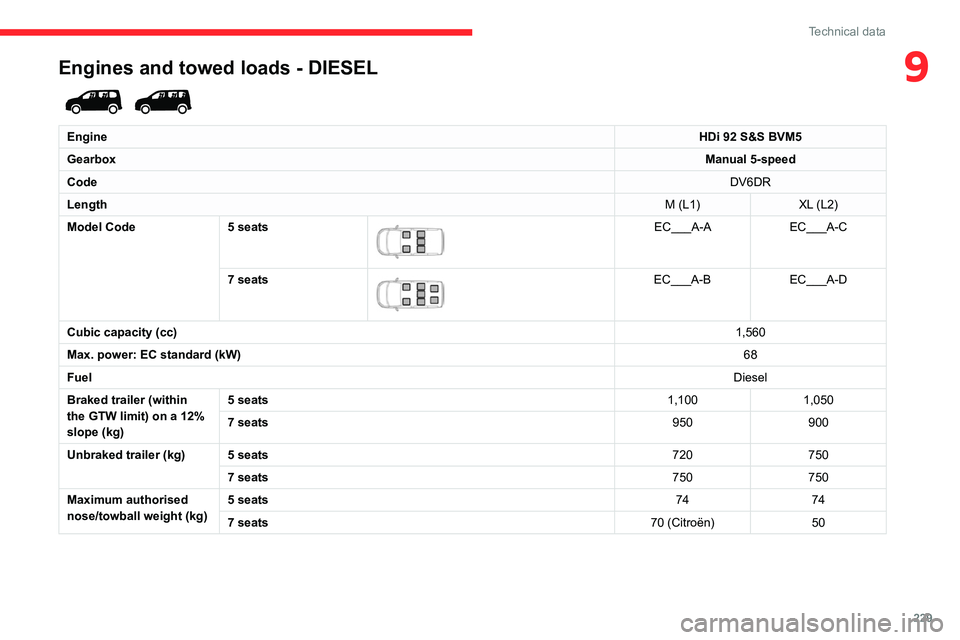
9Engines and towed loads - DIESEL
EngineHDi 92 S&S BVM5
Gearbox Manual 5-speed
Code DV6DR
Length M (L1)XL (L2)
Model Code 5 seats
EC___A-AEC___A-C
7 seats
EC___A-B EC___A-D
Cubic capacity (cc) 1,560
Max. power: EC standard (kW) 68
Fuel Diesel
Braked trailer (within
the GTW limit) on a 12%
slope (kg) 5 seats
1,1001,050
7 seats 950900
Unbraked trailer (kg) 5 seats 720750
7 seats 750750
Maximum authorised
nose/towball weight (kg) 5 seats
7474
7 seats 70 (Citroën)50
Page 232 of 324
230
Technical data
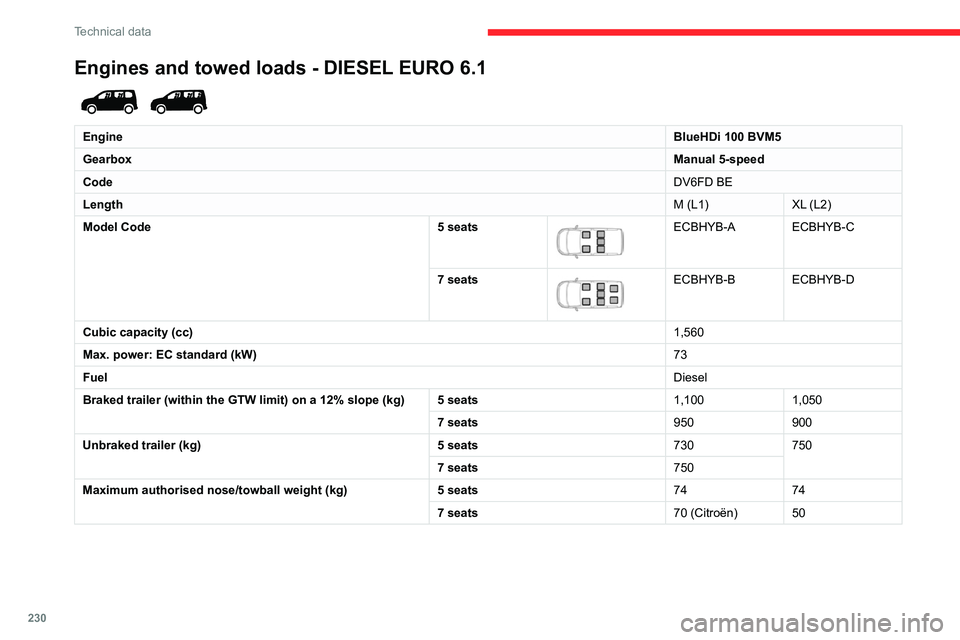
Engines and towed loads - DIESEL EURO 6.1
EngineBlueHDi 100 BVM5
Gearbox Manual 5-speed
Code DV6FD BE
Length M (L1)XL (L2)
Model Code 5 seats
ECBHYB-A ECBHYB-C
7 seats
ECBHYB-B ECBHYB-D
Cubic capacity (cc) 1,560
Max. power: EC standard (kW) 73
Fuel Diesel
Braked trailer (within the GTW limit) on a 12% slope (kg) 5 seats 1,1001,050
7 seats 950900
Unbraked trailer (kg) 5 seats730750
7 seats 750
Maximum authorised nose/towball weight (kg) 5 seats7474
7 seats 70 (Citroën) 50
Page 233 of 324
231
Technical data
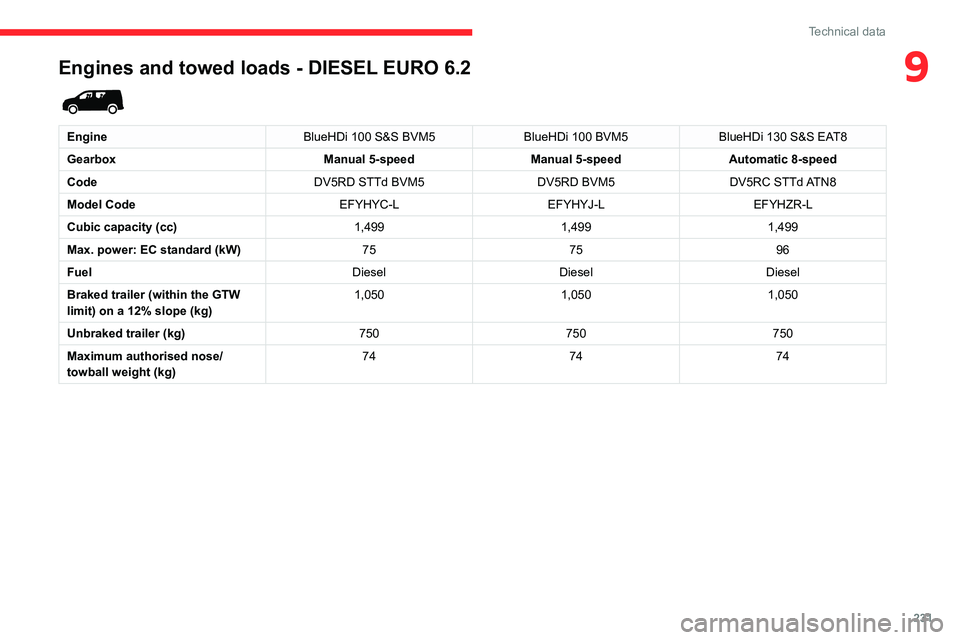
9Engines and towed loads - DIESEL EURO 6.2
EngineBlueHDi 100 S&S BVM5BlueHDi 100 BVM5BlueHDi 130 S&S EAT8
Gearbox Manual 5-speedManual 5-speedAutomatic 8-speed
Code DV5RD STTd BVM5DV5RD BVM5DV5RC STTd ATN8
Model Code EFYHYC-LEFYHYJ-LEFYHZR-L
Cubic capacity (cc) 1,4991,4991,499
Max. power: EC standard (kW) 757596
Fuel DieselDieselDiesel
Braked trailer (within the GTW
limit) on a 12% slope (kg) 1,050
1,0501,050
Unbraked trailer (kg) 750750750
Maximum authorised nose/
towball weight (kg) 74
7474