lock Citroen C ZERO 2015 1.G User Guide
[x] Cancel search | Manufacturer: CITROEN, Model Year: 2015, Model line: C ZERO, Model: Citroen C ZERO 2015 1.GPages: 176, PDF Size: 5.21 MB
Page 49 of 176

47
C-zero_en_Chap04_conduite_ed01-2014
Starting - stopping the vehicle
- Position 1: LOCK The steering is locked.
-
Po
sition 2: ACC
Th
e ancillaries (radio, 12 V socket...) can
be used.
-
Po
sition 3: ON
Ig
nition on.
-
Po
sition 4: S TA R T
"R
eady" lamp on.
Mo
tor ready to drive the vehicle.
Ignition switch
F Check that the drive selector is in
position P.
F In
sert the key in the ignition switch.
F
Tu
rn the key to position 4 (S TA R T ) .
Starting Stopping
F Stop the vehicle.
F Ke ep your foot on the brake pedal.
F
Pl
ace the drive selector in position P .
F
Ap
ply the parking brake.
F
Tu
rn the key to position 1 (LOCK) .
F
Re
move the key from the ignition switch.
F
Ho
ld it in this position for a few
seconds until the " RE ADY " lamp
comes on accompanied by an
audible signal.
F
Re
lease the key.
Th
e key returns automatically to position 3
(ON) . Do not attach any heavy objects to the
key as this could weigh down on it when
in the ignition switch and cause a fault.
If you use the ancillaries for a prolonged
period (with the key in the ACC position),
you risk discharging the ancillaries
battery. Starting your vehicle will then no
longer be possible. Be aware .
4
Driving
Page 55 of 176
53
C-zero_en_Chap05_visibilite_ed01-2014
Daytime running lamps
Special daytime lighting so that the vehicle can
be seen more easily.
The daytime running lamps come on
automatically when starting the motor, if no
other lighting is on.
They cannot be deactivated.Automatic illumination of headlamps
With the main lighting control ring in the AUTO
position, the sidelamps and dipped beam headlamps
come on automatically, without any action by the
driver, when a low level of ambient light is detected.
When the light returns to a sufficient level or the
wipers are switched off, the lighting is switched off
automatically.
The sensor is located at the base of the windscreen.
Automatic illumination of
headlamps
Automatic lighting off
When the lighting stalk is in the
"AUTO" p osition, if the ignition switch is in
the "LOCK" or "ACC" position or if the key
has been removed, the lighting switches off
automatically when the driver's door is
opened . The initial setting is position "0"
.
Headlamp
adjustment
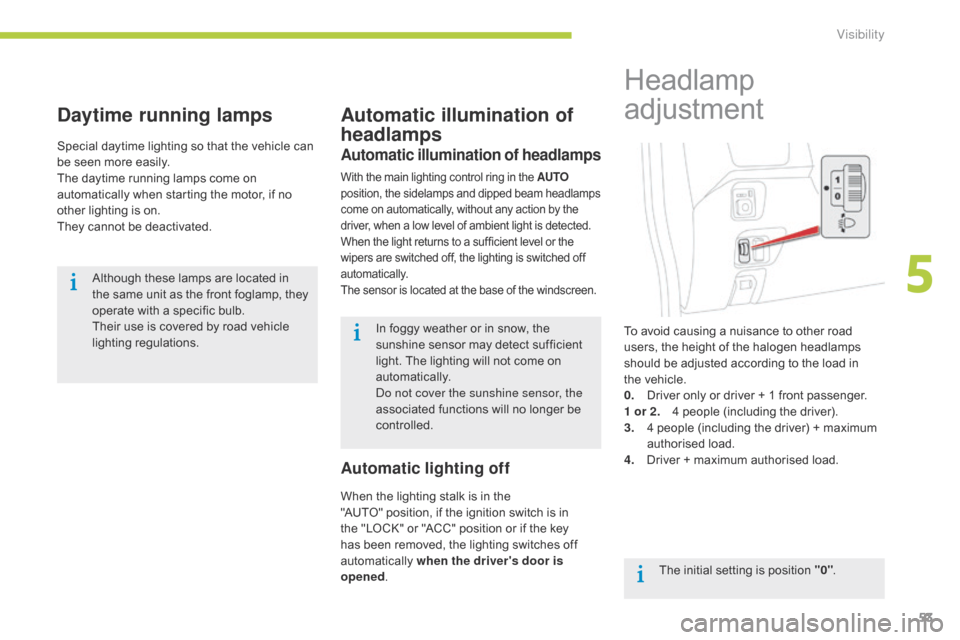
To avoid causing a nuisance to other road
users, the height of the halogen headlamps
should be adjusted according to the load in
the
v
ehicle.
0.
Dr
iver only or driver + 1 front passenger.
1 or 2.
4 pe
ople (including the driver).
3.
4 pe
ople (including the driver) + maximum
authorised load.
4.
Dr
iver + maximum authorised load.
Although these lamps are located in
the same unit as the front foglamp, they
operate with a specific bulb.
Their use is covered by road vehicle
lighting regulations.
In foggy weather or in snow, the
sunshine sensor may detect sufficient
light. The lighting will not come on
automatically.
do no
t cover the sunshine sensor, the
associated functions will no longer be
controlled.
5
Visibility
Page 57 of 176

55
C-zero_en_Chap05_visibilite_ed01-2014
Courtesy lamp
Position 1 "ON"
The courtesy lamp is permanently on.
Position 2 "●"
The courtesy lamp comes on when opening
a door or the boot; when the door or boot is
closed again, the lighting gradually dims for a
few seconds before going off.
However, the courtesy lamp is switched off
immediately when the doors and boot are
closed and you lock the vehicle from the inside
or using the remote control.
Position 3 "OFF"
The courtesy lamp is permanently off.Before leaving the vehicle, ensure that
the courtesy lamp is not on.
If left on, it discharges the ancillaries
battery, even if the main battery is
charged or on charge.
Starting your vehicle will then no longer
be possible.
5
Visibility
Page 64 of 176
62
C-zero_en_Chap06_securite_ed01-2014
Braking assistance systems
Anti-lock braking system
and electronic brake force
distributionGroup of supplementary systems which help
you to obtain optimum braking in complete
safety in emergency situations:
-
an
ti-lock braking system (ABS),
-
el
ectronic brake force distribution (EBFD),
-
em
ergency braking assistance (EBA).
When braking in an emergency, press
very firmly without releasing the
pressure.
Activation
The anti-lock braking system comes into
operation automatically when there is a risk of
wheel lock.
Normal operation of the ABS may make itself
felt by slight vibration of the brake pedal.
Linked systems which improve the stability and
manoeuvrability of your vehicle when braking,
in particular on poor or slippery sur faces.
Safety
Page 65 of 176

63
C-zero_en_Chap06_securite_ed01-2014
Fixed illumination of this warning
lamp indicates a malfunction of
the anti-lock braking system which
could result in a loss of control of the
vehicle on braking.
You must stop as soon as it is safe to do so.
Contact a CITROËN dealer or a qualified
workshop. Vehicle moving
Illumination of these two
warning lamps indicates a
malfunction of the electronic
brake force distribution
which could result in a loss of control of the
vehicle on braking.
You MUST stop as soon as it is safe to do so.
Contact a CITROËN dealer or a qualified
workshop.
When replacing wheels (tyres and rims),
ensure that they conform to the manufacturer's
recommendations.
Emergency braking assistance
System which, in an emergency, enables you
to obtain the optimum braking pressure more
quickly, thus reducing the stopping distance.
Activation
It is triggered by the speed at which the brake
pedal is pressed.
The effect of this is a reduction in the
resistance of the pedal and an increase in
braking efficiency.
When braking in an emergency, press
firmly without releasing the pressure.
Operating fault
Vehicle stationary
The warning lamp comes on for a few
seconds when the ignition is switched
on (ON position). If it does not go off or
does not come on, contact a CITROËN
dealer or a qualified workshop.Illumination of this warning lamp
indicates a malfunction of the anti-
lock braking system, which could
result in a loss of control of the
vehicle when braking.
Contact a CITROËN dealer or a qualified
workshop.
6
Safety
Page 69 of 176

67
C-zero_en_Chap06_securite_ed01-2014
The driver must ensure that passengers use
the seat belts correctly and that they are all
restrained securely before setting off.
Wherever you are seated in the vehicle,
always fasten your seat belt, even for short
journeys.
Do not interchange the seat belt buckles as
they will not fulfil their role fully.
The seat belts are fitted with an inertia reel
permitting automatic adjustment of the
length of the strap to your size. The seat belt
is stowed automatically when not in use.
Before and after use, ensure that the seat
belt is reeled in correctly.
The lower part of the strap must be
positioned as low as possible on the pelvis.
The upper part must be positioned in the
hollow of the shoulder.
The inertia reels are fitted with an automatic
locking device which comes into operation in
the event of a collision, emergency braking
or if the vehicle rolls over. You can release
the device by pulling the strap firmly and
then releasing it so that it reels in slightly.Recommendations for children
Use a suitable child seat if the passenger is
less than 12 years old or shorter than one
and a half metres.
Never use the same seat belt to secure more
than one person.
Never allow a child to travel on your lap.
For more information, refer to the "Child
seats" section.
In order to be effective, a seat belt must:
- be t
ightened as close to the body as
possible,
-
be p
ulled in front of you with a smooth
movement, checking that it does not
twist,
-
be u
sed to restrain only one person,
-
no
t bear any trace of cuts or fraying,
-
no
t be converted or modified to avoid
affecting its performance.
In accordance with current safety
regulations, for all repairs on your vehicle's
seat belts, go to a qualified workshop with
the skills and equipment needed, which a
CITROËN dealer is able to provide.
Have your seat belts checked regularly by
a CITROËN dealer or a qualified workshop,
particularly if the straps show signs of
damage.
Clean the seat belt straps with soapy
water or a textile cleaning product, sold by
CITROËN dealers.
After folding or moving a seat or rear bench
seat, ensure that the seat belt is positioned
and reeled in correctly.
In the event of an impact
Depending on the nature and
seriousness of the impact , the
pretensioning device may be deployed
before and independently of the airbags.
Deployment of the pretensioners is
accompanied by a slight discharge of
harmless smoke and a noise, due to the
activation of the pyrotechnic cartridge
incorporated in the system.
In all cases, the airbag warning lamp
comes
o
n.
Following an impact, have the seat belts
system checked, and if necessary replaced,
by a CITROËN dealer or a qualified
workshop.
6
Safety
Page 82 of 176

80
C-zero_en_Chap07_securite-enfants_ed01-2014
The incorrect installation of a child seat in a
vehicle compromises the child's protection
in the event of an accident.
Check that there is no seat belt or seat belt
buckle under the child seat as this could
destabilise it.
Remember to fasten the seat belts or the
child seat harnesses keeping the slack in
relation to the child's body to a minimum,
even for short journeys.
When installing a child seat using the seat
belt, check that the seat belt is tightened
correctly on the child seat and that it
secures the child seat firmly on the seat of
your vehicle.
at th
e rear seats, always leave sufficient
space between the front seat and:
-
a re
ar ward facing child seat,
-
th
e feet of a child seated in a for ward
facing child seat.
For this, move the front seat for ward and if
necessary straighten its backrest.
Advice on child seats
Children at the front
The legislation on carrying a child on the
front passenger seat is specific to each
c o unt r y.
Refer to the legislation in force in your
c o unt r y.
Deactivate the passenger's airbag when
a rear ward facing child seat is installed on
the front seat.
Other wise, the child would risk being
seriously injured or killed if the airbag were
deployed. For optimum installation of a for ward facing
child seat, ensure that the back of the
child seat is as close as possible to the
backrest of the vehicle's seat, or in contact
if possible.
The head restraint must be removed before
installing a child seat with a backrest on
the passenger seat. Ensure that the head
restraint is stowed or attached securely so
that it is not thrown around the vehicle in
the event of sharp braking.
Refit the head restraint as soon as the child
seat is removed.
Installing a booster seat
The chest part of the seat belt must be
positioned on the child's shoulder without
touching the neck.
Ensure that the lap part of the seat belt
passes correctly over the child's thighs.
CITROËN recommends the use of a
booster seat which has a back, fitted with a
seat belt guide at shoulder level.
As a safety precaution, do not leave:
-
on
e or more children alone and
unsupervised in a vehicle,
-
a ch
ild or an animal in a vehicle which
is exposed to the sun, with the windows
closed,
-
th
e keys within reach of children inside
the vehicle.
To prevent accidental opening of the doors,
use the "Child lock".
Take care not to open the rear windows by
more than one third.
To protect young children from the rays of
the sun, fit side blinds on the rear windows.
Child safety
Page 86 of 176

84
C-zero_en_Chap07_securite-enfants_ed01-2014
Child lock
Mechanical system to prevent opening of the
rear doors using their interior controls.
The control is located on the edge of each rear
d o o r.
Child lock on
F Lower the control A to position 1.
Child lock off
F Raise the control A to position 2.
Child safety
Page 87 of 176

85
C-zero_en_Chap08_info-pratiques_ed01-2014
Charging the main battery
F Pull lever 1, l ocated at the bottom of the
dashboard, driver's side, to open the
access flap for the normal charging socket
(right hand side of the vehicle).
Normal charging
Before connecting, check that the
electrical installation you want to use
meets standards* and is compatible
with a current rating of 8A.
In particular, check that the electric
power point is of suitable quality.
There are sockets available that are
specially designed for charging electric
vehicles.
In all cases, it is recommended that
that you first have an initial check
and then regular checks on your
installation by a qualified electrician.
There are two types of charging you can use:
normal or fast.
Normal charging should be used in preference;
it is done from a domestic mains power point.
Fast charging is done at a compatible fast
charging station.
F
Ap
ply the parking brake and put the drive
selector in position P .
F
Sw
itch off all electrical consumers and turn
the ignition switch to the "LOCK" position. You must always use only a genuine
CITROËN charging cable.
If the ambient temperature is lower
than
-
25° C, charging may not be
possible. F
Ta
ke the charging cable from the storage
bag provided. This cable has a control unit.
F
Co
nnect the charging cable to a compatible
standard power socket. On connecting
the cable, the three POWER , FA U LT and
CHARGING lamps all come on temporarily,
then only green POWER lamp stays on.
do no
t use an electrical
extension, multi-gang
socket, adaptor or timer.
* For example, in France the standard is NF C 15 -100.
In the event of damage to or
deterioration of the charging cable or
control unit, do not use it. Contact a
CITROËN dealer if in doubt or for a
replacement.
In most European countries, CITROËN
has established a partnership with a
specialist company that can check and
bring your electrical installation up to
standard. For more information, contact
a CITROËN dealer.
8
Practical information
Page 93 of 176

91
C-zero_en_Chap08_info-pratiques_ed01-2014
Check the compatibility of the charging
station and its charging cable with your
vehicle.F
Pr
ess latch 4 to open the socket cover.
F
En
sure that there is no foreign body on the
vehicle's charging socket.
Fast charging*
F Apply the parking brake and put the drive
s elector in position P .
F
Sw
itch off all electrical consumers and turn
the ignition switch to the "LOCK" position.
F
Pu
ll lever 3 , located alongside the driver's
seat, outer side, to open the access flap for
the fast charging socket (left hand side of
the vehicle). Do not touch the metal end of the
normal charging socket or of the
charging cable.
Risk of electrocution and/or faults.F
Co
nnect the charging cable of the charging
station to the vehicle following the
instructions on use of the station.
* Depending on equipment.
8
Practical information