ABS Citroen C1 2014 1.G Owner's Manual
[x] Cancel search | Manufacturer: CITROEN, Model Year: 2014, Model line: C1, Model: Citroen C1 2014 1.GPages: 256, PDF Size: 5.63 MB
Page 22 of 256

20
Emission control
systemfixed.
The emission control system has a
fault. Contact a CITROËN dealer or a qualified workshop
without delay.
Engine fault fixed. A major fault has been detected that
does not have a specific warning lamp. You must contact a CITROËN dealer or a qualified
workshop.
Anti-lock
Braking System
(ABS)
fixed.
The anti-lock braking system has a
fault. The vehicle retains conventional braking.
Drive carefully at reduced speed and contact a
CITROËN dealer or a qualified workshop without
d e l ay.
Dynamic
stability control
and traction
control (DSC/
TRC) flashing.
The DSC/ TRC system is in action. The system optimises traction and improves the
directional stability of the vehicle.
fixed. The DSC/ TRC system has a fault. Have it checked by a CITROËN dealer or a qualified
workshop.
Warning / indicator lamp
StateCause Action / Observations
Coolant
temperature flashing (VTi 68
engine only). The temperature of the engine
coolant is increasing. Drive gently.
fixed. The temperature of the engine
coolant is too high. Stop as soon as it is safe to do so.
Wait until the engine has cooled down before
checking up the level; top up if necessary.
If the problem persists, contact a CITROËN dealer or
qualified workshop.
Monitoring
Page 28 of 256
26
Trip computer
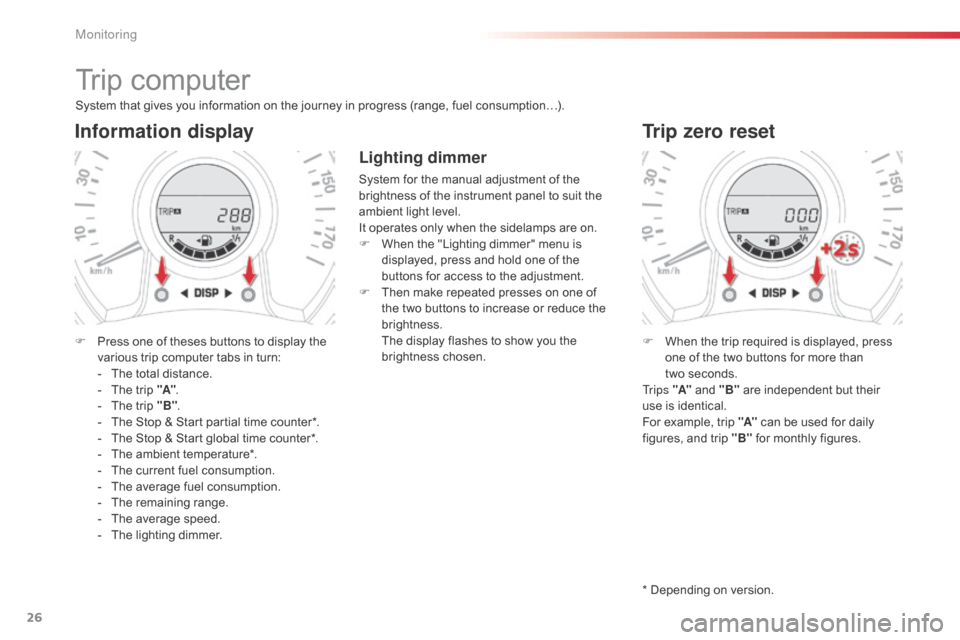
System that gives you information on the journey in progress (range, fuel consumption…).
Information display
F Press one of theses buttons to display the various trip computer tabs in turn:
-
T
he total distance.
-
T
he trip "A" .
-
T
he trip "B" .
-
T
he Stop & Start partial time counter*.
-
T
he Stop & Start global time counter*.
-
T
he ambient temperature*.
-
T
he current fuel consumption.
-
T
he average fuel consumption.
-
T
he remaining range.
-
T
he average speed.
-
T
he lighting dimmer.
Trip zero reset
F When the trip required is displayed, press one of the two buttons for more than
two
seconds.
Tr i p s "A" and "B" are independent but their
use is identical.
For example, trip "A" can be used for daily
figures, and trip "B" for monthly figures.
* Depending on version.
Lighting dimmer
System for the manual adjustment of the
brightness of the instrument panel to suit the
ambient light level.
It operates only when the sidelamps are on.
F
W
hen the "Lighting dimmer" menu is
displayed, press and hold one of the
buttons for access to the adjustment.
F
T
hen make repeated presses on one of
the two buttons to increase or reduce the
brightness.
T
he display flashes to show you the
brightness chosen.
Monitoring
Page 109 of 256
107
Electronic Stability Control (ESC) incorporating
the following systems:
-
a
nti-lock braking system (ABS) and the
electronic brake force distribution (EBFD),
-
em
ergency braking assistance,
-
t
raction control (TRC),
-
d
ynamic stability control (DSC).
Electronic stability control (ESC)
Definitions
Anti-lock braking system (ABS)
and electronic brake force
distribution (EBFD)
These systems improve the stability and
manoeuvrability of your vehicle when braking
and contribute towards better control in
corners, in particular on poor or slippery road
surfaces.
The ABS prevents wheel lock in the event of
emergency braking.
The electronic brake force distribution system
manages the braking pressure wheel by wheel.
Emergency braking assistance
In an emergency, this system enables you to
reach the optimum braking pressure more
quickly and therefore reduce the stopping
distance.
It is triggered according to the speed at which
the brake pedal is pressed. This is felt by a
reduction in the resistance of the pedal and an
increase in the effectiveness of the braking.
Traction control (TRC)
This system optimises traction in order to limit
wheel slip by acting on the brakes of the driving
wheels and on the engine. It also improves
the directional stability of the vehicle on
acceleration.
Dynamic stability control (DSC)
If there is a difference between the path
followed by the vehicle and that required by the
driver, this system monitors each wheel and
automatically acts on the brake of one or more
wheels and on the engine to return the vehicle
to the required path, within the limits of the laws
of physics.
7
Safety
Page 110 of 256
108
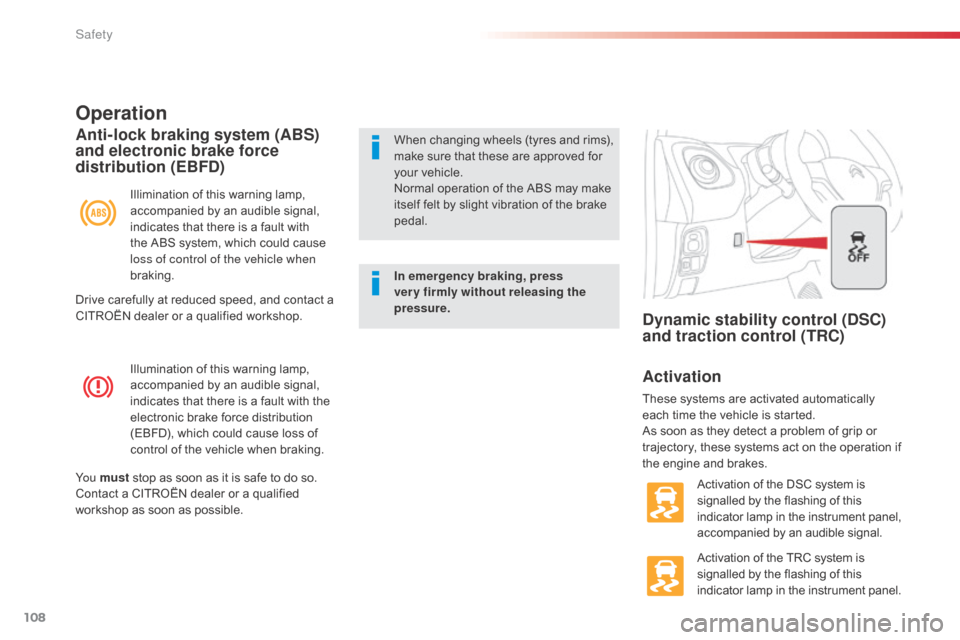
Illumination of this warning lamp,
accompanied by an audible signal,
indicates that there is a fault with the
electronic brake force distribution
(EBFD), which could cause loss of
control of the vehicle when braking.
Operation
Illimination of this warning lamp,
accompanied by an audible signal,
indicates that there is a fault with
the ABS system, which could cause
loss of control of the vehicle when
braking.
Anti-lock braking system (ABS)
and electronic brake force
distribution (EBFD)When changing wheels (tyres and rims),
make sure that these are approved for
your vehicle.
Normal operation of the ABS may make
itself felt by slight vibration of the brake
pedal.
In emergency braking, press
very firmly without releasing the
pressure.
Yo u must stop as soon as it is safe to do so.
Contact a CITROËN dealer or a qualified
workshop as soon as possible.
Dynamic stability control (DSC)
and traction control (TRC)
Activation
These systems are activated automatically
each time the vehicle is started.
As soon as they detect a problem of grip or
trajectory, these systems act on the operation if
the engine and brakes.
Activation of the DSC system is
signalled by the flashing of this
indicator lamp in the instrument panel,
accompanied by an audible signal.
Activation of the TRC system is
signalled by the flashing of this
indicator lamp in the instrument panel.
Drive carefully at reduced speed, and contact a
CITROËN dealer or a qualified workshop.
Safety
Page 156 of 256
154
Dashboard fuses
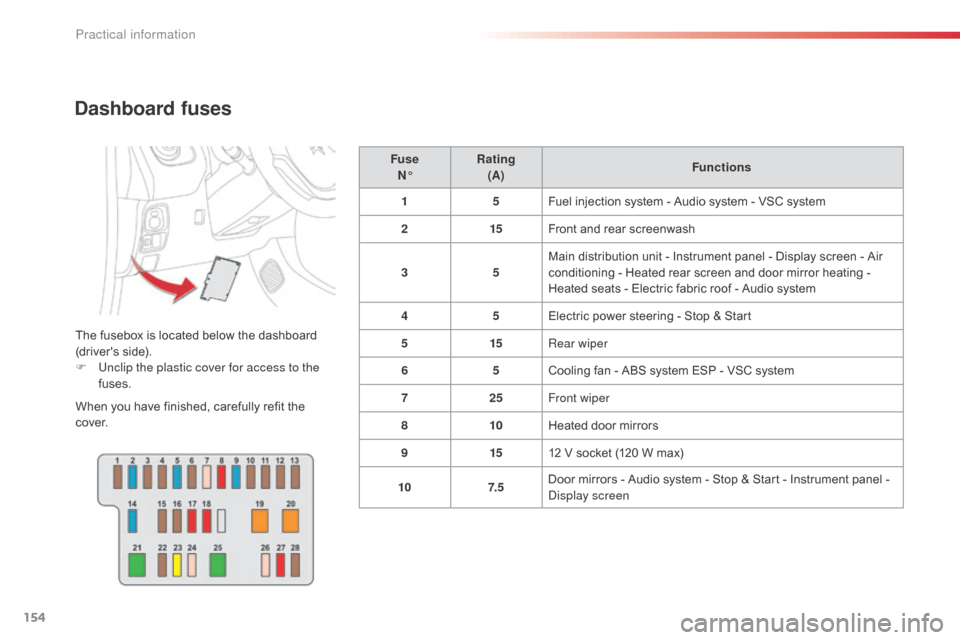
The fusebox is located below the dashboard
(driver's side).
F
U
nclip the plastic cover for access to the
fuses.
When you have finished, carefully refit the
c ove r. Fuse
N° Rating
(A) Functions
1 5Fuel injection system - Audio system - VSC system
2 15Front and rear screenwash
3 5Main distribution unit - Instrument panel - Display screen - Air
conditioning - Heated rear screen and door mirror heating -
Heated seats - Electric fabric roof - Audio system
4 5Electric power steering - Stop & Start
5 15Rear wiper
6 5Cooling fan - ABS system ESP - VSC system
7 25Front wiper
8 10Heated door mirrors
9 1512 V socket (120 W max)
10 7. 5Door mirrors - Audio system - Stop & Start - Instrument panel -
di
splay screen
Practical information
Page 157 of 256
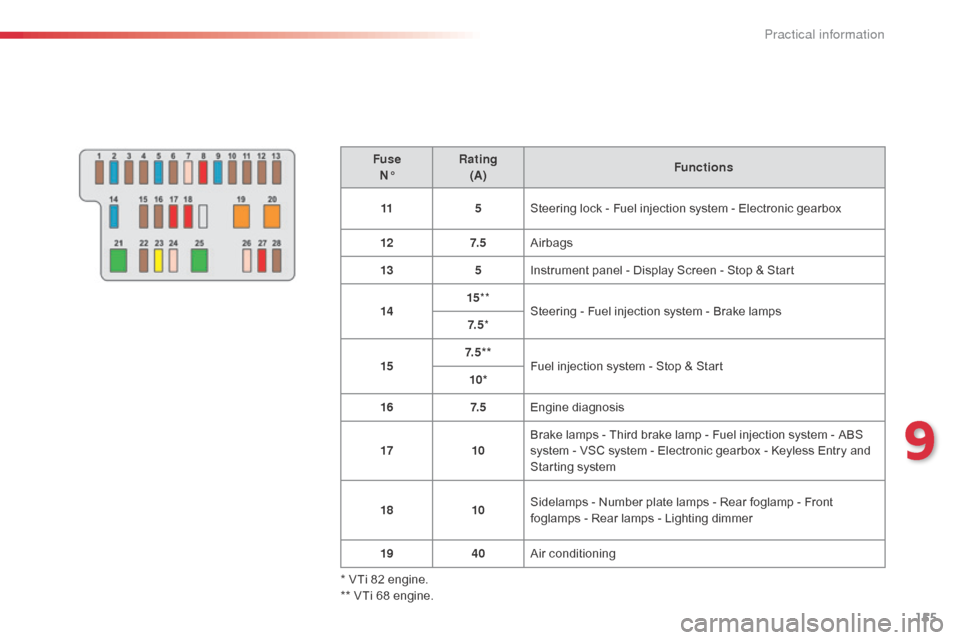
155
FuseN° Rating
(A) Functions
11 5Steering lock - Fuel injection system - Electronic gearbox
12 7. 5Airbags
13 5Instrument panel - Display Screen - Stop & Start
14 15
**
Steering - Fuel injection system - Brake lamps
7. 5 *
15 7. 5 * *
Fuel injection system - Stop & Start
10*
16 7. 5Engine diagnosis
17 10Brake lamps - Third brake lamp - Fuel injection system -
ABS
system - VSC system - Electronic gearbox - Keyless Entry and
Starting system
18 10Sidelamps - Number plate lamps - Rear foglamp - Front
foglamps - Rear lamps - Lighting dimmer
19 40Air conditioning
* VTi 82 engine.
** VTi 68 engine.
9
Practical information
Page 158 of 256
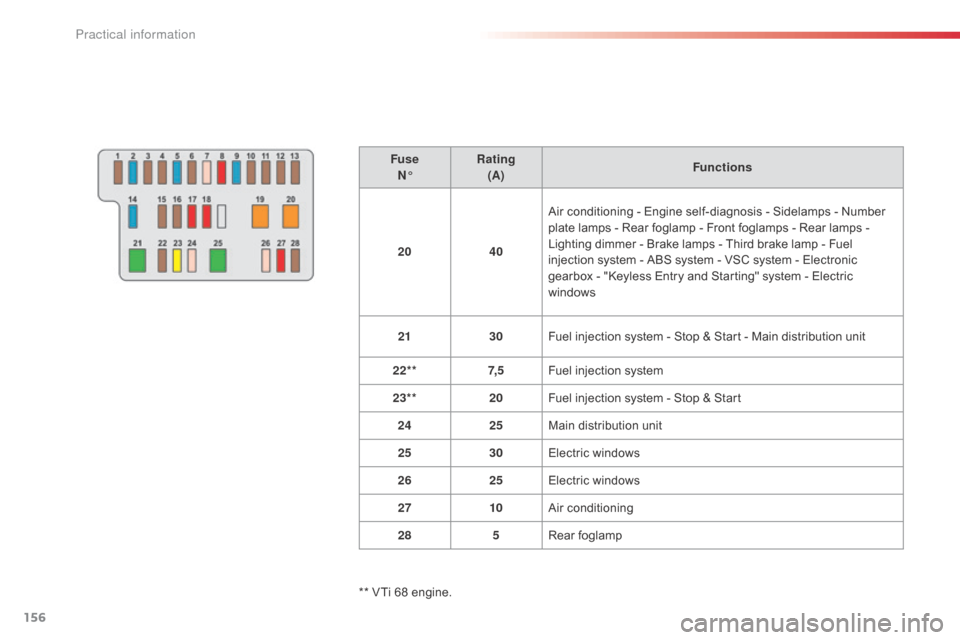
156
FuseN° Rating
(A) Functions
20 40Air conditioning - Engine self-diagnosis - Sidelamps - Number
plate lamps - Rear foglamp - Front foglamps - Rear lamps
-
Lighting dimmer - Brake lamps - Third brake lamp - Fuel
injection system - ABS system - VSC system - Electronic
gearbox - "Keyless Entry and Starting" system - Electric
windows
21 30Fuel injection system - Stop & Start - Main distribution unit
22** 7, 5Fuel injection system
23** 20Fuel injection system - Stop & Start
24 25Main distribution unit
25 30Electric windows
26 25Electric windows
27 10Air conditioning
28 5Rear foglamp
** VTi 68 engine.
Practical information
Page 161 of 256
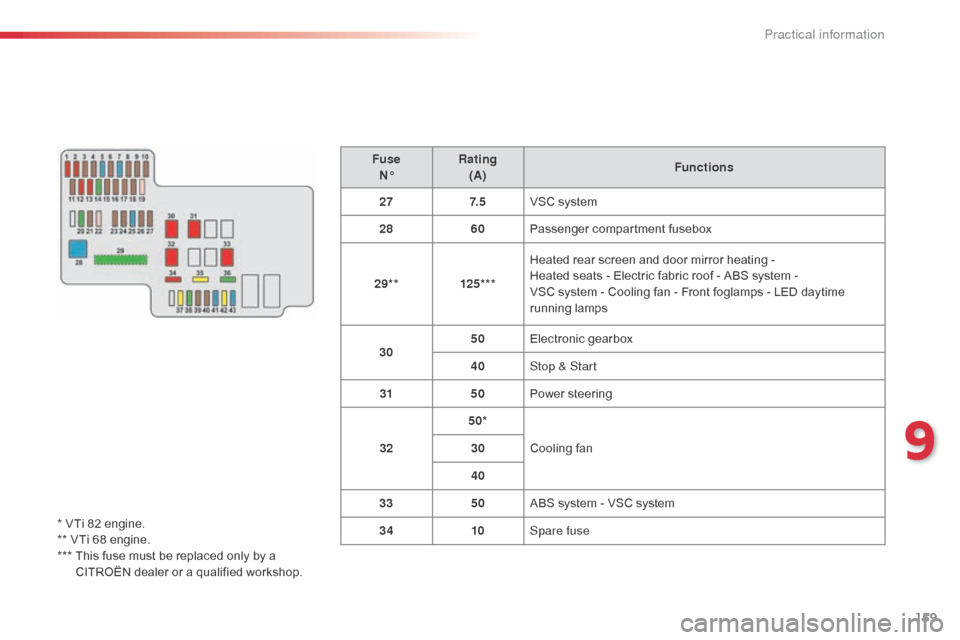
159
FuseN° Rating
(A) Functions
27 7. 5VSC system
28 60Passenger compartment fusebox
29** 125***Heated rear screen and door mirror heating -
Heated seats
- Electric fabric roof - ABS system -
VSC system - Cooling fan
- Front foglamps - LED daytime
running lamps
30 50
Electronic gearbox
40 Stop & Start
31 50Power steering
32 50*
Cooling fan
30
40
33 50ABS system - VSC system
34 10Spare fuse
* VTi 82 engine.
** VTi 68 engine.
***
T
his fuse must be replaced only by a
CITROËN dealer or a qualified workshop.
9
Practical information
Page 162 of 256
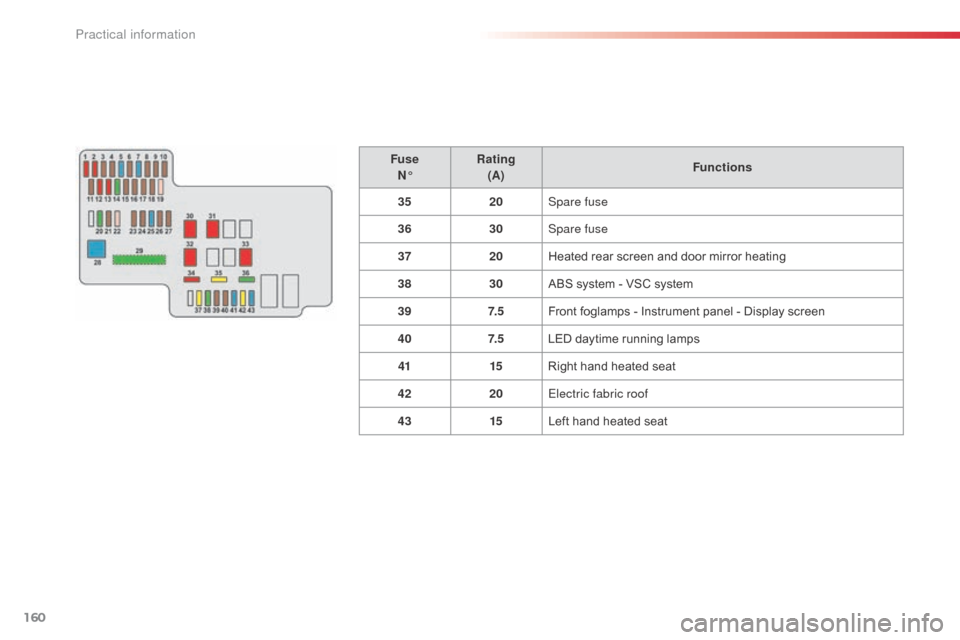
160
FuseN° Rating
(A) Functions
35 20Spare fuse
36 30Spare fuse
37 20Heated rear screen and door mirror heating
38 30ABS system - VSC system
39 7. 5Front foglamps - Instrument panel - Display screen
40 7. 5LED daytime running lamps
41 15Right hand heated seat
42 20Electric fabric roof
43 15Left hand heated seat
Practical information
Page 167 of 256
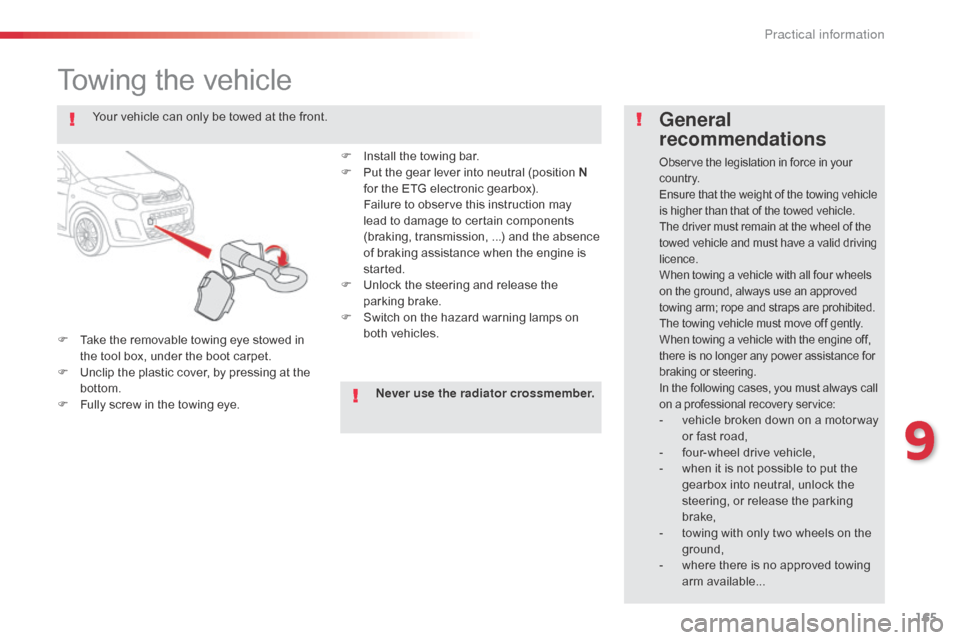
165
Towing the vehicle
F Take the removable towing eye stowed in the tool box, under the boot carpet.
F
U
nclip the plastic cover, by pressing at the
bottom.
F
F
ully screw in the towing eye.
General
recommendations
Observe the legislation in force in your
c o unt r y.
Ensure that the weight of the towing vehicle
is higher than that of the towed vehicle.
The driver must remain at the wheel of the
towed vehicle and must have a valid driving
licence.
When towing a vehicle with all four wheels
on the ground, always use an approved
towing arm; rope and straps are prohibited.
The towing vehicle must move off gently.
When towing a vehicle with the engine off,
there is no longer any power assistance for
braking or steering.
In the following cases, you must always call
on a professional recovery service:
- vehicle broken down on a motor way or fast road,
-
f
our-wheel drive vehicle,
-
w
hen it is not possible to put the
gearbox into neutral, unlock the
steering, or release the parking
brake,
-
t
owing with only two wheels on the
ground,
-
w
here there is no approved towing
arm available...
Your vehicle can only be towed at the front.
F
I
nstall the towing bar.
F
P
ut the gear lever into neutral (position N
for the ETG electronic gearbox).
F
ailure to observe this instruction may
lead to damage to certain components
(braking, transmission, ...) and the absence
of braking assistance when the engine is
started.
F
U
nlock the steering and release the
parking brake.
F
S
witch on the hazard warning lamps on
both vehicles.
Never use the radiator crossmember.
9
Practical information