battery Citroen C1 2014 1.G Owner's Manual
[x] Cancel search | Manufacturer: CITROEN, Model Year: 2014, Model line: C1, Model: Citroen C1 2014 1.GPages: 256, PDF Size: 5.63 MB
Page 5 of 256
.
.
Direction indicators 102
Horn
10
2
Hazard warning lamps
1
03
Under-inflation detection
1
03
ESC system
1
07
Seat belts
1
10
Airbags
1
13
Safety
Child seats 118
Deactivating the passenger's front airbag
1
21
ISOFIX child seats
1
27
Child lock
1
33
Child safety Checks
Fuel tank 1
34
Temporary puncture repair kit
1
36
Changing a wheel
1
41
Snow chains
1
46
Changing a bulb
1
47
Changing a fuse
1
52
12 V battery
1
61
Electrical energy economy mode
1
64
Changing a wiper blade
1
64
Towing the vehicle
1
65
Fitting roof bars
1
66
Accessories
1
67
Practical information Technical data
7-inch touch screen tablet 181
Audio system
2
21
Audio and telematics
Visual search
Alphabetical index
B o n n et 17 0
Petrol engines
1
71
Checking levels
1
72
C h e c ks
17
5Engines
1
77
We i g ht s
17
8
Dimensions
1
79
Identification markings
1
80
Contents
Page 23 of 256

21
Low fuel levelfixed. When it first comes on there remains
approximately 5 litres of fuel in the
tank. You must refuel as soon as possible to avoid running
out of fuel.
This warning lamp will come on every time the ignition
is switched on, until a sufficient addition of fuel is
made.
Fuel tank capacity: approximately 35 litres.
Never continue to drive until you run out of fuel as
this could damage the emission control and injection
systems.
Battery charge fixed. The battery charging circuit has a
fault (dirty or loose terminals, slack or
cut alternator belt, ...). Contact a CITROËN dealer or a qualified workshop.
Front seat belts flashing accompanied
by an audible signal. The driver has not fastened or has
unfastened their seat belt.
The front passenger has unfastened
their seat belt. Pull the strap then insert the tongue in the buckle.
Warning / indicator lamp
StateCause Action / Observations
1
Monitoring
Page 25 of 256
23
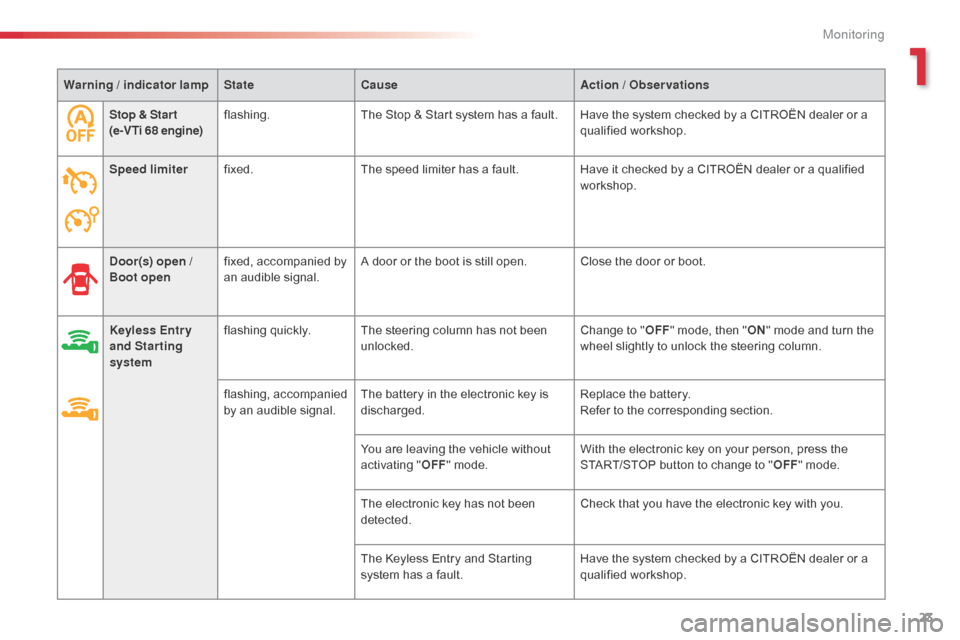
Stop & Star t
(e-VTi 68 engine) flashing.
The Stop & Start system has a fault. Have the system checked by a CITROËN dealer or a
qualified workshop.
Warning / indicator lamp
StateCause Action / Observations
Speed limiter fixed. The speed limiter has a fault. Have it checked by a CITROËN dealer or a qualified
workshop.
Door(s) open /
Boot open fixed, accompanied by
an audible signal. A door or the boot is still open. Close the door or boot.
Keyless Entr y
and Starting
system flashing quickly.
The steering column has not been
unlocked. Change to "
OFF" mode, then " ON" mode and turn the
wheel slightly to unlock the steering column.
flashing, accompanied
by an audible signal. The battery in the electronic key is
discharged. Replace the battery.
Refer to the corresponding section.
You are leaving the vehicle without
activating " OFF" mode. With the electronic key on your person, press the
START/STOP button to change to "
OFF" mode.
The electronic key has not been
detected. Check that you have the electronic key with you.
The Keyless Entry and Starting
system has a fault. Have the system checked by a CITROËN dealer or a
qualified workshop.
1
Monitoring
Page 34 of 256

32
Battery ref.: CR 2016 / 3 volts.
F U nclip the cover using a small screwdriver
in the cut-out.
F
L
ift of the cover.
F
R
emove the old battery from its housing.
F
F
it the new battery in its place, observing
the direction of fitment.
F
C
lip the cover in place.
Changing the remote
control battery
Do not discard the remote control
batteries, they contain metals which are
harmful to the environment.
Take them to a CITROËN dealership, or
to an approved collection point.
Electronic engine immobiliser
This locks the engine management system as soon
as the ignition has been switched off and therefore
prevents starting of the vehicle by anyone who does
not have the key.
The ignition key has an electronic chip which has a
special code. When the ignition is switched on, the
code must be recognised for starting to be possible.
In the event of a malfunction, your vehicle will not
start.
Contact a CITROËN dealer or a qualified workshop.
Do not make any modifications to the
electronic immobiliser system.
Access
Page 37 of 256

35
Emergency procedure
Unlocking
F Insert the integral key into the driver's door lock barrel and turn it towards the front of
the vehicle to unlock the vehicle.
Locking
F Insert the integral key into the driver's door lock barrel and turn it towards the rear of
the vehicle to lock the vehicle.
The integral key is used to lock and unlock the
vehicle when the electronic key cannot operate
and in the event of a fault with the Keyless
Entry and Starting system:
-
c
ell battery discharged, vehicle battery
discharged or disconnected, ...
-
v
ehicle located in an area with strong
electromagnetic signals.
F
P
ress and hold the latch 1 to extract the
integral key 2 .
2
Access
Page 38 of 256
36
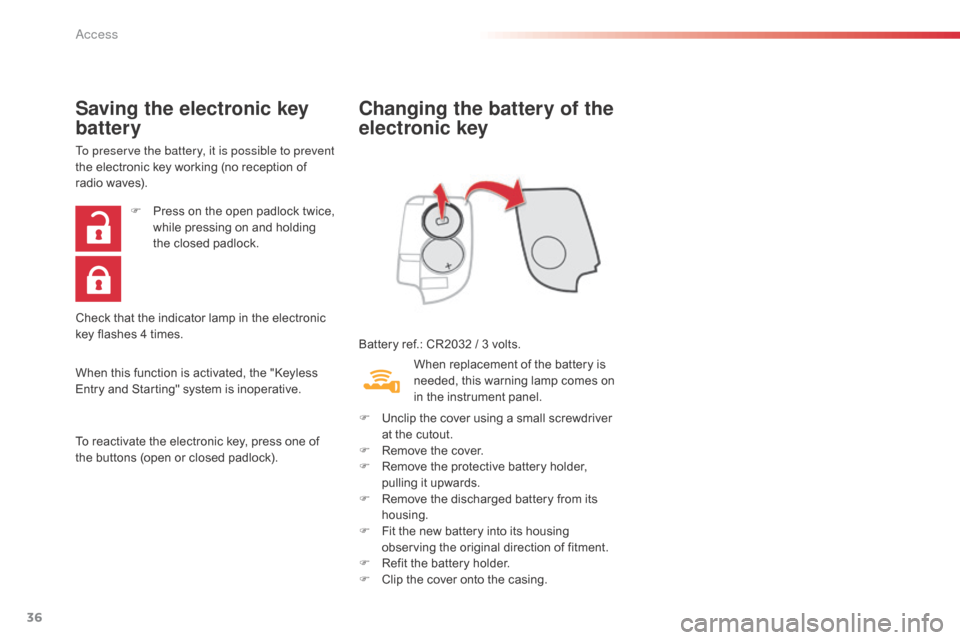
Changing the battery of the
electronic key
Battery ref.: CR2032 / 3 volts.
Saving the electronic key
battery
To preserve the battery, it is possible to prevent
the electronic key working (no reception of
radio waves).
When this function is activated, the "Keyless
Entry and Starting" system is inoperative.
To reactivate the electronic key, press one of
the buttons (open or closed padlock).F
P
ress on the open padlock twice,
while pressing on and holding
the closed padlock.
Check that the indicator lamp in the electronic
key flashes 4 times. When replacement of the battery is
needed, this warning lamp comes on
in the instrument panel.
F
U
nclip the cover using a small screwdriver
at the cutout.
F
R
emove the cover.
F
R
emove the protective battery holder,
pulling it upwards.
F
R
emove the discharged battery from its
housing.
F
F
it the new battery into its housing
observing the original direction of fitment.
F
R
efit the battery holder.
F
C
lip the cover onto the casing.
Access
Page 44 of 256

42
* Depending on version. Your vehicle may be fitted with an electrically operated fabric roof.
Electric fabric roof*
Electric opening and closing
The roof is opened and closed by pressing
the control at the interior lamp, in the opening
direction 1 and in the closing direction 2 .
In order to maintain the state of charge of
the battery, it is recommended that the roof
be operated with the engine running .
operation of the roof is possible with
the ignition on and when driving.
Operation of the roof could cause
serious injuries: before operating the
roof, ensure that no occupant of the
vehicle or person outside the vehicle
could be subject to any risk related
to the movement of the roof and that
no object could inter fere with the
operation. During operation of the roof with just
the ignition on, starting the engine may
cause the roof to stop, depending on
the state of charge of the battery. To
have the roof continue the operation,
operate the control again after the
engine has started.
The asymmetric shape of the opening
control avoids closing the roof by
mistake.
access
Page 73 of 256
71
Starting - stopping the engine with the key
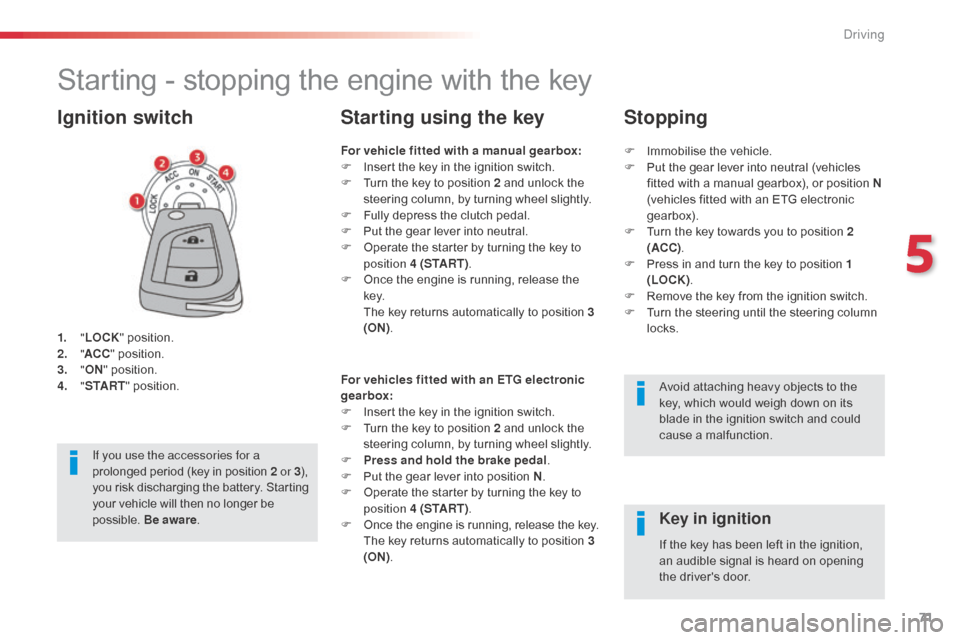
1. "LOCK " position.
2. " AC
C" position.
3.
"ON " position.
4.
" S
TA R T" position.
Ignition switch
Avoid attaching heavy objects to the
key, which would weigh down on its
blade in the ignition switch and could
cause a malfunction.
Key in ignition
For vehicle fitted with a manual gearbox:
F
I nsert the key in the ignition switch.
F
T
urn the key to position 2 and unlock the
steering column, by turning wheel slightly.
F
F
ully depress the clutch pedal.
F
P
ut the gear lever into neutral.
F
O
perate the starter by turning the key to
position 4 (S TA R T ) .
F
O
nce the engine is running, release the
key.
T
he key returns automatically to position 3
(ON) .
Starting using the key
If the key has been left in the ignition,
an audible signal is heard on opening
the driver's door.
For vehicles fitted with an ETG electronic
gearbox:
F
I
nsert the key in the ignition switch.
F
T
urn the key to position 2 and unlock the
steering column, by turning wheel slightly.
F
P
ress and hold the brake pedal
.
F
P
ut the gear lever into position N
.
F
O
perate the starter by turning the key to
position 4 (S TA R T ) .
F
O
nce the engine is running, release the key. T
he key returns automatically to position 3
(ON) .
If you use the accessories for a
prolonged period (key in position 2
or
3
),
you risk discharging the battery. Starting
your vehicle will then no longer be
possible. Be aware . F
I
mmobilise the vehicle.
F
P
ut the gear lever into neutral (vehicles
fitted with a manual gearbox), or position N
(vehicles fitted with an ETG electronic
gearbox).
F
T
urn the key towards you to position 2
(ACC) .
F
P
ress in and turn the key to position 1
(LOCK) .
F
R
emove the key from the ignition switch.
F
T
urn the steering until the steering column
locks.
Stopping
5
Driving
Page 74 of 256

72
If you use the accessories for a
prolonged period, the vehicle will
automatically switch to "OFF" mode
after about 20 minutes.
Be aware in order to avoid discharging
the battery.
Starting - stopping the engine with the Keyless Entry and
Starting system
Changing the mode of the
vehicle
With the electronic key inside the
vehicle; each press on the " S TA R T/
STOP " button, with no action on the
pedals, changes the vehicle's mode:
F
F
irst press (" ACC" mode).
T
he accessories (radio, 12V socket...) can
be used.
F
S
econd press (" ON" mode).
I
gnition on.
F
T
hird press (" OFF" mode).
driving
Page 85 of 256
83
Stop & Start (e-VTi 68 engine)
Operation
Going into engine STOP mode
This indicator lamp comes on in the
instrument panel and the engine
goes into standby automatically:
-
w
hen stationary, in neutral, and you
release the clutch pedal.
Never refuel with the engine in STOP
mode; you must switch off the ignition
with the button. For smoother operation, during
parking manoeuvres STOP mode is
not available for a few seconds after
coming out of reverse gear.
STOP mode does not affect the
vehicle's systems, such as for example,
braking, power steering...
Special cases: STOP mode not
available
STOP mode is not invoked principally when:
- t he driver's door is open,
-
t
he driver's seat belt is not fastened,
-
t
he engine is needed to maintain a
comfortable temperature in the passenger
compartment,
-
d
emisting is active,
-
s
ome special conditions (battery charge,
engine temperature, braking assistance,
vehicle stopped on a steep gradient, high
altitude...) where the engine is needed to
assure control of a system.
The Stop & Start
system puts the engine temporarily into standby - STOP mode - during stops in the traffic (red lights, traffic jams, or other...).
The
engine restarts automatically - START mode - as soon as you want to move off. The restart takes place instantly, quickly and silently.
Per fect for urban use, the Stop & Start system reduces fuel consumption and exhaust emissions as well as the noise level when stationary.
Stop & Start time counters
A partial time counter counts the periods in
STOP mode during a journey.
It is displayed in the trip computer once the
Stop & Start acts.
Press one of the screen management buttons
to return to the previous display.
A global time counter counts the periods in
STOP mode since the last reset.
When it is displayed, press one of the screen
management buttons to reset the counter.
5
Driving