Start Citroen C1 2015 1.G User Guide
[x] Cancel search | Manufacturer: CITROEN, Model Year: 2015, Model line: C1, Model: Citroen C1 2015 1.GPages: 271, PDF Size: 7.18 MB
Page 35 of 271
33
C1_en_Chap02_ouvertures_ed01-2015
Keyless Entry and Starting system
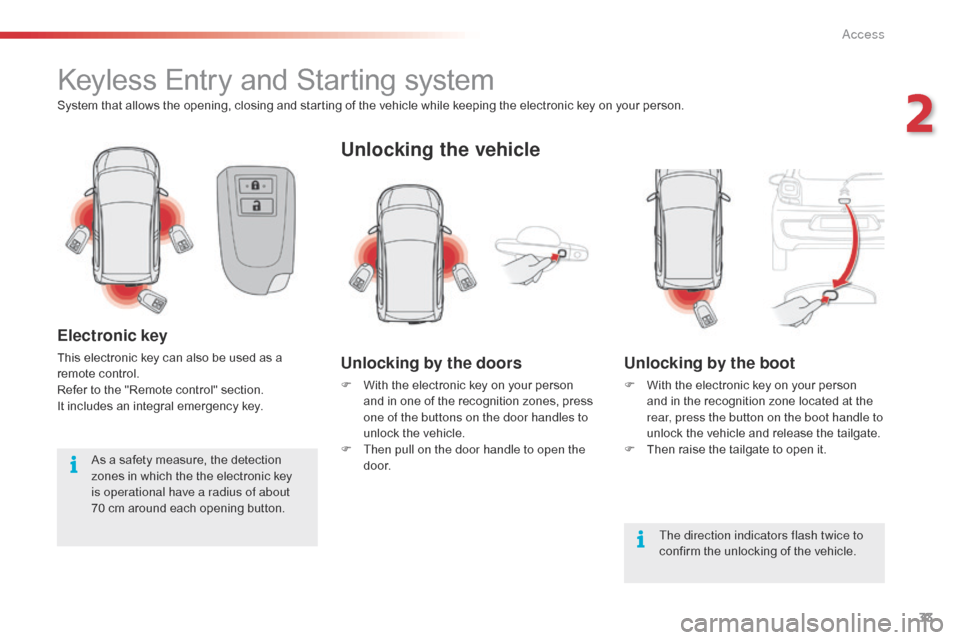
System that allows the opening, closing and starting of the vehicle while keeping the electronic key on your person.
Electronic key
This electronic key can also be used as a
remote control.
Refer to the "Remote control" section.
It includes an integral emergency key.
Unlocking the vehicle
Unlocking by the doors
F With the electronic key on your person and in one of the recognition zones, press
one of the buttons on the door handles to
unlock the vehicle.
F
T
hen pull on the door handle to open the
d o o r.
Unlocking by the boot
F With the electronic key on your person and in the recognition zone located at the
rear, press the button on the boot handle to
unlock the vehicle and release the tailgate.
F
T
hen raise the tailgate to open it.
The direction indicators flash twice to
confirm the unlocking of the vehicle.
As a safety measure, the detection
zones in which the the electronic key
is operational have a radius of about
70
cm around each opening button.
2
Access
Page 36 of 271
34
C1_en_Chap02_ouvertures_ed01-2015
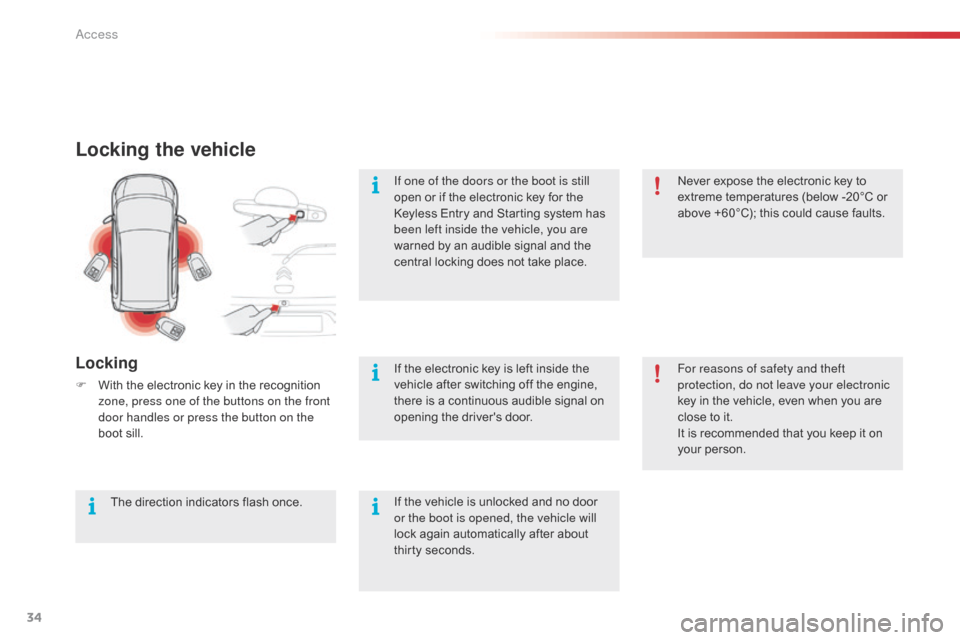
Locking the vehicle
Locking
F With the electronic key in the recognition zone, press one of the buttons on the front
door handles or press the button on the
boot sill.
The direction indicators flash once. If one of the doors or the boot is still
open or if the electronic key for the
Keyless Entry and Starting system has
been left inside the vehicle, you are
warned by an audible signal and the
central locking does not take place.
If the electronic key is left inside the
vehicle after switching off the engine,
there is a continuous audible signal on
opening the driver's door.
Never expose the electronic key to
extreme temperatures (below -20°C or
above +60°C); this could cause faults.
For reasons of safety and theft
protection, do not leave your electronic
key in the vehicle, even when you are
close to it.
It is recommended that you keep it on
your person.
If the vehicle is unlocked and no door
or the boot is opened, the vehicle will
lock again automatically after about
thirty
seconds.
Access
Page 37 of 271
35
C1_en_Chap02_ouvertures_ed01-2015
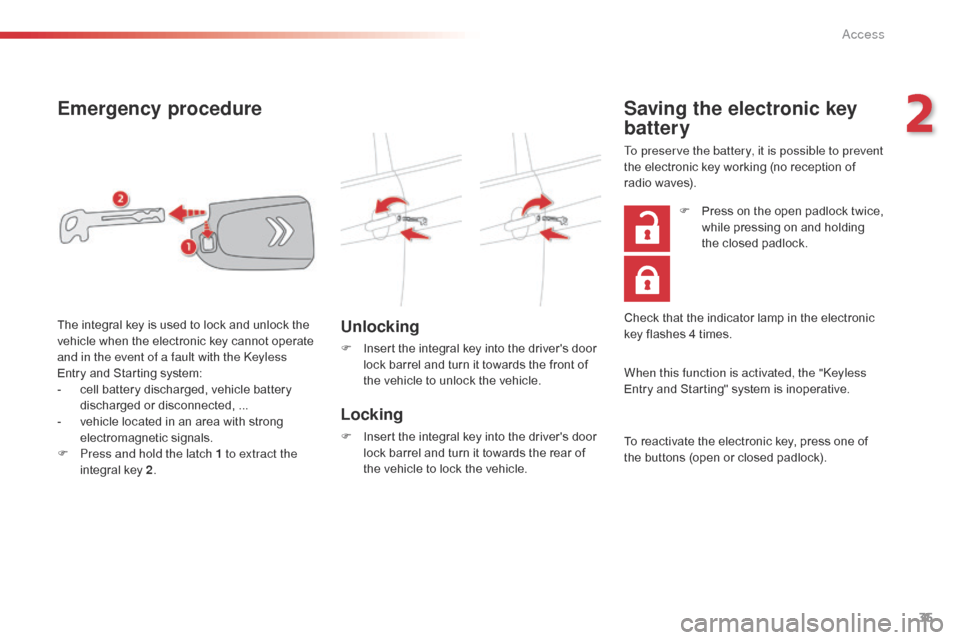
Emergency procedure
Unlocking
F Insert the integral key into the driver's door lock barrel and turn it towards the front of
the vehicle to unlock the vehicle.
Locking
F Insert the integral key into the driver's door lock barrel and turn it towards the rear of
the vehicle to lock the vehicle.
The integral key is used to lock and unlock the
vehicle when the electronic key cannot operate
and in the event of a fault with the Keyless
Entry and Starting system:
-
c
ell battery discharged, vehicle battery
discharged or disconnected, ...
-
v
ehicle located in an area with strong
electromagnetic signals.
F
P
ress and hold the latch 1 to extract the
integral key 2 .
Saving the electronic key
battery
To preserve the battery, it is possible to prevent
the electronic key working (no reception of
radio waves).
When this function is activated, the "Keyless
Entry and Starting" system is inoperative.
To reactivate the electronic key, press one of
the buttons (open or closed padlock).F
P
ress on the open padlock twice,
while pressing on and holding
the closed padlock.
Check that the indicator lamp in the electronic
key flashes 4 times.
2
Access
Page 38 of 271
36
C1_en_Chap02_ouvertures_ed01-2015
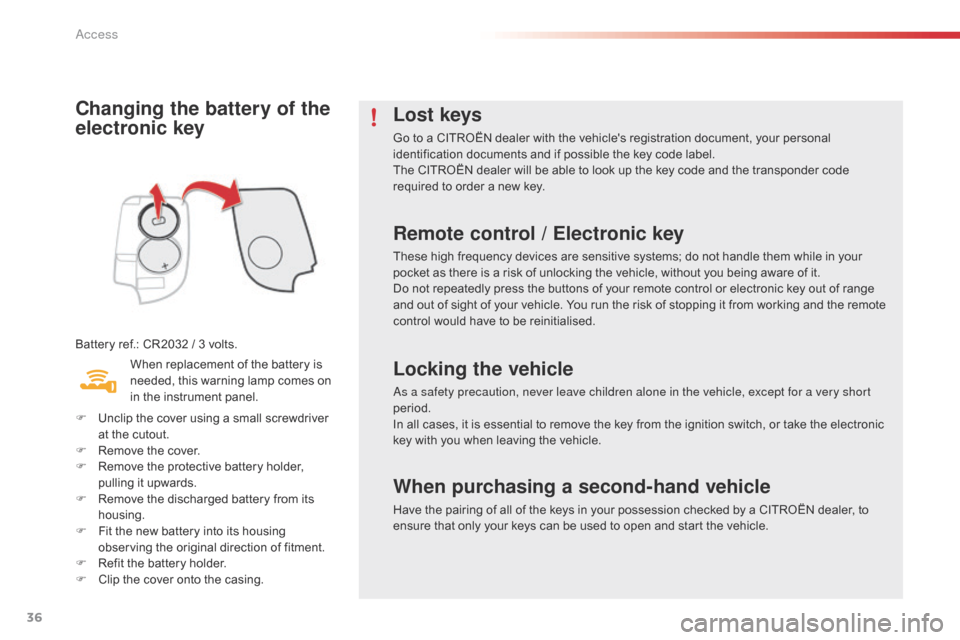
Changing the battery of the
electronic key
Battery ref.: CR2032 / 3 volts.When replacement of the battery is
needed, this warning lamp comes on
in the instrument panel.
F
U
nclip the cover using a small screwdriver
at the cutout.
F
R
emove the cover.
F
R
emove the protective battery holder,
pulling it upwards.
F
R
emove the discharged battery from its
housing.
F
F
it the new battery into its housing
observing the original direction of fitment.
F
R
efit the battery holder.
F
C
lip the cover onto the casing.
Lost keys
Go to a CITROËN dealer with the vehicle's registration document, your personal
identification documents and if possible the key code label.
The CITROËN dealer will be able to look up the key code and the transponder code
required to order a new key.
Remote control / Electronic key
These high frequency devices are sensitive systems; do not handle them while in your
pocket as there is a risk of unlocking the vehicle, without you being aware of it.
Do not repeatedly press the buttons of your remote control or electronic key out of range
and out of sight of your vehicle. You run the risk of stopping it from working and the remote
control would have to be reinitialised.
Locking the vehicle
As a safety precaution, never leave children alone in the vehicle, except for a very short
period.
In all cases, it is essential to remove the key from the ignition switch, or take the electronic
key with you when leaving the vehicle.
When purchasing a second-hand vehicle
Have the pairing of all of the keys in your possession checked by a CITROËN dealer, to
ensure that only your keys can be used to open and start the vehicle.
Access
Page 41 of 271
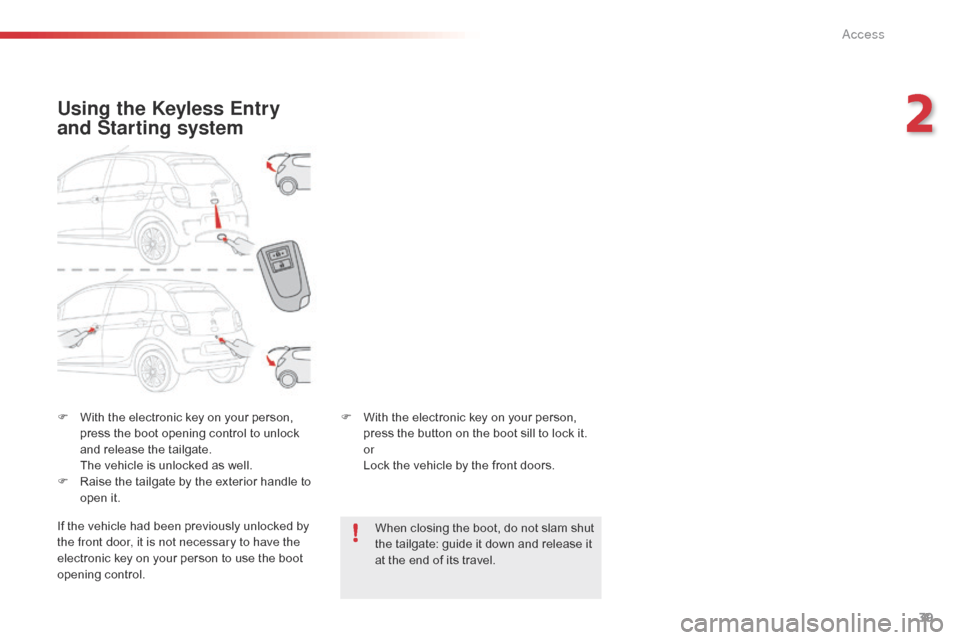
39
C1_en_Chap02_ouvertures_ed01-2015
F With the electronic key on your person, press the boot opening control to unlock
and release the tailgate.
T
he vehicle is unlocked as well.
F
R
aise the tailgate by the exterior handle to
open it.
Using the Keyless Entry
and Starting system
If the vehicle had been previously unlocked by
the front door, it is not necessary to have the
electronic key on your person to use the boot
opening control. F
W
ith the electronic key on your person,
press the button on the boot sill to lock it.
or
L
ock the vehicle by the front doors.
When closing the boot, do not slam shut
the tailgate: guide it down and release it
at the end of its travel.
2
Access
Page 43 of 271
41
C1_en_Chap02_ouvertures_ed01-2015
* Depending on version. Your vehicle may be fitted with an electrically operated fabric roof.
Electric fabric roof*
Electric opening and closing
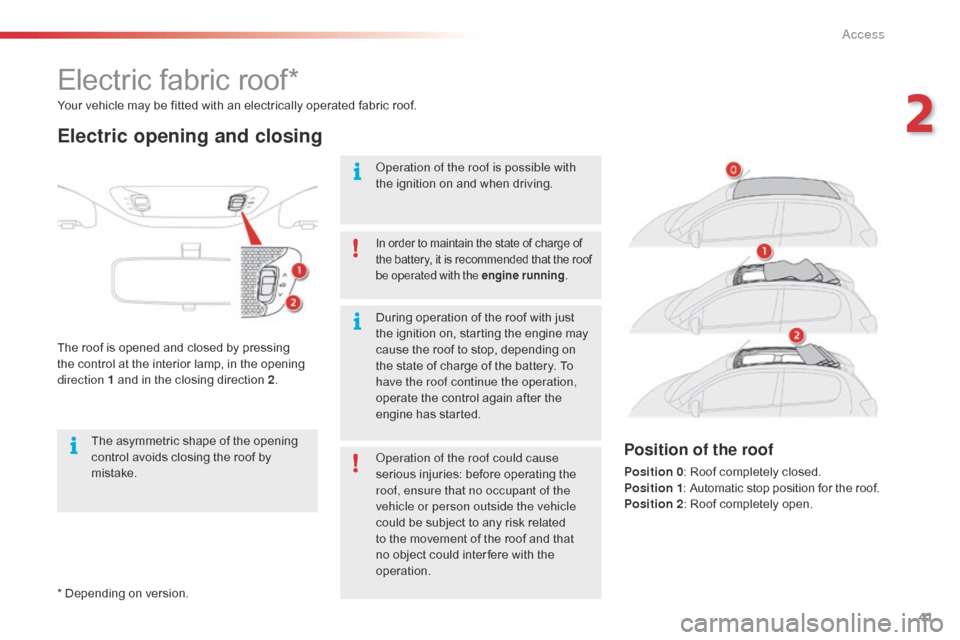
The roof is opened and closed by pressing
the control at the interior lamp, in the opening
direction 1 and in the closing direction 2.
In order to maintain the state of charge of
the battery, it is recommended that the roof
be operated with the engine running.
Operation of the roof is possible with
the ignition on and when driving.
Operation of the roof could cause
serious injuries: before operating the
roof, ensure that no occupant of the
vehicle or person outside the vehicle
could be subject to any risk related
to the movement of the roof and that
no object could inter fere with the
operation. During operation of the roof with just
the ignition on, starting the engine may
cause the roof to stop, depending on
the state of charge of the battery. To
have the roof continue the operation,
operate the control again after the
engine has started.
The asymmetric shape of the opening
control avoids closing the roof by
mistake.
Position of the roof
Position 0 : Roof completely closed.
Position 1 : Automatic stop position for the roof.
Position 2 : Roof completely open.
2
Access
Page 70 of 271
68
A few driving recommendations
Observe the driving regulations at all times and
remain vigilant whatever the traffic conditions.
Pay close attention to the traffic and keep your
hands on the wheel so that you are ready to
react at any time to any eventuality.
On a long journey, a break every two hours is
strongly recommended.
In difficult weather, drive smoothly, anticipate
the need to brake and increase the distance
from other vehicles.Never drive with the parking brake
applied - Risk of overheating and
damage to the braking system!
Do not park or run the engine when
stationary in areas where inflammable
substances and materials (dry grass,
dead leaves...) might come into contact
with the hot exhaust system - Risk of
fire!
Never leave a vehicle unsupervised
with the engine running. If you have
to leave your vehicle with the engine
running, apply the parking brake
and put the gearbox into neutral or
position
N, depending on the type of
gearbox.
Driving on flooded roads
We strongly advise against driving on flooded
roads, as this could cause serious damage
to the engine or gearbox, as well as to the
electrical systems of your vehicle.
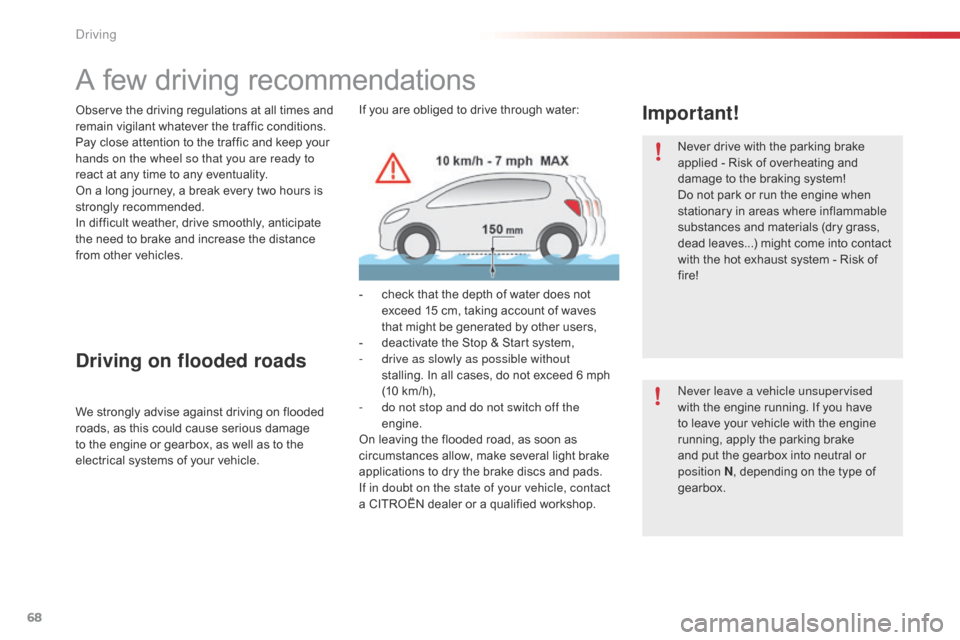
Important!If you are obliged to drive through water:
-
c
heck that the depth of water does not
exceed 15 cm, taking account of waves
that might be generated by other users,
-
d
eactivate the Stop & Start system,
-
d
rive as slowly as possible without
stalling. In all cases, do not exceed 6 mph
(10
km/h),
-
d
o not stop and do not switch off the
engine.
On leaving the flooded road, as soon as
circumstances allow, make several light brake
applications to dry the brake discs and pads.
If in doubt on the state of your vehicle, contact
a CITROËN dealer or a qualified workshop.
Driving
Page 71 of 271
69
Starting - switching off the engine with the key
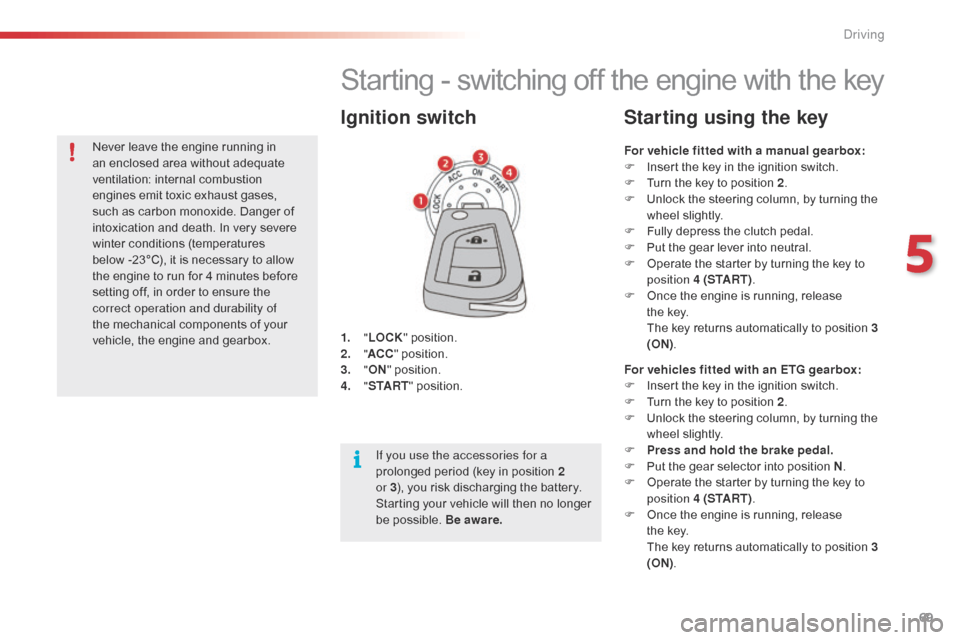
1. "LOCK " position.
2. " AC
C" position.
3.
"ON " position.
4.
" S
TA R T" position.
Ignition switch
For vehicle fitted with a manual gearbox:
F
I nsert the key in the ignition switch.
F
T
urn the key to position 2 .
F
U
nlock the steering column, by turning the
wheel slightly.
F
F
ully depress the clutch pedal.
F
P
ut the gear lever into neutral.
F
O
perate the starter by turning the key to
position 4 (S TA R T ) .
F
O
nce the engine is running, release
the
key.
T
he key returns automatically to position 3
(ON) .
Starting using the key
For vehicles fitted with an ETG gearbox:
F
I nsert the key in the ignition switch.
F
T
urn the key to position 2 .
F
U
nlock the steering column, by turning the
wheel slightly.
F
P
ress and hold the brake pedal.
F
P
ut the gear selector into position N .
F
O
perate the starter by turning the key to
position 4 (S TA R T ) .
F
O
nce the engine is running, release
the
key.
T
he key returns automatically to position 3
(ON) .
If you use the accessories for a
prolonged period (key in position 2
or
3 ), you risk discharging the battery.
Starting your vehicle will then no longer
be possible. Be aware.
Never leave the engine running in
an enclosed area without adequate
ventilation: internal combustion
engines emit toxic exhaust gases,
such as carbon monoxide. Danger of
intoxication and death. In very severe
winter conditions (temperatures
below
-23°C), it is necessary to allow
the engine to run for 4 minutes before
setting off, in order to ensure the
correct operation and durability of
the mechanical components of your
vehicle, the engine and gearbox.
5
Driving
Page 72 of 271
70
If you use the accessories for a
prolonged period, the vehicle will
automatically switch to "OFF" mode
after about 20 minutes.
Be aware in order to avoid discharging
the battery.
Starting - switching off the engine with the
Keyless Entry and Starting system
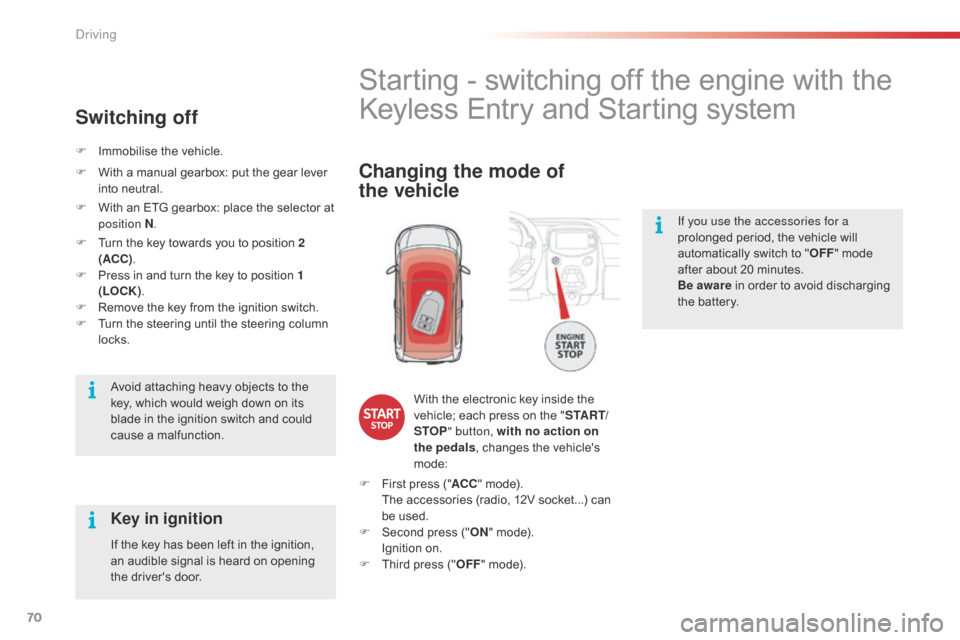
Changing the mode of
the vehicle
With the electronic key inside the
vehicle; each press on the " S TA R T/
STOP " button, with no action on
the pedals , changes the vehicle's
mode:
F
F
irst press (" ACC" mode).
T
he accessories (radio, 12V socket...) can
be used.
F
S
econd press (" ON" mode).
I
gnition on.
F
T
hird press (" OFF" mode).
Avoid attaching heavy objects to the
key, which would weigh down on its
blade in the ignition switch and could
cause a malfunction.
Key in ignition
If the key has been left in the ignition,
an audible signal is heard on opening
the driver's door.
F
I
mmobilise the vehicle.
Switching off
F With a manual gearbox: put the gear lever
into neutral.
F
W
ith an ETG gearbox: place the selector at
position N .
F
T
urn the key towards you to position 2
(ACC) .
F
P
ress in and turn the key to position 1
(LOCK) .
F
R
emove the key from the ignition switch.
F
T
urn the steering until the steering column
locks.
Driving
Page 73 of 271
71
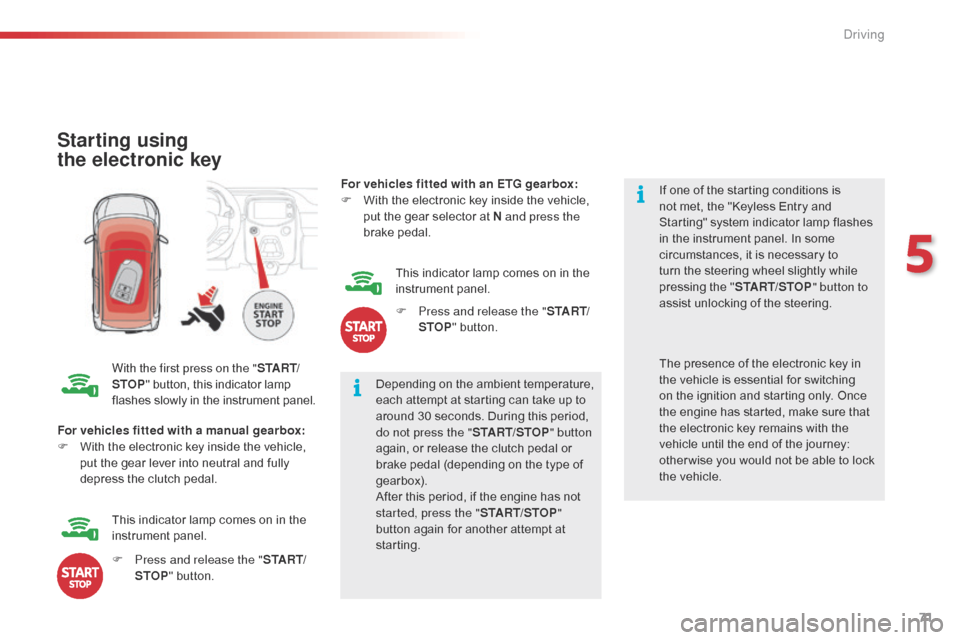
Starting using
the electronic key
With the first press on the " S TA R T/
STOP " button, this indicator lamp
flashes slowly in the instrument panel. Depending on the ambient temperature,
each attempt at starting can take up to
around 30 seconds. During this period,
do not press the "
START/STOP" button
again, or release the clutch pedal or
brake pedal (depending on the type of
gearbox).
After this period, if the engine has not
started, press the " START/STOP"
button again for another attempt at
starting. If one of the starting conditions is
not met, the "Keyless Entry and
Starting" system indicator lamp flashes
in the instrument panel. In some
circumstances, it is necessary to
turn the steering wheel slightly while
pressing the "
START/STOP " button to
assist unlocking of the steering.
For vehicles fitted with a manual gearbox:
F
W
ith the electronic key inside the vehicle,
put the gear lever into neutral and fully
depress the clutch pedal. The presence of the electronic key in
the vehicle is essential for switching
on the ignition and starting only. Once
the engine has started,
make sure that
the electronic key remains with the
vehicle until the end of the journey:
other wise you would not be able to lock
the
vehicle.
F
P
ress and release the " S TA R T/
STOP " button.
This indicator lamp comes on in the
instrument panel. For vehicles fitted with an ETG gearbox
:
F
W
ith the electronic key inside the vehicle,
put the gear selector at N and press the
brake pedal.
This indicator lamp comes on in the
instrument panel.
F
P
ress and release the "
S TA R T/
STOP " button.
5
Driving