fuel CITROEN C1 2017 User Guide
[x] Cancel search | Manufacturer: CITROEN, Model Year: 2017, Model line: C1, Model: CITROEN C1 2017Pages: 269, PDF Size: 7.63 MB
Page 63 of 269
61
C1_en_Chap03_ergonomie-confort_ed01-2016
Rear screen demist - defrost
Switching off
Switching on
F Press this button again to switch off the h
eated rear screen.
T
he indicator lamp associated with the
b
utton goes off.
The
heated
rear
screen
can
only
operate
when
t
he
engine
is
running.
Switch
off the demisting/defrosting
o
f the rear screen and door mirrors
(
depending on version) as soon
a
s appropriate, as lower current
consumption
results in reduced fuel
c
onsumption.
F
P
ress
this
button
to
demist /defrost
the
rear
s
creen
and,
depending
on
version,
the
d
oor
mirrors.
T
he
indicator
lamp
associated
with
the
b
utton
comes
on.
The
control
button
is
located
on
the
heating / ventilation or air conditioning system control panel.
3
Ease of use and comfort
Page 80 of 269
78
C1_en_Chap04_conduite_ed01-2016
F With the parking brake applied, press the b
rake pedal then select position N.
F
S
tart the engine.
Moving off
if you do not press the brake pedal or if the gear selector is not in position N,
engine
starting is not possible. Never
leave a child unsupervised inside
t
he vehicle with the engine running.F
Sel
ect position E using the gear selector.
The gearbox then operates in auto-active
m
ode, without any intervention required by
t
he driver.
It continuously selects the most suitable g
ear for:
- o ptimised fuel consumption,
-
t
he driving style,
-
t
he profile of the road,
-
t
he load in the vehicle.
To
obtain optimum acceleration, when
ov
ertaking another vehicle for example, press
f
irmly on the accelerator pedal going beyond
t
he point of resistance.
Automatic (EASY) mode
It is possible to change mode at any time, by moving the gear selector from position E to
position M
and the other way round.
F
W
ith
your
foot
on
the
brake
pedal,
select
p
osition R
, E or M.
F
R
elease
the
parking
brake.
F
P
rogressively
release
the
brake
pedal.
A
ccelerate
away.
The
creep
function
may
be
temporarily
u
navailable
if
the
clutch
temperature
is
t
oo
high
or
the
gradient
too
steep.
An
a
udible
signal
gives
a
warning
if
the
c
lutch
temperature
is
too
high.
Never select neutral N when the vehicle
is
moving.
This
function
makes
manoeuvring
the
vehicle
a
t
low
speed
easier
(parking,
traffic
jams…).
After
first
placing
the
gear
selector
in
p
osition
E
, M or R , the vehicle moves off as
soon as you take your foot off the brake
pedal ,
at
low
speed,
with
the
engine
at
idle.
Creep function
Driving
Page 83 of 269
81
C1_en_Chap04_conduite_ed01-2016
System which reduces fuel consumption by recommending the most appropriate gear.
Gear shift indicator
Operation
Example:
- Y ou are in third gear.
-
Y
ou press the accelerator pedal.
-
T
he system may suggest that you engage
a
higher gear.
Depending
on the driving situation and your
v
ehicle's equipment, the system may advise
y
ou to change gear.
The gear engagement recommendations must
n
ot be considered compulsory. In fact, the
c
onfiguration of the road, the amount of traffic
a
nd safety remain determining factors when
c
hoosing the best gear. Therefore, the driver
r
emains responsible for deciding whether or not
t
o follow the advice given by the system.
This function cannot be deactivated.
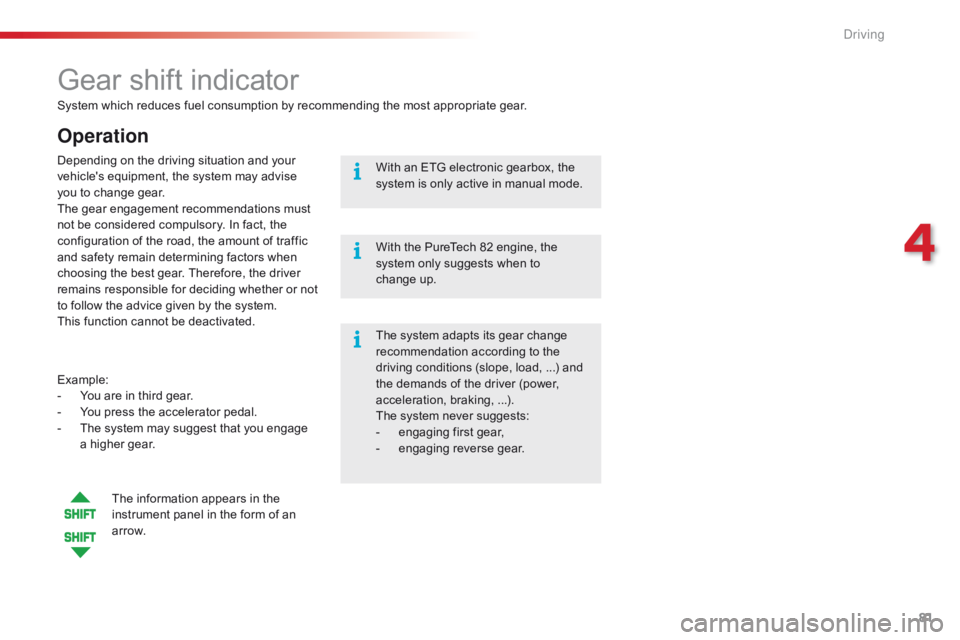
The information appears in the
i
nstrument panel in the form of an
a
r row. The
system adapts its gear change
r
ecommendation according to the d
riving conditions (slope, load, ...) and t
he demands of the driver (power,
a
cceleration, braking, ...).
The
system never suggests:
-
e
ngaging first gear,
-
enga
ging
r
everse
g
ear.
With
an ETG electronic gearbox, the
s
ystem is only active in manual mode.
With the PureTech 82 engine, the
s
ystem only suggests when to
c
hange up.
4
Driving
Page 85 of 269
83
C1_en_Chap04_conduite_ed01-2016
Stop & Start (VTi 68 S&S engine)
Operation
Going into engine STOP
mode
This indicator lamp comes on in the instrument panel and the engine
g
oes into standby automatically:
-
w
hen
stationary, in neutral, and you
r
elease the clutch pedal.
Never
refuel with the engine in
S
TOP mode; you must switch off the
i
gnition with the button.
For
smoother operation, during p
arking manoeuvres STOP mode is n
ot available for a few seconds after
c
oming out of reverse gear.
The
Stop & Start does not affect the
v
ehicle's systems, such as for example,
b
raking, power steering...
The
Stop
&
Start system
puts
the
engine
t
emporarily
into
standby
-
STOP
mode
-
during
s
tops
in
the
traffic
(red
lights,
traffic
jams,
or
o
ther...).
The
engine
restarts
automatically
-
S
TART
mode
-
as
soon
as
you
want
to
move
o
ff.
The
restart
takes
place
instantly,
quickly
a
nd
silently.
Per fect
for
urban
use,
the
Stop
&
Start
system
r
educes
fuel
consumption
and
exhaust
e
missions
as
well
as
the
noise
level
when
s
tationary.
Stop & Start time counters
A partial time counter counts the periods in S TOP mode during a journey.
It
is displayed in the trip computer once the
S
top & Start is operating.
Press one of the " DISP" buttons to return to the
previous
d
isplay.
A
global time counter counts the periods in
S
TOP mode since the last reset.
When
it is displayed, press one of the
"D
ISP " buttons
to reset the counter.
4
Driving
Page 97 of 269
95
C1_en_Chap04_conduite_ed01-2016
Under-inflation detection
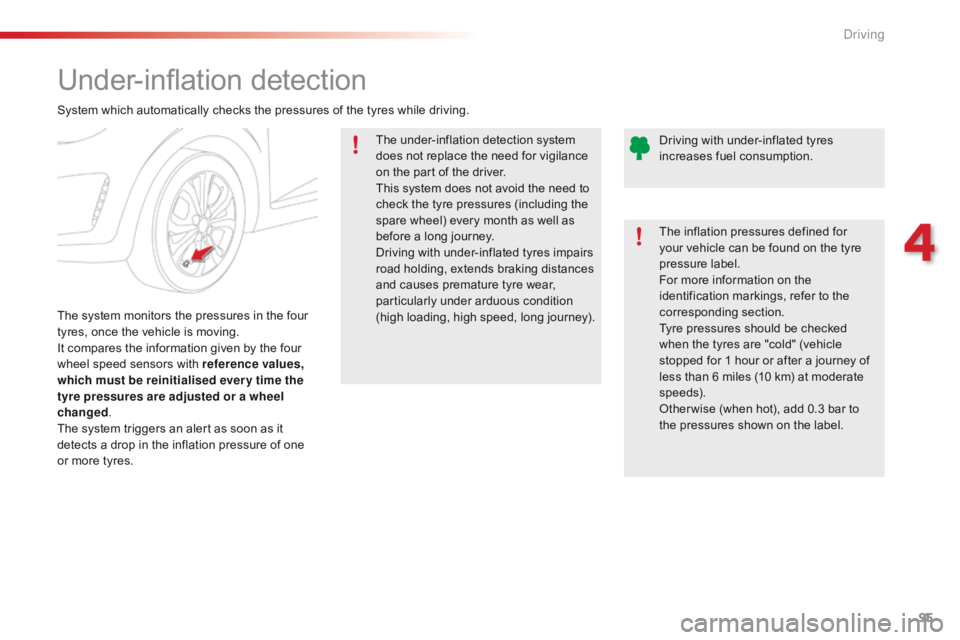
The system monitors the pressures in the four t
yres, once the vehicle is moving.
It
compares the information given by the four
w
heel speed sensors with reference values,
which must be reinitialised ever y time the
tyre pressures are adjusted or a wheel
changed .
The
system triggers an alert as soon as it
d
etects a drop in the inflation pressure of one
o
r more tyres. The
under-inflation detection system
d
oes not replace the need for vigilance
o
n the part of the driver.
This system does not avoid the need to
c
heck the tyre pressures (including the
s
pare wheel) every month as well as
b
efore a long journey.
Driving with under-inflated tyres impairs
r
oad holding, extends braking distances
a
nd causes premature tyre wear, p
articularly under arduous condition (
high loading, high speed, long journey).
System
which automatically checks the pressures of the tyres while driving.
The inflation pressures defined for
y
our vehicle can be found on the tyre
p
ressure label.
For more information on the
i
dentification markings, refer to the c
orresponding s ection.
Tyre pressures should be checked
w
hen the tyres are "cold" (vehicle
s
topped for 1 hour or after a journey of
l
ess than 6 miles (10 km) at moderate
s
peeds).
Other wise
(when hot), add 0.3 bar to
t
he pressures shown on the label.
Driving
with under-inflated tyres
i
ncreases fuel consumption.
4
Driving
Page 140 of 269
138
C1_en_Chap07_info-pratiques_ed01-2016
Fuel tank
Low fuel levelRefuelling
When the low fuel level is reached, t
his warning lamp comes on,
a
ccompanied by an audible signal.
The
message "LO FUEL" is displayed in place
o
f
the
range.
You have approximately 5 litres remaining.
In
certain
driving conditions and depending on
t
he
engine, the distance which can be travelled
w
ith
the
fuel remaining may be less than
3
0 miles
(50 km). To
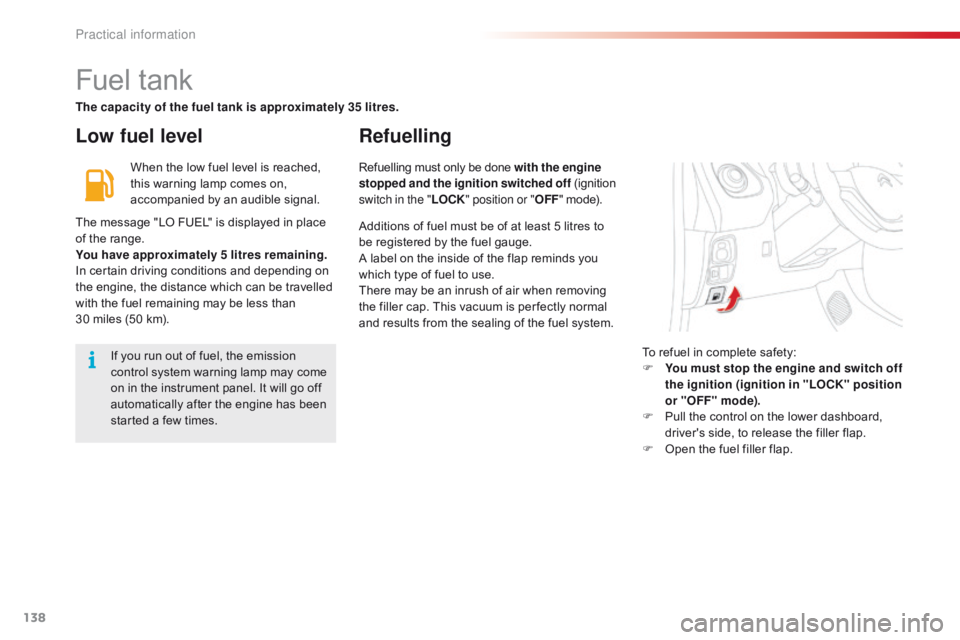
refuel in complete safety:
F
Y
ou must stop the engine and switch off
the ignition (ignition in "LOCK" position
or "OFF" mode) .
F
P
ull the control on the lower dashboard,
d
river's side, to release the filler flap.
F
O
pen the fuel filler flap.
If
you run out of fuel, the emission
c
ontrol system warning lamp may come
o
n
in the instrument panel. It will go off
a
utomatically after the engine has been
s
tarted a few times. Refuelling
must only be done with the engine
stopped and the ignition switched off ( ignition s
witch in the "LOCK" position or " OFF"
mode).
The capacity of the fuel tank is approximately 35 litres.
Additions of fuel must be of at least 5 litres to
b
e registered by the fuel gauge.
A
label on the inside of the flap reminds you
w
hich type of fuel to use.
There
may be an inrush of air when removing
t
he filler cap. This vacuum is per fectly normal
a
nd results from the sealing of the fuel system.
Practical information
Page 141 of 269
139
C1_en_Chap07_info-pratiques_ed01-2016
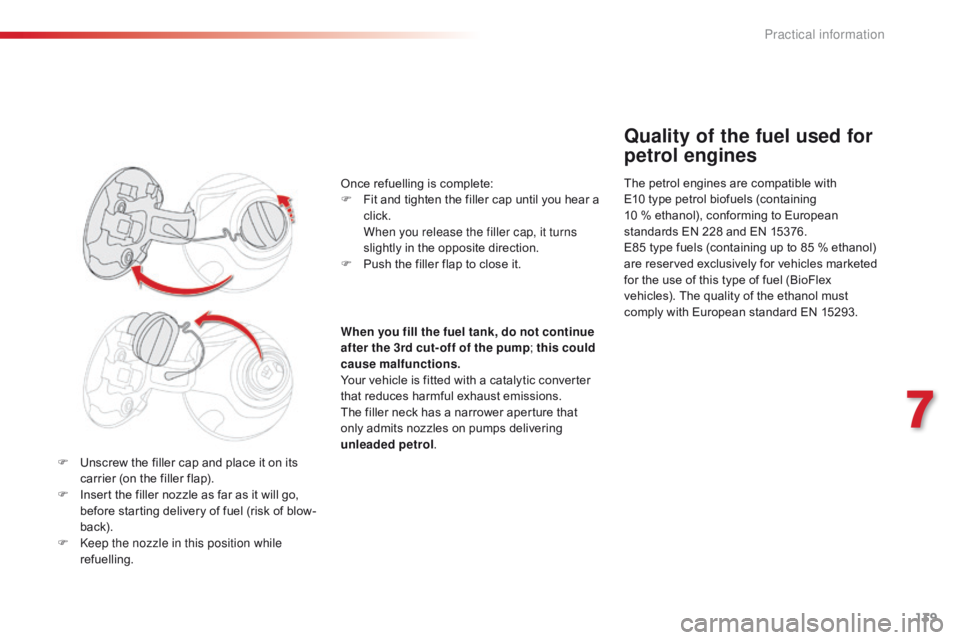
F Unscrew the filler cap and place it on its c
arrier (on the filler flap).
F
I
nsert the filler nozzle as far as it will go,
b
efore starting delivery of fuel (risk of blow-
back).
F
K
eep the nozzle in this position while
refuelling.
Quality of the fuel used for
petrol engines
The petrol engines are compatible with
E 10 type petrol biofuels (containing
10
% ethanol), conforming to European
s
tandards EN 228 and EN 15376.
E85
type fuels (containing up to 85 % ethanol)
a
re reserved exclusively for vehicles marketed
f
or the use of this type of fuel (BioFlex
v
ehicles). The quality of the ethanol must
c
omply with European standard EN 15293.
Once
refuelling
is
complete:
F
F
it
and
tighten
the
filler
cap
until
you
hear
a
c
lick.
W
hen you release the filler cap, it turns
slightly
in
the
opposite
direction.
F
P
ush
the
filler
flap
to
close
it.
When you fill the fuel tank, do not continue
after the 3rd cut- off of the pump ;
this could
cause malfunctions .
Your
vehicle
is
fitted
with
a
catalytic
converter
t
hat
reduces
harmful
exhaust
emissions.
The
filler
neck
has
a
narrower
aperture
that
o
nly
admits
nozzles
on
pumps
delivering
unl
eaded petrol .
7
Practical information
Page 172 of 269
170
C1_en_Chap08_en-cas-pannes_ed01-2016
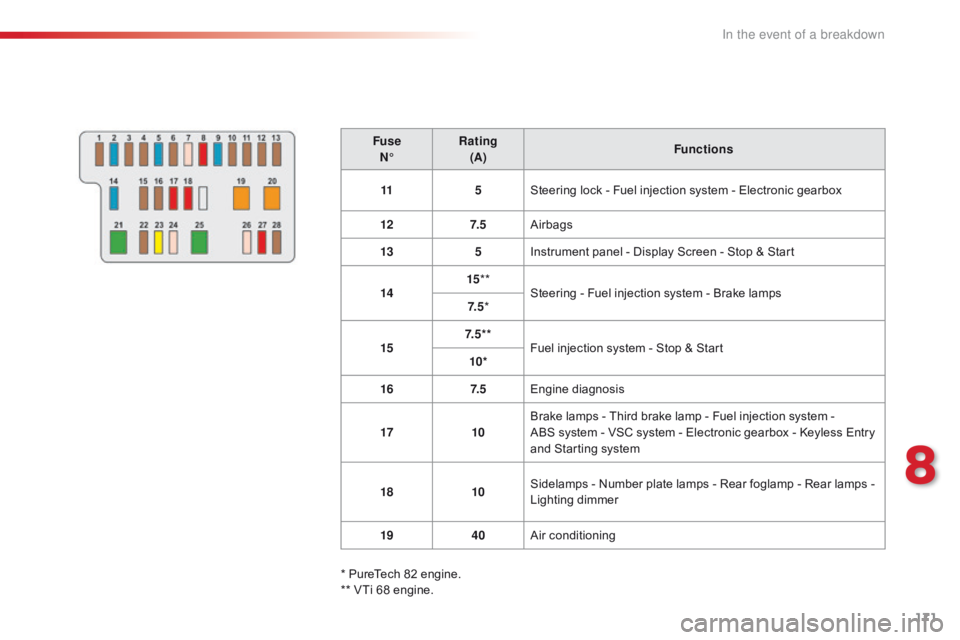
Dashboard fuses
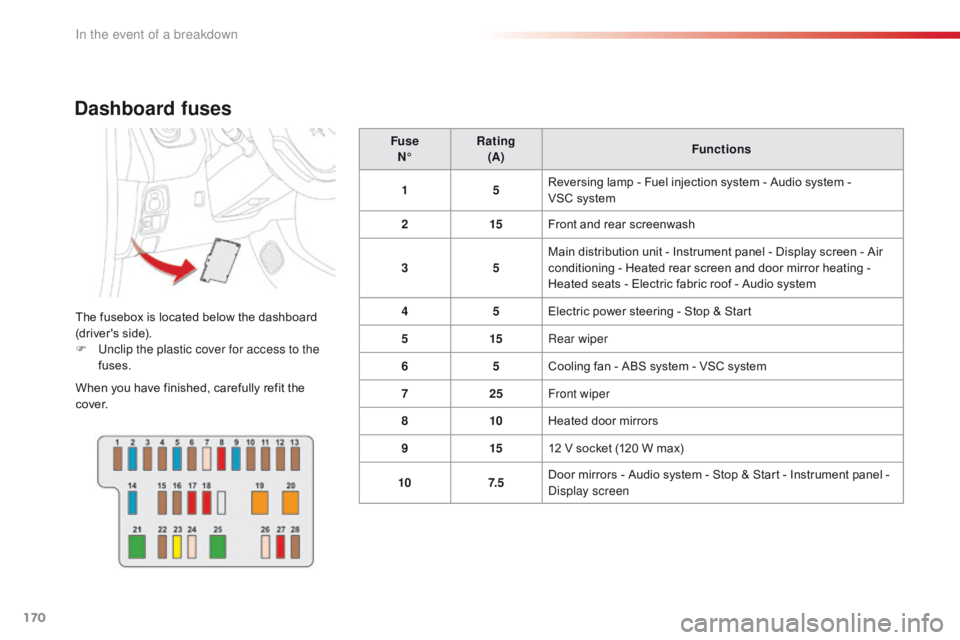
The fusebox is located below the dashboard (driver's side).
F
U
nclip the plastic cover for access to the
fuses.
When
you have finished, carefully refit the
c
ove r. Fuse
N° Rating
(A) Functions
1 5Reversing lamp - Fuel injection system - Audio system -
V
SC system
2 15Front and rear screenwash
3 5Main distribution unit - Instrument panel - Display screen - Air
c
onditioning - Heated rear screen and door mirror heating -
H
eated seats - Electric fabric roof - Audio system
4 5Electric power steering - Stop & Start
5 15Rear wiper
6 5Cooling
fan - ABS system - VSC system
7 25Front wiper
8 10Heated
door mirrors
9 1512
V socket (120 W max)
10 7. 5Door
mirrors - Audio system - Stop & Start - Instrument panel -
D
isplay screen
In the event of a breakdown
Page 173 of 269
171
C1_en_Chap08_en-cas-pannes_ed01-2016
FuseN° Rating
(A) Functions
11 5Steering
lock - Fuel injection system - Electronic gearbox
12 7. 5Airbags
13 5Instrument
panel - Display Screen - Stop & Start
14 15
**
Steering
- Fuel injection system - Brake lamps
7. 5 *
15 7. 5 * *
Fuel
injection system - Stop & Start
10*
16 7. 5Engine
d
iagnosis
17 10Brake
lamps - Third brake lamp - Fuel injection system -
ABS
system - VSC system - Electronic gearbox - Keyless Entry
a
nd Starting system
18 10Sidelamps
- Number plate lamps - Rear foglamp - Rear lamps -
L
ighting dimmer
19 40Air
c
onditioning
*
PureTech 82 engine.
**
VTi 68 engine.
8
In the event of a breakdown
Page 174 of 269
172
C1_en_Chap08_en-cas-pannes_ed01-2016
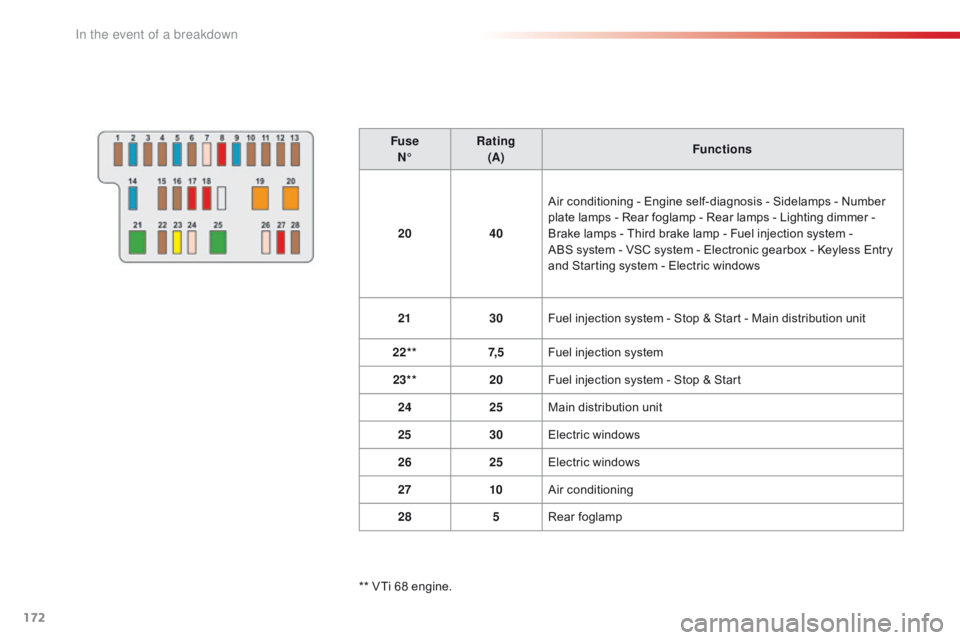
FuseN° Rating
(A) Functions
20 40Air
conditioning - Engine self-diagnosis - Sidelamps - Number
p
late lamps - Rear foglamp - Rear lamps - Lighting dimmer -
B
rake lamps - Third brake lamp - Fuel injection system -
A
BS system - VSC system - Electronic gearbox - Keyless Entry
a
nd Starting system - Electric windows
21 30Fuel
injection system - Stop & Start - Main distribution unit
22** 7, 5Fuel
injection system
23** 20Fuel
injection system - Stop & Start
24 25Main
distribution unit
25 30Electric
windows
26 25Electric
windows
27 10Air
c
onditioning
28 5Rear
fo
glamp
**
VTi 68 engine.
In the event of a breakdown