light CITROEN C1 2017 Owner's Manual
[x] Cancel search | Manufacturer: CITROEN, Model Year: 2017, Model line: C1, Model: CITROEN C1 2017Pages: 269, PDF Size: 7.63 MB
Page 103 of 269
101
C1_en_Chap05_eclairage-visibilite_ed01-2016
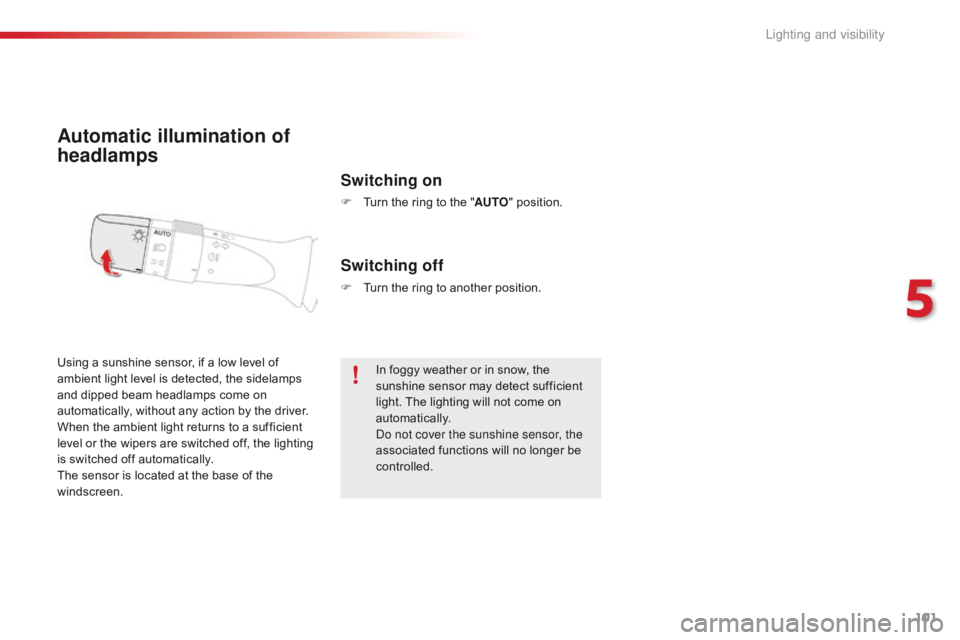
Automatic illumination of
headlamps
Switching on
F Turn the ring to the "AUTO " position.
Using
a
sunshine
sensor,
if
a
low
level
of
a
mbient
light
level
is
detected,
the
sidelamps
a
nd
dipped
beam
headlamps
come
on
a
utomatically,
without
any
action
by
the
driver.
When
the
ambient
light
returns
to
a
sufficient
l
evel
or
the
wipers
are
switched
off,
the
lighting
i
s
switched
off
automatically.
The
sensor
is
located
at
the
base
of
the
w
indscreen.
Switching off
F Turn the ring to another position.
In foggy weather or in snow, the
s
unshine sensor may detect sufficient
l
ight. The lighting will not come on
au
tomatically.
Do not cover the sunshine sensor, the
associated
functions will no longer be
c
ontrolled.
5
Lighting and visibility
Page 104 of 269
102
C1_en_Chap05_eclairage-visibilite_ed01-2016
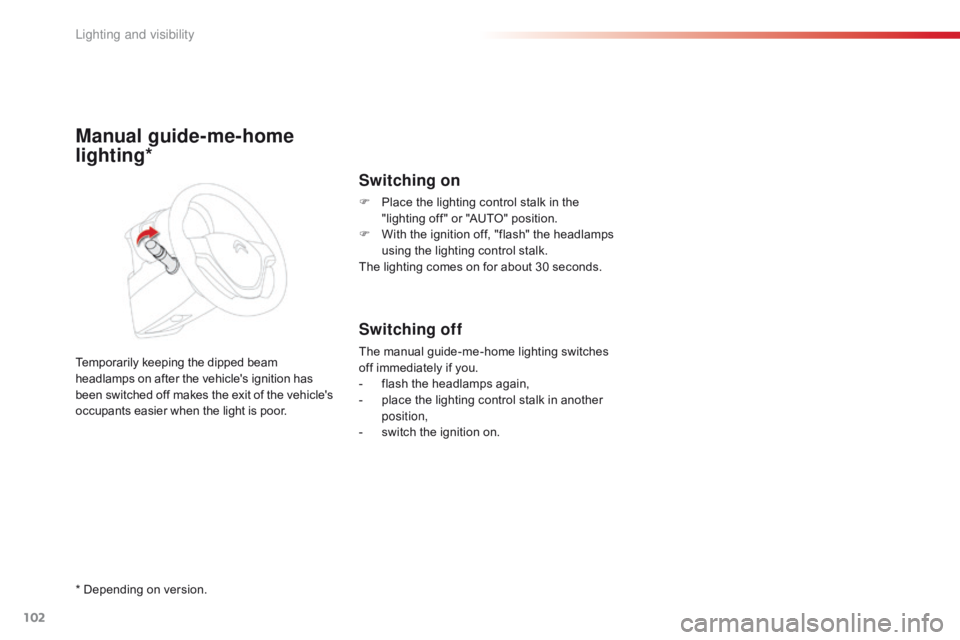
Manual guide-me-home
lighting*
Temporarily keeping the dipped beam headlamps on after the vehicle's ignition has b
een switched off makes the exit of the vehicle's
o
ccupants easier when the light is poor.
Switching on
F Place the lighting control stalk in the "
lighting off " or "AUTO" position.
F
W
ith the ignition off, "flash" the headlamps
u
sing the lighting control stalk.
The
lighting comes on for about 30 seconds.
Switching off
The manual guide-me-home lighting switches off immediately if you.
-
f
lash the headlamps again,
-
p
lace the lighting control stalk in another
p
osition,
-
s
witch the ignition on.
*
Depending
on
version.
Lighting and visibility
Page 105 of 269
103
C1_en_Chap05_eclairage-visibilite_ed01-2016
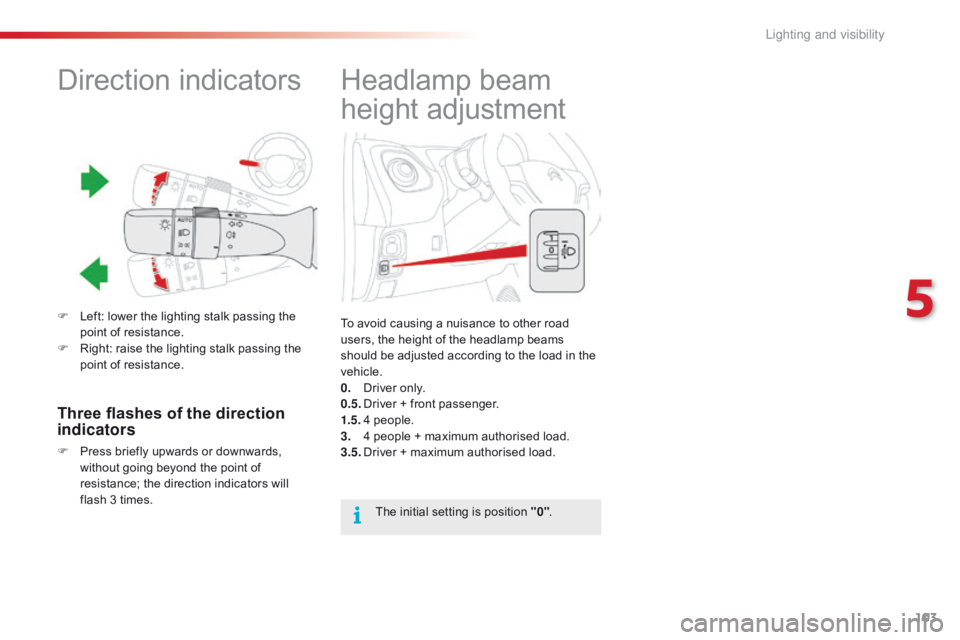
Headlamp beam
h
eight
ad
justment
To avoid causing a nuisance to other road u
sers, the height of the headlamp beams
s
hould be adjusted according to the load in the
v
ehicle.
0.
D
river only.
0.5.
D
river + front passenger.
1.5 .
4
people.
3.
4
people + maximum authorised load.
3.5.
D
river + maximum authorised load.
The
initial setting is position "0".
Direction indicators
F Left: lower the lighting stalk passing the p
oint of resistance.
F
R
ight: raise the lighting stalk passing the
p
oint of resistance.
Three flashes of the direction
indicators
F Press briefly upwards or downwards, w
ithout going beyond the point of
r
esistance; the direction indicators will
f
lash 3 times.
5
Lighting and visibility
Page 106 of 269
104
C1_en_Chap05_eclairage-visibilite_ed01-2016
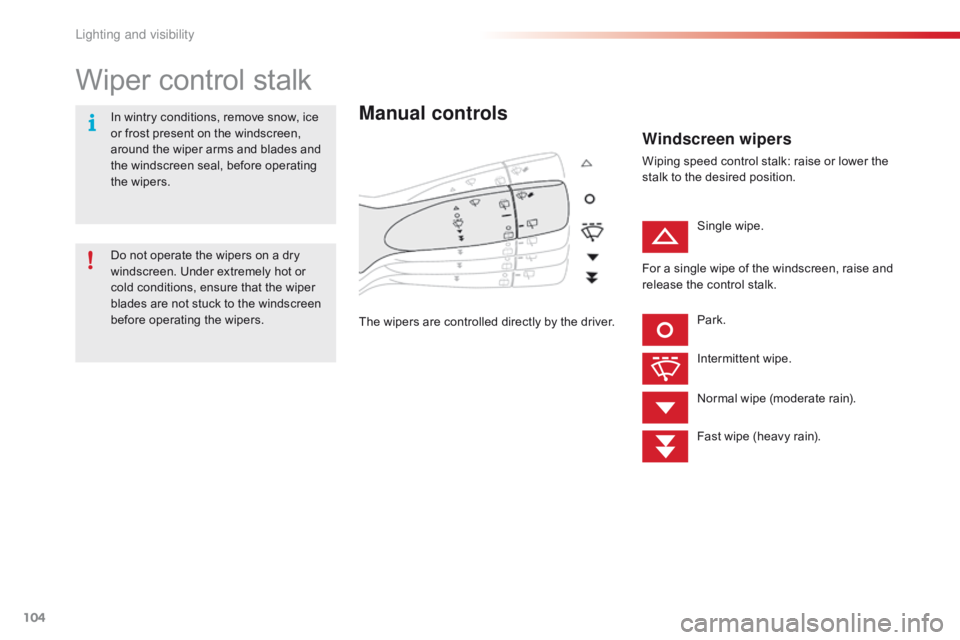
Wiper control stalk
Manual controls
The wipers are controlled directly by the driver.
Windscreen wipers
Wiping speed control stalk: raise or lower the stalk to the desired position.
Single
wipe.
Park.
Intermittent
wipe.
Normal
wipe (moderate rain).
Fast
wipe (heavy rain).
Do
not
operate
the
wipers
on
a
dry
w
indscreen.
Under
extremely
hot
or
c
old
conditions,
ensure
that
the
wiper
b
lades
are
not
stuck
to
the
windscreen
b
efore
operating
the
wipers.
In
wintry
conditions,
remove
snow,
ice
o
r
frost
present
on
the
windscreen,
a
round
the
wiper
arms
and
blades
and
t
he
windscreen
seal,
before
operating
t
he
wipers.
For
a single wipe of the windscreen, raise and
r
elease the control stalk.
Lighting and visibility
Page 107 of 269
105
C1_en_Chap05_eclairage-visibilite_ed01-2016
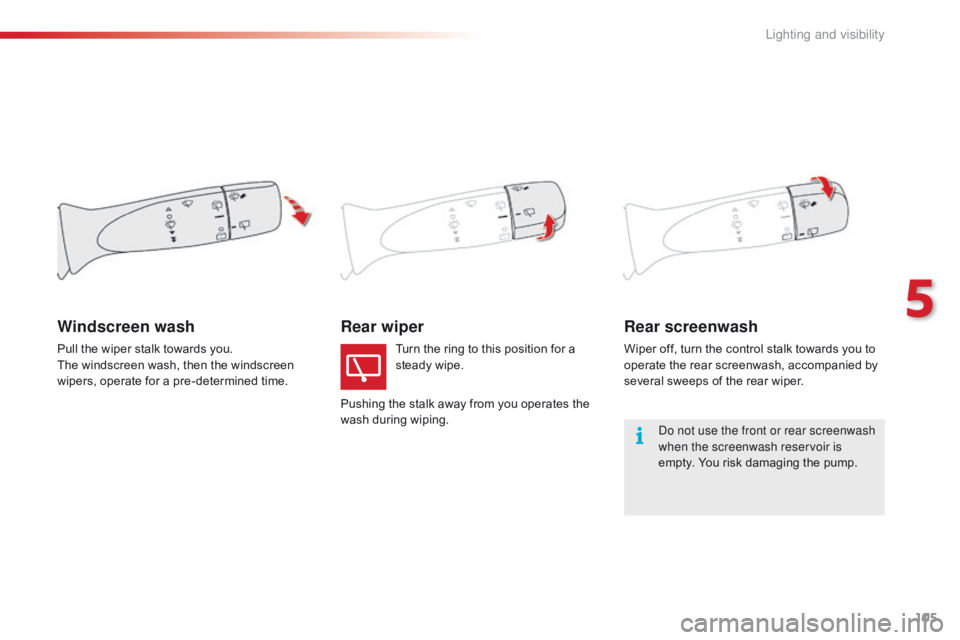
Rear wiperRear screenwash
Wiper off, turn the control stalk towards you to o
perate the rear screenwash, accompanied by
s
everal sweeps of the rear wiper.
Windscreen wash
Turn the ring to this position for a steady wipe.
Pushing
the stalk away from you operates the
w
ash
during wiping.
Pull
the
wiper
stalk
towards
you.
T
he windscreen
wash,
then
the
windscreen
w
ipers,
operate
for
a
pre-determined
time.
Do not use the front or rear screenwash
when the screenwash reservoir is
empty.
You risk damaging the pump.
5
Lighting and visibility
Page 110 of 269
108
C1_en_Chap06_securite_ed01-2016
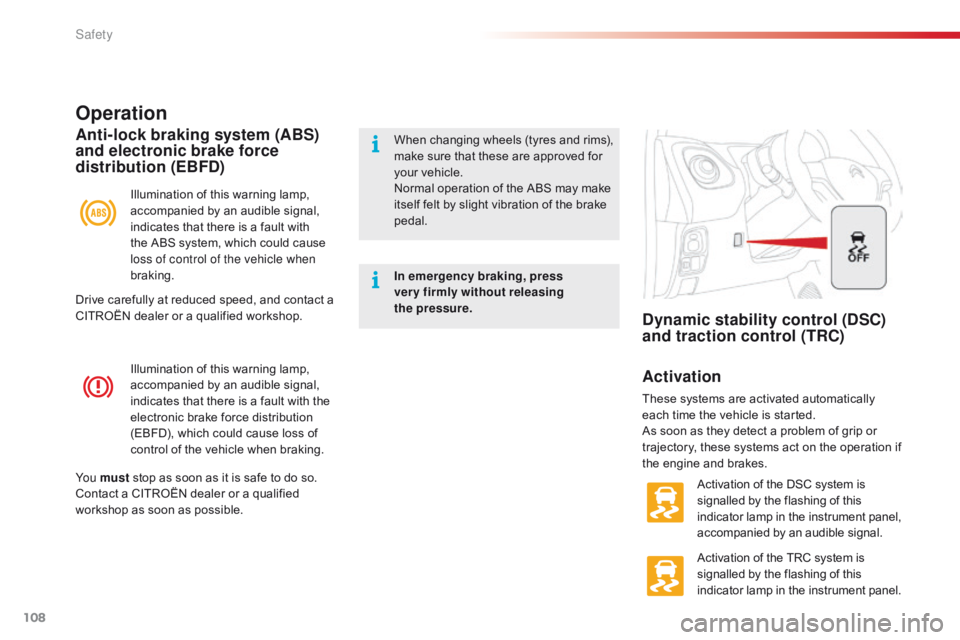
Illumination of this warning lamp, accompanied by an audible signal,
i
ndicates that there is a fault with the
e
lectronic brake force distribution
(
EBFD), which could cause loss of
c
ontrol of the vehicle when braking.
Operation
Illumination of this warning lamp, accompanied by an audible signal,
i
ndicates that there is a fault with
t
he ABS system, which could cause
l
oss of control of the vehicle when
braking.
Anti-lock braking system (ABS)
and electronic brake force
distribution (EBFD)When changing w heels ( tyres a nd r ims), m
ake sure that these are approved for
y
our vehicle.
Normal
operation of the ABS may make
i
tself felt by slight vibration of the brake
ped
al.
In emergency braking, press
very firmly without releasing
the
pressure.
Yo u must
stop
as
soon
as
it
is
safe
to
do
so.
Contact
a
CITROËN
dealer
or
a
qualified
w
orkshop
as
soon
as
possible.
Dynamic stability control (DSC)
and traction control (TRC)
Activation
These systems are activated automatically e ach time the vehicle is started.
As
soon as they detect a problem of grip or
t
rajectory, these systems act on the operation if
t
he engine and brakes.
Activation
of the DSC system is
s
ignalled by the flashing of this
i
ndicator lamp in the instrument panel,
a
ccompanied by an audible signal.
Activation
of the TRC system is
s
ignalled by the flashing of this
i
ndicator lamp in the instrument panel.
Drive
carefully
at
reduced
speed,
and
contact
a
C
ITROËN
dealer
or
a
qualified
workshop.
Safety
Page 115 of 269
113
C1_en_Chap06_securite_ed01-2016
Never leave accumulations of snow or any object projecting above the bonnet
o
r in front of the roof: this might fall into
t
he field of vision of the sensor and
g
enerate a detection.
Operating limits
The system o nly d etects v ehicles (cars, lorries) t
hat are stationary or moving in the same
d
irection as your vehicle. In
difficult weather conditions (very
h
eavy rain, snow, fog, hail...), braking
d
istances increase, which can reduce
t
he ability of the system to avoid a
c
ollision.
The
driver must therefore remain
par
ticularly
v
igilant.
The
system is not triggered or is interrupted if
t
he
d
river:
-
a
ccelerates strongly (even if the speed
l
imiter is on),
-
o
r turns the steering wheel suddenly
(
avoiding
m
anoeuvre).
Detection
capability is less effective if:
-
y
ou are driving on roads with pronounced
b
ends and/or on roads in poor condition,
-
y
our vehicle is excessively loaded, as
t
his changes the horizontal attitude of the
v
ehicle.
-
y
our vehicle skids.
It
does not detect small vehicles
(
bicycles, motorcycles), pedestrians or
a
nimals, nor non-reflective stationary
ob
jects.Unwanted triggering of the system
It is possible for the system to detect a risk of imminent collision and start working, in the
fo
llowing
c
onditions
in par
ticular:
-
d
etection of an object located close to the
e
dge of the road entering a corner (safety
b
arrier, lamp post or road sign),
-
d
etection of a structure located at the top
o
r bottom of a steep slope (advertising
h
oarding, steet lighting),
-
d
etection of reflective objects (central
r
eservation...) in the road,
-
d
etection of the upper bar of a bridge or a
t
raffic light gantry,
-
p
assing a vehicle travelling in the other
d
irection in a corner,
-
p
assing a vehicle traveling in the other
d
irection, at a crossroads, when your
v
ehicle is turning left or right,
-
i
f the vehicle ahead of you sends up water
o
r snow,
-
i
f your vehicle stops very close to an
ov
erhanging wall or other vehicles,
-
w
hen your vehicle closes rapidly on the
v
ehicle
a
head,
-
i
f the vehicle is raised or lowered,
-
i
f the vehicle passes through a plastic
c
urtain,
-
i
f driving through mist or smoke,
-
i
f the sensor is misaligned (following
r
eplacement after a collision).
6
Safety
Page 119 of 269
117
C1_en_Chap06_securite_ed01-2016
The driver must ensure that passengers use the seat belts correctly and that they are all
f
astened before setting off.
Wherever
you are seated in the vehicle,
a
lways fasten your seat belt, even for short
journeys.
Do
not interchange the seat belt buckles as
t
hey will not fulfil their role fully.
The
seat belts are fitted with an inertia reel
p
ermitting automatic adjustment of the
l
ength of the strap to your size. The seat belt
i
s stowed automatically when not in use.
Before
and after use, ensure that the seat
b
elt is reeled in correctly.
The
lower part of the strap must be
p
ositioned as low as possible on the pelvis.
The
upper part must be positioned in the
h
ollow of the shoulder.
The
inertia reels are fitted with an automatic
l
ocking device which comes into operation in
t
he event of a collision, emergency braking
o
r if the vehicle rolls over. You can release
t
he device by pulling the strap firmly and
t
hen releasing it so that it reels in slightly.Recommendations for children
Use a suitable child seat if the passenger is less than 12 years old or shorter than one
a
nd a half metres.
Never
use the same seat belt to secure more
t
han one person.
Never
allow a child to travel on your lap.
For
more information on child seats, refer to
t
he corresponding section.
In
order
to
be
effective,
a
seat
belt
must:
-
b
e
tightened
as
close
to
the
body
as
p
ossible,
-
b
e
pulled
in
front
of
you
with
a
smooth
m
ovement,
checking
that
it
does
not
t
wist,
-
b
e
used
to
restrain
only
one
person,
-
n
ot
bear
any
trace
of
cuts
or
fraying,
-
n
ot
be
converted
or
modified
to
avoid
a
ffecting
it
s
p
erformance.
In the event of an impact
Depending on the nature and
seriousness of the impact , the
pretensioning
device may be deployed
b
efore and independently of the airbags.
D
eployment of the pretensioners is
a
ccompanied by a slight discharge of
h
armless smoke and a noise, due to the
a
ctivation of the pyrotechnic cartridge
i
ncorporated in the system.
In
all cases, the airbag warning lamp
c
omes on.
Following
an impact, have the seat belts
s
ystem checked, and if necessary replaced,
b
y a CITROËN dealer or a qualified
w
orkshop.
In
accordance
with
current
safety
r
egulations,
for
all
repairs
on
your
vehicle's
s
eat
belts,
go
to
a
qualified
workshop
with
t
he
skills
and
equipment
needed,
which
a
C
ITROËN
dealer
is
able
to
provide.
Have
your
seat
belts
checked
regularly
by
a
CITROËN
dealer
or
a
qualified
workshop,
p
articularly
if
the
straps
show
signs
of
d
amage.
Clean the seat belt straps with soapy
water
or
a
textile
cleaning
product,
sold
by
C
ITROËN
dealers.
After
folding
or
moving
a
seat
or
rear
bench
s
eat,
ensure
that
the
seat
belt
is
positioned
a
nd
reeled
in
correctly.
Advice
6
Safety
Page 120 of 269
118
C1_en_Chap06_securite_ed01-2016
Airbags
Designed to contribute towards the safety of the occupants in the event of violent collisions.
T
he airbags supplement the action of the force-
limiting
seat belts.
If
a collision occurs, the electronic detectors
r
ecord and analyse the front and side impacts
s
ustained in the impact detection zones:
-
i
n the case of a serious impact, the airbags
a
re deployed instantly and contribute
t
owards better protection of the occupants
o
f the vehicle; immediately after the impact,
t
he airbags deflate rapidly so that they
d
o not hinder visibility or the exit of the
o
ccupants,
-
i
n the case of a minor or rear impact or in
c
ertain roll-over conditions, the airbags
m
ay not be deployed; the seat belt alone
c
ontributes towards providing your
p
rotection in these situations.
The airbags do not operate when the
ignition is switched off. The
deployment of an airbag is
a
ccompanied by a slight emission
o
f smoke and a noise, due to the
d
etonation of the pyrotechnic charge
i
ncorporated in the system.
This
smoke is not harmful, but sensitive
i
ndividuals may experience slight
ir
ritation.
The
detonation noise associated with
t
he deployment of an airbag may result
i
n a slight loss of hearing for a short
t
ime.
This
equipment will only deploy once.
I
f a second impact occurs (during the
s
ame or a subsequent accident), the
a
irbag will not be deployed again.
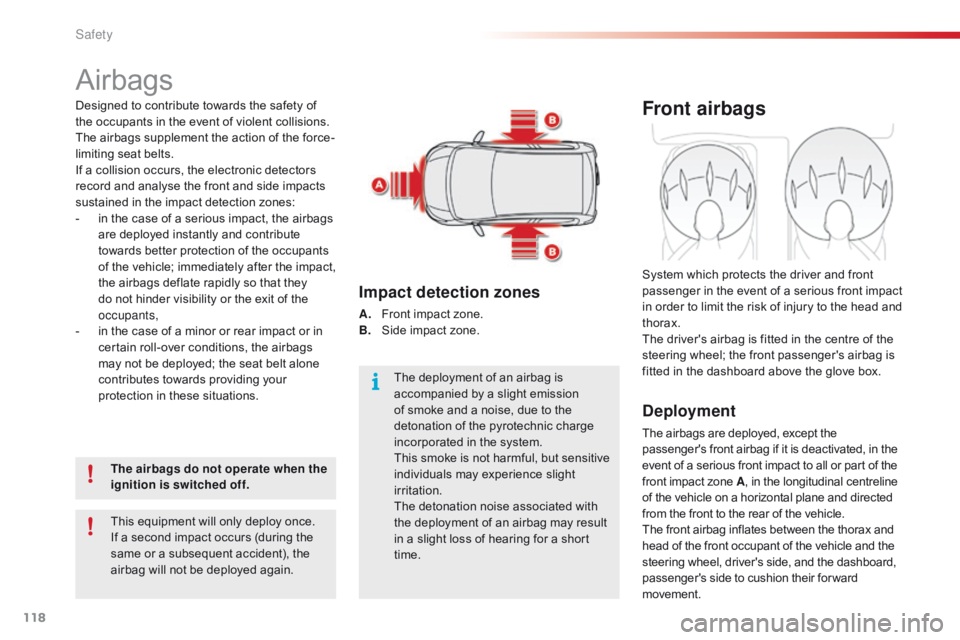
Impact detection zones
A. Front impact zone.
B. S ide impact zone.
Front airbags
Deployment
The airbags are deployed, except the passenger's front airbag if it is deactivated, in the e
vent of a serious front impact to all or part of the
f
ront impact zone A,
in the longitudinal centreline
o
f the vehicle on a horizontal plane and directed
f
rom the front to the rear of the vehicle.
The
front airbag inflates between the thorax and
h
ead of the front occupant of the vehicle and the
s
teering wheel, driver's side, and the dashboard,
p
assenger's side to cushion their for ward
m
ovement.
System
which protects the driver and front
p
assenger in the event of a serious front impact
i
n order to limit the risk of injury to the head and
t
horax.
The driver's airbag is fitted in the centre of the
s
teering wheel; the front passenger's airbag is
f
itted in the dashboard above the glove box.
Safety
Page 141 of 269
139
C1_en_Chap07_info-pratiques_ed01-2016
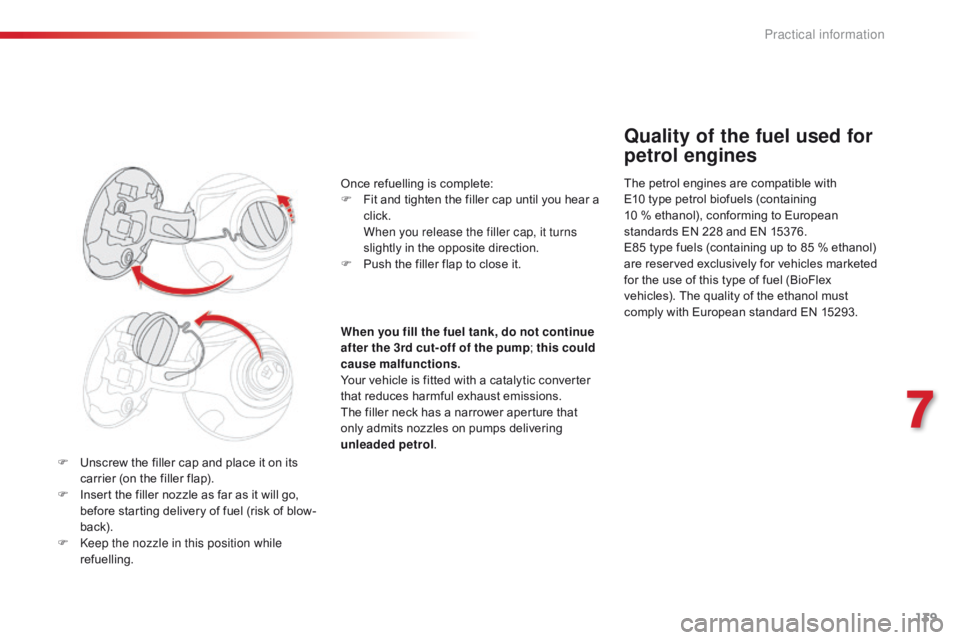
F Unscrew the filler cap and place it on its c
arrier (on the filler flap).
F
I
nsert the filler nozzle as far as it will go,
b
efore starting delivery of fuel (risk of blow-
back).
F
K
eep the nozzle in this position while
refuelling.
Quality of the fuel used for
petrol engines
The petrol engines are compatible with
E 10 type petrol biofuels (containing
10
% ethanol), conforming to European
s
tandards EN 228 and EN 15376.
E85
type fuels (containing up to 85 % ethanol)
a
re reserved exclusively for vehicles marketed
f
or the use of this type of fuel (BioFlex
v
ehicles). The quality of the ethanol must
c
omply with European standard EN 15293.
Once
refuelling
is
complete:
F
F
it
and
tighten
the
filler
cap
until
you
hear
a
c
lick.
W
hen you release the filler cap, it turns
slightly
in
the
opposite
direction.
F
P
ush
the
filler
flap
to
close
it.
When you fill the fuel tank, do not continue
after the 3rd cut- off of the pump ;
this could
cause malfunctions .
Your
vehicle
is
fitted
with
a
catalytic
converter
t
hat
reduces
harmful
exhaust
emissions.
The
filler
neck
has
a
narrower
aperture
that
o
nly
admits
nozzles
on
pumps
delivering
unl
eaded petrol .
7
Practical information