stop CITROEN C1 2018 User Guide
[x] Cancel search | Manufacturer: CITROEN, Model Year: 2018, Model line: C1, Model: CITROEN C1 2018Pages: 269, PDF Size: 7.63 MB
Page 30 of 269
28
With the touch screen tablet
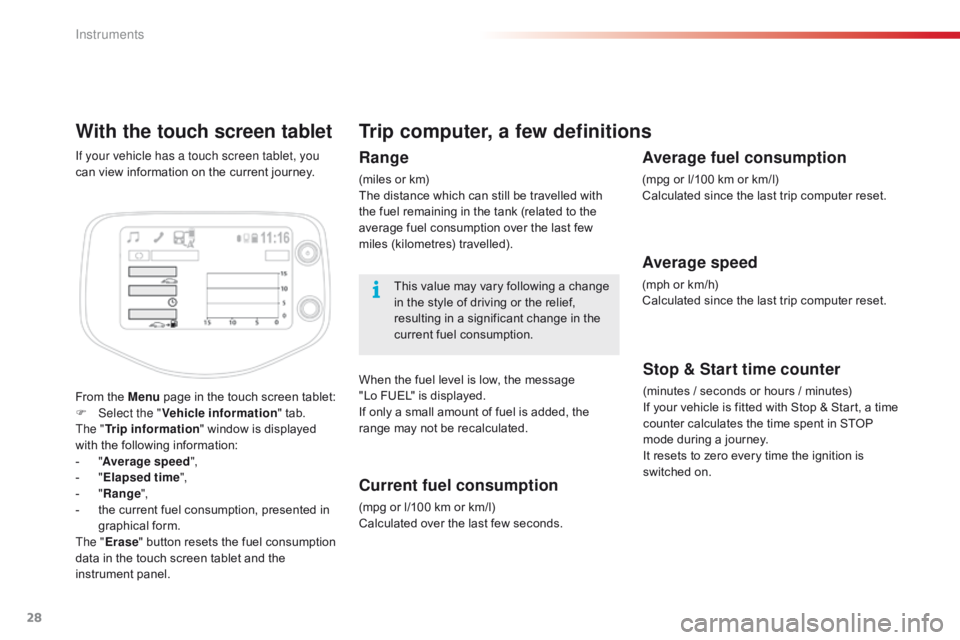
From the Menu page in the touch screen tablet:
F Sel ect the " Vehicle information "
tab.
The " Trip information "
window is displayed
w
ith the following information:
-
"A
verage speed ",
-
" E
lapsed time ",
-
" R
ange",
-
t
he current fuel consumption, presented in
g
raphical
fo
rm.
The " Erase "
button resets the fuel consumption
d
ata in the touch screen tablet and the
in
strument
pan
el.
If your vehicle has a touch screen tablet, you
can
view information on the current journey.
Trip computer, a few definitions
Range
(miles or km)
T he distance which can still be travelled with
t
he fuel remaining in the tank (related to the
a
verage fuel consumption over the last few
m
iles
(
kilometres)
t
ravelled).
This
value may vary following a change
i
n the style of driving or the relief,
r
esulting in a significant change in the
c
urrent fuel consumption.
When
the fuel level is low, the message
"
Lo FUEL" is displayed.
If
only a small amount of fuel is added, the
r
ange may not be recalculated.
Current fuel consumption
(mpg or l/100 km or km/l)
C alculated over the last few seconds.
Stop & Start time counter
(minutes / seconds or hours / minutes)
I f your vehicle is fitted with Stop & Start, a time
c
ounter calculates the time spent in STOP
m
ode during a journey.
It
resets to zero every time the ignition is
s
witched on.
Average fuel consumption
(mpg or l/100 km or km/l)
C alculated since the last trip computer reset.
Average speed
(mph or km/h)
C alculated since the last trip computer reset.
Instruments
Page 39 of 269
37
C1_en_Chap02_ouvertures_ed01-2016
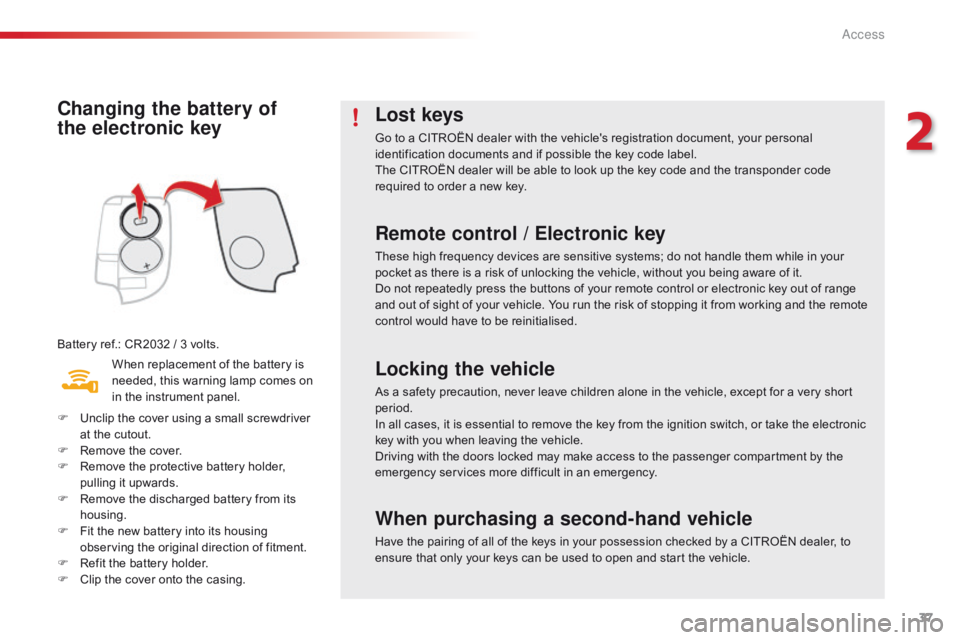
Changing the battery of
the electronic key
Battery ref.: CR2032 / 3 volts.
W hen replacement of the battery is
n
eeded, this warning lamp comes on
i
n the instrument panel.
F
U
nclip the cover using a small screwdriver
a
t the cutout.
F
R
emove the cover.
F
R
emove the protective battery holder,
p
ulling it upwards.
F
R
emove the discharged battery from its
h
ousing.
F
F
it the new battery into its housing
o
bserving the original direction of fitment.
F
R
efit the battery holder.
F
C
lip the cover onto the casing.
Lost keys
Go to a CITROËN dealer with the vehicle's registration document, your personal identification documents and if possible the key code label.
The
CITROËN dealer will be able to look up the key code and the transponder code
r
equired to order a new key.
Remote control / Electronic key
These high frequency devices are sensitive systems; do not handle them while in your pocket as there is a risk of unlocking the vehicle, without you being aware of it.
Do
not repeatedly press the buttons of your remote control or electronic key out of range
a
nd out of sight of your vehicle. You run the risk of stopping it from working and the remote
c
ontrol would have to be reinitialised.
Locking the vehicle
As a safety precaution, never leave children alone in the vehicle, except for a very short period.
In
all cases, it is essential to remove the key from the ignition switch, or take the electronic
k
ey with you when leaving the vehicle.
When purchasing a second-hand vehicle
Have the pairing of all of the keys in your possession checked by a CITROËN dealer, to ensure that only your keys can be used to open and start the vehicle.
Driving
with the doors locked may make access to the passenger compartment by the
e
mergency services more difficult in an emergency.
2
Access
Page 43 of 269
41
C1_en_Chap02_ouvertures_ed01-2016
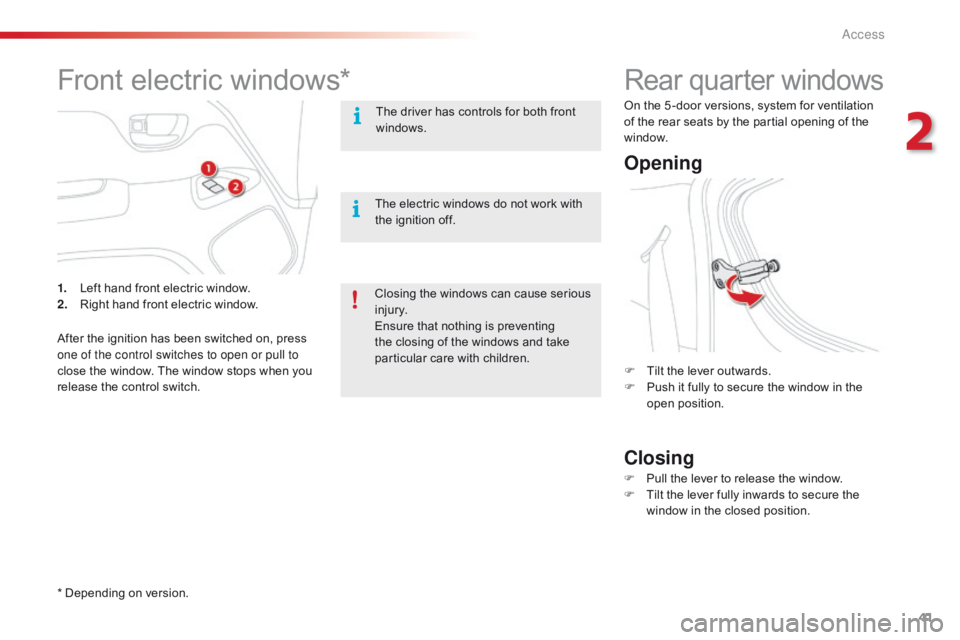
Rear quarter windows
Opening
Closing
F Tilt the lever outwards.
F P ush it fully to secure the window in the
ope
n
p
osition.
F
P
ull the lever to release the window.
F
T
ilt the lever fully inwards to secure the
w
indow in the closed position.
On
the 5 -door versions, system for ventilation
o
f the rear seats by the partial opening of the
w
indow.
Front electric windows*
The driver has controls for both front w
indows.
The
electric windows do not work with
t
he ignition off.
1.
L
eft
hand
front
electric
window.
2.
R
ight
hand
front
electric
window.
After
the
ignition
has
been
switched
on,
press
o
ne of the control switches to open or pull to
close
the
window.
The
window
stops
when
you
r
elease
the
control
switch.
*
Depending
on
version. Closing
the windows can cause serious
in
jury.
Ensure
that nothing is preventing
t
he closing of the windows and take
p
articular care with children.
2
Access
Page 44 of 269
42
C1_en_Chap02_ouvertures_ed01-2016
* Depending on version.
Y our vehicle may be fitted with an electrically operated fabric roof.
Electric fabric ro
of*
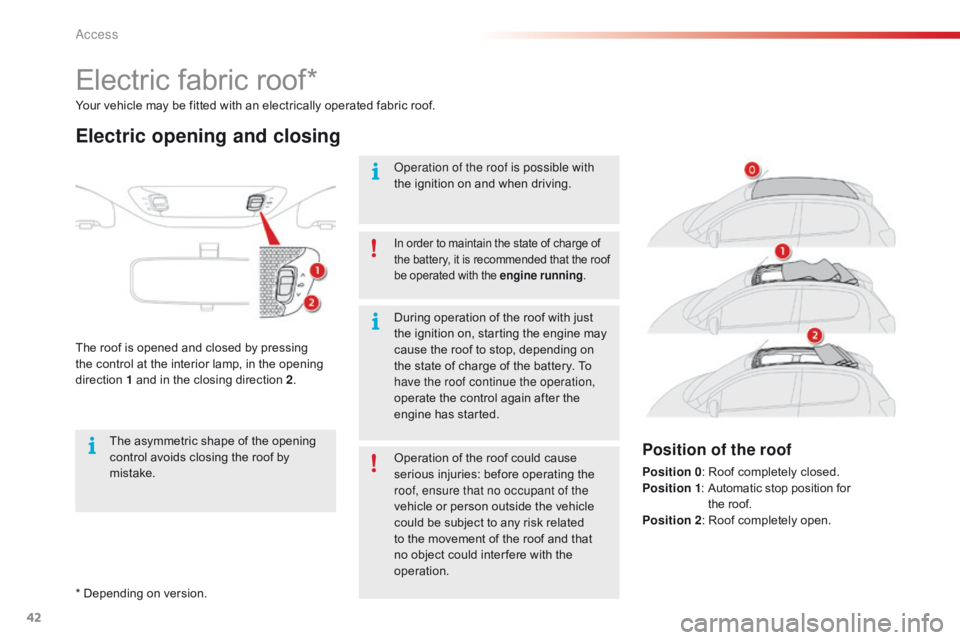
Electric opening and closing
The roof is opened and closed by pressing t
he control at the interior lamp, in the opening
d
irection
1
and in the closing direction 2.
In order to maintain the state of charge of t
he battery, it is recommended that the roof b
e operated with the engine running.
Operation of the roof is possible with
the
ignition on and when driving.
Operation
of the roof could cause
s
erious injuries: before operating the
r
oof, ensure that no occupant of the
vehicle
or person outside the vehicle
c
ould be subject to any risk related
t
o the movement of the roof and that
n
o object could inter fere with the
ope
ration.
During
operation of the roof with just
t
he ignition on, starting the engine may
c
ause the roof to stop, depending on
t
he state of charge of the battery. To
h
ave the roof continue the operation,
operate
the control again after the
e
ngine has started.
The
asymmetric
shape
of
the
opening
c
ontrol
avoids
closing
the
roof
by
m
istake.
Position of the roof
Position 0 : Roof completely closed.
Position 1 :
A utomatic stop position for
t
he roof.
Position 2 :
Roof completely open.
Access
Page 45 of 269
43
C1_en_Chap02_ouvertures_ed01-2016
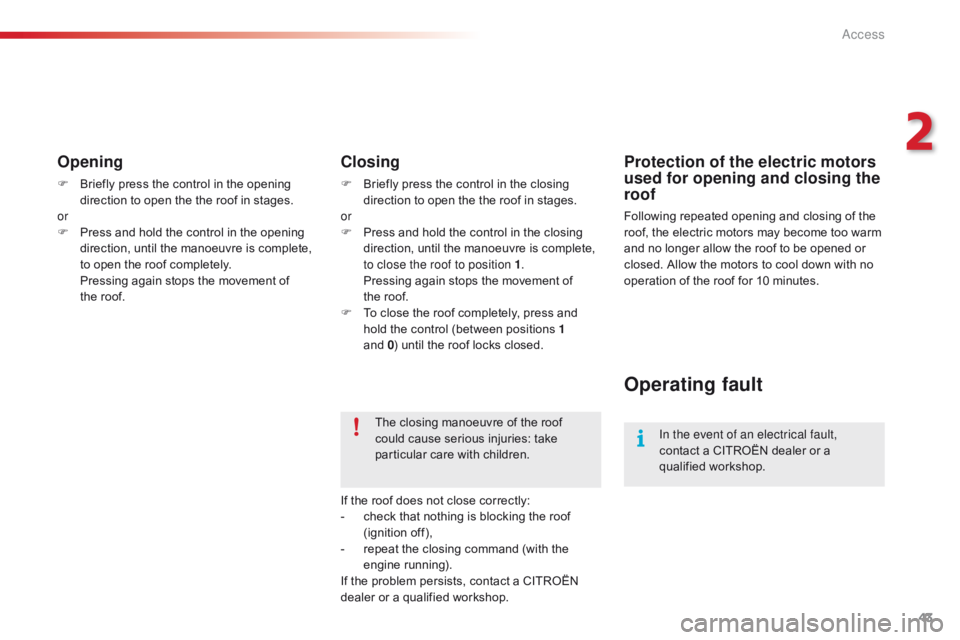
Opening
F Briefly press the control in the opening d
irection to open the the roof in stages.
or
F
P
ress and hold the control in the opening
d
irection, until the manoeuvre is complete,
t
o open the roof completely.
P
ressing again stops the movement of
the
roof.
Closing
F Briefly press the control in the closing d
irection to open the the roof in stages.
or
F
P
ress and hold the control in the closing
d
irection, until the manoeuvre is complete,
t
o close the roof to position 1 .
P
ressing again stops the movement of
t
he roof.
F
T
o close the roof completely, press and
h
old the control (between positions 1
and
0)
until the roof locks closed.
The
closing manoeuvre of the roof
c
ould cause serious injuries: take
p
articular care with children.
If
the roof does not close correctly:
-
c
heck that nothing is blocking the roof
(
ignition
o
ff),
-
r
epeat the closing command (with the
e
ngine
r
unning).
If
the problem persists, contact a CITROËN
d
ealer or a qualified workshop.
Operating fault
In the event of an electrical fault,
contact a CITROËN dealer or a
q
ualified
w
orkshop.
Protection of the electric motors
used for opening and closing the
roof
Following repeated opening and closing of the roof, the electric motors may become too warm
a
nd no longer allow the roof to be opened or
c
losed. Allow the motors to cool down with no
o
peration of the roof for 10 minutes.
2
Access
Page 48 of 269
46
C1_en_Chap03_ergonomie-confort_ed01-2016
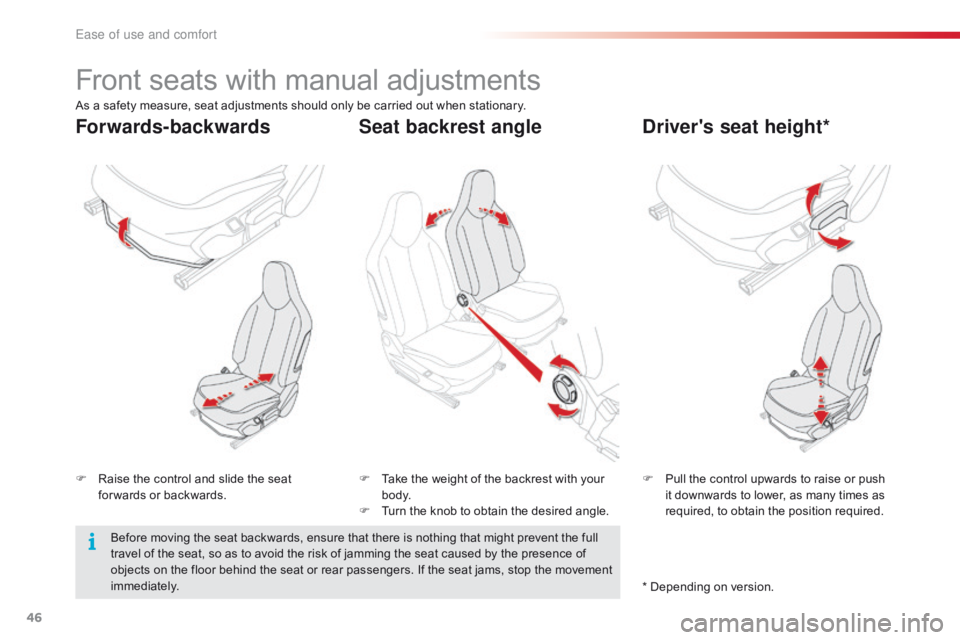
Front seats with manual adjustments
F Raise the control and slide the seat f
or wards or backwards. F
P ull the control upwards to raise or push i
t downwards to lower, as many times as
r
equired, to obtain the position required.
F
T ake the weight of the backrest with your b
o dy.
F
T
urn the knob to obtain the desired angle.
Forwards-backwardsDriver's seat height*
Seat backrest angle
As a safety measure, seat adjustments should only be carried out when stationary.
B efore moving the seat backwards, ensure that there is nothing that might prevent the full
t
ravel of the seat, so as to avoid the risk of jamming the seat caused by the presence of
o
bjects on the floor behind the seat or rear passengers. If the seat jams, stop the movement
i
mmediately. *
Depending on version.
Ease of use and comfort
Page 49 of 269
47
C1_en_Chap03_ergonomie-confort_ed01-2016
Ensure that no person or object prevents the seat slide from returning to
it
s
in
itial
p
osition.
Check
that the seat belt has reeled in
c
orrectly so as to not impede access for
p
assengers to the rear seats.
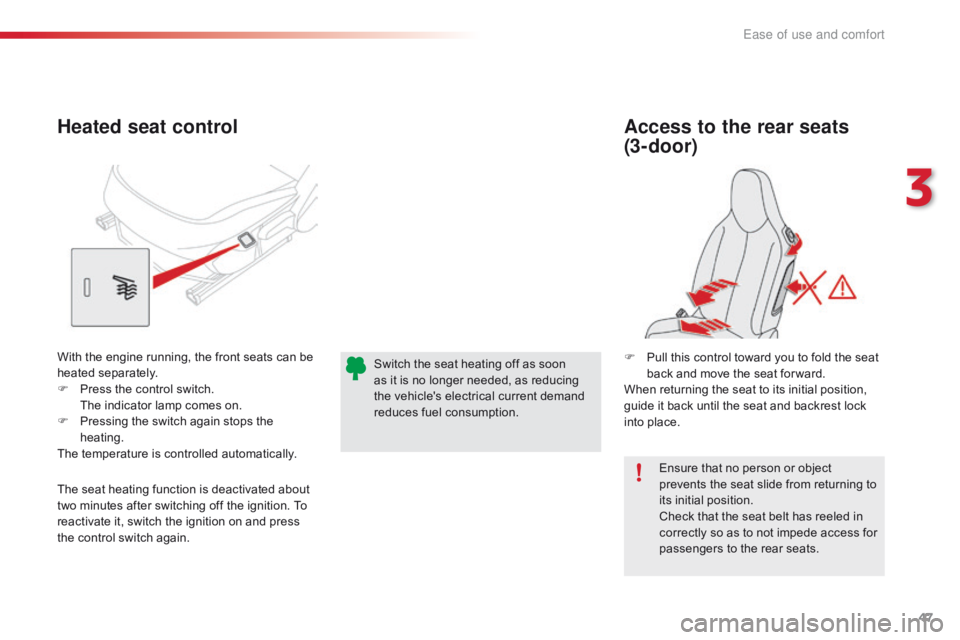
Heated seat control Access to the rear seats
(3-door)
F Pull this control toward you to fold the seat b
ack and move the seat for ward.
When
returning the seat to its initial position,
g
uide it back until the seat and backrest lock
i
nto place.
With
the
engine
running,
the
front
seats
can
be
h
eated s
eparately.
F
P
ress
the
control
switch.
T
he
indicator
lamp
comes
on.
F
P
ressing
the
switch
again
stops
the
hea
ting.
The
temperature
is
controlled
automatically.
The
seat
heating
function
is
deactivated
about
t
wo
minutes
after
switching
off
the
ignition.
To
r
eactivate
it,
switch
the
ignition
on
and
press
t
he
control
switch
again. Switch
the
seat
heating
off
as
soon
a
s
it
is
no
longer
needed,
as
reducing
t
he
vehicle's
electrical
current
demand
r
educes
fuel
consumption.
3
Ease of use and comfort
Page 61 of 269
59
C1_en_Chap03_ergonomie-confort_ed01-2016
Avoid driving for long periods with the air conditioning switched off (risk of misting a
nd reduction of the air quality in the cabin).
This action switches off all of the functions of
the air conditioning system.
Thermal
comfort is no longer controlled.
A s
light flow of air resulting from the movement
o
f the vehicle, remains perceptible however.
Pressing
the "AUTO"
button again reactivates
t
he system with the values set before it was
s
witched off.
Switching the system off
F Press the air flow adjustment b
utton until the fan symbol
d
isappears.
F
P
ress this button to stop the air
conditioning.
Air conditioning on / off
Stopping the air conditioning may cause some p roblems (humidity, misting).
Automatic
operation of the air conditioning is
r
esumed when the button is pressed again.
The "A /C "
symbol is displayed.
3
Ease of use and comfort
Page 72 of 269
70
C1_en_Chap04_conduite_ed01-2016
A few driving recommendations
Observe the driving regulations at all times and remain vigilant whatever the traffic conditions.
Pay
close attention to the traffic and keep your
h
ands on the wheel so that you are ready to
r
eact at any time to any eventuality.
On
a long journey, a break every two hours is
s
trongly
re
commended.
In
difficult weather, drive smoothly, anticipate
t
he need to brake and increase the distance
f
rom other vehicles. Never
drive with the parking brake
a
pplied - Risk of overheating and
d
amage to the braking system!
Do
not park or run the engine when
s
tationary in areas where inflammable
s
ubstances and materials (dry grass,
d
ead leaves...) might come into
c
ontact with the hot exhaust system -
R
isk of fire!
Never
leave a vehicle unsupervised
w
ith the engine running. If you have
t
o leave your vehicle with the engine
r
unning, apply the parking brake
a
nd put the gearbox into neutral or
p
osition
N,
depending on the type of
g
earbox.
Driving on flooded
roads
We strongly advise against driving on flooded roads, as this could cause serious damage
t
o the engine or gearbox, as well as to the
e
lectrical systems of your vehicle.
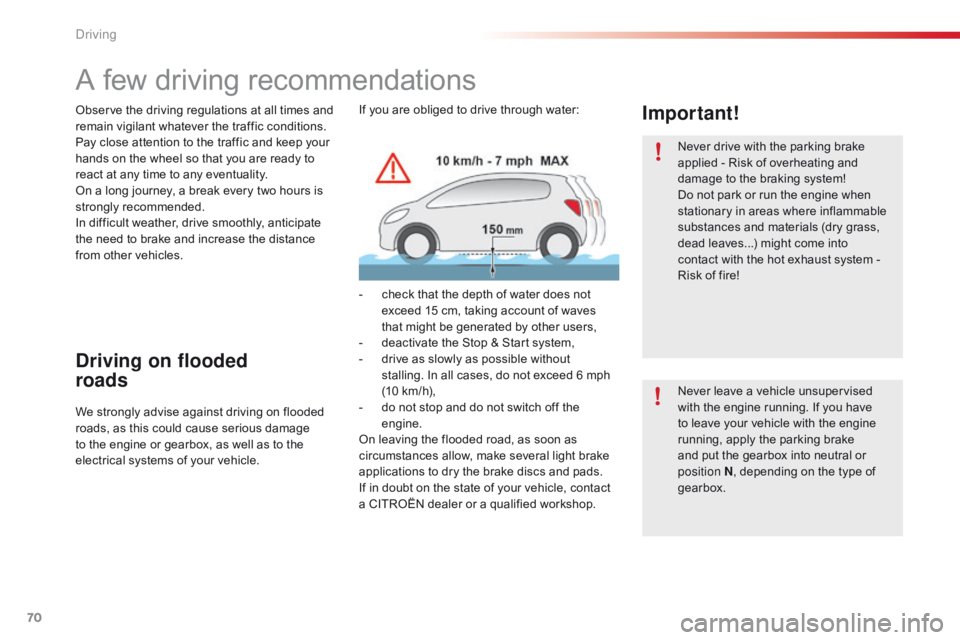
Important!If you are obliged to drive through water:
-
c
heck that the depth of water does not
e
xceed 15 cm, taking account of waves
t
hat might be generated by other users,
-
d
eactivate the Stop & Start system,
-
d
rive as slowly as possible without
s
talling. In all cases, do not exceed 6 mph
(
10 km/h),
-
d
o not stop and do not switch off the
e
ngine.
On
leaving the flooded road, as soon as
c
ircumstances allow, make several light brake
a
pplications to dry the brake discs and pads.
If
in doubt on the state of your vehicle, contact
a
CITROËN dealer or a qualified workshop.
Driving
Page 74 of 269
72
C1_en_Chap04_conduite_ed01-2016
If you use the ancillaries for a prolonged period, the vehicle will automatically
s
witch to " OFF"
mode after about
20
m
inutes.
Be aware
in order to avoid discharging
t
he battery.
Starting - switching off the engine
w ith the Keyless Entry and Starting
system
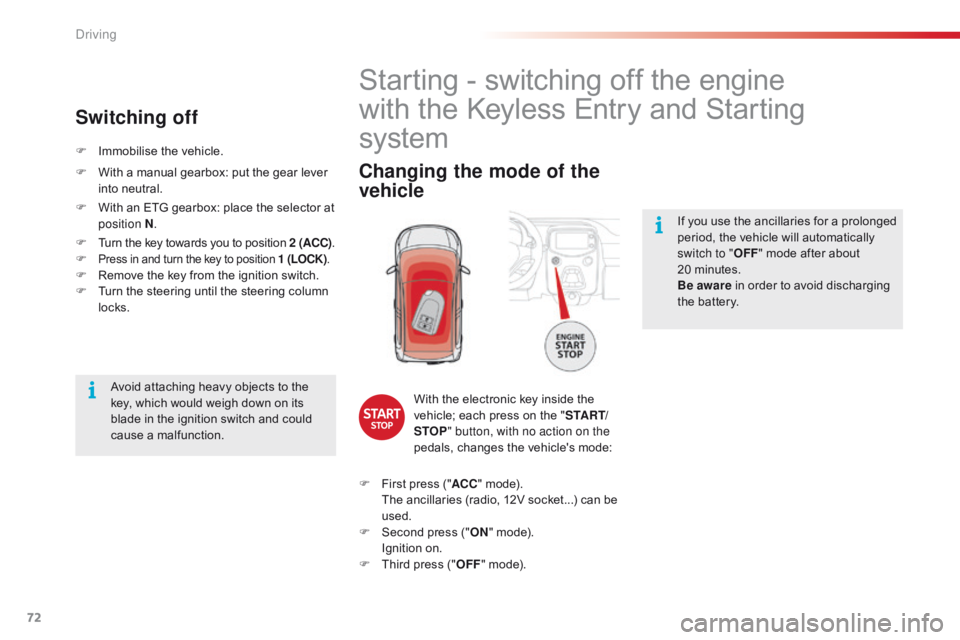
Changing the mode of the
vehicle
With the electronic key inside the v
ehicle; each press on the "S TA R T/
STOP " button, with no action on the
pedals,
changes the vehicle's mode:
F
F
irst
press ("ACC "
mode).
T
he
ancillaries (radio, 12V socket...) can be
u
sed.
F
S
econd press ("ON "
mode).
I
gnition on.
F
T
hird
press ("OFF "
mode).
Avoid
attaching
heavy
objects
to
the
k
ey,
which
would
weigh
down
on
its
b
lade
in
the
ignition
switch
and
could
c
ause
a
malfunction.
F
I
mmobilise
the
vehicle.
Switching off
F With
a manual gearbox: put the gear lever i
nto neutral.
F
W
ith an ETG gearbox: place the selector at
p
osition N .
F
T
urn the key towards you to position 2 (ACC).
F
Press in and turn the key to position 1 (LOCK) .F Remove the key from the ignition switch.
F T urn the steering until the steering column
l
ocks.
Driving