ignition CITROEN C1 2018 Owner's Guide
[x] Cancel search | Manufacturer: CITROEN, Model Year: 2018, Model line: C1, Model: CITROEN C1 2018Pages: 269, PDF Size: 7.63 MB
Page 140 of 269
138
C1_en_Chap07_info-pratiques_ed01-2016
Fuel tank
Low fuel levelRefuelling
When the low fuel level is reached, t
his warning lamp comes on,
a
ccompanied by an audible signal.
The
message "LO FUEL" is displayed in place
o
f
the
range.
You have approximately 5 litres remaining.
In
certain
driving conditions and depending on
t
he
engine, the distance which can be travelled
w
ith
the
fuel remaining may be less than
3
0 miles
(50 km). To
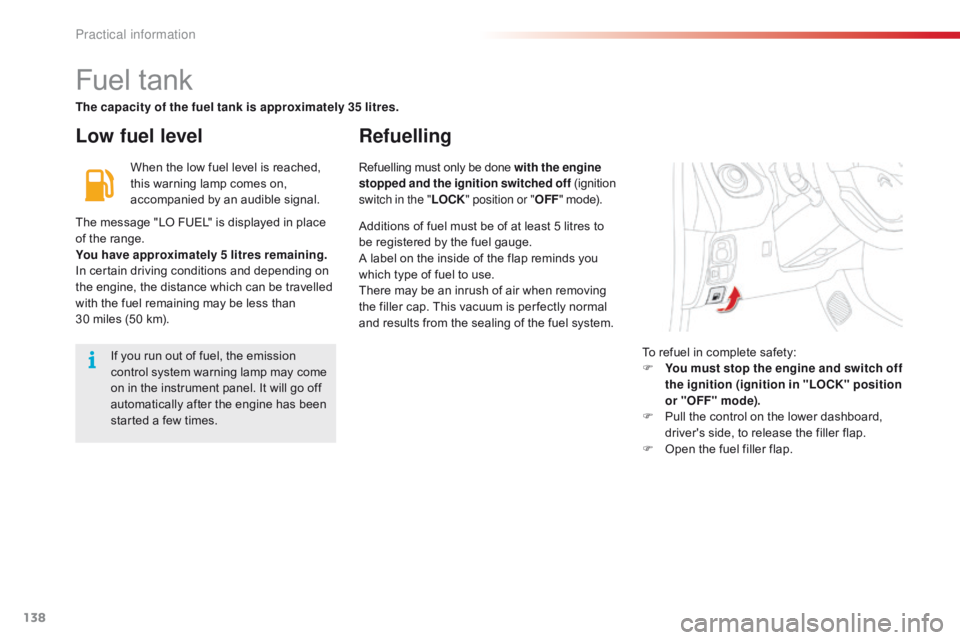
refuel in complete safety:
F
Y
ou must stop the engine and switch off
the ignition (ignition in "LOCK" position
or "OFF" mode) .
F
P
ull the control on the lower dashboard,
d
river's side, to release the filler flap.
F
O
pen the fuel filler flap.
If
you run out of fuel, the emission
c
ontrol system warning lamp may come
o
n
in the instrument panel. It will go off
a
utomatically after the engine has been
s
tarted a few times. Refuelling
must only be done with the engine
stopped and the ignition switched off ( ignition s
witch in the "LOCK" position or " OFF"
mode).
The capacity of the fuel tank is approximately 35 litres.
Additions of fuel must be of at least 5 litres to
b
e registered by the fuel gauge.
A
label on the inside of the flap reminds you
w
hich type of fuel to use.
There
may be an inrush of air when removing
t
he filler cap. This vacuum is per fectly normal
a
nd results from the sealing of the fuel system.
Practical information
Page 150 of 269
148
C1_en_Chap07_info-pratiques_ed01-2016
Checking levels
Take care when working under the bonnet, as certain areas of the engine
m
ay be extremely hot (risk of burns) and
t
he cooling fan could start at any time
(
even with the ignition off).
Engine oil level
The check of the oil level is carried out with the dipstick, located under
t
he bonnet. For the position of the
d
ipstick, refer to the under-bonnet
v
iew on a previous page.
Checking with dipstick
Check all of these levels regularly, in line with the manufacturer's service schedule. Top them up if necessary, unless other wise indicated.
I f a level drops significantly, have the corresponding system checked by a CITROËN dealer or a qualified workshop.
To
ensure the accuracy of the reading,
y
our vehicle must be on a level
s
ur face, with the engine off for at least
3
0 minutes.
It
is normal to top up the oil level between
t
wo services (or oil changes). CITROËN
r
ecommends that you check the level, and top
u
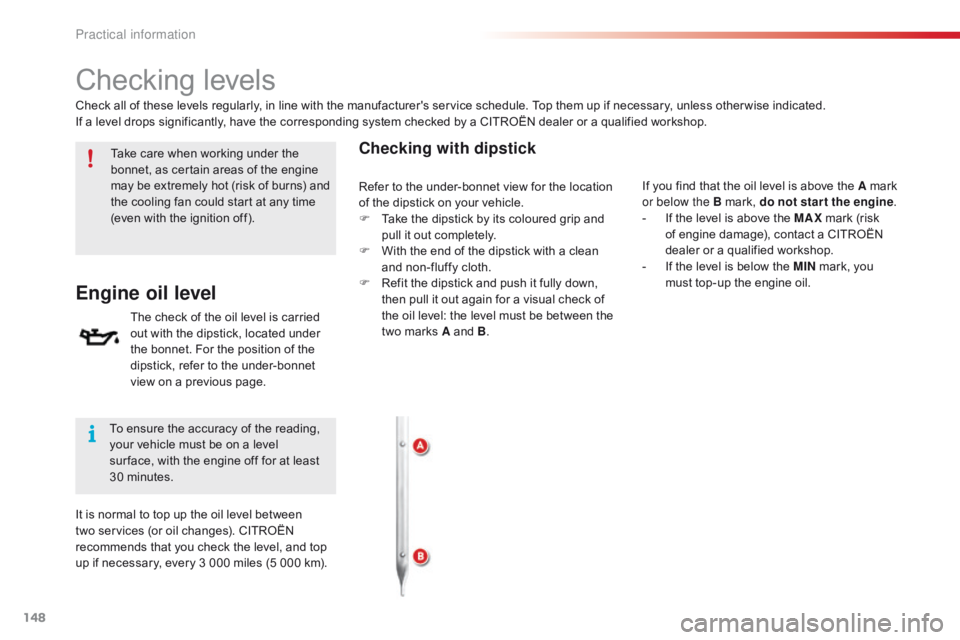
p if necessary, every 3 000 miles (5 000 km). If
you find that the oil level is above the A mark
o
r below the B mark, do not star t the engine.
-
I
f the level is above the MAX
mark (risk
o
f engine damage), contact a CITROËN
d
ealer or a qualified workshop.
-
I
f the level is below the MIN
mark, you
m
ust top-up the engine oil.
Refer
to the under-bonnet view for the location
o
f the dipstick on your vehicle.
F
T
ake the dipstick by its coloured grip and
p
ull it out completely.
F
W
ith the end of the dipstick with a clean
a
nd non-fluffy cloth.
F
R
efit the dipstick and push it fully down,
t
hen pull it out again for a visual check of
t
he oil level: the level must be between the
t
wo marks A and B.
Practical information
Page 156 of 269
154
C1_en_Chap08_en-cas-pannes_ed01-2016
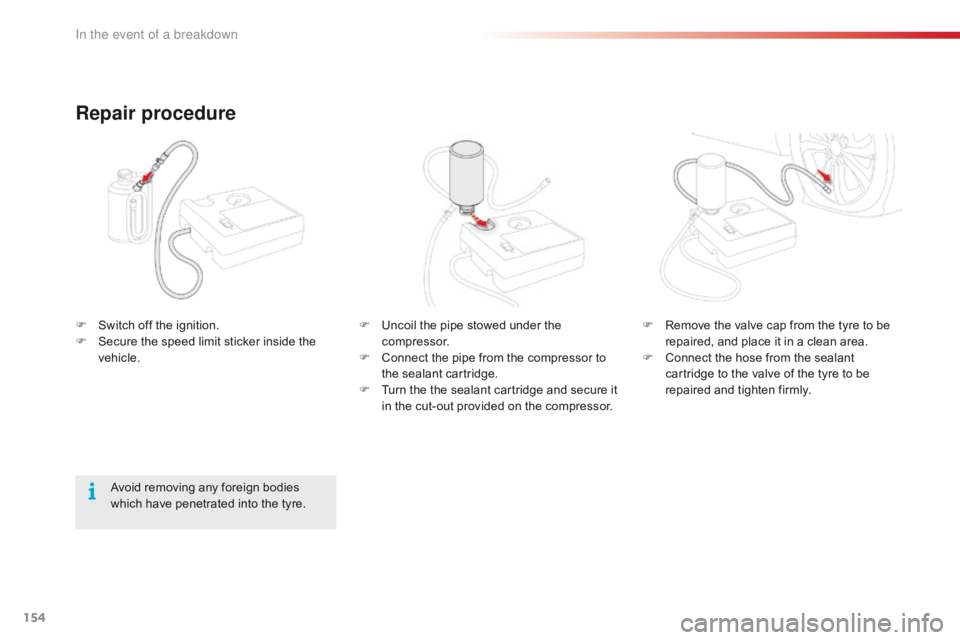
F Uncoil the pipe stowed under the c
ompressor.
F
C
onnect the pipe from the compressor to
t
he sealant cartridge.
F
T
urn the the sealant cartridge and secure it
i
n the cut-out provided on the compressor.
Repair procedure
Avoid removing any foreign bodies which have penetrated into the tyre. F
R
emove the valve cap from the tyre to be
r
epaired, and place it in a clean area.
F
C
onnect the hose from the sealant
c
artridge to the valve of the tyre to be
r
epaired and tighten firmly.
F
S
witch off the ignition.
F
S
ecure the speed limit sticker inside the
v
ehicle.
In the event of a breakdown
Page 157 of 269
155
C1_en_Chap08_en-cas-pannes_ed01-2016
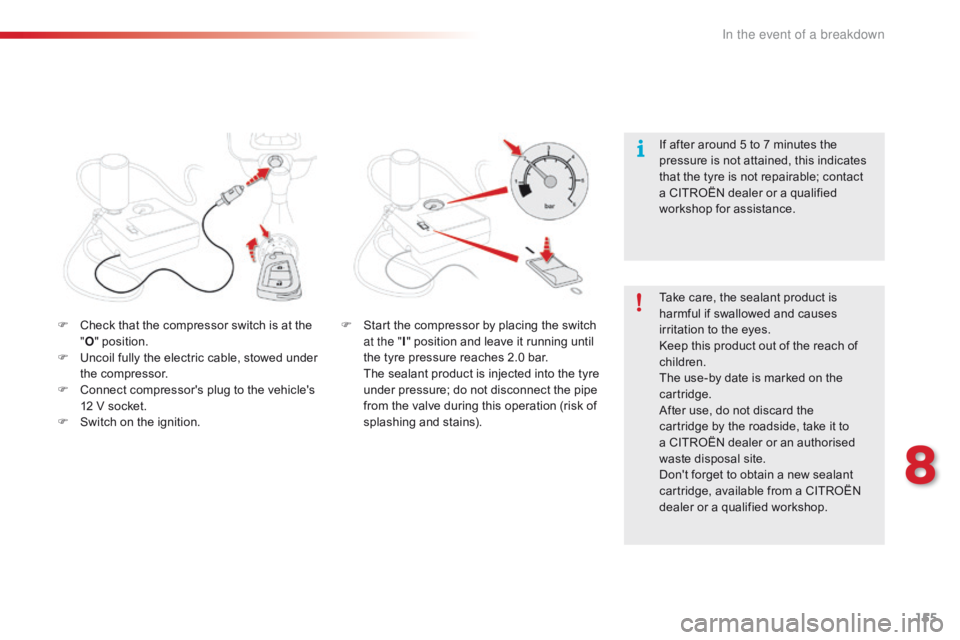
F Check that the compressor switch is at the "O "
position.
F
U
ncoil fully the electric cable, stowed under
t
he compressor.
F
C
onnect compressor's plug to the vehicle's
1
2 V socket.
F
S
witch on the ignition. Take
care, the sealant product is h
armful if swallowed and causes i
rritation to the eyes.
Keep
this product out of the reach of
c
hildren.
The
use-by date is marked on the
c
artridge.
After
use, do not discard the
c
artridge by the roadside, take it to
a
CITROËN dealer or an authorised
w
aste disposal site.
Don't
forget to obtain a new sealant
c
artridge, available from a CITROËN
d
ealer or a qualified workshop.
If
after around 5 to 7 minutes the
p
ressure is not attained, this indicates
t
hat the tyre is not repairable; contact
a
CITROËN dealer or a qualified
w
orkshop for assistance.
F S tart the compressor by placing the switch a
t the "I"
position and leave it running until
t
he tyre pressure reaches 2.0 bar.
T
he sealant product is injected into the tyre
u
nder pressure; do not disconnect the pipe
f
rom the valve during this operation (risk of
sp
lashing
an
d
s
tains).
8
In the event of a breakdown
Page 158 of 269
156
C1_en_Chap08_en-cas-pannes_ed01-2016
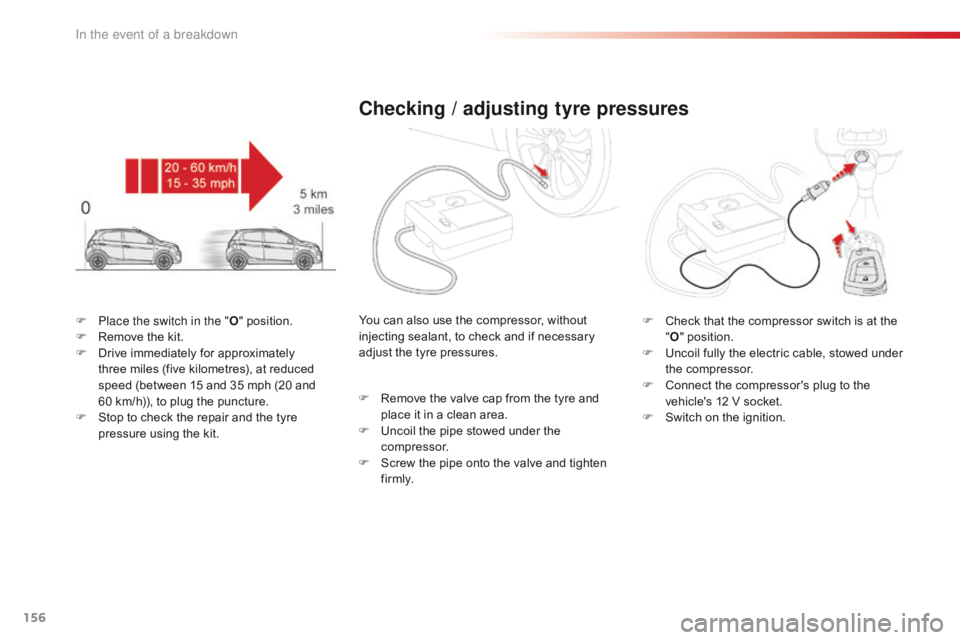
F Place the switch in the "O" position.
F R emove the kit.
F
D
rive immediately for approximately
t
hree miles (five kilometres), at reduced
s
peed (between 15 and 35 mph (20 and
6
0 km/h)), to plug the puncture.
F
S
top to check the repair and the tyre
p
ressure using the kit.
Checking / adjusting tyre pressures
F Check that the compressor switch is at the "O "
position.
F
U
ncoil fully the electric cable, stowed under
t
he compressor.
F
C
onnect the compressor's plug to the
v
ehicle's 12 V socket.
F
S
witch on the ignition.
You
can
also
use
the
compressor,
without
i
njecting
sealant,
to
check
and
if
necessary
a
djust
the
tyre
pressures.
F
R
emove
the
valve
cap
from
the
tyre
and
p
lace
it
in
a
clean
area.
F
U
ncoil
the
pipe
stowed
under
the
c
ompressor.
F
S
crew
the
pipe
onto
the
valve
and
tighten
f
i r m l y.
In the event of a breakdown
Page 160 of 269
158
C1_en_Chap08_en-cas-pannes_ed01-2016
Spare wheel
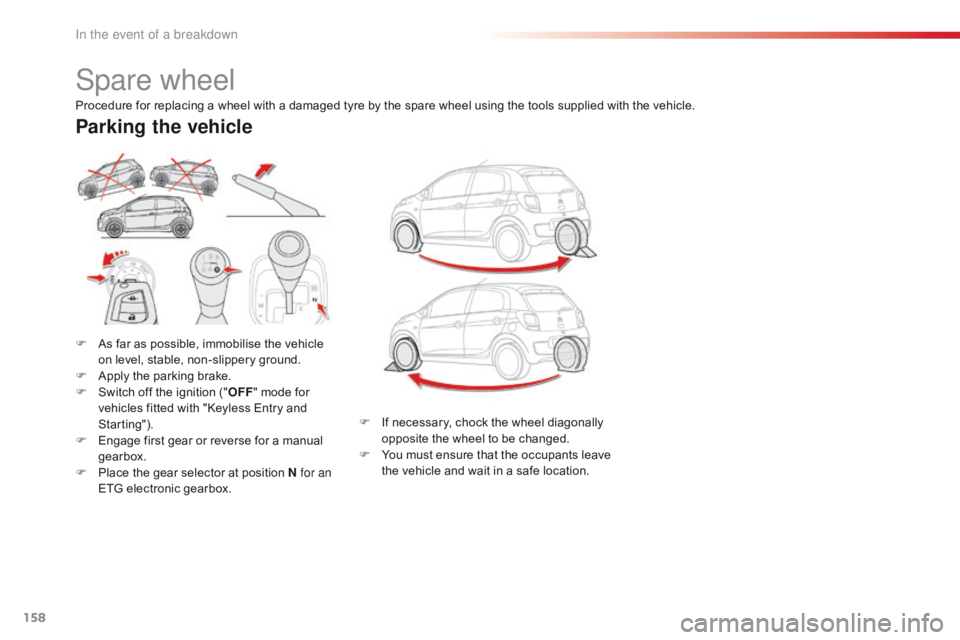
F As far as possible, immobilise the vehicle o
n level, stable, non-slippery ground.
F
A
pply the parking brake.
F
S
witch off the ignition ("OFF "
mode for
v
ehicles fitted with "Keyless Entry and
S
tarting").
F
E
ngage first gear or reverse for a manual
g
earbox.
F
P
lace the gear selector at position N for an
ETG
electronic gearbox.
Parking the vehicle
Procedure for replacing a wheel with a damaged tyre by the spare wheel using the tools supplied with the vehicle.
F
I
f necessary, chock the wheel diagonally
o
pposite the wheel to be changed.
F
Y
ou must ensure that the occupants leave
t
he vehicle and wait in a safe location.
In the event of a breakdown
Page 179 of 269
177
C1_en_Chap08_en-cas-pannes_ed01-2016
12 V battery
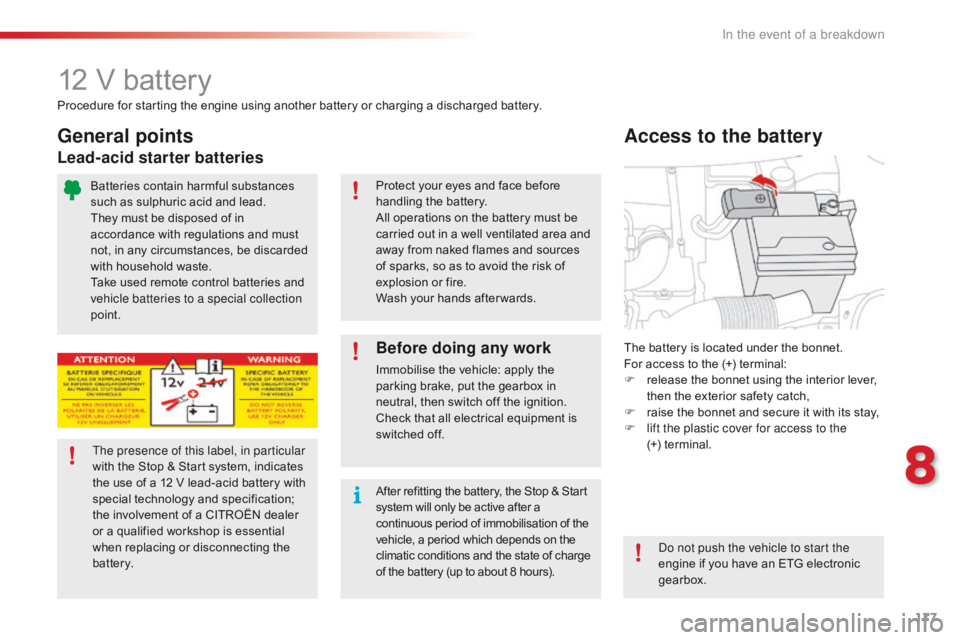
The battery is located under the bonnet.
F or access to the (+) terminal:
F
r
elease the bonnet using the interior lever,
t
hen the exterior safety catch,
F
r
aise the bonnet and secure it with its stay,
F
l
ift the plastic cover for access to the
(+)
t
erminal.
Access to the battery
Procedure for starting the engine using another battery or charging a discharged battery.
Before doing any work
Immobilise the vehicle: apply the parking brake, put the gearbox in
n
eutral, then switch off the ignition.
Check
that all electrical equipment is
s
witched off.
The presence of this label, in particular
with
the
Stop
&
Start
system,
indicates
t
he
use
of
a
12
V
lead-acid
battery
with
s
pecial
t
echnology
a
nd
s
pecification;
t
he
involvement
of
a
CITROËN
dealer
o
r
a
qualified
workshop
is
essential
w
hen
replacing
or
disconnecting
the
b
attery. After
refitting the battery, the Stop & Start
s
ystem will only be active after a
c
ontinuous period of immobilisation of the
v
ehicle, a period which depends on the
c
limatic conditions and the state of charge
o
f the battery (up to about 8 hours).Do not push the vehicle to start the
engine
if you have an ETG electronic
g
earbox.
General points
Lead-acid starter batteries
Batteries contain harmful substances such as sulphuric acid and lead.
They
must be disposed of in
a
ccordance with regulations and must
n
ot, in any circumstances, be discarded
w
ith household waste.
Take
used remote control batteries and
v
ehicle batteries to a special collection
point. Protect
your eyes and face before h
andling the battery.
All
operations on the battery must be
c
arried out in a well ventilated area and
a
way from naked flames and sources
o
f sparks, so as to avoid the risk of
e
xplosion or fire.
Wash
your hands after wards.
8
In the event of a breakdown
Page 180 of 269
178
C1_en_Chap08_en-cas-pannes_ed01-2016
Starting using another battery
F Start the engine of the vehicle with the g
ood battery and leave it running for a few
m
inutes.
F
O
perate the starter on the broken down
v
ehicle and let the engine run.
If
the engine does not start straight away,
s
witch off the ignition and wait a few moments
b
efore trying again.
Never
try
to
start
the
engine
by
c
onnecting
a
battery
charger.
Never
use
a
24
V
or
higher
battery
b
o o s t e r.
First
check
that
the
slave
battery
has
a
n
ominal
voltage
of
12
V
and
a
capacity
a
t
least
equal
to
that
of
the
discharged
b
attery.
The
two
vehicles
must
not
be
in
contact
w
ith
each
other.
Switch
off
the
electrical
consumers
on
b
oth
vehicles
(audio
system,
wipers,
l
ighting,
...
).
Ensure
that
the
jump
lead
cables
do
n
ot
pass
close
to
moving
parts
of
the
e
ngine
(cooling
fan,
belts,
...).
Do
not
disconnect
the
(+)
terminal
when
t
he
engine
is
running. F
W
ait until the engine returns to idle then
d
isconnect the jump lead cables in the
r
everse
o
rder.
F
R
efit the plastic cover to the (+) terminal, if
y
our vehicle has one.
F
A
llow the engine to run for at least
3
0 minutes, by driving or with the vehicle
s
tationary, so that the battery reaches an
adequate
state of charge.
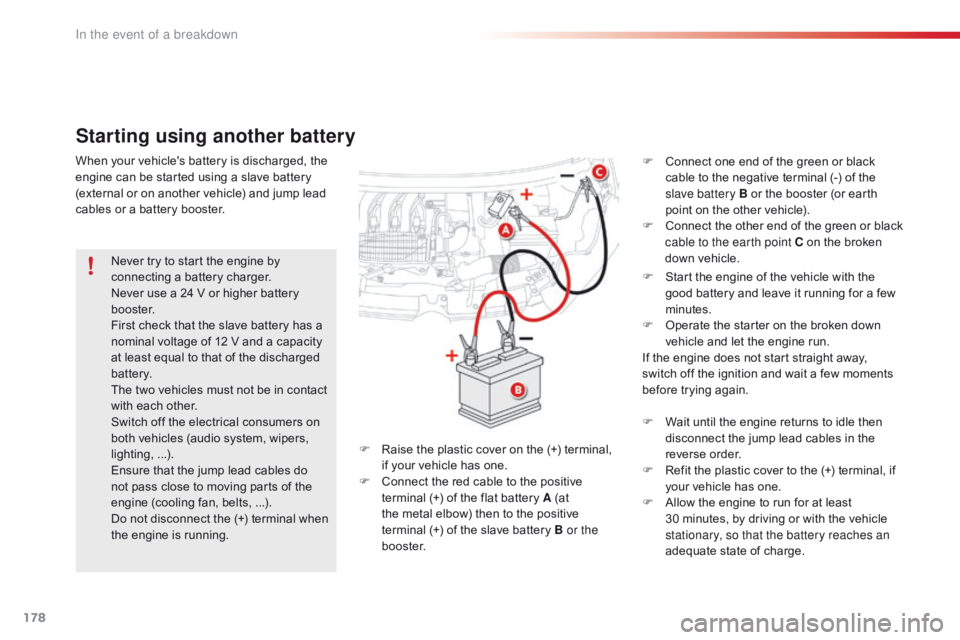
When
your
vehicle's
battery
is
discharged,
the
e
ngine
can
be
started
using
a
slave
battery
(
external
or
on
another
vehicle)
and
jump
lead
c
ables
or
a
battery
booster.
F
R
aise
the
plastic
cover
on
the
(+)
terminal,
i
f
your
vehicle
has
one.
F
C
onnect
the
red
cable
to
the
positive
t
erminal
(+)
of
the
flat
battery
A
(at
t
he
metal
elbow)
then
to
the
positive
t
erminal (+)
of
the
slave
battery
B or the
b o o s t e r. F
C
onnect one end of the green or black
c
able to the negative terminal (-) of the
s
lave battery B or the booster (or earth
p
oint on the other vehicle).
F
C
onnect
t
he
o
ther
e
nd
o
f
t
he
g
reen
o
r
b
lack
c
able to the earth point C on the broken
d
own vehicle.
In the event of a breakdown
Page 181 of 269
179
C1_en_Chap08_en-cas-pannes_ed01-2016
Never try to charge a frozen battery.
I f the battery has been frozen, have
it
checked by a CITROËN dealer or a
q
ualified workshop, who will check that
t
he internal components have not been
d
amaged and the casing is not cracked,
w
hich could cause a leak of toxic and
c
orrosive acid.
Charging the battery using
a battery charger
F Disconnect the battery from the vehicle.
F F ollow the instructions for use provided by
t
he manufacturer of the charger.
F
C
onnect the battery starting with the
p
ositive terminal (+).
F
C
heck that the terminals and connectors
a
re clean. If they are covered with sulphate
(
whitish or greenish deposit), remove them
a
nd clean them.
Some
functions, including Stop & Start,
a
re not available if the battery is not
sufficiently
c
harged.Before disconnecting the battery
Wait 2 minutes after switching off the ignition before disconnecting the battery.
Close
the windows, the fabric roof and the
d
oors before disconnecting the battery.
Following reconnection of the
battery
Following reconnection of the battery, switch on the ignition and wait 1 minute before starting to
p
ermit initialisation of the electronic systems.
H
owever, if problems remain following this
o
peration, contact a CITROËN dealer or a
q
ualified
w
orkshop.
8
In the event of a breakdown
Page 207 of 269
205
C1_en_Chap10a_ Autoradio-Toyota-tactile-1_ed01-2016
The services available depend on the network, the SIM card and the
c
ompatibility of the Bluetooth telephone
u
sed. Check the telephone manual and
w
ith your network provider for details of
t
he services available to you.
The
profiles compatible with the system
a
re: HFP, OPP, PBAP, A2DP, AVRCP,
M
A P. This function allows the connection or
disconnection
of a peripheral device as
w
ell as the deletion of a pairing.
Automatic reconnection
When the ignition is switched on, the last telephone connected when the ignition was
s
witched off reconnects automatically, if this
c
onnection made had been activated during the
p
airing procedure (see previous pages).
Connection
is confirmed by the display of a
m
essage and the name of the telephone.
Managing paired
telephones
Press "Telephone ".
Select " Telephone/message
configuration ".
Select " Connect telephone " to
display
the list of paired devices.
Select " Remove "
then select the device in the
l
ist
and
confirm.
.
Audio and Telematics