battery Citroen C3 2012 2.G User Guide
[x] Cancel search | Manufacturer: CITROEN, Model Year: 2012, Model line: C3, Model: Citroen C3 2012 2.GPages: 252, PDF Size: 8.11 MB
Page 122 of 252
9
120
DRIVING
Going into engine START mode
The "ECO"
warning lamp goes
off and the engine starts:
- with a manual gearbox
, when you
depress the clutch pedal,
- with a 5-speed or 6-speed elec-
tronic gearbox
:
●
gear lever in position A
or M
, when
you release the brake pedal,
●
or gear lever in position N
and the
brake pedal released, when you
move the gear lever to position A
or M
,
●
or when you engage reverse gear.
Special cases: START invoked
automatically
For reasons of safety and for your com-
fort, START mode is invoked automati-
cally when:
- you open the driver's door,
- you unfasten the driver's seat belt,
- the speed of the vehicle exceeds
7 mph (11 km/h) with the electronic
gearbox system,
- some special conditions (battery
charge, engine temperature, brak-
ing assistance, ambient tempera-
ture...) where the engine is needed
for control of a system.
Deactivation
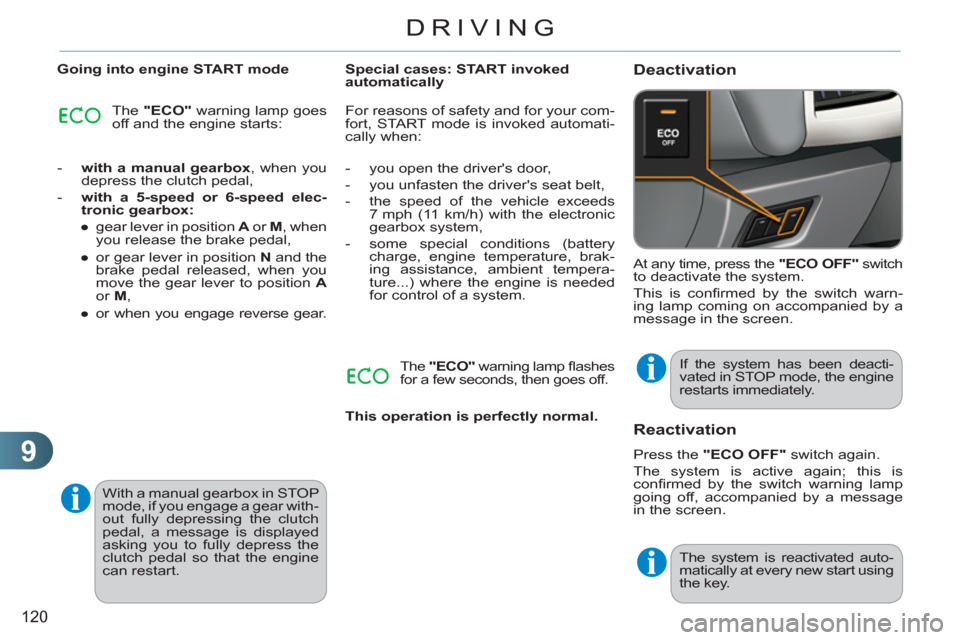
At any time, press the "ECO OFF"
switch
to deactivate the system.
This is confi rmed by the switch warn-
ing lamp coming on accompanied by a
message in the screen.
If the system has been deacti-
vated in STOP mode, the engine
restarts immediately.
Reactivation
Press the "ECO OFF"
switch again.
The system is active again; this is
confi rmed by the switch warning lamp
going off, accompanied by a message
in the screen.
The system is reactivated auto-
matically at every new start using
the key.
The "ECO"
warning lamp fl ashes
for a few seconds, then goes off.
This operation is perfectly normal.
With a manual gearbox in STOP
mode, if you engage a gear with-
out fully depressing the clutch
pedal, a message is displayed
asking you to fully depress the
clutch pedal so that the engine
can restart.
Page 123 of 252
9
121
DRIVING
Operating fault Maintenance
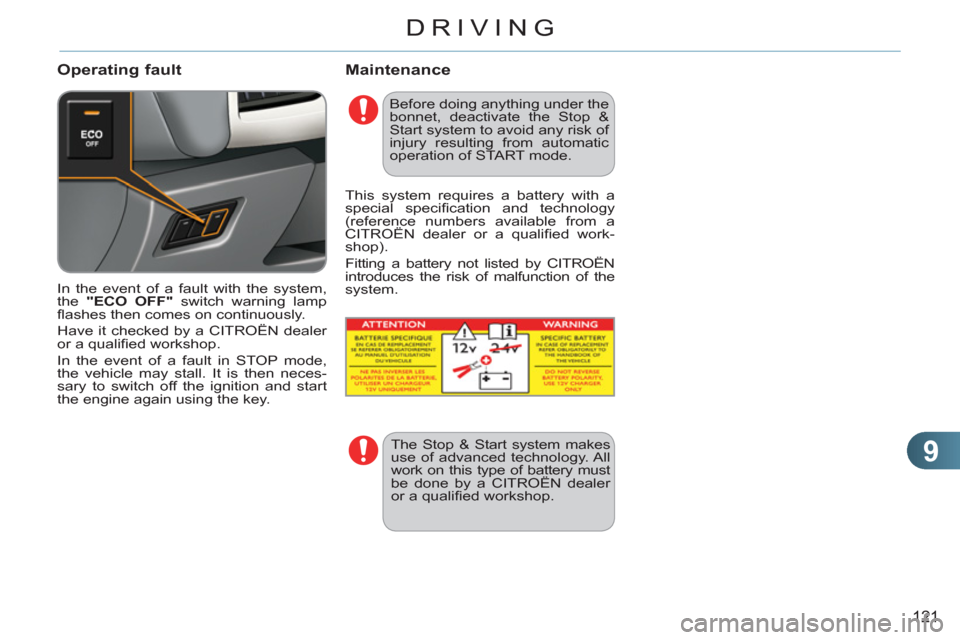
In the event of a fault with the system,
the "ECO OFF"
switch warning lamp
fl ashes then comes on continuously.
Have it checked by a CITROËN dealer
or a qualifi ed workshop.
In the event of a fault in STOP mode,
the vehicle may stall. It is then neces-
sary to switch off the ignition and start
the engine again using the key.
Before doing anything under the
bonnet, deactivate the Stop &
Start system to avoid any risk of
injury resulting from automatic
operation of START mode.
The Stop & Start system makes
use of advanced technology. All
work on this type of battery must
be done by a CITROËN dealer
or a qualifi ed workshop.
This system requires a battery with a
special specifi cation and technology
(reference numbers available from a
CITROËN dealer or a qualifi ed work-
shop).
Fitting a battery not listed by CITROËN
introduces the risk of malfunction of the
system.
Page 133 of 252
10
CHECKS
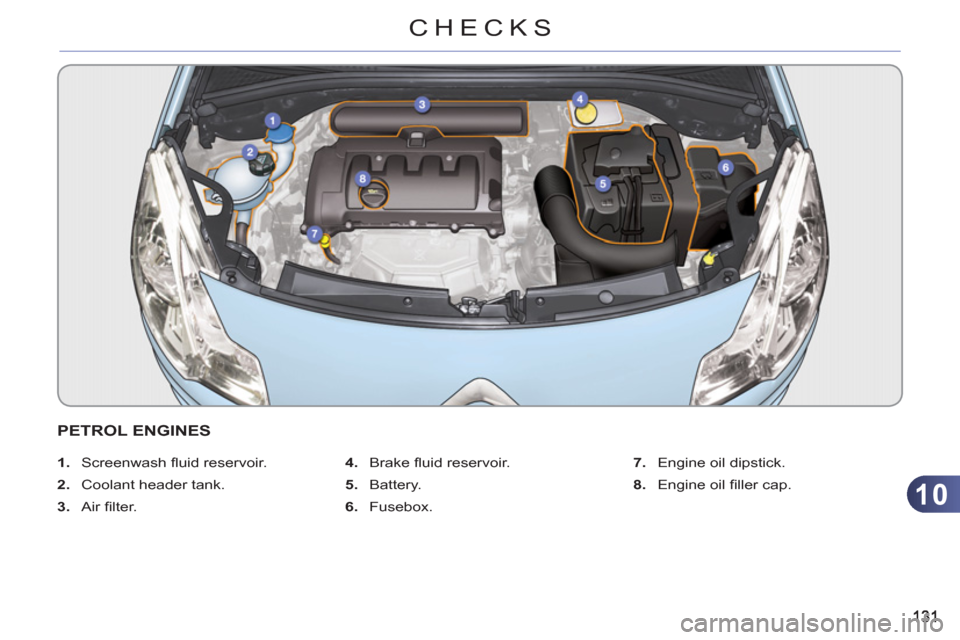
PETROL ENGINES
1.
Screenwash fl uid reservoir.
2.
Coolant header tank.
3.
Air fi lter.
4.
Brake fl uid reservoir.
5.
Battery.
6.
Fusebox.
7.
Engine oil dipstick.
8.
Engine oil fi ller cap.
Page 134 of 252
10
CHECKS
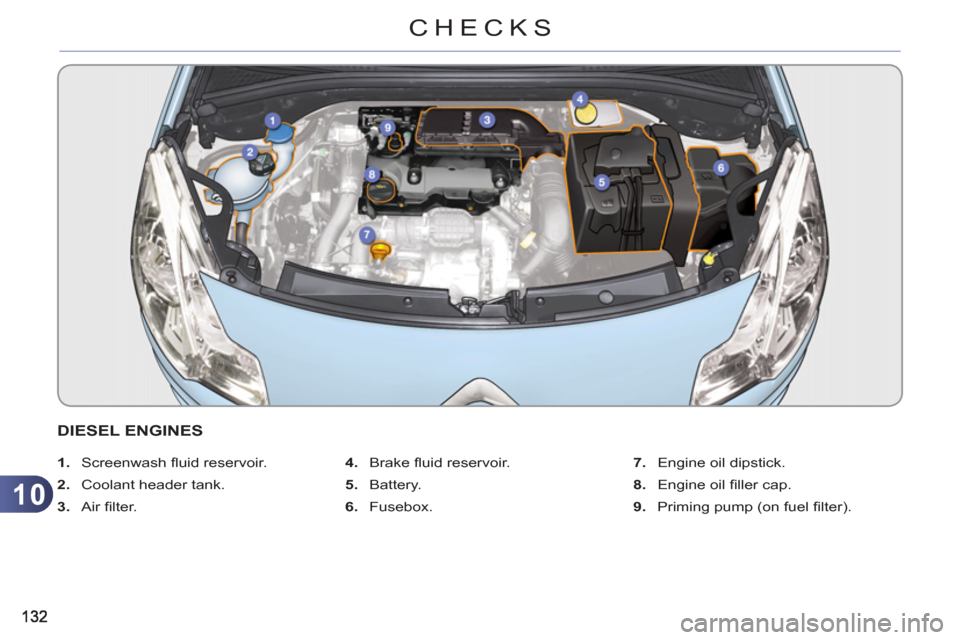
DIESEL ENGINES
1.
Screenwash fl uid reservoir.
2.
Coolant header tank.
3.
Air fi lter.
4.
Brake fl uid reservoir.
5.
Battery.
6.
Fusebox.
7.
Engine oil dipstick.
8.
Engine oil fi ller cap.
9.
Priming pump (on fuel fi lter).
Page 136 of 252
10
134
CHECKS
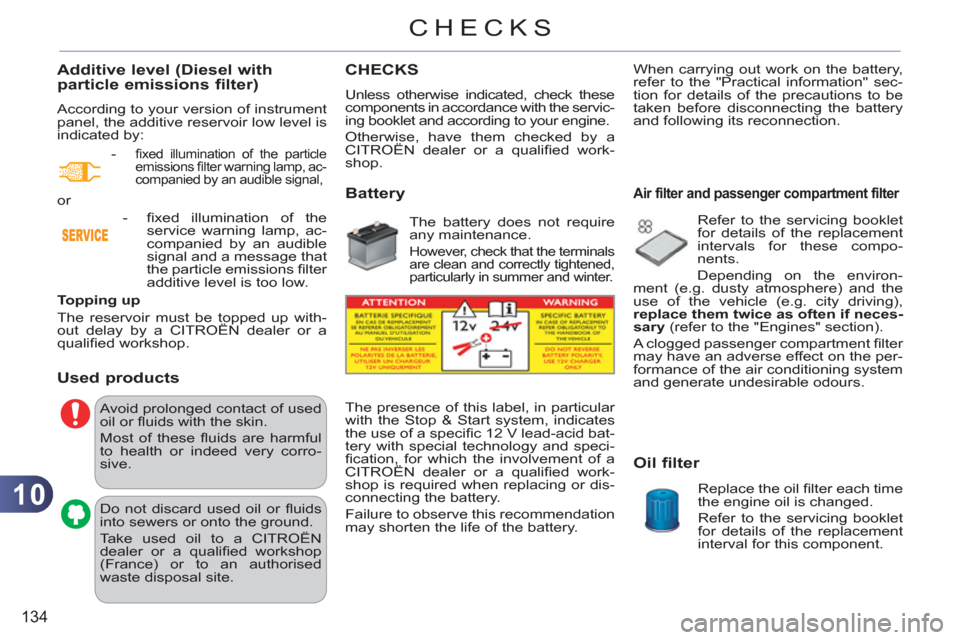
Additive level (Diesel with particle emissions filter)
According to your version of instrument
panel, the additive reservoir low level is
indicated by:
Topping up
The reservoir must be topped up with-
out delay by a CITROËN dealer or a
qualifi ed workshop.
Used products
Avoid prolonged contact of used
oil or fl uids with the skin.
Most of these fl uids are harmful
to health or indeed very corro-
sive.
Do not discard used oil or fl uids
into sewers or onto the ground.
Take used oil to a CITROËN
dealer or a qualifi ed workshop
(France) or to an authorised
waste disposal site.
CHECKS
Unless otherwise indicated, check these
components in accordance with the servic-
ing booklet and according to your engine.
Otherwise, have them checked by a
CITROËN dealer or a qualifi ed work-
shop.
Battery
The battery does not require
any maintenance.
However, check that the terminals
are clean and correctly tightened,
particularly in summer and winter.
Air filter and passenger compartment filter
Refer to the servicing booklet
for details of the replacement
intervals for these compo-
nents.
Depending on the environ-
ment (e.g. dusty atmosphere) and the
use of the vehicle (e.g. city driving),
replace them twice as often if neces-
sary
(refer to the "Engines" section).
A clogged passenger compartment fi lter
may have an adverse effect on the per-
formance of the air conditioning system
and generate undesirable odours.
Oil filter
Replace the oil fi lter each time
the engine oil is changed.
Refer to the servicing booklet
for details of the replacement
interval for this component.
The presence of this label, in particular
with the Stop & Start system, indicates
the use of a specifi c 12 V lead-acid bat-
tery with special technology and speci-
fi cation, for which the involvement of a
CITROËN dealer or a qualifi ed work-
shop is required when replacing or dis-
connecting the battery.
Failure to observe this recommendation
may shorten the life of the battery. When carrying out work on the battery,
refer to the "Practical information" sec-
tion for details of the precautions to be
taken before disconnecting the battery
and following its reconnection.
-
fi xed illumination of the particle
emissions fi lter warning lamp, ac-
companied by an audible signal,
or
- fi xed illumination of the
service warning lamp, ac-
companied by an audible
signal and a message that
the particle emissions fi lter
additive level is too low.
Page 156 of 252
11
154
PRACTICAL INFORMATION
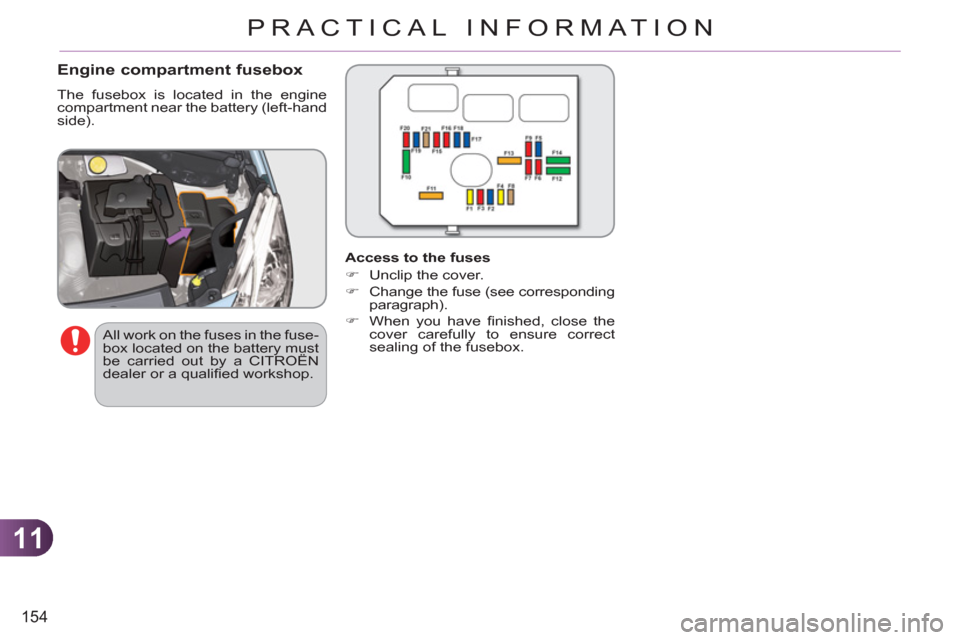
Engine compartment fusebox
The fusebox is located in the engine
compartment near the battery (left-hand
side).
All work on the fuses in the fuse-
box located on the battery must
be carried out by a CITROËN
dealer or a qualifi ed workshop.
Access to the fuses
)
Unclip the cover.
)
Change the fuse (see corresponding
paragraph).
)
When you have fi nished, close the
cover carefully to ensure correct
sealing of the fusebox.
Page 160 of 252
11
158
PRACTICAL INFORMATION
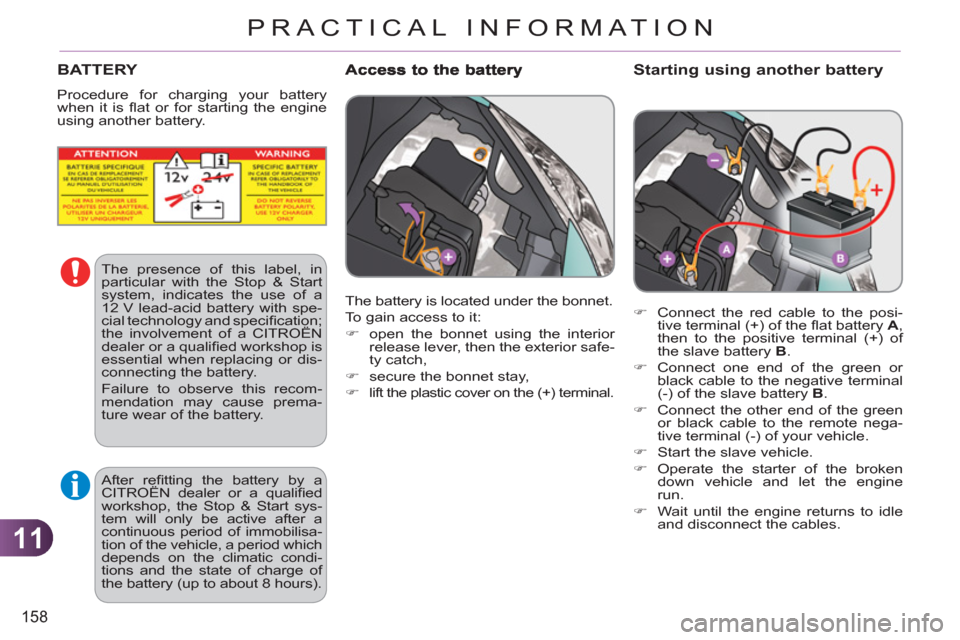
Starting using another battery
)
Connect the red cable to the posi-
tive terminal (+) of the fl at battery A
,
then to the positive terminal (+) of
the slave battery B
.
)
Connect one end of the green or
black cable to the negative terminal
(-) of the slave battery B
.
)
Connect the other end of the green
or black cable to the remote nega-
tive terminal (-) of your vehicle .
)
Start the slave vehicle.
)
Operate the starter of the broken
down vehicle and let the engine
run.
)
Wait until the engine returns to idle
and disconnect the cables.
BATTERY
Procedure for charging your battery
when it is fl at or for starting the engine
using another battery.
The battery is located under the bonnet.
To gain access to it:
)
open the bonnet using the interior
release lever, then the exterior safe-
ty catch,
)
secure the bonnet stay,
)
lift the plastic cover on the (+) terminal.
The presence of this label, in
particular with the Stop & Start
system, indicates the use of a
12 V lead-acid battery with spe-
cial technology and specifi cation;
the involvement of a CITROËN
dealer or a qualifi ed workshop is
essential when replacing or dis-
connecting the battery.
Failure to observe this recom-
mendation may cause prema-
ture wear of the battery.
After refi tting the battery by a
CITROËN dealer or a qualifi ed
workshop, the Stop & Start sys-
tem will only be active after a
continuous period of immobilisa-
tion of the vehicle, a period which
depends on the climatic condi-
tions and the state of charge of
the battery (up to about 8 hours).
Page 161 of 252
11
159
PRACTICAL INFORMATION
LOAD REDUCTION MODE
System which manages the use of cer-
tain functions according to the level of
charge remaining in the battery.
When the vehicle is being driven, the load
reduction function temporarily deactivates
certain functions, such as the air condi-
tioning, the heated rear screen...
The deactivated functions are reactivat-
ed automatically as soon as conditions
permit.
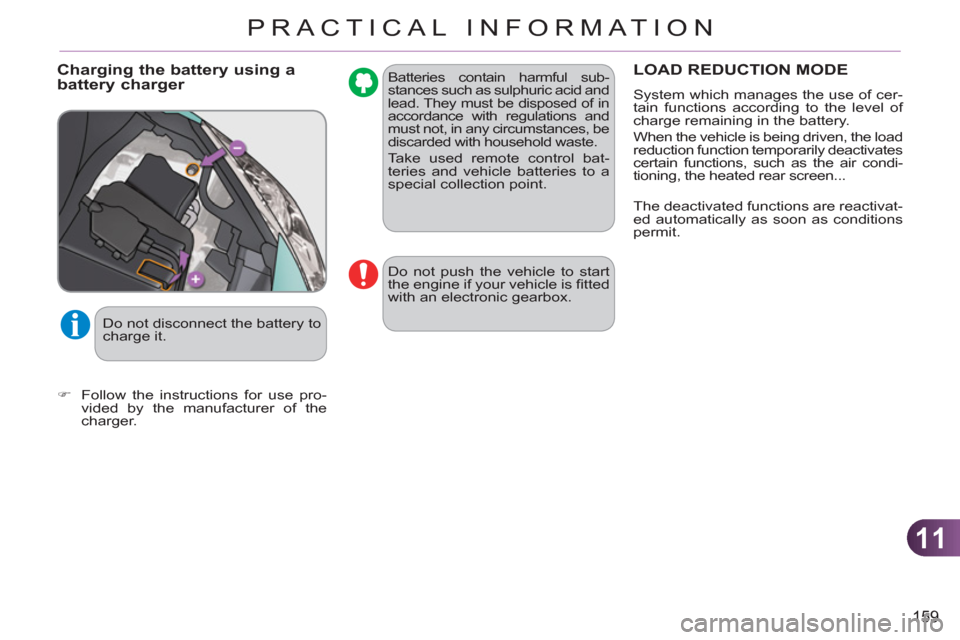
Charging the battery using a
battery charger
Do not disconnect the battery to
charge it.
)
Follow the instructions for use pro-
vided by the manufacturer of the
charger. Batteries contain harmful sub-
stances such as sulphuric acid and
lead. They must be disposed of in
accordance with regulations and
must not, in any circumstances, be
discarded with household waste.
Take used remote control bat-
teries and vehicle batteries to a
special collection point.
Do not push the vehicle to start
the engine if your vehicle is fi tted
with an electronic gearbox.
Page 162 of 252
11
160
PRACTICAL INFORMATION
If the telephone is being used at
the same time on the MyWay au-
dio navigation system, it will be
interrupted after 10 minutes. A fl at battery prevents the engine
from starting (refer to the corre-
sponding paragraph).
ENERGY ECONOMY MODE
System which manages the period of
use of certain functions to conserve a
suffi cient level of charge in the battery.
After the engine has stopped, you can
still use functions such as the audio
equipment, windscreen wipers, dipped
beam headlamps, courtesy lamps, etc.
for a maximum combined period of
thirty minutes.
Switching to economy mode
Once this period has elapsed, a message ap-
pears on the multifunction screen indicating
that the vehicle has switched to economy mode
and the active functions are put on standby.
Exiting economy mode
These functions are reactivated auto-
matically the next time the vehicle is
driven.
)
In order to resume the use of these
functions immediately, start the en-
gine and let it run for a few minutes.
The time available to you will then be
double the period for which the engine is
left running. However, this period will al-
ways be between fi ve and thirty minutes.
This period may be greatly re-
duced if the battery is not fully
charged.
CHANGING A FRONT OR REARWIPER BLADE
Procedure for replacing a worn wiper
blade with a new one without the use
of tools.
Before removing a front wiper blade
)
Within one minute after switching off
the ignition, operate the wiper stalk
to position the wiper blades in the
vertical position.
This position must be used in order to
avoid damaging the wiper blade and the
bonnet.
Removal
)
Raise the corresponding wiper arm.
)
Unclip the wiper blade and remove it.
Fitting
)
At the front, check the size of the wip-
er blade as the shorter blade is fi tted
to the passenger side of the vehicle.
)
Put the corresponding new wiper
blade in place and clip it.
)
Fold down the wiper arm carefully.
After fitting a front wiper blade
)
Switch on the ignition.
)
Operate the wiper stalk again to
park the wiper blades.
Page 166 of 252
11
164
PRACTICAL INFORMATION
AUDIO PRE-EQUIPMENT
Your vehicle is equipped with certain
factory-fi tted audio equipment:
- a dual-function aerial at the rear of
the roof,
- a coaxial aerial cable,
- basic interference suppression,
- cabling for speakers in the front
doors and tweeters in the dash-
board,
- cabling for speakers in the rear
doors
- a 40-way connector.
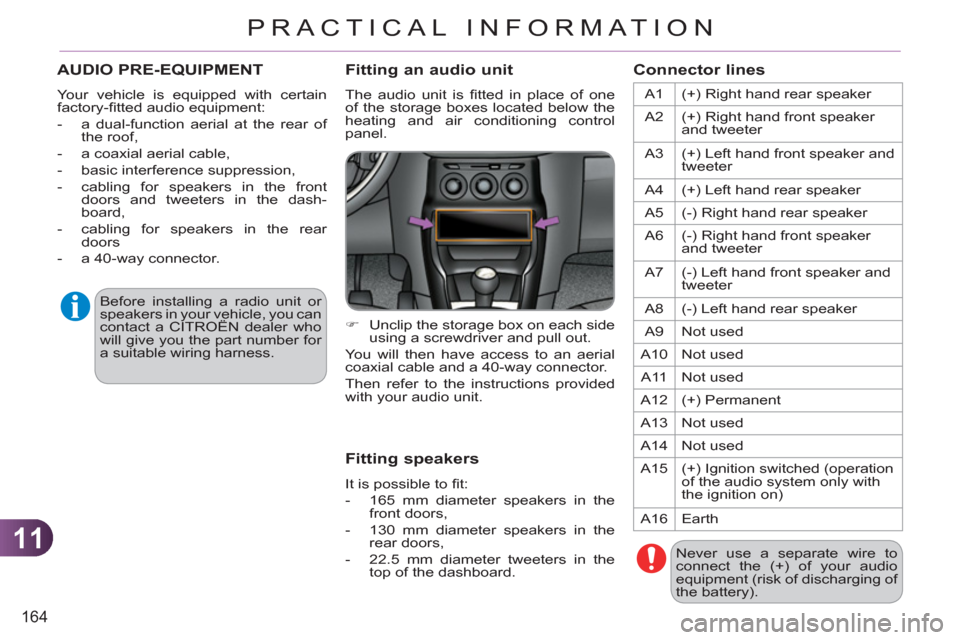
Fitting an audio unit
The audio unit is fi tted in place of one
of the storage boxes located below the
heating and air conditioning control
panel.
Fitting speakers
It is possible to fi t:
- 165 mm diameter speakers in the
front doors,
- 130 mm diameter speakers in the
rear doors,
- 22.5 mm diameter tweeters in the
top of the dashboard.
Connector lines
A1 (+) Right hand rear speaker
A2 (+) Right hand front speaker
and tweeter
A3 (+) Left hand front speaker and
tweeter
A4 (+) Left hand rear speaker
A5 (-) Right hand rear speaker
A6 (-) Right hand front speaker
and tweeter
A7 (-) Left hand front speaker and
tweeter
A8 (-) Left hand rear speaker
A9 Not used
A10 Not used
A11 Not used
A12 (+) Permanent
A13 Not used
A14 Not used
A15 (+) Ignition switched (operation
of the audio system only with
the ignition on)
A16 Earth
Never use a separate wire to
connect the (+) of your audio
equipment (risk of discharging of
the battery). Before installing a radio unit or
speakers in your vehicle, you can
contact a CITROËN dealer who
will give you the part number for
a suitable wiring harness.
)
Unclip the storage box on each side
using a screwdriver and pull out.
You will then have access to an aerial
coaxial cable and a 40-way connector.
Then refer to the instructions provided
with your audio unit.