ecu Citroen C3 2015 2.G User Guide
[x] Cancel search | Manufacturer: CITROEN, Model Year: 2015, Model line: C3, Model: Citroen C3 2015 2.GPages: 401, PDF Size: 13.04 MB
Page 114 of 401
112
The driver must ensure that passengers use
the seat belts correctly and that they are all
restrained securely before setting off.
Wherever you are seated in the vehicle,
always fasten your seat belt, even for short
journeys.
do n
ot interchange the seat belt buckles as
they will not fulfil their role fully.
The seat belts are fitted with an inertia reel
permitting automatic adjustment of the length
of the strap to your size. The seat belt is
stowed automatically when not in use.
be
fore and after use, ensure that the seat
belt is reeled in correctly.
The lower part of the strap must be
positioned as low as possible on the pelvis.
The upper part must be positioned in the
hollow of the shoulder.
The inertia reels are fitted with an automatic
locking device which comes into operation in
the event of a collision, emergency braking
or if the vehicle rolls over. You can release
the device by pulling the strap firmly and
then releasing it so that it reels in slightly.Recommendations for children
Use a suitable child seat if the passenger is
less than 12 years old or shorter than one
and a half metres.
ne
ver use the same seat belt to secure more
than one person.
Never allow a child to travel on your lap.
For more information, refer to the "Child
seats" section.
In order to be effective, a seat belt must:
-
b
e tightened as close to the body as
possible,
-
b
e pulled in front of you with a smooth
movement, checking that it does not
twist,
-
b
e used to restrain only one person,
-
n
ot bear any trace of cuts or fraying,
-
n
ot be converted or modified to avoid
affecting its performance.
In accordance with current safety
regulations, for all repairs on your vehicle's
seat belts, go to a qualified workshop with
the skills and equipment needed, which a
CITR
oËn
dealer is able to provide.
Have your seat belts checked regularly by
a CITROËN dealer or a qualified workshop,
particularly if the straps show signs of
damage.
Clean the seat belt straps with soapy
water or a textile cleaning product, sold by
CITR
oËn d
ealers.
af
ter folding or moving a seat or rear bench
seat, ensure that the seat belt is positioned
and reeled in correctly.
In the event of an impact
Depending on the nature and seriousness
of the impact , the pretensioning device may
be deployed before and independently of the
airbags.
d
ep
loyment of the pretensioners
is accompanied by a slight discharge of
harmless smoke and a noise, due to the
activation of the pyrotechnic cartridge
incorporated in the system.
In all cases, the airbag warning lamp comes
on.
Following an impact, have the seat belts
system checked, and if necessary replaced,
by a CITR
oËn
dealer or a qualified
workshop.
Safety
Page 118 of 401
116
For the airbags to be fully
effective, observe the following
safety rules:
Sit in a normal upright position.
Wear a correctly adjusted seat belt.
Do not leave anything between the
occupants and the airbags (a child, pet,
object...). This could hamper the operation of
the airbags or injure the occupants.
af
ter an accident or if the vehicle has been
stolen or broken into, have the airbag
systems checked.
All work on the airbag system must be
carried out by a CITR
oËn
dealer or a
qualified workshop.
Even if all of the precautions mentioned
are observed, a risk of injury or of minor
burns to the head, chest or arms when an
airbag is deployed cannot be ruled out. The
bag inflates almost instantly (within a few
milliseconds) then deflates within the same
time discharging the hot gas via openings
provided for this purpose.
Front airbags
Do not drive holding the steering wheel by its spokes or resting your hands on the centre part
of the wheel.
Passengers must not place their feet on the dashboard.
do n
ot smoke as deployment of the airbags can cause burns or the risk of injury from a
cigarette or pipe.
Never remove or pierce the steering wheel or hit it violently.
Do not fit or attach anything to the steering wheel or dashboard, this could cause injuries with
deployment of the airbags.
Lateral airbags
Use only approved covers on the seats, compatible with the deployment the lateral airbags.
For information on the range of seat covers suitable for your vehicle, you can contact a
CITR
oËn
dealer.
Refer to the "
ac
cessories" section.
Do not fix or attach anything to the seat backs (clothing...). This could cause injury to the chest
or arms if the lateral airbag is deployed.
Do not sit with the upper part of the body any nearer to the door than necessary.
Curtain airbags
Do not fix or attach anything to the roof. This could cause injury to the head if the curtain
airbag is deployed.
If fitted on your vehicle, do not remove the grab handles installed on the roof, they play a part
in securing the curtain airbags.
Safety
Page 139 of 401
137
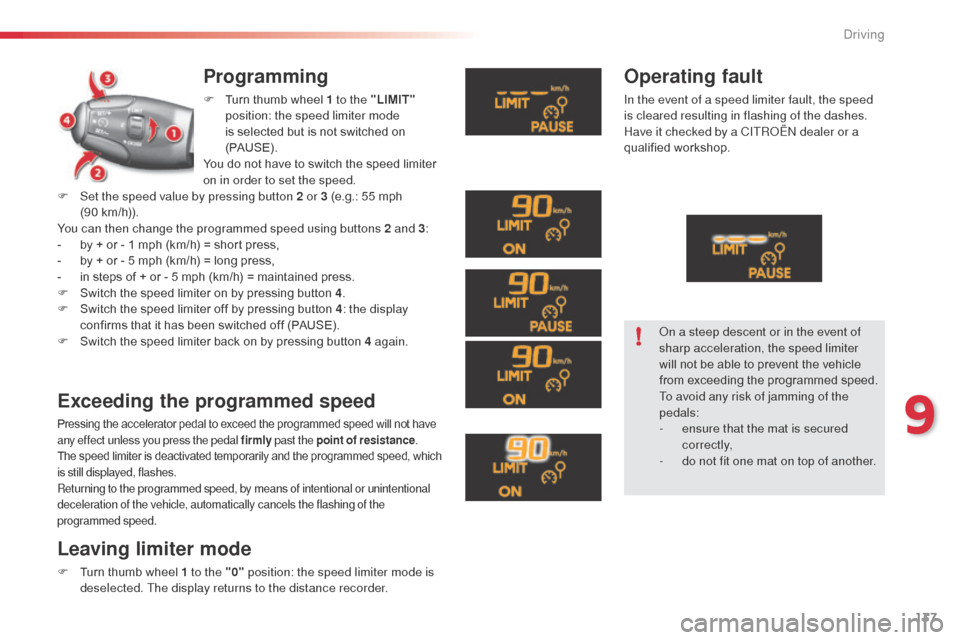
Programming
F Turn thumb wheel 1 to the "LIMIT"
position: the speed limiter mode
is selected but is not switched on
(PAUS E).
You do not have to switch the speed limiter
on in order to set the speed.
Exceeding the programmed speed
Pressing the accelerator pedal to exceed the programmed speed will not have
any effect unless you press the pedal firmly past the point of resistance.
The speed limiter is deactivated temporarily and the programmed speed, which
is still displayed, flashes.
Returning to the programmed speed, by means of intentional or unintentional
deceleration of the vehicle, automatically cancels the flashing of the
programmed speed.
Leaving limiter mode
F Turn thumb wheel 1 to the "0" position: the speed limiter mode is
deselected. The display returns to the distance recorder.
Operating fault
In the event of a speed limiter fault, the speed
is cleared resulting in flashing of the dashes.
Have it checked by a CITR
oËn
dealer or a
qualified workshop.
F
S
et the speed value by pressing button 2 or 3 (e.g.: 55 mph
(90 km/h)).
You can then change the programmed speed using buttons 2 and 3 :
-
b
y + or - 1 mph (km/h) = short press,
-
b
y + or - 5 mph (km/h) = long press,
-
i
n steps of + or - 5 mph (km/h) = maintained press.
F
S
witch the speed limiter on by pressing button 4 .
F
S
witch the speed limiter off by pressing button 4 : the display
confirms that it has been switched off (PAUSE).
F
S
witch the speed limiter back on by pressing button 4 again.
on a s
teep descent or in the event of
sharp acceleration, the speed limiter
will not be able to prevent the vehicle
from exceeding the programmed speed.
To avoid any risk of jamming of the
pedals:
-
e
nsure that the mat is secured
c o r r e c t l y,
-
d
o not fit one mat on top of another.
9
Driving
Page 141 of 401
139
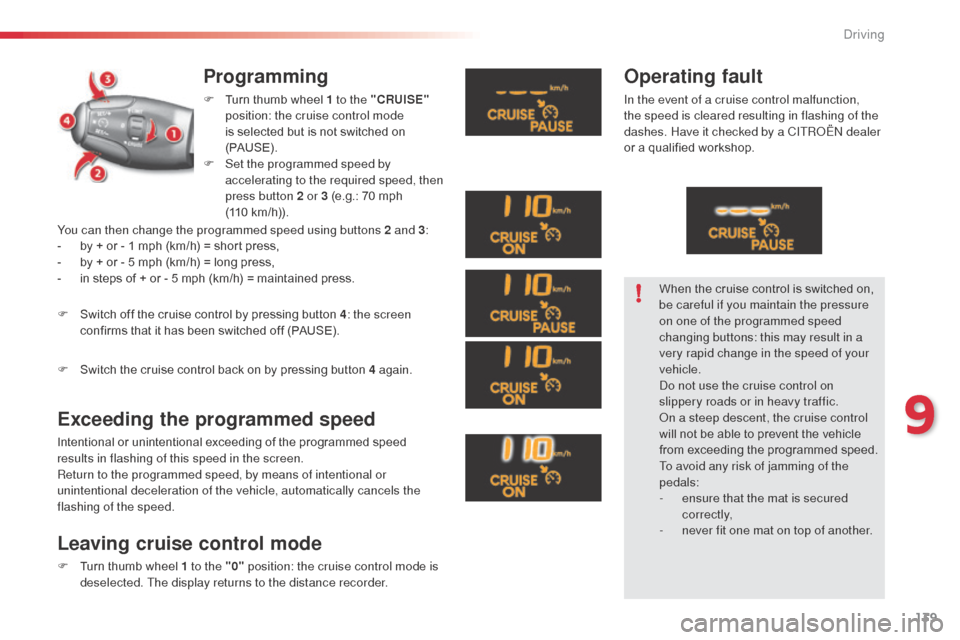
Programming
F Turn thumb wheel 1 to the "CRUISE"
position: the cruise control mode
is selected but is not switched on
(PAUS E).
F
S
et the programmed speed by
accelerating to the required speed, then
press button 2 or 3 (e.g.: 70 mph
(110 km/h)).
Exceeding the programmed speed
Intentional or unintentional exceeding of the programmed speed
results in flashing of this speed in the screen.
Return to the programmed speed, by means of intentional or
unintentional deceleration of the vehicle, automatically cancels the
flashing of the speed.
Leaving cruise control mode
F Turn thumb wheel 1 to the "0" position: the cruise control mode is
deselected. The display returns to the distance recorder.
F
S
witch off the cruise control by pressing button 4
: the screen
confirms that it has been switched off (PAUSE).
F
S
witch the cruise control back on by pressing button 4 again.
Operating fault
In the event of a cruise control malfunction,
the speed is cleared resulting in flashing of the
dashes. Have it checked by a CITR
oËn
dealer
or a qualified workshop.
When the cruise control is switched on,
be careful if you maintain the pressure
on one of the programmed speed
changing buttons: this may result in a
very rapid change in the speed of your
vehicle.
do n
ot use the cruise control on
slippery roads or in heavy traffic.
on a s
teep descent, the cruise control
will not be able to prevent the vehicle
from exceeding the programmed speed.
To avoid any risk of jamming of the
pedals:
-
e
nsure that the mat is secured
c o r r e c t l y,
-
n
ever fit one mat on top of another.
You can then change the programmed speed using buttons 2 and 3
:
-
b
y + or - 1 mph (km/h) = short press,
-
b
y + or - 5 mph (km/h) = long press,
-
i
n steps of + or - 5 mph (km/h) = maintained press.
9
Driving
Page 168 of 401
166
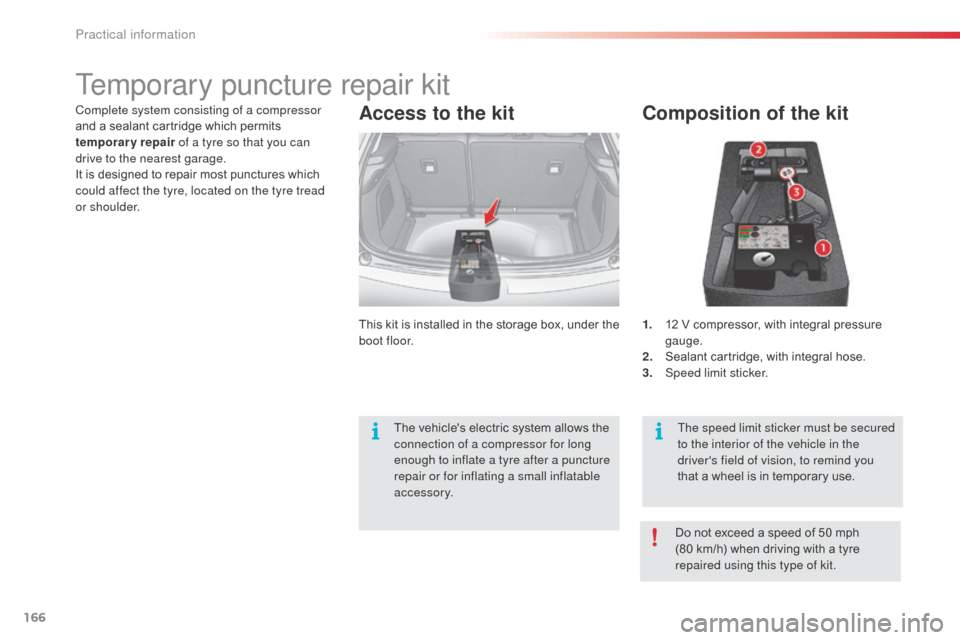
Temporary puncture repair kit
Composition of the kit
1. 12 V compressor, with integral pressure gauge.
2.
S
ealant cartridge, with integral hose.
3.
Spe
ed limit sticker.
Access to the kit
This kit is installed in the storage box, under the
boot floor.
The speed limit sticker must be secured
to the interior of the vehicle in the
driver's field of vision, to remind you
that a wheel is in temporary use.
Complete system consisting of a compressor
and a sealant cartridge which permits
temporary repair
of a tyre so that you can
drive to the nearest garage.
It is designed to repair most punctures which
could affect the tyre, located on the tyre tread
or shoulder.
Do not exceed a speed of 50 mph
(80 km/h) when driving with a tyre
repaired using this type of kit.
The vehicle's electric system allows the
connection of a compressor for long
enough to inflate a tyre after a puncture
repair or for inflating a small inflatable
accessory.
Practical information
Page 169 of 401
167
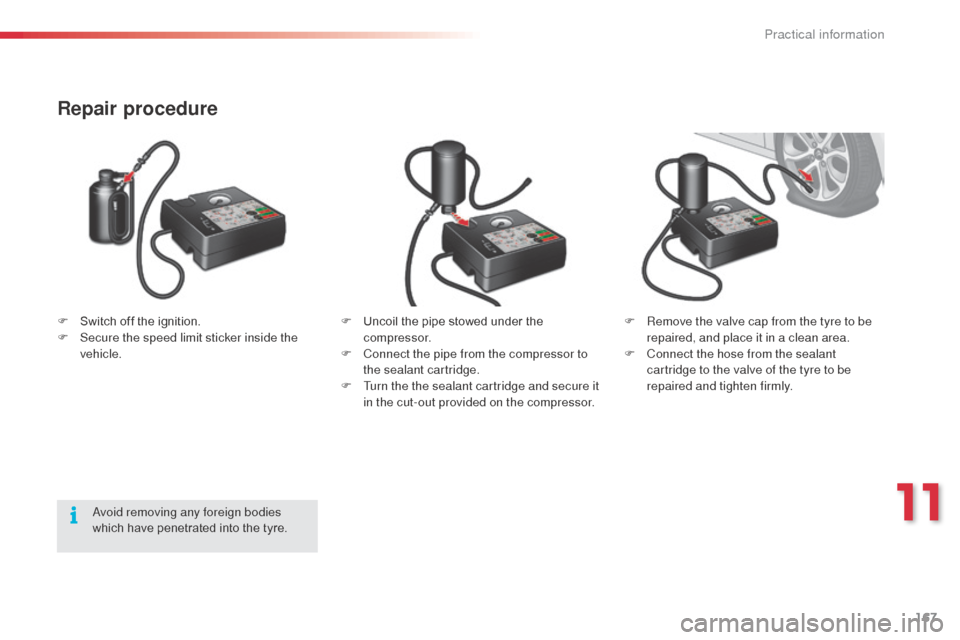
Repair procedure
F Uncoil the pipe stowed under the compressor.
F
C
onnect the pipe from the compressor to
the sealant cartridge.
F
T
urn the the sealant cartridge and secure it
in the cut-out provided on the compressor.
av
oid removing any foreign bodies
which have penetrated into the tyre.
F
S
witch off the ignition.
F
S
ecure the speed limit sticker inside the
vehicle. F
R emove the valve cap from the tyre to be
repaired, and place it in a clean area.
F
C
onnect the hose from the sealant
cartridge to the valve of the tyre to be
repaired and tighten firmly.
11
Practical information
Page 173 of 401

171
Changing a wheel
The tools are stowed in the boot under the
f l o o r.
To gain access to them:
F
o
pen the boot,
F
r
aise the floor,
F
r
emove the polystyrene storage box,
F
u
nclip and remove the box containing the
tools.
Access to the tools
Procedure for changing a faulty wheel for the spare wheel using the tools provided with the vehicle.
List of tools
1. Wheelbrace. F
or removing the wheel trim and removal of
the wheel fixing bolts.
2.
J
ack with integral handle.
F
or raising of the vehicle.
3.
"bo
lt cover" tool.
F
or removing the bolt protectors (covers)
on alloy wheels.
4.
S
ocket for the security wheel bolts (located
in the glove box).
F
or adapting the wheelbrace to the special
"security" wheel bolts (if your vehicle has
them).
al
l of these tools are specific to your
vehicle.
d
o n
ot use them for other
purposes.
ne
ver use a jack other than the one
listed by the manufacturer. If the vehicle
does not have one, contact a CITR
oËn
dealer or a qualified workshop to obtain
a jack intended for the the vehicle.
11
Practical information
Page 174 of 401

172
Wheel with trim
When removing the wheel, first
detach the trim using the wheelbrace 1
pulling at the valve passage hole.
When refitting the wheel , refit the
trim starting by placing its cut-out at the
valve and press around its edge with
the palm of your hand.
Access to the spare wheel
The spare wheel is installed in the boot under
t h e f l o o r.
According to country, the spare wheel may be
steel or of the "space-saver" type.
To gain access to it, refer to the paragraph
"
ac
cess to the tools" on the previous page.
Fitting the steel or "space-
saver" type spare wheel
If your vehicle is fitted with alloy wheels,
it is normal to notice, when tightening
the bolts on fitting, that the washers do
not come into contact with the steel or
"space-saver" type spare wheel. The
wheel is secured by the conical contact
of each bolt.
Practical information
Page 176 of 401

174
Removing a wheel
List of operations
F Remove the bolt cover from each of the bolts using the tool 3 (with alloy wheels
only).
F
F
it the security bolt socket 4 on the
wheelbrace 1 to slacken the security bolt
(if your vehicle has them).
F
S
lacken the other bolts using the
wheelbrace 1 o n l y.
Parking the vehicle
Immobilise the vehicle where it does not
block traffic: the ground must be level,
stable and not slippery.
Apply the parking brake, switch off the
ignition and engage first gear* to lock
the wheels.
If necessary, place a chock under the
wheel diagonally opposite the wheel to
be changed.
You must ensure that the occupants get
out of the vehicle and wait where they
are safe.
ne
ver go underneath a vehicle raised
using a jack; use an axle stand.
*
position R for an electronic gearbox;
position
P for an automatic gearbox.
Practical information
Page 178 of 401

176
List of operations
F Put the wheel in place on the hub.
F S crew in the bolts by hand.
F
P
re-tighten the security bolt (if your vehicle
has them) using the wheelbrace 1 fitted
with the security bolt socket 4 .
F
P
re-tighten the other bolts using the
wheelbrace 1 o n l y.
Fitting a wheel
After changing a wheel
To store the punctured wheel in the
boot correctly, first remove the central
c ove r.
When using the "space-saver" type
temporary use spare wheel, do not
exceed 50 mph (80 km/h).
Have the tightening of the bolts and the
pressure of the spare wheel checked
by a CITR
oËn
dealer or a qualified
workshop without delay.
Have the punctured wheel repaired and
replace it on the vehicle as soon as
possible.
Do not drive with more than one
temporary use spare wheel fitted to the
vehicle at one time.
Practical information