brake CITROEN C3 2021 Owner's Manual
[x] Cancel search | Manufacturer: CITROEN, Model Year: 2021, Model line: C3, Model: CITROEN C3 2021Pages: 450, PDF Size: 10.11 MB
Page 168 of 450
166
B618_en_Chap06_conduite_ed01-2016
Hill start assist
System which keeps your vehicle immobilised
temporarily (approximately 2 seconds) when
starting on a gradient, the time it takes to
move your foot from the brake pedal to the
accelerator pedal.
It only operates when:
-
t
he vehicle is completely stationary, with
your foot on the brake pedal,
-
p
articular conditions on a slope are met,
-
t
he driver’s door is closed.
This hill start assist system cannot be
deactivated.
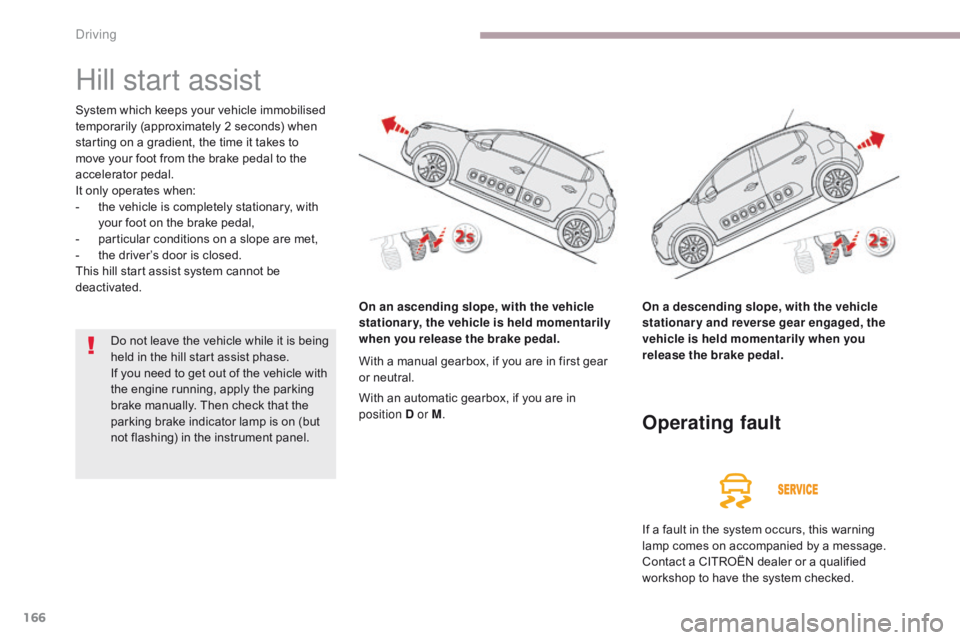
On an ascending slope, with the vehicle
stationary, the vehicle is held momentarily
when you release the brake pedal.On a descending slope, with the vehicle
stationary and reverse gear engaged, the
vehicle is held momentarily when you
release the brake pedal.
Operating fault
If a fault in the system occurs, this warning
lamp comes on accompanied by a message.
Contact a CITROËN dealer or a qualified
workshop to have the system checked.
Do not leave the vehicle while it is being
held in the hill start assist phase.
If you need to get out of the vehicle with
the engine running, apply the parking
brake manually. Then check that the
parking brake indicator lamp is on (but
not flashing) in the instrument panel.
With a manual gearbox, if you are in first gear
or neutral.
With an automatic gearbox, if you are in
position D or M
.
Driving
Page 169 of 450
167
B618_en_Chap06_conduite_ed01-2016
Stop & Start
Going into engine STOP mode
Never refuel with the engine in STOP
mode; you must switch off the ignition. For your comfort, during parking
maoeuvres, STOP mode is not
available for a few seconds after
coming out of reverse gear.
Stop & Start does not affect the
operation of vehicle systems such as
braking, power steering, etc.
The Stop & Start system puts the engine
temporarily into standby - STOP mode - during
stops in the traffic (red lights, traffic jams, etc.).
The engine restarts automatically - START
mode - as soon as you want to move off.
The restart takes place instantly, quickly and
silently.
Per fect for urban use, the Stop & Start system
reduces fuel consumption and exhaust
emissions as well as the noise level when
stationary.
With a manual gearbox
, vehicle
stationary, this warning lamp
comes on in the instrument panel
and the engine goes into standby
automatically when you place the
gear lever in neutral and you release
the clutch pedal.
With an automatic gearbox ,
vehicle stationary, this warning lamp
comes on in the instrument panel
and the engine goes into standby
automatically when you press
the brake pedal or place the gear
selector in position N .
Stop & Star t time counter
(minutes / seconds or hours / minutes) A time counter calculates the time
spent in STOP mode during a
j o u r n ey.
It resets to zero every time the ignition is
switched on.
6
Driving
Page 170 of 450

168
B618_en_Chap06_conduite_ed01-2016
Going into engine START mode
Special cases: START invoked
automatically
As a safety measure or to maintain comfort
levels in the vehicle, START mode is invoked
automatically when:
-
y
ou open the driver's door,
-
y
ou unfasten the driver's seat belt,
-
t
he speed of the vehicle exceeds 2 mph
(3
km/h),
-
s
ome special conditions (battery charge,
engine temperature, braking assistance,
exterior temperature, etc.) where the
engine is needed to assure control of a
system.
In this case, this warning lamp
flashes for a few seconds, then goes
of f.
This operation is perfectly normal.
-
y
ou release the brake pedal with the gear
selector in position D or M ,
-
y
ou are in position N with the brake pedal
released and you move the gear selector to
position D or M ,
-
y
ou engage reverse. With a manual gearbox , this
warning lamp goes off in the
instrument panel and the engine
restarts automatically when you fully
depress the clutch pedal.
Special cases: STOP mode not
available
STOP mode is not invoked when:
- t he vehicle is on a steep slope (rising or
falling),
-
t
he driver's door is open,
-
t
he driver's seat belt is not fastened,
-
t
he vehicle has not exceeded 6 mph
(10
km/h) since the last engine start,
-
t
he engine is needed to maintain a
comfortable temperature in the passenger
compartment,
-
d
emisting is active,
-
s
ome special conditions (battery charge,
engine temperature, braking assistance,
exterior temperature, etc.) where the
engine is needed to assure control of a
system.
In this case, this warning lamp
flashes for a few seconds,
then goes off.
This operation is perfectly normal. With an automatic gearbox
, this
warning lamp goes off and the engine
restarts automatically when:
Driving
Page 180 of 450
178
B618_en_Chap06_conduite_ed01-2016
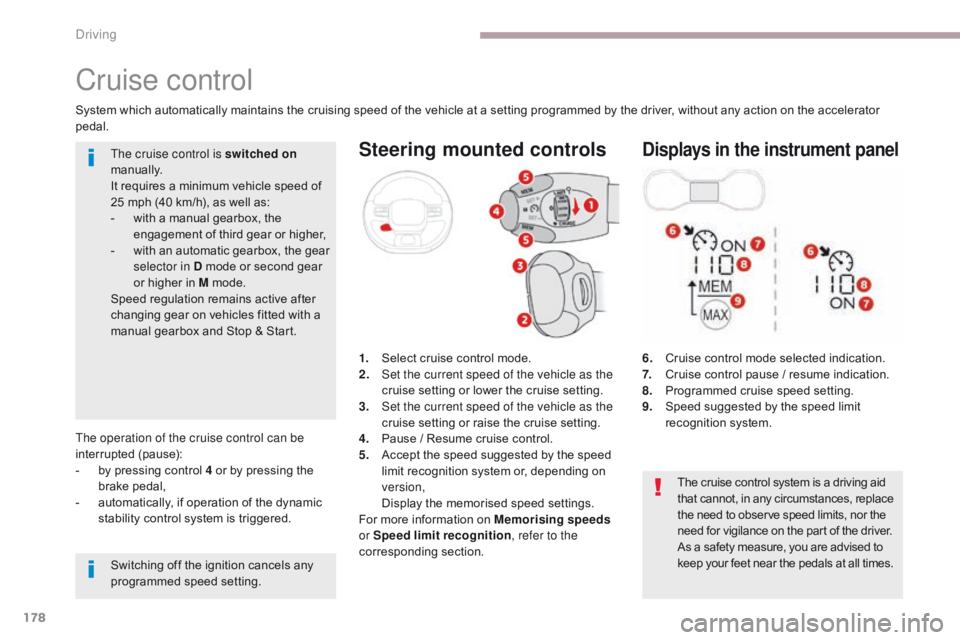
Steering mounted controls
6. Cruise control mode selected indication.
7. Cruise control pause / resume indication.
8.
P
rogrammed cruise speed setting.
9.
S
peed suggested by the speed limit
recognition system.
Cruise control
System which automatically maintains the cruising speed of the vehicle at a setting programmed by the driver, without any action on the accelerator
pedal.
The cruise control system is a driving aid
that cannot, in any circumstances, replace
the need to observe speed limits, nor the
need for vigilance on the part of the driver.
As a safety measure, you are advised to
keep your feet near the pedals at all times.
1.
S
elect cruise control mode.
2.
S
et the current speed of the vehicle as the
cruise setting or lower the cruise setting.
3.
S
et the current speed of the vehicle as the
cruise setting or raise the cruise setting.
4.
P
ause / Resume cruise control.
5.
A
ccept the speed suggested by the speed
limit recognition system or, depending on
version,
D
isplay the memorised speed settings.
For more information on Memorising speeds
or Speed limit recognition , refer to the
corresponding section.
Displays in the instrument panelThe cruise control is switched on
manually.
It requires a minimum vehicle speed of
25 mph (40 km/h), as well as:
-
w
ith a manual gearbox, the
engagement of third gear or higher,
-
w
ith an automatic gearbox, the gear
selector in D mode or second gear
or higher in M mode.
Speed regulation remains active after
changing gear on vehicles fitted with a
manual gearbox and Stop & Start.
Switching off the ignition cancels any
programmed speed setting.
The operation of the cruise control can be
interrupted (pause):
-
b
y pressing control 4 or by pressing the
brake pedal,
-
a
utomatically, if operation of the dynamic
stability control system is triggered.
Driving
Page 182 of 450
180
B618_en_Chap06_conduite_ed01-2016
When descending a steep hill, the
cruise control system cannot prevent
the vehicle from exceeding the
programmed speed.
As a precaution, it is recommended
that the cruise speed chosen be close
to the current speed of your vehicle, so
as to avoid any sudden acceleration or
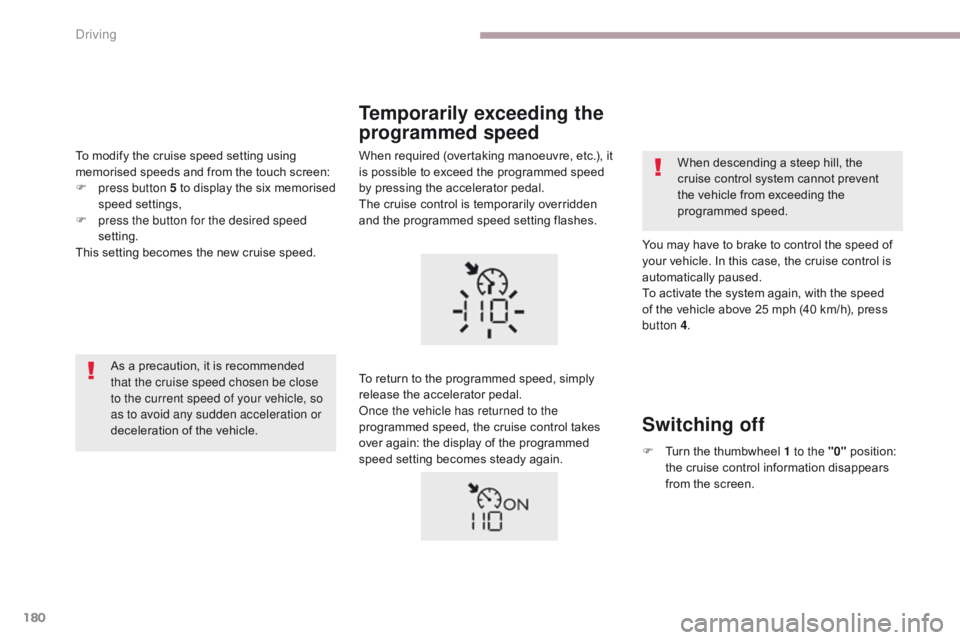
deceleration of the vehicle. When required (overtaking manoeuvre, etc.), it
is possible to exceed the programmed speed
by pressing the accelerator pedal.
The cruise control is temporarily overridden
and the programmed speed setting flashes.
You may have to brake to control the speed of
your vehicle. In this case, the cruise control is
automatically paused.
To activate the system again, with the speed
of the vehicle above 25 mph (40 km/h), press
button 4.
Temporarily exceeding the
programmed speed
To return to the programmed speed, simply
release the accelerator pedal.
Once the vehicle has returned to the
programmed speed, the cruise control takes
over again: the display of the programmed
speed setting becomes steady again.
Switching off
F Turn the thumbwheel 1 to the "0" position:
the cruise control information disappears
from the screen.
To modify the cruise speed setting using
memorised speeds and from the touch screen:
F
p
ress button 5 to display the six memorised
speed settings,
F
p
ress the button for the desired speed
setting.
This setting becomes the new cruise speed.
Driving
Page 202 of 450
200
B618_en_Chap07_info-pratiques_ed01-2016
Snow chains
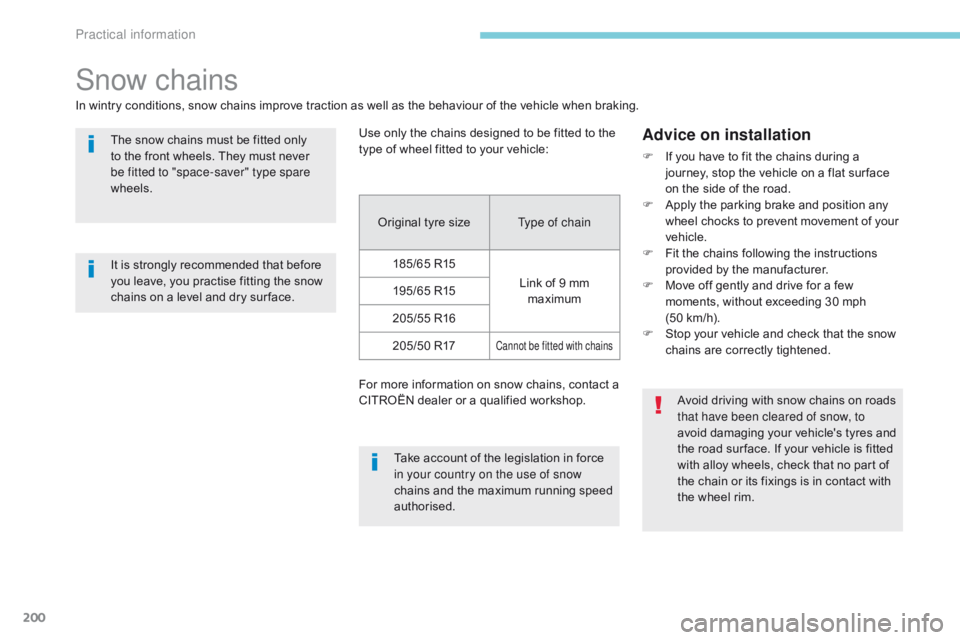
In wintry conditions, snow chains improve traction as well as the behaviour of the vehicle when braking.Use only the chains designed to be fitted to the
type of wheel fitted to your vehicle:
Original tyre size Type of chain
185/65 R15 Link of 9 mm maximum
195/65 R15
205/55 R16 205/50 R17
Cannot be fitted with chains
For more information on snow chains, contact a
CITROËN dealer or a qualified workshop.
Advice on installation
F If you have to fit the chains during a journey, stop the vehicle on a flat sur face
on the side of the road.
F
A
pply the parking brake and position any
wheel chocks to prevent movement of your
vehicle.
F
F
it the chains following the instructions
provided by the manufacturer.
F
M
ove off gently and drive for a few
moments, without exceeding 30 mph
(50
km/h).
F
S
top your vehicle and check that the snow
chains are correctly tightened.
Take account of the legislation in force
in your country on the use of snow
chains and the maximum running speed
authorised.
The snow chains must be fitted only
to the front wheels. They must never
be fitted to "space-saver" type spare
wheels.
Avoid driving with snow chains on roads
that have been cleared of snow, to
avoid damaging your vehicle's tyres and
the road sur face. If your vehicle is fitted
with alloy wheels, check that no part of
the chain or its fixings is in contact with
the wheel rim.
It is strongly recommended that before
you leave, you practise fitting the snow
chains on a level and dry sur face.
Practical information
Page 212 of 450
210
B618_en_Chap07_info-pratiques_ed01-2016
After topping up the oil, the check when
switching on the ignition with the oil
level indicator in the instrument panel
is not valid during the 30 minutes after
topping up.
Topping up the engine oil level
The location of the oil filler cap is shown in the
corresponding underbonnet layout view.
F
U
nscrew the oil filler cap to reveal the filler
aperture.
F
A
dd oil in small quantities, avoiding any
spills on engine components (risk of fire).
F
W
ait a few minutes before checking the
level again using the dipstick.
F
A
dd more oil if necessary.
F
A
fter checking the level, carefully refit the
oil filler cap and the dipstick in its tube.
Engine oil change
Refer to the manufacturer's service schedule
for details of the interval for this operation.
In order to maintain the reliability of the engine
and emission control system, never use
additives in the engine oil. The brake fluid level should be close
to the "MA X" mark. If it is not, check
the brake pad wear.
Brake fluid level
Changing the fluid
Refer to the manufacturer's service schedule
for details of the interval for this operation.
Fluid specification
The brake fluid must conform to the
manufacturer's recommendations.
Practical information
Page 216 of 450
214
B618_en_Chap07_info-pratiques_ed01-2016
Brake wear depends on the style
of driving, particularly in the case
of vehicles used in town, over short
distances. It may be necessary to
Brake pads
For information on checking brake
disc wear, contact a CITROËN dealer
or a qualified workshop.
Brake disc wearOnly use products recommended by
CITROËN or products of equivalent
quality and specification.
In order to optimise the operation of
units as important as those in the
braking system, CITROËN selects and
offers very specific products.
After washing the vehicle, dampness,
or in wintry conditions, ice can form
on the brake discs and pads: braking
efficiency may be reduced. Make light
brake applications to dry and defrost
the brakes.Manual gearbox
The gearbox does not require any
maintenance (no oil change).
Refer to the manufacturer's service
schedule for the checking interval for
this component.
Automatic gearbox
The gearbox does not require any
maintenance (no oil change).
Refer to the manufacturer's service
schedule for the checking interval for
this component.
Parking brake
If excessive travel or a loss of
effectiveness of this system is
noticed, the parking brake must be
checked, even between two services.
Checking this system must be done by a
CITROËN dealer or a qualified workshop.
have the condition of the brakes checked, even
between vehicle services.
Unless there is a leak in the circuit, a drop in
the brake fluid level indicates that the brake
pads are worn.
Practical information
Page 231 of 450
229
B618_en_Chap08_En-cas-de-panne_ed01-2016
Removing a wheel
Parking the vehicle
Immobilise the vehicle where it does not
block traffic: the ground must be level,
stable and not slippery.
Apply the parking brake, switch off the
ignition and engage first gear* to block
the wheels.
Check that the parking brake warning
lamp in the instrument panel comes on
fixed.
The occupants must get out of the
vehicle and wait where they are safe.
Ensure that the jack is correctly
positioned at one of the vehicle's
jacking points.
Incorrect use of the jack could cause
the vehicle to drop.
Never go underneath a vehicle raised
using a jack; use an axle stand.
Wheel with wheel trim
When removing the wheel, first
remove the wheel trim using the
wheelbrace 1 by pulling at the valve
aperture.
When refitting the wheel , refit the
wheel trim, starting by placing its
cut-out in line with the valve and then
pressing around its edge with the palm
of your hand.
Do not use a jack other than the one
supplied by the manufacturer.
* Position P for an automatic gearbox. F
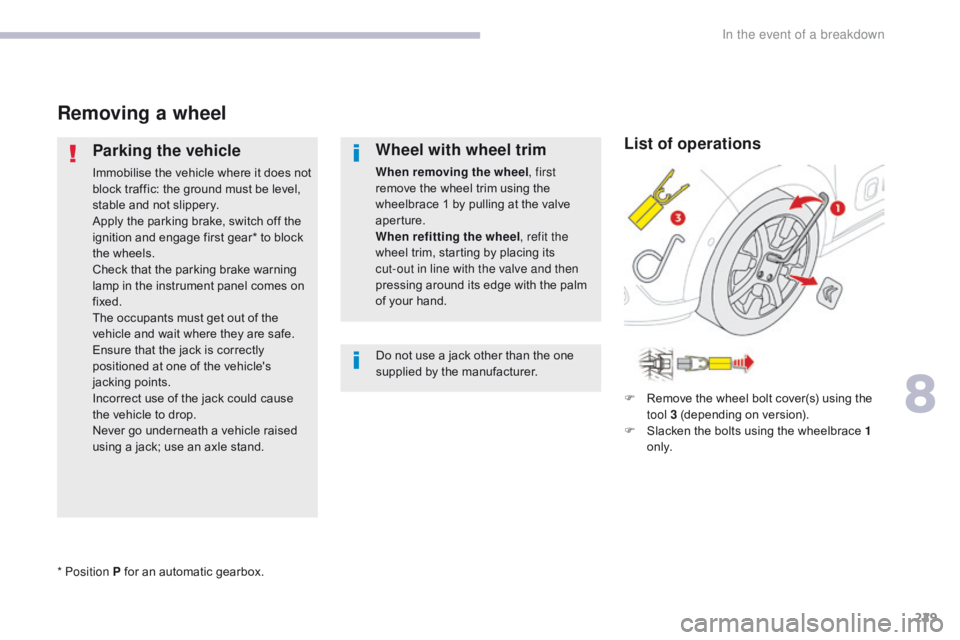
R
emove the wheel bolt cover(s) using the
tool 3 (depending on version).
F
S
lacken the bolts using the wheelbrace 1
o n l y.
List of operations
8
In the event of a breakdown
Page 240 of 450
238
B618_en_Chap08_En-cas-de-panne_ed01-2016
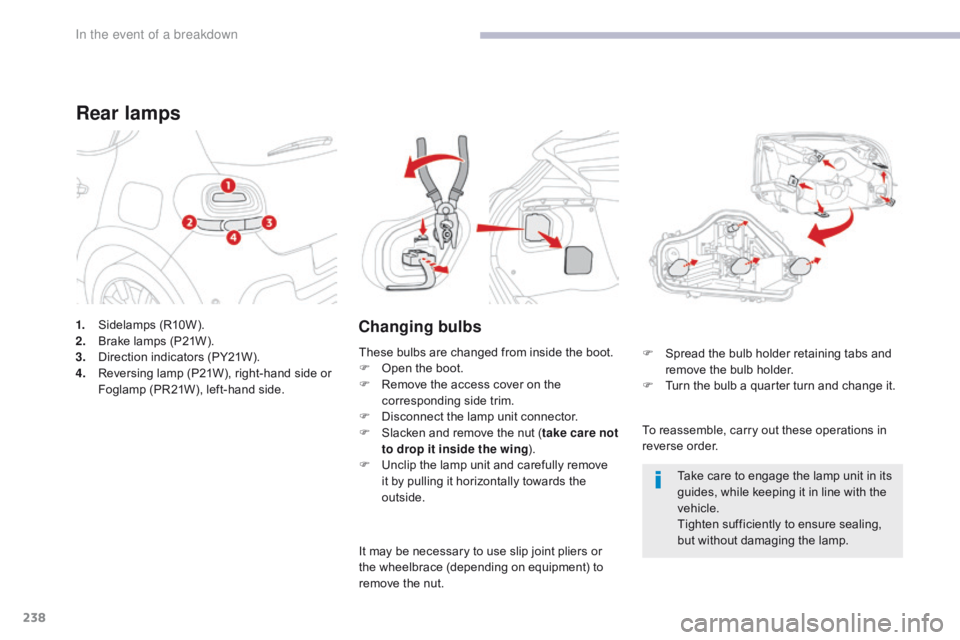
1. Sidelamps (R10W).
2. Brake lamps (P21W).
3.
D
irection indicators (PY21W).
4.
R
eversing lamp (P21W), right-hand side or
Foglamp (PR21W), left-hand side.
Rear lamps
Changing bulbs
To reassemble, carry out these operations in
reverse order. F
S
pread the bulb holder retaining tabs and
remove the bulb holder.
F
T
urn the bulb a quarter turn and change it.
These bulbs are changed from inside the boot.
F
O
pen the boot.
F
R
emove the access cover on the
corresponding side trim.
F
D
isconnect the lamp unit connector.
F
S
lacken and remove the nut ( take care not
to drop it inside the wing ).
F
U
nclip the lamp unit and carefully remove
it by pulling it horizontally towards the
outside. Take care to engage the lamp unit in its
guides, while keeping it in line with the
vehicle.
Tighten sufficiently to ensure sealing,
but without damaging the lamp.
It may be necessary to use slip joint pliers or
the wheelbrace (depending on equipment) to
remove the nut.
In the event of a breakdown