brake CITROEN C3 2021 User Guide
[x] Cancel search | Manufacturer: CITROEN, Model Year: 2021, Model line: C3, Model: CITROEN C3 2021Pages: 450, PDF Size: 10.11 MB
Page 153 of 450
151
B618_en_Chap06_conduite_ed01-2016
Driving recommendations
Observe the driving regulations and remain
vigilant whatever the traffic conditions.
Pay close attention to the traffic and keep your
hands on the wheel so that you are ready to
react at any time to any eventuality.
As a safety precaution, the driver must only
carry out actions requiring sustained attention
when the vehicle is stationary.
On a long journey, a break every two hours is
strongly recommended.
In difficult weather, drive smoothly, anticipate
the need to brake and increase the distance
from other vehicles.
Driving on flooded
roads
We strongly advise against driving on flooded
roads, as this could cause serious damage
to the engine or gearbox, as well as to the
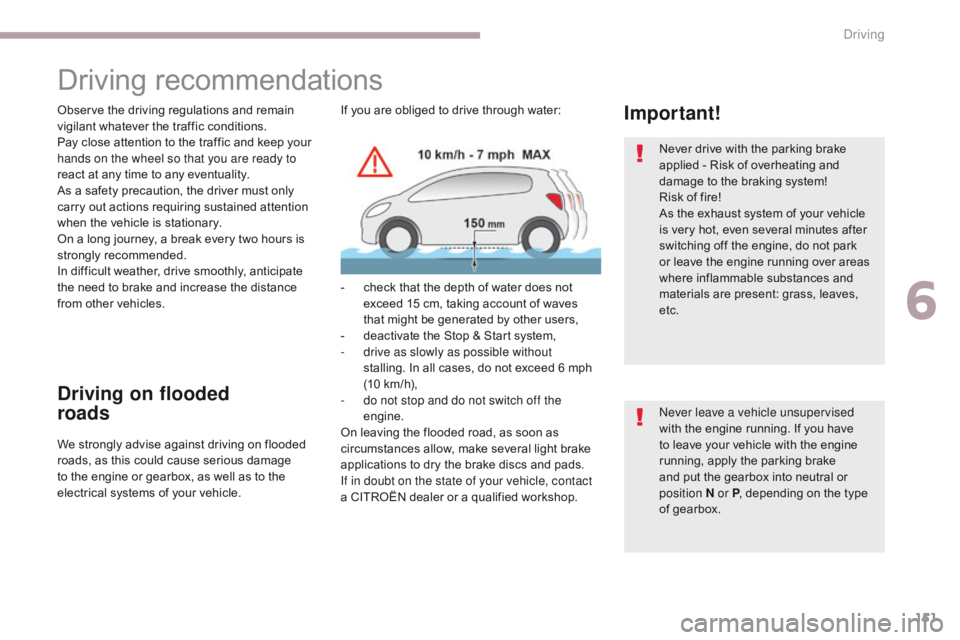
electrical systems of your vehicle.If you are obliged to drive through water:
-
c
heck that the depth of water does not
exceed 15 cm, taking account of waves
that might be generated by other users,
-
d
eactivate the Stop & Start system,
-
d
rive as slowly as possible without
stalling. In all cases, do not exceed 6 mph
(10 km/h),
-
d
o not stop and do not switch off the
engine.
On leaving the flooded road, as soon as
circumstances allow, make several light brake
applications to dry the brake discs and pads.
If in doubt on the state of your vehicle, contact
a CITROËN dealer or a qualified workshop.
Important!
Never drive with the parking brake
applied - Risk of overheating and
damage to the braking system!
Risk of fire!
As the exhaust system of your vehicle
is very hot, even several minutes after
switching off the engine, do not park
or leave the engine running over areas
where inflammable substances and
materials are present: grass, leaves,
etc.
Never leave a vehicle unsupervised
with the engine running. If you have
to leave your vehicle with the engine
running, apply the parking brake
and put the gearbox into neutral or
position
N or P, depending on the type
of gearbox.
6
Driving
Page 154 of 450
152
B618_en_Chap06_conduite_ed01-2016
When towing
Distribution of loads
F Distribute the load in the trailer so that the heaviest items are as close as possible to
the axle and the nose weight approaches
the maximum permitted without
exceeding
it.
Air density decreases with altitude, thus
reducing engine per formance. Above
1
000 metres, the maximum towed load must
be reduced by 10
% for every 1 000 metres of
altitude.
For more information on Weights , refer to the
corresponding section.
Side wind
F Take into account the increased sensitivity to side wind.
Cooling
Towing a trailer on a slope increases the
temperature of the coolant.
As the fan is electrically controlled, its cooling
capacity is not dependent on the engine speed.
F
T
o lower the engine speed, reduce your
speed.
The maximum towed load on a long incline
depends on the gradient and the exterior
temperature.
In all cases, keep a check on the coolant
temperature.
F
I
f the warning lamp and the
STOP warning lamp come on,
stop the vehicle and switch off
the engine as soon as possible.
Braking
Towing a trailer increases the braking distance.
To avoid overheating of the brakes, the use of
engine braking is recommended.
Ty r e s
F Check the tyre pressures of the towing vehicle and of the trailer, observing the
recommended pressures.
Lighting
F Check the electrical lighting and signalling on the trailer and the headlamp beam
height of your vehicle.
For more information on Adjusting the
headlamp beam height , refer to the
corresponding section.
The rear parking sensors will be
deactivated automatically to avoid the
audible signal if a genuine CITROËN
towbar is used.
If the exterior temperature is high, it
is recommended that the engine be
allowed to idle for 1 to 2 minutes after
the vehicle comes to a stop, to facilitate
its cooling.
Driving
Page 156 of 450
154
B618_en_Chap06_conduite_ed01-2016
F With a Diesel engine, turn the key to position 2 , ignition on, to operate the
engine pre-heating system.
Wait until this warning lamp goes off in the
instrument panel then operate the starter
motor by turning the key to position
3
without pressing the accelerator pedal,
until the engine starts. Once the engine is
running, release the key.
In wintry conditions, the warning lamp
can stay on for a longer period. When
the engine is hot, the warning lamp
does not come on. In temperate conditions, do not leave
the engine at idle to warm up but move
off straight away and drive at moderate
speed.
Never leave the engine running in
an enclosed area without adequate
ventilation: internal combustion
engines emit toxic exhaust gases,
such as carbon monoxide. Danger of
intoxication and death!
In very severe wintry conditions
(temperatures below -23°C), to ensure
the correct operation and durability of
the mechanical components of your
vehicle, engine and gearbox, it is
necessary to leave the engine running
for 4 minutes before moving off.
If the engine does not start straight
away, switch off the ignition. Wait a
few moments before operating the
starter motor again. If the engine does
not start after several attempts, do not
keep trying: you risk damaging the
starter motor or the engine. Contact
a CITROËN dealer or a qualified
workshop.
Starting the engine
With the parking brake applied and the gearbox
in neutral or position N
or P:
F
d
epress the clutch pedal fully (manual
gearbox),
or
F
p
ress the brake pedal firmly (automatic
gearbox),
F
i
nsert the key into the ignition switch; the
system recognises the code,
F
u
nlock the steering column by simultaneously
turning the steering and the key.
In certain cases, you may have to apply
more force to the steering (wheels on
full lock, for example).
F
W
ith a petrol engine, operate the starter
motor by turning the key to position 3
without pressing the accelerator pedal,
until the engine starts. Once the engine is
running, release the key.
Driving
Page 157 of 450
155
B618_en_Chap06_conduite_ed01-2016
Key left in the "Ignition on"
position
If the key has been left in the ignition
switch at position 2 (Ignition on),
the ignition will be switched off
automatically after one hour.
To switch the ignition back on, turn the
key to position 1 (Stop) , then back to
position 2 (Ignition on) .
Never switch off the ignition before the
vehicle is at a complete stop. With the
engine off, the braking and steering
assistance systems are also cut off: risk
of loss of control of the vehicle.
When you leave the vehicle, keep the
key with you and lock the vehicle. To facilitate unlocking of the steering
column, it is recommended that the
wheels be returned to the straight ahead
position before switching off the engine.
Switching off the engine
F Stop the vehicle.
F
W ith the engine running at idle, turn the key
to position 1 .
F
R
emove the key from the ignition switch.
F
T
o lock the steering column, turn the
steering until it locks.
F
C
heck that the parking brake is correctly
applied, particularly on sloping ground. For more information on Energy
economy mode
, refer to the
corresponding section.Energy economy mode
After switching off the engine (position 1- Stop ),
for a maximum of 30 minutes you can still use
functions such as the audio and telematic
system, the wipers, dipped beam headlamps,
courtesy lamps, ...
6
Driving
Page 158 of 450
156
B618_en_Chap06_conduite_ed01-2016
Starting / Switching off the engine with Keyless Entry and
Starting
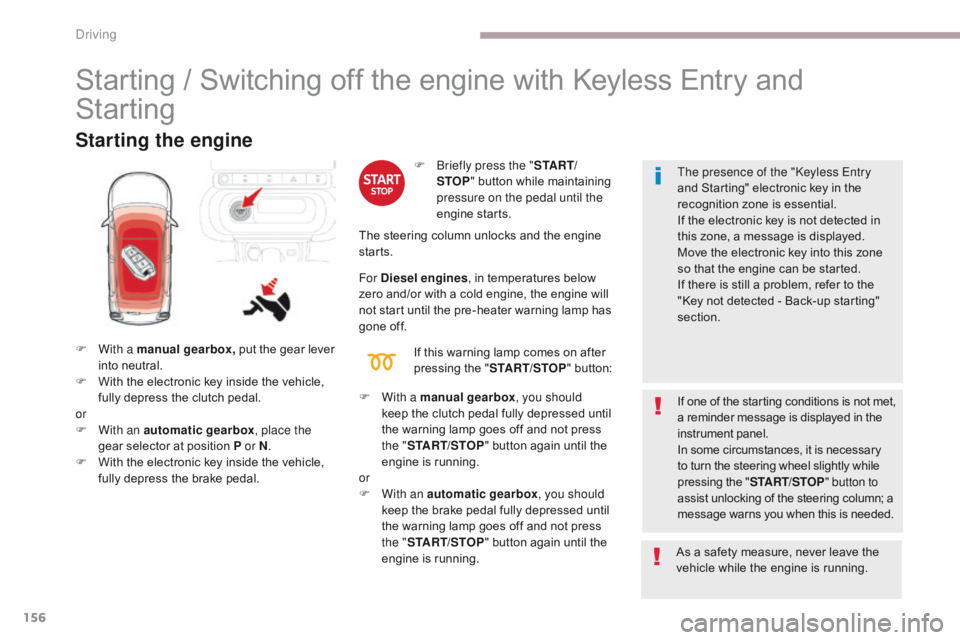
Starting the engine
F With a manual gearbox, put the gear lever
into neutral.
F
W
ith the electronic key inside the vehicle,
fully depress the clutch pedal.
or
F
W
ith an automatic gearbox , place the
gear selector at position P or N .
F
W
ith the electronic key inside the vehicle,
fully depress the brake pedal. If one of the starting conditions is not met,
a reminder message is displayed in the
instrument panel.
In some circumstances, it is necessary
to turn the steering wheel slightly while
pressing the "
START/STOP " button to
assist unlocking of the steering column; a
message warns you when this is needed. The presence of the "Keyless Entry
and Starting" electronic key in the
recognition zone is essential.
If the electronic key is not detected in
this zone, a message is displayed.
Move the electronic key into this zone
so that the engine can be started.
If there is still a problem, refer to the
"Key not detected - Back-up starting"
section.
F
B
riefly press the "
S TA R T/
STOP " button while maintaining
pressure on the pedal until the
engine starts.
The steering column unlocks and the engine
starts.
For Diesel engines , in temperatures below
zero and/or with a cold engine, the engine will
not start until the pre-heater warning lamp has
gone off.
If this warning lamp comes on after
pressing the " START/STOP " button:
F
W
ith a manual gearbox, you should
keep the clutch pedal fully depressed until
the warning lamp goes off and not press
the
"START/STOP " button again until the
engine is running.
or
F
W
ith an automatic gearbox, you should
keep the brake pedal fully depressed until
the warning lamp goes off and not press
the " START/STOP " button again until the
engine is running. As a safety measure, never leave the
vehicle while the engine is running.
Driving
Page 160 of 450
158
B618_en_Chap06_conduite_ed01-2016
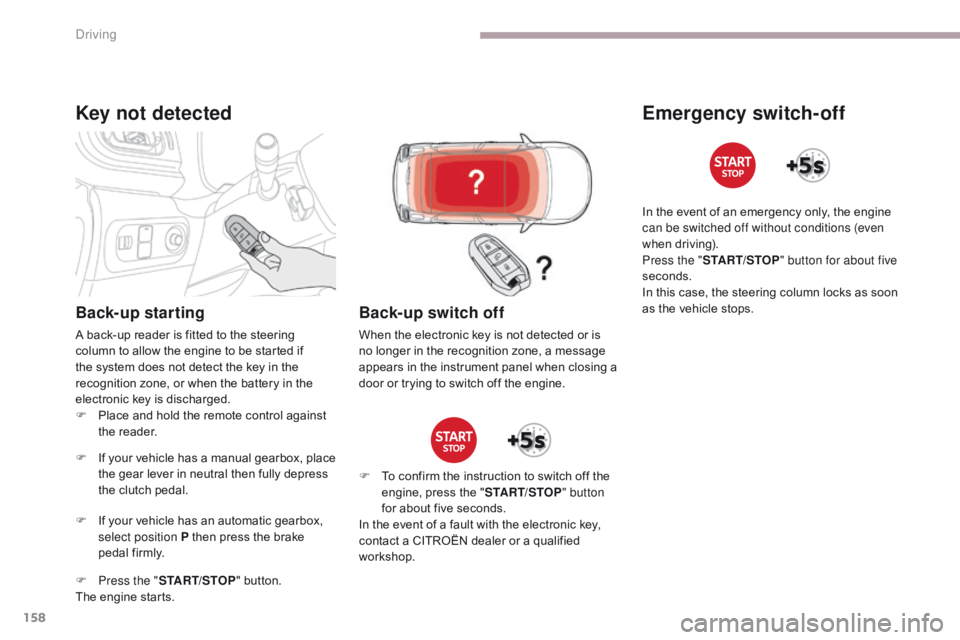
Key not detected
Back-up starting
A back-up reader is fitted to the steering
column to allow the engine to be started if
the system does not detect the key in the
recognition zone, or when the battery in the
electronic key is discharged.
F
P
lace and hold the remote control against
the reader.
F
P
ress the " START/STOP " button.
The engine starts.
Back-up switch off
When the electronic key is not detected or is
no longer in the recognition zone, a message
appears in the instrument panel when closing a
door or trying to switch off the engine.
Emergency switch-off
In the event of an emergency only, the engine
can be switched off without conditions (even
when driving).
Press the " START/STOP " button for about five
seconds.
In this case, the steering column locks as soon
as the vehicle stops.
F
T
o confirm the instruction to switch off the
engine, press the " START/STOP" button
for about five seconds.
In the event of a fault with the electronic key,
contact a CITROËN dealer or a qualified
workshop.
F
I
f your vehicle has a manual gearbox, place
the gear lever in neutral then fully depress
the clutch pedal.
F
I
f your vehicle has an automatic gearbox,
select position P then press the brake
pedal firmly.
Driving
Page 161 of 450
159
B618_en_Chap06_conduite_ed01-2016
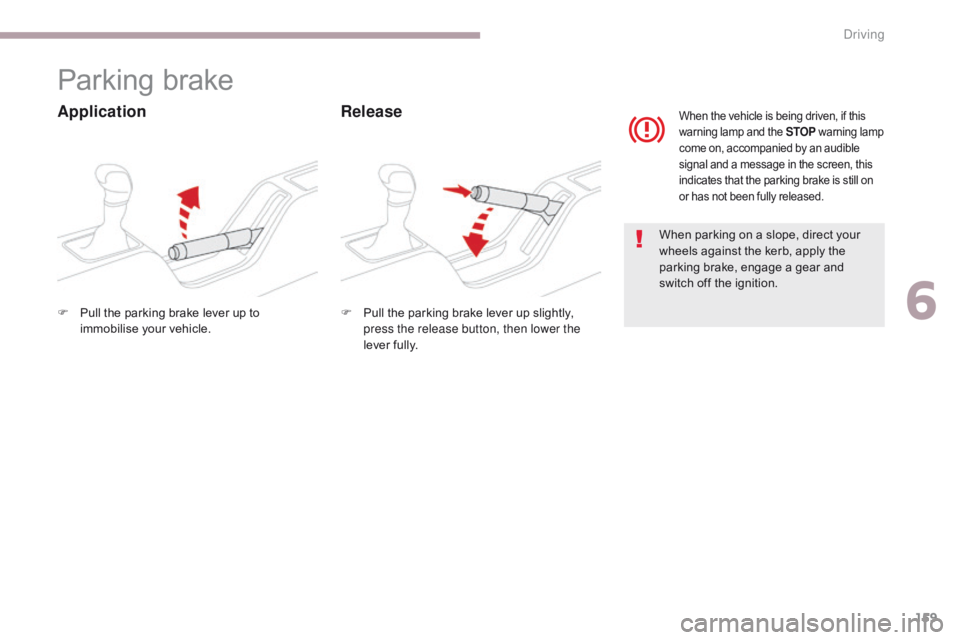
Parking brake
ApplicationRelease
When parking on a slope, direct your
wheels against the kerb, apply the
parking brake, engage a gear and
switch off the ignition.
When the vehicle is being driven, if this
warning lamp and the STOP warning lamp
come on, accompanied by an audible
signal and a message in the screen, this
indicates that the parking brake is still on
or has not been fully released.
F Pull the parking brake lever up to immobilise your vehicle. F
P ull the parking brake lever up slightly,
press the release button, then lower the
lever fully.
6
Driving
Page 163 of 450
161
B618_en_Chap06_conduite_ed01-2016
Automatic gearbox (EAT6)
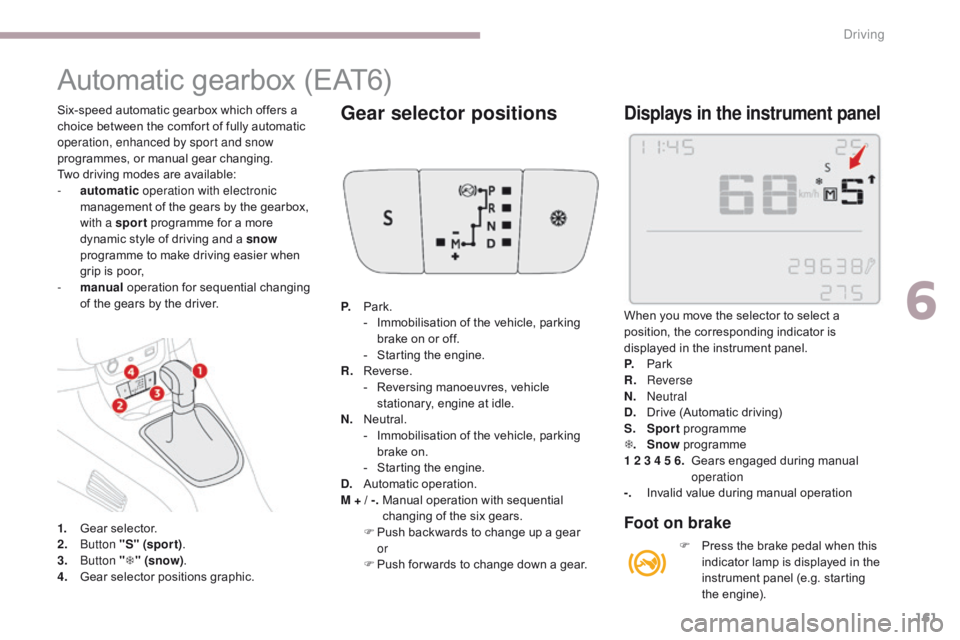
1. Gear selector.
2. Button "S" (spor t) .
3.
Button "T " (snow) .
4.
G
ear selector positions graphic. P.
Pa
rk.
-
I
mmobilisation of the vehicle, parking
brake on or off.
-
S
tarting the engine.
R.
R
everse.
-
R
eversing manoeuvres, vehicle
stationary, engine at idle.
N.
N
eutral.
-
I
mmobilisation of the vehicle, parking
brake on.
-
S
tarting the engine.
D.
A
utomatic operation.
M + / -.
M
anual operation with sequential
changing of the six gears.
F P ush backwards to change up a gear
or
F
P
ush for wards to change down a gear.
Gear selector positionsDisplays in the instrument panel
Foot on brake
Six-speed automatic gearbox which offers a
choice between the comfort of fully automatic
operation, enhanced by sport and snow
programmes, or manual gear changing.
Two driving modes are available:
-
a
utomatic operation with electronic
management of the gears by the gearbox,
with a sport programme for a more
dynamic style of driving and a snow
programme to make driving easier when
grip is poor,
-
m
anual operation for sequential changing
of the gears by the driver. When you move the selector to select a
position, the corresponding indicator is
displayed in the instrument panel.
P.
Pa
rk
R.
Reverse
N.
N
eutral
D.
D
rive (Automatic driving)
S.
Sport programme
T .
Snow programme
1 2 3 4 5 6.
G
ears engaged during manual
operation
-.
I
nvalid value during manual operationF
P
ress the brake pedal when this
indicator lamp is displayed in the
instrument panel (e.g. starting
the engine).
6
Driving
Page 164 of 450
162
B618_en_Chap06_conduite_ed01-2016
Moving off
When the engine is running at
idle, with the brakes released, if
position
R,
D or M is selected, the
vehicle moves even without the
accelerator being pressed.
When the engine is running, never
leave children in the vehicle without
supervision.
When carrying out maintenance with
the engine running, apply the parking
brake and select position P .
If position N is selected inadvertently
while driving, allow the engine to
return to idle, then select position D to
accelerate.
If the temperature is below -23°C, the
engine should be left at idle for four
minutes, to ensure the correct operation
and life of the engine and gearbox.
F
A
pply the parking brake.
F
Sel
ect position P or N .
F
S
tart the engine.
If these conditions are not met, there is an
audible signal, accompanied by the display of a
warning message.
F
W
ith the engine running, press the brake
pedal.
F
R
elease the parking brake.
F
Sel
ect position R , D or M.
F
G
radually release the brake pedal.
The vehicle moves off immediately.
Automatic operation
Never select position N while the
vehicle is moving.
Never select positions P or R unless the
vehicle is completely stationary.
F
Sel
ect position D for automatic
changing
of the six gears.
The gearbox then operates in auto-adaptive
mode, without any intervention on the part
of the driver. It continuously selects the most
suitable gear according to the style of driving,
the profile of the road and the load in the
vehicle.
For maximum acceleration without touching
the selector, press the accelerator pedal down
fully (kick down). The gearbox changes down
automatically or maintains the gear selected
until the maximum engine speed is reached.
On braking, the gearbox changes down
automatically to provide efficient engine
braking.
If you release the accelerator sharply, the
gearbox will not change to a higher gear for
safety reasons.
Driving
Page 166 of 450
164
B618_en_Chap06_conduite_ed01-2016
Invalid value during manual
operation
This symbol is displayed if a gear
is not engaged correctly (selector
between two positions).Before switching off the engine, you can
engage position P or N to place the gearbox in
neutral.
In both cases, apply the parking brake to
immobilise the vehicle.
Stopping the vehicle
There is a risk of damage to the
gearbox:
-
i
f you press the accelerator and
brake pedals at the same time,
-
i
f you force the movement of the
selector from the P position to
another position when the battery
is
flat.
To reduce fuel consumption when at
a prolonged standstill with the engine
running (traffic jam, etc.), put the
selector in the N position and apply the
parking brake.
If the selector is not in position P
,
when the driver's door is opened or
approximately 45 seconds after the
ignition is switched off, a warning
message appears in the screen.
F
R
eturn the selector to position P
;
the message disappears.
When driving on flooded roads or when
crossing a ford, proceed at walking
pace.
Operating fault
When the ignition is on, the lighting
of this warning lamp, accompanied
by an audible signal and a message in the
multifunction screen, indicates a gearbox fault.
In this case, the gearbox switches to back-up
mode and is locked in 3rd gear. You may feel
a substantial knock when changing from P
to R and from N to R . This will not cause any
damage to the gearbox.
Do not exceed 60 mph (100 km/h), local speed
restrictions permitting.
Contact a CITROËN dealer or a qualified
workshop as soon as possible.
Driving