fuel CITROEN C3 2021 Owner's Manual
[x] Cancel search | Manufacturer: CITROEN, Model Year: 2021, Model line: C3, Model: CITROEN C3 2021Pages: 450, PDF Size: 10.11 MB
Page 201 of 450
199
B618_en_Chap07_info-pratiques_ed01-2016
Fuel used for petrol engines
The petrol engines are compatible with
bio-fuels that conform to current and future
European standards and can be obtained from
filling stations:
Fuel used for Diesel
engines
The Diesel engines are compatible with
biofuels that conform to current and future
European standards and can be obtained from
filling stations:
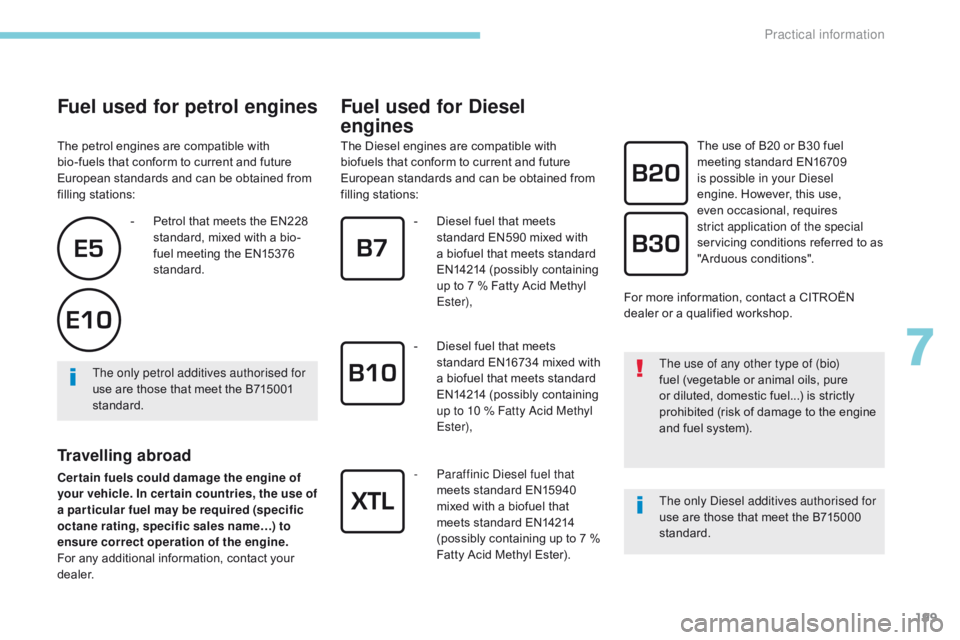
-
Pe
trol that meets the EN228
standard, mixed with a bio-
fuel meeting the EN15376
standard. -
D
iesel fuel that meets
standard EN590 mixed with
a biofuel that meets standard
EN14214 (possibly containing
up to 7 % Fatty Acid Methyl
Ester), The use of B20 or B30 fuel
meeting standard EN16709
is possible in your Diesel
engine. However, this use,
even occasional, requires
strict application of the special
servicing conditions referred to as
"Arduous conditions".
-
D
iesel fuel that meets
standard EN16734 mixed with
a biofuel that meets standard
EN14214 (possibly containing
up to 10 % Fatty Acid Methyl
Ester),
-
P
araffinic Diesel fuel that
meets standard EN15940
mixed with a biofuel that
meets standard EN14214
(possibly containing up to 7 %
Fatty Acid Methyl Ester). The use of any other type of (bio)
fuel (vegetable or animal oils, pure
or diluted, domestic fuel...) is strictly
prohibited (risk of damage to the engine
and fuel system).
The only petrol additives authorised for
use are those that meet the B715001
standard. For more information, contact a CITROËN
dealer or a qualified workshop.
The only Diesel additives authorised for
use are those that meet the B715000
standard.
Travelling abroad
Cer tain fuels could damage the engine of
your vehicle. In cer tain countries, the use of
a par ticular fuel may be required (specific
octane rating, specific sales name…) to
ensure correct operation of the engine.
For any additional information, contact your
dealer.
7
Practical information
Page 210 of 450
208
B618_en_Chap07_info-pratiques_ed01-2016
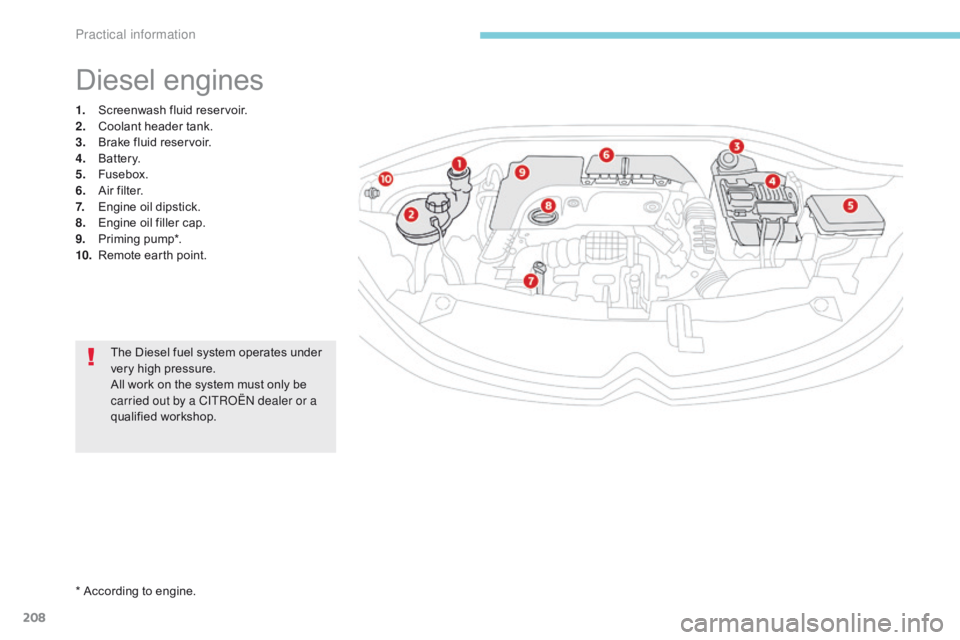
1. Screenwash fluid reservoir.
2. Coolant header tank.
3.
B
rake fluid reservoir.
4.
B
attery.
5.
F
usebox.
6.
A
ir filter.
7.
E
ngine oil dipstick.
8.
E
ngine oil filler cap.
9.
P
riming pump*.
10.
R
emote earth point.
Diesel engines
* According to engine. The Diesel fuel system operates under
very high pressure.
All work on the system must only be
carried out by a CITROËN dealer or a
qualified workshop.
Practical information
Page 214 of 450
212
B618_en_Chap07_info-pratiques_ed01-2016
To p p i n g u p
The reservoir must be topped up without delay
by a CITROËN dealer or a qualified workshop.
Diesel fuel additive level
(Diesel with particle filter)
The additive reservoir low level is
indicated by fixed illumination of this
warning lamp, accompanied by an
audible signal and a message that
the particle filter additive level is too
low.Avoid prolonged contact of used oil or
fluids with the skin.
Most of these fluids are harmful to
health or indeed very corrosive.
Do not discard used oil or fluids into
sewers or onto the ground.
Take used oil to a CITROËN dealer or
a qualified workshop (France) or to an
authorised waste disposal site.
Used products
AdBlue level
An alert is triggered when the reserve level is
reached.
To avoid statutory immobilisation of the vehicle,
the AdBlue must be topped up.
For more information on AdBlue and the SCR
system, and in particular topping up, refer to
the corresponding section.
Practical information
Page 217 of 450
215
B618_en_Chap07_info-pratiques_ed01-2016
AdBlue® and SCR system
for BlueHDi Diesel engines
To assure respect for the environment and
conformity with the new Euro 6 emissions
standard, without adversely affecting the
per formance or fuel consumption of Diesel
engines, CITROËN has taken the decision to
equip its vehicles with an effective system that
associates SCR (Selective Catalytic Reduction)
with a particle filter (FAP) for the treatment of
exhaust gases.
SCR system
Using a fluid called AdBlue® containing urea, a
catalytic converter turns up to 85% of nitrogen
oxides (NOx) into nitrogen and water, which are
harmless to health and the environment. Once the AdBlue
® tank is empty, a
s
ystem required by regulations prevents
starting of the engine.
If the SCR
system is faulty, the level
of emissions from your vehicle will no
longer meet the Euro 6 standard: your
vehicle becomes polluting.
In the event of a confirmed fault
with the SCR system, you must go
to a CITROËN dealer or a qualified
workshop as soon as possible: after
a running distance of 650 miles
(1
100 km), a system will be triggered
automatically to prevent engine starting.
In either case, a range indicator gives
you the distance you can travel before
the vehicle is immobilised.
The AdBlue® is held in a special tank with
a capacity of about 15 litres: this provides
a driving range of about 11 000 miles
(18
000
km). An alert is triggered automatically
to warn you when the reserve level is
reached: you can then drive about 1 500 miles
(2
400
km) before the tank is empty.
Freezing of the AdBlue
®
AdBlue® freezes at temperatures below
around -11°C.
The SCR system includes a heater
for the AdBlue
® tank, allowing you
to continue driving in all weather
conditions.
7
Practical information
Page 218 of 450
216
B618_en_Chap07_info-pratiques_ed01-2016
Precautions in use
Keep AdBlue® out of the reach of
children, in its original container or
bottle.
Never transfer AdBlue
® to another
container: it would lose its purity.
Never dilute AdBlue
® with water.
Never pour AdBlue® into the Diesel fuel
tank.
Never top up from an AdBlue
®
dispenser reserved for heavy goods
vehicles.
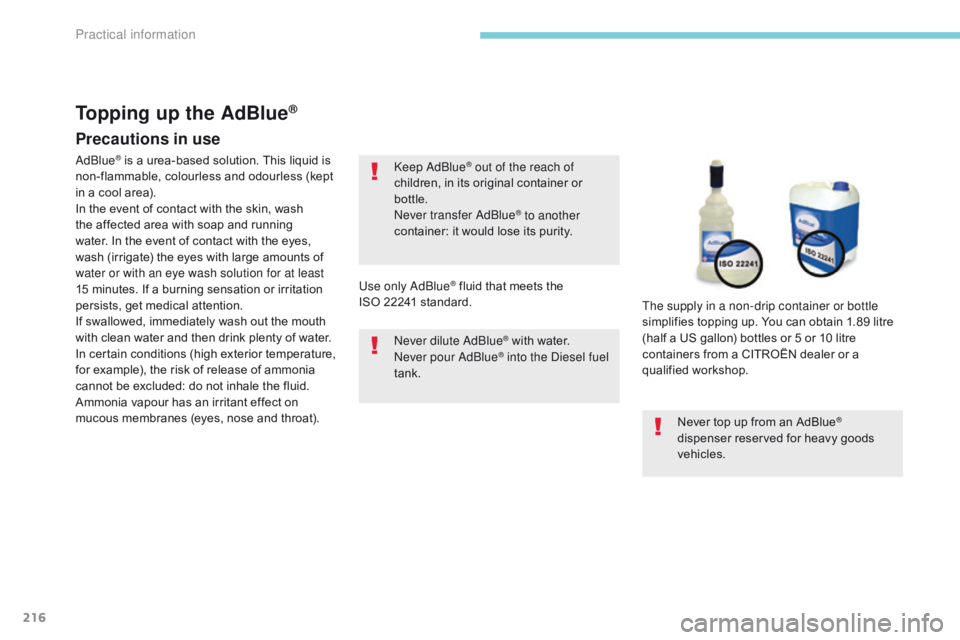
Use only AdBlue
® fluid that meets the
ISO
22241 standard. The supply in a non-drip container or bottle
simplifies topping up. You can obtain 1.89
litre
(half a US gallon) bottles or 5 or 10 litre
containers from a CITROËN dealer or a
qualified workshop.
AdBlue
® is a urea-based solution. This liquid is
non-flammable, colourless and odourless (kept
in a cool area).
In the event of contact with the skin, wash
the affected area with soap and running
water. In the event of contact with the eyes,
wash (irrigate) the eyes with large amounts of
water or with an eye wash solution for at least
15
minutes. If a burning sensation or irritation
persists, get medical attention.
If swallowed, immediately wash out the mouth
with clean water and then drink plenty of water.
In certain conditions (high exterior temperature,
for example), the risk of release of ammonia
cannot be excluded: do not inhale the fluid.
Ammonia vapour has an irritant effect on
mucous membranes (eyes, nose and throat).
Topping up the AdBlue®
Practical information
Page 219 of 450
217
B618_en_Chap07_info-pratiques_ed01-2016
Recommendations on storage
Never store bottles of AdBlue® in your
vehicle.
Procedure
Park the vehicle
F Switch off the ignition and remove the key from the switch to switch off the engine.
or
F
W
ith Keyless Entry and Starting, press the
" START/STOP " button to switch off the
engine.
AdBlue
® freezes at about -11°C and
deteriorates above 25°C. It is recommended
that bottles be stored in a cool area and
protected from direct sunlight .
Under these conditions, the fluid can be kept
for at least a year .
If the additive has frozen, it can be used once it
has completely thawed out. Before topping up, ensure that the vehicle is
parked on a flat and level sur face.
In wintry conditions, ensure that the
temperature of the vehicle is above -11°C.
Otherwise the AdBlue
® may be frozen and
so cannot be poured into its tank. Park your
vehicle in a warmer area for a few hours to
allow the top-up to be carried out.
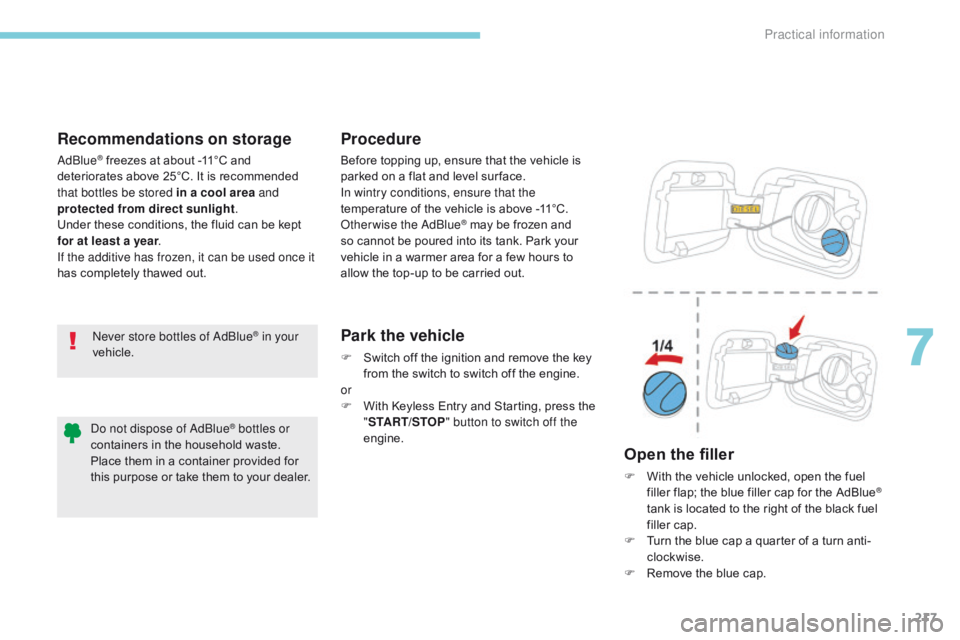
Open the filler
F With the vehicle unlocked, open the fuel filler flap; the blue filler cap for the AdBlue®
tank is located to the right of the black fuel
filler cap.
F
T
urn the blue cap a quarter of a turn anti-
clockwise.
F
R
emove the blue cap.
Do not dispose of AdBlue
® bottles or
containers in the household waste.
Place them in a container provided for
this purpose or take them to your dealer.
7
Practical information
Page 222 of 450
220
B618_en_Chap08_En-cas-de-panne_ed01-2016
Warning triangle
The triangle can be stored on the rear face of
the boot, secured by straps.
Assembling the triangle
As a safety precaution, before leaving your
vehicle to set up and install the triangle, switch
on the hazard warning lamps and put on your
high visibility vest.Refer to the instructions provided with the
triangle.
Positioning the triangle
Running out of fuel
(Diesel)
On vehicles fitted with Diesel engines, the fuel
system must be primed if you run out of fuel. For more information on Misfuel
prevention (Diesel) , refer to the
corresponding section.
If the engine does not start first
time, don't keep trying, but start the
procedure again from the beginning.
BlueHDi engines
F Fill the fuel tank with at least five litres of Diesel.
F
S
witch on the ignition (without starting the
engine).
F
W
ait around 6 seconds and switch off the
ignition.
F
R
epeat the operation 10 times.
F
O
perate the starter to run the engine.
F
P
lace the triangle behind the vehicle, as
required by local legislation.
Other HDi engines
(except BlueHDi version)
F A dd at least five litres of Diesel fuel to the
tank.
F
O
pen the bonnet.
F
I
f necessary, unclip the styling cover for
access to the priming pump.
F
S
queeze and release the priming pump
repeatedly until resistance is felt (there
may be resistance at the first press).
F
O
perate the starter to start the engine
(if the engine does not start at the first
attempt, wait around 15 seconds before
trying again).
F
I
f the engine does not start after a few
attempts, operate the priming pump again
then start the engine.
F
R
efit the styling cover and clip it in place.
F
C
lose the bonnet.
In the event of a breakdown
Page 246 of 450

244
B618_en_Chap08_En-cas-de-panne_ed01-2016
Lower fusebox
FuseN° Rating
(A) Functions
F1 10Electrochromatic interior mirror, heated rear screen,
particle
filter pump (Diesel), parking sensors, power steering,
LPG
system, clutch pedal switch, exterior mirror adjustment.
F10(+) -
F11 (Gnd) 30Locking / unlocking of the doors and fuel filler flap (depending
on engine).
F13 10Rain and sunshine sensor, air conditioning, front camera.
F14 5Alarm, telematic unit.
F16 3Automatic gearbox gear selector, brake pedal switch,
Stop & Start system.
F17 5Instrument panel, driving school module.
F18 5Air conditioning, gear selector position indicator (automatic
gearbox).
F19 3Steering mounted controls.
F21 3START/STOP switch or button.
F23 5Seat belts not fastened warning lamps display.
In the event of a breakdown
Page 256 of 450

254
B618_en_Chap09_caracteristiques-techniques_ed01-2016
Engines
Engine characteristics
The engine characteristics (capacity, maximum
power, maximum engine speed, fuel, CO
2
emissions, etc.) for your vehicle are given in
the registration document, as well as in sales
brochures.
These characteristics correspond to the
values type-approved on a test bed, under
conditions defined in European legislation
(Directive
1
999/99/EC).
For more information, contact a CITROËN
dealer or a qualified workshop.
Weights
Weights and towed loads
The maximum weights and towed loads for your
vehicle are given are given in the registration
document, as well as in sales brochures.
These values are also present on the
manufacturer's plate or label.
For more information, contact a CITROËN
dealer or a qualified workshop.
The kerb weight is equal to the unladen
weight
+ driver (75 kg).
The GTW and towed load values indicated
apply up to a maximum altitude of
1
000 metres; the towed load mentioned
must be reduced by 10 % for every additional
1
000 metres.
The weight of the braked trailer can be
increased, within the GTW limit, on condition
that the GV W of the towing vehicle is reduced
by the same amount.
The recommended nose weight is the vertical
load on the towbar ball (removable with or
without tools).
GV W: gross vehicle weight, the maximum
authorised vehicle weight.
GT W: gross train weight, the maximum
authorised weight of vehicle plus trailer. High exterior temperatures may result
in a reduction in the per formance of
the vehicle to protect the engine; when
the exterior temperature is higher than
37
°C, limit the towed weight.
Towing with a lightly loaded vehicle can
adversely affect roadholding.
Braking distances are increased when
towing a trailer.
Never exceed 60 mph (100 km/h) when
towing (comply with the legislation in
force in your country).
If the exterior temperature is high, it
is recommended that the engine be
allowed to idle for 1 to 2 minutes after
the vehicle comes to a stop, to facilitate
its cooling.
Technical data
Page 257 of 450

255
B618_en_Chap09_caracteristiques-techniques_ed01-2016
* The maximum power corresponds to the value type-approved on a test bed, under conditions defined in European legislation (Directive 1999/99/EC).
Engines and towed loads - PETROL
Engine PureTech 70
manual PureTech 82
manual PureTech 110 S&S
VTI 115 EAT6
Gearbox 5-speed
manual(BVM5) 5-speed
manual(BVM5) 5-speed
manual(BVM5) 6-speed
automatic ( E AT 6 ) 6-speed
automatic ( E AT 6 )
Code EB2FB - MA EB2F - MAEB2DT - BM -
S T Td EB2DT - AT6III -
S T Td EC5F - AT6III
Model code Wheel 640 = /A...
Wheel 620 = /B… SXHMP6/B0 -
SXHMP6/A0 SXHMZ6/…
B0 - B1 - A0 - B0M - A0M SXHNZ6/A0S
SXHNZT/A0S SXNFPT/A0
Capacity (cm
3) 1 1991 1991 1991 1991 587
Maximum power: EU standard (kW)* 5060 818185
Fuel Unleaded Unleaded Unleaded Unleaded Unleaded
Braked trailer (within GTW limit) on a 10 or 12%
gradient (kg) 450
450600 450450
Unbraked trailer (kg) 450450450450450
Recommended nose weight (kg) 2626 323232
9
Technical data