lock CITROEN C3 2021 Owner's Manual
[x] Cancel search | Manufacturer: CITROEN, Model Year: 2021, Model line: C3, Model: CITROEN C3 2021Pages: 450, PDF Size: 10.11 MB
Page 72 of 450
70
B618_en_Chap02_ouvertures_ed01-2016
Central locking
This function allows the doors and boot to be locked or unlocked simultaneously from inside the vehicle.
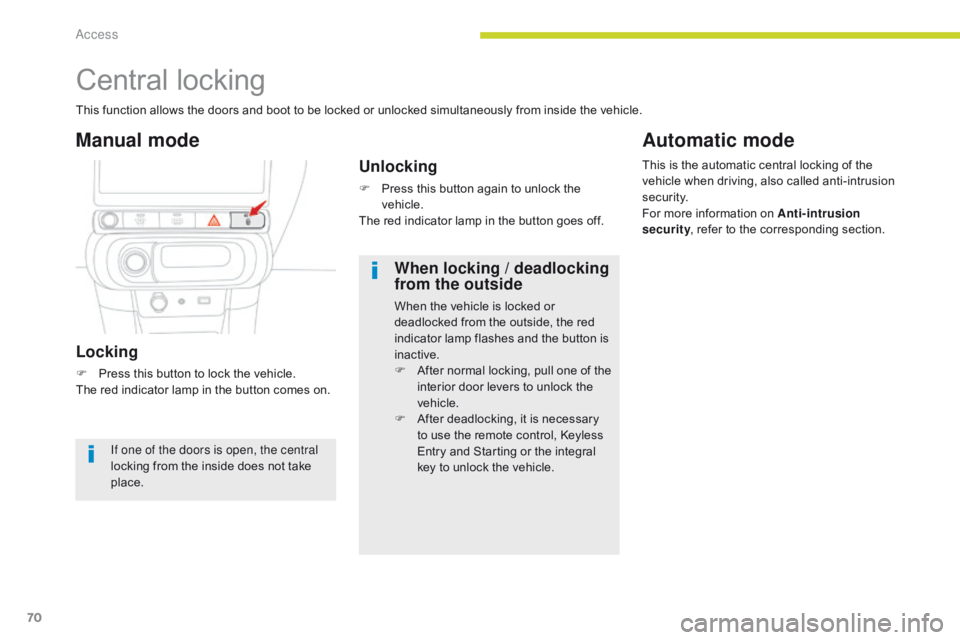
Locking
F Press this button to lock the vehicle.
The red indicator lamp in the button comes on.
Unlocking
F Press this button again to unlock the vehicle.
The red indicator lamp in the button goes off.
If one of the doors is open, the central
locking from the inside does not take
place.
When locking / deadlocking
from the outside
When the vehicle is locked or
deadlocked from the outside, the red
indicator lamp flashes and the button is
inactive.
F
A
fter normal locking, pull one of the
interior door levers to unlock the
vehicle.
F
A
fter deadlocking, it is necessary
to use the remote control, Keyless
Entry and Starting or the integral
key to unlock the vehicle.
Manual mode Automatic mode
This is the automatic central locking of the
vehicle when driving, also called anti-intrusion
s e c u r i t y.
For more information on Anti-intrusion
security, refer to the corresponding section.
Access
Page 73 of 450
71
B618_en_Chap02_ouvertures_ed01-2016
Anti-intrusion security
This system allows automatic simultaneous locking of the doors and boot as soon as the speed of
the vehicle exceeds 6 mph (10 km/h).
Operation
If one of the doors or the boot is open, the
automatic central locking does not take place.
Activation / Deactivation
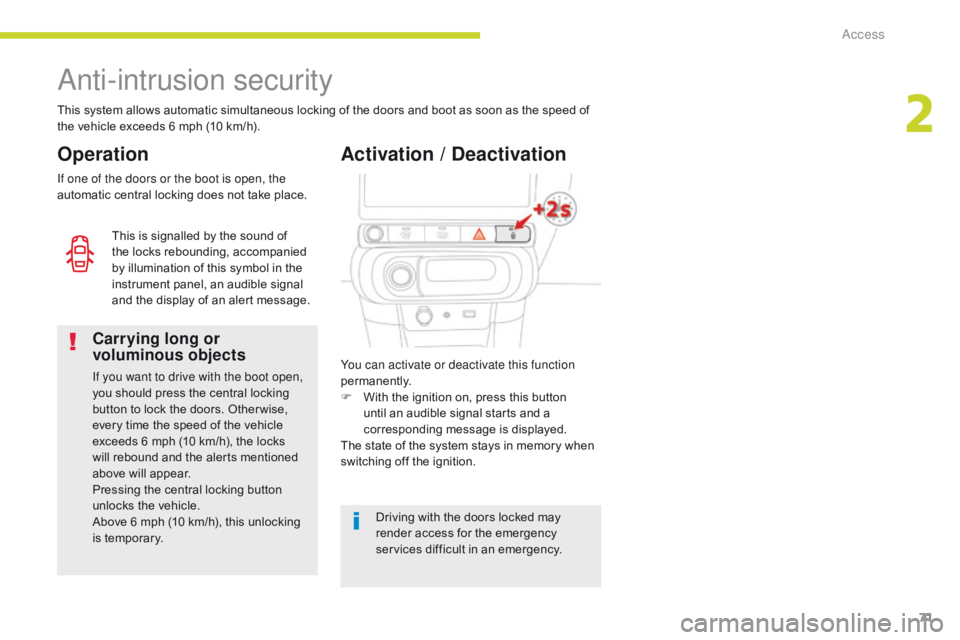
You can activate or deactivate this function
permanently.
F
W
ith the ignition on, press this button
until an audible signal starts and a
corresponding message is displayed.
The state of the system stays in memory when
switching off the ignition.
This is signalled by the sound of
the locks rebounding, accompanied
by illumination of this symbol in the
instrument panel, an audible signal
and the display of an alert message.
Carrying long or
voluminous objects
If you want to drive with the boot open,
you should press the central locking
button to lock the doors. Other wise,
every time the speed of the vehicle
exceeds 6 mph (10 km/h), the locks
will rebound and the alerts mentioned
above will appear.
Pressing the central locking button
unlocks the vehicle.
Above 6 mph (10 km/h), this unlocking
is temporary.
Driving with the doors locked may
render access for the emergency
services difficult in an emergency.
2
Access
Page 74 of 450
72
B618_en_Chap02_ouvertures_ed01-2016
* Depending on the country of sale.
Alarm*
System which protects and provides a deterrent
against theft and break-ins. It provides the
following type of monitoring:
- exterior perimeter
The system checks for opening of the vehicle.
The alarm is triggered if anyone tries to open a
door, the boot, the bonnet, etc.
Self-protection function
The system checks for the putting out of
service of its components.
The alarm is triggered if the battery, the central
control or the siren wiring are put out of service
or damaged.For all work on the alarm system,
contact a CITROËN dealer or a
qualified workshop. Following an instruction to lock
the vehicle, the exterior perimeter
monitoring is activated after a delay of
5 seconds.
If an opening (door, boot, etc.) is not
fully closed, the vehicle is not locked but
the exterior perimeter monitoring will be
activated after a delay of 45 seconds.
Locking the vehicle with alarm system
Activation
F Switch off the ignition and get out of the
vehicle.
F
L
ock the vehicle with the remote control
or with the "Keyless Entry and Starting"
system.
The monitoring system is active: the indicator
lamp in the locking button on the dashboard
flashes once per second and the direction
indicators come on for about 2 seconds.
Deactivation
F Unlock the vehicle with the "Keyless Entry and Starting" system.
The monitoring system is deactivated: the
indicator lamp in the locking button goes off
and the direction indicators flash for about
2
seconds.
If the vehicle automatically locks itself
again (as happens if a door or boot
is not opened within 30 seconds of
unlocking), the monitoring system is
also reactivated automatically.
Access
Page 75 of 450
73
B618_en_Chap02_ouvertures_ed01-2016
Triggering of the alarm
This is indicated by sounding of the siren
and flashing of the direction indicators for
30 seconds.
The monitoring functions remain active until
the alarm has been triggered eleven times in
succession.
When the vehicle is unlocked using the remote
control or the Keyless Entry and Starting
system, rapid flashing of the indicator lamp in
the locking button informs you that the alarm
was triggered during your absence. When the
ignition is switched on, this flashing stops.
Failure of the remote control
F unlock the vehicle using the key (integral to the remote control) in the driver's door lock,
F
o
pen the door; the alarm is triggered,
F
s
witch on the ignition; the alarm stops; the
indicator lamp in the button goes off. When the ignition is switched on, and for
10
seconds, the flashing of the indicator lamp
in the locking button indicates a fault with the
system.
Have it checked by a CITROËN dealer or a
qualified workshop.
Locking the vehicle without
activating the alarm
To deactivate the monitoring functions:
F
L
ock or deadlock the vehicle using the
key (integral to the remote control) in the
driver's door lock.
Operating fault
2
Access
Page 84 of 450
82
B618_en_Chap03_Ergonomie-et-confort_ed01-2016
Steering wheel adjustment
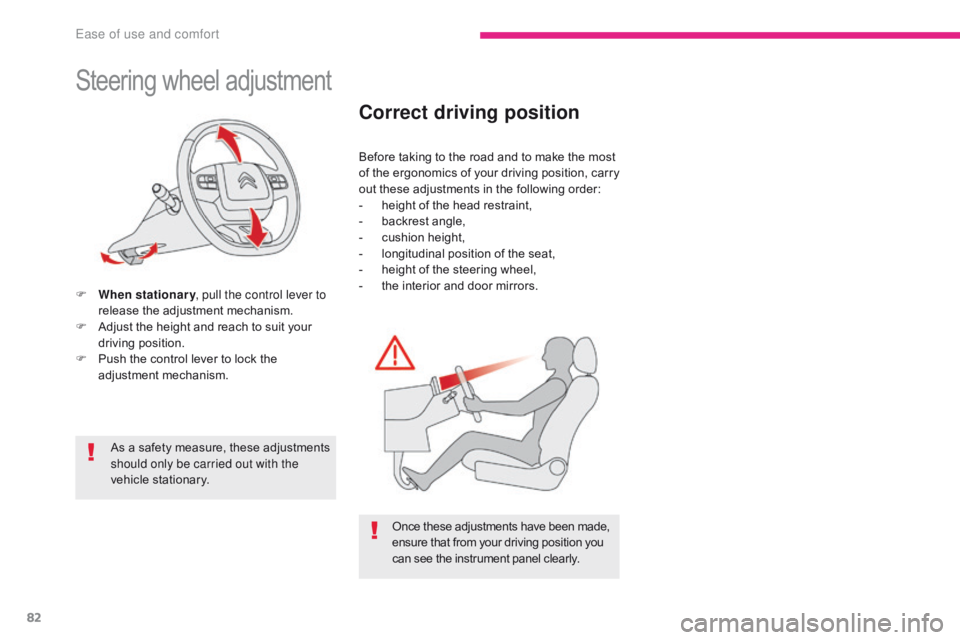
F When stationary, pull the control lever to
release the adjustment mechanism.
F
A
djust the height and reach to suit your
driving position.
F
P
ush the control lever to lock the
adjustment mechanism.
As a safety measure, these adjustments
should only be carried out with the
vehicle stationary.
Correct driving position
Before taking to the road and to make the most
of the ergonomics of your driving position, carry
out these adjustments in the following order:
-
h
eight of the head restraint,
-
b
ackrest angle,
-
c
ushion height,
-
l
ongitudinal position of the seat,
-
h
eight of the steering wheel,
-
t
he interior and door mirrors.
Once these adjustments have been made,
ensure that from your driving position you
can see the instrument panel clearly.
Ease of use and comfort
Page 96 of 450
94
B618_en_Chap03_Ergonomie-et-confort_ed01-2016
Courtesy lamp
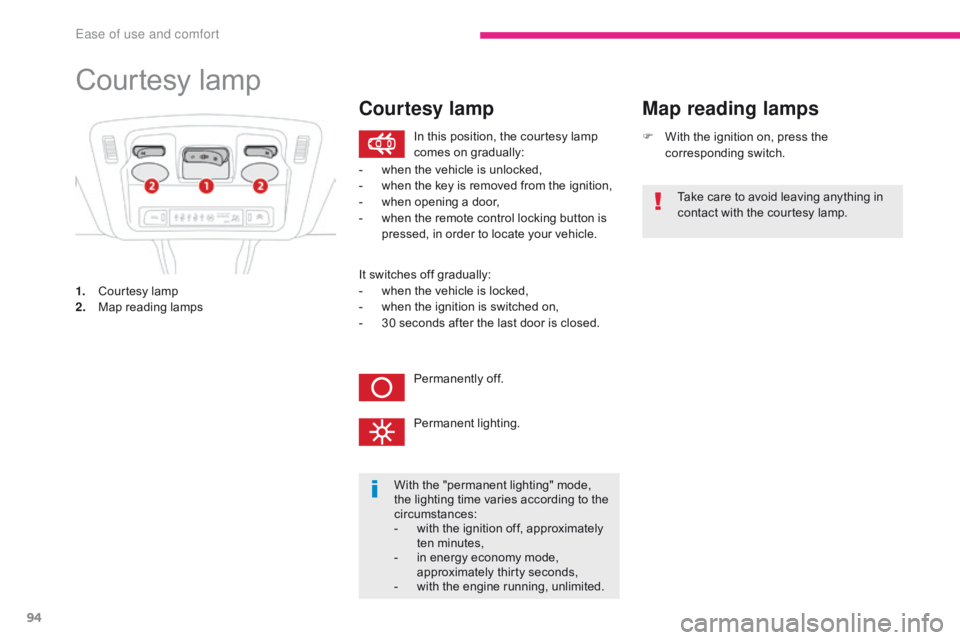
1. Courtesy lamp
2. Map reading lamps F
W
ith the ignition on, press the
corresponding switch.
Map reading lamps
With the "permanent lighting" mode,
the lighting time varies according to the
circumstances:
-
w
ith the ignition off, approximately
ten minutes,
-
i
n energy economy mode,
approximately thirty seconds,
-
w
ith the engine running, unlimited.
In this position, the courtesy lamp
comes on gradually:
Permanently off.
Permanent lighting.
-
w
hen the vehicle is unlocked,
-
w
hen the key is removed from the ignition,
-
w
hen opening a door,
-
w
hen the remote control locking button is
pressed, in order to locate your vehicle. Take care to avoid leaving anything in
contact with the courtesy lamp.
Courtesy lamp
It switches off gradually:
-
w hen the vehicle is locked,
-
w
hen the ignition is switched on,
-
3
0 seconds after the last door is closed.
Ease of use and comfort
Page 97 of 450
95
B618_en_Chap03_Ergonomie-et-confort_ed01-2016
This comes on automatically when the boot is
opened and switches off automatically when
the boot is closed.
Different lighting times are provided:
-
w
hen the ignition is off, approximately
ten
m
inutes,
-
i
n energy economy mode, approximately
thirty seconds,
-
w
hen the engine is running, no limit.
Boot lamp
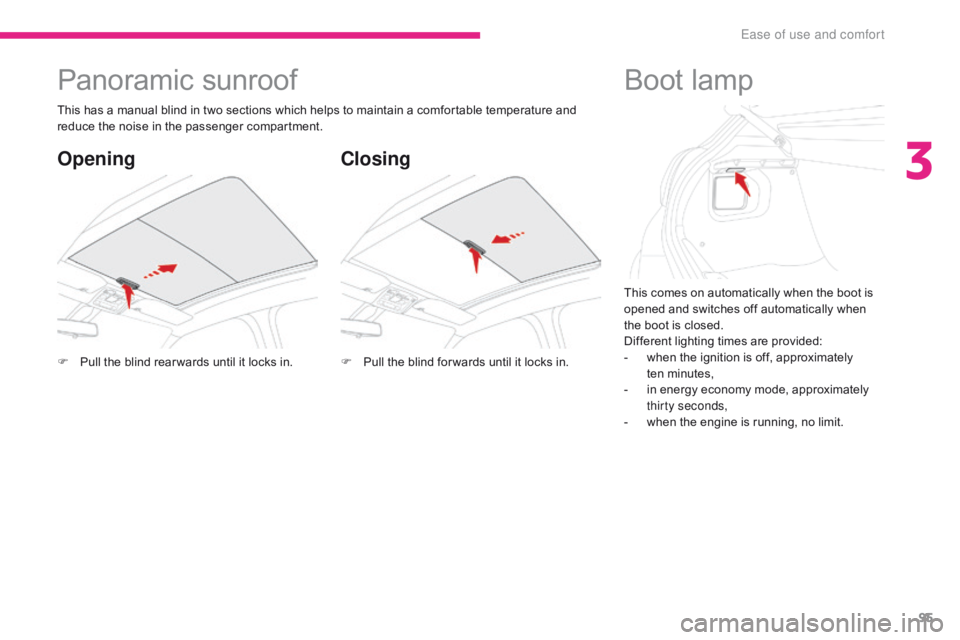
This has a manual blind in two sections which helps to maintain a comfortable temperature and
reduce the noise in the passenger compartment.
Panoramic sunroof
F Pull the blind rear wards until it locks in.
Closing
Opening
F Pull the blind for wards until it locks in.
3
Ease of use and comfort
Page 113 of 450
111
B618_en_Chap04_Eclairage-et-visibilite_ed01-2016
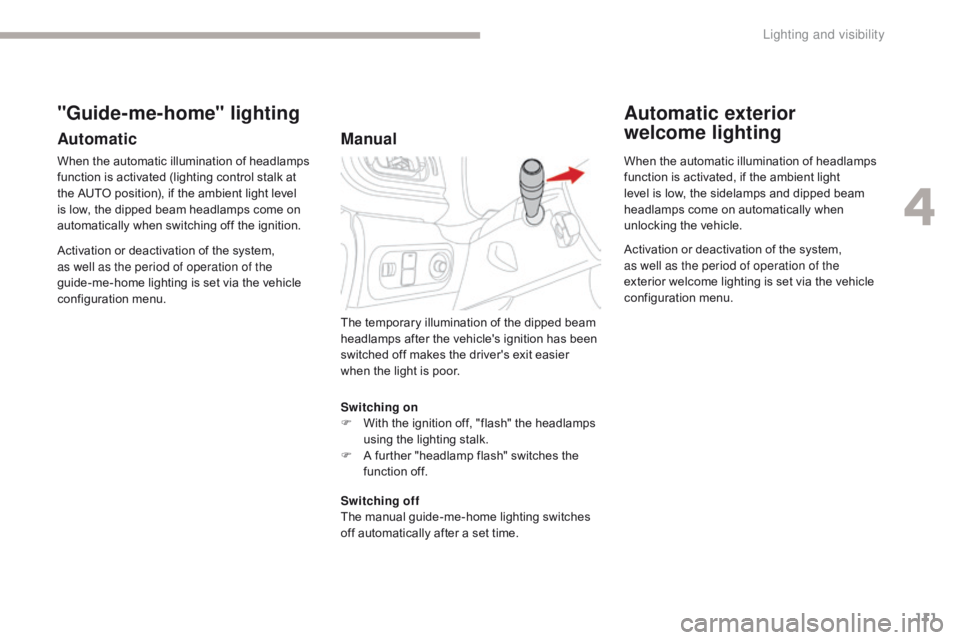
Switching on
F W ith the ignition off, "flash" the headlamps
using the lighting stalk.
F
A f
urther "headlamp flash" switches the
function off.
Switching off
The manual guide-me-home lighting switches
off automatically after a set time. The temporary illumination of the dipped beam
headlamps after the vehicle's ignition has been
switched off makes the driver's exit easier
when the light is poor.
"Guide-me-home" lighting
Automatic
When the automatic illumination of headlamps
function is activated (lighting control stalk at
the AUTO position), if the ambient light level
is low, the dipped beam headlamps come on
automatically when switching off the ignition.
Activation or deactivation of the system,
as well as the period of operation of the
guide-me-home lighting is set via the vehicle
configuration menu.
Manual
Automatic exterior
welcome lighting
When the automatic illumination of headlamps
function is activated, if the ambient light
level is low, the sidelamps and dipped beam
headlamps come on automatically when
unlocking the vehicle.
Activation or deactivation of the system,
as well as the period of operation of the
exterior welcome lighting is set via the vehicle
configuration menu.
4
Lighting and visibility
Page 125 of 450

123
B618_en_Chap05_securite_ed01-2016
Electronic stability control (ESC) incorporating the following systems:
- a nti-lock braking system (ABS) and electronic brake force distribution (EBFD),
-
e
mergency braking assistance (EBA),
-
w
heel anti-slip regulation (ASR) or traction control,
-
d
ynamic stability control (DSC).
Electronic stability control (ESC)
Definitions
Anti-lock braking system (ABS)
and electronic brake force
distribution (EBFD)
This system improves the stability and
manoeuvrability of your vehicle when braking
and contributes towards improved control on
corners, in particular on poor or slippery road
surfaces.
The ABS prevents wheel lock in the event of
emergency braking.
The EBFD manages the braking pressure
wheel by wheel.
Emergency braking assistance
(EBA)
In an emergency, this system enables you to
reach the optimum braking pressure more
quickly and therefore reduce the stopping
distance.
It is triggered according to the speed at which
the brake pedal is pressed. This is felt by a
reduction in the resistance of the pedal and an
increase in the effectiveness of the braking.
Anti-slip regulation (ASR)
The ASR system (also known as Traction
Control) optimises traction in order to limit
wheel slip by acting on the brakes of the driving
wheels and on the engine. It also improves
the directional stability of the vehicle on
acceleration.
Dynamic stability control (DSC)
If there is a difference between the path
followed by the vehicle and that required by
the driver, the DSC monitors each wheel and
automatically acts on the brake of one or more
wheels and on the engine to return the vehicle
to the required path, within the limits of the laws
of physics.
5
Safety
Page 126 of 450
124
B618_en_Chap05_securite_ed01-2016
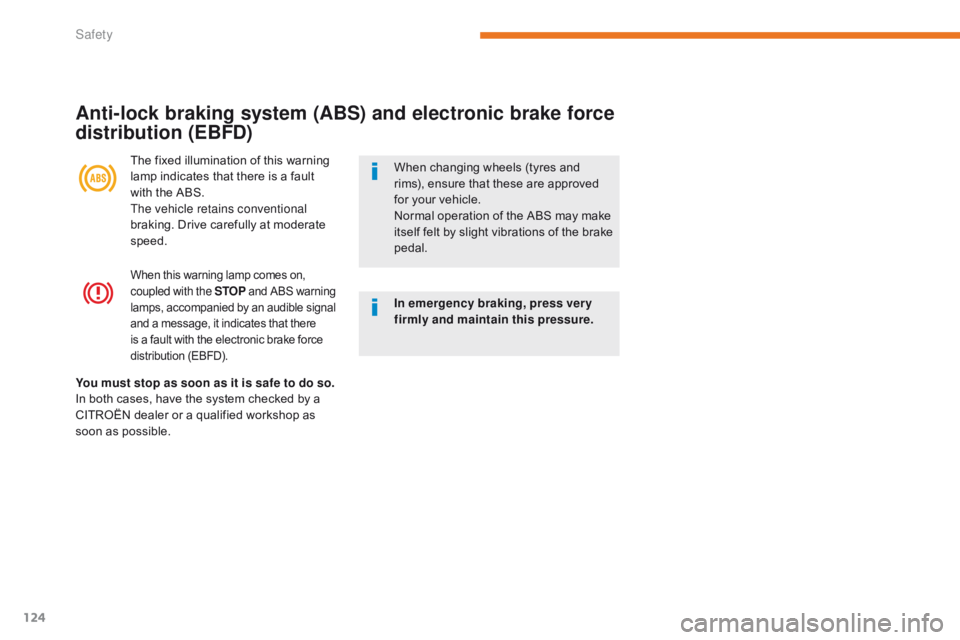
When this warning lamp comes on,
coupled with the STOP and ABS warning
lamps, accompanied by an audible signal
and a message, it indicates that there
is a fault with the electronic brake force
distribution (EBFD).
Anti-lock braking system (ABS) and electronic brake force
distribution (EBFD)
The fixed illumination of this warning
lamp indicates that there is a fault
with the ABS.
The vehicle retains conventional
braking. Drive carefully at moderate
speed. When changing wheels (tyres and
rims), ensure that these are approved
for your vehicle.
Normal operation of the ABS may make
itself felt by slight vibrations of the brake
pedal.
In emergency braking, press ver y
firmly and maintain this pressure.
You must stop as soon as it is safe to do so.
In both cases, have the system checked by a
CITROËN dealer or a qualified workshop as
soon as possible.
Safety