start CITROEN C3 2021 Workshop Manual
[x] Cancel search | Manufacturer: CITROEN, Model Year: 2021, Model line: C3, Model: CITROEN C3 2021Pages: 450, PDF Size: 10.11 MB
Page 171 of 450
169
B618_en_Chap06_conduite_ed01-2016
In the event of a fault with the system, the
indicator lamp in the button flashes for a
few moments, then remains on.
Have it checked by a CITROËN dealer or a
qualified workshop.
Operating fault
In the event of a fault in STOP mode, the
vehicle may stall.
All of the instrument panel warning lamps
come
on.
It is then necessary to switch off the ignition
and start the engine again.
In certain circumstances, such as the need
to maintain the temperature in the passenger
compartment, it may be useful to deactivate the
Stop & Start system.
The system can be deactivated at any time,
once the ignition is switched on.
If the engine is in STOP mode, it then restarts.
The Stop & Start system is reactivated
automatically every time the ignition is
switched
on.
Deactivation / Reactivation
The Stop & Start system requires
a 12 V battery of specific technology
and specification.
All work on this type of battery must be
carried out only by a CITROËN dealer
or a qualified workshop.
For more information on the 12 V
Battery , refer to the corresponding
section.
Before doing anything under the bonnet,
deactivate the Stop & Start system to
avoid the risk of injury related to an
automatic change to START mode. Opening the bonnet
Driving on flooded roads
Before driving through a flooded road,
it is strongly recommended that you
deactivate the Stop & Start system.
For more information on Driving
advice , particularly on flooded roads,
refer to the corresponding section. F
P
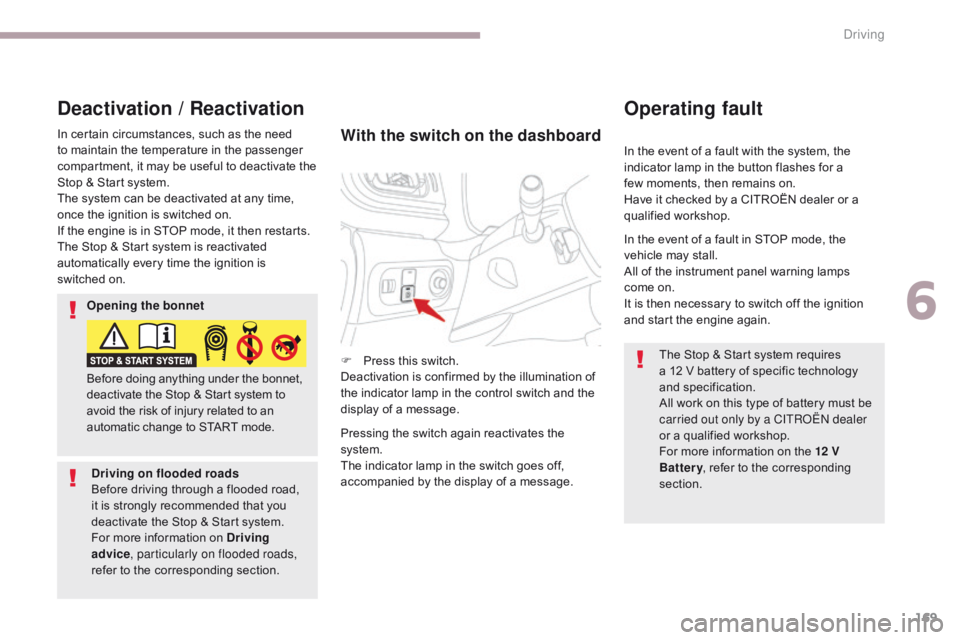
ress this switch.
Deactivation is confirmed by the illumination of
the indicator lamp in the control switch and the
display of a message.
Pressing the switch again reactivates the
system.
The indicator lamp in the switch goes off,
accompanied by the display of a message.
With the switch on the dashboard
6
Driving
Page 180 of 450
178
B618_en_Chap06_conduite_ed01-2016
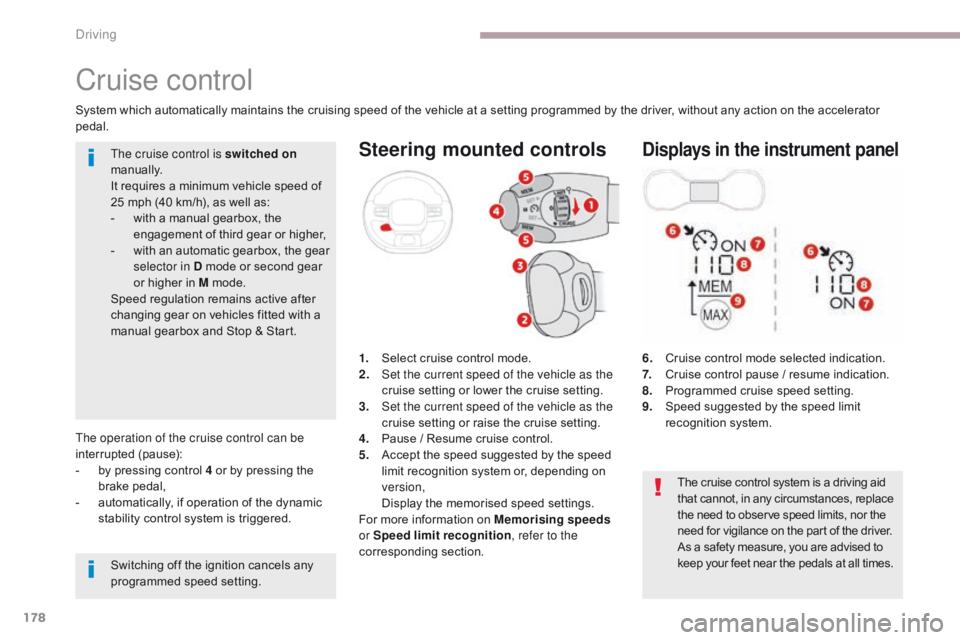
Steering mounted controls
6. Cruise control mode selected indication.
7. Cruise control pause / resume indication.
8.
P
rogrammed cruise speed setting.
9.
S
peed suggested by the speed limit
recognition system.
Cruise control
System which automatically maintains the cruising speed of the vehicle at a setting programmed by the driver, without any action on the accelerator
pedal.
The cruise control system is a driving aid
that cannot, in any circumstances, replace
the need to observe speed limits, nor the
need for vigilance on the part of the driver.
As a safety measure, you are advised to
keep your feet near the pedals at all times.
1.
S
elect cruise control mode.
2.
S
et the current speed of the vehicle as the
cruise setting or lower the cruise setting.
3.
S
et the current speed of the vehicle as the
cruise setting or raise the cruise setting.
4.
P
ause / Resume cruise control.
5.
A
ccept the speed suggested by the speed
limit recognition system or, depending on
version,
D
isplay the memorised speed settings.
For more information on Memorising speeds
or Speed limit recognition , refer to the
corresponding section.
Displays in the instrument panelThe cruise control is switched on
manually.
It requires a minimum vehicle speed of
25 mph (40 km/h), as well as:
-
w
ith a manual gearbox, the
engagement of third gear or higher,
-
w
ith an automatic gearbox, the gear
selector in D mode or second gear
or higher in M mode.
Speed regulation remains active after
changing gear on vehicles fitted with a
manual gearbox and Stop & Start.
Switching off the ignition cancels any
programmed speed setting.
The operation of the cruise control can be
interrupted (pause):
-
b
y pressing control 4 or by pressing the
brake pedal,
-
a
utomatically, if operation of the dynamic
stability control system is triggered.
Driving
Page 181 of 450
179
B618_en_Chap06_conduite_ed01-2016
Switching on
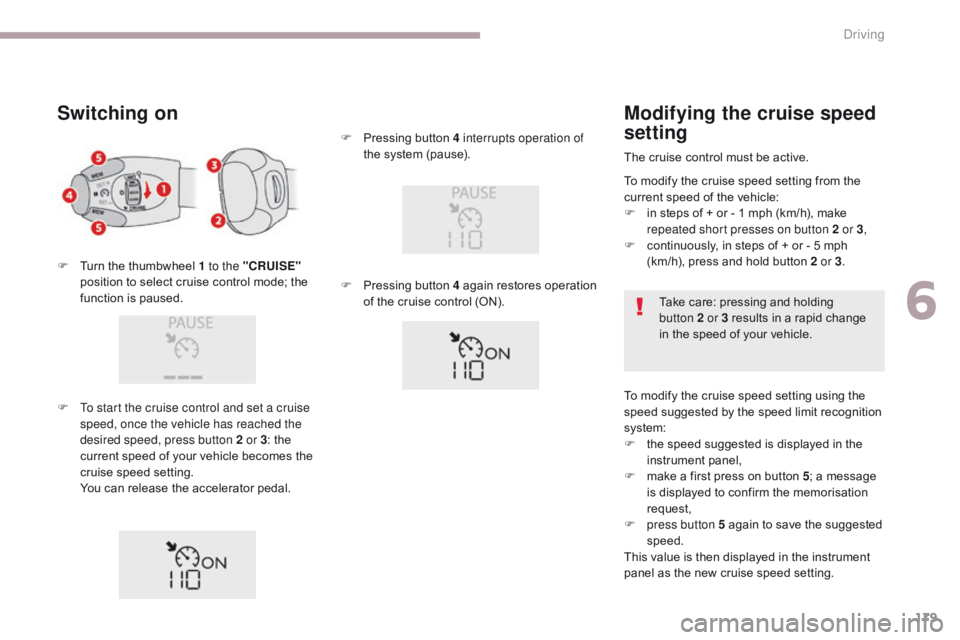
F Turn the thumbwheel 1 to the "CRUISE"
position to select cruise control mode; the
function is paused.
F
T
o start the cruise control and set a cruise
speed, once the vehicle has reached the
desired speed, press button 2 or 3 : the
current speed of your vehicle becomes the
cruise speed setting.
Y
ou can release the accelerator pedal. F
P
ressing button 4 interrupts operation of
the system (pause).
F
P
ressing button 4 again restores operation
of the cruise control (ON). Take care: pressing and holding
button
2 or 3 results in a rapid change
in the speed of your vehicle.
Modifying the cruise speed
setting
The cruise control must be active.
To modify the cruise speed setting from the
current speed of the vehicle:
F
i
n steps of + or - 1 mph (km/h), make
repeated short presses on button 2 or 3 ,
F
c
ontinuously, in steps of + or - 5 mph
(km/h), press and hold button 2 or 3 .
To modify the cruise speed setting using the
speed suggested by the speed limit recognition
system:
F
t
he speed suggested is displayed in the
instrument panel,
F
m
ake a first press on button 5 ; a message
is displayed to confirm the memorisation
request,
F
p
ress button 5 again to save the suggested
speed.
This value is then displayed in the instrument
panel as the new cruise speed setting.
6
Driving
Page 195 of 450
193
B618_en_Chap06_conduite_ed01-2016
ConnectedCAM CITROËN™*
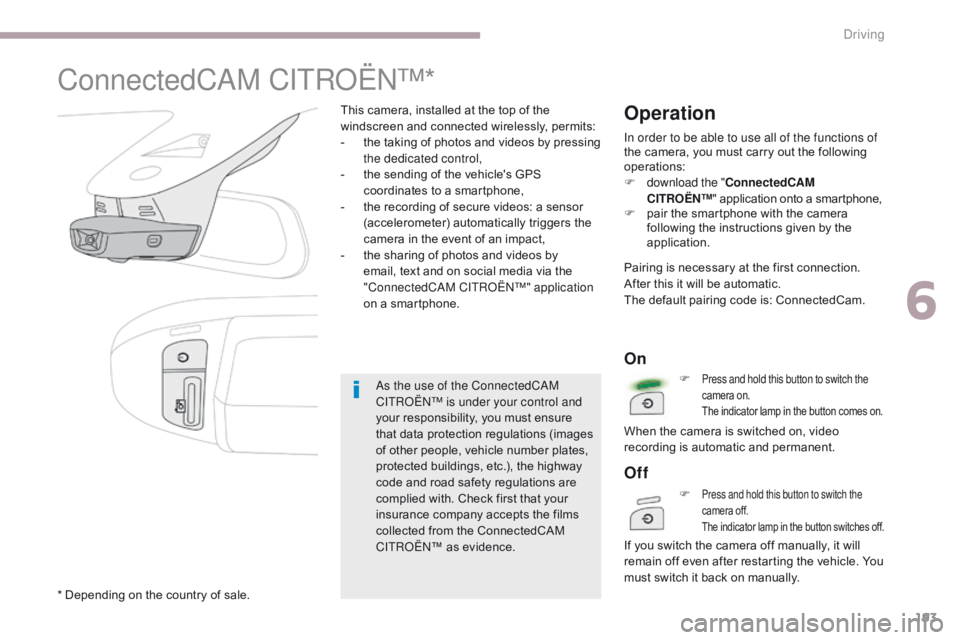
This camera, installed at the top of the
windscreen and connected wirelessly, permits:
-
t
he taking of photos and videos by pressing
the dedicated control,
-
t
he sending of the vehicle's GPS
coordinates to a smartphone,
-
t
he recording of secure videos: a sensor
(accelerometer) automatically triggers the
camera in the event of an impact,
-
t
he sharing of photos and videos by
email, text and on social media via the
"ConnectedCAM C
ITROËN
™
" application
on a smartphone.
* Depending on the country of sale. As the use of the ConnectedCAM
C
ITROËN
™ i
s under your control and
your responsibility, you must ensure
that data protection regulations (images
of other people, vehicle number plates,
protected buildings, etc.), the highway
code and road safety regulations are
complied with. Check first that your
insurance company accepts the films
collected from the ConnectedCAM
C
ITROËN
™ a
s evidence.Operation
In order to be able to use all of the functions of
the camera, you must carry out the following
operations:
F
do
wnload the " ConnectedCAM
C
I
TROËN
™" a
pplication onto a smartphone,
F
p
air the smartphone with the camera
following the instructions given by the
application.
Pairing is necessary at the first connection.
After this it will be automatic.
The default pairing code is: ConnectedCam.
On
F Press and hold this button to switch the
camera on.
T
he indicator lamp in the button comes on.
Off
F Press and hold this button to switch the
camera off.
T
he indicator lamp in the button switches off.
If you switch the camera off manually, it will
remain off even after restarting the vehicle. You
must switch it back on manually. When the camera is switched on, video
recording is automatic and permanent.
6
Driving
Page 198 of 450
196
B618_en_Chap07_info-pratiques_ed01-2016
Fuel tank
Capacity of the tank:
- Pe trol: approximately 45 litres.
-
D
iesel: approximately 42 or 50 litres (depending on version).
Low fuel level Refuelling
When the low fuel level is reached,
this warning lamp in the instrument
panel comes on, accompanied by
an audible warning, a message and
the last bar of the fuel gauge flashes
in red.
To refuel in complete safety:
F
Y
ou must switch off the engine.
F
O
pen the filler flap.
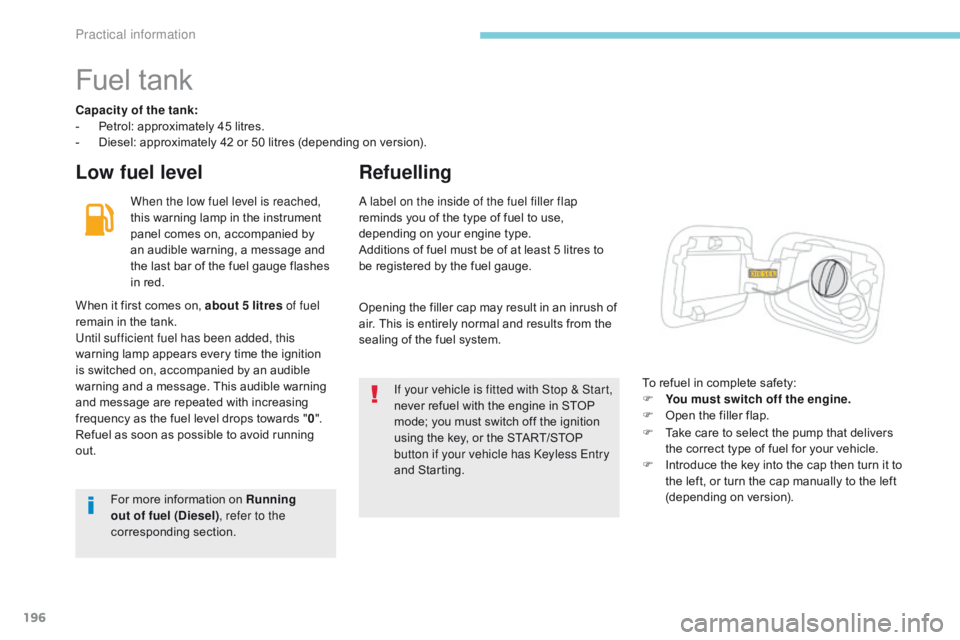
A label on the inside of the fuel filler flap
reminds you of the type of fuel to use,
depending on your engine type.
Additions of fuel must be of at least 5 litres to
be registered by the fuel gauge.
When it first comes on, about 5 litres of fuel
remain in the tank.
Until sufficient fuel has been added, this
warning lamp appears every time the ignition
is switched on, accompanied by an audible
warning and a message. This audible warning
and message are repeated with increasing
frequency as the fuel level drops towards " 0".
Refuel as soon as possible to avoid running
out. Opening the filler cap may result in an inrush of
air. This is entirely normal and results from the
sealing of the fuel system.
If your vehicle is fitted with Stop & Start,
never refuel with the engine in STOP
mode; you must switch off the ignition
using the key, or the START/STOP
button if your vehicle has Keyless Entry
and Starting.
For more information on Running
out of fuel (Diesel) , refer to the
corresponding section. F
T
ake care to select the pump that delivers
the correct type of fuel for your vehicle.
F
I
ntroduce the key into the cap then turn it to
the left, or turn the cap manually to the left
(depending on version).
Practical information
Page 199 of 450
197
B618_en_Chap07_info-pratiques_ed01-2016
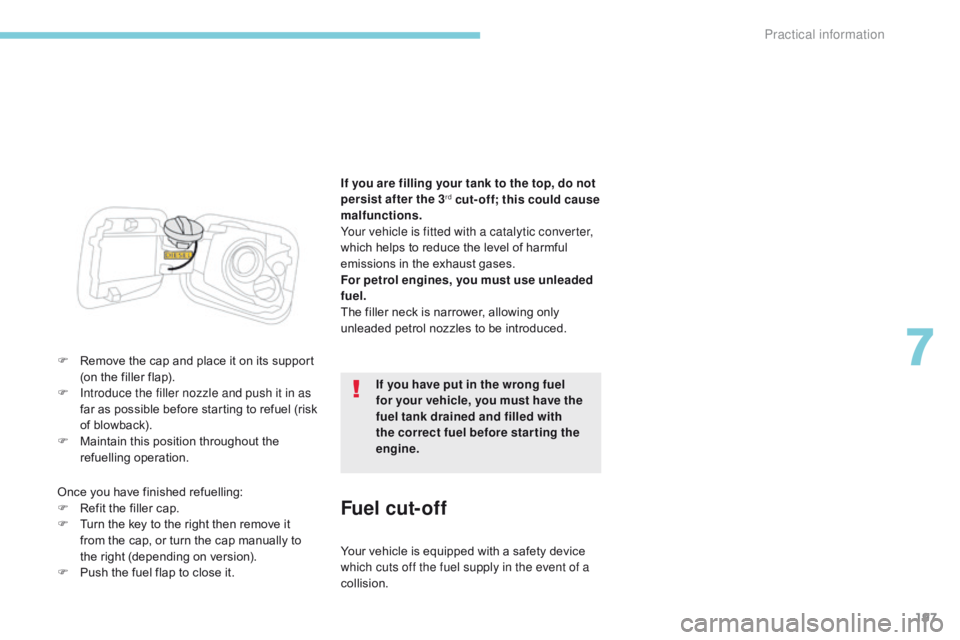
F Remove the cap and place it on its support (on the filler flap).
F
I
ntroduce the filler nozzle and push it in as
far as possible before starting to refuel (risk
of blowback).
F
M
aintain this position throughout the
refuelling operation.
Once you have finished refuelling:
F
R
efit the filler cap.
F
T
urn the key to the right then remove it
from the cap, or turn the cap manually to
the right (depending on version).
F
P
ush the fuel flap to close it. If you are filling your tank to the top, do not
persist after the 3
rd cut-off
; this could cause
malfunctions.
Your vehicle is fitted with a catalytic converter,
which helps to reduce the level of harmful
emissions in the exhaust gases.
For petrol engines, you must use unleaded
fuel.
The filler neck is narrower, allowing only
unleaded petrol nozzles to be introduced.
Your vehicle is equipped with a safety device
which cuts off the fuel supply in the event of a
collision.
Fuel cut- of f
If you have put in the wrong fuel
for your vehicle, you must have the
fuel tank drained and filled with
the correct fuel before star ting the
engine.
7
Practical information
Page 205 of 450
203
B618_en_Chap07_info-pratiques_ed01-2016
Load reduction mode
System which manages the use of certain
functions according to the level of charge
remaining in the battery.
When the vehicle is being driven, the load
reduction function temporarily deactivates
certain functions, such as the air conditioning,
the heated rear screen...
The deactivated functions are reactivated
automatically as soon as conditions permit.System which manages the duration of use of
certain functions to conserve a sufficient level
of charge in the battery.
After the engine has stopped, you can
still use functions such as the audio and
telematics system,
windscreen wipers, dipped
beam headlamps,
courtesy lamps, etc. for
a maximum combined duration of about
forty
m
inutes.
Energy economy mode
Switching to economy mode
A message appears in the instrument panel
screen indicating that the vehicle has switched
to economy mode and the active functions are
put on standby.
If a telephone call is being made at this time, it
will be maintained for around 10 minutes with
the Bluetooth
® hands-free system of your audio
system.
Exiting economy mode
These functions are reactivated automatically
next time the vehicle is driven.
In order to restore the use of these functions
immediately, start the engine and let it run:
-
f
or less than ten minutes, to use the
equipment for approximately five minutes,
-
f
or more than ten minutes, to use the
equipment for up to approximately
thirty
m
inutes.
Let the engine run for the duration specified to
ensure that the battery charge is sufficient.
Do not repeatedly and continuously restart the
engine in order to charge the battery.
A flat battery prevents the engine from
starting.
For more information on the 12 V
battery , refer to the corresponding
section.
7
Practical information
Page 208 of 450
206
B618_en_Chap07_info-pratiques_ed01-2016
Bonnet
F Open the left-hand front door.The location of the interior bonnet
release lever prevents opening of the
bonnet when the left-hand front door
is shut.
When the engine is hot, handle the
exterior safety catch and the stay with
care (risk of burns), using the protected
area.
When the bonnet is open, take care not
to damage the safety catch.
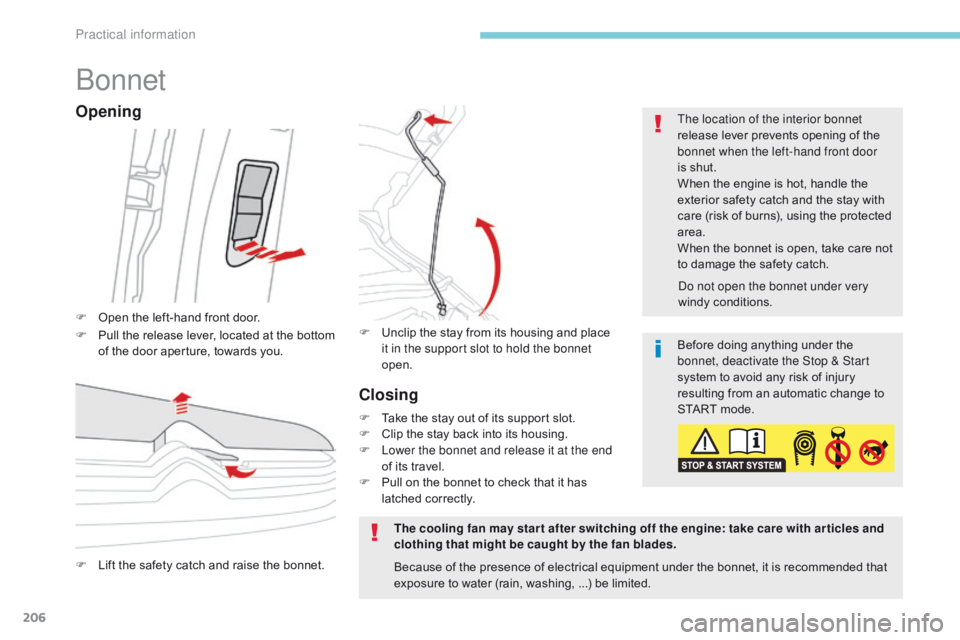
F
L
ift the safety catch and raise the bonnet. F
U nclip the stay from its housing and place
it in the support slot to hold the bonnet
open.
Opening
F Pull the release lever, located at the bottom of the door aperture, towards you.
The cooling fan may star t after switching off the engine: take care with ar ticles and
clothing that might be caught by the fan blades.Do not open the bonnet under very
windy conditions.
Closing
F Take the stay out of its support slot.
F
C lip the stay back into its housing.
F
L
ower the bonnet and release it at the end
of its travel.
F
P
ull on the bonnet to check that it has
latched correctly.
Because of the presence of electrical equipment under the bonnet, it is recommended that
exposure to water (rain, washing,
...) be limited.Before doing anything under the
bonnet, deactivate the Stop & Start
system to avoid any risk of injury
resulting from an automatic change to
START mode.
Practical information
Page 211 of 450
209
B618_en_Chap07_info-pratiques_ed01-2016
Checking levels
Take care when working under the
bonnet, as certain areas of the engine
may be extremely hot (risk of burns)
and the cooling fan could start at any
time (even with the ignition off).
Engine oil level
The check is carried out either when
the ignition is switched on using the
oil level indicator in the instrument
panel for vehicles so equipped, or
using the dipstick.
Checking using the dipstick
Check all of these levels regularly, in line with the manufacturer's service schedule. Top them up if necessary, unless other wise indicated.
If a level drops significantly, have the corresponding system checked by a CITROËN dealer or a qualified workshop.If you find that the level is above the A mark or
below the B mark, do not star t the engine.
-
I
f the level is above the MAX mark (risk
of damage to the engine), contact a
CITROËN dealer or a qualified workshop.
-
I
f the level is below the MIN mark, you
must top up the engine oil.
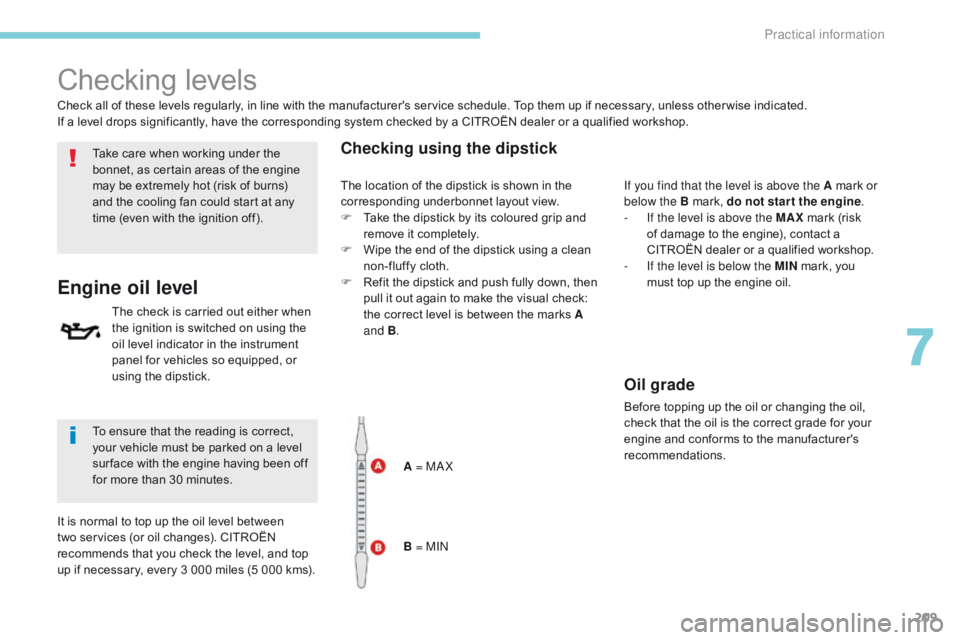
A = MA X
B = MIN
To ensure that the reading is correct,
your vehicle must be parked on a level
sur face with the engine having been off
for more than 30 minutes.
It is normal to top up the oil level between
two services (or oil changes). CITROËN
recommends that you check the level, and top
up if necessary, every 3 000 miles (5 000 kms). The location of the dipstick is shown in the
corresponding underbonnet layout view.
F
T
ake the dipstick by its coloured grip and
remove it completely.
F
W
ipe the end of the dipstick using a clean
non-fluffy cloth.
F
R
efit the dipstick and push fully down, then
pull it out again to make the visual check:
the correct level is between the marks A
and B .
Oil grade
Before topping up the oil or changing the oil,
check that the oil is the correct grade for your
engine and conforms to the manufacturer's
recommendations.
7
Practical information
Page 215 of 450

213
B618_en_Chap07_info-pratiques_ed01-2016
Checking components
12 V battery
The battery does not require any maintenance.
However, check regularly that the terminals
are correctly tightened (versions without quick
release terminals) and that the connections
are clean.Refer to the manufacturer's
service schedule for details of the
replacement intervals for these
components.
Air filter and passenger compartment filter
Replace the oil filter each time the
engine oil is changed.
Refer to the manufacturer's
service schedule for details of
the replacement interval for this
component.
Oil filter
Unless other wise indicated, check these components in accordance with the manufacturer's service schedule and according to your engine.
Other wise, have them checked by a CITROËN dealer or a qualified workshop.Depending on the environment (e.g. dusty
atmosphere) and the use of the vehicle (e.g.
city driving), replace them twice as often if
necessary.
A clogged passenger compartment filter may
have an adverse effect on the per formance
of the air conditioning system and generate
undesirable odours.
Particle filter (Diesel)
The start of saturation of the particle
filter is indicated by the fixed
illumination of this warning lamp
accompanied by a warning message.
As soon as the traffic conditions permit,
regenerate the filter by driving at a speed of at
least 40 mph (60 km/h) until the warning lamp
goes off.
If the warning lamp stays on, this indicates a
low additive level.
For more information on Checking levels and
the Diesel additive level in particular, refer to
the corresponding section.
On a new vehicle, the first particle
filter regeneration operations may be
accompanied by a "burning" smell,
which is per fectly normal.
Following prolonged operation of the
vehicle at very low speed or at idle,
you may, in exceptional circumstances,
notice the emission of water vapour at
the exhaust on acceleration. This does
not affect the behaviour of the vehicle
or the environment.
For more information and the precautions to
take before starting work on the 12 V batter y
,
refer to the corresponding section.
Versions equipped with Stop & Start are
fitted with a 12 V lead-acid battery of
specific technology and specification.
Its replacement should be carried out
only by a CITROËN dealer or a qualified
workshop.
7
Practical information