ignition CITROEN C3 2022 Workshop Manual
[x] Cancel search | Manufacturer: CITROEN, Model Year: 2022, Model line: C3, Model: CITROEN C3 2022Pages: 450, PDF Size: 10.11 MB
Page 169 of 450
167
B618_en_Chap06_conduite_ed01-2016
Stop & Start
Going into engine STOP mode
Never refuel with the engine in STOP
mode; you must switch off the ignition. For your comfort, during parking
maoeuvres, STOP mode is not
available for a few seconds after
coming out of reverse gear.
Stop & Start does not affect the
operation of vehicle systems such as
braking, power steering, etc.
The Stop & Start system puts the engine
temporarily into standby - STOP mode - during
stops in the traffic (red lights, traffic jams, etc.).
The engine restarts automatically - START
mode - as soon as you want to move off.
The restart takes place instantly, quickly and
silently.
Per fect for urban use, the Stop & Start system
reduces fuel consumption and exhaust
emissions as well as the noise level when
stationary.
With a manual gearbox
, vehicle
stationary, this warning lamp
comes on in the instrument panel
and the engine goes into standby
automatically when you place the
gear lever in neutral and you release
the clutch pedal.
With an automatic gearbox ,
vehicle stationary, this warning lamp
comes on in the instrument panel
and the engine goes into standby
automatically when you press
the brake pedal or place the gear
selector in position N .
Stop & Star t time counter
(minutes / seconds or hours / minutes) A time counter calculates the time
spent in STOP mode during a
j o u r n ey.
It resets to zero every time the ignition is
switched on.
6
Driving
Page 171 of 450

169
B618_en_Chap06_conduite_ed01-2016
In the event of a fault with the system, the
indicator lamp in the button flashes for a
few moments, then remains on.
Have it checked by a CITROËN dealer or a
qualified workshop.
Operating fault
In the event of a fault in STOP mode, the
vehicle may stall.
All of the instrument panel warning lamps
come
on.
It is then necessary to switch off the ignition
and start the engine again.
In certain circumstances, such as the need
to maintain the temperature in the passenger
compartment, it may be useful to deactivate the
Stop & Start system.
The system can be deactivated at any time,
once the ignition is switched on.
If the engine is in STOP mode, it then restarts.
The Stop & Start system is reactivated
automatically every time the ignition is
switched
on.
Deactivation / Reactivation
The Stop & Start system requires
a 12 V battery of specific technology
and specification.
All work on this type of battery must be
carried out only by a CITROËN dealer
or a qualified workshop.
For more information on the 12 V
Battery , refer to the corresponding
section.
Before doing anything under the bonnet,
deactivate the Stop & Start system to
avoid the risk of injury related to an
automatic change to START mode. Opening the bonnet
Driving on flooded roads
Before driving through a flooded road,
it is strongly recommended that you
deactivate the Stop & Start system.
For more information on Driving
advice , particularly on flooded roads,
refer to the corresponding section. F
P
ress this switch.
Deactivation is confirmed by the illumination of
the indicator lamp in the control switch and the
display of a message.
Pressing the switch again reactivates the
system.
The indicator lamp in the switch goes off,
accompanied by the display of a message.
With the switch on the dashboard
6
Driving
Page 177 of 450
175
B618_en_Chap06_conduite_ed01-2016
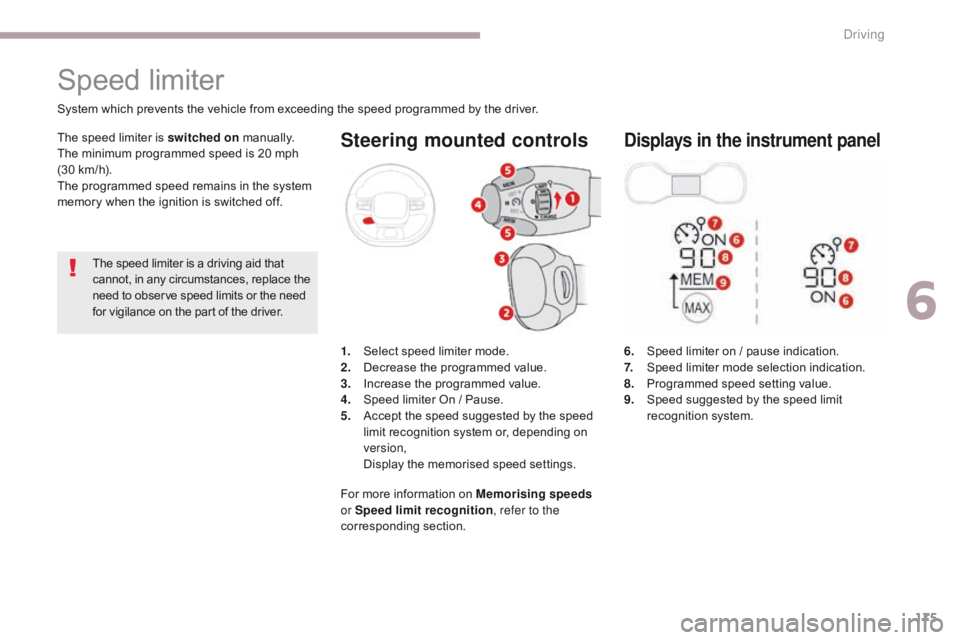
Steering mounted controls
6. Speed limiter on / pause indication.
7. Speed limiter mode selection indication.
8.
P
rogrammed speed setting value.
9.
S
peed suggested by the speed limit
recognition system.
Speed limiter
System which prevents the vehicle from exceeding the speed programmed by the driver.
The speed limiter is a driving aid that
cannot, in any circumstances, replace the
need to observe speed limits or the need
for vigilance on the part of the driver. 1.
S
elect speed limiter mode.
2.
D
ecrease the programmed value.
3.
I
ncrease the programmed value.
4.
S
peed limiter On / Pause.
5.
A
ccept the speed suggested by the speed
limit recognition system or, depending on
version,
D
isplay the memorised speed settings.
Displays in the instrument panelThe speed limiter is switched on manually.
The minimum programmed speed is 20 mph
(30 km/h).
The programmed speed remains in the system
memory when the ignition is switched off.
For more information on Memorising speeds
or Speed limit recognition , refer to the
corresponding section.
6
Driving
Page 180 of 450
178
B618_en_Chap06_conduite_ed01-2016
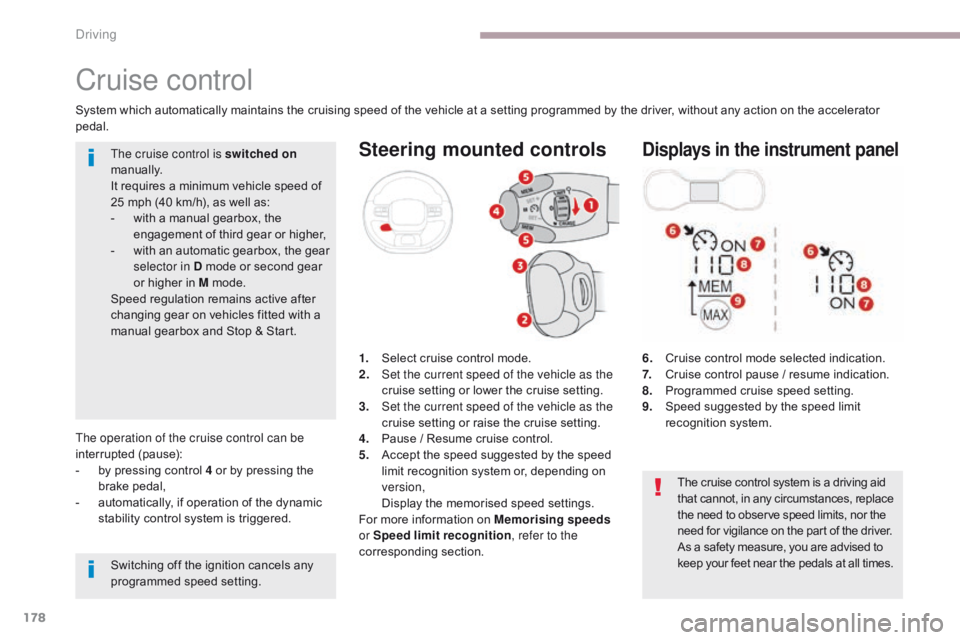
Steering mounted controls
6. Cruise control mode selected indication.
7. Cruise control pause / resume indication.
8.
P
rogrammed cruise speed setting.
9.
S
peed suggested by the speed limit
recognition system.
Cruise control
System which automatically maintains the cruising speed of the vehicle at a setting programmed by the driver, without any action on the accelerator
pedal.
The cruise control system is a driving aid
that cannot, in any circumstances, replace
the need to observe speed limits, nor the
need for vigilance on the part of the driver.
As a safety measure, you are advised to
keep your feet near the pedals at all times.
1.
S
elect cruise control mode.
2.
S
et the current speed of the vehicle as the
cruise setting or lower the cruise setting.
3.
S
et the current speed of the vehicle as the
cruise setting or raise the cruise setting.
4.
P
ause / Resume cruise control.
5.
A
ccept the speed suggested by the speed
limit recognition system or, depending on
version,
D
isplay the memorised speed settings.
For more information on Memorising speeds
or Speed limit recognition , refer to the
corresponding section.
Displays in the instrument panelThe cruise control is switched on
manually.
It requires a minimum vehicle speed of
25 mph (40 km/h), as well as:
-
w
ith a manual gearbox, the
engagement of third gear or higher,
-
w
ith an automatic gearbox, the gear
selector in D mode or second gear
or higher in M mode.
Speed regulation remains active after
changing gear on vehicles fitted with a
manual gearbox and Stop & Start.
Switching off the ignition cancels any
programmed speed setting.
The operation of the cruise control can be
interrupted (pause):
-
b
y pressing control 4 or by pressing the
brake pedal,
-
a
utomatically, if operation of the dynamic
stability control system is triggered.
Driving
Page 184 of 450
182
B618_en_Chap06_conduite_ed01-2016
Fatigue detection system
As soon as the speed of the vehicle
drops below 40 mph (65 km/h), the
system goes into standby.
The driving time is counted again once
the speed is above 40 mph (65 km/h).
It is recommended that you take a break as soon as you feel tired or at least every two hours.
The system cannot in any
circumstances replace the need for
vigilance on the part of the driver.
Do not take the wheel if you are tired.
Driving time warning
The system triggers an alert once it detects that
the driver has not taken a break after two hours
of driving at a speed above 40 mph (65 km/h).
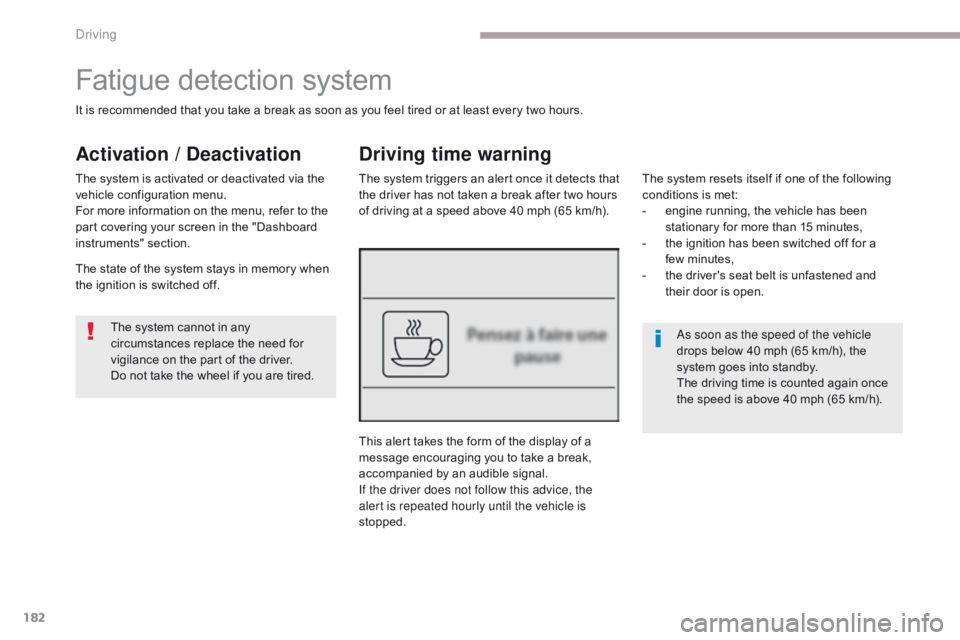
This alert takes the form of the display of a
message encouraging you to take a break,
accompanied by an audible signal.
If the driver does not follow this advice, the
alert is repeated hourly until the vehicle is
stopped. The system resets itself if one of the following
conditions is met:
-
e
ngine running, the vehicle has been
stationary for more than 15 minutes,
-
t
he ignition has been switched off for a
few
m
inutes,
-
t
he driver's seat belt is unfastened and
their door is open.
Activation / Deactivation
The system is activated or deactivated via the
vehicle configuration menu.
For more information on the menu, refer to the
part covering your screen in the "Dashboard
instruments" section.
The state of the system stays in memory when
the ignition is switched off.
Driving
Page 185 of 450
183
B618_en_Chap06_conduite_ed01-2016
Lane Departure Warning System
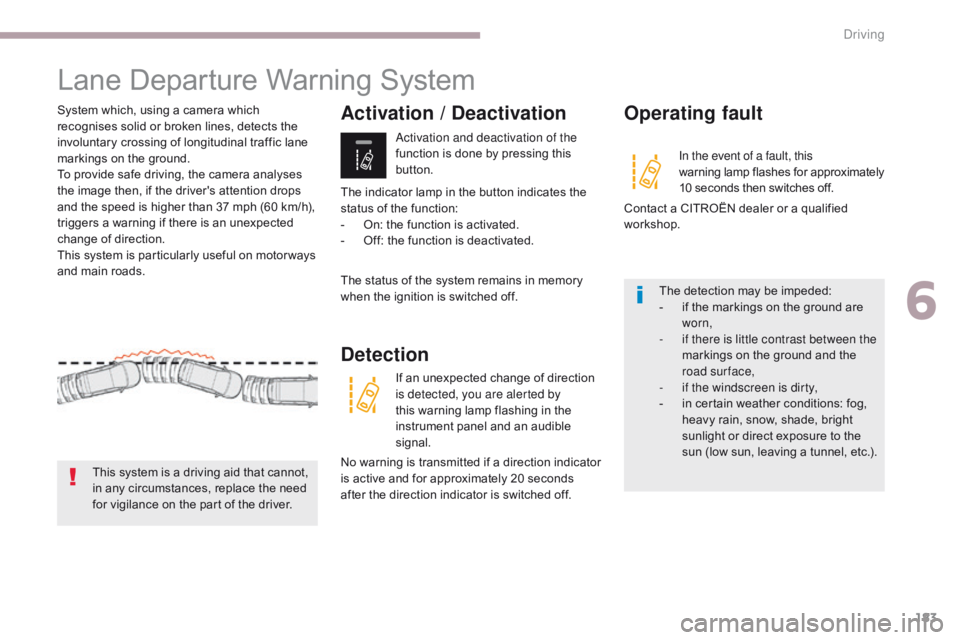
System which, using a camera which
recognises solid or broken lines, detects the
involuntary crossing of longitudinal traffic lane
markings on the ground.
To provide safe driving, the camera analyses
the image then, if the driver's attention drops
and the speed is higher than 37 mph (60 km/h),
triggers a warning if there is an unexpected
change of direction.
This system is particularly useful on motor ways
and main roads.This system is a driving aid that cannot,
in any circumstances, replace the need
for vigilance on the part of the driver. The detection may be impeded:
-
i
f the markings on the ground are
worn,
-
i
f there is little contrast between the
markings on the ground and the
road surface,
-
i
f the windscreen is dirty,
-
i
n certain weather conditions: fog,
heavy rain, snow, shade, bright
sunlight or direct exposure to the
sun (low sun, leaving a tunnel, etc.).Activation / Deactivation
Activation and deactivation of the
function is done by pressing this
button.
The status of the system remains in memory
when the ignition is switched off.
Detection
If an unexpected change of direction
is detected, you are alerted by
this warning lamp flashing in the
instrument panel and an audible
signal.
No warning is transmitted if a direction indicator
is active and for approximately 20 seconds
after the direction indicator is switched off.
Operating fault
In the event of a fault, this
warning lam p flashes for approximately
10 seconds then switches off.
Contact a CITROËN dealer or a qualified
workshop.
The indicator lamp in the button indicates the
status of the function:
-
O
n: the function is activated.
-
O
ff: the function is deactivated.
6
Driving
Page 186 of 450
184
B618_en_Chap06_conduite_ed01-2016
Blind Spot Monitoring System
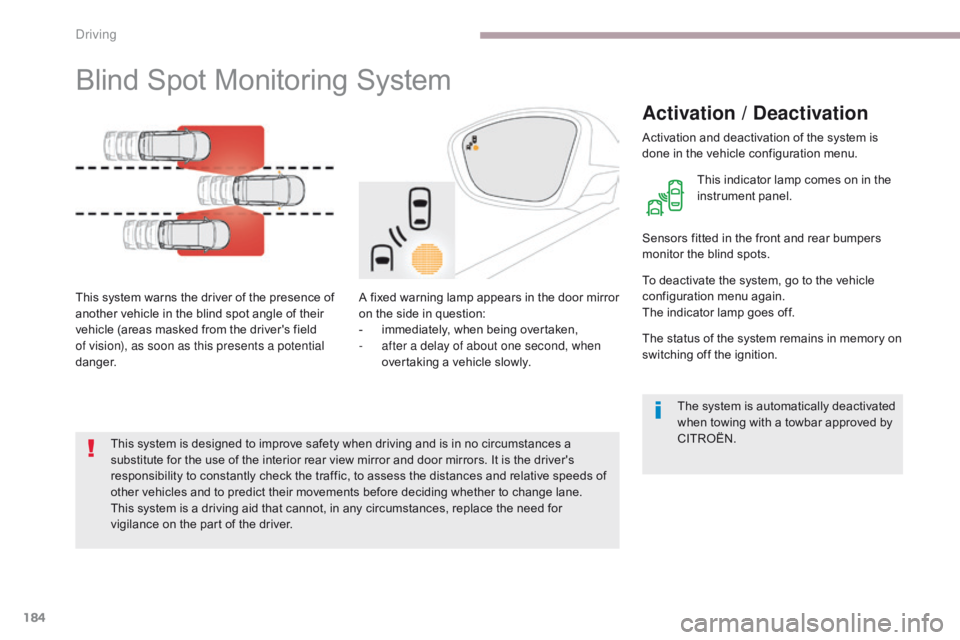
This system warns the driver of the presence of
another vehicle in the blind spot angle of their
vehicle (areas masked from the driver's field
of vision), as soon as this presents a potential
danger.A fixed warning lamp appears in the door mirror
on the side in question:
-
i
mmediately, when being overtaken,
-
a
fter a delay of about one second, when
overtaking a vehicle slowly.
This system is designed to improve safety when driving and is in no circumstances a
substitute for the use of the interior rear view mirror and door mirrors. It is the driver's
responsibility to constantly check the traffic, to assess the distances and relative speeds of
other vehicles and to predict their movements before deciding whether to change lane.
This system is a driving aid that cannot, in any circumstances, replace the need for
vigilance on the part of the driver.
Activation / Deactivation
Activation and deactivation of the system is
done in the vehicle configuration menu. This indicator lamp comes on in the
instrument panel.
Sensors fitted in the front and rear bumpers
monitor the blind spots.
To deactivate the system, go to the vehicle
configuration menu again.
The indicator lamp goes off.
The system is automatically deactivated
when towing with a towbar approved by
CITROËN.
The status of the system remains in memory on
switching off the ignition.
Driving
Page 194 of 450
192
B618_en_Chap06_conduite_ed01-2016
Reinitialisation of the system must be done with
the ignition on and the vehicle stationary:
-
i
n the vehicle configuration menu, for
vehicles fitted with a display screen,
-
u
sing the instrument panel display or the
button on the dashboard, for vehicles
without a display screen.
Touch screen
Monochrome screen C
Operating fault
The flashing and then fixed illumination of the
under-inflation warning lamp accompanied
by illumination of the Service warning lamp
indicates a fault with the system.
A message appears, accompanied by an
audible signal.
In this case, under-inflation monitoring of the
tyres is no longer assured.
Have the system checked by a CITROËN
dealer or a qualified workshop.
Before doing anything to the system,
the pressures of the four tyres must be
checked and the system reinitialised.
Instrument panel displayReinitialisation of the function is done
in the Driving menu.
F
I
n the Driving menu, select the " Driving
functions " tab.
F
I
n the page, select the " Under-inflation
initialisation " function.
F
Sel
ect " Ye s" to confirm.
The reinitialisation is confirmed by the display
of a message and an audible signal.
Reinitialisation of the function is
done in the " Personalisation-
configuration " menu of the screen.
F
Sel
ect the " Define the vehicle
parameters " menu. F
M
ake a short press on this button
to access the menu.
F
S
elect the corresponding item
then confirm.
A high tone audible signal confirms the
reinitialisation.
A low tone audible signal indicates that the
reinitialisation was not completed.
Dashboard button
F Make a long press on this button.
A high tone audible signal confirms the
reinitialisation.
A low tone audible signal indicates that the
reinitialisation was not completed. F
Sel
ect the "
Comfort " menu.
F
Sel
ect the "
Tyre inflation " menu.
F
Sel
ect the "
Reinitialisation " function.
F
Sel
ect "
Ye s" to confirm.
The reinitialisation is confirmed by an audible
signal.
Driving
Page 198 of 450
196
B618_en_Chap07_info-pratiques_ed01-2016
Fuel tank
Capacity of the tank:
- Pe trol: approximately 45 litres.
-
D
iesel: approximately 42 or 50 litres (depending on version).
Low fuel level Refuelling
When the low fuel level is reached,
this warning lamp in the instrument
panel comes on, accompanied by
an audible warning, a message and
the last bar of the fuel gauge flashes
in red.
To refuel in complete safety:
F
Y
ou must switch off the engine.
F
O
pen the filler flap.
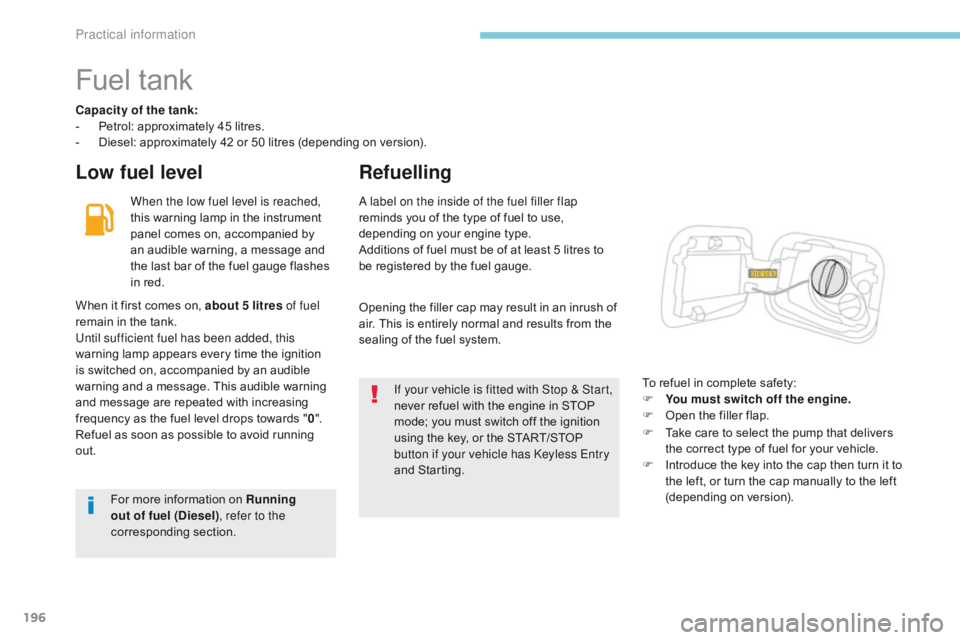
A label on the inside of the fuel filler flap
reminds you of the type of fuel to use,
depending on your engine type.
Additions of fuel must be of at least 5 litres to
be registered by the fuel gauge.
When it first comes on, about 5 litres of fuel
remain in the tank.
Until sufficient fuel has been added, this
warning lamp appears every time the ignition
is switched on, accompanied by an audible
warning and a message. This audible warning
and message are repeated with increasing
frequency as the fuel level drops towards " 0".
Refuel as soon as possible to avoid running
out. Opening the filler cap may result in an inrush of
air. This is entirely normal and results from the
sealing of the fuel system.
If your vehicle is fitted with Stop & Start,
never refuel with the engine in STOP
mode; you must switch off the ignition
using the key, or the START/STOP
button if your vehicle has Keyless Entry
and Starting.
For more information on Running
out of fuel (Diesel) , refer to the
corresponding section. F
T
ake care to select the pump that delivers
the correct type of fuel for your vehicle.
F
I
ntroduce the key into the cap then turn it to
the left, or turn the cap manually to the left
(depending on version).
Practical information
Page 206 of 450
204
B618_en_Chap07_info-pratiques_ed01-2016
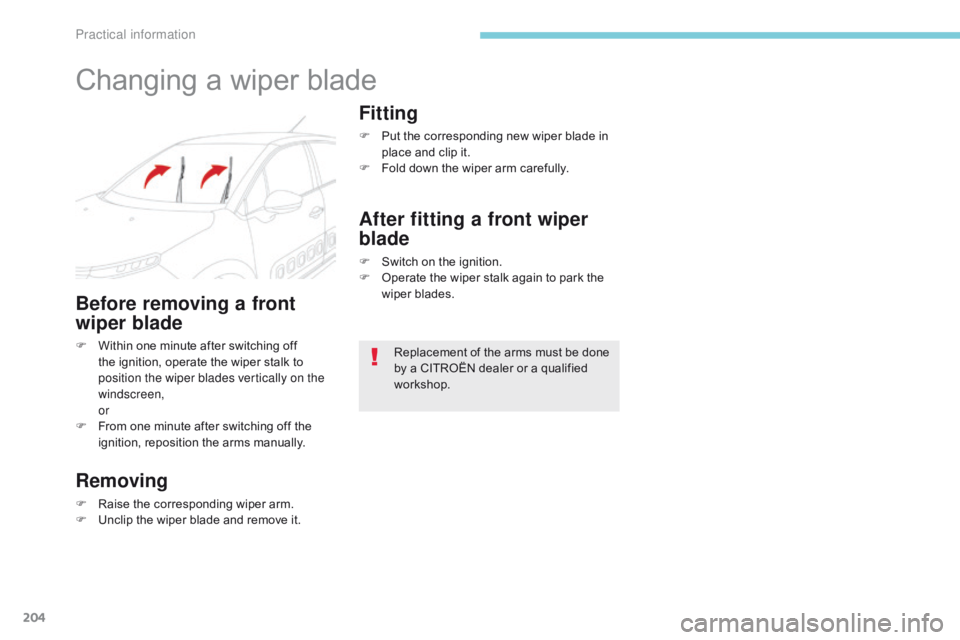
Changing a wiper blade
Before removing a front
wiper blade
F Within one minute after switching off the ignition, operate the wiper stalk to
position the wiper blades vertically on the
windscreen,
or
F
F
rom one minute after switching off the
ignition, reposition the arms manually.
Fitting
F Put the corresponding new wiper blade in place and clip it.
F
F
old down the wiper arm carefully.
Removing
F Raise the corresponding wiper arm.
F U nclip the wiper blade and remove it.
After fitting a front wiper
blade
F Switch on the ignition.
F O perate the wiper stalk again to park the
wiper blades.
Replacement of the arms must be done
by a CITROËN dealer or a qualified
workshop.
Practical information