light CITROEN C3 2023 User Guide
[x] Cancel search | Manufacturer: CITROEN, Model Year: 2023, Model line: C3, Model: CITROEN C3 2023Pages: 104, PDF Size: 2.38 MB
Page 26 of 104
24
Safety
When changing wheels (tyres and rims),
ensure that these are approved by the
manufacturer for your vehicle.
After an impact, have these systems checked by a CITROËN dealer.
Seat belts
Inertia reel
The seat belts are equipped with an inertia reel
which allows the strap length to automatically
adjust to your shape. The seat belt returns to its
storage automatically when it is not used.
The inertia reels are fitted with a device which
automatically locks the strap in the event of a
collision, emergency braking or if the vehicle rolls
over. It can be released by pulling the strap firmly
and then releasing it so that it reels in slightly.
Force limiter
This system reduces the pressure of the seat
belt on the chest of the occupant, thus improving
their protection.
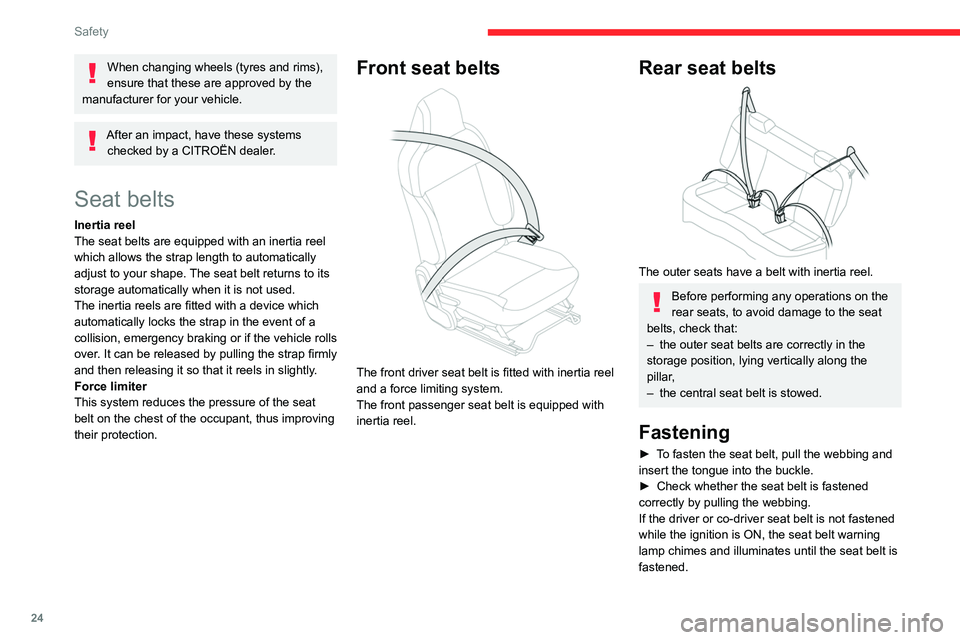
Front seat belts
The front driver seat belt is fitted with inertia reel
and a force limiting system.
The front passenger seat belt is equipped with
inertia reel.
Rear seat belts
The outer seats have a belt with inertia reel.
Before performing any operations on the
rear seats, to avoid damage to the seat
belts, check that:
–
the outer seat belts are correctly in the
storage position, lying vertically along the
pillar
,
–
the central seat belt is stowed.
Fastening
► To fasten the seat belt, pull the webbing and
insert the tongue into the buckle.
►
Check whether the seat belt is fastened
correctly by pulling the webbing.
If the driver or co-driver seat belt is not fastened
while the ignition is ON, the seat belt warning
lamp chimes and illuminates until the seat belt is
fastened.
Page 28 of 104
26
Safety
Clean the seat belt straps with soapy water or
a textile cleaning product, sold by CITROËN
dealers.
Airbags
General information
The airbags have been designed to optimise the
safety of the occupants in the event of a violent
collision.
The airbags are supplementary restraint systems
(SRS) that help cushion the impact force to the
head and chest during severe frontal collisions.
The SRS includes Airbags, Seatbelts, Airbag
ECU, Collision sensors and SRS warning lamp.
Electronic detectors record and analyse the front
impacts sustained in the impact detection zones:
–
In the event of violent impact, the airbags
deploy instantly and help better protect the
occupants of the vehicle; immediately after the
impact, the airbags deflate rapidly in order not
to hinder the visibility or the possible exit of the
occupants.
–
In the event of a slight impact, a rear impact
and under certain rollover conditions, the airbags
may not deploy; only the seat belt helps to
protect you in these situations.
During a frontal crash, children could be fatally
injured if they are sitting on driver
’s lap/standing
very close to the dashboard, as the airbags exert
severe force levels during deployment.
The seriousness of the impact depends on the
nature of the obstacle and the speed of the
vehicle at the moment of collision.
The airbags do not operate when the
ignition is switched off.
This equipment will only deploy once. If a
second impact occurs (during the same or a
subsequent accident), the airbag will not be
deployed again.
When one or more airbags are deployed,
the detonation of the pyrotechnic charge
incorporated in the system makes a noise and
releases a small quantity of smoke.
This smoke is not harmful, but sensitive
individuals may experience slight irritation.
The detonation noise associated with the
deployment of one or more airbags may result
in a slight loss of hearing for a short time.
The airbags will deploy irrespective of whether the seat belt is buckled or not. In
order to reduce the risk of SERIOUS INJURY
or DEATH, we recommend occupants to
always be buckled.
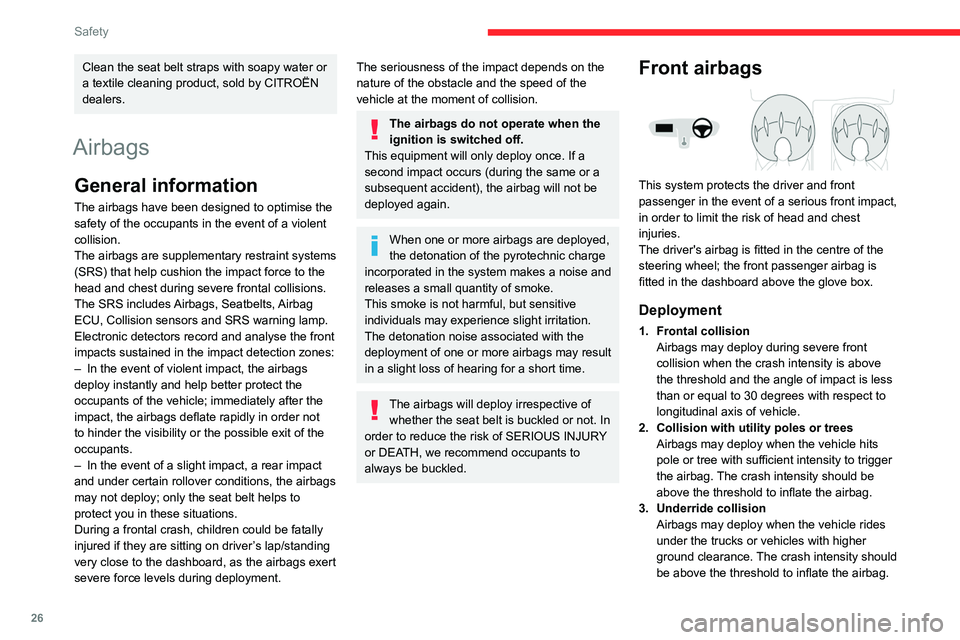
Front airbags
This system protects the driver and front
passenger in the event of a serious front impact,
in order to limit the risk of head and chest
injuries.
The driver's airbag is fitted in the centre of the
steering wheel; the front passenger airbag is
fitted in the dashboard above the glove box.
Deployment
1. Frontal collision Airbags may deploy during severe front
collision when the crash intensity is above
the threshold and the angle of impact is less
than or equal to 30 degrees with respect to
longitudinal axis of vehicle.
2. Collision with utility poles or trees Airbags may deploy when the vehicle hits
pole or tree with sufficient intensity to trigger
the airbag. The crash intensity should be
above the threshold to inflate the airbag.
3. Underride collision Airbags may deploy when the vehicle rides
under the trucks or vehicles with higher
ground clearance. The crash intensity should
be above the threshold to inflate the airbag.
Page 33 of 104
31
Driving
6Driving recommendations
► Observe the driving regulations and remain
vigilant whatever the traffic conditions.
►
Monitor your environment and keep your
hands on the wheel to be able to react to
anything that may happen any time.
►
Drive smoothly
, anticipate the need for
braking and maintain a longer safety distance,
especially in bad weather.
►
Stop the vehicle to carry out operations that
require close attention (such as adjustments).
►
During long trips, take a break every two
hours.
Important!
Never leave the engine running in a
closed space without sufficient
ventilation. Internal combustion engines emit
toxic exhaust gases such as carbon
monoxide. Danger of poisoning and death!
In severe wintry conditions, let the engine
run for 4 minutes before moving off, to
ensure the correct operation and durability of
the mechanical components of your vehicle
(engine and gearbox).
Never drive with the parking brake
applied . Risk of overheating and
damage to the braking system!
Do not park the vehicle or leave the
engine running on a flammable
surface (dry grass, dead leaves, etc.). The
exhaust system of your vehicle is very hot,
even several minutes after the engine stops.
Risk of fire!
Never leave a vehicle unattended with
the engine running. If you have to leave
your vehicle with the engine running, apply
the parking brake and put the gearbox into
neutral.
Never leave children inside the vehicle
unsupervised.
On flooded roads
We strongly advise against driving on flooded
roads, as this could cause serious damage to
the engine or gearbox, as well as to the electrical
systems of your vehicle.
If you have to drive on a flooded road:
► drive as slowly as possible without stalling. In
all cases, do not exceed 10
km/h,►
do not stop and do not switch off the engine.
On leaving the flooded road, as soon as safety
conditions allow
, make several light brake
applications to dry the brake discs and pads.
If in doubt about the state of your vehicle,
contact a CITROËN dealer.
Starting / Switching off the
engine
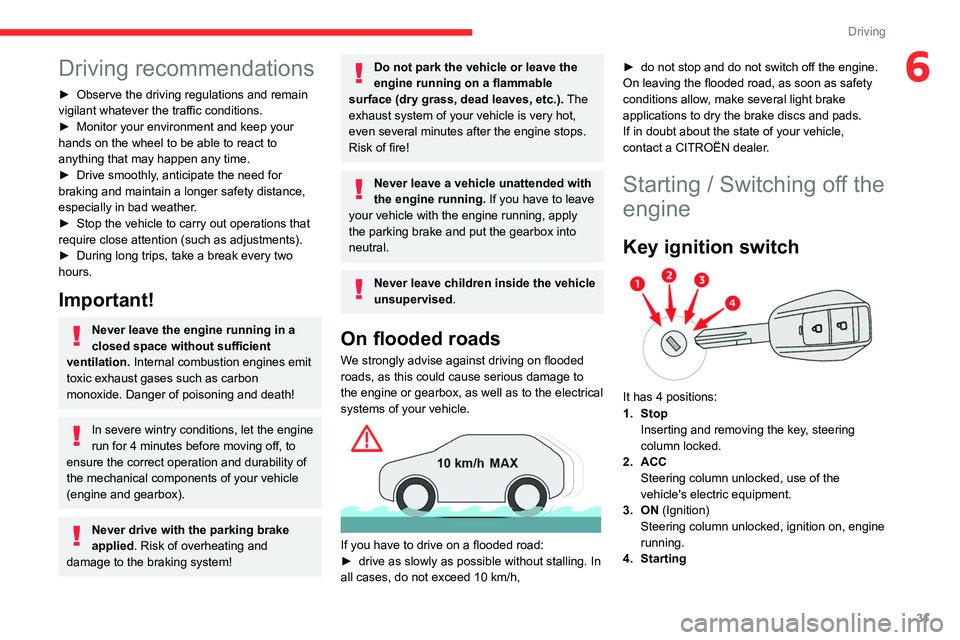
Key ignition switch
It has 4 positions:
1. Stop Inserting and removing the key, steering
column locked.
2. ACC Steering column unlocked, use of the
vehicle's electric equipment.
3. ON (Ignition) Steering column unlocked, ignition on, engine
running.
4. Starting
Page 47 of 104

45
In the event of a breakdown
8► Tighten the spare wheel fixing screw by a few
turns.
After changing a wheel
The temporary spare wheel is only intended for temporary emergency use,
until the conventional wheel can be repaired
or replaced.
Continuous use of this spare can result in tire
failure and loss of control. Always observe
these precautions when using this spare:
–
Y
our vehicle will respond differently with
this temporary spare.
–
Do not exceed 80 km/h speed.
–
Replace this spare with a standard tire and
wheel as soon as possible.
–
Use of this spare will reduce ground
clearance.
–
Set the specified tire pressure indicated
on the tire information label located on the
driver's door lock pillar
.
–
Do not use tire chains on the temporary
spare. If you must use tire chains, rearrange
the wheels so standard tires and wheels are
fitted to the front axle.
–
The temporary spare wheel has a much
shorter tread life than the conventional
wheels
on your vehicle. Replace the tire as soon as
possible as the tread wear indicator appears.
The inflation pressure of the temporary spare
wheel should be checked at least monthly. At
the same time, check that the tire is stored
securely. If it is not, tighten it.
Note that two or more temporary spare
wheels should not be used on one vehicle
simultaneously.
Changing a bulb
In some weather conditions (e.g. low
temperature or humidity), misting on the
internal surface of the glass of the headlamps
and rear lamps is normal, and will disappear
after the lamps have been on for a few
minutes.
The headlamps have polycarbonate lenses with a protective coating:
–
Do not clean them with a dry or abrasive
cloth, nor with detergent or solvent
products.
–
Use a sponge and soapy water or a pH
neutral product.
–
When using a high-pressure washer on
persistent marks, do not keep the lance
directed towards the headlamps, lamps or
their edges for too long, so as not to damage
their protective coating and seals.
Changing a bulb must only be done with
the ignition off and after the headlamp /
lamp has been switched off for several
minutes - risk of serious burns!
Do not touch the bulb directly with your
fingers; use a lint-free cloth.
It is essential only to use anti-ultraviolet
(UV) type bulbs, so as not to damage the
headlamp.
Always replace a failed bulb with a new bulb
of the same type and specification. To avoid
lighting imbalance, replace the bulbs in pairs.
Refitting the lamp units
Perform the operations in the reverse
order to dismantling.
Opening the bonnet / Accessing the
bulbs
With the engine warm, proceed with caution -
risk of burns!
Take care with objects or clothing that could
be caught in the blades of the cooling fan -
risk of strangulation!
Halogen bulbs (Hx)
To ensure good quality lighting, check
that the bulb is correctly positioned in its
housing.
Page 48 of 104

46
In the event of a breakdown
Light-emitting diode (LED)
headlamps and lamps
Depending on version, the affected types of
headlamps / lamps are:
–
Daytime running lamps / sidelamps.
–
Direction indicator side repeaters.
–
Third brake lamp.
–
Number plate lamps.
Light emitting diodes (LED)
For the replacement of this type of bulb,
you must contact a CITROËN dealer.
Do not touch the LED technology lamps - risk
of electrocution!
Front lamps
Model 1
1. Daytime running lamps/sidelamps (W5W
bulb)
2. Direction indicators (PY21W
- 12V - 21W)
3. Beam headlamps (H4
- 12V - 60/55W)
Model 2
1.Daytime running lamps/sidelamps (LED)
2. Direction indicators (PY21W
- 12V - 21W)
3. Beam headlamps (H4
- 12V - 60/55W)
Daytime running lamps/sidelamps
► Turn the bulb holder a quarter of a turn and
pull it out.
►
Pull the bulb out and change it.
Direction indicators
Rapid flashing of a direction indicator
lamp (left or right) indicates that one of
the bulbs on the corresponding side has
failed.
► Turn the bulb holder a eighth of a turn anti-
clockwise and remove it.
►
Remove the bulb and replace it.
Amber coloured bulbs, such as the direction indicators, must be replaced by
bulbs with identical colour and specifications.
Beam headlamps
► Remove the protective cover by pulling on
the tab.
►
Disconnect the bulb connector
.
►
Release the retaining tab.
►
Change the bulb taking care to align the
metal part with the grooves on the lamp.
►
Reposition the retaining tab.
►
Reconnect the bulb connector
.
Page 49 of 104

47
In the event of a breakdown
8► Ensure that the cover is refitted correctly all
around to ensure correct sealing.
Rear lamps
Model 1
1. Sidelamps / Brake lamps
(P21/5W - 12V - 21W/5W)
2. Direction indicators (PY21W
- 12V - 21W)
3. Reversing lamp (P21W
- 12V - 21W)
Model 2
1.Sidelamps / Brake lamps
(P21/5W - 12V - 21W/5W)
2. Direction indicators (PY21W
- 12V - 21W)
3. Reversing lamp (P21W
- 12V - 21W)
4. Additional sidelamps (W3W
- 12V - 3W)
5. Connecting tail lamps (W3W
- 12V - 3W)
Changing bulbs
These bulbs are changed after removing the tail
lamp assembly.
►
Open the boot.
►
Unscrew the nut and remove it. Be careful
not to drop it inside the wing.
►
Unclip the lamp unit and carefully extract it
pulling straight towards the outside.
A
standard pair of pliers or the wheel wrench
(depending on equipment) may be necessary to
remove the nut.
Sidelamps/Brake lamps / Reversing lamp /
Direction indicators
► Turn the bulb holder a eighth of a turn anti-
clockwise and remove it.
►
Remove the bulb and replace it.
Additional sidelamps / Connecting tail
lamps (if equipped)
► Turn the bulb holder a quarter of a turn and
pull it out.
►
Pull the bulb out and change it.
Interior lighting
Courtesy lamp (10W - 12V - 10W)
► Using a thin, flap tip screwdriver , unclip the
entire console surrounding the courtesy lamp.
►
Remove the defective bulb and replace it.
►
Fit the console back into place around the
courtesy lamp and clip it correctly
.
Page 59 of 104
57
In the event of a breakdown
8at least equal to that of the discharged
battery.
The two vehicles must not be in contact with
each other.
Switch off all electricity-consuming equipment
on both vehicles (audio system, wipers,
lighting, etc.).
Make sure that the jump leads are well away
from the engine’s moving parts (fan, belt,
etc.).
Do not disconnect the (+) terminal while the
engine is running.
During jump start, extra care should be taken
to ensure right terminals are connected. If
terminal connections are reversed, it will
lead to failure of alternator & other electrical,
electronic components.
Never power electrical or electronic
components directly from battery terminals
as it will lead to poor battery charging, poor
performance of components and battery
sensor malfunction, which will impact fuel
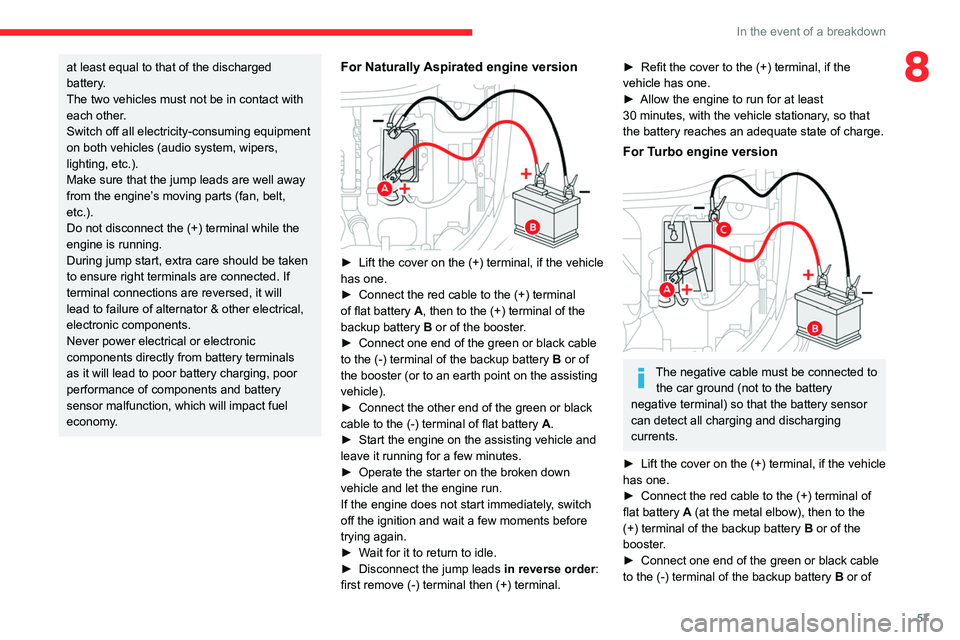
economy. For Naturally Aspirated engine version
► Lift the cover on the (+) terminal, if the vehicle
has one.
►
Connect the red cable to the (+) terminal
of flat battery
A, then to the (+) terminal of the
backup battery
B or of the booster.
►
Connect one end of the green or black cable
to the (-) terminal of the backup battery
B or of
the booster (or to an earth point on the assisting
vehicle).
►
Connect the other end of the green or black
cable to the (-) terminal of flat battery
A.
►
Start the engine on the assisting vehicle and
leave it running for a few minutes.
►
Operate the starter on the broken down
vehicle and let the engine run.
If the engine does not start immediately
, switch
off the ignition and wait a few moments before
trying again.
►
W
ait for it to return to idle.
►
Disconnect the jump leads in reverse order:
first remove (-) terminal then (+) terminal.
► Refit the cover to the (+) terminal, if the
vehicle has one.
►
Allow the engine to run for at least
30
minutes, with the vehicle stationary, so that
the battery reaches an adequate state of charge.
For Turbo engine version
The negative cable must be connected to the car ground (not to the battery
negative terminal) so that the battery sensor
can detect all charging and discharging
currents.
►
Lift
the cover on the (+) terminal, if the vehicle
has one.
►
Connect the red cable to the (+) terminal of
flat battery
A (at the metal elbow), then to the
(+) terminal of the backup battery
B or of the
booster.
►
Connect one end of the green or black cable
to the (-) terminal of the backup battery
B or of
Page 60 of 104

58
In the event of a breakdown
the booster (or to an earth point on the assisting
vehicle).
►
Connect the other end of the green or black
cable to the earth point
C
on the broken down
vehicle.
►
Start the engine on the assisting vehicle and
leave it running for a few minutes.
►
Operate the starter on the broken down
vehicle and let the engine run.
If the engine does not start immediately
, switch
off the ignition and wait a few moments before
trying again.
►
W
ait for it to return to idle.
►
Disconnect the jump leads in reverse order:
first remove (-) terminal then (+) terminal..
►
Refit the cover to the (+) terminal, if the
vehicle has one.
►
Allow the engine to run for at least
30
minutes, with the vehicle stationary, so that
the battery reaches an adequate state of charge.
Driving immediately without having
reached a sufficient level of charge may
affect some of the vehicle's functionalities.
Disconnecting/removing the
battery
In order to maintain an adequate state of charge
for starting the engine, it is recommended that
the battery be disconnected if the vehicle is
taken out of service for a long period.
Before disconnecting the battery: ►
Close all openings (doors, boot, windows).
►
Switch off all electrical consumers (audio
system, wipers, lighting, etc.).
►
Switch off the ignition and wait for 4
minutes.
Naturally Aspirated engine version
Turbo engine version
►
Disconnect the negative cable.
►
Disconnect the positive cable.
► Remove the mounting bracket if you need to
remove the battery .
Be careful not to cause accidental short
circuits between the positive and
negative battery terminals.
Do not allow smoking, sparks or flames
around fuel or the battery.
After reconnection
After reconnecting the battery, turn on the
ignition and wait 1 minute before starting the
engine, to enable the electronic systems to
initialise.
If minor problems nevertheless persist following
this operation, contact a CITROËN dealer.
Referring to the relevant section, initialise or
reset certain equipment:
–
Date and time.
–
Preset radio stations.
Towing the vehicle
General recommendations
Observe the legislation in force in the
country where you are driving.
Ensure that the weight of the towing vehicle is
higher than that of the towed vehicle.
The driver must remain at the wheel of the
towed vehicle and must have a valid driving
licence.
Page 72 of 104
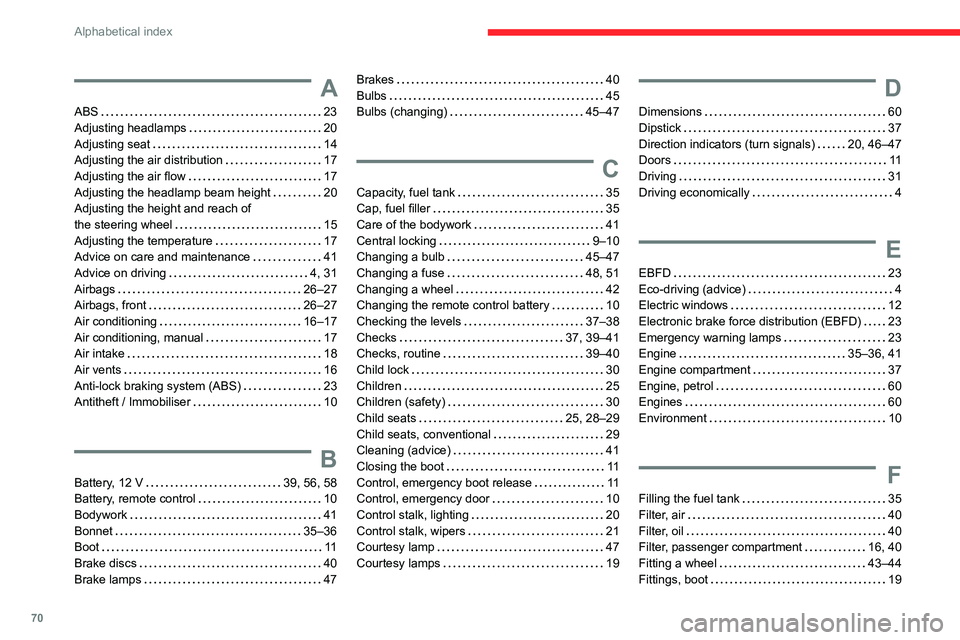
70
Alphabetical index
A
ABS 23
Adjusting headlamps
20
Adjusting seat
14
Adjusting the air distribution
17
Adjusting the air flow
17
Adjusting the headlamp beam height
20
Adjusting the height and reach of
the steering wheel
15
Adjusting the temperature
17
Advice on care and maintenance
41
Advice on driving
4, 31
Airbags
26–27
Airbags, front
26–27
Air conditioning
16–17
Air conditioning, manual
17
Air intake
18
Air vents
16
Anti-lock braking system (ABS)
23
Antitheft / Immobiliser
10
B
Battery, 12 V 39, 56, 58
Battery, remote control
10
Bodywork
41
Bonnet
35–36
Boot
11
Brake discs
40
Brake lamps
47
Brakes 40
Bulbs
45
Bulbs (changing)
45–47
C
Capacity, fuel tank 35
Cap, fuel filler
35
Care of the bodywork
41
Central locking
9–10
Changing a bulb
45–47
Changing a fuse
48, 51
Changing a wheel
42
Changing the remote control battery
10
Checking the levels
37–38
Checks
37, 39–41
Checks, routine
39–40
Child lock
30
Children
25
Children (safety)
30
Child seats
25, 28–29
Child seats, conventional
29
Cleaning (advice)
41
Closing the boot
11
Control, emergency boot release
11
Control, emergency door
10
Control stalk, lighting
20
Control stalk, wipers
21
Courtesy lamp
47
Courtesy lamps
19
D
Dimensions 60
Dipstick
37
Direction indicators (turn signals)
20, 46–47
Doors
11
Driving
31
Driving economically
4
E
EBFD 23
Eco-driving (advice)
4
Electric windows
12
Electronic brake force distribution (EBFD)
23
Emergency warning lamps
23
Engine
35–36, 41
Engine compartment
37
Engine, petrol
60
Engines
60
Environment
10
F
Filling the fuel tank 35
Filter, air
40
Filter, oil
40
Filter, passenger compartment
16, 40
Fitting a wheel
43–44
Fittings, boot
19
Page 73 of 104
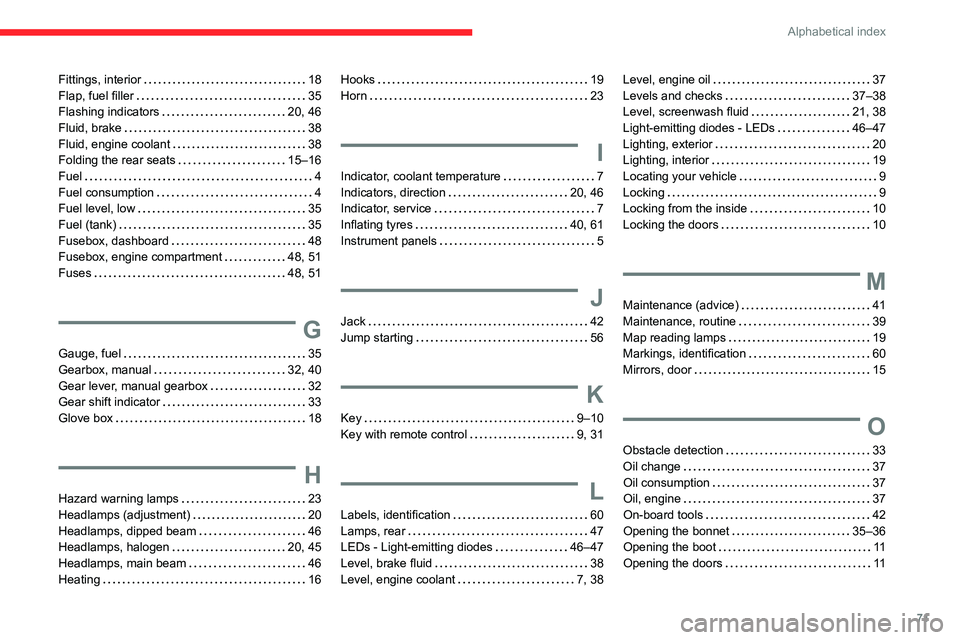
71
Alphabetical index
Fittings, interior 18
Flap, fuel filler
35
Flashing indicators
20, 46
Fluid, brake
38
Fluid, engine coolant
38
Folding the rear seats
15–16
Fuel
4
Fuel consumption
4
Fuel level, low
35
Fuel (tank)
35
Fusebox, dashboard
48
Fusebox, engine compartment
48, 51
Fuses
48, 51
G
Gauge, fuel 35
Gearbox, manual
32, 40
Gear lever, manual gearbox
32
Gear shift indicator
33
Glove box
18
H
Hazard warning lamps 23
Headlamps (adjustment)
20
Headlamps, dipped beam
46
Headlamps, halogen
20, 45
Headlamps, main beam
46
Heating
16
Hooks 19
Horn
23
I
Indicator, coolant temperature 7
Indicators, direction
20, 46
Indicator, service
7
Inflating tyres
40, 61
Instrument panels
5
J
Jack 42
Jump starting
56
K
Key 9–10
Key with remote control
9, 31
L
Labels, identification 60
Lamps, rear
47
LEDs - Light-emitting diodes
46–47
Level, brake fluid
38
Level, engine coolant
7, 38
Level, engine oil 37
Levels and checks
37–38
Level, screenwash fluid
21, 38
Light-emitting diodes - LEDs
46–47
Lighting, exterior
20
Lighting, interior
19
Locating your vehicle
9
Locking
9
Locking from the inside
10
Locking the doors
10
M
Maintenance (advice) 41
Maintenance, routine
39
Map reading lamps
19
Markings, identification
60
Mirrors, door
15
O
Obstacle detection 33
Oil change
37
Oil consumption
37
Oil, engine
37
On-board tools
42
Opening the bonnet
35–36
Opening the boot
11
Opening the doors
11