lock CITROEN C3 2023 User Guide
[x] Cancel search | Manufacturer: CITROEN, Model Year: 2023, Model line: C3, Model: CITROEN C3 2023Pages: 104, PDF Size: 2.38 MB
Page 26 of 104
24
Safety
When changing wheels (tyres and rims),
ensure that these are approved by the
manufacturer for your vehicle.
After an impact, have these systems checked by a CITROËN dealer.
Seat belts
Inertia reel
The seat belts are equipped with an inertia reel
which allows the strap length to automatically
adjust to your shape. The seat belt returns to its
storage automatically when it is not used.
The inertia reels are fitted with a device which
automatically locks the strap in the event of a
collision, emergency braking or if the vehicle rolls
over. It can be released by pulling the strap firmly
and then releasing it so that it reels in slightly.
Force limiter
This system reduces the pressure of the seat
belt on the chest of the occupant, thus improving
their protection.
Front seat belts
The front driver seat belt is fitted with inertia reel
and a force limiting system.
The front passenger seat belt is equipped with
inertia reel.
Rear seat belts
The outer seats have a belt with inertia reel.
Before performing any operations on the
rear seats, to avoid damage to the seat
belts, check that:
–
the outer seat belts are correctly in the
storage position, lying vertically along the
pillar
,
–
the central seat belt is stowed.
Fastening
► To fasten the seat belt, pull the webbing and
insert the tongue into the buckle.
►
Check whether the seat belt is fastened
correctly by pulling the webbing.
If the driver or co-driver seat belt is not fastened
while the ignition is ON, the seat belt warning
lamp chimes and illuminates until the seat belt is
fastened.
Page 27 of 104
25
Safety
5Unlocking
► To unfasten the seat belt, press the red
button written “PRESS” on the buckle.
►
Allow the belt to retract and make sure the
webbing is not twisted.
T
wisted webbing would not allow smooth
retraction of the belt.
Seat belt not fastened/
unfastened alerts
It comes on in red in the instrument panel
once the system detects that a seat belt is
not fastened or is unfastened.
Advice
The driver must ensure that passengers use the seat belts correctly and that they
are all fastened before setting off.
Wherever seated in the vehicle, you must
always fasten the seat belt, even for short
journeys.
Do not interchange the seat belt buckles, as
they will not fulfil their role fully.
Before and after use, ensure that the seat belt
is reeled in correctly.
After folding or moving a seat or rear bench
seat, ensure that the seat belt is positioned
and reeled in correctly.
While fastening the seat belt ensure that strap
must pass over your chest and top of your
shoulder and not touch your face, neck, side
of your shoulder or pass under your arm.
An accident or sudden stop could damage
the seat belt, please have your seat belts
inspected by authorized dealers after an
accident or sudden stop.
Do not use a damaged seat belt which would
result in serious injury.
Installation
The lower part of the strap must be
positioned as low as possible on the pelvis.
The upper part must be positioned on the
shoulder.
In order to be effective, a seat belt:
–
must be tightened as close to the body as
possible;
–
must be pulled in front of you with a smooth
movement, ensuring that it is not twisted;
–
must only be used to secure one person;
–
must not show signs of tearing or fraying;
–
must not be changed or modified, in order
to avoid affecting its performance.
Do not wear your seat belt over hard or
breakable objects in your pockets or on your
clothing. If an accident occurs, objects such
as glasses, pens, etc. under the seat belt can
cause injury
.
Recommendations for children
Use a suitable child seat if the passenger
is less than 12 years old or shorter than one
and a half metres.
Never use the same seat belt to secure more
than one child.
Never carry a child on your lap.
For more information on Child seats, refer to
the corresponding section.
Recommendations for pregnant
women
Pregnant women should use seat belts,
although specific recommendations about
driving should be made by the woman's
medical advisor. Remember that the lap
portion of the belt should be worn as low as
possible across the hips.
A pregnant woman should not wear the seat
belt across the stomach which would result in
serious injury to the fetus and/or the pregnant
mother.
Maintenance
In accordance with current safety
regulations, for all repairs on your vehicle's
seat belts, go to a qualified workshop with
the skills and equipment needed, which a
CITROËN dealer is able to provide.
Have the seat belts checked regularly by a
CITROËN dealer, particularly if the straps
show signs of damage.
Page 30 of 104

28
Safety
Child seats
Warning label on the sun visor - Front
passenger airbag
NEVER use a rearward facing child restraint on a seat protected by an ACTIVE AIRBAG
in front of it, SERIOUS INJURY to the CHILD may occur.
Do not install a rear-facing child restraint
on the front passenger’s seat.
A child in a rear-facing child restraint could be seriously harmed if the
passenger's front airbag inflates. The inflated
airbag would be too close to the back of a
rear-facing child restraint.
An incorrectly installed child seat compromises the child's safety in the
event of an accident.
Ensure that there is no seat belt or seat belt
buckle under the child seat, as this could
destabilise it.
Remember to fasten the seat belts or the
harness of child seats, keeping the slack
relative to the child's body to a minimum,
even for short journeys.
When installing a child seat using the seat
belt, ensure that the seat belt is tightened
correctly on the child seat and that it secures
the child seat firmly on the seat of the vehicle.
Ensure that the head restraint is stored or
attached securely to prevent it from being
thrown around the vehicle in the event of
sharp braking. Refit the head restraint once
the child seat has been removed.
Additional protections
To prevent accidental opening of the
doors and rear windows, use the "Child lock".
Take care not to open the rear windows by
more than one third.
To protect young children from the rays of the
sun, fit side blinds on the rear windows.
As a safety precaution, do not leave:
–
a child alone and unattended in a vehicle,
–
a child or an animal in a vehicle which is
exposed to the sun, with the windows closed,
–
the keys within reach of children inside the
vehicle.
Page 32 of 104

30
Safety
Manual child lock
This system prevents opening of a rear door
using its interior handle.
The control is located on the edge of each rear
door (marked by a label).
Locking / Unlocking
► To lock, pull the lever down.
► T o unlock, pull the lever up.
Refer to the legislation in force in your
country before using this system.
Page 33 of 104
31
Driving
6Driving recommendations
► Observe the driving regulations and remain
vigilant whatever the traffic conditions.
►
Monitor your environment and keep your
hands on the wheel to be able to react to
anything that may happen any time.
►
Drive smoothly
, anticipate the need for
braking and maintain a longer safety distance,
especially in bad weather.
►
Stop the vehicle to carry out operations that
require close attention (such as adjustments).
►
During long trips, take a break every two
hours.
Important!
Never leave the engine running in a
closed space without sufficient
ventilation. Internal combustion engines emit
toxic exhaust gases such as carbon
monoxide. Danger of poisoning and death!
In severe wintry conditions, let the engine
run for 4 minutes before moving off, to
ensure the correct operation and durability of
the mechanical components of your vehicle
(engine and gearbox).
Never drive with the parking brake
applied . Risk of overheating and
damage to the braking system!
Do not park the vehicle or leave the
engine running on a flammable
surface (dry grass, dead leaves, etc.). The
exhaust system of your vehicle is very hot,
even several minutes after the engine stops.
Risk of fire!
Never leave a vehicle unattended with
the engine running. If you have to leave
your vehicle with the engine running, apply
the parking brake and put the gearbox into
neutral.
Never leave children inside the vehicle
unsupervised.
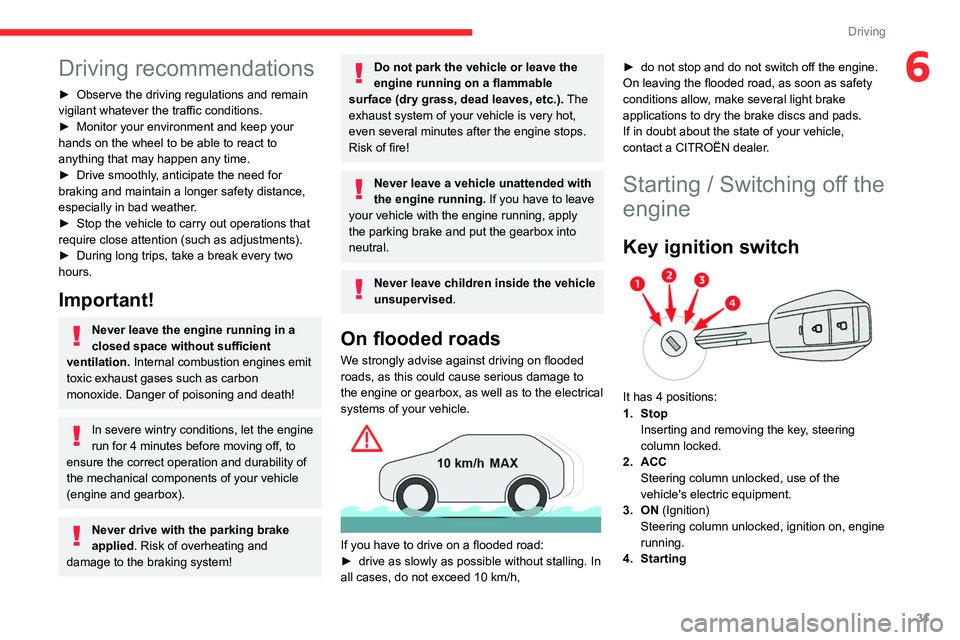
On flooded roads
We strongly advise against driving on flooded
roads, as this could cause serious damage to
the engine or gearbox, as well as to the electrical
systems of your vehicle.
If you have to drive on a flooded road:
► drive as slowly as possible without stalling. In
all cases, do not exceed 10
km/h,►
do not stop and do not switch off the engine.
On leaving the flooded road, as soon as safety
conditions allow
, make several light brake
applications to dry the brake discs and pads.
If in doubt about the state of your vehicle,
contact a CITROËN dealer.
Starting / Switching off the
engine
Key ignition switch
It has 4 positions:
1. Stop Inserting and removing the key, steering
column locked.
2. ACC Steering column unlocked, use of the
vehicle's electric equipment.
3. ON (Ignition) Steering column unlocked, ignition on, engine
running.
4. Starting
Page 34 of 104

32
Driving
Avoid attaching heavy objects to the key or the remote control. It would weigh
down on its shaft in the ignition switch and
could cause a malfunction.
Ignition on position
It allows the use of the vehicle's electric
equipment or portable devices to be charged.
Starting the engine
With the parking brake applied:
► Place the gear lever in neutral then fully
depress the clutch pedal.
►
Insert the key into the ignition switch; the
system recognises the code.
►
Unlock
the steering column by simultaneously
turning the steering wheel and the key.
In certain cases, you may have to apply
significant force to move the steering
wheel (wheels on full lock, for example).
►
Operate the starter motor by turning the key
to position
3 without pressing the accelerator
pedal, until the engine starts. Once the engine
starts, release the key.
After a cold start, preheating the catalytic converter can cause noticeable engine
vibrations for anything up to 2 minutes while
stationary with the engine running
(accelerated idle speed).
If the engine does not start straight away,
switch off the ignition. Wait a few
seconds before operating the starter motor
again. If the engine does not start after a few
attempts, do not keep trying - risk of
damaging the starter motor, the battery and
the engine.
Contact a CITROËN dealer.
In mild conditions, do not leave the
engine at idle to warm up but move off
straight away and drive at moderate speed.
5-speed manual gearbox
Engaging reverse gear
► Fully depress the clutch pedal.
► Push the gear lever fully to the right, then
backwards.
Only engage reverse gear when the
vehicle is stationary with the engine at
idle.
As a safety precaution and to facilitate starting the engine:
–
Always select neutral.
–
Depress the clutch pedal.
6-speed manual gearbox
Engaging 5th or 6th gear
► Move the gear selector fully to the right to
engage 5th or 6th gear.
Failure to follow this instruction could
cause permanent damage to the gearbox
(inadvertent engagement of 3
rd or 4th gear).
Engaging reverse gear
► Raise the ring under the knob and move the
gear selector to the left, then forwards.
Page 38 of 104

36
Practical information
Do not open the bonnet under very windy
conditions.
Cooling of the engine when stopped
The engine cooling fan may start after
the engine has been switched off.
Take care with objects or clothing that
could be caught in the blades of the fan!
Water washing in the engine
compartment including high pressure
water washing may cause the failure of
electrical circuits located in the engine
compartment.
Never allow water or other liquids to come in
contact with electrical/electronic components
inside the vehicle as this may damage them.
Opening
► Pull the release lever towards you.
► Lift the safety catch and raise the bonnet.
► Unclip the stay from its housing and place it
in the support slot to hold the bonnet open.
Closing
► Take the stay out of the support slot.
► Clip the stay in its housing.
►
Lower the bonnet and release it near the end
of its travel.
►
Pull on the bonnet to check that it is locked
correctly
.
Engine compartment
The engines represented are examples given for
illustration purposes only.
The locations of the following elements may
vary:
Page 43 of 104

41
Practical information
7Timing and accessory kits
Timing and accessory kits are used from
the time the engine is started until it is
switched off. It is normal for them to wear over
time.
A
faulty timing or accessory kit can damage
the engine, rendering it unusable. Observe the
recommended replacement frequency, stated in
distance travelled or time elapsed, whichever is
reached first.
Advice on care and maintenance
General recommendations
Observe the following recommendations to avoid
damaging the vehicle.
Exterior
Never use a high-pressure jet wash in
the engine compartment - risk of
damaging the electrical components!
Do not wash the vehicle in bright sunshine or
extremely cold conditions.
When washing the vehicle in an
automatic roller-brush car wash, be sure
to lock the doors.
When using a pressure washer, hold the
lance at least 30 cm from the vehicle
(particularly when cleaning areas containing
chipped paint, sensors or seals).
Promptly clean up any stains containing
chemicals liable to damage the vehicle's paint
(including tree resin, bird droppings, insect
secretions, pollen and tar).
If justified by the environment, clean the
vehicle more frequently to remove salty
deposits (in coastal areas), soot (in industrial
areas) and mud (in wet or cold areas). These
substances can be highly corrosive.
Contact a CITROËN dealer for advice on
removing stubborn stains requiring special
products (such as tar or insect removers).
Preferably, have paint touch-ups performed
by a CITROËN dealer.
The versions provided with roof rails are not designed for fitting roof racks. It is
only for aesthetic factor.
Do not apply loads on the roof rails.
Interior
When washing the vehicle, never use a
water hose or high-pressure jet to clean
the interior.
Liquids carried in cups or other open
containers can spill, presenting a risk of
damage if they come into contact with the
controls in the dashboard and centre console.
Be vigilant!
Bodywork
High-gloss paint
Do not use abrasive products, solvents,
petrol or oil to clean the bodywork.
Never use an abrasive sponge to clean
stubborn stains - risk of scratching the
paintwork!
Do not apply polish in strong sunshine, or to
plastic or rubber parts.
Use a soft cloth and soapy water or a pH
neutral product.
Gently wipe the bodywork with a clean
microfibre cloth.
Apply polish with the vehicle clean and dry.
Comply with the instructions for use stated on
the product.
Page 44 of 104

42
In the event of a breakdown
Tool kit
Set of tools supplied with the vehicle.
Accessing the tools
The tools are located under the boot floor carpet,
with the spare wheel.
List of tools
1.Jack
To raise the vehicle.
2.Jack handle
3. Wheel wrench
To remove the wheel bolts.
4. Removable towing eye
For more information on Towing the vehicle
and using the removable towing eye, refer to the
corresponding section.
These tools are specific to the vehicle and may vary according to the level of
equipment.
Do not use them for any other purpose.
The jack must only be used to change a wheel with a damaged or punctured tyre.
Do not use any jack other than the one
supplied with the vehicle.
If the vehicle does not have its original jack,
contact a CITROËN dealer.
The jack does not require any maintenance.
Spare wheel
Access to the spare wheel
The spare wheel is installed in the boot, under
the floor carpet.
Removing the spare wheel
► Rotate the fixing screw to unlock the spare
wheel.
►
Lift the spare wheel towards you from the
rear
.
►
T
ake the wheel out of the boot.
Removing the jack
► Rotate the fixing screw to unlock the jack on
one end.
►
T
ilt the jack towards the right and lift it from
the rear.
Page 45 of 104

43
In the event of a breakdown
8Removing a wheel
Parking the vehicle
Immobilise the vehicle where it does
not obstruct traffic: the ground must be level,
stable and non-slippery.
With a manual gearbox, engage first gear to
lock the wheels, apply the parking brake and
switch off the ignition.
Check for the fixed illumination of the parking
brake indicator lamps in the instrument panel.
The occupants must get out of the vehicle
and wait where they are safe.
If necessary, place a chock under the wheel
diagonally opposite the wheel to be changed.
Never go underneath a vehicle raised using a
jack; use an axle stand.
Wheel with wheel trim
When removing the wheel , first remove
the wheel trim by pulling at the valve aperture.
When refitting the wheel , refit the wheel
trim, starting by placing its aperture in line
with the valve and then pushing it into place
all round its edge with the palm of your hand.
Wheel nuts removing pattern
► Loosen the nuts on the wheel in diagonal
sequence. Do not remove wheel nuts.
► Slacken the bolts using the wheel wrench 3
only.
► Place the foot of jack 1 on the ground and
ensure that it is directly below the front A or
rear
B jacking point on the underbody, whichever
is closest to the wheel to be changed.
► Extend jack 1 with the jack handle 2 and
wheel wrench 3 until its head comes into contact
with jacking point
A
or B; contact area A or B
on the vehicle must be properly inserted into the
central part of the head of the jack.
►
Raise the vehicle until there is sufficient
space between the wheel and the ground to
admit the spare (not punctured) wheel easily
.