fuse CITROEN C3 AIRCROSS 2023 Owners Manual
[x] Cancel search | Manufacturer: CITROEN, Model Year: 2023, Model line: C3 AIRCROSS, Model: CITROEN C3 AIRCROSS 2023Pages: 244, PDF Size: 7.09 MB
Page 5 of 244
3
Contents
Parking sensors 11 2
Top Rear Vision 11 3
Park Assist 11 6
7Practical informationCompatibility of fuels 121
Refuelling 121
Misfuel prevention (Diesel) 122
Snow chains 123
Towing device with quickly detachable
towball
123
Towing device 126
Energy economy mode 127
Roof bars 127
Bonnet 128
Engine compartment 129
Checking levels 130
Checks 132
AdBlue® (BlueHDi) 133
Advice on care and maintenance 135
8In the event of a breakdownRunning out of fuel (Diesel) 137
Tool kit 137
Temporary puncture repair kit 138
Spare wheel 141
Changing a bulb 144
Fuses 147
12
V battery 147
Towing 150
9Technical dataEngine technical data and towed loads 153
Petrol engines 154
Diesel engines 156
Dimensions 157
Identification markings 157
10Bluetooth® audio systemFirst steps 159
Steering mounted controls 160
Menus 160
Radio 161
DAB (Digital Audio Broadcasting) radio 162
Media 163
Telephone 165
Frequently asked questions 168
11CITROËN Connect RadioFirst steps 171
Steering mounted controls 172
Menus 173
Applications 174
Radio 174
DAB (Digital Audio Broadcasting) radio 176
Media 176
Telephone 178
Settings 181
Frequently asked questions 182
12CITROËN Connect NavFirst steps 184
Steering mounted controls 185
Menus 185
Voice commands 187
Navigation 190
Connected navigation 193
Applications 195
Radio 198
DAB (Digital Audio Broadcasting) radio 199
Media 199
Telephone 201
Settings 203
Frequently asked questions 205
13Event data recorders
■
Alphabetical index
bit.ly/helpPSA
Access to additional videos
Page 6 of 244
4
Overview
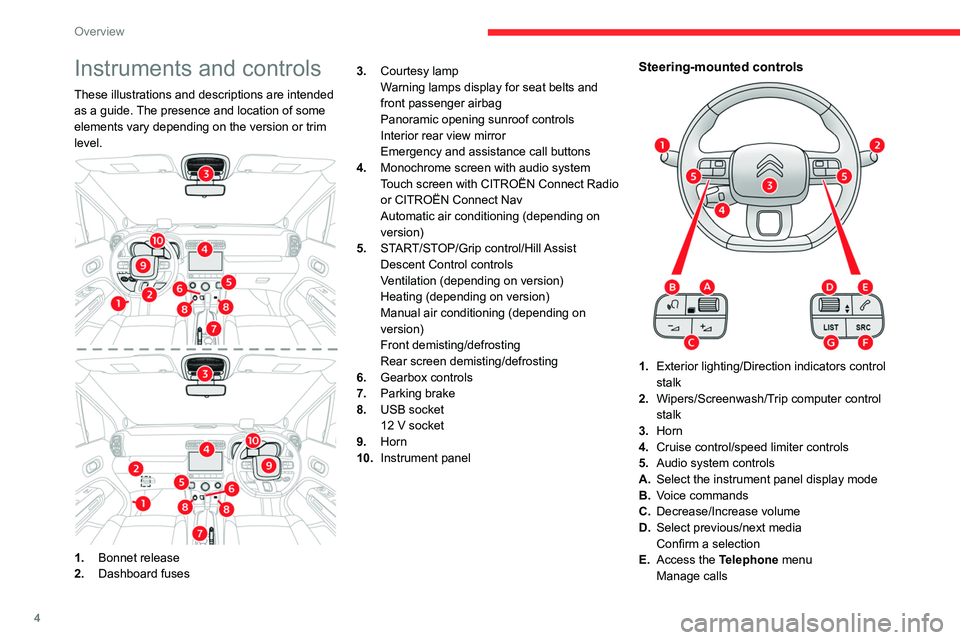
Instruments and controls
These illustrations and descriptions are intended
as a guide. The presence and location of some
elements vary depending on the version or trim
level.
1.Bonnet release
2. Dashboard fuses 3.
Courtesy lamp
Warning lamps display for seat belts and
front passenger airbag
Panoramic opening sunroof controls
Interior rear view mirror
Emergency and assistance call buttons
4. Monochrome screen with audio system
Touch screen with CITROËN Connect Radio
or CITROËN Connect Nav
Automatic air conditioning (depending on
version)
5. START/STOP/Grip control/Hill Assist
Descent Control controls
Ventilation (depending on version)
Heating (depending on version)
Manual air conditioning (depending on
version)
Front demisting/defrosting
Rear screen demisting/defrosting
6. Gearbox controls
7. Parking brake
8. USB socket
12 V socket
9. Horn
10. Instrument panel
Steering-mounted controls
1.Exterior lighting/Direction indicators control
stalk
2. Wipers/Screenwash/Trip computer control
stalk
3. Horn
4. Cruise control/speed limiter controls
5. Audio system controls
A. Select the instrument panel display mode
B. Voice commands
C. Decrease/Increase volume
D. Select previous/next media
Confirm a selection
E. Access the Telephone menu
Manage calls
Page 66 of 244
64
Safety
General safety
recommendations
Do not remove the labels attached in
different places on your vehicle. They
include safety warnings as well as
identification information for the vehicle.
For all work on your vehicle, use a
qualified workshop that has the technical
information, skills and equipment required, all
of which a CITROËN dealer is able to
provide.
Depending on country regulations,
certain safety equipment may be
mandatory: high visibility safety vests,
warning triangles, breathalysers, spare bulbs,
spare fuses, fire extinguisher, first aid kit, mud
flaps at the rear of the vehicle, etc.
Installing electrical accessories:
– The fitting of electrical equipment or
accessories not approved by CITROËN may
cause excessive current consumption and
faults and failures with the electrical system
of your vehicle. Contact a CITROËN dealer
for information on the range of approved
accessories.
–
As a safety measure, access to the
diagnostic socket, used for the vehicle's
electronic systems, is reserved strictly for
CITROËN dealers or qualified workshops,
equipped with the special tools required (risk
of malfunctions of the vehicle's electronic
systems that could cause breakdowns or
serious accidents). The Manufacturer cannot
be held responsible if this advice is not
followed.
–
Any modification or adaptation not intended
or authorised by CITROËN or carried out
without meeting the technical requirements
defined by the Manufacturer will result in the
suspension of the commercial warranty
.
Installation of accessory radio
communication transmitters
Before installing a radio communication
transmitter with an external aerial, you must
without fail contact a CITROËN dealer for
the specification of transmitters which can
be fitted (frequency, maximum power, aerial
position, specific installation requirements),
in line with the Vehicle Electromagnetic
Compatibility Directive (2004/104/EC).
Declarations of conformity for radio
equipment
The relevant certificates are available on the
http://service.citroen.com/ACddb/ website.
Hazard warning lamps
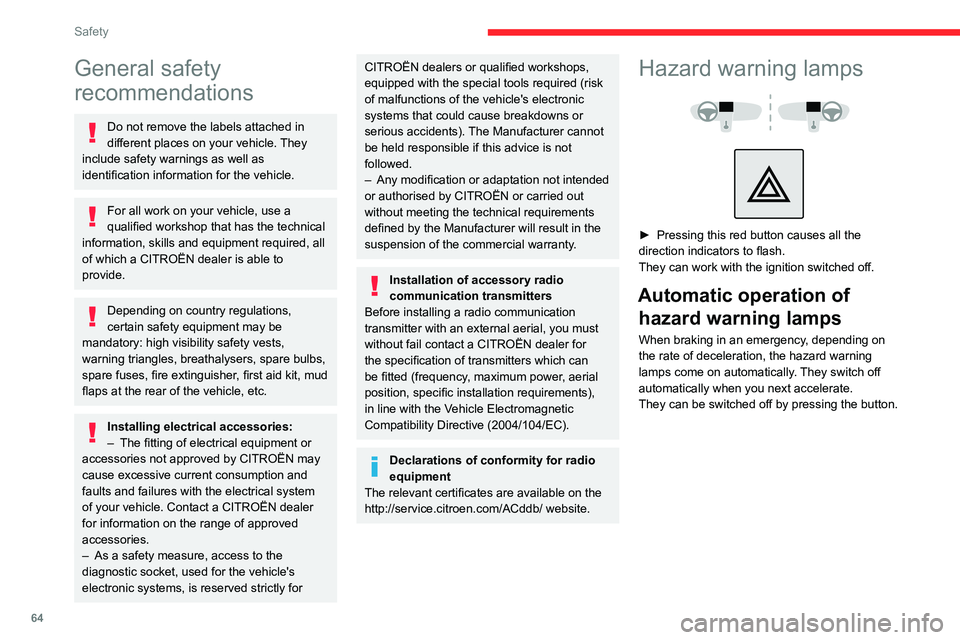
► Pressing this red button causes all the
direction indicators to flash.
They can work with the ignition switched off.
Automatic operation of hazard warning lamps
When braking in an emergency, depending on
the rate of deceleration, the hazard warning
lamps come on automatically. They switch off
automatically when you next accelerate.
They can be switched off by pressing the button.
Horn
► Press the central part of the steering wheel.
Emergency or assistance
call
1. Localised Emergency Call
* In accordance with the general conditions of use of the service, available from dealers and subject to technological and technical limitations.
** Depending on the geographic coverage of "Localised Emergency Call" and "Localised Assistance Call".
The list of countries covered and the telematic services provided is available from dealers or on the website for your country .
Page 85 of 244
83
Safety
5For seat adjustments, refer to the table
"Installing universal, ISOFIX and i-Size child
seats".
Manual child lock
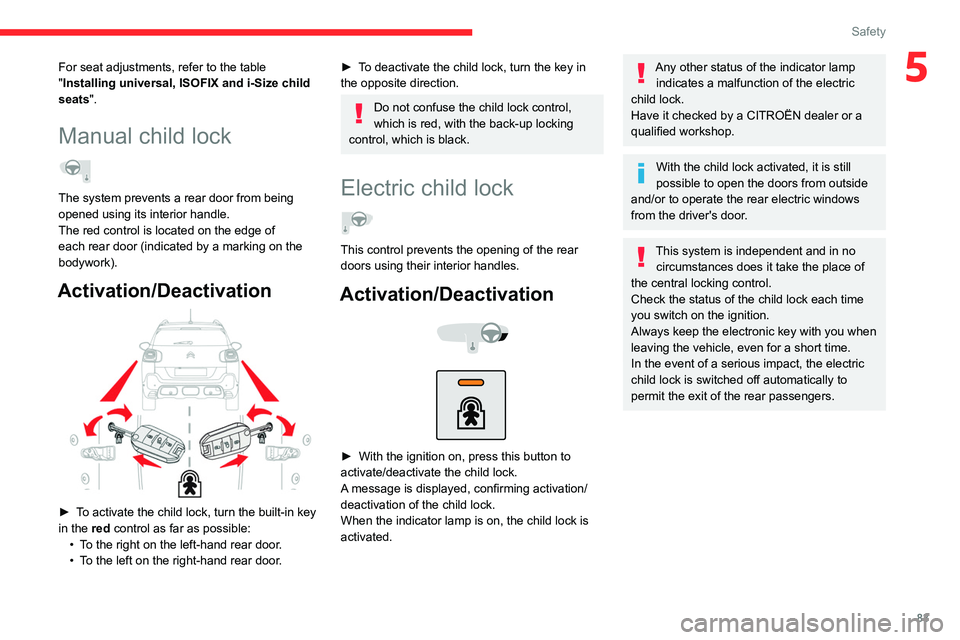
The system prevents a rear door from being
opened using its interior handle.
The red control is located on the edge of
each rear door (indicated by a marking on the
bodywork).
Activation/Deactivation
► To activate the child lock, turn the built-in key
in the red control as far as possible:
•
T
o the right on the left-hand rear door.
•
T
o the left on the right-hand rear door.
► To deactivate the child lock, turn the key in
the opposite direction.
Do not confuse the child lock control,
which is red, with the back-up locking
control, which is black.
Electric child lock
This control prevents the opening of the rear
doors using their interior handles.
Activation/Deactivation
► With the ignition on, press this button to
activate/deactivate the child lock.
A
message is displayed, confirming activation/
deactivation of the child lock.
When the indicator lamp is on, the child lock is
activated.
Any other status of the indicator lamp indicates a malfunction of the electric
child lock.
Have it checked by a CITROËN dealer or a
qualified workshop.
With the child lock activated, it is still
possible to open the doors from outside
and/or to operate the rear electric windows
from the driver's door.
This system is independent and in no circumstances does it take the place of
the central locking control.
Check the status of the child lock each time
you switch on the ignition.
Always keep the electronic key with you when
leaving the vehicle, even for a short time.
In the event of a serious impact, the electric
child lock is switched off automatically to
permit the exit of the rear passengers.
Page 114 of 244
11 2
Driving
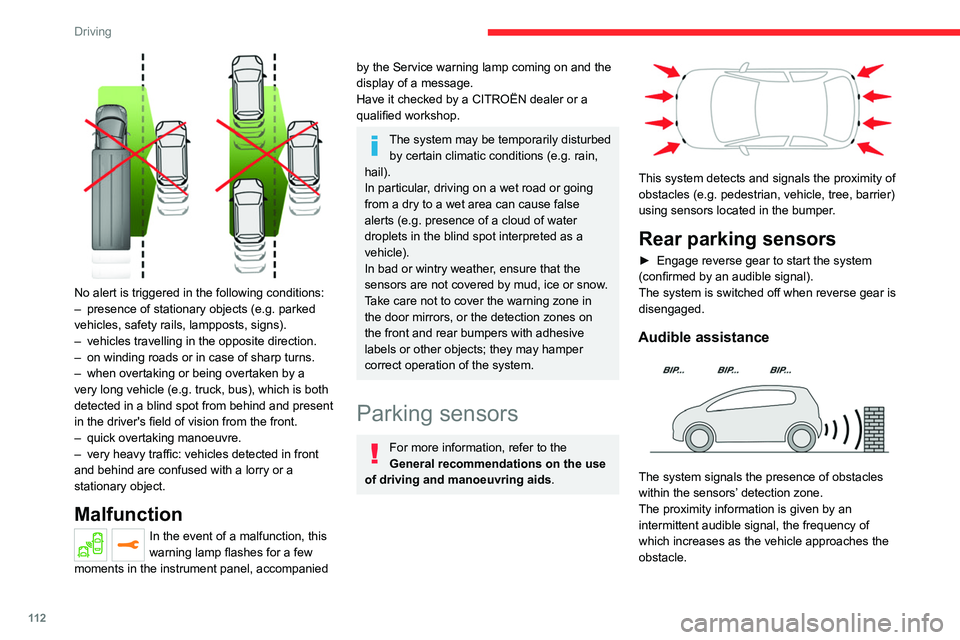
No alert is triggered in the following conditions:
– presence of stationary objects (e.g. parked
vehicles, safety rails, lampposts, signs).
–
vehicles travelling in the opposite direction.
–
on winding roads or in case of sharp turns.
–
when overtaking or being overtaken by a
very long vehicle (e.g.
truck, bus), which is both
detected in a blind spot from behind and present
in the driver's field of vision from the front.
–
quick overtaking manoeuvre.
–
very heavy traffic: vehicles detected in front
and behind are confused with a lorry or a
stationary object.
Malfunction
In the event of a malfunction, this
warning lamp flashes for a few
moments in the instrument panel, accompanied
by the Service warning lamp coming on and the
display of a message.
Have it checked by a CITROËN dealer or a
qualified workshop.
The system may be temporarily disturbed by certain climatic conditions (e.g. rain,
hail).
In particular, driving on a wet road or going
from a dry to a wet area can cause false
alerts (e.g.
presence of a cloud of water
droplets in the blind spot interpreted as a
vehicle).
In bad or wintry weather, ensure that the
sensors are not covered by mud, ice or snow.
Take care not to cover the warning zone in
the door mirrors, or the detection zones on
the front and rear bumpers with adhesive
labels or other objects; they may hamper
correct operation of the system.
Parking sensors
For more information, refer to the
General recommendations on the use
of driving and manoeuvring aids .
This system detects and signals the proximity of
obstacles (e.g.
pedestrian, vehicle, tree, barrier)
using sensors located in the bumper.
Rear parking sensors
► Engage reverse gear to start the system
(confirmed by an audible signal).
The system is switched off when reverse gear is
disengaged.
Audible assistance
The system signals the presence of obstacles
within the sensors’ detection zone.
The proximity information is given by an
intermittent audible signal, the frequency of
which increases as the vehicle approaches the
obstacle.
When the distance between the vehicle and
the obstacle becomes less than about thirty
centimetres, the audible signal becomes
continuous.
The sound emitted by the speaker (right or
left) indicates the side on which the obstacle is
located.
Visual assistance
This supplements the audible signal by
displaying bars on the screen whose location
represents the distance between the obstacle
and the vehicle (white: more distant, orange:
close, red: very close).
When the obstacle is very close, the "Danger"
symbol is displayed on the screen.
Front parking sensors
In addition to the rear parking sensors, the front
parking sensors are triggered when an obstacle
Page 131 of 244
129
Practical information
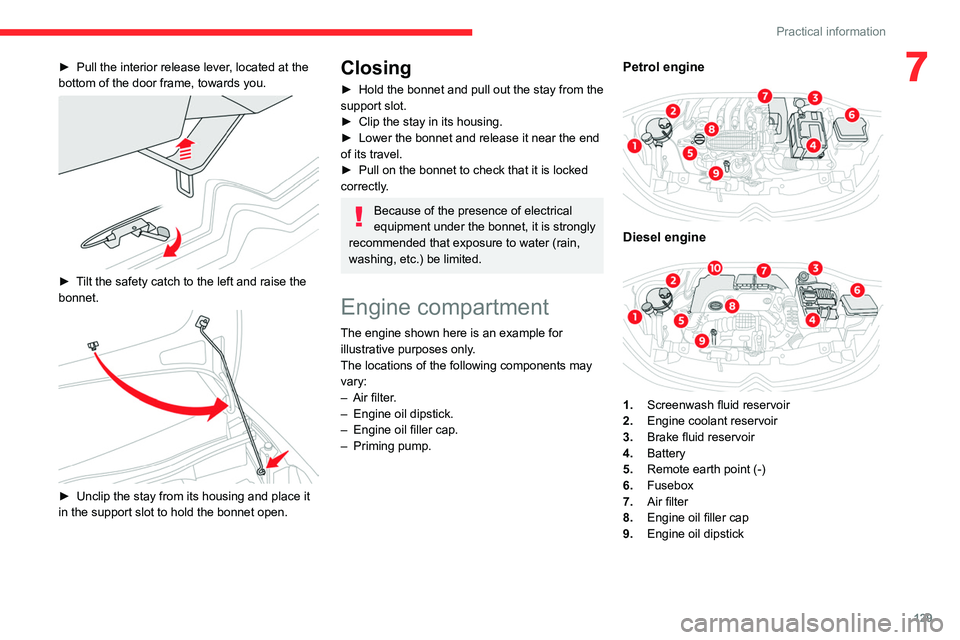
7► Pull the interior release lever, located at the
bottom of the door frame, towards you.
► Tilt the safety catch to the left and raise the
bonnet.
► Unclip the stay from its housing and place it
in the support slot to hold the bonnet open.
Closing
► Hold the bonnet and pull out the stay from the
support slot.
►
Clip the stay in its housing.
►
Lower the bonnet and release it near the end
of its travel.
►
Pull on the bonnet to check that it is locked
correctly
.
Because of the presence of electrical
equipment under the bonnet, it is strongly
recommended that exposure to water (rain,
washing, etc.) be limited.
Engine compartment
The engine shown here is an example for
illustrative purposes only.
The locations of the following components may
vary:
–
Air filter
.
–
Engine oil dipstick.
–
Engine oil filler cap.
–
Priming pump.
Petrol engine
Diesel engine
1. Screenwash fluid reservoir
2. Engine coolant reservoir
3. Brake fluid reservoir
4. Battery
5. Remote earth point (-)
6. Fusebox
7. Air filter
8. Engine oil filler cap
9. Engine oil dipstick
Page 149 of 244
147
In the event of a breakdown
8► Fit the console back into place around the
courtesy lamp and clip it correctly .
Rear courtesy lamp
► Using a thin, flat blade screwdriver , unclip the
courtesy lamp.
►
Remove the defective bulb and replace it.
►
Fit the courtesy lamp back into place and clip
it correctly
.
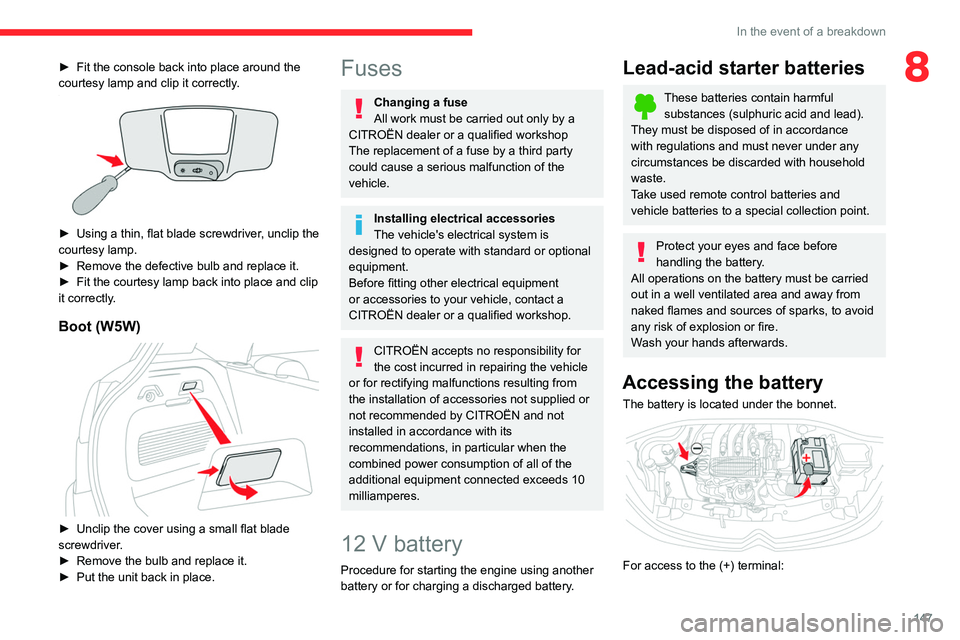
Boot (W5W)
► Unclip the cover using a small flat blade
screwdriver .
►
Remove the bulb and replace it.
►
Put the unit back in place.
Fuses
Changing a fuse
All work must be carried out only by a
CITROËN dealer or a qualified workshop
The replacement of a fuse by a third party
could cause a serious malfunction of the
vehicle.
Installing electrical accessories
The vehicle's electrical system is
designed to operate with standard or optional
equipment.
Before fitting other electrical equipment
or accessories to your vehicle, contact a
CITROËN dealer or a qualified workshop.
CITROËN accepts no responsibility for
the cost incurred in repairing the vehicle
or for rectifying malfunctions resulting from
the installation of accessories not supplied or
not recommended by CITROËN and not
installed in accordance with its
recommendations, in particular when the
combined power consumption of all of the
additional equipment connected exceeds 10
milliamperes.
12 V battery
Procedure for starting the engine using another
battery or for charging a discharged battery.
Lead-acid starter batteries
These batteries contain harmful substances (sulphuric acid and lead).
They must be disposed of in accordance
with regulations and must never under any
circumstances be discarded with household
waste.
Take used remote control batteries and
vehicle batteries to a special collection point.
Protect your eyes and face before
handling the battery.
All operations on the battery must be carried
out in a well ventilated area and away from
naked flames and sources of sparks, to avoid
any risk of explosion or fire.
Wash your hands afterwards.
Accessing the battery
The battery is located under the bonnet.
For access to the (+) terminal:
Page 213 of 244
2 11
Alphabetical index
180° rear vision 11 6
A
ABS 67
Accessories
64
Active Safety Brake
106–108
AdBlue®
15, 133
AdBlue® tank
134
Additive, Diesel
131–132
Adjusting headlamps
59
Adjusting head restraints
36
Adjusting seat
36–37
Adjusting the air distribution
45
Adjusting the air flow
44–45
Adjusting the date
18–19, 23, 182, 204
Adjusting the height and reach of
the steering wheel
41
Adjusting the seat angle
37
Adjusting the seat belt height
71
Adjusting the temperature
44–45
Adjusting the time
18–19, 23, 181, 205
Advice on care and maintenance
135
Advice on driving
7, 84–85
Airbags
73, 75, 77
Airbags, curtain
74–75
Airbags, front
74–75, 77
Airbags, lateral
74–75
Air conditioning
43–44
Air conditioning, automatic
44–45
Air conditioning, manual
44
Air intake 44–45
Air vents
42
Alarm
31–32
Android Auto connection
196
Anti-lock braking system (ABS)
67
Antitheft / Immobiliser
25
Apple CarPlay connection
178, 195
Applications
196
Armrest, front
50
Armrest, rear
51
Assistance call
65
Assistance, emergency braking
67, 108
Audible warning
65
Audio streaming (Bluetooth)
165, 177, 200
B
Battery, 12 V 127, 132, 147–149
Battery, charging
148–149
Battery, remote control
28
Blind
32–34
Blind spot sensors
111
Blinds, side
50
BlueHDi
15, 131, 137
Bluetooth (hands-free)
165–166, 179, 201
Bluetooth (telephone)
179–180, 201–202
Bodywork
136
Bonnet
128–129
Boot
30, 54
Brake discs
133
Brake lamps
146
Brakes 133
Braking assistance system
67
Braking, automatic emergency
106–108
Brightness
181
Bulbs
145
Bulbs (changing)
144–146
C
Cable, audio 199
Cable, Jack
199
Capacity, fuel tank
121–122
Cap, fuel filler
121–122
Care of the bodywork
136
CD
164
CD, MP3
164
Central locking
26, 30
Changing a bulb
144–146
Changing a fuse
147
Changing a wheel
137, 141
Changing a wiper blade
61–62
Changing the remote control battery
28
Charger, induction
48
Charger, wireless
48
Checking the engine oil level
15
Checking the levels
130–131
Checking tyre pressures
(using the kit)
138, 141
Checks
129, 132–133
Checks, routine
132–133
Child lock
83
Page 215 of 244
213
Alphabetical index
Fitting roof bars 127–128
Fittings, boot
52
Fittings, interior
47–48, 50
Fittings, rear
50
Flap, fuel filler
121–122
Flashing indicators
56, 145
Floor, boot, adjustable
52
Fluid, brake
131
Fluid, engine coolant
131
Foglamp, rear
55–56
Foglamps, front
55–56, 59–60, 145
Foglamps, rear
55
Folding the rear seats
38–40
Frequency (radio)
198
Fuel
7, 121
Fuel consumption
7
Fuel tank
121–122
Fuses
147
G
Gauge, fuel 121–122
Gearbox, automatic
90, 92–93, 133, 148
Gearbox, manual
89–90, 93, 132
Gear lever, manual gearbox
89–90
Gear shift indicator ~ Gear efficiency
indicator
92
Glove box
48
G.P.S.
192
Grab handles
50
Grip control
68
H
Hazard warning lamps 64
headlamp adjustment
59
Headlamp adjustment
59
Headlamps, automatic dipping
58–59
Headlamps, automatic illumination
57–58
Headlamps, dipped beam
55, 145
Headlamps, halogen
145
Headlamps, main beam
55, 58, 145
Head restraints, front
36
Head restraints, rear
38–40
Head-up display
98–99
Heating
42, 44
Hill Assist Descent Control (HADC)
69–70
Hill Descent Control
69–70
Hill start assist
93
Hooks
52
Horn
65
I
Ignition 45, 88, 202
Ignition on
88
Ignition switch
86–87
Immobiliser, electronic
85
Indicator, AdBlue® range
15
Indicator, coolant temperature
14
Indicator, engine oil level
15
Indicators, direction
56
Inflating tyres
133, 158
Inflating tyres and accessories
(using the kit)
138, 141
Infrared camera
97
Instrument panel
8, 8–9, 98
Instrument panel, matrix
8
Instrument panels
8
Internet browser
193, 196
ISOFIX mountings
78, 80, 82
J
Jack 138, 141, 199
Jump starting
148
K
Key 24–27
Key, electronic
25–26
Keyless Entry and Starting
25–26, 85, 87–88
Key not recognised
88–89
Key with remote control
24, 85–86
Kit, hands-free
165–166, 179, 201
Kit, puncture repair
138
Kit, temporary puncture repair
137–139, 141
L
Labels 5
Labels, identification
157
Page 217 of 244
215
Alphabetical index
R
Radio 161–162, 174–175, 198
Radio, digital (Digital Audio Broadcasting -
DAB)
162, 176, 199
Range, AdBlue®
15, 131
RDS
175, 198
Reading lamps
53
Rear screen, demisting
47
Recharging the battery
148–149
Recirculation, air
44–45
Recorder, total distance
17
Recovery
150
Recovery of the vehicle
150
Reduction of electrical load
127
Regeneration of the particle filter
132
Reinitialisation of the under-inflation
detection system
96
Reinitialising the remote control
29
Reminder, key in ignition
87
Reminder, lighting on
56
Remote control
24–27
Removing a wheel
141–143
Removing the mat
50
Replacing bulbs
144–146
Replacing fuses
147
Replacing the air filter
132
Replacing the oil filter
132
Replacing the passenger compartment
filter
132
Reservoir, screenwash
131
Resetting the trip recorder
17
Reversing camera 97, 113–114, 116
Roof bars
127–128
Running out of fuel (Diesel)
137
S
Safety, children 74–80
Saturation of the particle filter (Diesel)
132
Screen, instrument panel
21
Screen menu map
178
Screen, monochrome
18–19
Screen, multifunction (with audio system)
160
Screenwash
61
Screenwash, front
60
Screenwash, rear
61
SCR (Selective Catalytic Reduction)
16, 133
Seat angle
37
Seat belts
70–72, 78
Seat belts, rear
71
Seats, front
36–37
Seats, heated
38
Seats, rear
38–40, 76
Sensors (warnings)
97
Serial number, vehicle
157
Service indicator
14
Servicing
14, 132
Settings, equipment
17–20
Settings, system
181, 204
Sidelamps
55–57, 145–146
Smartphone
48
Snow chains
96, 123
Socket, 12 V accessory 48
Socket, auxiliary
164, 177, 199
Socket, Jack
164, 199
Speed limiter
99, 101–104
Speed limit recognition
100–101
Speedometer
98
Stability control (ESC)
67–68
Starting a Diesel engine
121
Starting the engine
86
Starting the vehicle
86–87
Starting using another battery
88, 148
Station, radio
161, 174–175, 198
Stay, bonnet
128–129
Steering mounted controls,
audio
160, 172, 185
Steering wheel, adjustment
41
Stickers, customising ~ Stickers,
expressive
136
Stopping the vehicle
86–88
Stop & Start
22, 43, 46, 93–95,
121, 128, 132, 150
Storage
48, 51
Storage box
53
Storage wells
53
Stowing rings
50
Sunroof, panoramic
32–34
Sunshine sensor
43
Sun visor
48
Switching off the engine
86
Synchronising the remote control
29