brake Citroen C3 PICASSO 2014 1.G User Guide
[x] Cancel search | Manufacturer: CITROEN, Model Year: 2014, Model line: C3 PICASSO, Model: Citroen C3 PICASSO 2014 1.GPages: 292, PDF Size: 9.23 MB
Page 128 of 292

126
C3Picasso_en_Chap09_conduite_ed01-2014
F Select position M. To engage reverse gear R
, the vehicle must be
immobilised with your foot on the brake pedal.
F
Sel
ect position R.
At very low speed, if reverse gear is requested,
this will only be acted on when the vehicle is
immobilised.
at h
igh speed, if reverse gear is requested,
the
N indicator flashes and the gearbox goes
into neutral. To engage a gear again, put the
gear lever in position A or M .Temporary control of gear
changing
You can temporarily take over control of
gear changing using the "+" and "-" steering
mounted paddles: if the engine speed allows,
the request to change gear is acted on.
This function allows you to anticipate certain
situations such as overtaking a vehicle or the
approach to a corner.
After a few moments without any action on
the control paddles, the gearbox resumes
automatic control of the gears. The gears engaged appear in
succession in the instrument panel
screen.
The gear change requests are only acted on if
the engine speed permits.
It is not necessary to release the accelerator
during gear changes.
When braking or slowing down, the gearbox
changes down automatically to allow the
vehicle to accelerate in the correct gear.
On sharp acceleration, the gearbox will not
change up unless the driver acts on the gear
lever or the steering mounted paddles.
ne
ver select neutral N while the vehicle
is moving. You can change mode at any time, be
moving the gear lever from M to A or
the other way round. Engagement of reverse gear is
accompanied by an audible signal.
Manual mode
Reverse
driving
Page 129 of 292

127
C3Picasso_en_Chap09_conduite_ed01-2014
Stopping the vehicleOperating fault
With the ignition on, the flashing of AUTO ,
accompanied by an audible signal and a
message in the screen, indicates a malfunction
of the gearbox.
Have it checked by a CITR
oËn
dealer or a
qualified workshop.
In all cases when parking, you must
apply the parking brake to immobilise
the vehicle.
When immobilising the vehicle, with
the engine running, you must place the
gear lever in neutral N .
Before carrying out any work in the
engine compartment, ensure that the
gear lever is in neutral N and that the
parking brake is applied.
Before switching off the engine, you can:
-
m
ove to position N to engage neutral,
or
-
l
eave the gear engaged; in this case, it will
not be possible to move the vehicle. If the ambient temperature is
below
-23°C, the engine should be left
running at idle for four minutes, in order
to ensure the correct operation and
durability of the engine and gearbox.
When traversing a flooded road or a
ford, drive at walking pace.
9
driving
Page 131 of 292

129
C3Picasso_en_Chap09_conduite_ed01-2014
Hill start assist
(with the 6-speed
electronic gearbox
sy s te m)
System which holds your vehicle temporarily
(approximately 2 seconds) when starting on a
slope, the time it takes to move your foot from
the brake pedal to the accelerator pedal.
This function is only active when:
-
t
he vehicle is completely stationary, with
your foot on the brake pedal,
-
c
ertain conditions on a slope are met,
-
w
ith the driver’s door closed.
The hill start assist function cannot be
deactivated. On an ascending slope, with the vehicle
stationary, the vehicle is held momentarily
when you release the brake pedal:
-
p
rovided you are in automated mode
(position A ) or in manual mode (position M )
on an electronic gearbox. On a descending slope, with the vehicle
stationary and reverse gear engaged, the
vehicle is held momentarily when you
release the brake pedal.
Operating fault
If a malfunction of the system occurs, these
warning lamps come on. Contact a CITROËN
dealer or a qualified workshop to have the
system checked.
Do not leave the vehicle while it is being
held in the hill start assist phase.
If you need to leave the vehicle with
the engine running, manually apply
the parking brake then ensure that the
parking brake warning lamp is on (not
flashing) in the instrument panel.
Operation
9
driving
Page 132 of 292
130
C3Picasso_en_Chap09_conduite_ed01-2014
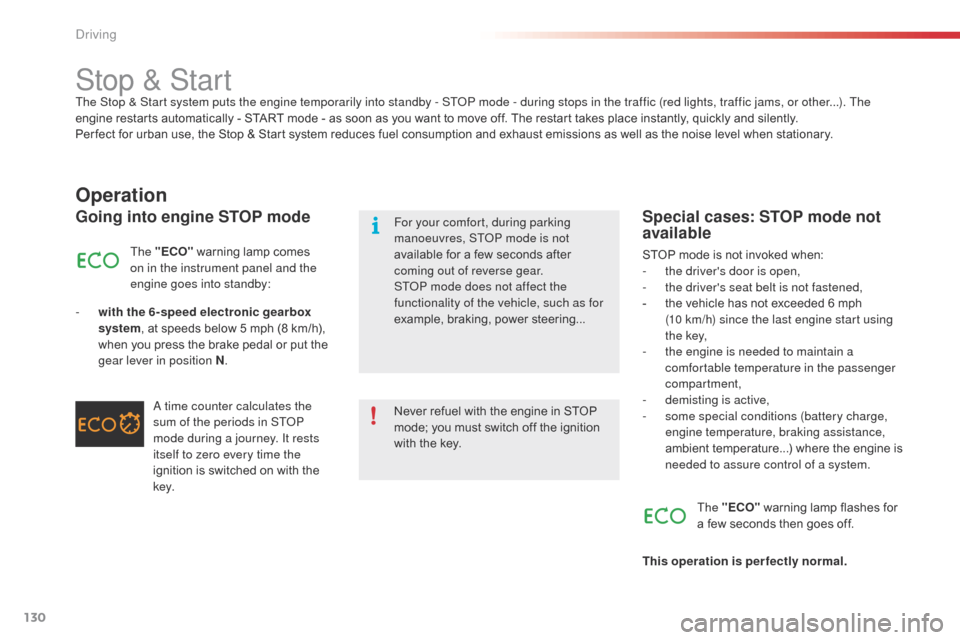
Stop & StartThe Stop & Start system puts the engine temporarily into standby - SToP mode - during stops in the traffic (red lights, traffic jams, or other...). The
engine restarts automatically - START mode - as soon as you want to move off. The restart takes place instantly, quickly and silently.
Per fect for urban use, the Stop & Start system reduces fuel consumption and exhaust emissions as well as the noise level when stationary.
Operation
Going into engine STOP mode
The "ECO" warning lamp comes
on in the instrument panel and the
engine goes into standby:
-
w
ith the 6-speed electronic gearbox
system, at speeds below 5 mph (8 km/h),
when you press the brake pedal or put the
gear lever in position N .
a
time counter calculates the
sum of the periods in ST
oP
m
ode during a journey. It rests
itself to zero every time the
ignition is switched on with the
key.
Special cases: STOP mode not
available
STOP mode is not invoked when:
- t he driver's door is open,
-
t
he driver's seat belt is not fastened,
-
t
he vehicle has not exceeded 6 mph
(10
km/h) since the last engine start using
t h e key,
-
t
he engine is needed to maintain a
comfortable temperature in the passenger
compartment,
-
d
emisting is active,
-
s
ome special conditions (battery charge,
engine temperature, braking assistance,
ambient temperature...) where the engine is
needed to assure control of a system.
The "ECO" warning lamp flashes for
a few seconds then goes off.
This operation is perfectly normal.
Never refuel with the engine in STOP
mode; you must switch off the ignition
with the key. For your comfort, during parking
manoeuvres, ST
oP m
ode is not
available for a few seconds after
coming out of reverse gear.
ST
oP m
ode does not affect the
functionality of the vehicle, such as for
example, braking, power steering...
driving
Page 133 of 292

131
C3Picasso_en_Chap09_conduite_ed01-2014
Going into engine START mode
The "ECO" warning lamp goes
off and the engine starts with the
electronic gearbox system:
-
g
ear lever in position A or M , when you
release the brake pedal,
-
o
r gear lever in position N and the brake
pedal released, when you move the gear
lever to position A or M ,
-
o
r when you engage reverse gear.
Special cases: START invoked
automatically
For reasons of safety and for your comfort,
START mode is invoked automatically when:
-
y
ou open the driver's door,
-
y
ou unfasten the driver's seat belt,
-
t
he speed of the vehicle exceeds 7 mph
(11
km/h) with the electronic gearbox
system,
-
s
ome special conditions (battery charge,
engine temperature, braking assistance,
ambient temperature...) where the engine is
needed for control of a system.
The "ECO" warning lamp flashes for
a few seconds, then goes off.
This operation is perfectly normal.
Deactivation
at any time, press the "ECO OFF" switch to
deactivate the system.
This is confirmed by the switch warning lamp
coming on accompanied by a message in the
screen.
If the system has been deactivated
in ST
oP m
ode, the engine restarts
immediately.
9
driving
Page 137 of 292

135
C3Picasso_en_Chap09_conduite_ed01-2014
System which automatically maintains the
speed of the vehicle at the value programmed
by the driver, without any action on the
accelerator pedal.The controls of this system are grouped
together on control stalk A.The programmed information is grouped
together in the instrument panel screen.Steering mounted controlsDisplays in the instrument panel
The cruise control is switched on
manually: it
requires a minimum vehicle speed of 25 mph
(40 km/h) and the engaging of at least 4th gear.
The cruise control is switched off manually
or by pressing the brake or clutch pedal or
on triggering of the ESP system for safety
reasons.
It is possible to exceed the programmed speed
temporarily by pressing the accelerator pedal.
To return to the programmed speed, simply
release the accelerator pedal.
Switching off the ignition cancels any
programmed speed value. 1.
C
ruise control mode selection dial
2.
S
peed programming / value decrease
button
3.
S
peed programming / value increase
button
4.
C
ruise control off / resume button5.
C
ruise control off / resume indication
6.
C
ruise control mode selection indication
7.
P
rogrammed speed value
The cruise control cannot, in any circumstances,
replace the need to respect speed limits, nor can it
replace the need for vigilance on the part of the driver.
Cruise control
9
driving
Page 148 of 292
146
C3Picasso_en_Chap10_verification_ed01-2014
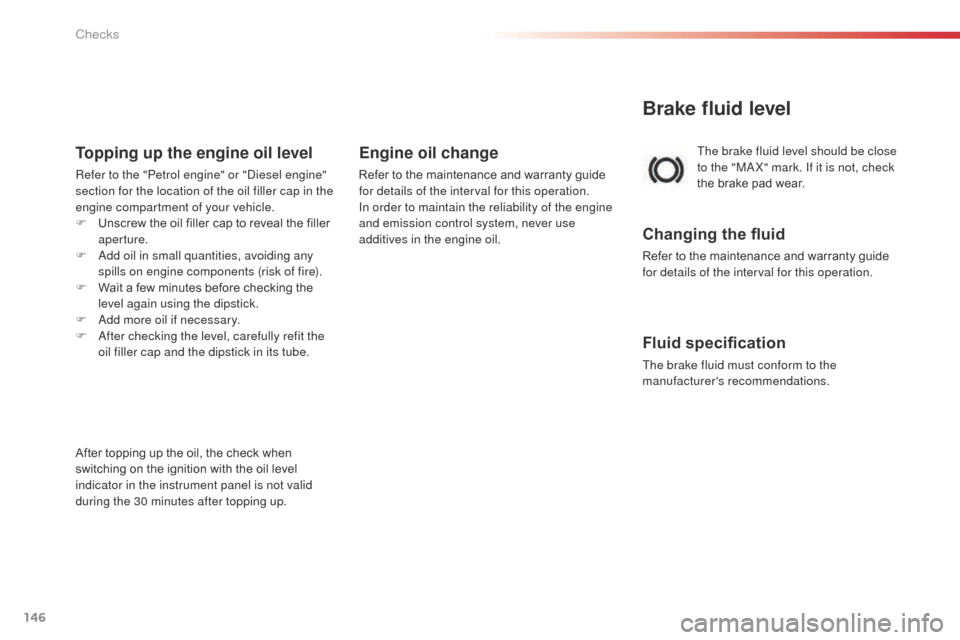
Brake fluid level
The brake fluid level should be close
to the "MaX" mark. If it is not, check
the brake pad wear.
Changing the fluid
Refer to the maintenance and warranty guide
for details of the interval for this operation.
Fluid specification
The brake fluid must conform to the
manufacturer's recommendations.
Topping up the engine oil level
Refer to the "Petrol engine" or "di esel engine"
section for the location of the oil filler cap in the
engine compartment of your vehicle.
F
U
nscrew the oil filler cap to reveal the filler
aperture.
F
a
d
d oil in small quantities, avoiding any
spills on engine components (risk of fire).
F
W
ait a few minutes before checking the
level again using the dipstick.
F
a
d
d more oil if necessary.
F
a
f
ter checking the level, carefully refit the
oil filler cap and the dipstick in its tube.
After topping up the oil, the check when
switching on the ignition with the oil level
indicator in the instrument panel is not valid
during the 30 minutes after topping up.
Engine oil change
Refer to the maintenance and warranty guide
for details of the interval for this operation.
In order to maintain the reliability of the engine
and emission control system, never use
additives in the engine oil.
Checks
Page 151 of 292
149
C3Picasso_en_Chap10_verification_ed01-2014
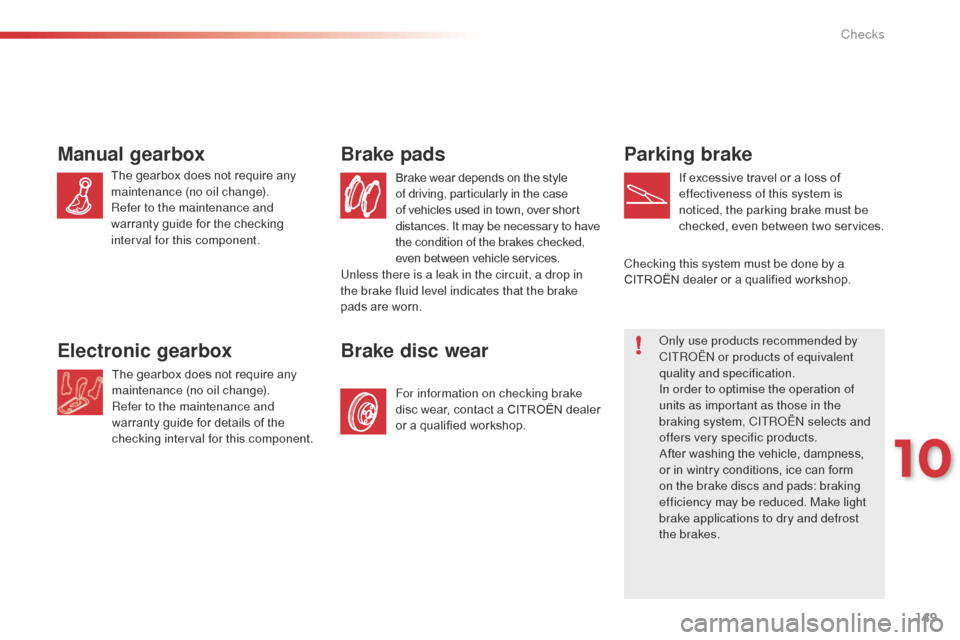
Parking brake
If excessive travel or a loss of
effectiveness of this system is
noticed, the parking brake must be
checked, even between two services.
Manual gearbox
The gearbox does not require any
maintenance (no oil change).
Refer to the maintenance and
warranty guide for the checking
interval for this component.For information on checking brake
disc wear, contact a CITROËN dealer
or a qualified workshop.
Brake disc wear
Brake wear depends on the style
of driving, particularly in the case
of vehicles used in town, over short
distances. It may be necessary to have
the condition of the brakes checked,
even between vehicle services.
Brake pads
The gearbox does not require any
maintenance (no oil change).
Refer to the maintenance and
warranty guide for details of the
checking interval for this component.
Electronic gearboxonly use products recommended by
CITRoËn or products of equivalent
quality and specification.
In order to optimise the operation of
units as important as those in the
braking system, CITR
oËn
selects and
offers very specific products.
After washing the vehicle, dampness,
or in wintry conditions, ice can form
on the brake discs and pads: braking
efficiency may be reduced. Make light
brake applications to dry and defrost
the brakes.
Checking this system must be done by a
CITROËN dealer or a qualified workshop.
Unless there is a leak in the circuit, a drop in
the brake fluid level indicates that the brake
pads are worn.
10
Checks
Page 160 of 292

158
C3Picasso_en_Chap11_informations-pratiques_ed01-2014
Removing a wheel
List of operations
F Remove the bolt cover from each of the bolts using the tool 3 (with allow wheels
only).
F
F
it the security socket 4 to the
wheelbrace
1
to slacken the security bolt
(if your vehicle has them).
F
S
lacken the other bolts using the
wheelbrace 1 o n l y.
Parking the vehicle
Immobilise the vehicle where it does not
block traffic: the ground must be level,
stable and non-slippery.
Apply the parking brake, switch off the
ignition and engage first gear* to lock
the wheels.
If necessary, place a chock under the
wheel diagonally opposite the wheel to
be changed.
You must ensure that the occupants get
out of the vehicle and wait where they
are safe.
ne
ver go underneath a vehicle raised
using a jack; use an axle stand.
* Position R for an electronic gearbox.
Practical information
Page 164 of 292

162
C3Picasso_en_Chap11_informations-pratiques_ed01-2014
Snow chains
original tyre sizeMaximum link size.
195 / 60 R15 9 mm
195 / 55 R16 9 mm
205 / 45 R17 7 mm
For more information on snow chains,
contact a CITR
oËn
dealer or a
qualified workshop.
In wintry conditions, snow chains improve traction as well as the behaviour of the vehicle when
braking.
The snow chains must be fitted only
to the front wheels. They must never
be fitted to "space-saver" type spare
wheels.
Take account of the legislation in force
in your country on the use of snow
chains and the maximum running speed
authorised.
Advice on installation
F If you have to fit the chains during a journey, stop the vehicle on a flat sur face
on the side of the road.
F
a
p
ply the parking brake and position any
wheel chocks to prevent movement of your
vehicle.
F
F
it the chains following the instructions
provided by the manufacturer.
F
M
ove off gently and drive for a few
moments, without exceeding 30 mph
(50
km/h).
F
S
top your vehicle and check that the snow
chains are correctly tightened.
Avoid driving with snow chains on roads
that have been cleared of snow, to
avoid damaging your vehicle's tyres and
the road sur face. If your vehicle is fitted
with alloy wheels, check that no part of
the chain or its fixings is in contact with
the wheel rim.
al
l original tyre sizes (15", 16", 17") can be
fitted with chains.
Use only the chains designed to be fitted to the
type of wheel fitted to your vehicle:
It is strongly recommended that before
you leave, you practise fitting the snow
chains on a level and dry sur face.
Practical information