ignition Citroen C3 PICASSO 2014 1.G Service Manual
[x] Cancel search | Manufacturer: CITROEN, Model Year: 2014, Model line: C3 PICASSO, Model: Citroen C3 PICASSO 2014 1.GPages: 292, PDF Size: 9.23 MB
Page 153 of 292

151
C3Picasso_en_Chap11_informations-pratiques_ed01-2014
F Switch off the ignition.
F S ecure the speed limit sticker inside the
vehicle. F
U ncoil the pipe stowed under the
compressor.
F
C
onnect the pipe from the compressor to
the sealant cartridge.
F
T
urn the the sealant cartridge and secure it
in the cut-out provided on the compressor.
av
oid removing any foreign bodies
which have penetrated into the tyre. F
R emove the valve cap from the tyre to be
repaired, and place it in a clean area.
F
C
onnect the hose from the sealant
cartridge to the valve of the tyre to be
repaired and tighten firmly.
Repair procedure
11
Practical information
Page 154 of 292

152
C3Picasso_en_Chap11_informations-pratiques_ed01-2014
F Check that the compressor switch is at the "O " position).
F
U
ncoil fully the electric cable, stowed under
the compressor.
F
C
onnect compressor's plug to the vehicle's
12 V socket.
F
S
witch on the ignition. Take care, the sealant product
is harmful (e.g. ethylene-glycol,
colophony...) if swallowed and causes
irritation to the eyes.
ke
ep this product out of the reach of
children.
The use-by date is marked on the
cartridge.
af
ter use, do not discard the
cartridge by the roadside, take it to
a CITR
oËn
dealer or an authorised
waste disposal site.
Don't forget to obtain a new sealant
cartridge, available from a CITR
oËn
dealer or a qualified workshop.
F
S tart the compressor by placing the switch
at the " I" position and leave it running until
the tyre pressure reaches 2.0 bar.
T
he sealant product is injected into the tyre
under pressure; do not disconnect the pipe
from the valve during this operation (risk of
splashing and stains). If after around 5 to 7 minutes the
pressure is not attained, this indicates
that the tyre is not repairable; contact
a CITR
oËn
dealer or a qualified
workshop for assistance.
Practical information
Page 155 of 292

153
C3Picasso_en_Chap11_informations-pratiques_ed01-2014
F Place the switch in the "O" position.
F R emove the kit.
F
D
rive immediately for approximately
three miles (five kilometres), at reduced
speed (between 15 and 35 mph (20 and
60
km/h)), to plug the puncture.
F
S
top to check the repair and the tyre
pressure using the kit.
Checking / adjusting tyre pressures
You can also use the compressor, without
injecting sealant, to check and if necessary
adjust the tyre pressures
F
R
emove the valve cap from the tyre and
place it in a clean area.
F
U
ncoil the pipe stowed under the
compressor.
F
S
crew the pipe onto the valve and tighten
f i r m l y. F
C heck that the compressor switch is at
the
"O " position.
F
U
ncoil fully the electric cable, stowed under
the compressor.
F
C
onnect compressor's plug to the vehicle's
12 V socket.
F
S
witch on the ignition.
11
Practical information
Page 160 of 292

158
C3Picasso_en_Chap11_informations-pratiques_ed01-2014
Removing a wheel
List of operations
F Remove the bolt cover from each of the bolts using the tool 3 (with allow wheels
only).
F
F
it the security socket 4 to the
wheelbrace
1
to slacken the security bolt
(if your vehicle has them).
F
S
lacken the other bolts using the
wheelbrace 1 o n l y.
Parking the vehicle
Immobilise the vehicle where it does not
block traffic: the ground must be level,
stable and non-slippery.
Apply the parking brake, switch off the
ignition and engage first gear* to lock
the wheels.
If necessary, place a chock under the
wheel diagonally opposite the wheel to
be changed.
You must ensure that the occupants get
out of the vehicle and wait where they
are safe.
ne
ver go underneath a vehicle raised
using a jack; use an axle stand.
* Position R for an electronic gearbox.
Practical information
Page 176 of 292
174
C3Picasso_en_Chap11_informations-pratiques_ed01-2014
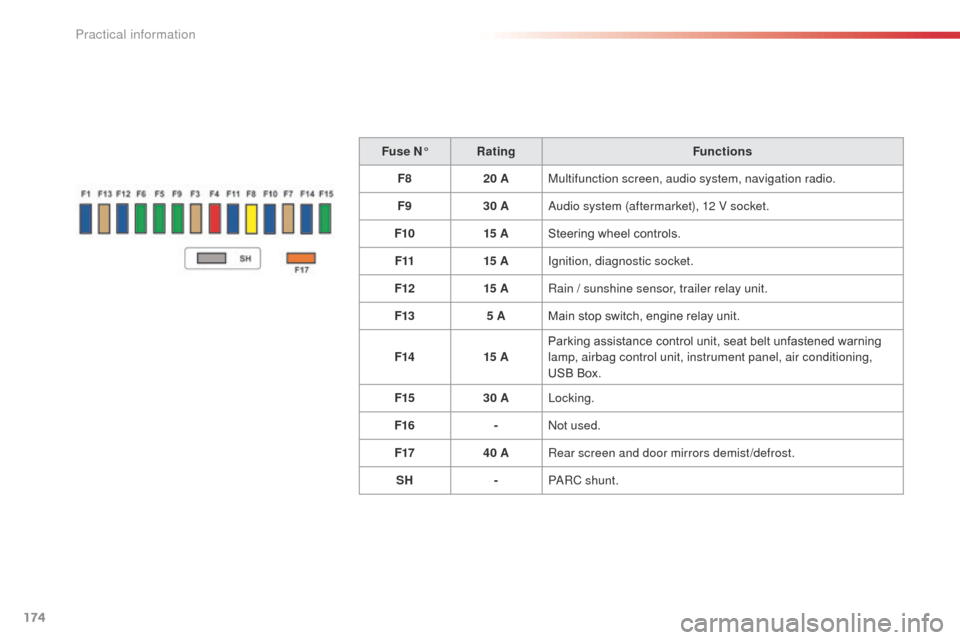
Fuse N°Rating Functions
F8 20 AMultifunction screen, audio system, navigation radio.
F9 30 A
au
dio system (aftermarket), 12 V socket.
F10 15 ASteering wheel controls.
F11 15 AIgnition, diagnostic socket.
F12 15 ARain / sunshine sensor, trailer relay unit.
F13 5 AMain stop switch, engine relay unit.
F14 15 AParking assistance control unit, seat belt unfastened warning
lamp, airbag control unit, instrument panel, air conditioning,
USB Box.
F15 30 ALocking.
F16 -
no
t used.
F17 40 ARear screen and door mirrors demist/defrost.
SH -P
aR
C shunt.
Practical information
Page 178 of 292
176
C3Picasso_en_Chap11_informations-pratiques_ed01-2014
Fuse table
Fuse N°Rating Functions
F1 20 AEngine control unit supply, cooling fan unit control, multifunction
engine control main relay.
F2 15 AHorn.
F3 10 AFront / rear wash-wipe.
F4 20 A
da
ytime running lamps.
F5 15 A
di
esel heater (
di
esel engine), fuel pump (petrol engine)
F6 10 A
a
b
S
/ESP control unit, ab
S
/ESP cut-off relay, secondary stop
switch.
F7 10 AElectric power steering.
F8 25 AStarter motor control.
F9 10 ASwitching and protection unit (Diesel).
F10 30 A
di
esel engine injection pump valve, injectors and ignition coils
(petrol engine)
F11 40 A
air
conditioning fan.
Practical information
Page 179 of 292
177
C3Picasso_en_Chap11_informations-pratiques_ed01-2014
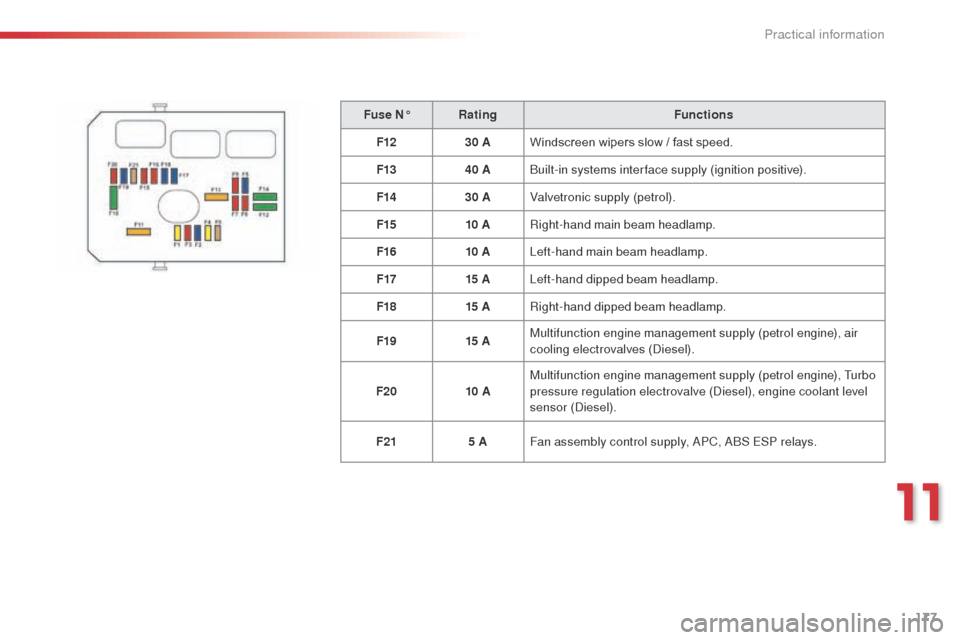
Fuse N°Rating Functions
F12 30 AWindscreen wipers slow / fast speed.
F13 40 A
bu
ilt-in systems inter face supply (ignition positive).
F14 30 AValvetronic supply (petrol).
F15 10 ARight-hand main beam headlamp.
F16 10 ALeft-hand main beam headlamp.
F17 15 ALeft-hand dipped beam headlamp.
F18 15 ARight-hand dipped beam headlamp.
F19 15 AMultifunction engine management supply (petrol engine), air
cooling electrovalves (
die
sel).
F20 10 AMultifunction engine management supply (petrol engine), Turbo
pressure regulation electrovalve (
di
esel), engine coolant level
sensor (
di
esel).
F21 5 AFan assembly control supply,
a
P
C, ab
S E
SP relays.
11
Practical information
Page 182 of 292

180
C3Picasso_en_Chap11_informations-pratiques_ed01-2014
First check that the slave battery has a
nominal voltage of 12 V and a capacity
at least equal to that of the discharged
battery.
do n
ot try to start the engine by
connecting a battery charger.
Do not disconnect the (+) terminal when
the engine is running.
F
C
onnect the red cable to the positive
terminal (+) of the flat battery A , then to the
positive terminal (+) of the slave battery B.
F
C
onnect one end of the green or black
cable to the negative terminal (-) of the
slave battery B (or earth point on the other
vehicle).
F
C
onnect the other end of the green or
black cable to the negative terminal C (or
the engine mounting) of the broken-down
vehicle.
F
S
tart the engine of the other vehicle and
allow it to run for a few minutes.
Starting using another
battery
When the battery on your vehicle is discharged,
the engine can be started using a slave battery
(external or on another vehicle) and jump leads.
F
O
perate the starter of the broken-down
vehicle and let the engine run.
I
f the engine does not start immediately,
switch off the ignition and wait a few
moments before trying again.
F
W
ait until the engine returns to idle, then
disconnect the jump leads in reverse order. Some functions are not available if the
battery is not sufficiently charged.
Practical information
Page 185 of 292
183
C3Picasso_en_Chap11_informations-pratiques_ed01-2014
Changing a front or rear wiper blade
Removal
F Raise the corresponding wiper arm.
F U nclip the wiper blade and remove it.
Fitting
F At the front, check the size of the wiper blade as the shorter blade is fitted to the
passenger side of the vehicle.
F
P
ut the corresponding new wiper blade in
place and clip it.
F
F
old down the wiper arm carefully.
Before removing a front
wiper blade
F Within one minute after switching off the ignition, operate the wiper stalk to position
the wiper blades in the vertical position.
This position must be used in order to avoid
damaging the wiper blade and the bonnet.
After fitting a front wiper
blade
F Switch on the ignition.
F O perate the wiper stalk again to park the
wiper blades.
Procedure for replacing a worn wiper blade with a new one without the use of tools.
11
Practical information
Page 202 of 292
200
EMERGENCY OR ASSIST ANCE CALL
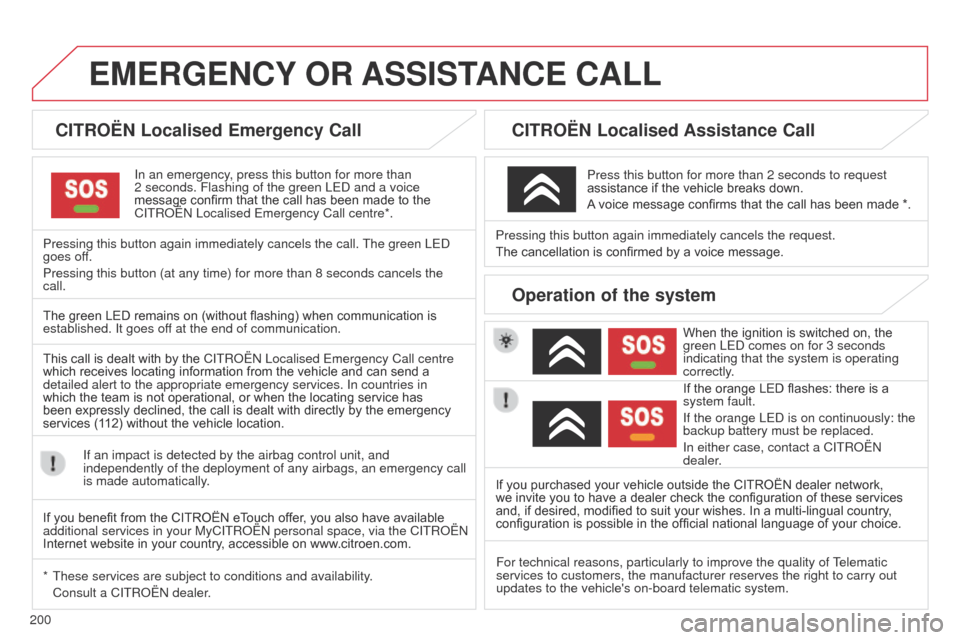
CITROËN Localised Emergency Call
In an emergency, press this button for more than
2
seconds. Flashing of the green LE d and a voice
message confirm that the call has been made to the
C
ITR o Ë n Localised Emergency Call centre*.
Pressing this button again immediately cancels the call. The green LE
d
goes off.
Pressing this button (at any time) for more than 8 seconds cancels the\
call.
CITROËN Localised Assistance Call
When the ignition is switched on, the
green LE d comes on for 3 seconds
indicating that the system is operating
correctly.
If the orange LED flashes: there is a
system fault.
If the orange LE
d is on continuously: the
backup battery must be replaced.
In either case, contact a CITR
o Ë n
dealer.
Pressing this button again immediately cancels the request.
The cancellation is confirmed by a voice message.
Press this button for more than 2 seconds to request
assistance if the vehicle breaks down.
A voice message confirms that the call has been made *.
Operation of the system
The green LED remains on (without flashing) when communication is
established. It goes off at the end of communication.
This call is dealt with by the
C
ITR o Ë n Localised Emergency Call centre
which receives locating information from the vehicle and can send a
detailed alert to the appropriate emergency services. In countries in
which the team is not operational, or when the locating service has
been expressly declined, the call is dealt with directly by the emergency
services (112) without the vehicle location.
If an impact is detected by the airbag control unit, and
independently of the deployment of any airbags, an emergency call
is made automatically.
*
These services are subject to conditions and availability
.
Consult a CITR
o Ë n dealer. If you purchased your vehicle outside the CITROËN dealer network,
we invite you to have a dealer check the configuration of these services
and, if desired, modified to suit your wishes. In a multi-lingual country
,
configuration is possible in the official national language of your choice.
For technical reasons, particularly to improve the quality of Telematic
services to customers, the manufacturer reserves the right to carry out \
updates to the vehicle's on-board telematic system.
If you benefit from the CITROËN eTouch offer, you also have available
additional services in your MyCITR
o Ë n personal space, via the CITR o Ë n
Internet website in your country, accessible on www.citroen.com.