fuel consumption Citroen C3 RHD 2014 2.G User Guide
[x] Cancel search | Manufacturer: CITROEN, Model Year: 2014, Model line: C3 RHD, Model: Citroen C3 RHD 2014 2.GPages: 284, PDF Size: 8.99 MB
Page 48 of 284
46
Rear screen demist - defrost
Switching on
The rear screen demisting/defrosting can only
operate when the engine is running.
F
P
ress this button to demist /defrost the
rear screen and (depending on version)
the door mirrors. The indicator lamp
associated with the button comes on.
Switching off
The demisting/defrosting switches off
automatically to prevent an excessive
consumption of current.
F
I
t is possible to stop the demisting/
defrosting operation before it is switched
off automatically by pressing the button
again. The indicator lamp associated with
the button switches off.
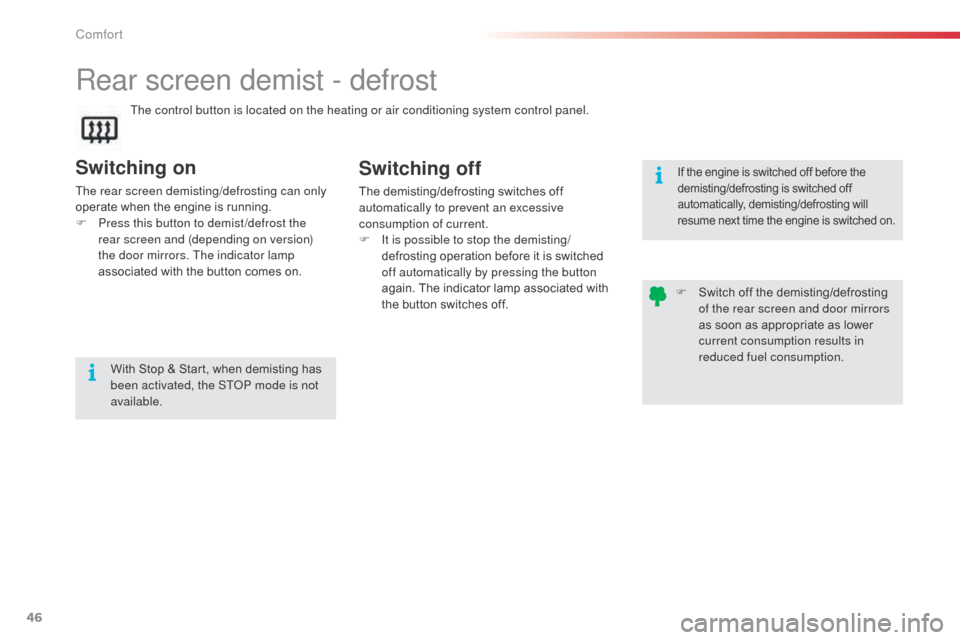
The control button is located on the heating or air conditioning system control panel.
F
S
witch off the demisting/defrosting
of the rear screen and door mirrors
as soon as appropriate as lower
current consumption results in
reduced fuel consumption.
With Stop & Start, when demisting has
been activated, the ST
oP m
ode is not
available.
If the engine is switched off before the
demisting/defrosting is switched off
automatically, demisting/defrosting will
resume next time the engine is switched on.
Comfort
Page 103 of 284

101
Tyre under-inflation detection
System which automatically checks the pressure of the tyres while driving.
The system monitors the pressures on the four
tyres, once the vehicle is moving.
It compares the information given by the four
wheel speed sensors with reference values,
which must be reinitialised ever y time the
tyre pressures are adjusted or a wheel
changed.
The system triggers an alert as soon as it
detects a drop in the inflation pressure of one
or more tyres. The under-inflation detection system
does not replace the vigilance or the
responsibility of the driver.
This system does not avoid the need to
check the tyre pressures (including the
spare wheel) every month as well as
before a long journey.
Driving with under-inflated tyres impairs
road holding, extends braking distances
and causes premature tyre wear,
particularly under arduous condition
(high loading, high speed, long journey).The inflation pressures defined for
your vehicle can be found on the tyre
pressure label.
See the "Identification markings"
section.
Tyre pressures should be checked
when the tyres are "cold" (vehicle
stopped for 1 hour or after a journey of
less than 6 miles (10 km) at moderate
speeds).
Other wise (when hot), add 0.3 bar to
the pressures shown on the label.
Driving with under-inflated tyres
increases fuel consumption.
8
Safety
Page 118 of 284
116
Manual mode
The gears engaged appear in
succession in the instrument panel.
The gear change requests are only carried out
if the engine speed permits.
It is not necessary to release the accelerator
pedal during gear changes.
When braking or slowing down, the gearbox
changes down automatically so that the vehicle
picks up in the right gear.
Under full acceleration, the change up will
not take place unless the driver operates the
gear lever or steering mounted control paddle
(unless the engine is close to its maximum
speed).
Temporary control of gear
changing
You can temporarily take over control of gear
changes using the steering mounted "+" and
"-"
control paddles: if the engine speed allows, the
gear change is carried out.
This function allows you to anticipate certain
situations such as overtaking another vehicle or
approaching a bend.
After a few moments without any action on the
paddles, the gearbox resumes control of gear
changing automatically.
Automated mode
AUTO and the gear engaged appear
in the instrument panel.
The gearbox then operates in auto-adaptive
mode, without any action on the part of the
driver. It continuously selects the most suitable
gear taking account of:
-
o
ptimisation of fuel consumption,
-
d
riving style,
-
r
oad conditions,
-
v
ehicle load.
For optimum acceleration, when overtaking
another vehicle for example, press the
accelerator pedal fully down, beyond the point
of resistance.
You can change mode at any time by
moving the gear lever from A to M or
the other way round. You can change mode at any time by
moving the gear lever from A to M or
the other way round.
ne
ver select neutral (position N ) when
moving.
ne
ver select neutral (position N) when
moving.
F
Sel
ect position A
. F
Sel
ect position M
.
Driving
Page 123 of 284
121
Stopping the vehicleOperating fault
When the ignition is on, the lighting
of this warning lamp, accompanied
by an audible signal and a message in the
multifunction screen, indicates a gearbox fault.
In this case, the gearbox switches to back-up
mode and is locked in 3rd gear. You may feel
a substantial knock when changing from P
to R and from N to R . This will not cause any
damage to the gearbox.
do n
ot exceed 60 mph (100 km/h), local speed
restrictions permitting.
Contact a CITR
oËn
dealer or a qualified
workshop as soon as possible. To reduce fuel consumption when at
a prolonged standstill with the engine
running (traffic jam...), put the gear lever
in the N position and apply the parking
brake.There is a risk of damage to the
gearbox:
-
i
f you press the accelerator and
brake pedals at the same time,
-
i
f you force the movement of the gear
lever from the P position to another
position when the battery is flat.
If the lever is not in position P
, when the
driver's door is opened or approximately
45 seconds after the ignition is switched
off, a warning message appears in the
screen.
F
R
eturn the lever to position P ; the
message disappears.
If the ambient temperature is below
-23°C, the engine should be left running
at idle for four minutes, in order to
ensure the correct operation and
durability of the engine and gearbox.
When traversing a flooded road or a
ford, drive at walking pace.
Before switching off the engine, you can engage
position
P or N to place the gearbox in neutral.
In both cases, apply the parking brake to
immobilise the vehicle.
9
Driving
Page 124 of 284
122
Gear efficiency indicator*
In the case of driving which makes
particular demands on the performance
of the engine (firm pressure on the
accelerator pedal, for example, when
overtaking...), the system will not
recommend a gear change.
The system never suggests:
-
e
ngaging first gear,
-
enga
ging reverse gear,
-
e
ngaging a lower gear.
System which reduces fuel consumption by advising the driver to change up.
Operation
The system intervenes only when driving
economically.
dep
ending on the driving situation and your
vehicle's equipment, the system may advise
you to skip one or more gears. You can
follow this instruction without engaging the
intermediate gears.
The gear engagement recommendations must
not be considered compulsory. In fact, the
configuration of the road, the amount of traffic
and safety remain determining factors when
choosing the best gear. Therefore, the driver
remains responsible for deciding whether or not
to follow the advice given by the system.
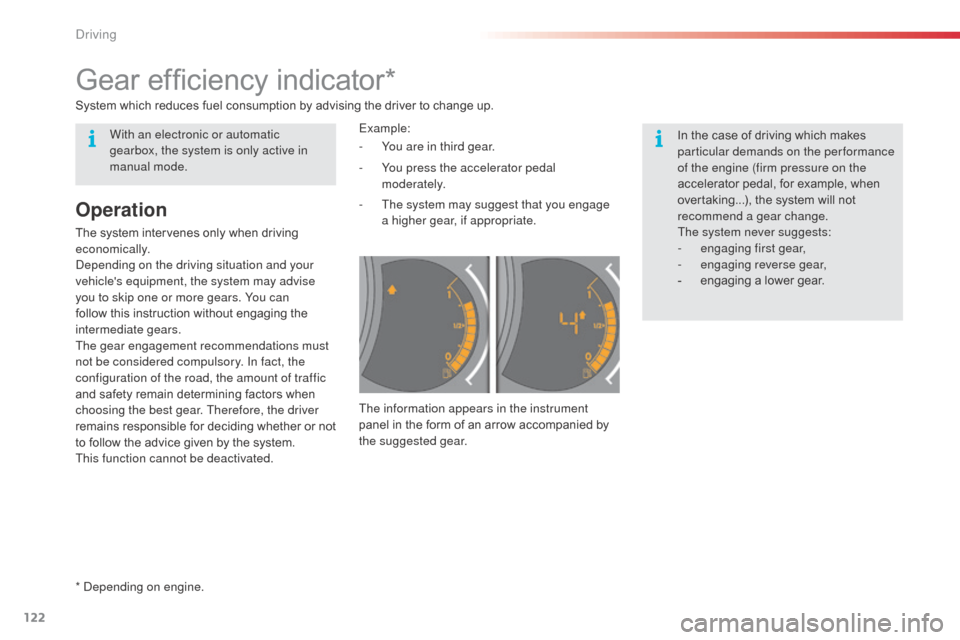
This function cannot be deactivated. Example:
-
T
he system may suggest that you engage
a higher gear, if appropriate.
-
Y
ou are in third gear.
-
Y
ou press the accelerator pedal
moderately.
* d
ep
ending on engine.With an electronic or automatic
gearbox, the system is only active in
manual mode.
The information appears in the instrument
panel in the form of an arrow accompanied by
the suggested gear.
driving
Page 125 of 284

123
The Stop & Start system puts the engine temporarily into standby - SToP mode - during stops in the traffic (red lights, traffic jams, or other...). The
engine restarts automatically - START mode - as soon as you want to move off. The restart takes place instantly, quickly and silently.
Per fect for urban use, the Stop & Start system reduces fuel consumption and exhaust emissions as well as the noise level
when stationary.
Operation
- with a manual gearbox , at speeds below
12 mph (20 km/h), when you put the gear
lever into neutral, and you release the
clutch pedal.
-
w
ith a 5 or 6-speed electronic gearbox ,
when stationary or at speeds below 5 mph
(8 km/h) (depending on version), when you
press the brake pedal or put the gear lever
in position N .
Going into engine STOP
mode
The "ECO" warning lamp comes
on in the instrument panel and the
engine goes into standby:
a
time counter calculates the sum
of the periods in ST
oP m
ode
during a journey. It rests itself
to zero every time the ignition is
switched on with the key.
Special cases: STOP mode not
available
STOP mode is not invoked when:
- t he driver's door is open,
-
t
he driver's seat belt is not fastened,
-
t
he vehicle has not exceeded 6 mph
(10 km/h) since the last engine start using
t h e key,
-
t
he engine is needed to maintain a
comfortable temperature in the passenger
compartment,
-
d
emisting is active,
-
s
ome special conditions (battery charge,
engine temperature, braking assistance,
ambient temperature...) where the engine is
needed to assure control of a system.
The "ECO" warning lamp flashes for
a few seconds then goes off.
This operation is perfectly normal.
Stop & Start
Never refuel with the engine in STOP
mode; you must switch off the ignition
with the key. For your comfort, during parking
manoeuvres, ST
oP m
ode is not
available for a few seconds after
coming out of reverse gear.
ST
oP m
ode does not affect the
functionality of the vehicle, such as for
example, braking, power steering...
9
driving
Page 196 of 284

194
Identification markings
B. Vehicle identification number on the dashboard.This number is indicated on a self-adhesive
label which is visible through the windscreen.C. Manufacturer's label.
The VI
n
is indicated on a self-destroying label
affixed to the left hand centre pillar. It bears the following information:
-
t
he tyre pressures, laden and unladen,
-
t
he tyre sizes (including the load index and
speed rating for the tyre),
-
t
he tyre pressure for the spare wheel,
-
t
he paint colour code.
The tyre pressures must be checked
when the tyres are cold, at least once
a month.
Low tyre pressures increase fuel
consumption.
A.
V
ehicle identification number (VIN)
under the bonnet.
This number is engraved on the bodywork near
the passenger compartment filter. Various visible markings for the identification of your vehicle.
D. Tyre/paint label.
This label is affixed to the left hand centre
pillar.
Technical data
Page 267 of 284
07
265
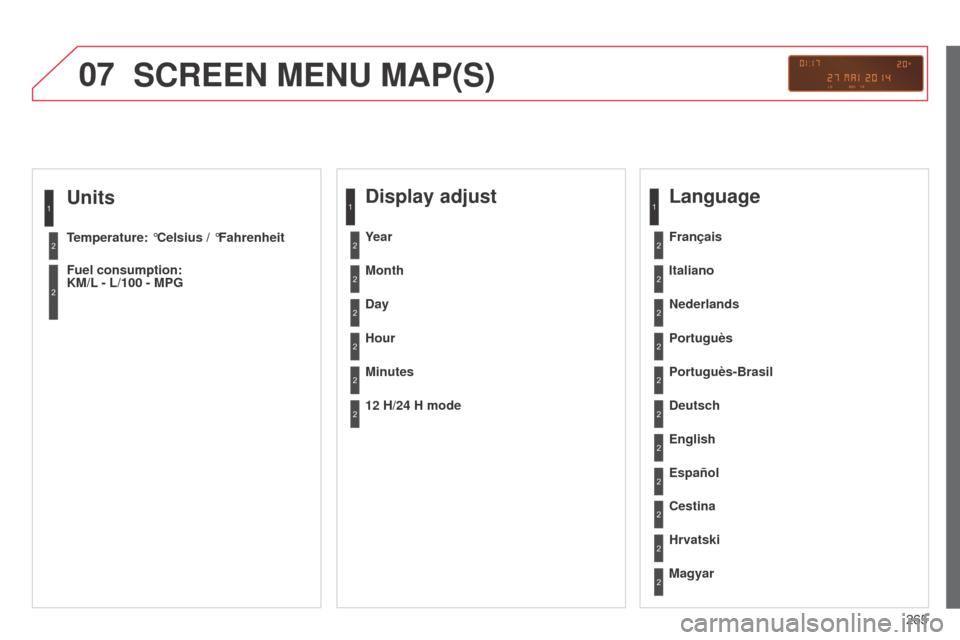
Units
Temperature: °Celsius / °Fahrenheit
Fuel consumption:
KM/L - L/100 - MPG
1
2
2
SCREEN MENU MAP(S)
Display adjust
Month
Day
Hour
Minutes Year
12 H/24 H mode
Language
Italiano
Nederlands
Portuguès
Portuguès-Brasil Français
Deutsch
Cestina English
Hrvatski Español
Magyar
1
2
2
2
2
2
2
2
1
2
2
2
2
2
2
2
2
2
2
Page 279 of 284
277
Filling with fuel ........................................6 6-68
Fitting a wheel ............................... ..............152
Fittings, boot
................................................. 84
F
itting speakers ........................................... 180
E
ba (
Emergency braking assistance)
........
105
Eco-driving
.....................................................
8
Eco-driving (advice)
........................................ 8
Economical driving
........................................ 8
Economy mode
........................................... 174
Electric window controls
............................... 60
D
F
date (setting) ............................... ......30, 33, 37da
ytime running lamps .................................73
dea
ctivating the passenger airbag
.............109
Deactivating the rear windows
.....................60
de
adlocking
.................................................. 54
d
efrosting
................................................ 41, 4 6
dem
isting
...............................
.................41, 4 4
di
als and gauges
.................................... 1 0 , 11
di
esel additive level
.................................... 141
Diesel engine pre-heat warning lamp
..........13
di
mensions
................................................. 193
di
pped beam
...............................
..........69, 158
di
pstick
................
.................................. 24, 139
di
rection indicators
...............................99, 161
do
ors
............................................................. 62
do
ors emergency control
.............................64
do
or trays
...............................
.......................79
dy
namic stability control (
dSC
)
......16
, 18, 10 6 Flashing indicators
........................................99
Foglamps, rear
..............................................70
Fragrance cartridge
......................................47
Front foglamps
......................................70, 160
Front seats
....................................................48
Fuel ............................................................ 8, 67
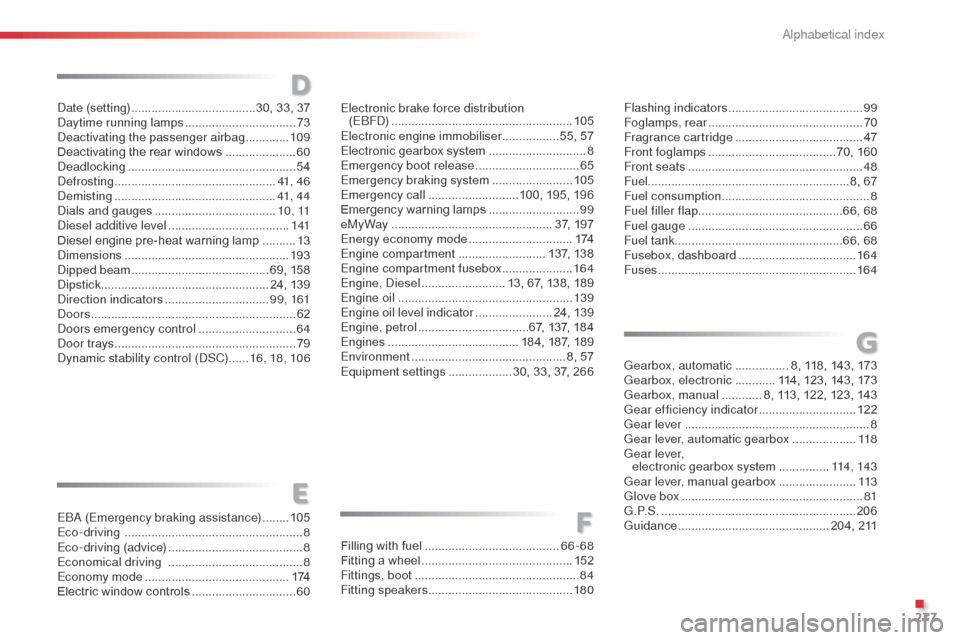
Fuel consumption
............................................ 8
F
uel filler flap ...........................................66, 68
Fuel gauge
....................................................66
Fuel tank ..................................................66, 68
Fusebox, dashboard
...................................16 4
Fuses
...........................................................16 4
Electronic brake force distribution
(EbFd)
......................................................105
Electronic engine immobiliser .................55, 57
Electronic gearbox system
.............................8
Emergency boot release
............................... 65
E
mergency braking system
........................105
Emergency call
........................... 1
00, 195, 196
Emergency warning lamps
........................... 99
e
MyWay
................................................37, 197
Energy economy mode
...............................174
Engine compartment
..........................137, 13 8
Engine compartment fusebox
.....................16 4
Engine,
d
i
esel
.........................1
3, 67, 138, 189
Engine oil
....................................................13 9
Engine oil level indicator
.......................24, 139
Engine, petrol
.................................67, 137, 184
Engines
.......................................184, 187, 189
Environment
...............................
...............8, 57
Equipment settings
...................30, 33, 37, 266
E
G
Gearbox, automatic ................8, 118, 143, 173
Gearbox, electronic ............114, 123, 143, 173
Gearbox, manual
............8, 113, 122, 123, 143
Gear efficiency indicator
.............................12 2
Gear lever
..............................
.........................8
Gear lever, automatic gearbox
................... 11
8
Gear lever, electronic gearbox system
............... 1
14, 143
Gear lever, manual gearbox
.......................113
Glove box
...................................................... 81
G . P. S .
.......................................................... 206
Guidance
............................................. 204, 211
.
alphabetical index
Page 281 of 284

279
oil change ................................................... 13 9oi
l consumption .......................................... 13 9
oil
filter
...............
......................................... 142
oi
l level .................................................. 24, 139
op
ening the bonnet
.................................... 13
5
op
ening the boot
..............................
......53, 65
op
ening the doors
...............................
...53, 62
op
ening the fuel filler flap
.............................66op
eration indicator lamps
......................12, 16
O
P
Paint colour code ........................................ 19 4
Parcel shelf, rear ........................................... 85
P
arking brake
...................................... 113 , 14 3
Parking sensors, rear ..................................131
Particle emission filter
........................141, 142
Passenger compartment filter
....................142
Player, C
d
MP3 ........................................... 257
Port, US
b
.............................. 8
2, 237, 258, 260
Preheater,
d
i
esel
.......................................... 13
Priming the fuel system
..............................13 6
Protecting children
........86 - 88, 93 -96, 98, 109
Puncture
...................................................... 14 4 Screen, colour 16/9
.......................................
37
Screen, colour and mapping ...............201, 240
Screen menu map
......................
240, 264, 266
Screen, monochrome
................
254, 264, 266
Screen, multifunction (with audio equipment)
...................
3
0, 33, 37
Screenwash
..................................................
75
Screenwash fluid level ................................
141
Screen-wash reservoir
...............................
141
Seat adjustment
...............................
.............
48
Seat belts
...................................... 9
2, 107, 108
Seat, rear bench
...........................................
50
Seats, rear
.....................................................
50
Serial number, vehicle
................................ 19
4
Service indicator ...........................................
22
Service warning light ....................................17
S
ervicing
...............................
..........................8
Setting the clock
.........................25, 30, 33, 37
Short-cut menus
.........................................202
Sidelamps
.....................................69, 159, 161
Side repeater
..............................
................159
Snow chains
................................................15
6
Spare wheel
...............................
.................149
Speakers (fitting)
.........................................180
Speed limiter
...............................................127
Speedometer
..........................................1 0 , 11
Starting the vehicle
.......................55, 114, 118
Steering mounted controls, audio
..............253
Stopping the vehicle
.....................55, 114, 118
Stop Start
..........29, 46, 66, 123, 135, 142, 171
Storage
....................................................79, 81
Storage box
................................................... 85
St
orage drawer
.............................................83
Stowing rings
................................................84
Rear foglamp
............................................... 161
Rear screen (demisting)
................................
46
Recharging the battery
............................... 17
1
Reduction of electrical load
........................
174
Regeneration of the particle emissions filter
1 4 2
Reinitialising the electric windows ................
60
Reinitialising the remote control
................... 56
R
emote control
........................................
5
3, 57
Removing a wheel ......................................
152
Removing the mat
.........................................
83
Replacing bulbs
..........................
157, 161, 162
Replacing fuses
..............................
............
16 4
Replacing the air filter
.................................
142
Replacing the oil filter
................................. 14
2
Replacing the passenger compartment filter ....................................142
Replacing wiper blades .........................76, 175
Resetting the service indicator
.....................23
Resetting the trip recorder
............................25
Rev counter
.............................................1 0 , 11
Reversing camera
.......................................13 3
Reversing lamp
........................................... 16
1
Risk areas (update)
.....................................208
Routine checks
...................................142, 143
Running out of fuel (
di
esel)
........................13
6
S
Safety for children ............................9 3, 96, 98
Scented air freshener ................................... 47
R
Radio .......................................... 229, 230, 255
Radio pre-equipment .................................. 18
0
.
alphabetical index