ECU Citroen C3 RHD 2017 2.G User Guide
[x] Cancel search | Manufacturer: CITROEN, Model Year: 2017, Model line: C3 RHD, Model: Citroen C3 RHD 2017 2.GPages: 442, PDF Size: 9.75 MB
Page 140 of 442
138
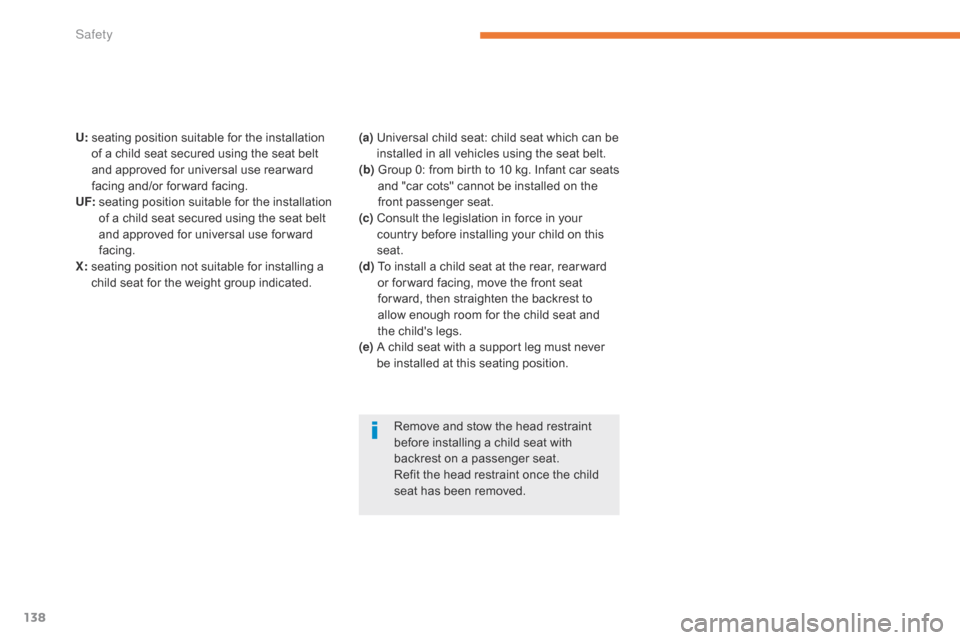
U: seating position suitable for the installation
of a child seat secured using the seat belt
and approved for universal use rear ward
facing and/or for ward facing.
UF:
s
eating position suitable for the installation
of a child seat secured using the seat belt
and approved for universal use for ward
facing.
X:
s
eating position not suitable for installing a
child seat for the weight group indicated. (a)
U niversal child seat: child seat which can be
installed in all vehicles using the seat belt.
(b)
G
roup 0: from birth to 10 kg. Infant car seats
and "car cots" cannot be installed on the
front passenger seat.
(c)
C
onsult the legislation in force in your
country before installing your child on this
seat.
(d)
T
o install a child seat at the rear, rear ward
or for ward facing, move the front seat
for ward, then straighten the backrest to
allow enough room for the child seat and
the child's legs.
(e)
A c
hild seat with a support leg must never
be installed at this seating position.
Remove and stow the head restraint
before installing a child seat with
backrest on a passenger seat.
Refit the head restraint once the child
seat has been removed.
Safety
Page 141 of 442
139
"ISOFIX" mountings
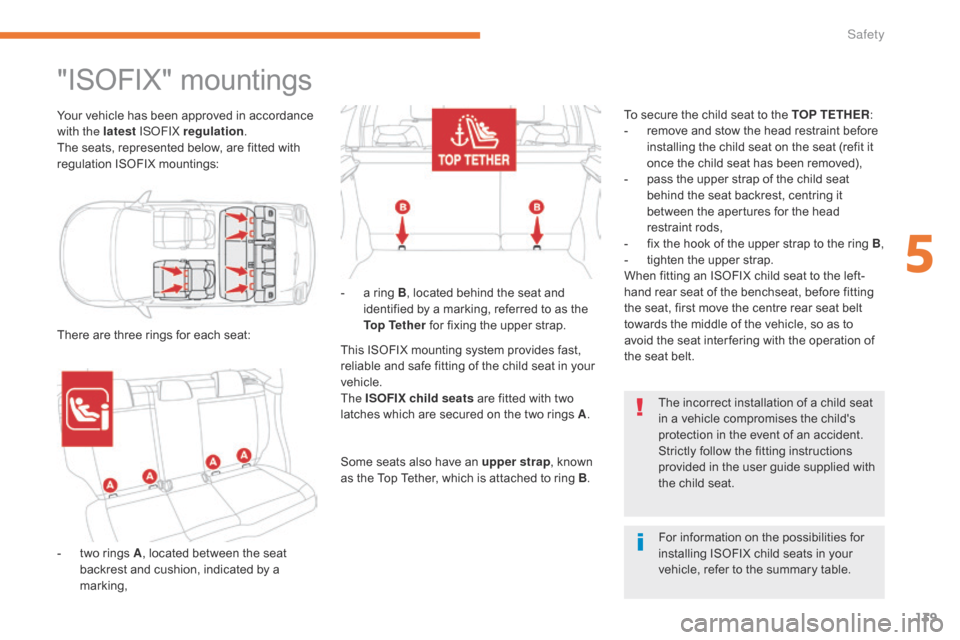
Your vehicle has been approved in accordance
with the latest ISOFIX regulation .
The seats, represented below, are fitted with
regulation ISOFIX mountings:
-
a r
ing B, located behind the seat and
identified by a marking, referred to as the
Top Tether for fixing the upper strap.
There are three rings for each seat:
-
t
wo rings A , located between the seat
backrest and cushion, indicated by a
marking, To secure the child seat to the TOP TETHER
:
- r emove and stow the head restraint before
installing the child seat on the seat (refit it
once the child seat has been removed),
-
p
ass the upper strap of the child seat
behind the seat backrest, centring it
between the apertures for the head
restraint rods,
-
f
ix the hook of the upper strap to the ring B,
-
t
ighten the upper strap.
When fitting an ISOFIX child seat to the left-
hand rear seat of the benchseat, before fitting
the seat, first move the centre rear seat belt
towards the middle of the vehicle, so as to
avoid the seat inter fering with the operation of
the seat belt.
The incorrect installation of a child seat
in a vehicle compromises the child's
protection in the event of an accident.
Strictly follow the fitting instructions
provided in the user guide supplied with
the child seat.
For information on the possibilities for
installing ISOFIX child seats in your
vehicle, refer to the summary table.
This ISOFIX mounting system provides fast,
reliable and safe fitting of the child seat in your
vehicle.
The ISOFIX child seats are fitted with two
latches which are secured on the two rings A
.
Some seats also have an upper strap , known
as the Top Tether, which is attached to ring B .
5
Safety
Page 142 of 442

140
ISOFIX child seats recommended by CITROËN
"RÖMER Baby- Safe Plus" and its ISOFIX base
(size category: E )
Group 0+: from bir th to 13 kg
Installed rear ward facing using an ISOFIX
base which is attached to the rings A .
The base has a support leg, adjustable for
height, which sits on the vehicle's floor.
This child seat can also be secured with a
seat belt. In this case, only the shell is used
and attached to the vehicle's seat by the
three-point seat belt. "RÖMER Duo Plus ISOFIX"
(size category: B1 )
Group 1: from 9 to 18 kg
Is installed only in the for ward facing
position.
Is attached to the rings A and the upper
ring
B, referred to as the TOP TETHER,
using an upper strap.
Three seat body angles: sitting, reclining,
lying down.
This child seat can also be used on seats
not equipped with ISOFIX mountings. In
this case, it must be secured to the vehicle's
seat by the three-point seat belt. Adjust the
position of the vehicle's front seat so that the
child's feet are not touching the backrest.
CITROËN offers a range of ISOFIX child seats listed and type approved for your vehicle.
Refer also to the child seat
manufacturer's fitting instructions for
information on installing and removing
the seat.
Safety
Page 144 of 442
142
(a) Refer to the legislation in force in your country before installing a child at this
seating position.
Remove and stow the head restraint
before installing a child seat with a
backrest on a passenger seat. Refit the
head restraint once the child seat has
been removed.
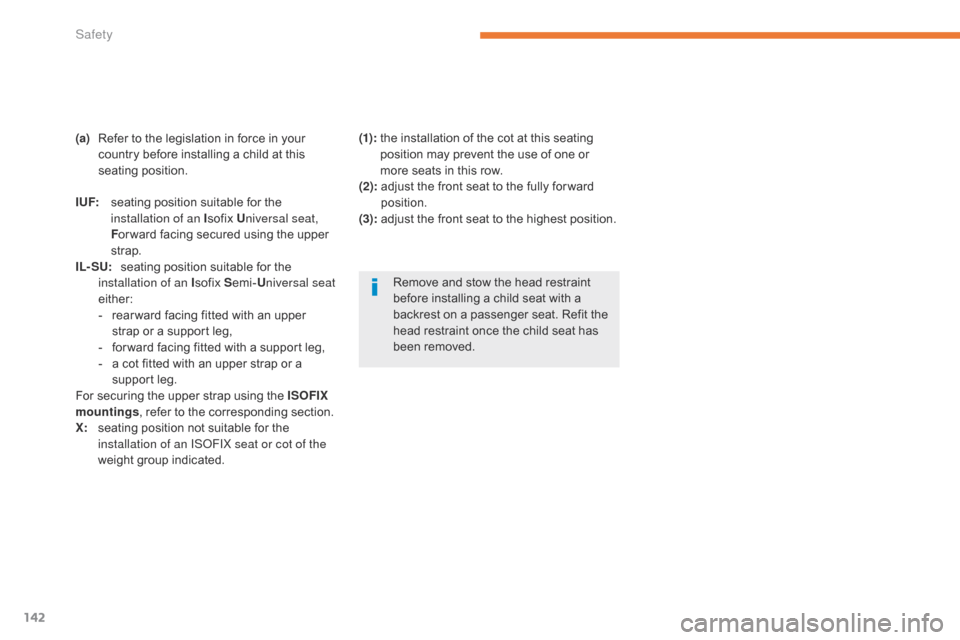
I UF:
s
eating position suitable for the
installation of an I sofix Universal seat,
F or ward facing secured using the upper
strap.
IL- SU:
s
eating position suitable for the
installation of an I sofix Semi-Universal seat
either:
-
r
ear ward facing fitted with an upper
strap or a support leg,
-
f
or ward facing fitted with a support leg,
-
a c
ot fitted with an upper strap or a
support leg.
For securing the upper strap using the ISOFIX
mountings , refer to the corresponding section.
X:
s
eating position not suitable for the
installation of an ISOFIX seat or cot of the
weight group indicated. (1):
t he installation of the cot at this seating
position may prevent the use of one or
more seats in this row.
(2):
a
djust the front seat to the fully for ward
position.
(3): adjust the front seat to the highest position.
Safety
Page 147 of 442
145
Advice
Children at the front
The legislation on carrying children on the
front passenger seat is specific to each
country. Refer to the legislation in force in
your country.
Deactivate the passenger's front airbag
when a rear ward facing child seat is installed
on the front passenger seat.
Otherwise, the child risks being seriously
injured or killed if the airbag is deployed.For optimum installation of the forward facing
child seat, ensure that the back of the child
seat is as close as possible to the backrest
of the vehicle's seat, in contact if possible.
You must remove the head restraint before
installing a child seat with backrest to a
passenger seat.
Ensure that the head restraint is stored or
attached securely to prevent it from being
thrown around the vehicle in the event of
sharp braking. Refit the head restraint when
the child seat is removed.
Installing a booster seat
The chest part of the seat belt must be
positioned on the child's shoulder without
touching the neck.
Ensure that the lap part of the seat belt
passes correctly over the child's thighs.
CITROËN recommends the use of a booster
seat which has a back, fitted with a seat belt
guide at shoulder level.
As a safety precaution, do not leave:
-
a c
hild or children alone and
unsupervised in a vehicle,
-
a c
hild or an animal in a vehicle which
is exposed to the sun, with the windows
closed,
-
t
he keys within reach of children inside
the vehicle.
To prevent accidental opening of the doors
and rear windows, use the child lock.
Take care not to open the rear windows by
more than one third.
To protect young children from the rays of
the sun, fit side blinds on the rear windows.
The incorrect installation of a child seat in a
vehicle compromises the child's protection in
the event of an accident.
Ensure that there is no seat belt or seat belt
buckle under the child seat, as this could
destabilise it.
Remember to fasten the seat belts or the
child seat harnesses keeping the slack
relative to the child's body to a minimum,
even for short journeys.
When installing a child seat using the seat
belt, ensure that the seat belt is tightened
correctly on the child seat and that it secures
the child seat firmly on the seat of your
vehicle. If your passenger seat is adjustable,
move it for wards if necessary.
At rear seating positions, always leave
sufficient space between the front seat and:
-
a r
ear ward facing child seat,
-
t
he child's feet for a child seat fitted
forward facing.
To do this, move the front seat for wards
and, if necessary, move its backrest into the
upright position.
5
Safety
Page 191 of 442
189
CITROËN ConnectedCAM™*
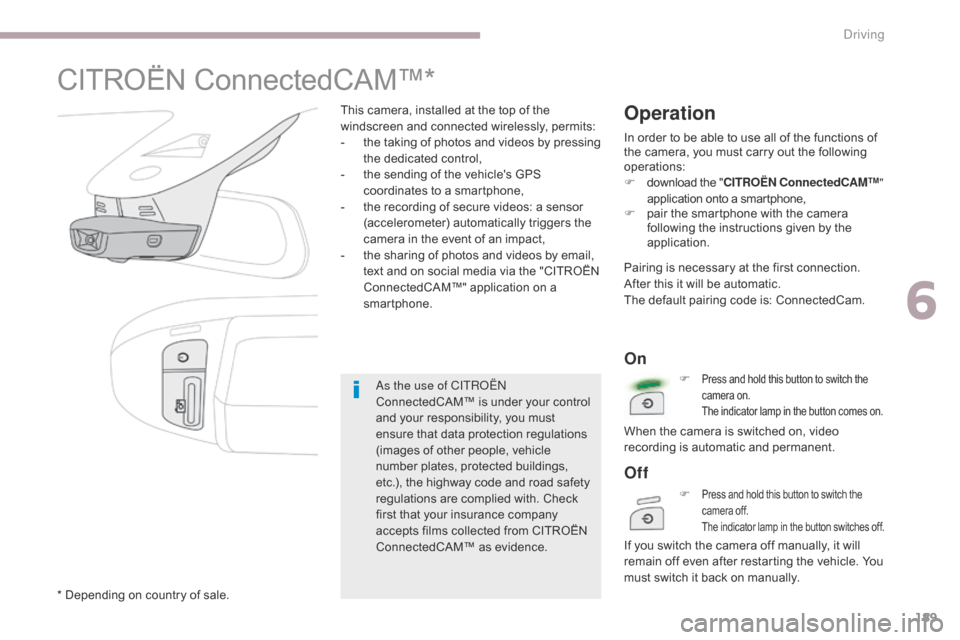
This camera, installed at the top of the
windscreen and connected wirelessly, permits:
-
t
he taking of photos and videos by pressing
the dedicated control,
-
t
he sending of the vehicle's GPS
coordinates to a smartphone,
-
t
he recording of secure videos: a sensor
(accelerometer) automatically triggers the
camera in the event of an impact,
-
t
he sharing of photos and videos by email,
text and on social media via the "CITROËN
ConnectedCAM™" application on a
smartphone.
*
Depending on country of sale. As the use of CITROËN
ConnectedCAM™ is under your control
and your responsibility, you must
ensure that data protection regulations
(images of other people, vehicle
number plates, protected buildings,
etc.), the highway code and road safety
regulations are complied with. Check
first that your insurance company
accepts films collected from CITROËN
ConnectedCAM™ as evidence.Operation
In order to be able to use all of the functions of
the camera, you must carry out the following
operations:
F
d
ownload the " CITROËN ConnectedCAM™ "
application onto a smartphone,
F
p
air the smartphone with the camera
following the instructions given by the
application.
Pairing is necessary at the first connection.
After this it will be automatic.
The default pairing code is: ConnectedCam.
On
F Press and hold this button to switch the
camera on.
T
he indicator lamp in the button comes on.
Off
F Press and hold this button to switch the
camera off.
T
he indicator lamp in the button switches off.
If you switch the camera off manually, it will
remain off even after restarting the vehicle. You
must switch it back on manually. When the camera is switched on, video
recording is automatic and permanent.
6
Driving
Page 202 of 442
200
Roof bars
Observe the fitting instructions and the
conditions of use given in the information
provided with the roof bars. For safety reasons and to avoid damaging the
roof, it is essential to use transverse roof bars
that are approved for your vehicle.Maximum load, distributed over the roof
bars, for a loading height not exceeding
40 cm: 70 kg
.
This value is subject to change, please
check the maximum load stated in the
instructions provided with he roof bars.
If the height exceeds 40 cm, adapt the
speed of the vehicle to the profile of the
road to avoid damaging the roof bars
and the fixings on the vehicle.
Please refer to national legislation so as
to meet the requirements on carrying
objects that are longer than the vehicle.
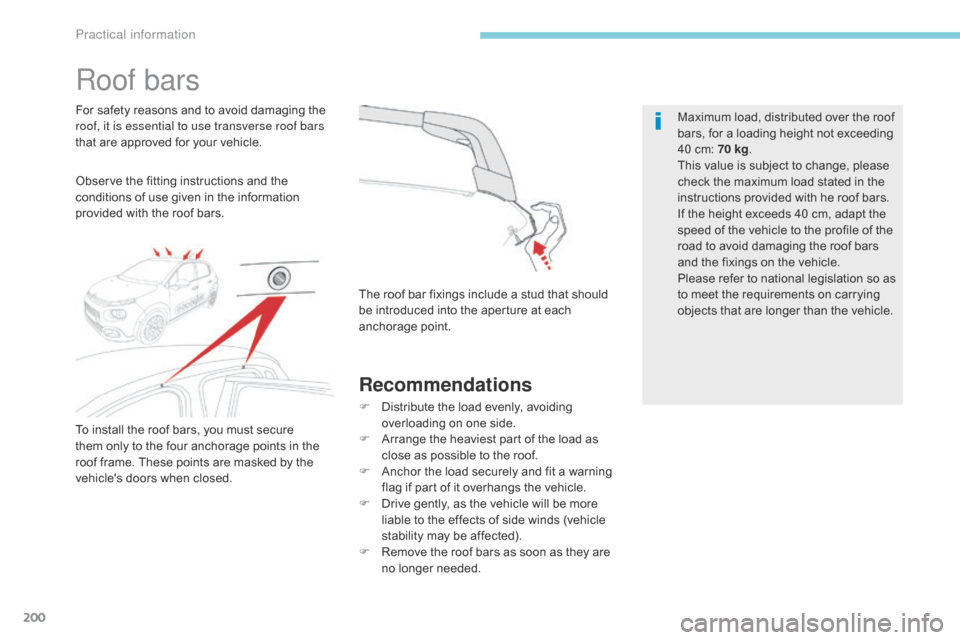
To install the roof bars, you must secure
them only to the four anchorage points in the
roof frame. These points are masked by the
vehicle's doors when closed. The roof bar fixings include a stud that should
be introduced into the aperture at each
anchorage point.
Recommendations
F Distribute the load evenly, avoiding
overloading on one side.
F
A
rrange the heaviest part of the load as
close as possible to the roof.
F
A
nchor the load securely and fit a warning
flag if part of it overhangs the vehicle.
F
D
rive gently, as the vehicle will be more
liable to the effects of side winds (vehicle
stability may be affected).
F
R
emove the roof bars as soon as they are
no longer needed.
Practical information
Page 217 of 442
215
Warning triangle
The triangle can be stored on the rear face of
the boot, secured by straps.
Assembling the triangle
As a safety precaution, before leaving your
vehicle to set up and install the triangle, switch
on the hazard warning lamps and put on your
high visibility vest.Refer to the instructions provided with the
triangle.
Positioning the triangle
Running out of fuel
(Diesel)
On vehicles fitted with Diesel engines, the fuel
system must be primed if you run out of fuel. For more information on Misfuel
prevention (Diesel) , refer to the
corresponding section.
If the engine does not start first
time, don't keep trying, but start the
procedure again from the beginning.
BlueHDi engines
F Fill the fuel tank with at least five litres of Diesel.
F
S
witch on the ignition (without starting the
engine).
F
W
ait around 6 seconds and switch off the
ignition.
F
R
epeat the operation 10 times.
F
O
perate the starter to run the engine.
F
P
lace the triangle behind the vehicle, as
required by local legislation.
Other HDi engines
(except BlueHDi version)
F A dd at least five litres of Diesel fuel to the
tank.
F
O
pen the bonnet.
F
I
f necessary, unclip the styling cover for
access to the priming pump.
F
S
queeze and release the priming pump
repeatedly until resistance is felt (there
may be resistance at the first press).
F
O
perate the starter to start the engine
(if the engine does not start at the first
attempt, wait around 15 seconds before
trying again).
F
I
f the engine does not start after a few
attempts, operate the priming pump again
then start the engine.
F
R
efit the styling cover and clip it in place.
F
C
lose the bonnet.
8
In the event of a breakdown
Page 218 of 442
216
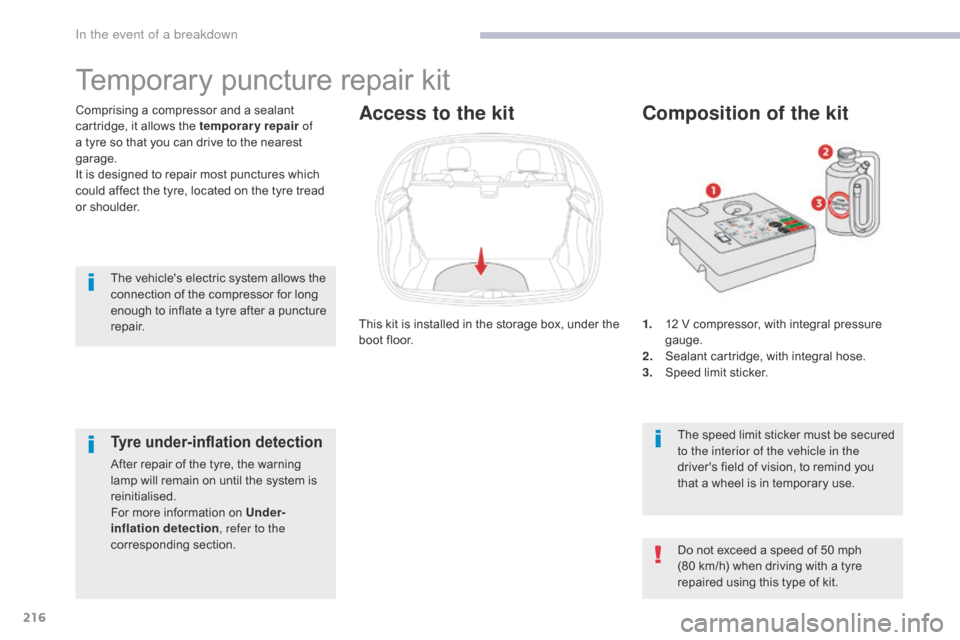
1. 12 V compressor, with integral pressure gauge.
2.
S
ealant cartridge, with integral hose.
3.
S
peed limit sticker.
Composition of the kit
The speed limit sticker must be secured
to the interior of the vehicle in the
driver's field of vision, to remind you
that a wheel is in temporary use.
The vehicle's electric system allows the
connection of the compressor for long
enough to inflate a tyre after a puncture
repair.
This kit is installed in the storage box, under the
boot floor.
Comprising a compressor and a sealant
cartridge, it allows the temporary repair
of
a tyre so that you can drive to the nearest
garage.
It is designed to repair most punctures which
could affect the tyre, located on the tyre tread
or shoulder.
Temporary puncture repair kit
Access to the kit
Do not exceed a speed of 50 mph
(80 km/h) when driving with a tyre
repaired using this type of kit.
Tyre under-inflation detection
After repair of the tyre, the warning
lamp will remain on until the system is
reinitialised.
For more information on Under-
inflation detection , refer to the
corresponding section.
In the event of a breakdown
Page 219 of 442
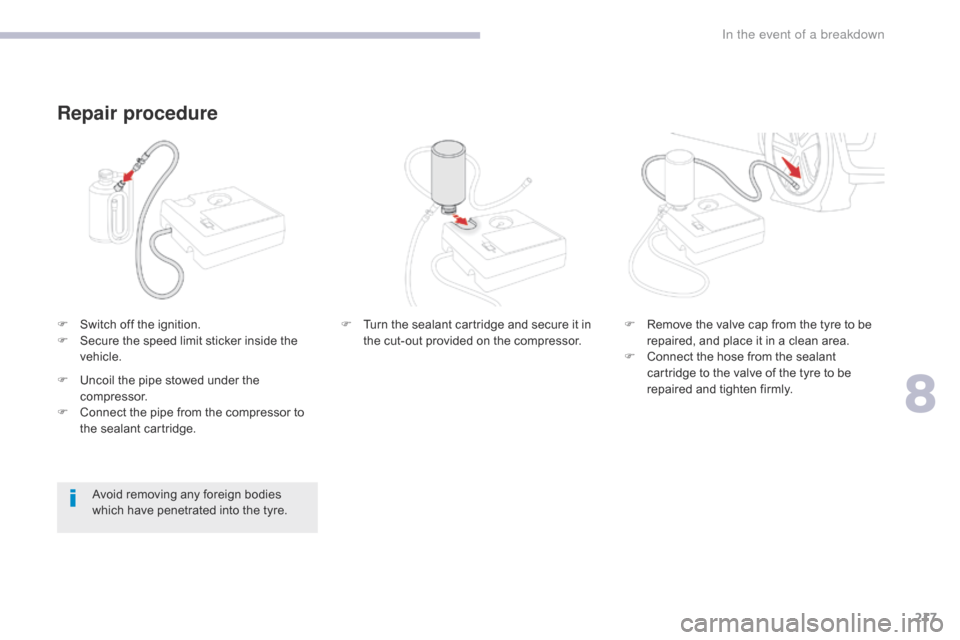
217
F Switch off the ignition.
F S ecure the speed limit sticker inside the
vehicle.
Repair procedure
Avoid removing any foreign bodies
which have penetrated into the tyre. F
T
urn the sealant cartridge and secure it in
the cut-out provided on the compressor. F
R
emove the valve cap from the tyre to be
repaired, and place it in a clean area.
F
C
onnect the hose from the sealant
cartridge to the valve of the tyre to be
repaired and tighten firmly.
F
U
ncoil the pipe stowed under the
compressor.
F
C
onnect the pipe from the compressor to
the sealant cartridge.
8
In the event of a breakdown