light Citroen C3 RHD 2017 2.G Workshop Manual
[x] Cancel search | Manufacturer: CITROEN, Model Year: 2017, Model line: C3 RHD, Model: Citroen C3 RHD 2017 2.GPages: 442, PDF Size: 9.75 MB
Page 211 of 442
209
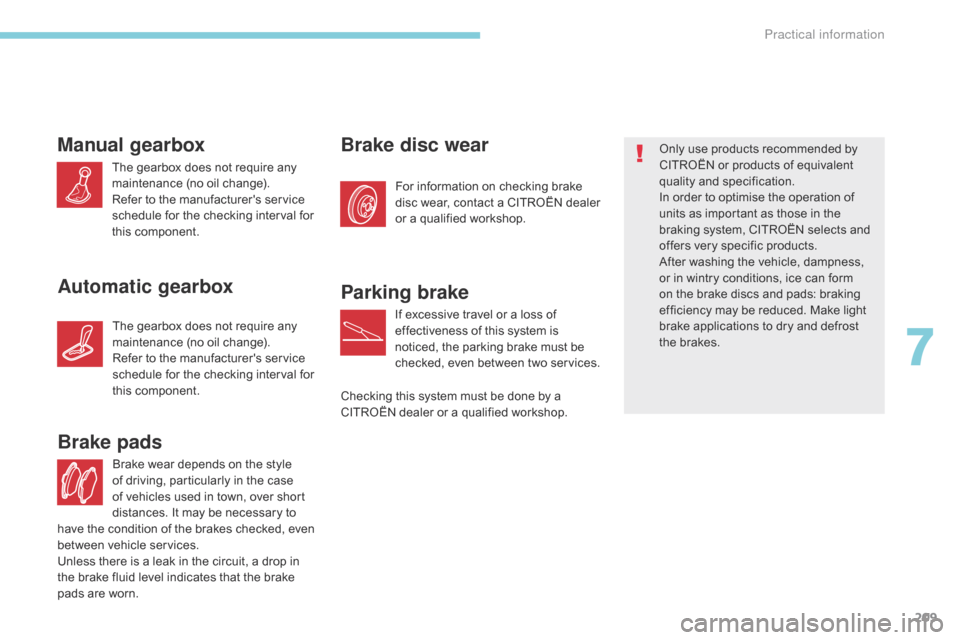
Brake wear depends on the style
of driving, particularly in the case
of vehicles used in town, over short
distances. It may be necessary to
Brake pads
For information on checking brake
disc wear, contact a CITROËN dealer
or a qualified workshop.
Brake disc wearOnly use products recommended by
CITROËN or products of equivalent
quality and specification.
In order to optimise the operation of
units as important as those in the
braking system, CITROËN selects and
offers very specific products.
After washing the vehicle, dampness,
or in wintry conditions, ice can form
on the brake discs and pads: braking
efficiency may be reduced. Make light
brake applications to dry and defrost
the brakes.Manual gearbox
The gearbox does not require any
maintenance (no oil change).
Refer to the manufacturer's service
schedule for the checking interval for
this component.
Automatic gearbox
The gearbox does not require any
maintenance (no oil change).
Refer to the manufacturer's service
schedule for the checking interval for
this component.
Parking brake
If excessive travel or a loss of
effectiveness of this system is
noticed, the parking brake must be
checked, even between two services.
Checking this system must be done by a
CITROËN dealer or a qualified workshop.
have the condition of the brakes checked, even
between vehicle services.
Unless there is a leak in the circuit, a drop in
the brake fluid level indicates that the brake
pads are worn.
7
Practical information
Page 214 of 442
212
Recommendations on storage
Never store bottles of AdBlue® in your
vehicle.
Procedure
Park the vehicle
F Switch off the ignition and remove the key from the switch to switch off the engine.
or
F
W
ith Keyless Entry and Starting, press the
" START/STOP " button to switch off the
engine.
AdBlue
® freezes at about -11°C and
deteriorates above 25°C. It is recommended
that bottles be stored in a cool area and
protected from direct sunlight .
Under these conditions, the fluid can be kept
for at least a year .
If the additive has frozen, it can be used once it
has completely thawed out. Before topping up, ensure that the vehicle is
parked on a flat and level sur face.
In wintry conditions, ensure that the
temperature of the vehicle is above -11°C.
Otherwise the AdBlue
® may be frozen and
so cannot be poured into its tank. Park your
vehicle in a warmer area for a few hours to
allow the top-up to be carried out.
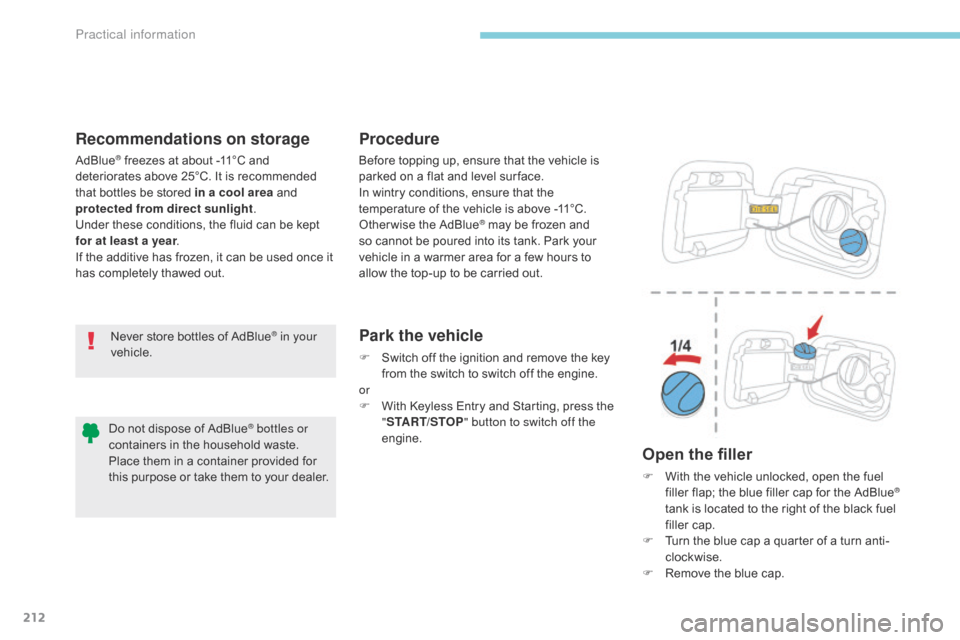
Open the filler
F With the vehicle unlocked, open the fuel filler flap; the blue filler cap for the AdBlue®
tank is located to the right of the black fuel
filler cap.
F
T
urn the blue cap a quarter of a turn anti-
clockwise.
F
R
emove the blue cap.
Do not dispose of AdBlue
® bottles or
containers in the household waste.
Place them in a container provided for
this purpose or take them to your dealer.
Practical information
Page 231 of 442
229
Changing a bulb
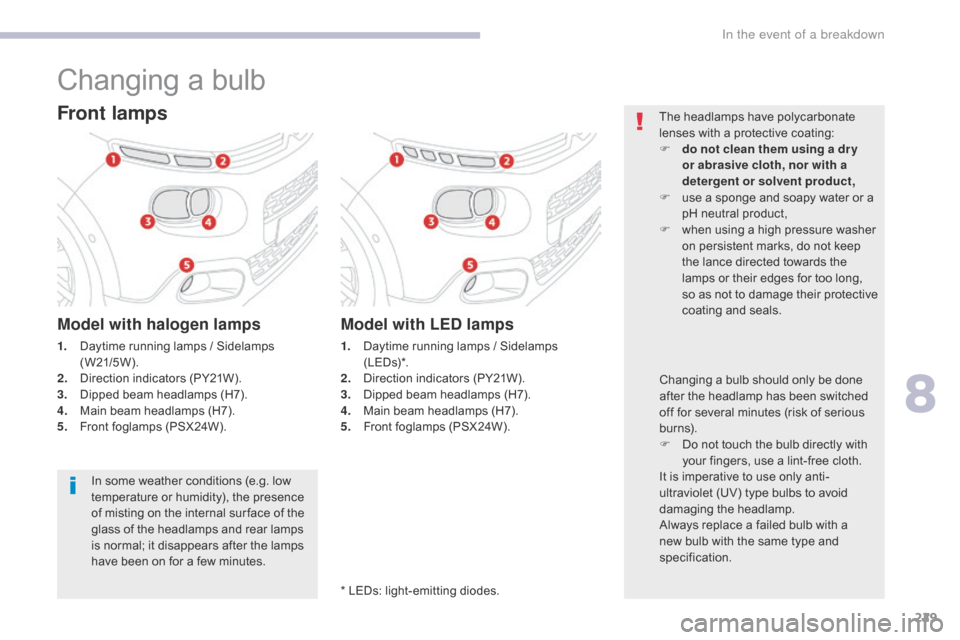
Front lamps
Model with halogen lamps
1. Daytime running lamps / Sidelamps ( W21/5W ).
2.
D
irection indicators (PY21W).
3.
D
ipped beam headlamps (H7).
4.
M
ain beam headlamps (H7).
5.
F
ront foglamps (PSX24W).In some weather conditions (e.g. low
temperature or humidity), the presence
of misting on the internal sur face of the
glass of the headlamps and rear lamps
is normal; it disappears after the lamps
have been on for a few minutes. The headlamps have polycarbonate
lenses with a protective coating:
F
d
o not clean them using a dr y
or abrasive cloth, nor with a
detergent or solvent product,
F
u
se a sponge and soapy water or a
pH neutral product,
F
w
hen using a high pressure washer
on persistent marks, do not keep
the lance directed towards the
lamps or their edges for too long,
so as not to damage their protective
coating and seals.
Changing a bulb should only be done
after the headlamp has been switched
off for several minutes (risk of serious
burns).
F
D
o not touch the bulb directly with
your fingers, use a lint-free cloth.
It is imperative to use only anti-
ultraviolet (UV) type bulbs to avoid
damaging the headlamp.
Always replace a failed bulb with a
new bulb with the same type and
specification.
* LEDs: light-emitting diodes.
Model with LED lamps
1. Daytime running lamps / Sidelamps (LEDs)*.
2.
D
irection indicators (PY21W).
3.
D
ipped beam headlamps (H7).
4.
M
ain beam headlamps (H7).
5.
F
ront foglamps (PSX24W).
8
In the event of a breakdown
Page 237 of 442
235
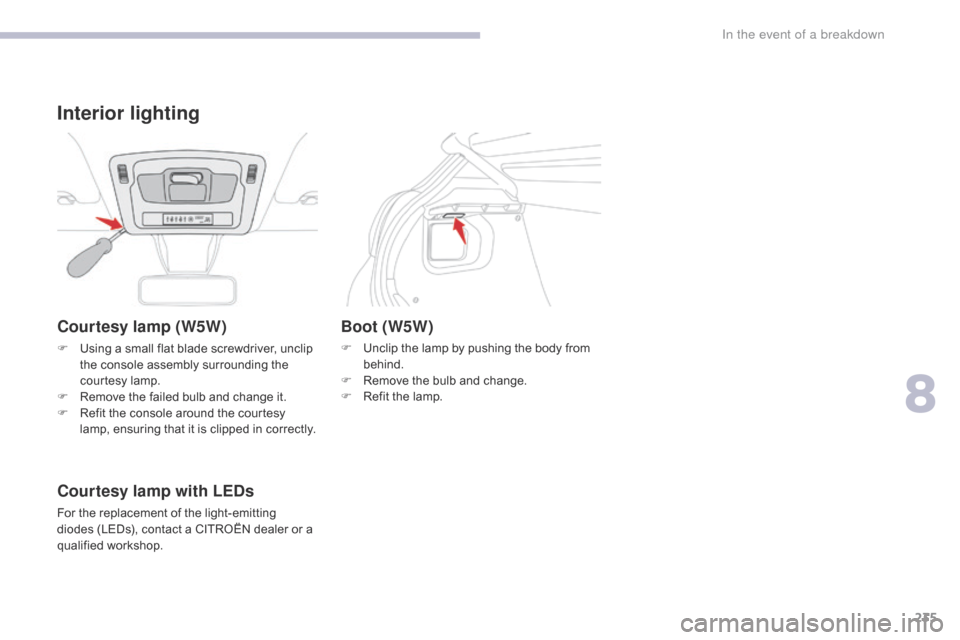
Courtesy lamp (W5W)
F Using a small flat blade screwdriver, unclip the console assembly surrounding the
courtesy lamp.
F
R
emove the failed bulb and change it.
F
R
efit the console around the courtesy
lamp, ensuring that it is clipped in correctly.
Boot (W5W)
F Unclip the lamp by pushing the body from behind.
F
R
emove the bulb and change.
F
R
efit the lamp.
Interior lighting
Courtesy lamp with LEDs
For the replacement of the light-emitting
diodes (LEDs), contact a CITROËN dealer or a
qualified workshop.
8
In the event of a breakdown
Page 246 of 442
244
When your vehicle's battery is discharged, the
engine can be started using a slave battery
(external or on another vehicle) and jump lead
cables or a battery booster.
Starting using another battery
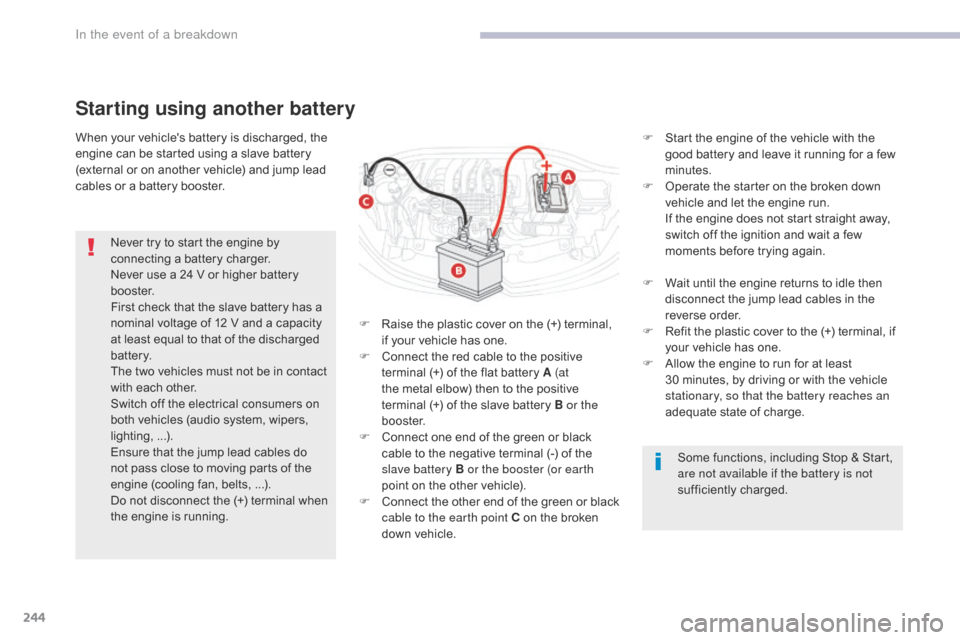
F Raise the plastic cover on the (+) terminal, if your vehicle has one.
F
C
onnect the red cable to the positive
terminal (+) of the flat battery A (at
the metal elbow) then to the positive
terminal
(+) of the slave battery B or the
b o o s t e r.
F
C
onnect one end of the green or black
cable to the negative terminal (-) of the
slave battery B or the booster (or earth
point on the other vehicle).
F
C
onnect the other end of the green or black
cable to the earth point C on the broken
down vehicle. F
S
tart the engine of the vehicle with the
good battery and leave it running for a few
minutes.
F
O
perate the starter on the broken down
vehicle and let the engine run.
I
f the engine does not start straight away,
switch off the ignition and wait a few
moments before trying again.
Never try to start the engine by
connecting a battery charger.
Never use a 24 V or higher battery
b o o s t e r.
First check that the slave battery has a
nominal voltage of 12 V and a capacity
at least equal to that of the discharged
battery.
The two vehicles must not be in contact
with each other.
Switch off the electrical consumers on
both vehicles (audio system, wipers,
lighting,
...
).
Ensure that the jump lead cables do
not pass close to moving parts of the
engine (cooling fan, belts,
...).
Do not disconnect the (+) terminal when
the engine is running. F
W
ait until the engine returns to idle then
disconnect the jump lead cables in the
reverse order.
F R efit the plastic cover to the (+) terminal, if
your vehicle has one.
F
A
llow the engine to run for at least
30
minutes, by driving or with the vehicle
stationary, so that the battery reaches an
adequate state of charge.
Some functions, including Stop & Start,
are not available if the battery is not
sufficiently charged.
In the event of a breakdown
Page 247 of 442
245
Charging the battery using a battery charger
For optimum service life of the battery, it is
essential to maintain an adequate state of
charge.
In some circumstances it may be necessary to
charge the battery:
-
i
f you use your vehicle essentially for short
journeys,
-
i
f the vehicle is to be taken off the road for
several weeks.
Contact a CITROËN dealer or a qualified
workshop. It is not necessary to disconnect the
battery.
Never try to charge a frozen battery.
If the battery has been frozen, have
it checked by a CITROËN dealer or a
qualified workshop, who will check that
the internal components have not been
damaged and the casing is not cracked,
which could cause a leak of toxic and
corrosive acid.
If you envisage charging your vehicle's
battery yourself, use only a charger
compatible with lead-acid batteries of a
nominal voltage of 12 V.
If this label is present, it is essential
to use only a 12 V charger, to avoid
causing irreversible damage to the
electrical components related to the
Stop & Start system. Follow the instructions for use provided
by the manufacturer of the charger.
Never reverse polarities.
F
S
witch off the ignition.
F
S
witch off all electrical consumers (audio
system, lighting, wipers,
...).
F
S
witch off the charger B before connecting
the cables to the battery, so as to avoid any
dangerous sparks.
F
E
nsure that the charger cables are in good
condition.
F
R
aise the plastic cover, if your vehicle has
one, on the (+) terminal.
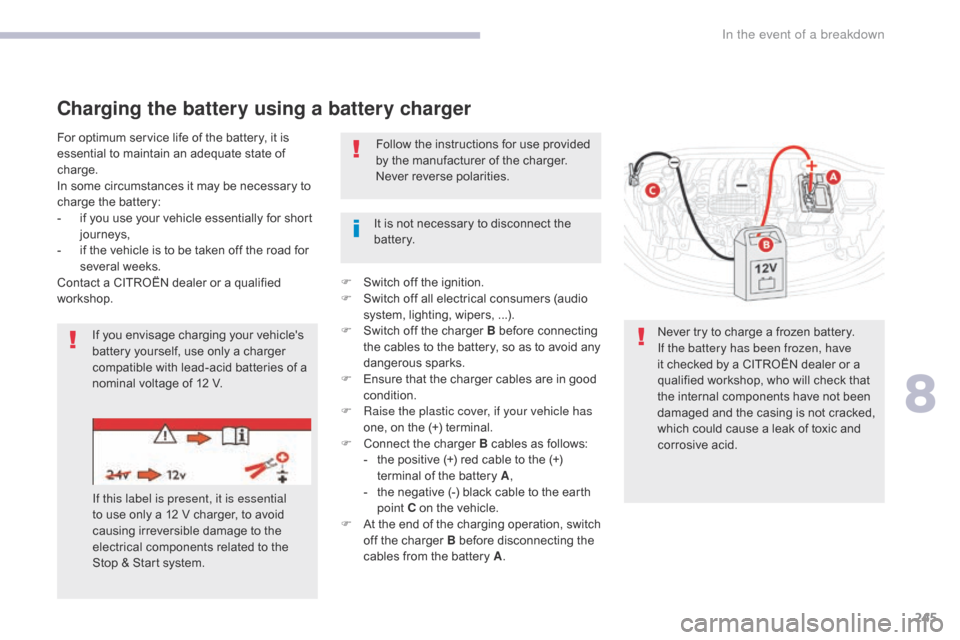
F
C
onnect the charger B cables as follows:
-
t
he positive (+) red cable to the (+)
terminal of the battery A ,
-
t
he negative (-) black cable to the earth
point C on the vehicle.
F
A
t the end of the charging operation, switch
off the charger B before disconnecting the
cables from the battery A .
8
In the event of a breakdown
Page 248 of 442
246
Do not force the lever as locking will
not be possible if the clamp is not
positioned correctly; start the procedure
again.
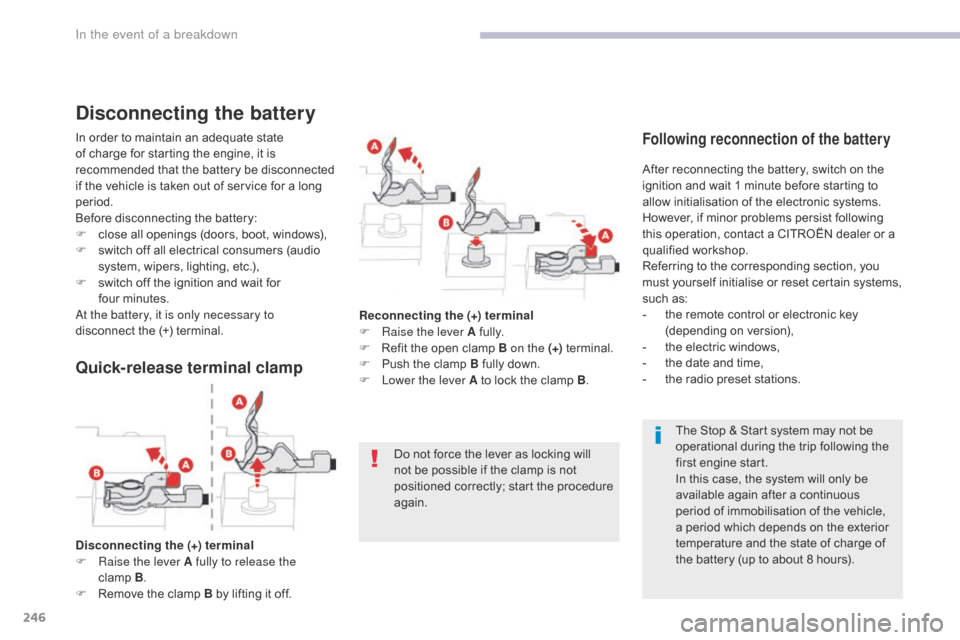
Quick-release terminal clamp
Disconnecting the (+) terminal
F Ra ise the lever A fully to release the
clamp
B .
F
R
emove the clamp B by lifting it off. The Stop & Start system may not be
operational during the trip following the
first engine start.
In this case, the system will only be
available again after a continuous
period of immobilisation of the vehicle,
a period which depends on the exterior
temperature and the state of charge of
the battery (up to about 8 hours).
In order to maintain an adequate state
of charge for starting the engine, it is
recommended that the battery be disconnected
if the vehicle is taken out of service for a long
period.
Before disconnecting the battery:
F
c
lose all openings (doors, boot, windows),
F
s
witch off all electrical consumers (audio
system, wipers, lighting, etc.),
F
s
witch off the ignition and wait for
four
m
inutes.
At the battery, it is only necessary to
disconnect the (+) terminal.
Disconnecting the battery
After reconnecting the battery, switch on the
ignition and wait 1 minute before starting to
allow initialisation of the electronic systems.
However, if minor problems persist following
this operation, contact a CITROËN dealer or a
qualified workshop.
Referring to the corresponding section, you
must yourself initialise or reset certain systems,
such as:
-
t
he remote control or electronic key
(depending on version),
-
t
he electric windows,
-
t
he date and time,
-
t
he radio preset stations.
Following reconnection of the battery
Reconnecting the (+) terminal
F Ra ise the lever A fully.
F
R
efit the open clamp B on the (+) terminal.
F
P
ush the clamp B fully down.
F
L
ower the lever A to lock the clamp B .
In the event of a breakdown
Page 251 of 442
249
Engines
Engine characteristics
The engine characteristics (capacity, maximum
power, maximum engine speed, fuel, CO
2
emissions, etc.) for your vehicle are given in
the registration document, as well as in sales
brochures.
These characteristics correspond to the
values type-approved on a test bed, under
conditions defined in European legislation
(Directive
1
999/99/EC).
For more information, contact a CITROËN
dealer or a qualified workshop.
Weights
Weights and towed loads
The maximum weights and towed loads for your
vehicle are given are given in the registration
document, as well as in sales brochures.
These values are also present on the
manufacturer's plate or label.
For more information, contact a CITROËN
dealer or a qualified workshop.
The kerb weight is equal to the unladen
weight
+ driver (75 kg).
The GTW and towed load values indicated
apply up to a maximum altitude of
1
000 metres; the towed load mentioned
must be reduced by 10 % for every additional
1
000 metres.
The weight of the braked trailer can be
increased, within the GTW limit, on condition
that the GV W of the towing vehicle is reduced
by the same amount.
The recommended nose weight is the vertical
load on the towbar ball (removable with or
without tools).
GV W: gross vehicle weight, the maximum
authorised vehicle weight.
GT W: gross train weight, the maximum
authorised weight of vehicle plus trailer. High exterior temperatures may result
in a reduction in the per formance of
the vehicle to protect the engine; when
the exterior temperature is higher than
37
°C, limit the towed weight.
Towing with a lightly loaded vehicle can
adversely affect roadholding.
Braking distances are increased when
towing a trailer.
Never exceed 60 mph (100 km/h) when
towing (comply with the legislation in
force in your country).
If the exterior temperature is high, it
is recommended that the engine be
allowed to idle for 1 to 2 minutes after
the vehicle comes to a stop, to facilitate
its cooling.
9
Technical data
Page 256 of 442
254
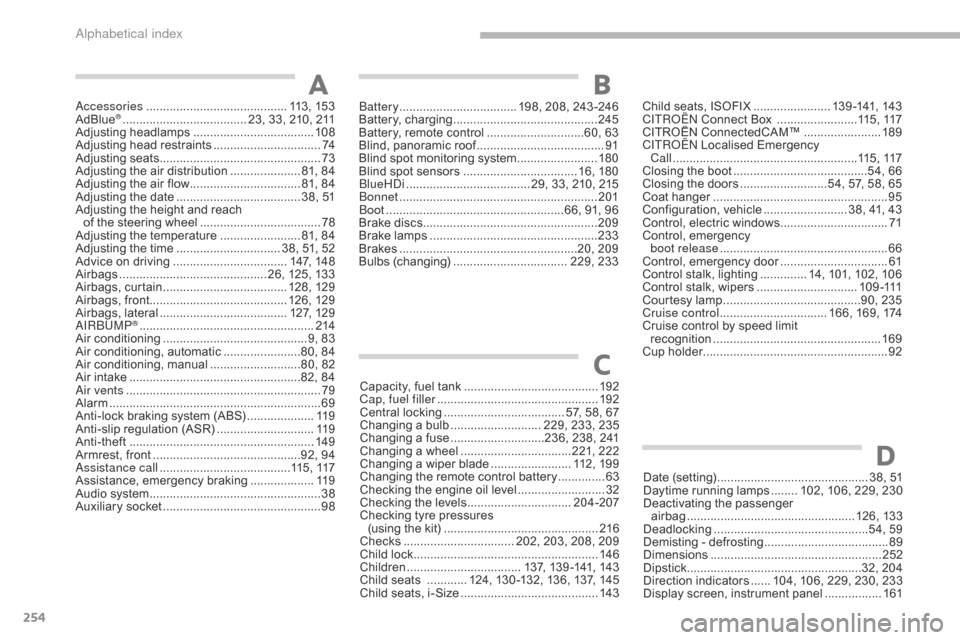
Accessories .......................................... 113, 153
AdBlue® ............................... ...... 23, 33, 210, 211
Adjusting headlamps .................................... 10
8
Adjusting head restraints
................................ 74
A
djusting seats
................................................ 73
A
djusting the air distribution
..................... 8
1, 84
Adjusting the air flow
................................. 8
1, 84
Adjusting the date
..................................... 3
8, 51
Adjusting the height and reach of the steering wheel
.................................... 78
A
djusting the temperature
........................ 8
1, 84
Adjusting the time
............................... 3
8, 51, 52
Advice on driving
..............................
....147, 148
Airbags
...............
............................. 26, 125, 133
Airbags, curtain
..................................... 12
8, 129
Airbags, front......................................... 126, 129
Airbags, lateral
...................................... 12
7, 129
AIRBUMP
® .................................................... 2 14
Air conditioning ............................... ............9, 83
Air conditioning, automatic
.......................8
0, 84
Air conditioning, manual
...........................8
0, 82
Air intake
...............
....................................82, 84
Air vents
..............................
............................ 79
Alarm
............................................................... 69
A
nti-lock braking system (ABS)
....................11
9
Anti-slip regulation (ASR)
............................. 11
9
Anti-theft
..............................
.........................149
Armrest, front
............................................9
2, 94
Assistance call
...............................
........115 , 117
Assistance, emergency braking
................... 11
9
Audio system
...............................
....................38
Auxiliary socket
............................................... 98
ABChild seats, ISOFIX .......................1 3 9 -141, 143
C ITROËN C onnect Box ........................11
5 , 117
CITROËN ConnectedCAM™
....................... 18
9
C
ITROËN
Localised Emergency
Call
........
............................................... 115 , 117
Closing the boot
...............................
.........54, 66
Closing the doors
..........................5
4, 57, 58, 65
Coat hanger
..............................
......................95
Configuration, vehicle
......................... 3
8, 41, 43
Control, electric windows
................................71
C
ontrol, emergency
boot release
...............................
...................66
Control, emergency door
................................ 61
C
ontrol stalk, lighting
.............. 1
4, 101, 102, 106
Control stalk, wipers
..............................1
0 9 -111
Courtesy lamp
...............................
..........90, 235
Cruise control
................................ 1
66, 169, 174
Cruise control by speed limit recognition
.................................................. 16
9
Cup holder
...............................
........................92
Capacity, fuel tank
..............................
.......... 192
Cap, fuel filler
................................................ 19
2
Central locking
.................................... 5
7, 58, 67
Changing a bulb
........................... 2
29, 233, 235
Changing a fuse
............................2
36, 238, 241
Changing a wheel
...............................
.. 221, 222
Changing a wiper blade
........................ 1
12, 199
Changing the remote control battery
.............. 63
C
hecking the engine oil level
.......................... 32
C
hecking the levels
............................... 20
4-207
Checking tyre pressures (using the kit)
..............................
................ 216
Checks
...............
.................. 202, 203, 208, 209
Child lock
...............................
........................ 146
Children
...............................
... 137, 139 -141, 143
Child seats
............ 1
24, 130 -132, 136, 137, 145
Child seats, i-Size
...............................
.......... 143 Date (setting)
...............................
.............. 38, 51
Daytime running lamps
........ 1
02, 106, 229, 230
Deactivating the passenger
airbag
.................................................. 1
26, 133
Deadlocking
...............................
...............54, 59
Demisting - defrosting
..................................... 89
D
imensions
..............................
.....................252
Dipstick
................
....................................32, 204
Direction indicators
...... 1
04, 106, 229, 230, 233
Display screen, instrument panel
.................16
1
C
D
Battery ................................... 198, 208, 243 -246
Battery, charging ............................... ............245
Battery, remote control
.............................6
0, 63
Blind, panoramic roof
...................................... 91
B
lind spot monitoring system
........................18
0
Blind spot sensors
.................................. 1
6, 180
BlueHDi
...............................
...... 29, 33, 210, 215
Bonnet
...............
............................................ 201
Boot
........
.............................................66, 91, 96
Brake discs
.................................................... 20
9
Brake lamps
...............................
...................233
Brakes
.....................................................2
0, 209
Bulbs (changing)
...............................
... 229, 233
Alphabetical index
Page 258 of 442
256
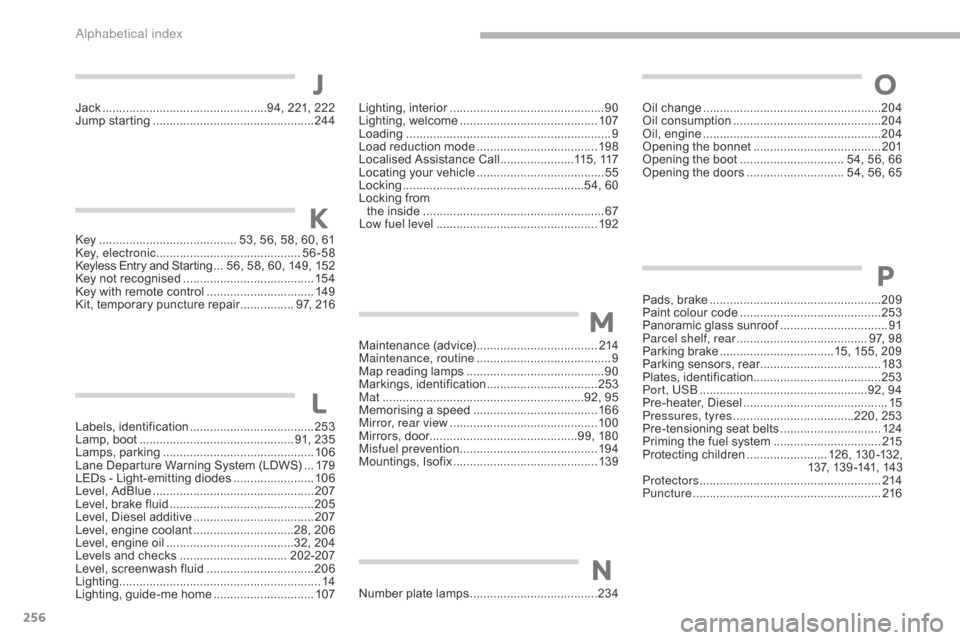
Maintenance (advice) ....................................2 14
Maintenance, routine ........................................ 9
M
ap reading lamps
......................................... 90
M
arkings, identification
................................. 25
3
Mat
.......
.....................................................92, 95
Memorising a speed
..................................... 16
6
Mirror, rear view
............................................ 10
0
Mirrors, door............................................99, 180
Misfuel prevention
...............................
..........19 4
Mountings, Isofix
...............................
............13 9 Pads, brake
...................................................
20
9
Paint colour code
..........................................
25
3
Panoramic glass sunroof
................................
91
P
arcel shelf, rear ....................................... 9 7, 98
Parking brake ..................................1 5, 155, 209
Parking sensors, rear.................................... 183
Plates, identification ...................................... 253
Port, USB
..................................................
92, 94
Pre-heater, Diesel
...............................
............15
Pressures, tyres
....................................2
20, 253
Pre-tensioning seat belts
..............................12
4
Priming the fuel system
................................2
15
Protecting children
........................ 1
26, 130 -132,
137, 139 -141, 143
Protectors
...................................................... 2
14
Puncture
................
........................................216
Number plate lamps
...................................... 23
4
M
P
N
Lighting, interior ..............................................90
L ighting, welcome ......................................... 10
7
Loading
..............................
............................... 9
Load reduction mode
.................................... 19
8
Localised Assistance Call
......................11
5 , 117
Locating your vehicle
...................................... 55
Lo
cking
......................................................5
4, 60
Locking from the inside
..............................
........................67
Low fuel level
..............................
..................192Oil change
............................... ......................204
Oil consumption
............................................20
4
Oil, engine
...............................
......................204
Opening the bonnet
......................................2
01
Opening the boot
..............................
. 54, 56, 66
Opening the doors
............................. 5
4, 56, 65
O
Labels, identification .....................................25 3
Lamp, boot ............................... ............... 91, 235
Lamps, parking
............................................. 10
6
Lane Departure Warning System (LDWS)
...17
9
LEDs - Light-emitting diodes
........................10
6
Level, AdBlue
................................................ 2
07
Level, brake fluid
........................................... 20
5
Level, Diesel additive
.................................... 2
07
Level, engine coolant
..............................2
8, 206
Level, engine oil
...............................
.......32, 204
Levels and checks
..............................
..202-207
Level, screenwash fluid
................................20
6
Lighting
................
............................................ 14
Lighting, guide-me home
..............................10
7
L
Key ......................................... 53, 56, 58, 60, 61
Key, electronic ...........................................56
-58
Keyless Entry and Starting
... 5
6, 58, 60, 149, 152
Key not recognised
....................................... 15
4
Key with remote control
................................14
9
Kit, temporary puncture repair
................ 9
7, 216K
Jack .................................................94, 221, 222
Jump starting .............................. ..................244
J
Alphabetical index