warning light Citroen C4 2016 2.G User Guide
[x] Cancel search | Manufacturer: CITROEN, Model Year: 2016, Model line: C4, Model: Citroen C4 2016 2.GPages: 396, PDF Size: 10.22 MB
Page 148 of 396
146
C4-2_en_Chap05_securite_ed02-2015
The driver must ensure that passengers use the seat belts correctly and that they are all
fastened
before setting off.
Wherever you are seated in the vehicle,
always fasten your seat belt, even for short
journeys.
Do
not interchange the seat belt buckles as
t
hey will not fulfil their role fully.
The seat belts are fitted with an inertia reel
permitting
automatic adjustment of the length
o
f the strap to your size. The seat belt is
s
towed automatically when not in use.
Before and after use, ensure that the seat belt
is
reeled in correctly.
The
lower part of the strap must be positioned
a
s low as possible on the pelvis.
The
upper part must be positioned in the
h
ollow of the shoulder.
The
inertia reels are fitted with an automatic
l
ocking device which comes into operation in
t
he event of a collision, emergency braking
o
r if the vehicle rolls over. You can release
t
he device by pulling the strap firmly and then
r
eleasing it so that it reels in slightly.Recommendations for children
Use a suitable child seat if the passenger is less than 12 years old or shorter than one
and
a half metres.
Never
use the same seat belt to secure more
t
han one person.
Never
allow a child to travel on your lap.
For
more information on child seats, refer to
t
he corresponding section.
In the event of an impact
Depending on the nature and seriousness
of the impact,
the pretensioning device may
b
e deployed before and independently of the
airbags.
Deployment of the pretensioners
i
s accompanied by a slight discharge of
h
armless smoke and a noise, due to the
a
ctivation of the pyrotechnic cartridge
i
ncorporated in the system.
In
all cases, the airbag warning lamp comes on.
Following
an impact, have the seat belts
s
ystem checked, and if necessary replaced,
b
y a CITROËN dealer or a qualified
w
orkshop.
Advice
In order to be effective, a seat belt must:
- b e tightened as close to the body as
p
ossible,
-
b
e pulled in front of you with a smooth
m
ovement, checking that it does not
t
wist,
-
b
e used to restrain only one person,
-
n
ot bear any trace of cuts or fraying,
-
n
ot be converted or modified to avoid
a
ffecting
it
s
p
erformance.
In accordance with current safety
regulations,
for all repairs on your vehicle's
s
eat belts, go to a qualified workshop with
t
he skills and equipment needed, which a
C
ITROËN dealer is able to provide.
Have
your seat belts checked regularly by
a
CITROËN dealer or a qualified workshop,
p
articularly if the straps show signs of
d
amage.
Clean the seat belt straps with soapy
water
or a textile cleaning product, sold by
C
ITROËN dealers.
After
folding or moving a seat or rear bench
s
eat, ensure that the seat belt is positioned
and
reeled in correctly.
Safety
Page 169 of 396
167
C4-2_en_Chap06_conduite_ed02-2015
When towing
Distribution of loads
F Distribute the load in the trailer so that the heaviest items are as close as possible to t
he axle and the nose weight approaches the
m
aximum permitted without exceeding it.
Air density decreases with altitude,
thus
r
educing
e
ngine
p
erformance.
A
bove 1 000 metres, the maximum towed
l
oad must be reduced by 10 % for every
1 0
00 metres of altitude.
Side wind
F Take into account the increased sensitivity t
o side wind.
For
more information on weights (and the
t
owed loads which apply to your vehicle) refer
t
o the corresponding section.
F
I
f the warning lamp and the
S
TOP
warning lamp come on,
s
top the vehicle and switch off
the engine as soon as possible.
Braking
Towing a trailer increases the braking distance.
T o avoid overheating of the brakes, the use of
e
ngine braking is recommended.
Ty r e s
F Check the tyre pressures of the towing v
ehicle and of the trailer, observing the
re
commended
p
ressures.
Lighting
F Check the electrical lighting and signalling o
n the trailer and the hadlamp beam height
o
f your vehicle.
For
more information on adjusting the
h
eadlamp beam height, refer to the
c
orresponding
s
ection.
The
rear parking sensors will be
d
eactivated automatically if a genuine
C
ITROËN towbar is used.
Cooling
Towing a trailer on a slope increases the temperature of the coolant.
As
the fan is electrically controlled, its cooling
c
apacity is not dependent on the engine speed.
F
T
o lower the engine speed, reduce your
s
peed.
The
maximum towed load on a long incline
d
epends on the gradient and the ambient
t
emperature.
In
all cases, keep a check on the coolant
t
emperature.
6
Driving
Page 173 of 396
171
C4-2_en_Chap06_conduite_ed02-2015
Starting / Switching off the engine with Keyless Entry and
S
tarting
Starting the engine
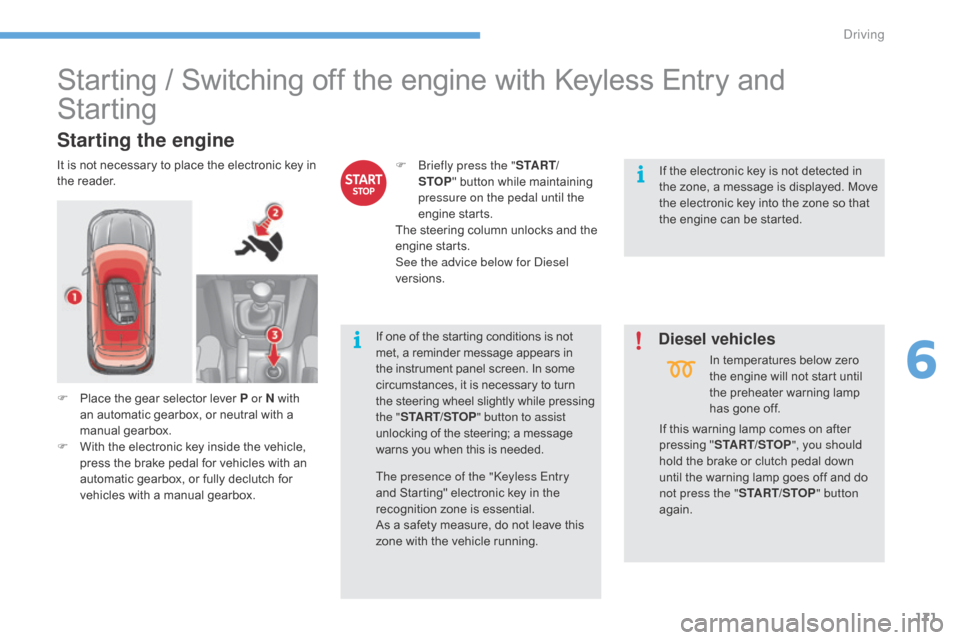
It is not necessary to place the electronic key in t
he r eader. F
B riefly press the "S TA R T/
STOP "
button while maintaining
p
ressure on the pedal until the
engine
s
tarts.
The
steering column unlocks and the
e
ngine
s
tarts.
See the advice below for Diesel
versions.
If
this warning lamp comes on after
p
ressing "START/STOP ", you should
hold
the brake or clutch pedal down
u
ntil the warning lamp goes off and do
n
ot press the "START/STOP " button
again.
If
one of the starting conditions is not
m
et, a reminder message appears in
t
he instrument panel screen. In some
c
ircumstances, it is necessary to turn
t
he steering wheel slightly while pressing
t
he "START/STOP " button to assist
unlocking
of the steering; a message
w
arns you when this is needed.If
the electronic key is not detected in
t
he zone, a message is displayed. Move
t
he electronic key into the zone so that
t
he engine can be started.
The presence of the "Keyless Entry
and
Starting" electronic key in the
r
ecognition zone is essential.
As
a safety measure, do not leave this
z
one with the vehicle running.In
temperatures below zero
t
he engine will not start until
t
he preheater warning lamp
h
as gone off.
F
P
lace the gear selector lever P or N with
an
automatic gearbox, or neutral with a
m
anual
g
earbox.
F
W
ith the electronic key inside the vehicle,
p
ress the brake pedal for vehicles with an
a
utomatic gearbox, or fully declutch for
v
ehicles with a manual gearbox.
Diesel vehicles
6
Driving
Page 190 of 396
188
C4-2_en_Chap06_conduite_ed02-2015
Stop & Start
Operation
Going into engine STOP mode
The "ECO" warning lamp comes on i
n the instrument panel and the engine g
oes into standby automatically:
-
w
ith a manual gearbox , at speeds below
12
m
ph
(
20
k
m/h),
o
r
v
ehicle
s
tationary
w
ith
P
ureTech 130 petrol and BlueHDi 115 and
1
20
Diesel versions, when you put the gear
l
ever into neutral and release the clutch
pedal,
If your vehicle is fitted with the
system,
a time counter calculates
t
he sum of the periods in STOP
m
ode during a journey. It resets
i
tself to zero every time the
i
gnition is switched on with the
k
ey or the "START/STOP" button.
-
w
ith an automatic gearbox, vehicle
stationary,
when you press the brake pedal
o
r
place the gear selector in position N.
Special cases: STOP mode
unavailable
STOP mode is not invoked when:
- t he vehicle is on a steep slope (up or
d
ow n),
-
t
he driver's door is open,
-
t
he driver's seat belt is not fastened,
-
t
he vehicle has not exceeded 6 mph
(
10 km/h) since the last engine start (using
t
he key or the "START/STOP" button),
-
t
he electric parking brake is applied or
be
ing
a
pplied,
-
t
he engine is needed to maintain a
c
omfortable temperature in the passenger
c
ompartment,
-
d
emisting is active,
-
s
ome special conditions (battery charge,
e
ngine temperature, braking assistance,
a
mbient temperature...) where the engine is
n
eeded to assure control of a system.
In this case, the "ECO"
warning lamp
f
lashes for a few seconds, then goes
o
f f.
This operation is perfectly normal.
The
Stop
&
Start system
puts
the
engine
temporarily
into
standby
-
STOP
mode
-
during
stops
in
the
traffic (red lights, traffic jams, or other...). The
e
ngine
restarts
automatically
-
START
mode
-
as
soon
as
you
want
to
move
off.
The
restart
takes
place
instantly, quickly and silently.
Per fect
for
urban
use,
the
Stop
&
Start
system
reduces
fuel
consumption
and
exhaust
emissions
as
well
as the noise level when stationary.
Never
refuel
with
the
engine
in
STOP
m
ode;
you
must
switch
off
the
ignition
w
ith
the
key
or
the
"START/STOP"
b
utton.
STOP
mode
does
not
affect
the
f
unctionality of the vehicle, such as
braking,
power
steering,
for
example.
Driving
Page 198 of 396
196
C4-2_en_Chap06_conduite_ed02-2015
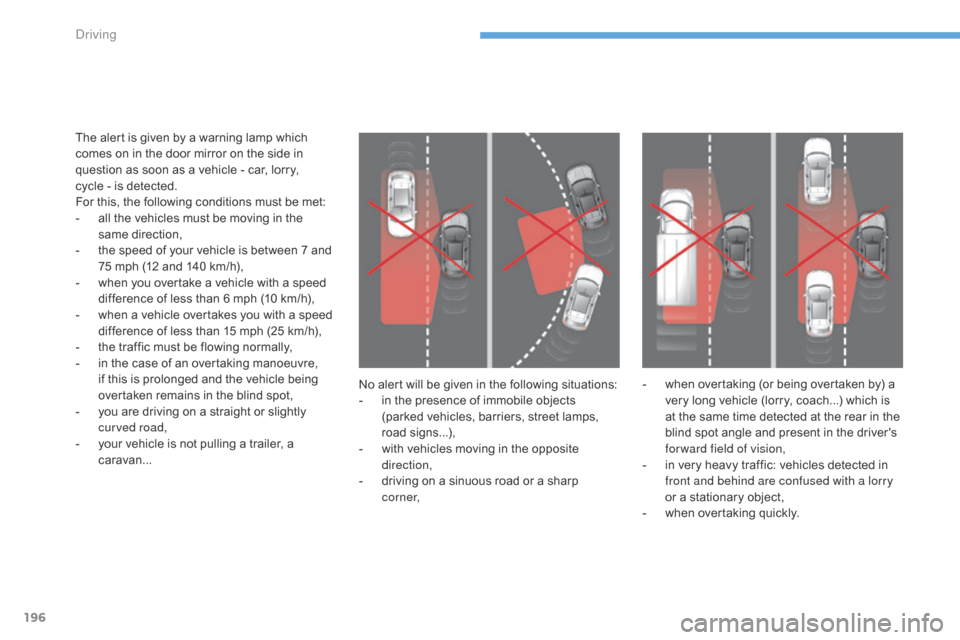
No alert will be given in the following situations:
- i n the presence of immobile objects
(
parked vehicles, barriers, street lamps,
r
oad
s
igns...),
-
w
ith vehicles moving in the opposite
d
irection,
-
d
riving on a sinuous road or a sharp
c
o r n e r,
The
alert
is
given
by
a
warning
lamp
which
c
omes
on
in
the
door
mirror
on
the
side
in
q
uestion
as
soon
as
a
vehicle
-
car,
lorry,
cycle
-
is
detected.
For
this,
the
following
conditions
must
be
met:
-
a
ll
the
vehicles
must
be
moving
in
the
sa
me
d
irection,
-
t
he
speed
of
your
vehicle
is
between
7
and
7
5
mph
(12
and
140
km/h),
-
w
hen
you
overtake
a
vehicle
with
a
speed
d
ifference
of
less
than
6
mph
(10
km/h),
-
w
hen
a
vehicle
overtakes
you
with
a
speed
d
ifference
of
less
than
15
mph
(25
km/h),
-
t
he
traffic
must
be
flowing
normally,
-
i
n
the
case
of
an
overtaking
manoeuvre,
i
f
this
is
prolonged
and
the
vehicle
being
ov
ertaken
remains
in
the
blind
spot,
-
y
ou
are
driving
on
a
straight
or
slightly
c
urved road,
-
y
our
vehicle
is
not
pulling
a
trailer,
a
c
aravan... -
w hen overtaking (or being overtaken by) a v
ery long vehicle (lorry, coach...) which is
a
t the same time detected at the rear in the
b
lind spot angle and present in the driver's
f
orward field of vision,
-
i
n very heavy traffic: vehicles detected in
f
ront and behind are confused with a lorry
or
a stationary object,
-
w
hen overtaking quickly.
Driving
Page 274 of 396
272
C4-2_en_Chap09_caracteristiques_ed02-2015
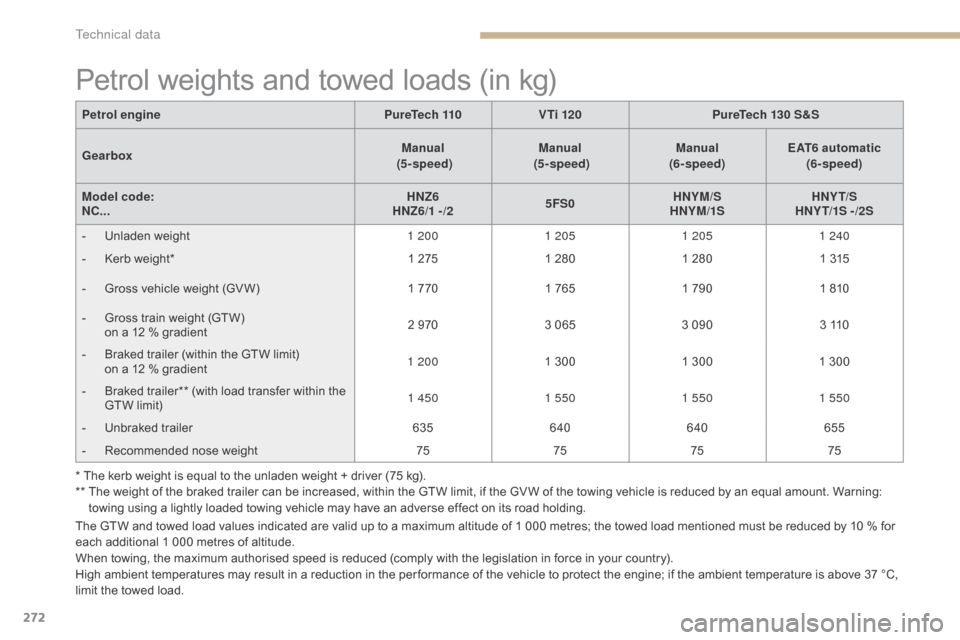
Petrol weights and towed loads (in kg)
The GTW and towed load values indicated are valid up to a maximum altitude of 1 000 metres; the towed load mentioned must be reduced by 10 % for each additional 1 000 metres of altitude.
When
towing, the maximum authorised speed is reduced (comply with the legislation in force in your country).
High
ambient temperatures may result in a reduction in the per formance of the vehicle to protect the engine; if the ambient temperature is above 37 °C,
l
imit the towed load.
Petrol engine
PureTech 110 V Ti 120 PureTech 130 S&S
Gearbox Manual
(5 - speed) Manual
(5 - speed) Manual
(6- speed) EAT6 automatic
(6- speed)
Model code:
NC... HNZ6
HNZ6/1 -/2 5FS0HNYM/S
HNYM/1S HNY T/S
HNY T/1S - /2S
-
U
nladen weight
1 2001 2051 205 1 240
-
K
erb weight*
1 275
1 280
1 280
1 315
-
G
ross vehicle weight (GV W)
1 770
1 765
1 790
1 810
-
G
ross train weight (GTW)
o
n a 12 % gradient
2 970
3 065
3 090
3 110
-
B
raked trailer (within the GTW limit)
o
n a 12 % gradient
1 200
1 300
1 300
1 300
-
B
raked trailer** (with load transfer within the
G
TW limit)
1 450
1 550 1 5501 550
-
U
nbraked trailer
635640 640 655
-
R
ecommended nose weight
75757575
* The kerb weight is equal to the unladen weight + driver (75 kg).
**
T
he weight of the braked trailer can be increased, within the GTW limit, if the GV W of the towing vehicle is reduced by an equal amount. Warning:
t
owing using a lightly loaded towing vehicle may have an adverse effect on its road holding.
Technical data
Page 277 of 396
275
C4-2_en_Chap09_caracteristiques_ed02-2015
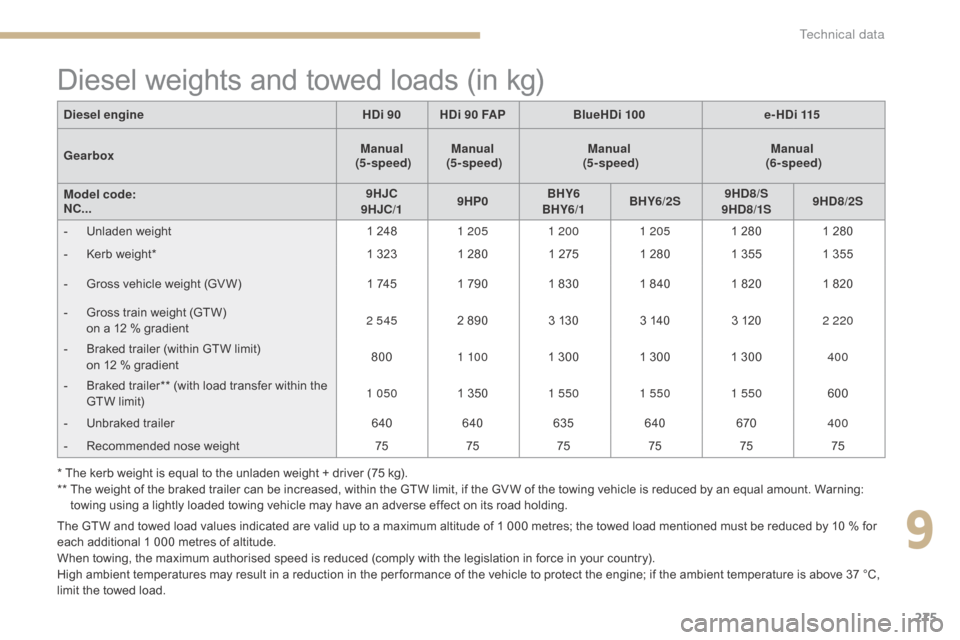
Diesel weights and towed loads (in kg)
The GTW and towed load values indicated are valid up to a maximum altitude of 1 000 metres; the towed load mentioned must be reduced by 10 % for each additional 1 000 metres of altitude.
When
towing, the maximum authorised speed is reduced (comply with the legislation in force in your country).
High
ambient temperatures may result in a reduction in the per formance of the vehicle to protect the engine; if the ambient temperature is above 37 °C,
l
imit the towed load.
Diesel engine
HDi 90HDi 90 FAP BlueHDi 100 e-HDi 115
Gearbox Manual
(5 - speed) Manual
(5 - speed) Manual
(5 - speed) Manual
(6- speed)
Model code:
NC... 9HJC
9HJC/1 9HP0BHY6
BHY6/1 BHY6/2S 9HD8/S
9HD8/1S 9HD8/2S
-
U
nladen weight
1 248
1 205 1 200 1 2051 280
1 280
-
K
erb weight*
1 323 1 280 1 275
1 280
1 355
1 355
-
G
ross vehicle weight (GV W)
1 745
1 790 1 830 1 840
1 820
1 820
-
G
ross train weight (GTW)
o
n a 12 % gradient
2 545
2 890 3 130
3 140
3 120
2 220
-
B
raked trailer (within GTW limit)
o
n 12 % gradient
800
1 10 0 1 300 1 300 1 300
400
-
B
raked trailer** (with load transfer within the
G
TW limit)
1 050
1 350
1 550 1 550 1 550 600
-
U
nbraked trailer
640640 635 640 670400
-
R
ecommended nose weight
757575 757575
* The kerb weight is equal to the unladen weight + driver (75 kg).
**
T
he weight of the braked trailer can be increased, within the GTW limit, if the GV W of the towing vehicle is reduced by an equal amount. Warning:
t
owing using a lightly loaded towing vehicle may have an adverse effect on its road holding.
9
Technical data
Page 278 of 396
276
C4-2_en_Chap09_caracteristiques_ed02-2015
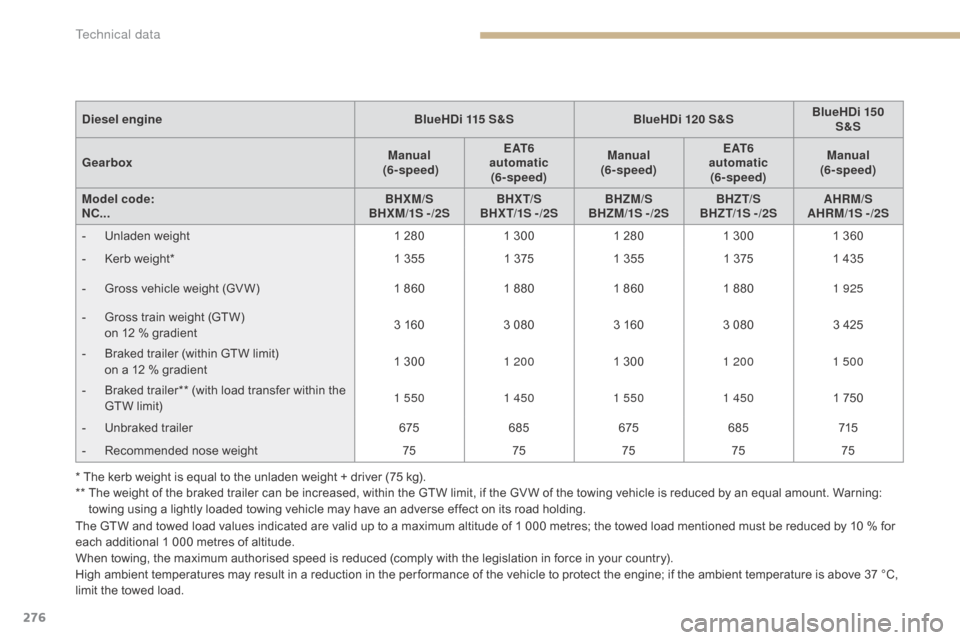
The GTW and towed load values indicated are valid up to a maximum altitude of 1 000 metres; the towed load mentioned must be reduced by 10 % for each additional 1 000 metres of altitude.
When
towing, the maximum authorised speed is reduced (comply with the legislation in force in your country).
High
ambient temperatures may result in a reduction in the per formance of the vehicle to protect the engine; if the ambient temperature is above 37 °C,
l
imit the towed load.
Diesel engine
BlueHDi 115 S&SBlueHDi 120 S&SBlueHDi 150
S&S
Gearbox Manual
(6- speed) E AT 6
automatic (6- speed) Manual
(6- speed) E AT 6
automatic (6- speed) Manual
(6- speed)
Model code:
NC... BHXM/S
BHXM/1S -/2S BHX T/S
BHX T/1S - /2S BHZM/S
BHZM/1S - /2S BHZT/S
BHZ T/1S - /2S AHRM/S
AHRM/1S -/2S
-
U
nladen weight
1 280
1 300
1 280
1 300
1 360
-
K
erb weight*
1 355
1 375
1 355
1 375
1 435
-
G
ross vehicle weight (GV W)
1 860
1 880
1 860
1 880
1 925
-
G
ross train weight (GTW)
o
n 12 % gradient
3 160
3 080
3 160
3 080
3 425
-
B
raked trailer (within GTW limit)
o
n a 12 % gradient
1 300
1 200 1 300
1 200 1 500
-
B
raked trailer** (with load transfer within the
G
TW limit)
1 550
1 4501 550 1 450 1 750
-
U
nbraked trailer
675685 675685 715
-
R
ecommended nose weight
7575757575
* The kerb weight is equal to the unladen weight + driver (75 kg).
**
T
he weight of the braked trailer can be increased, within the GTW limit, if the GV W of the towing vehicle is reduced by an equal amount. Warning:
t
owing using a lightly loaded towing vehicle may have an adverse effect on its road holding.
Technical data
Page 386 of 396
384
C4-2_en_Chap11_index-alpha_ed02-2015
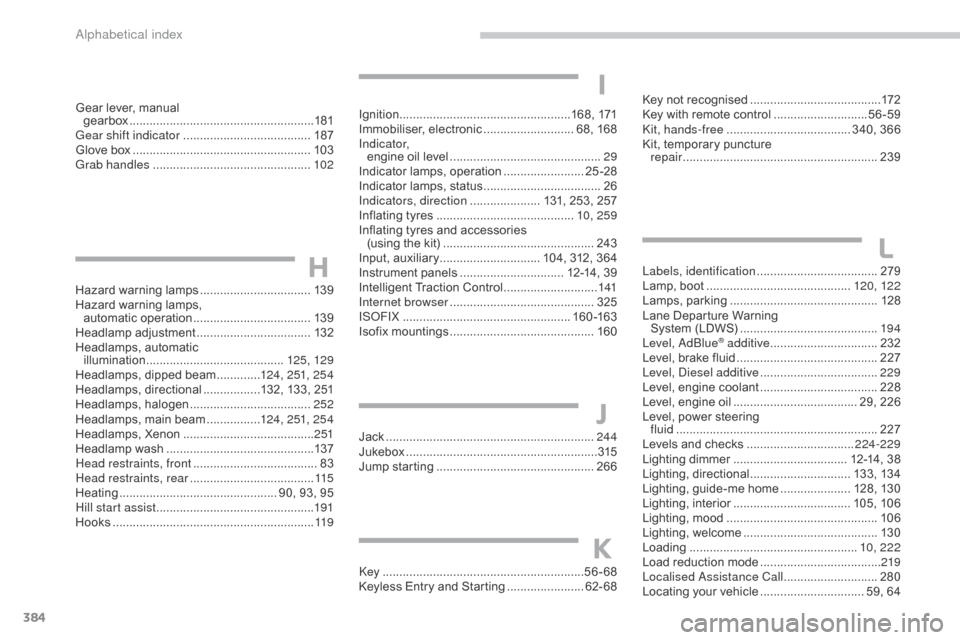
Hazard warning lamps ................................. 13 9
Hazard warning lamps,
automatic
ope
ration
................................... 13
9
Headlamp
adj
ustment
.................................. 13
2
Headlamps,
automatic
illumination
...............................
..........125, 129
Headlamps,
dipped beam
.............12
4, 251, 25 4
Headlamps,
d
irectional
.................1
32, 133, 251
Headlamps,
hal
ogen
.................................... 2
52
Headlamps,
main beam
................12
4, 251, 25 4
Headlamps,
Xenon
....................................... 2
51
Headlamp
w
ash
............................................ 13
7
Head restraints, front
..................................... 83
H
ead restraints, rear
..................................... 11
5
Heating
................
............................... 90, 93, 95
Hill start assist
............................................... 19
1
Hooks
...............................
.............................11 9Jack
........
......................................................244
Jukebox
...............
..........................................315
Jump
starting
..............................
.................266
Key
.......
.....................................................56-68
Keyless
Entry and Starting
.......................6
2- 68Key
not recognised
.......................................
17
2
Key with remote control
............................
5
6-59
Kit, hands-free
..................................... 3
40, 366
Kit, temporary puncture
repair
...............................
...........................
239
Labels, identification
.................................... 2
79
Lamp, boot ............................... ............
120, 12 2
Lamps, par king ............................................12
8
Lane
Departure Warning
System
(LDWS)
...............................
..........19 4
Level, AdBlue
® additive ................................ 2 32
Level,
brake
fluid .......................................... 2
27
Level, Diesel additive
................................... 2
29
Level,
engine
coolant
................................... 2
28
Level,
engine
oil
...............................
...... 29, 226
Level,
power
steering
fluid
...............
............................................. 227
Levels
and
checks
..............................
..224-229
Lighting
dimmer
..............................
.... 12-14, 38
Lighting,
d
irectional
.............................. 13
3,
13
4
Lighting,
guide-me home
..................... 1
28, 130
Lighting,
i
nterior
................................... 10
5,
10
6
Lighting,
m
ood
..............................
...............10 6
Lighting,
welcome
........................................ 13
0
Loading
..............................
.................... 10, 222
Load
reduction mode
.................................... 2
19
Localised Assistance Call
............................ 28
0
Locating
your
vehicle
............................... 5
9, 64
H
J
K
L
Gear lever, manual
g earbox ................ ....................................... 181
Gear shift indicator
...................................... 18
7
Glove
box
..................................................... 10
3
Grab handles
............................................... 10
2Ignition ................
...................................168, 171
Immobiliser,
e
lectronic
........................... 6
8, 168
I n d i c a t o r, engine
oil level
.............................................29
I
ndicator lamps, operation
........................2
5 -28
Indicator
lamps, status
...................................26
I
ndicators, direction
..................... 1
31, 253, 257
Inflating
tyres
..............................
...........10, 259
Inflating
tyres and accessories
(using
the kit)
..............................
...............243
Input,
a
uxiliary
.............................. 1
04, 312, 364
Instrument
p
anels
............................... 1
2-14, 39
Intelligent
T
raction
C
ontrol
............................1
41
Internet browser
........................................... 325
I
SOFIX
...............
...................................160 -163
Isofix
m
ountings
...............................
............160
I
Alphabetical index