child seat Citroen C4 2016 2.G Owner's Manual
[x] Cancel search | Manufacturer: CITROEN, Model Year: 2016, Model line: C4, Model: Citroen C4 2016 2.GPages: 396, PDF Size: 10.22 MB
Page 4 of 396
C4-2_en_Chap00a_sommaire_ed02-2015
Instrument panels 12
Rev counter 1 5
Warning
and indicator lamps
1
6
Indicators
29
Time
and units
3
7
Customising
the instrument
panel
colours
3
9
Monochrome
screen A
4
0
Monochrome
screen C
4
2
Touch
screen tablet
4
7
Trip
computer
5
2
InstrumentsOver view
Remote control key 5
6
"Keyless Entry and Starting" 6 2
Alarm
7
1
Electric
windows
7
5
Doors
7
8
Boot
7
9
Access
Front seats 81
Steering wheel adjustment 8 6
Mirrors
87
V
entilation / Heating
9
0
Manual
a
ir
c
onditioning
9
3
Dual-zone
d
igital
a
ir
c
onditioning
9
5
Front
demist - defrost
1
00
Rear
screen demist -
d
efrost
10
1
Front
fittings
1
02
Courtesy
lamps
1
05
Interior
mood lighting
1
06
Panoramic
sunroof
1
07
Centre
consoles
1
08
Front
armrest
1
10
Rear seats
1
15
Rear
fittings
1
17
Boot
fittings
1
18
Boot
lamp
1
22
Luggage
cover (enterprise version)
1
23
Ease of use a nd c omfort
Lighting controls 1 24
Automatic illumination of headlamps 1 29
Welcome
lighting
1
30
Direction
indicators
1
31
Headlamp
beam height adjustment
1
32
Directional
l
ighting
1
33
Wiper
controls
1
35
Automatic
rain sensitive wipers
1
36
Lighting and v isibility
Hazard warning lamps 1 39
H or n 13 9
Emergency
or assistance call
1
39
Braking
assistance systems
1
40
Trajectory
control systems
1
41
Front
seat belts
1
43
Airbags
1
47
Child seats
1
51
Deactivating
the passenger's front airbag
1
53
ISOFIX
child seats
1
60
Child
lock
1
65
Safety
Eco-driving
Contents
Page 7 of 396
5
C4-2_en_Chap00b_vue-ensemble_ed02-2015
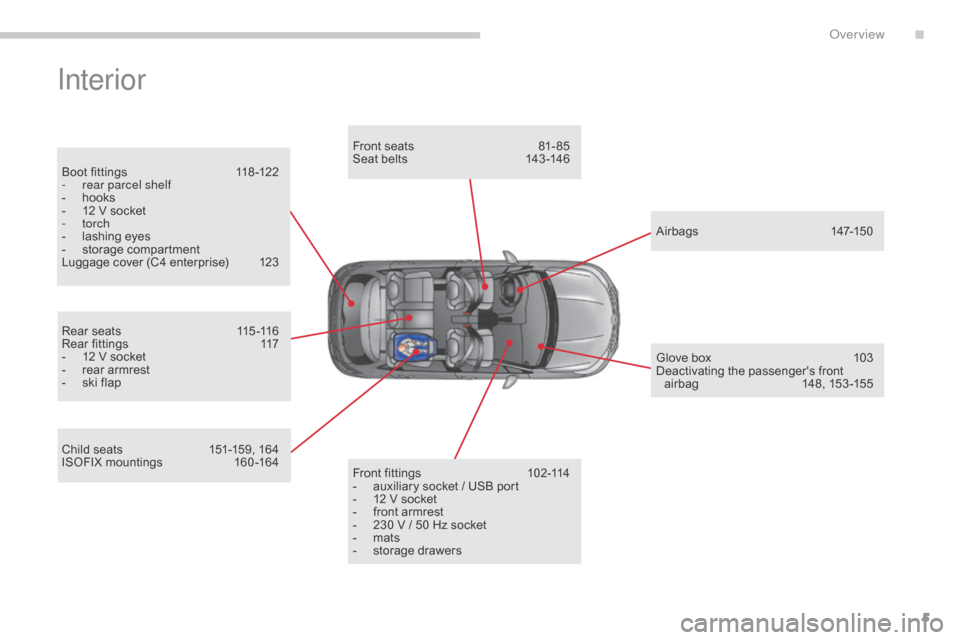
Interior
Boot fittings 118 -122
- r ear parcel shelf
-
h
ooks
-
1
2 V socket
-
torch
-
l
ashing eyes
-
s
torage compartment
Luggage
cover (C4 enterprise)
1
23
Rear
seats
1
15 -116
Rear
fittings
1
17
-
1
2 V socket
-
r
ear armrest
-
s
ki flap
Child
seats
1
51-159, 164
ISOFIX
mountings
1
60 -164Front
seats
8
1- 85
Seat belts 1 43 -146
A ir bags
1
47-150
Front
fittings
1
02-114
-
a
uxiliary socket / USB port
-
1
2 V socket
-
f
ront armrest
-
2
30 V / 50 Hz socket
-
m
ats
-
s
torage drawersGlove
box
1
03
Deactivating
t
he
p
assenger's
f
ront
a
irbag
1
48, 153 -155
.
Over view
Page 29 of 396
27
C4-2_en_Chap01_instruments-de-bord_ed02-2015
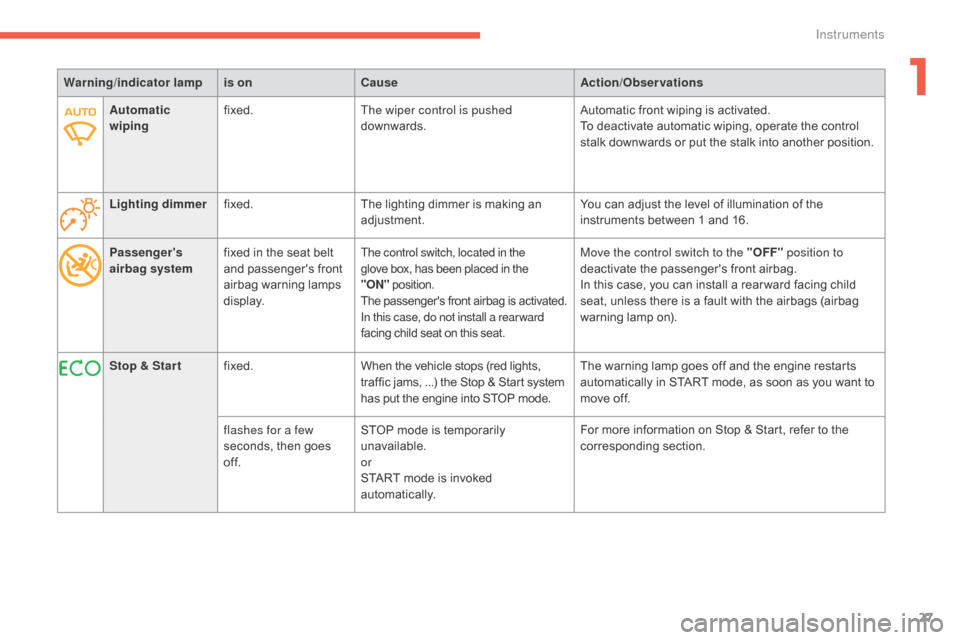
Passenger's
airbag systemfixed
in the seat belt a
nd passenger's front
a
irbag
w
arning
lam
ps
d
isplay.The control switch, located in the
glove box, has been placed in the "O
N" position.
The
p
assenger's
f
ront
a
irbag
i
s
a
ctivated.
In this case, do not install a rear ward
facing
child seat on this seat.Move the control switch to the "OFF" position to
deactivate the passenger's front airbag.
In
this case, you can install a rear ward facing child
s
eat, unless there is a fault with the airbags (airbag
w
arning lamp on).
Warning
/indicator lampis on Cause Action/Observations
Stop & Star t fixed. When
the
vehicle
stops
(red
lights,
t
raffic
jams, ...)
the
Stop
&
Start
system
h
as
put
the
engine
into
STOP
mode. The
warning lamp goes off and the engine restarts
a
utomatically in START mode, as soon as you want to
m
ove off.
flashes for a few
seconds,
then
goes
o
f f. STOP
mode
is
temporarily
u
navailable.
or
START
mode
is
invoked
au
tomatically. For
more information on Stop & Start, refer to the
c
orresponding
s
ection.
Automatic
wiping
fixed.
The wiper control is pushed
downwards. Automatic front wiping is activated.
To deactivate automatic wiping, operate the control
s
talk downwards or put the stalk into another position.
Lighting dimmer fixed. The
lighting
dimmer
is
making
an
adj
ustment.
You can adjust the level of illumination of the
i
nstruments between 1 and 16.
1
Instruments
Page 30 of 396

28
C4-2_en_Chap01_instruments-de-bord_ed02-2015
Deactivation indicator lamps
If one of the following indicator lamps comes on, this confirms that the corresponding system has been switched off intentionally.
T his is may be accompanied by an audible signal and a message in the multifunction screen.
Warning /indicator lampis on Cause Action/Observations
Passenger's
airbag system fixed
in the instrument
p
anel and/or seat belt
a
nd front passenger's
a
irbag
w
arning
lam
ps
d
isplay.The control switch, located in the
glove
box, is set to the OFF
p
osition.
The
passenger's front airbag is
d
eactivated.
You
can install a rear ward facing
c
hild seat, unless there is a fault with
the
airbags (airbag warning lamp on).Set the control to the "ON"
position to activate the
passenger's
front airbag.
In
this case, do not install a rear ward facing child seat
o
n this seat.
Instruments
Page 148 of 396
146
C4-2_en_Chap05_securite_ed02-2015
The driver must ensure that passengers use the seat belts correctly and that they are all
fastened
before setting off.
Wherever you are seated in the vehicle,
always fasten your seat belt, even for short
journeys.
Do
not interchange the seat belt buckles as
t
hey will not fulfil their role fully.
The seat belts are fitted with an inertia reel
permitting
automatic adjustment of the length
o
f the strap to your size. The seat belt is
s
towed automatically when not in use.
Before and after use, ensure that the seat belt
is
reeled in correctly.
The
lower part of the strap must be positioned
a
s low as possible on the pelvis.
The
upper part must be positioned in the
h
ollow of the shoulder.
The
inertia reels are fitted with an automatic
l
ocking device which comes into operation in
t
he event of a collision, emergency braking
o
r if the vehicle rolls over. You can release
t
he device by pulling the strap firmly and then
r
eleasing it so that it reels in slightly.Recommendations for children
Use a suitable child seat if the passenger is less than 12 years old or shorter than one
and
a half metres.
Never
use the same seat belt to secure more
t
han one person.
Never
allow a child to travel on your lap.
For
more information on child seats, refer to
t
he corresponding section.
In the event of an impact
Depending on the nature and seriousness
of the impact,
the pretensioning device may
b
e deployed before and independently of the
airbags.
Deployment of the pretensioners
i
s accompanied by a slight discharge of
h
armless smoke and a noise, due to the
a
ctivation of the pyrotechnic cartridge
i
ncorporated in the system.
In
all cases, the airbag warning lamp comes on.
Following
an impact, have the seat belts
s
ystem checked, and if necessary replaced,
b
y a CITROËN dealer or a qualified
w
orkshop.
Advice
In order to be effective, a seat belt must:
- b e tightened as close to the body as
p
ossible,
-
b
e pulled in front of you with a smooth
m
ovement, checking that it does not
t
wist,
-
b
e used to restrain only one person,
-
n
ot bear any trace of cuts or fraying,
-
n
ot be converted or modified to avoid
a
ffecting
it
s
p
erformance.
In accordance with current safety
regulations,
for all repairs on your vehicle's
s
eat belts, go to a qualified workshop with
t
he skills and equipment needed, which a
C
ITROËN dealer is able to provide.
Have
your seat belts checked regularly by
a
CITROËN dealer or a qualified workshop,
p
articularly if the straps show signs of
d
amage.
Clean the seat belt straps with soapy
water
or a textile cleaning product, sold by
C
ITROËN dealers.
After
folding or moving a seat or rear bench
s
eat, ensure that the seat belt is positioned
and
reeled in correctly.
Safety
Page 150 of 396
148
C4-2_en_Chap05_securite_ed02-2015
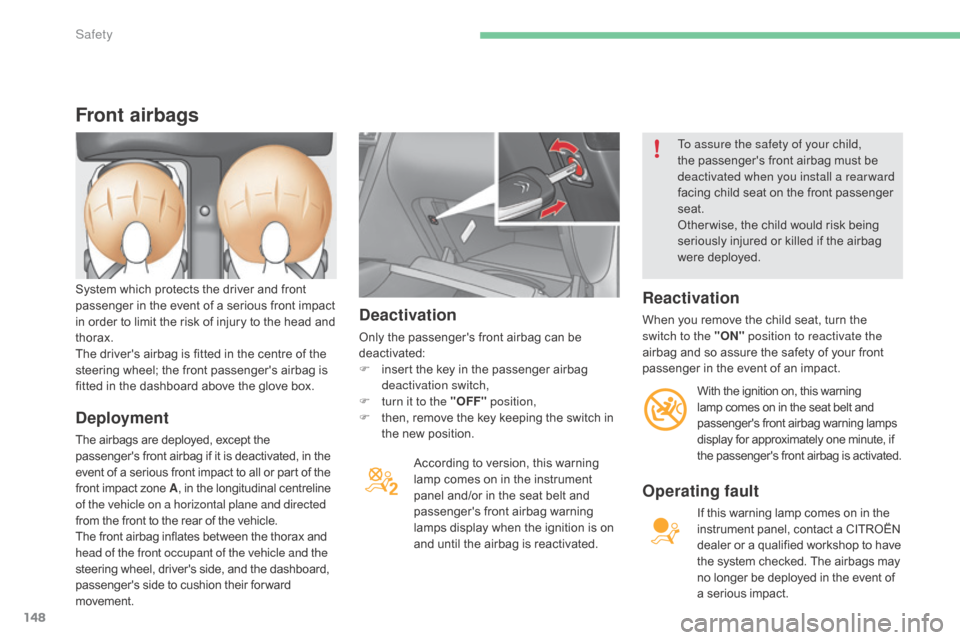
Deactivation
Only the passenger's front airbag can be deactivated:
F
i
nsert the key in the passenger airbag
d
eactivation switch,
F
t
urn it to the "OFF" position,
F
t
hen, remove the key keeping the switch in
t
he new position.
According
to version, this warning
l
amp comes on in the instrument
p
anel and/or in the seat belt and
p
assenger's front airbag warning
l
amps display when the ignition is on
a
nd until the airbag is reactivated.
Front airbags
Deployment
The airbags are deployed, except the passenger's front airbag if it is deactivated, in the e
vent of a serious front impact to all or part of the
f
ront impact zone A,
in the longitudinal centreline
o
f the vehicle on a horizontal plane and directed
from
the front to the rear of the vehicle.
The
front airbag inflates between the thorax and
h
ead of the front occupant of the vehicle and the
steering
wheel, driver's side, and the dashboard,
p
assenger's side to cushion their for ward
m
ovement. To assure the safety of your child,
the
passenger's front airbag must be
d
eactivated when you install a rear ward
facing child seat on the front passenger
sea
t.
Other wise, the child would risk being
s
eriously injured or killed if the airbag
w
ere deployed.
System which protects the driver and front
p
assenger in the event of a serious front impact
i
n order to limit the risk of injury to the head and
t
horax.
The driver's airbag is fitted in the centre of the
s
teering wheel; the front passenger's airbag is
f
itted in the dashboard above the glove box.
Reactivation
When you remove the child seat, turn the s
witch to the "ON" position to reactivate the
airbag
and so assure the safety of your front
p
assenger in the event of an impact.
With
the ignition on, this warning
l
amp comes on in the seat belt and
p
assenger's front airbag warning lamps
d
isplay for approximately one minute, if
t
he passenger's front airbag is activated.
Operating fault
If this warning lamp comes on in the instrument panel, contact a CITROËN d
ealer or a qualified workshop to have
t
he system checked. The airbags may
n
o longer be deployed in the event of
a
serious impact.
Safety
Page 152 of 396
150
C4-2_en_Chap05_securite_ed02-2015
Advice
Front airbags
Do not drive holding the steering wheel by its spokes or resting your hands on the centre
p
art of the wheel.
Passengers
must not place their feet on the
das
hboard.
Do
not smoke as deployment of the airbags
c
an cause burns or the risk of injury from a
c
igarette or pipe.
Never
remove or pierce the steering wheel or
h
it it violently.
Do
not fit or attach anything to the steering
w
heel
o
r
d
ashboard,
t
his
c
ould
c
ause
i
njuries
w
ith deployment of the airbags.
Lateral airbags
Use only approved covers on the seats, compatible with the deployment the lateral
a
irbags. For information on the range of seat
c
overs suitable for your vehicle, you can
contact
a CITROËN dealer.
For
more information on accessories, refer
t
o the corresponding section.
Do
not fix or attach anything to the seat
b
acks (clothing...). This could cause injury
t
o the chest or arms if the lateral airbag is
d
eployed.
Do not sit with the upper part of the body any
nearer
to the door than necessary.
Curtain airbags
Do not fix or attach anything to the roof. This could cause injury to the head if the curtain
a
irbag is deployed.
If
fitted on your vehicle, do not remove the
g
rab handles installed on the roof, they play
a
part in securing the curtain airbags.
Sit
in
a
normal
upright
position.
Wear
a
correctly
adjusted
seat
belt.
Do
not
leave
anything
between
the
o
ccupants
and
the
airbags
(a
child,
pet,
o
bject...),
nor
fix
or
attach
anything
close
to
t
he
inflation
trajectory
of
the
airbags;
this
c
ould
cause
injuries
during
their
deployment.
Never
modify
the
original
definition
of
your
v
ehicle, particularly in the area directly
around
the
airbags.
After an accident or if the vehicle has been
stolen
or
broken
into,
have
the
airbag
s
ystems
checked.
All
work
on
the
airbag
system
must
be
c
arried out by a CITROËN dealer or a
qualified
w
orkshop.
Even
if
all
of
the
precautions
mentioned
a
re
observed,
a
risk
of
injury
or
of
minor
b
urns
to
the
head,
chest
or
arms
when
an
a
irbag
is
deployed
cannot
be
ruled
out.
The
b
ag
inflates
almost
instantly
(within
a
few
m
illiseconds)
then
deflates
within
the
same
t
ime
discharging
the
hot
gas
via
openings
p
rovided
for
this
purpose.
For the airbags to be fully effective, observe the safety recommendations below:
Safety
Page 153 of 396
151
C4-2_en_Chap05_securite_ed02-2015
General points relating to child seats
Although one of CITROËN main criteria when designing your vehicle, the safety of your children also depends on you.
*
T
he regulations on carrying children are
s
pecific to each country. Refer to the
l
egislation in force in your country.
For
maximum safety, please observe the
f
ollowing
r
ecommendations:
-
i
n accordance with European regulations,
a
ll children under the age of 12 or less
than one and a half metres tall must
travel in approved child seats suited to
their weight , on seats fitted with a seat
belt
or ISOFIX mountings*,
-
s
tatistically, the safest seats in your
vehicle for carr ying children are the
rear seats,
-
a c
hild weighing less than 9 kg must
travel in the rear ward facing position
both in the front and in the rear. CITROËN recommends
that children
should travel on the rear seats of your
vehicle:
-
r
earward facing
up to the age of 3,
-
fo
rward facing
over the age of 3.
5
Safety
Page 154 of 396
152
C4-2_en_Chap05_securite_ed02-2015
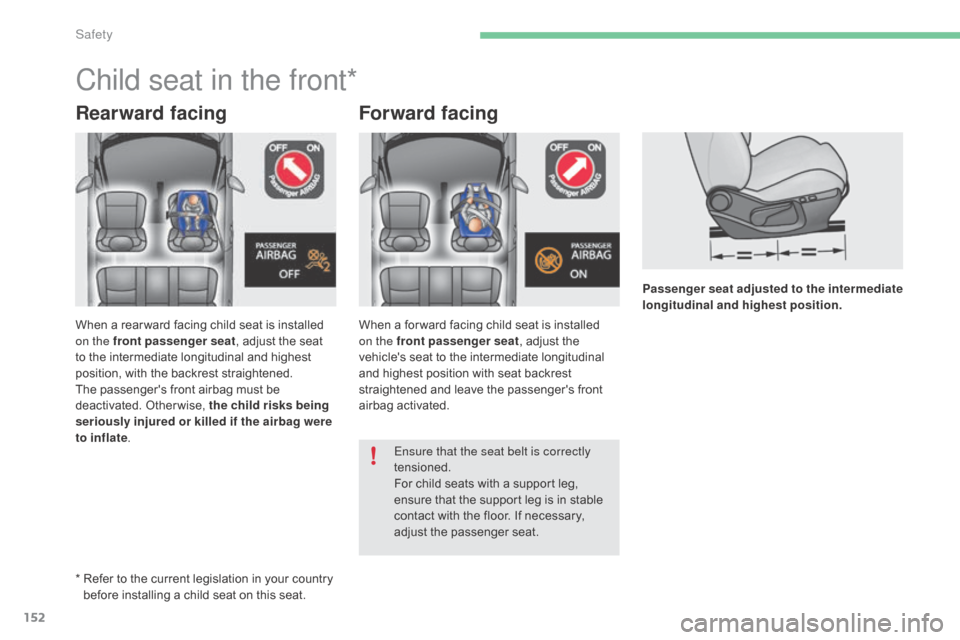
Passenger seat adjusted to the intermediate
longitudinal and highest position.
Child seat in the front*
Rearward facingForward facing
When a rear ward facing child seat is installed o
n the front passenger seat ,
adjust the seat
t
o the intermediate longitudinal and highest
p
osition, with the backrest straightened.
The
passenger's front airbag must be
d
eactivated.
O
therwise,
t
he child risks being
seriously injured or killed if the airbag were
to inflate . When
a for ward facing child seat is installed o
n the front passenger seat,
adjust the
v
ehicle's seat to the intermediate longitudinal
a
nd highest position with seat backrest
s
traightened and leave the passenger's front
a
irbag activated.
*
R
efer to the current legislation in your country
b
efore installing a child seat on this seat.Ensure that the seat belt is correctly
tensioned.
For
child seats with a support leg,
e
nsure that the support leg is in stable
c
ontact with the floor. If necessary,
a
djust
t
he
p
assenger
sea
t.
Safety
Page 155 of 396
153
C4-2_en_Chap05_securite_ed02-2015
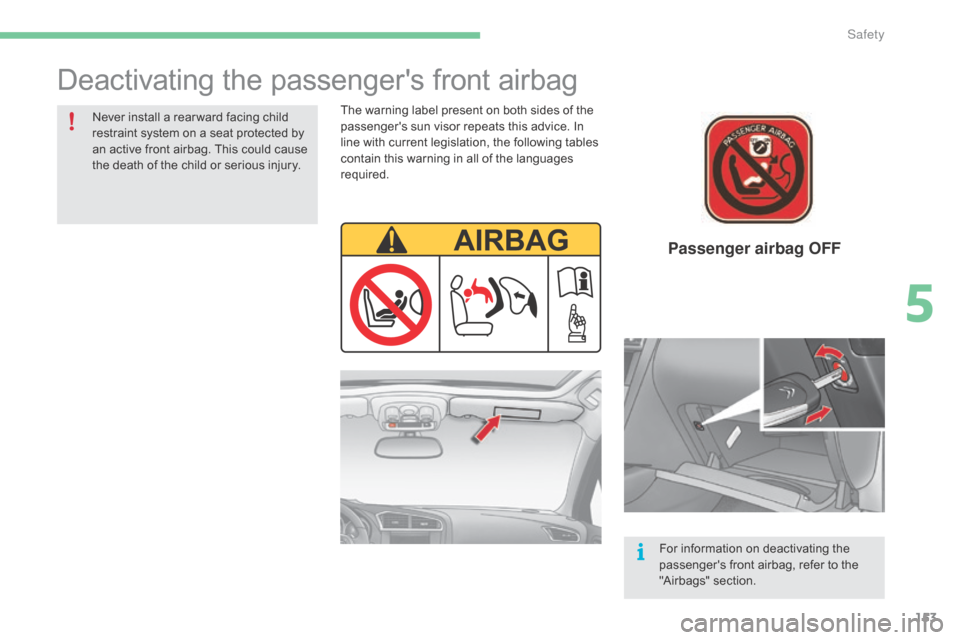
Passenger airbag OFF
Deactivating the passenger's front airbag
The warning label present on both sides of the passenger's sun visor repeats this advice. In
l
ine with current legislation, the following tables
c
ontain this warning in all of the languages
r
equired.
For
information on deactivating the
p
assenger's front airbag, refer to the
"
Airbags" section.
Never
install
a
rear ward
facing
child
r
estraint
system
on
a
seat
protected
by
a
n
active
front
airbag.
This
could
cause
t
he
death
of
the
child
or
serious
injury.
5
Safety