weight Citroen C4 2016 2.G Owner's Manual
[x] Cancel search | Manufacturer: CITROEN, Model Year: 2016, Model line: C4, Model: Citroen C4 2016 2.GPages: 396, PDF Size: 10.22 MB
Page 5 of 396
C4-2_en_Chap00a_sommaire_ed02-2015
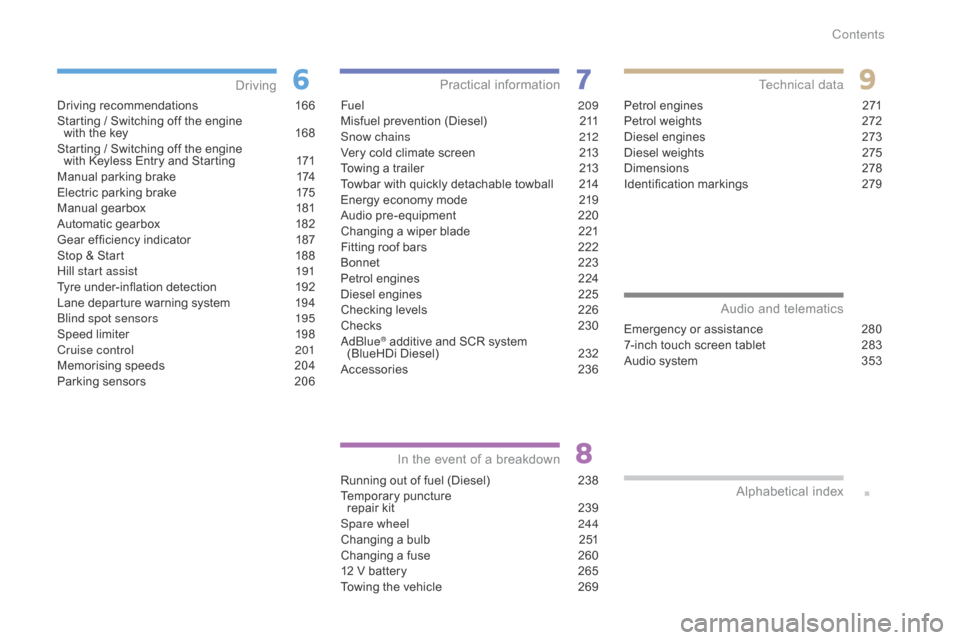
Driving recommendations 166
Starting / Switching off the engine
with
the key
1
68
Starting
/ Switching off the engine
with
Keyless Entry and Starting
1
71
Manual
par
king
b
rake
1
74
Electric
parking brake
1
75
Manual
g
earbox
1
81
Automatic
gearbox
1
82
Gear
ef ficiency indicator
1
87
Stop
& Start
1
88
Hill start assist
1
91
Tyre
under-inflation detection
1
92
Lane
departure warning system
1
94
Blind spot sensors
1
95
Speed
limiter
1
98
Cruise control
2
01
Memorising
speeds
2
04
Parking
sensors
2
06
Driving
Fuel 20 9
Misfuel prevention (Diesel) 2 11
Snow chains
2
12
Very
cold climate screen
2
13
Towing
a trailer
2
13
Towbar
with quickly detachable towball
2
14
Energy
economy mode
2
19
Audio
pre-equipment
2
20
Changing
a wiper blade
2
21
Fitting
roof bars
2
22
Bonnet
2
23
Petrol
engines
2
24
Diesel
engines
2
25
Checking
levels
2
26
Checks
23
0
AdBlue
® additive and SCR system
(
BlueHDi Diesel) 2 32
Accessories
2
36
Practical information
Running out of fuel (Diesel) 2 38
Temporary pu ncture
r
epair kit
2
39
Spare wheel
2
44
Changing
a bulb
2
51
Changing
a fuse
2
60
12
V battery
2
65
Towing
the vehicle
2
69
In the event o f a b reakdown
Petrol engines 2 71
Petrol weights 2 72
Diesel
engines
2
73
Diesel
weights
2
75
Dimensions
2
78
Identification
ma
rkings
2
79
Technical data
Emergency or assistance 280
7-inch touch screen tablet 2 83
Audio
system
3
53
Audio and telematics
Alphabetical
in
dex
Contents
Page 153 of 396
151
C4-2_en_Chap05_securite_ed02-2015
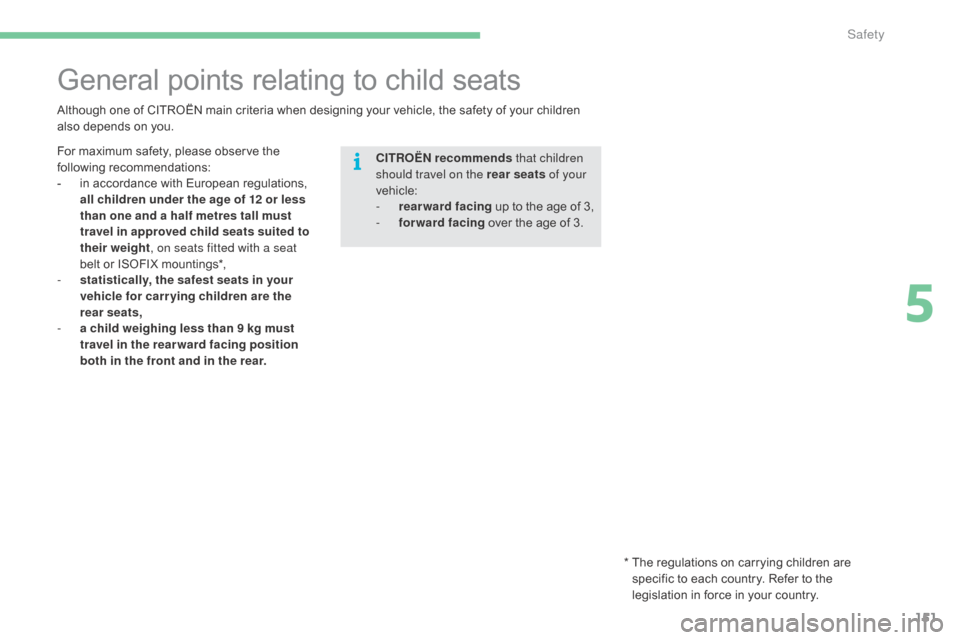
General points relating to child seats
Although one of CITROËN main criteria when designing your vehicle, the safety of your children also depends on you.
*
T
he regulations on carrying children are
s
pecific to each country. Refer to the
l
egislation in force in your country.
For
maximum safety, please observe the
f
ollowing
r
ecommendations:
-
i
n accordance with European regulations,
a
ll children under the age of 12 or less
than one and a half metres tall must
travel in approved child seats suited to
their weight , on seats fitted with a seat
belt
or ISOFIX mountings*,
-
s
tatistically, the safest seats in your
vehicle for carr ying children are the
rear seats,
-
a c
hild weighing less than 9 kg must
travel in the rear ward facing position
both in the front and in the rear. CITROËN recommends
that children
should travel on the rear seats of your
vehicle:
-
r
earward facing
up to the age of 3,
-
fo
rward facing
over the age of 3.
5
Safety
Page 160 of 396
158
C4-2_en_Chap05_securite_ed02-2015
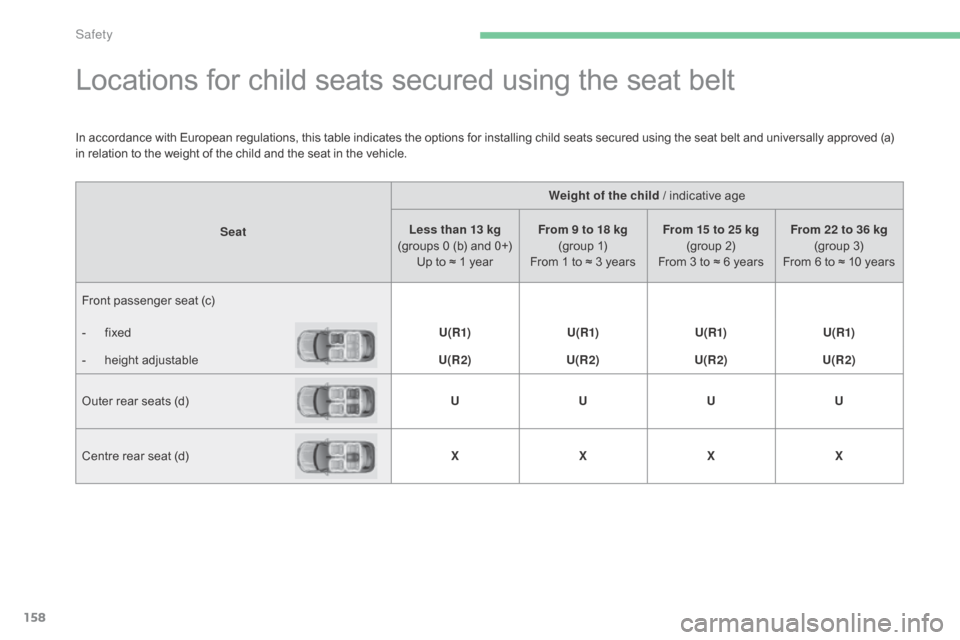
Locations for child seats secured using the seat belt
SeatWeight of the child /
indicative age
Less than 13 kg
(groups 0 (b) and 0+)
Up
to ≈ 1 yearFrom 9 to 18 kg
(group 1)
From
1 to ≈ 3 yearsFrom 15 to 25 kg
(group 2)
From
3 to ≈ 6 yearsFrom 22 to 36 kg
(group 3)
From
6 to ≈ 10 years
Front
passenger
seat
(c)
-
f
ixed U(R1)U(R1)U(R1)U(R1)
-
h
eight
adjustable U(R2)U(R2)U(R2)U(R2)
Outer
rear
seats
(d) UUUU
Centre
rear
seat
(d) XXXX
In
accordance
with
European regulations, this table indicates the options for installing child seats secured using the seat belt and universally approved (a)
i
n
relation
to
the
weight
of
the child and the seat in the vehicle.
Safety
Page 161 of 396
159
C4-2_en_Chap05_securite_ed02-2015
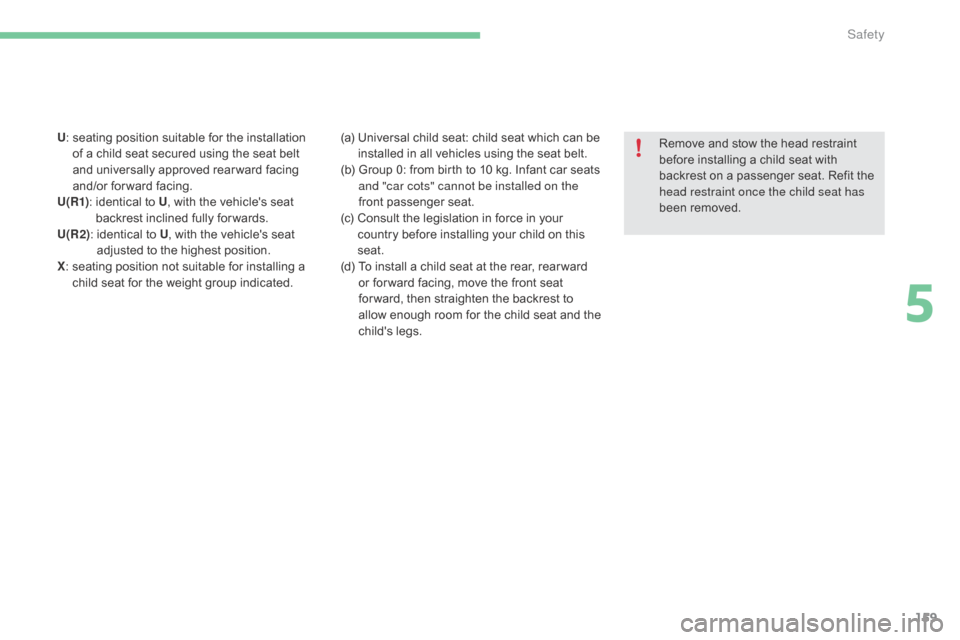
U: seating position suitable for the installation o
f a child seat secured using the seat belt
a
nd universally approved rear ward facing
a
nd/or for ward facing.
U(R1) :
i
dentical to U,
with the vehicle's seat
b
ackrest inclined fully for wards.
U(R2) :
i
dentical to U,
with the vehicle's seat
a
djusted to the highest position.
X :
s
eating position not suitable for installing a
c
hild seat for the weight group indicated.(a)
U niversal child seat: child seat which can be i
nstalled in all vehicles using the seat belt.
(b)
G
roup 0: from birth to 10 kg. Infant car seats
a
nd "car cots" cannot be installed on the
front
p
assenger
sea
t.
(c)
C
onsult the legislation in force in your
c
ountry before installing your child on this
sea
t.
(d)
T
o install a child seat at the rear, rear ward
o
r for ward facing, move the front seat
f
or ward, then straighten the backrest to
a
llow enough room for the child seat and the
c
hild's legs.Remove
and stow the head restraint
b
efore installing a child seat with
b
ackrest on a passenger seat. Refit the
h
ead restraint once the child seat has
been
removed.
5
Safety
Page 165 of 396
163
C4-2_en_Chap05_securite_ed02-2015
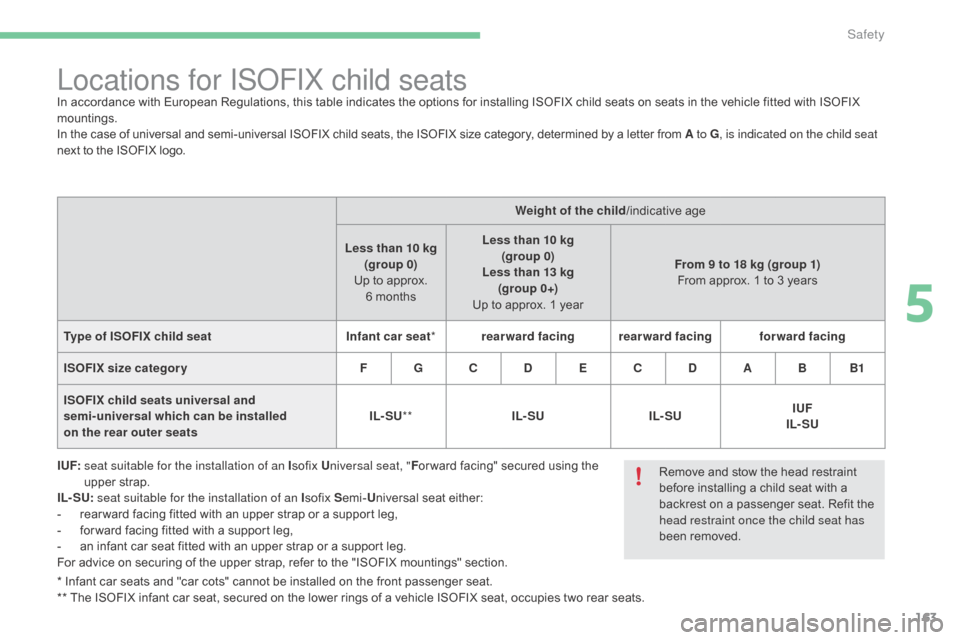
* Infant car seats and "car cots" cannot be installed on the front passenger seat.
* * The ISOFIX infant car seat, secured on the lower rings of a vehicle ISOFIX seat, occupies two rear seats.
Locations for ISOFIX child seatsIn accordance with European Regulations, this table indicates the options for installing ISOFIX child seats on seats in the vehicle fitted with ISOFIX mountings.
In
the case of universal and semi-universal ISOFIX child seats, the ISOFIX size category, determined by a letter from A to G , is indicated on the child seat
next
to the ISOFIX logo.
I UF:
s
eat suitable for the installation of an I sofix
Universal seat, " For ward
facing" secured using the
u
pper strap.
IL- SU: seat suitable for the installation of an I sofix
Semi- Universal
sea
t
ei
ther:
-
r
ear ward facing fitted with an upper strap or a support leg,
-
f
or ward facing fitted with a support leg,
-
a
n infant car seat fitted with an upper strap or a support leg.
For
advice on securing of the upper strap, refer to the "ISOFIX mountings" section.Weight of the child
/indicative
age
Less than 10
kg
(group 0)
Up
to approx.
6
monthsLess than 10 kg
(group 0)
Less than 13 kg (group 0+)
Up
to approx. 1 yearFrom 9 to 18 kg (group 1)
From
approx. 1 to 3 years
Type of ISOFIX child seat Infant car seat*rearward facing rearward facing forward facing
ISOFIX size categor y F G C D E C D A B B1
ISOFIX child seats universal and
semi-universal which can be installed
on the rear outer seats IL- SU
** IL- SU IL- SU IUF
IL- SU
Remove
and stow the head restraint
b
efore installing a child seat with a
b
ackrest on a passenger seat. Refit the
h
ead restraint once the child seat has
been
removed.
5
Safety
Page 169 of 396
167
C4-2_en_Chap06_conduite_ed02-2015
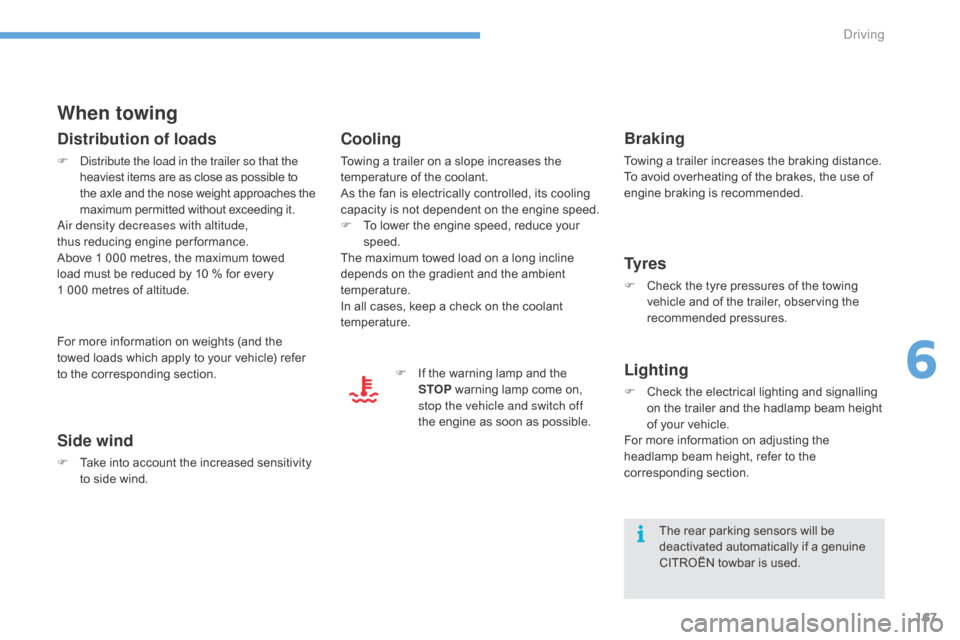
When towing
Distribution of loads
F Distribute the load in the trailer so that the heaviest items are as close as possible to t
he axle and the nose weight approaches the
m
aximum permitted without exceeding it.
Air density decreases with altitude,
thus
r
educing
e
ngine
p
erformance.
A
bove 1 000 metres, the maximum towed
l
oad must be reduced by 10 % for every
1 0
00 metres of altitude.
Side wind
F Take into account the increased sensitivity t
o side wind.
For
more information on weights (and the
t
owed loads which apply to your vehicle) refer
t
o the corresponding section.
F
I
f the warning lamp and the
S
TOP
warning lamp come on,
s
top the vehicle and switch off
the engine as soon as possible.
Braking
Towing a trailer increases the braking distance.
T o avoid overheating of the brakes, the use of
e
ngine braking is recommended.
Ty r e s
F Check the tyre pressures of the towing v
ehicle and of the trailer, observing the
re
commended
p
ressures.
Lighting
F Check the electrical lighting and signalling o
n the trailer and the hadlamp beam height
o
f your vehicle.
For
more information on adjusting the
h
eadlamp beam height, refer to the
c
orresponding
s
ection.
The
rear parking sensors will be
d
eactivated automatically if a genuine
C
ITROËN towbar is used.
Cooling
Towing a trailer on a slope increases the temperature of the coolant.
As
the fan is electrically controlled, its cooling
c
apacity is not dependent on the engine speed.
F
T
o lower the engine speed, reduce your
s
peed.
The
maximum towed load on a long incline
d
epends on the gradient and the ambient
t
emperature.
In
all cases, keep a check on the coolant
t
emperature.
6
Driving
Page 215 of 396
213
C4-2_en_Chap07_infos-pratiques_ed02-2015
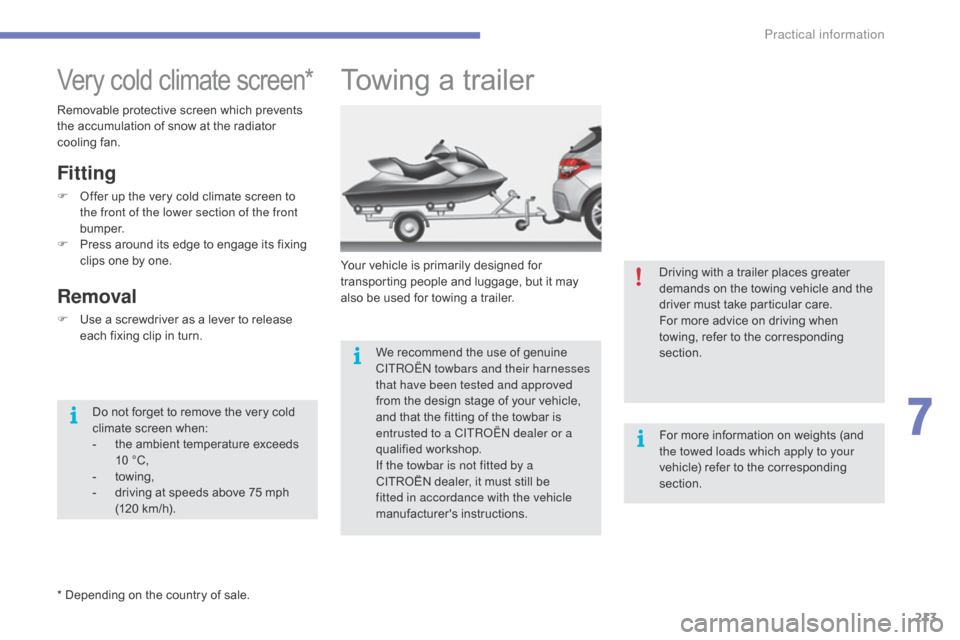
Towing a trailer
Your vehicle is primarily designed for transporting people and luggage, but it may
a
lso be used for towing a trailer.
We
recommend the use of genuine
C
ITROËN towbars and their harnesses
that have been tested and approved
from
the design stage of your vehicle,
a
nd that the fitting of the towbar is
e
ntrusted to a CITROËN dealer or a
qualified
w
orkshop.
If the towbar is not fitted by a
CITROËN
dealer, it must still be
f
itted in accordance with the vehicle
manufacturer's
i
nstructions.
Very cold climate screen*
* Depending on the country of sale.
Fitting
F Offer up the very cold climate screen to t
he front of the lower section of the front
b u m p e r.
F
P
ress around its edge to engage its fixing
c
lips one by one.
Removal
F Use a screwdriver as a lever to release e
ach fixing clip in turn.
Removable
protective screen which prevents
t
he accumulation of snow at the radiator
c
ooling fan.
Do not forget to remove the very cold
c
limate screen when:
-
t
he ambient temperature exceeds
1
0 °C,
-
tow
ing,
-
d
riving at speeds above 75 mph
(
120 km/h). Driving
with a trailer places greater
d
emands on the towing vehicle and the d
river must take particular care.
For more advice on driving when
t
owing, refer to the corresponding
s
ection.
For
more information on weights (and
t
he towed loads which apply to your
vehicle)
refer to the corresponding
s
ection.
7
Practical information
Page 217 of 396
215
C4-2_en_Chap07_infos-pratiques_ed02-2015
Before each use
Check that the towball is correctly fitted by verifying the following points:
- t he towball is correctly locked in place (position A),
-
t
he security key lock is on and the key removed; the locking wheel can no longer be
ope
rated,
-
t
he towball must no longer move at all in its carrier; try to shake it by hand.
During use
Never unlock the device when a trailer or load carrier is fitted to the towball.
N ever exceed the maximum authorised weight for the vehicle plus trailer (Gross Train
W
eight - GTW).
Before
driving, check the adjustment of the headlamp beam height.
For
more information on adjusting the headlamps, refer to the corresponding section.
After use
For journeys made without a trailer or load carrier, the trailer harness socket must be folded away, the towball removed and the blanking plug inserted in the carrier. This measure
a
pplies particularly if the towball could hinder visibility of the number plate or lighting.
7
Practical information
Page 220 of 396
218
C4-2_en_Chap07_infos-pratiques_ed02-2015
Maintenance
Correct operation is only possible if the towball
and its carrier remain clean.
Before
cleaning the vehicle with a high pressure
j
et wash, the towbar harness socket carrier must
b
e folded away, the towball removed and the
b
lanking plug inserted in the carrier.
For
any work on the towbar, got to a CITROËN
d
ealer or a qualified workshop.
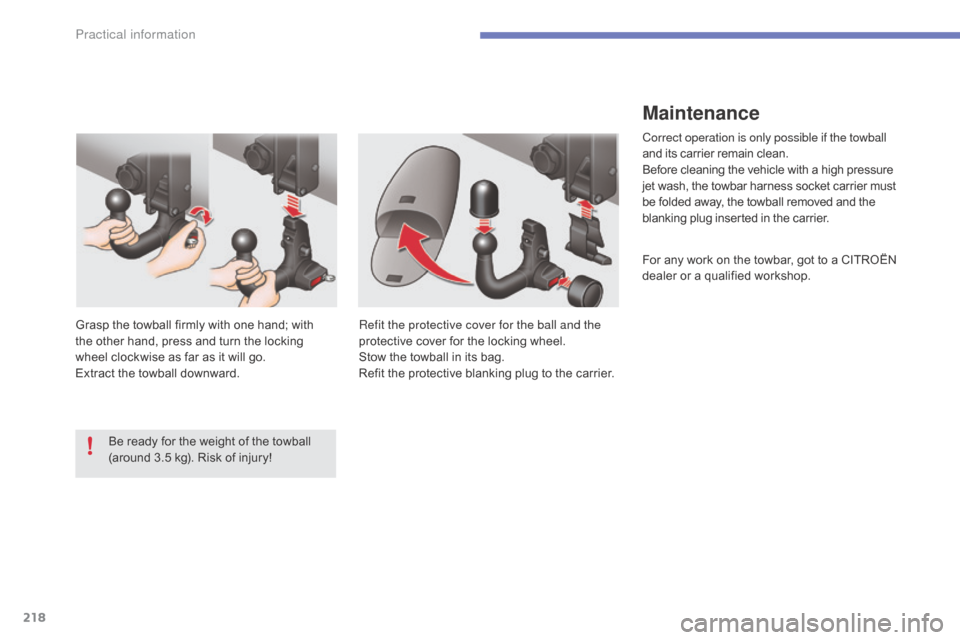
Refit the protective cover for the ball and the
protective
cover
for
the
locking
wheel.
Stow
the
towball
in
its
bag.
Refit
the
protective
blanking
plug
to
the
carrier.
Grasp
the
towball
firmly
with
one
hand;
with
t
he
other
hand,
press
and
turn
the
locking
w
heel clockwise
as
far
as
it
will
go.
Extract
the
towball
downward.
Be
ready
for
the
weight
of
the
towball
(
around
3.5
kg).
Risk
of
injury!
Practical information
Page 271 of 396
269
C4-2_en_Chap08_en-cas-de-panne_ed02-2015
Towing the vehicle
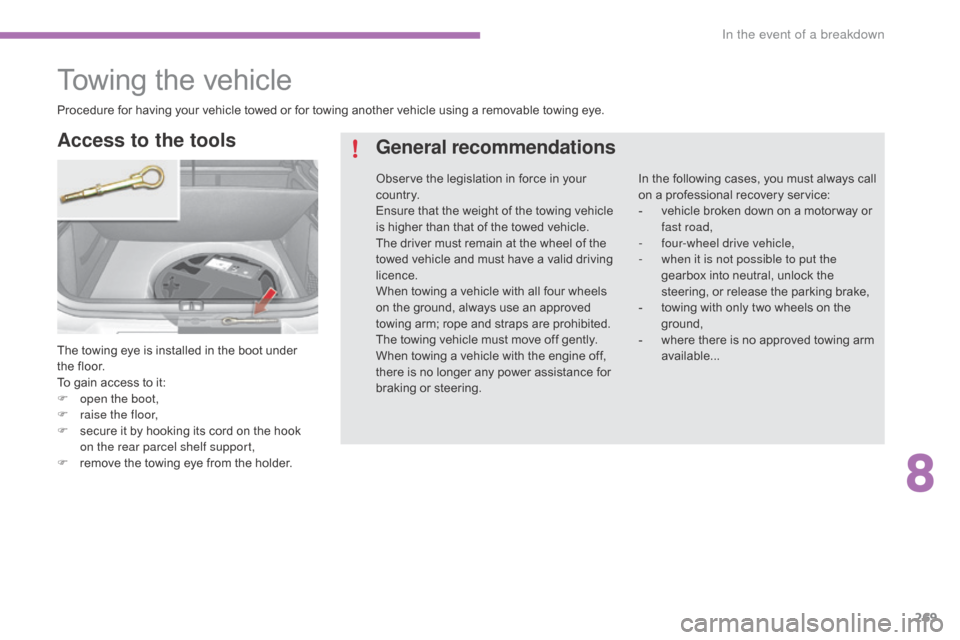
The towing eye is installed in the boot under the floor.
To
gain access to it:
F
o
pen the boot,
F
r
aise the floor,
F
s
ecure it by hooking its cord on the hook
o
n the rear parcel shelf support,
F
r
emove the towing eye from the holder.
Access to the tools General recommendations
In the following cases, you must always call o
n a professional recovery service:
-
v
ehicle broken down on a motor way or
f
ast road,
-
f
our-wheel drive vehicle,
-
w
hen it is not possible to put the
gearbox
into neutral, unlock the
s
teering, or release the parking brake,
-
t
owing with only two wheels on the
g
round,
-
w
here there is no approved towing arm
a
vailable...
Procedure
for
having
your
vehicle
towed
or
for
towing
another
vehicle
using
a
removable
towing
eye.
Observe
the
legislation
in
force
in
your
c
o unt r y.
Ensure
that
the
weight
of
the
towing
vehicle
i
s
higher
than
that
of
the
towed
vehicle.
The
driver
must
remain
at
the
wheel
of
the
t
owed
vehicle
and
must
have
a
valid
driving
l
icence.
When
towing
a
vehicle
with
all
four
wheels
o
n
the
ground,
always
use
an
approved
t
owing
arm;
rope
and
straps
are
prohibited.
The
towing
vehicle
must
move
off
gently.
When
towing
a
vehicle
with
the
engine
off,
t
here
is
no
longer
any
power
assistance
for
b
raking
or
steering.
8
In the event of a breakdown