maintenance Citroen C4 2016 2.G Owner's Manual
[x] Cancel search | Manufacturer: CITROEN, Model Year: 2016, Model line: C4, Model: Citroen C4 2016 2.GPages: 396, PDF Size: 10.22 MB
Page 11 of 396
9
C4-2_en_Chap00b_vue-ensemble_ed02-2015
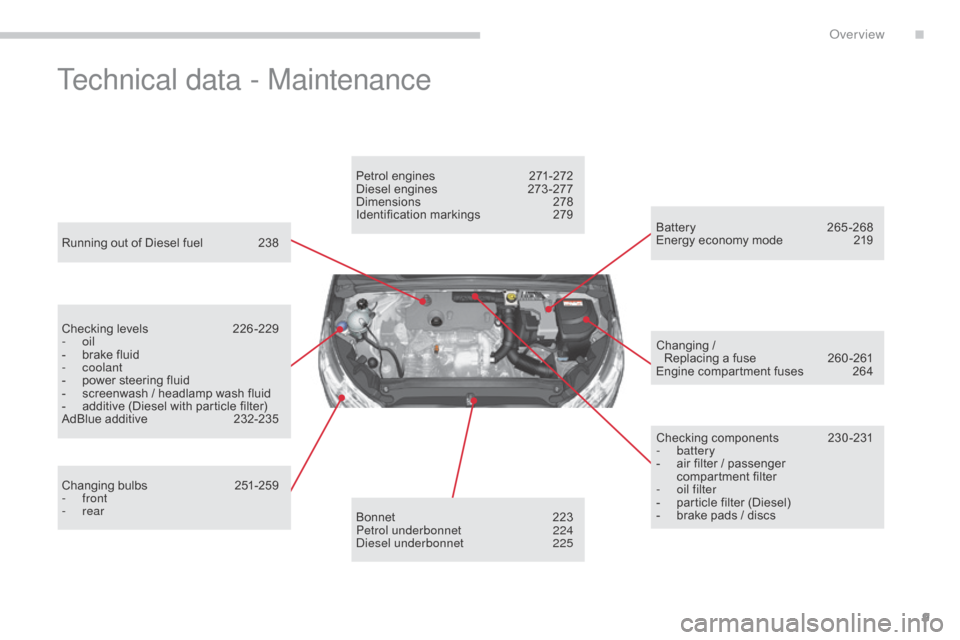
Technical data - Maintenance
Running out of Diesel fuel 238
Checking levels
2
26 -229
-
oil
-
b
rake fluid
-
coolant
-
p
ower steering fluid
-
s
creenwash / headlamp wash fluid
-
a
dditive (Diesel with particle filter)
AdBlue
additive
2
32-235
Changing
bu
lbs
2
51-259
-
front
-
rear Petrol
engines
2
71-272
Diesel engines
2
73 -277
Dimensions
2
78
Identification
ma
rkings
2
79
Bonnet
2
23
Petrol underbonnet
2
24
Diesel underbonnet
2
25Checking
c
omponents
23
0-231
-
battery
-
a
ir filter / passenger
c
ompartment filter
-
o
il filter
-
p
article filter (Diesel)
-
b
rake pads / discs
Battery 2
65 -268
Energy economy mode 2 19
Changing
/
R
eplacing a fuse
2
60 -261
Engine
compartment fuses
2
64
.
Over view
Page 13 of 396
11
C4-2_en_Chap00c_eco-conduite_ed02-2015
Limit the causes of excess consumption
Spread loads throughout the vehicle; place the heaviest items in the bottom of the boot, as close as possible to the rear seats.
Limit
the loads carried in the vehicle and reduce wind resistance (roof
b
ars, roof rack, bicycle carrier, trailer...). Use a roof box in preference.
Remove
roof bars and roof racks after use.
At
the end of winter, remove snow tyres and refit your summer tyres.
Observe the recommendations on
maintenance
Check the tyre pressures regularly, when cold, referring to the label in the door aperture, driver's side.
Carry
out this check in particular:
-
b
efore a long journey,
-
a
t each change of season,
-
a
fter a long period out of use.
Don't
forget the spare wheel and the tyres on any trailer or caravan.
Have
your vehicle serviced regularly (engine oil, oil filter, air filter,
p
assenger compartment filter...) and observe the schedule of
o
perations recommended in the manufacturer's service schedule.
With
a BlueHDi Diesel engine, if the SCR system is faulty your vehicle
b
ecomes polluting; go to a CITROËN dealer or a qualified workshop
w
ithout delay to have the emissions of nitrous oxides brought back to
t
he legal level.
When
refuelling, do not continue after the third cut-off of the nozzle to
a
void any over flow.
At
the wheel of your new vehicle, it is only after the first 1 800 miles
(
3 000 kilometres) that you will see the fuel consumption settle down to
a
consistent average.
.
Eco-driving
Page 93 of 396
91
C4-2_en_Chap03_ergonomie-et-confort_ed02-2015
Stop & Start
The heating and air conditioning systems only work when the engine is
r
unning.
To
maintain a comfortable temperature
i
n the passenger compartment, you can
t
emporarily deactivate the Stop & Start
s
ystem.
For
more information on Stop & Start,
r
efer to the corresponding section.
In
order
for
these
systems
to
be
fully
effective,
follow
the
operation
and
maintenance
g
uidelines
belo
w:
F
T
o
obtain
an
even
air
distribution,
take
care
not
to
obstruct
the
exterior
air
intake
grilles
l
ocated at the base of the windscreen, the nozzles, the vents and the air outlets, as well
as
the
air
extractor
located
in
the
boot.
F
D
o
not
cover
the
sunshine
sensor,
located
on
the
dashboard;
this
is
used
for
regulation
o
f
the
air
conditioning
system.
F
O
perate
the
air
conditioning
system
for
at
least
5
to
10
minutes,
once
or
twice
a
month
t
o
keep
it
in
per fect
working
order.
F
E
nsure
that
the
passenger
compartment
filter
is
in
good
condition
and
have
the
filter
e
lements
replaced
regularly.
W
e
recommend
the
use
of
a
combined
passenger
compartment
filter.
Thanks
to
its
s
pecial active additive, it contributes to the purification of the air breathed by the
occupants
and
the
cleanliness
of
the
passenger
compartment
(reduction
of
allergic
s
ymptoms,
bad
odours
and
greasy
deposits).
F
T
o
ensure
correct
operation
of
the
air
conditioning
system,
you
are
also
advised
to
have
i
t
checked
regularly
as
recommended
in
the
maintenance
and
warranty
guide.
F
I
f
the
system
does
not
produce
cold
air,
switch
it
off
and
contact
a
CITROËN
dealer
or
a
q
ualified
w
orkshop.
When
towing
the
maximum
load
on
a
steep
gradient
in
high
temperatures,
switching
off
the
a
ir
conditioning
increases
the
available
engine
power
and
so
improves
the
towing
ability. The condensation created by the air
conditioning
results in a discharge
o
f water under the vehicle which is
per fectly normal.
If after an extended stop in sunshine,
t
he interior temperature is very
h
igh, first ventilate the passenger
c
ompartment for a few moments.
Put the air flow control at a setting high
e
nough to quickly change the air in the
p
assenger
c
ompartment.
The air conditioning system does not
c
ontain chlorine and does not present
any danger to the ozone layer.
Recommendations for ventilation and air conditioning
3
Ease of use and comfort
Page 185 of 396
183
C4-2_en_Chap06_conduite_ed02-2015
Moving off
If position N is engaged inadvertently while driving, allow the engine to
r
eturn to idle then engage position D to
accelerate. F
Sel
ect position D for automatic
c
hanging
o
f the six gears.
The gearbox then operates in auto-adaptive
m
ode, without any intervention on the part
o
f the driver. It continuously selects the most
s
uitable gear according to the style of driving, t
he profile of the road and the load in the
vehicle.
For
maximum acceleration without touching
t
he selector, press the accelerator pedal down
fully
(kick down). The gearbox changes down
a
utomatically or maintains the gear selected
u
ntil the maximum engine speed is reached.
On
braking, the gearbox changes down
a
utomatically to provide effective engine
b
raking.
If you release the accelerator sharply, the
gearbox
will not change to a higher gear for
s
afety reasons.
When
the engine is running at idle, with
t
he brakes released, if position R,
D
or
M is selected, the vehicle moves
e
ven without the accelerator being
p
ressed.
Never leave children unsupervised in
the
vehicle when the engine is running.
When
carrying out maintenance with
t
he engine running, apply the parking
b
rake and select position P.
Never select position N while the
vehicle
is moving.
Never select positions P or R unless the
vehicle
is completely stationary.
If
the parking brake does not release
a
utomatically, check that the front doors
a
re fully closed.
F
W
ith
your
foot
on
the
brake,
select
p
osition
P or N
.
F
S
tart
the
engine.
If this procedure is not followed, an audible
signal
is
heard,
accompanied
by
a
message
in
t
he
instrument
panel
screen.
F
W
ith
the
engine
running,
press
the
brake
ped
al.
F
Sel
ect position R , D or M.
Automatic operation
The parking brake is released manually, the v
ehicle moves off.
If
the parking brake is on and automatic mode
i
s activated, accelerate progressively.
If you do not press the brake pedal when trying to move the gear selector out o
f position P ,
this warning lamp or this
s
ymbol
ap
pears
in t
he
in
strument
pan
el
a
ccompanied
b
y
a
message, flashing of the P
symbol, the display of
a
message
and an audible signal.
F Check that the display in the instrument p
anel agrees with the position engaged.
F
G
radually release the brake pedal.
6
Driving
Page 192 of 396
190
C4-2_en_Chap06_conduite_ed02-2015
Maintenance
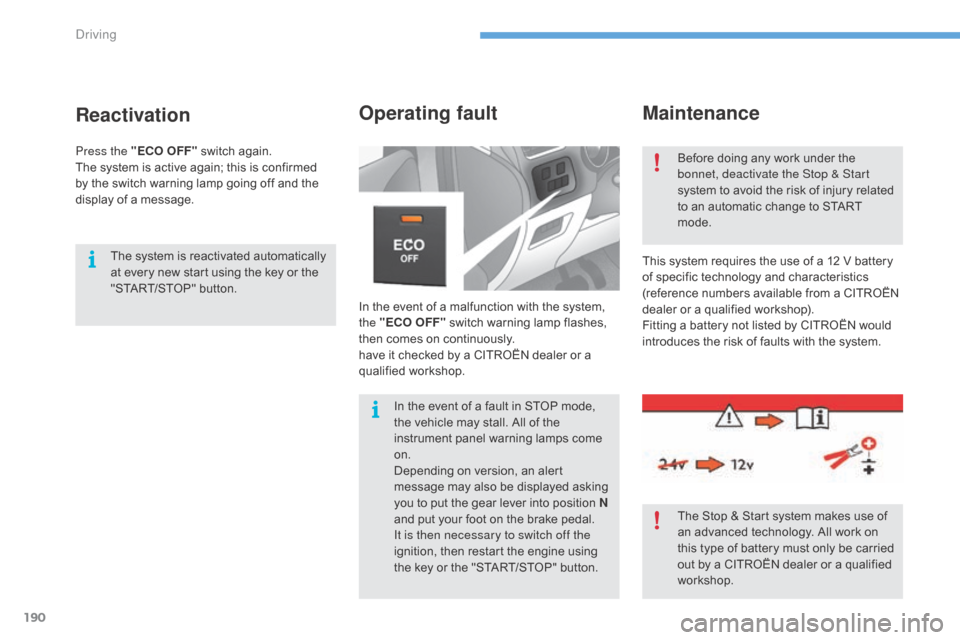
In the event of a malfunction with the system, the "ECO OFF" switch warning lamp flashes,
t
hen comes on continuously.
have
it checked by a CITROËN dealer or a
q
ualified
w
orkshop.
Operating fault
This system requires the use of a 12 V battery of specific technology and characteristics
(
reference numbers available from a CITROËN
d
ealer or a qualified workshop).
Fitting
a battery not listed by CITROËN would
i
ntroduces the risk of faults with the system.
Before
doing any work under the
b
onnet, deactivate the Stop & Start
system to avoid the risk of injury related
t
o an automatic change to START
m
ode.
The Stop & Start system makes use of
a
n advanced technology. All work on
t
his type of battery must only be carried
o
ut by a CITROËN dealer or a qualified
w
orkshop.
In
the
event
of
a
fault
in
STOP
mode,
t
he
vehicle
may
stall.
All
of
the
i
nstrument
panel
warning
lamps
come
o
n.
Depending
on
version,
an
alert
m
essage
may
also
be
displayed
asking
y
ou
to
put
the
gear
lever
into
position
N
and
put
your
foot
on
the
brake
pedal.
It is then necessary to switch off the
ignition,
then
restart
the
engine
using
t
he
key
or
the
"START/STOP"
button.
Reactivation
The system is reactivated automatically a t every new start using the key or the
"
START/STOP" button.
Press the "ECO OFF"
switch again.
The
system is active again; this is confirmed
b
y
the
switch warning lamp going off and the
d
isplay of a message.
Driving
Page 220 of 396
218
C4-2_en_Chap07_infos-pratiques_ed02-2015
Maintenance
Correct operation is only possible if the towball
and its carrier remain clean.
Before
cleaning the vehicle with a high pressure
j
et wash, the towbar harness socket carrier must
b
e folded away, the towball removed and the
b
lanking plug inserted in the carrier.
For
any work on the towbar, got to a CITROËN
d
ealer or a qualified workshop.
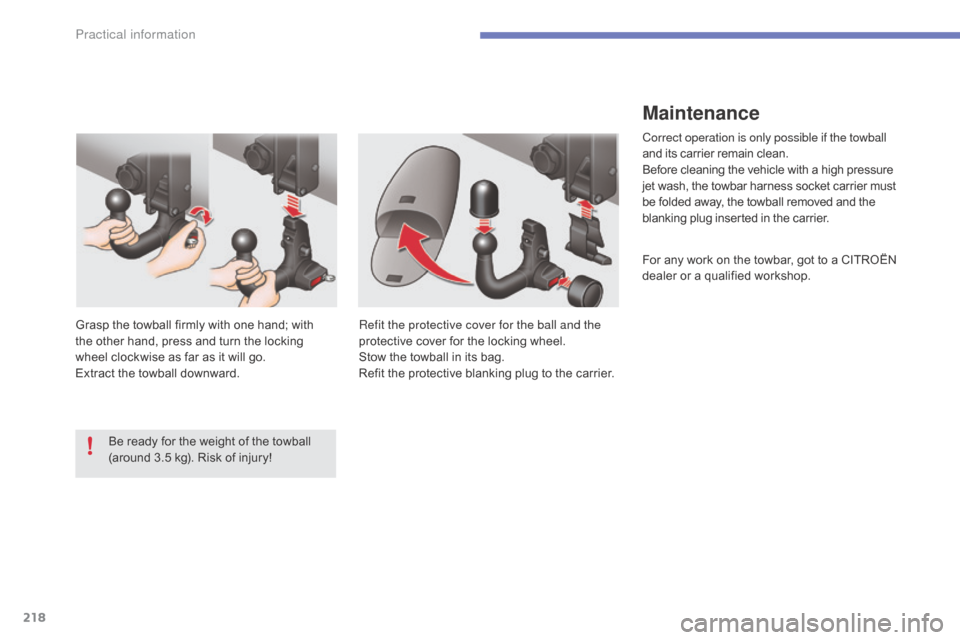
Refit the protective cover for the ball and the
protective
cover
for
the
locking
wheel.
Stow
the
towball
in
its
bag.
Refit
the
protective
blanking
plug
to
the
carrier.
Grasp
the
towball
firmly
with
one
hand;
with
t
he
other
hand,
press
and
turn
the
locking
w
heel clockwise
as
far
as
it
will
go.
Extract
the
towball
downward.
Be
ready
for
the
weight
of
the
towball
(
around
3.5
kg).
Risk
of
injury!
Practical information
Page 227 of 396
225
C4-2_en_Chap07_infos-pratiques_ed02-2015
* According to engine.
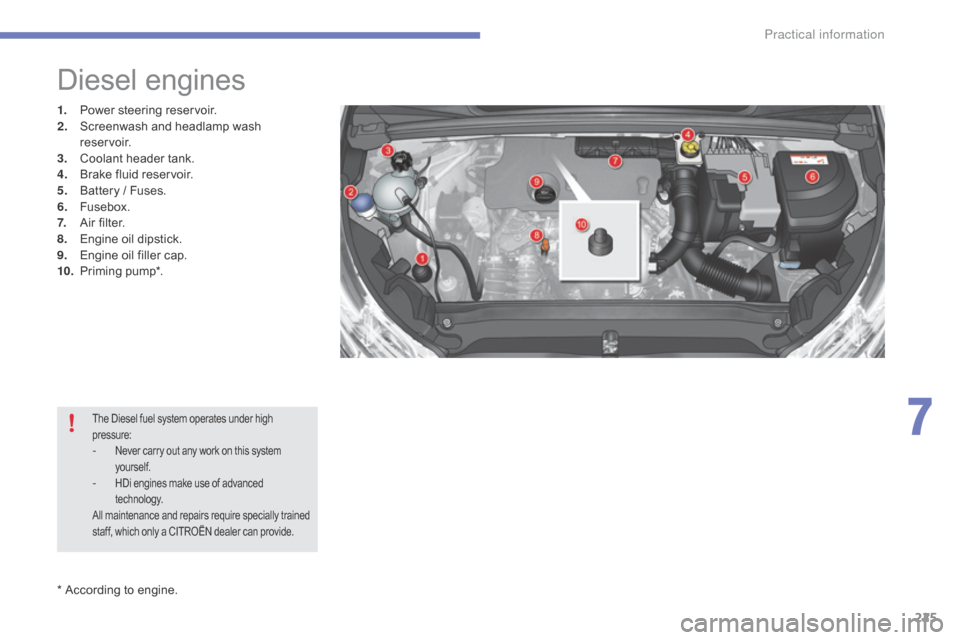
Diesel engines
1. Power steering r eservoir.
2. S creenwash and headlamp wash
reservoir.
3.
C
oolant header tank.
4.
B
rake fluid reservoir.
5.
B
attery / Fuses.
6.
F
usebox.
7.
A
ir filter.
8.
E
ngine oil dipstick.
9.
E
ngine oil filler cap.
10.
P
riming
pu
mp*.
The Diesel fuel system operates under high pressure:
- Never carry out any work on this system y
ourself.
- HDi engines make use of advanced t
echnology.
All
maintenance and repairs require specially trained
s
taff, which only a CITROËN dealer can provide.
7
Practical information
Page 232 of 396
230
C4-2_en_Chap07_infos-pratiques_ed02-2015
Checks
Particle filter (Diesel)
- fixed illumination of the particle f
ilter warning lamp, accompanied
b
y an audible signal and a
m
essage that there is a risk of
b
lockage of the particle filter.
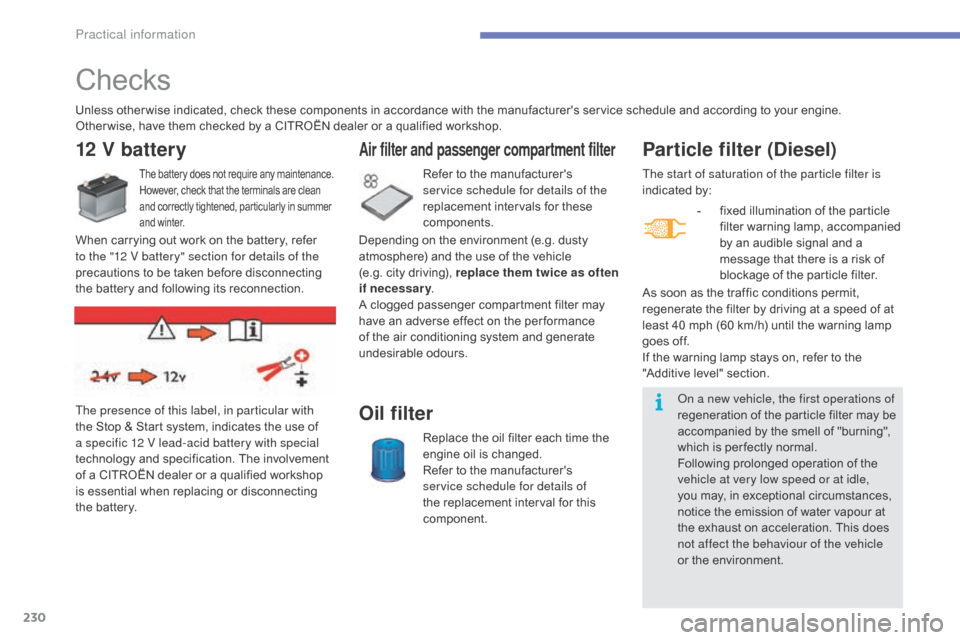
The presence of this label, in particular with
the
Stop
&
Start
system,
indicates
the
use
of
a s
pecific 12 V lead-acid battery with special
technology
and
specification.
The
involvement
o
f
a
CITROËN
dealer
or
a
qualified
workshop
i
s
essential
when
replacing
or
disconnecting
t
he
battery. As
soon
as the traffic conditions permit,
r
egenerate the filter by driving at a speed of at
l
east
40
mph (60 km/h) until the warning lamp
g
oes
off.
If
the
warning lamp stays on, refer to the
"
Additive
level" section.
Unless
other wise
indicated,
check
these
components
in
accordance
with
the
manufacturer's
service
schedule
and according to your engine.
Other wise,
have
them
checked
by
a
CITROËN
dealer
or
a
qualified
workshop.
Air filter and passenger compartment filter
Refer to the manufacturer's s
ervice schedule for details of the
replacement
intervals for these
c
omponents.
Oil filter
Replace the oil filter each time the e ngine oil is changed.
Refer
to the manufacturer's
s
ervice schedule for details of
the
replacement interval for this
c
omponent.
12 V battery
The battery does not require any maintenance.
H owever, check that the terminals are clean a
nd correctly tightened, particularly in summer
a
nd winter.
When carrying out work on the battery, refer to the "12 V battery" section for details of the
precautions
to be taken before disconnecting
t
he battery and following its reconnection.Depending
on the environment (e.g. dusty a
tmosphere) and the use of the vehicle
(e.g.
city driving), replace them twice as often
if necessary .
A
clogged passenger compartment filter may
h
ave an adverse effect on the per formance
o
f the air conditioning system and generate
u
ndesirable
o
dours.The start of saturation of the particle filter is
indicated
by:
On a new vehicle, the first operations of
regeneration of the particle filter may be
a
ccompanied by the smell of "burning",
w
hich is per fectly normal.
Following
prolonged operation of the
v
ehicle at very low speed or at idle,
you
may, in exceptional circumstances,
n
otice the emission of water vapour at
t
he exhaust on acceleration. This does
n
ot affect the behaviour of the vehicle
or
the environment.
Practical information
Page 233 of 396
231
C4-2_en_Chap07_infos-pratiques_ed02-2015
Automatic gearbox
The gearbox does not require any maintenance (no oil change).
Refer
to the manufacturer's
s
ervice schedule for details of
the
level checking interval for this
c
omponent.
Electric parking brake
This system does not require any routine servicing. However, in
t
he event of a problem, have the
s
ystem checked by a CITROËN
d
ealer or a qualified workshop.
Manual parking brake
If a loss of effectiveness of this
system i s n oticed, t he p arking b rake
m
ust be checked, even between
t
wo services.
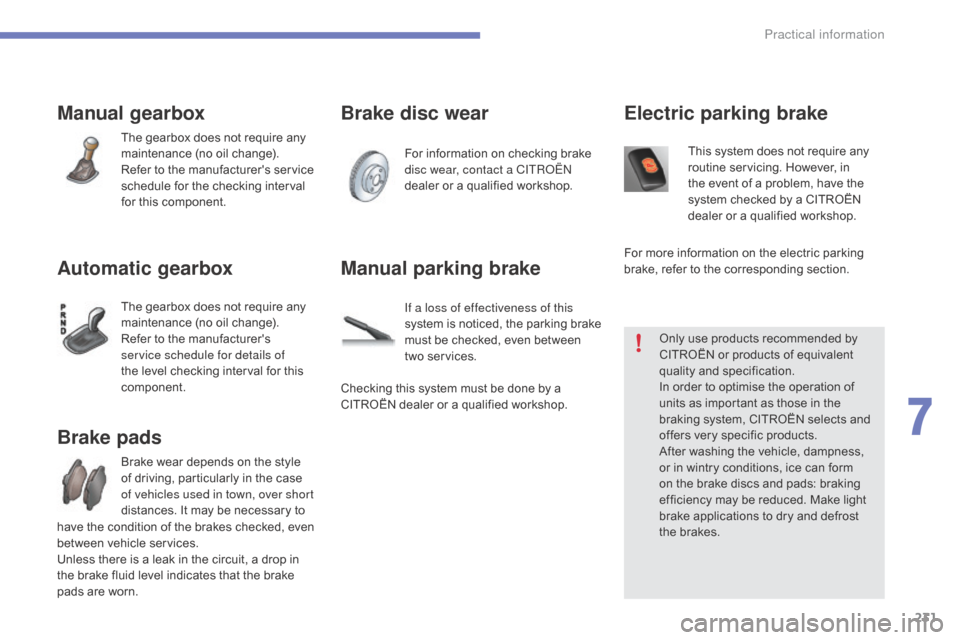
Brake pads
Brake wear depends on the style of driving, particularly in the case
o
f vehicles used in town, over short
distances.
It may be necessary to
Brake disc wear
For information on checking brake disc wear, contact a CITROËN
dealer
or a qualified workshop.
For
more information on the electric parking
b
rake, refer to the corresponding section.
Manual gearbox
The gearbox does not require any maintenance (no oil change).
Refer
to the manufacturer's service
s
chedule for the checking interval
f
or this component.
Only
use products recommended by
C
ITROËN or products of equivalent
q
uality
an
d
sp
ecification.
In
order to optimise the operation of
u
nits as important as those in the
b
raking system, CITROËN selects and
o
ffers very specific products.
After
washing the vehicle, dampness,
o
r in wintry conditions, ice can form
o
n the brake discs and pads: braking
e
fficiency may be reduced. Make light
b
rake applications to dry and defrost
t
he brakes.
have
the
condition of the brakes checked, even
b
etween
v
ehicle
s
ervices.
Unless
there is a leak in the circuit, a drop in
t
he
brake
fluid level indicates that the brake
p
ads
are
worn. Checking
this system must be done by a
C
ITROËN dealer or a qualified workshop.
7
Practical information
Page 239 of 396
237
C4-2_en_Chap07_infos-pratiques_ed02-2015
"Multimedia":
audio systems, steering mounted audio controls, speakers, Hi-Fi module, Bluetooth
h
ands-free system, portable satellite navigation
s
ystem, semi-integral support bracket for
p
ortable navigation system, mapping update
C
D, driving assistant, portable video screen,
p
ortable video support bracket, 230 V/50 Hz
s
ocket, 230 V/50 Hz adaptor, iPhone
®
compatible
mobile
phone
charger,
mobile
p
hone/smartphone
bracket,
Wi-Fi
on
board...
By
going to a CITROËN dealer, you can also
o
btain cleaning and maintenance products
(
interior and exterior) - including ecological
p
roducts in the "TECHNATURE" range -,
p
roducts for topping up (screenwash...), touch-
up
pens and paint aerosols for the exact colour
o
f your vehicle, recharges (cartridge for the
t
emporary puncture repair kit...), ...
Installation of radio
communication
transmitters
Before installing any after-market radio communication transmitter, you can
c
ontact a CITROËN dealer for the
specification
of transmitters which can
b
e fitted (frequency, maximum power,
a
erial position, specific installation
requirements),
in line with the Vehicle
E
lectromagnetic
C
ompatibility
D
irective (2004/104/EC). The
fitting of electrical equipment or
a
ccessories which are not recommended
b
y CITROËN may result in a failure of
y
our vehicle's electronic system and
e
xcessive electrical consumption.
Contact a CITROËN dealer
for
information on the range of
r
ecommended equipment and
a
ccessories.
Depending
on the legislation in force in
t
he country, certain safety equipment
m
ay be compulsory: high visibility s
afety vests, warning triangles, b
reathalyzers, spare bulbs, spare fuses,
fire
extinguisher, first aid kit, mud flaps
a
t the rear of the vehicle.
7
Practical information