tow CITROEN C4 2018 Owner's Manual
[x] Cancel search | Manufacturer: CITROEN, Model Year: 2018, Model line: C4, Model: CITROEN C4 2018Pages: 317, PDF Size: 9.31 MB
Page 117 of 317
115
C4-cactus_en_Chap05_securite_ed01-2016
Locations for ISOFIX child seats
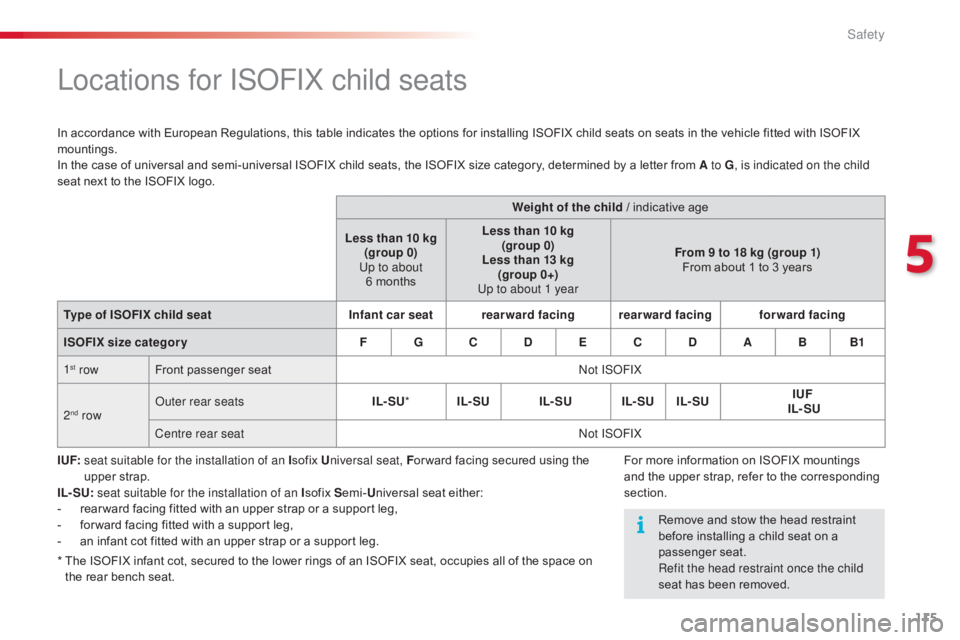
In accordance with European Regulations, this table indicates the options for installing ISOFIX child seats on seats in the vehicle fitted with ISOFIX mountings.
In
the case of universal and semi-universal ISOFIX child seats, the ISOFIX size category, determined by a letter from A to G, is indicated on the child
seat
next to the ISOFIX logo.
I UF:
s
eat suitable for the installation of an I sofix
Universal seat, F or ward
facing secured using the
u
pper strap.
IL- SU: seat suitable for the installation of an I sofix
Semi- Universal
sea
t
ei
ther:
-
r
ear ward facing fitted with an upper strap or a support leg,
-
f
or ward facing fitted with a support leg,
-
a
n infant cot fitted with an upper strap or a support leg.Weight of the child
/ indicative age
Less than 10 kg (group 0)
Up to about 6 months Less than 10 kg
(group 0)
Less than 13 kg (group 0+)
Up to about 1 year From 9 to 18 kg (group 1)
From
about 1 to 3 years
Type of ISOFIX child seat Infant car seatrearward facing rearward facing forward facing
ISOFIX size categor y F G C D E C D A B B1
1
st row Front p assenger sea t Not ISOFIX
2
nd row Outer rear seats
IL- SU* IL- SU IL- SU IL- SU IL- SU IUF
IL- SU
Centre rear seat Not ISOFIX
Remove
and stow the head restraint
b
efore installing a child seat on a
p
assenger
sea
t.
Refit the head restraint once the child
seat
has been removed.
For
more information on ISOFIX mountings
a
nd the upper strap, refer to the corresponding
s
ection.
*
T
he ISOFIX infant cot, secured to the lower rings of an ISOFIX seat, occupies all of the space on
t
he rear bench seat.
5
Safety
Page 118 of 317
116
C4-cactus_en_Chap05_securite_ed01-2016
Locations for i-Size child seats
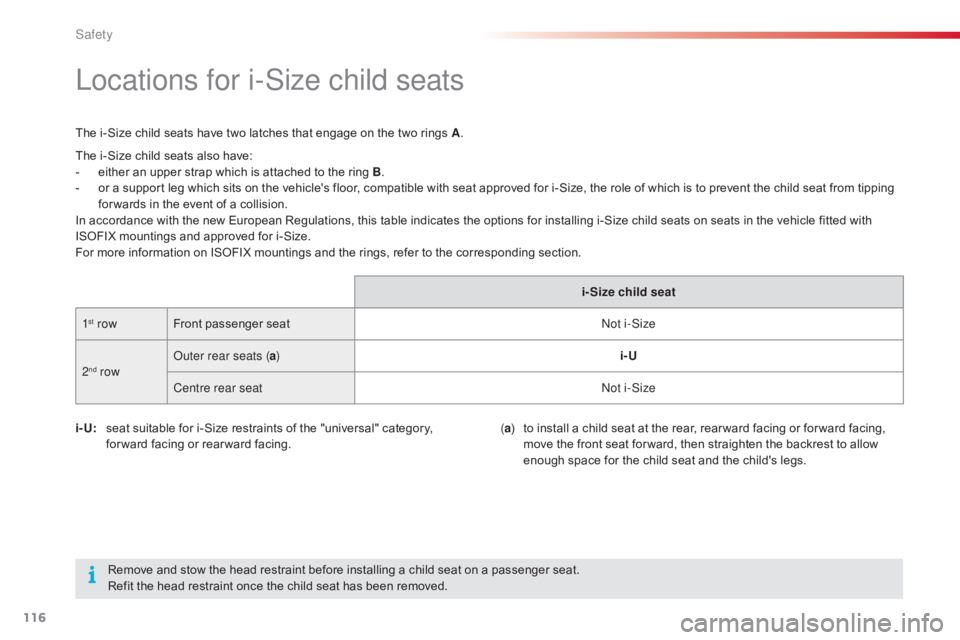
The i-Size child seats have two latches that engage on the two rings A.
i - U:
s
eat suitable for i-Size restraints of the "universal" category,
f
or ward facing or rear ward facing.
Remove
and stow the head restraint before installing a child seat on a passenger seat.
Refit
the head restraint once the child seat has been removed.(
a )
t
o install a child seat at the rear, rear ward facing or for ward facing,
m
ove the front seat for ward, then straighten the backrest to allow
e
nough space for the child seat and the child's legs.
The
i-Size child seats also have:
-
e
ither an upper strap which is attached to the ring B.
-
o
r a support leg which sits on the vehicle's floor, compatible with seat approved for i-Size, the role of which is to prevent the child seat from tipping
f
or wards in the event of a collision.
In
accordance with the new European Regulations, this table indicates the options for installing i-Size child seats on seats in the vehicle fitted with
I
SOFIX mountings and approved for i-Size.
For
more information on ISOFIX mountings and the rings, refer to the corresponding section.i-Size child seat
1
st row Front p assenger sea t Not i-Size
2
nd row Outer rear seats (
a) i-U
Centre rear seat Not i-Size
Safety
Page 119 of 317
117
C4-cactus_en_Chap05_securite_ed01-2016
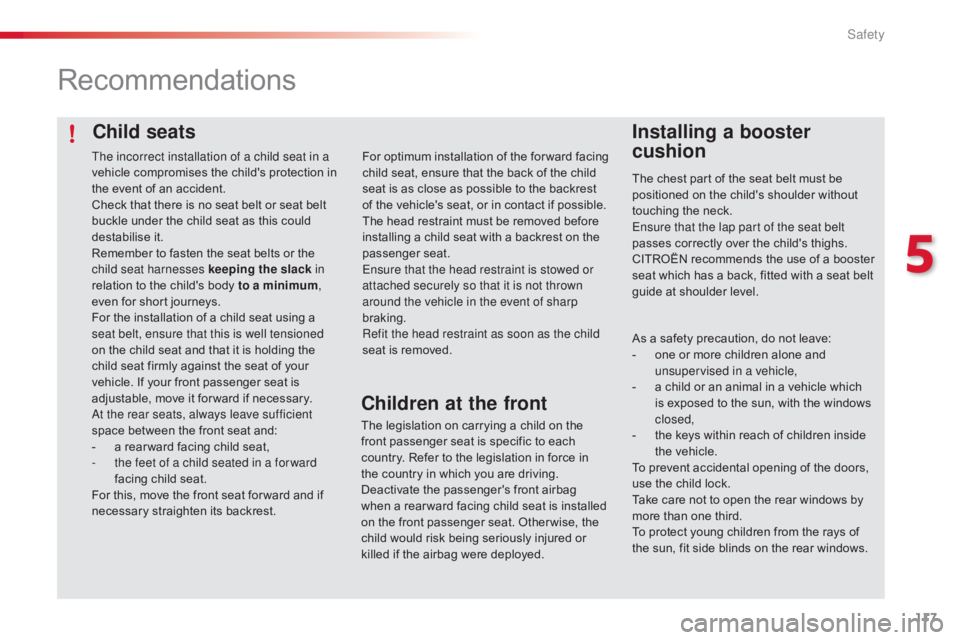
Child seats
Recommendations
Installing a booster
cushion
The chest part of the seat belt must be positioned on the child's shoulder without
t
ouching the neck.
Ensure that the lap part of the seat belt
passes
correctly over the child's thighs.
CITROËN
recommends the use of a booster
s
eat which has a back, fitted with a seat belt
g
uide at shoulder level.
As
a safety precaution, do not leave:
-
o
ne or more children alone and
u
nsupervised in a vehicle,
-
a
child or an animal in a vehicle which
i
s exposed to the sun, with the windows
c
losed,
-
t
he keys within reach of children inside
t
he vehicle.
To
prevent accidental opening of the doors,
u
se the child lock.
Take
care not to open the rear windows by
m
ore than one third.
To
protect young children from the rays of
t
he sun, fit side blinds on the rear windows.
Children at the front
For optimum installation o f t he fo rward f acing c
hild seat, ensure that the back of the child
s
eat is as close as possible to the backrest
o
f the vehicle's seat, or in contact if possible.
The
head restraint must be removed before
i
nstalling a child seat with a backrest on the
p
assenger
sea
t.
Ensure that the head restraint is stowed or
attached securely so that it is not thrown
around the vehicle in the event of sharp
braking.
Refit the head restraint as soon as the child
seat
is removed.
The
legislation on carrying a child on the
f
ront passenger seat is specific to each
c
ountry. Refer to the legislation in force in
t
he country in which you are driving.
Deactivate
the passenger's front airbag
w
hen a rear ward facing child seat is installed
o
n the front passenger seat. Other wise, the
c
hild would risk being seriously injured or
k
illed if the airbag were deployed.
The incorrect installation of a child seat in a
vehicle
compromises
the
child's
protection
in
t
he
event
of
an
accident.
Check
that
there
is
no
seat
belt
or
seat
belt
b
uckle
under
the
child
seat
as
this
could
de
stabilise
i
t.
Remember
to
fasten
the
seat
belts
or
the
c
hild seat harnesses keeping the slack in
relation
to
the
child's
body
to a minimum ,
even
for
short
journeys.
For
the
installation
of
a
child
seat
using
a
s
eat belt, ensure that this is well tensioned
on
the
child
seat
and
that
it
is
holding
the
c
hild
seat
firmly
against
the
seat
of
your
v
ehicle.
If
your
front
passenger
seat
is
a
djustable,
move
it
for ward
if
necessary.
At the rear seats, always leave sufficient
space
between
the
front
seat
and:
-
a
rear ward
facing
child
seat,
-
t
he feet of a child seated in a for ward
facing
child
seat.
For
this,
move
the
front
seat
for ward
and
if
n
ecessary
straighten
its
backrest.
5
Safety
Page 122 of 317

120
C4-cactus_en_Chap06_conduite_ed01-2016
When towing
Distribution of loads
F Distribute the load in the trailer so that the heaviest items are as close as possible to
t
he axle and the nose weight approaches
t
he maximum permitted without
e
xceeding it.
Air density decreases with altitude, thus
reducing
engine per formance. Above
1 0
00 metres, the maximum towed load must
b
e reduced by 10 % for every 1 000 metres of
al
titude.
For
more information on weights (and the
t
owed loads which apply to your vehicle) refer
to
the corresponding section.
Side wind
F Take into account the increased sensitivity t
o side wind.
Cooling
Towing a trailer on a slope increases the temperature of the coolant.
As
the fan is electrically controlled, its cooling
c
apacity is not dependent on the engine speed.
F
T
o lower the engine speed, reduce your
s
peed.
The
maximum towed load on a long incline
d
epends on the gradient and the ambient
t
emperature.
In
all cases, keep a check on the coolant
t
emperature. F
I
f the warning lamp and the
S
TOP
warning lamp come on,
s
top the vehicle and switch off
the
engine as soon as possible.
Braking
Towing a trailer increases the braking distance.
T o avoid overheating of the brakes, the use of
e
ngine braking is recommended.
Ty r e s
F Check the tyre pressures of the towing v
ehicle and of the trailer, observing the
re
commended
p
ressures.
Lighting
F Check the electrical lighting and signalling o
n the trailer and the hadlamp beam height
o
f your vehicle.
For
more information on adjusting the
h
eadlamp beam height, refer to the
c
orresponding
s
ection.
The
rear parking sensors will be
d
eactivated automatically if a genuine
C
ITROËN towbar is used.
Driving
Page 142 of 317

140
C4-cactus_en_Chap06_conduite_ed01-2016
Flashing of the dashes indicates a fault with the cruise control.
Have
it checked by a CITROËN dealer or a
q
ualified
w
orkshop.
Operating fault Switching off
F Turn wheel 1 to the "0" p osition. T
he display of information related to the
c
ruise control disappears. When the cruise control is switched on,
be
careful if you maintain the pressure o
n one of the programmed speed
c
hanging buttons: this may result in a
v
ery rapid change in the speed of your
v
ehicle.
Do not use the cruise control on
slippery
roads or in heavy traffic.
On a steep descent, the cruise control
will not be able to prevent the vehicle
from
exceeding the programmed speed.
On
steep climbs or when towing, the
p
rogrammed speed may not be reached
o
r maintained.
The
use of mats not approved by
C
ITROËN may inter fere with the
o
peration of the cruise control.
To
avoid any risk of jamming of the
ped
als:
-
e
nsure that the mat is secured
c
o r r e c t l y,
-
n
ever fit one mat on top of another.
It
is
possible
to
exceed
the
programmed
speed
t
emporarily
by
pressing
the
accelerator
pedal.
To
return
to
the
programmed
speed,
simply
r
elease the accelerator pedal until the
programmed
cruise
speed
is
reached
again.
Exceeding the programmed
speed
Once switched on, you can pause the cruise
control at any time by pressing button 4: the
s
creen confirms the pause.
Pause
If the programmed speed is exceeded, the displayed speed flashes.
Once the speed of the vehicle returns
to
the programmed speed setting, the
d
isplay becomes steady again.
The cruise control is paused
m
anually
o
r by pressing the brake or clutch pedal
o
r if the ESC system is invoked for
s
afety reasons.
Driving
Page 145 of 317

143
C4-cactus_en_Chap06_conduite_ed01-2016
Front parking
sensors
The sound emitted by the speaker (front or rear) indicates whether the obstacle
is
in front or behind. The
system will be deactivated a
utomatically if a trailer is being
t
owed or a bicycle carrier is fitted on
a towbar (vehicle fitted with a towbar
installed
in line with the manufacturer's
r
ecommendations).In bad weather or in winter, ensure
that the sensors are not covered with
mud,
ice or snow. When reverse gear is
e
ngaged, an audible signal (long beep)
i
ndicates that the sensors may be dirty.
Certain
sound sources (motorcycle,
l
orry, pneumatic drill, etc.) may trigger
t
he audible signals of the parking
s
ensor system.
As
an
addition to the rear parking sensors, the
f
ront
parking sensors are triggered when an
o
bstacle is detected in front and the speed of
the
vehicle is still below 6 mph (10 km/h).
The
front parking sensors are interrupted if
t
he
vehicle stops for more than three seconds
i
n
for ward gear, if no further obstacles are
d
etected or when the speed of the vehicle
exceeds 6 mph (10 km/h).
Operating fault
In the event of a malfunction of t
he system, when reverse gear is
e
ngaged the symbol for the button
c
hanges to alert mode and the
w
arning lamp flashes for a few
m
oments then stays on continuously.
A
message appears, accompanied by an
a
udible
signal (short beep).
Contact
a CITROËN dealer or a qualified
w
orkshop.
F
Sel
ect " Parking sensors " in the
" Driving assistance "
menu.
T
he
indicator
lamp
in
the
button
c
omes
on.
High pressure jet wash
When
washing your vehicle, do not direct the
l
ance
within 30 cm of the sensors.
Pressing
this
button
again
reactivates
the
s
ystem.
The
indicator
lamp
goes
off.
The
parking
sensors
can
be
deactivated
in
the
t
ouch
screen
tablet.
The
parking
sensors
are
deactivated
w
hile
the
Park
Assist
system
is
m
easuring
a
space.
See
the
"Park
Assist"
section.
Deactivation / Activation of
the front and rear parking
sensors
6
Driving
Page 151 of 317

149
C4-cactus_en_Chap06_conduite_ed01-2016
In bad weather and in winter, ensure
that the sensors are not covered by
road dirt, ice or snow.
In
the event of a fault, have the system
c
hecked by a CITROËN dealer or a
q
ualified
w
orkshop.
If
the
system
is
deactivated
during
a
m
anoeuvre,
the
driver
should
reactivate
i
t
to
repeat
the
measurement.
If the lateral distance between your vehicle
and the space is too great, the system may
n
ot be able to measure the space.
Anything projecting beyond the envelope
o
f the vehicle (long or wide load) is not
t
aken into account by the Park Assist
s
ystem during a manoeuvre.
Deactivation
A message is displayed in the screen.
T he driver then takes back control of the
v
ehicle's
s
teering.
The
system
is
deactivated
by
pressing
the
P
ark
Assist
control
(or
the
Park
Assist
button
i
n the " Driving assistance "
menu
of
the
touch
s
creen tablet),
The
system
is
deactivated
automatically:
-
o
n
switching
off
the
ignition,
-
i
f
the
engine
stalls,
-
i
f
no
manoeuvre
is
started
within
5
minutes
o
f
selection
of
the
type
of
manoeuvre,
-
a
fter
a
prolonged
stop
of
the
vehicle
during
a
manoeuvre,
-
i
f
the
road
wheel
anti-spin
regulation
(ASR)
s
ystem
is
invoked,
-
i
f
the
speed
of
the
vehicle
exceeds
the
s
tated
limit,
-
w
hen
the
driver
interrupts
movement
of
the
s
teering
w
heel,
-
i
f
the
driver
presses
the
Park
Assist
control
(
or
the
Park
Assist
button
of
the
"Driving
a
ssistance"
menu
in
the
touch
screen
t
ablet),
-
i
f
correct
positioning
of
the
vehicle
is
not
p
ossible
(too
many
manoeuvres
needed
to
i
nsert
or
extract
the
vehicle),
-
i
f
the
driver's
door
is
open,
-
i
f one of the front wheels encounters an
obstacle.
Switching off
The system is switched off automatically:
- w hen towing a trailer,
-
i
f the driver's door is opened,
-
i
f the speed of the vehicle is above 42 mph
(
70 km/h).
To
switch the system of for a prolonged period,
c
ontact a CITROËN dealer or a qualified
w
orkshop.
Operating faults
In the event of a fault with the system, the symbol in the button (located in
t
he touch screen tablet) changes to
a
lert mode and the warning lamp
f
lashes and then goes off.
Contact
a
CITROËN dealer or a qualified
w
orkshop.
6
Driving
Page 155 of 317

153
C4-cactus_en_Chap07_info-pratiques_ed01-2016
Fuel tank
Capacity of the tank:
- Pe trol: approximately 50 litres.
-
D
iesel: approximately 45 or 50 litres (depending on version).
Low fuel levelRefuelling
When the low fuel level is reached,
this
warning lamp in the instrument
p
anel comes on, accompanied by
a
n audible warning, a message and
t
he last bar of the fuel gauge flashes
i
n red.
To
refuel in complete safety:
F
Y
ou must switch off the engine.
F
O
pen the filler flap.
A label on the inside of the fuel filler flap
reminds
you of the type of fuel to use,
d
epending on your engine type.
Additions
of fuel must be of at least 5 litres to
b
e registered by the fuel gauge.
When
it
first comes on, about 5 litres of fuel
remain
in
the tank.
Until sufficient fuel has been added, this
warning
lamp appears every time the ignition
i
s
switched on, accompanied by an audible
w
arning
and a message. This audible warning
a
nd
message are repeated with increasing
f
requency
as the fuel level drops towards "0 ".
Refuel
as
soon as possible to avoid running
o
ut. Opening
the filler cap may result in an inrush of
a
ir. This is entirely normal and results from the
s
ealing of the fuel system.
With Stop & Start, never refuel with the
system
in STOP mode; you must switch
o
ff the ignition with the key.
For
more information on running out of
f
uel (Diesel), refer to the corresponding
s
ection. F
T
ake care to select the pump that delivers
t
he correct type of fuel for your vehicle.
F
I
ntroduce the key into the cap and turn it to
t
he left.
7
Practical information
Page 160 of 317

158
C4-cactus_en_Chap07_info-pratiques_ed01-2016
Very cold climate screens
Removable protective screens which prevents the accumulation of snow at the radiator
c ooling fan.
F
O
ffer up the corresponding screen to the
f
ront bumper upper grille.
F
P
ress on the edge to engage its fixing clips
i
n turn.
Proceed
in the same way for the screen on the
l
ower grille. F
U
sing a screwdriver, lever in turn on the
f
ixings of each screen to unclip them.
Do
not forget to remove the very cold
c
limate screens when:
-
t
he ambient temperature exceeds
1
0° C,
-
tow
ing,
-
a
t speeds above 75 mph (120 km/h).
Removal
Fitting
Before fitting or removing a screen, e
nsure that the engine is off and the
c
ooling fan has stopped. It
is recommended that the screens b
e fitted and removed by a CITROËN
d
ealer or a qualified workshop.
Practical information
Page 161 of 317
159
C4-cactus_en_Chap07_info-pratiques_ed01-2016
When not towing a trailer, remove the quickly-detachable tow ball before
d
riving.
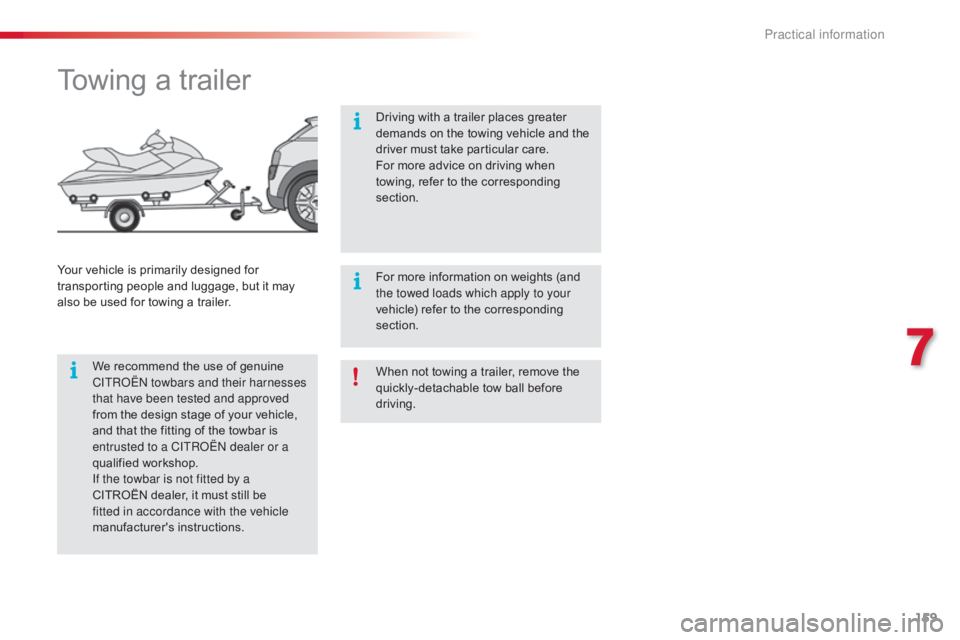
Towing a trailer
We recommend the use of genuine C ITROËN towbars and their harnesses
that have been tested and approved
from
the design stage of your vehicle,
a
nd that the fitting of the towbar is
e
ntrusted to a CITROËN dealer or a
qualified
w
orkshop.
If the towbar is not fitted by a
CITROËN
dealer, it must still be
f
itted in accordance with the vehicle
manufacturer's
i
nstructions.
Your
vehicle is primarily designed for
t
ransporting people and luggage, but it may
a
lso
be used for towing a trailer. Driving with a trailer places greater
d
emands on the towing vehicle and the
d
river must take particular care.
For more advice on driving when
t
owing, refer to the corresponding
s
ection.
For more information on weights (and
t
he towed loads which apply to your
vehicle) refer to the corresponding
s
ection.
7
Practical information