brake light CITROEN C4 2018 Owners Manual
[x] Cancel search | Manufacturer: CITROEN, Model Year: 2018, Model line: C4, Model: CITROEN C4 2018Pages: 317, PDF Size: 9.31 MB
Page 6 of 317
4
C4-cactus_en_Chap00b_vue-ensemble_ed01-2016
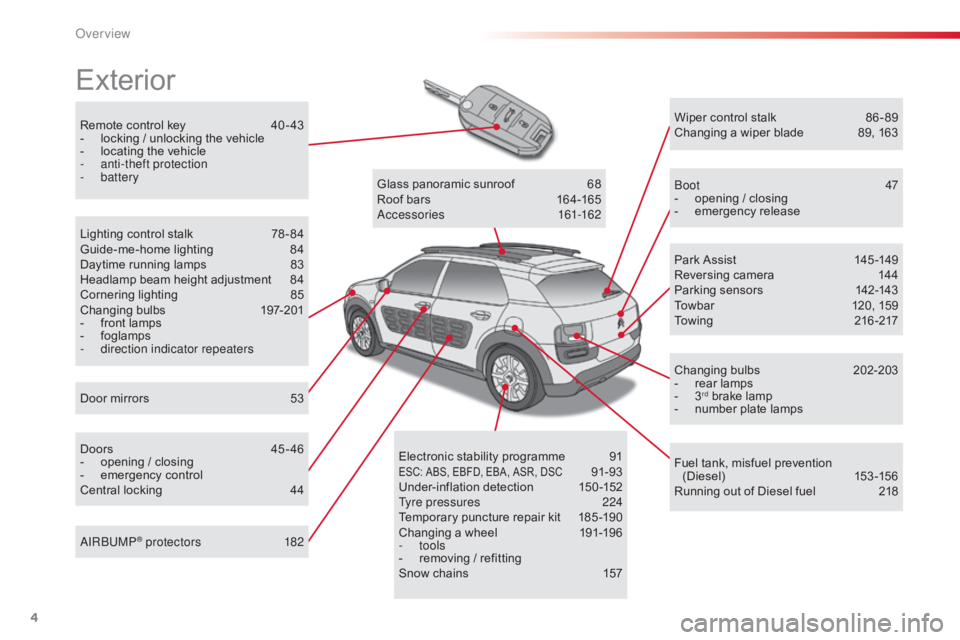
Remote control key 40 - 43
- l ocking / unlocking the vehicle
-
l
ocating the vehicle
-
a
nti-theft protection
-
battery
Exterior
Door mirrors 5 3
Lighting control stalk
7
8 - 84
Guide-me-home lighting
8
4
Daytime running lamps
8
3
Headlamp beam height adjustment
8
4
Cornering lighting
8
5
Changing
bu
lbs
1
97-201
-
f
ront lamps
-
fo
glamps
-
d
irection indicator repeaters
Doors
4
5 - 46
-
o
pening / closing
-
em
ergency
c
ontrol
Central
locking
4
4Glass
panoramic sunroof
6
8
Roof bars
1
64-165
Accessories
1
61-162
Wiper control stalk
8
6 - 89
Changing a wiper blade
8
9, 163
Boot
47
-
o
pening / closing
-
em
ergency
r
elease
Park Assist
1
45 -149
Reversing camera
1
44
Parking sensors
1
42-143
Towbar
1
20, 159
Towing
21
6 -217
Changing
bu
lbs
2
02-203
- r ear lamps
- 3rd brake lamp
-
n
umber plate lamps
Fuel
tank, misfuel prevention
(
Diesel)
15
3 -15 6
Running
out of Diesel fuel
2
18
Electronic
s
tability
pro
gramme
9
1
ESC: ABS, EBFD, EBA, ASR, DSC 91-93
Under-inflation d
etection 1 50-152
Tyre pressures
2
24
Temporary
puncture
repair
kit
1
85 -190
Changing
a
wheel
1
91-196
-
tools
-
r
emoving
/
refitting
Snow
chains
1
57
AIRBUMP
® protectors 1
82
Over view
Page 11 of 317
9
C4-cactus_en_Chap00c_eco-conduite_ed01-2016
Optimise the use of your gearbox
With a manual gearbox, move off gently and change up without waiting. During acceleration change up early.
The
gear efficiency indicator invites you engage the most suitable gear:
a
s soon as the indication is displayed in the instrument panel, follow it
s
traight away.
Control the use of your electrical
equipment
Before moving off, if the passenger compartment is too warm, ventilate it by opening the windows and air vents before using the air conditioning.
Above
30 mph (50 km/h), close the windows and leave the air vents
ope
n.
Remember
to make use of equipment that can help keep the
t
emperature in the passenger compartment down (sunroof and window
b
linds...).
To
save energy, do not set the air conditioning at too low a temperature.
As
soon as the desired temperature has been reached, limit the use of
t
he air conditioning, except if regulation is automatic.
Switch
off the demisting and defrosting controls as soon as you consider
p
ossible.
Switch
off the heated seat as soon as possible.
Switch
off the headlamps and foglamp when the level of light does not
r
equire their use.
Avoid
running the engine before moving off, particularly in winter; your
v
ehicle will warm up much faster while driving.
As
a passenger, if you avoid connecting your multimedia devices
(
film, music, video game...), you will contribute towards limiting the
c
onsumption of electrical energy, and so of fuel.
Disconnect
your portable devices before leaving the vehicle.
Eco-driving
Eco-driving is a range of everyday practices that allow the motorist to optimise their fuel consumption and CO2 emissions.
With
an
electronic
gearbox,
do
not
press
the
accelerator
pedal
heavily
o
r
s
uddenly.
Drive smoothly
Maintain a safe distance between vehicles, use engine braking rather t han the brake pedal, and press the accelerator progressively. These
p
ractices contribute towards a reduction in fuel consumption and CO
2
emissions
and
also
help
reduce
the
background
traffic
noise.
If
your
vehicle
has
cruise
control,
make
use
of
the
system
at
speeds
a
bove
25
mph
(40
km/h)
when
the
traffic
is
flowing
well.
.
Eco-driving
Page 16 of 317
14
C4-cactus_en_Chap01_Instruments-de-bord_ed01-2016
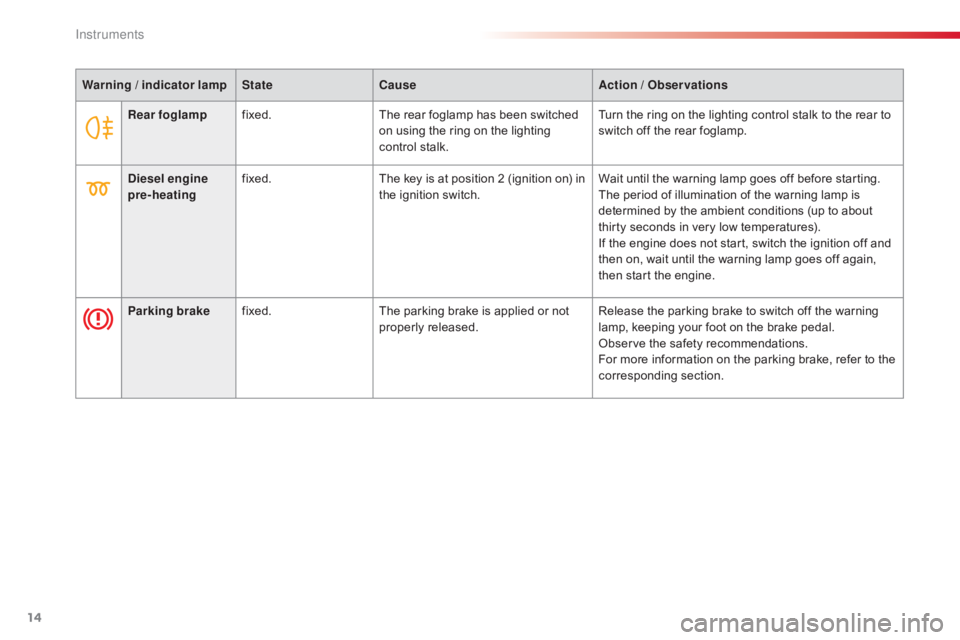
Rear foglampfixed. The rear foglamp has been switched o
n using the ring on the lighting
c
ontrol stalk.Turn
the ring on the lighting control stalk to the rear to s
witch off the rear foglamp.
Diesel engine
pre-heating fixed.
The
key is at position 2 (ignition on) in
t
he ignition switch.Wait
until the warning lamp goes off before starting.
The
period of illumination of the warning lamp is
d
etermined by the ambient conditions (up to about
t
hirty seconds in very low temperatures).
If
the engine does not start, switch the ignition off and
t
hen on, wait until the warning lamp goes off again,
t
hen start the engine.
Parking brake fixed. The
parking brake is applied or not
p
roperly
r
eleased.Release
the parking brake to switch off the warning
l
amp, keeping your foot on the brake pedal.
Observe
the safety recommendations.
For
more information on the parking brake, refer to the
c
orresponding
s
ection.
Warning / indicator lamp
StateCause Action / Observations
Instruments
Page 94 of 317
92
C4-cactus_en_Chap05_securite_ed01-2016
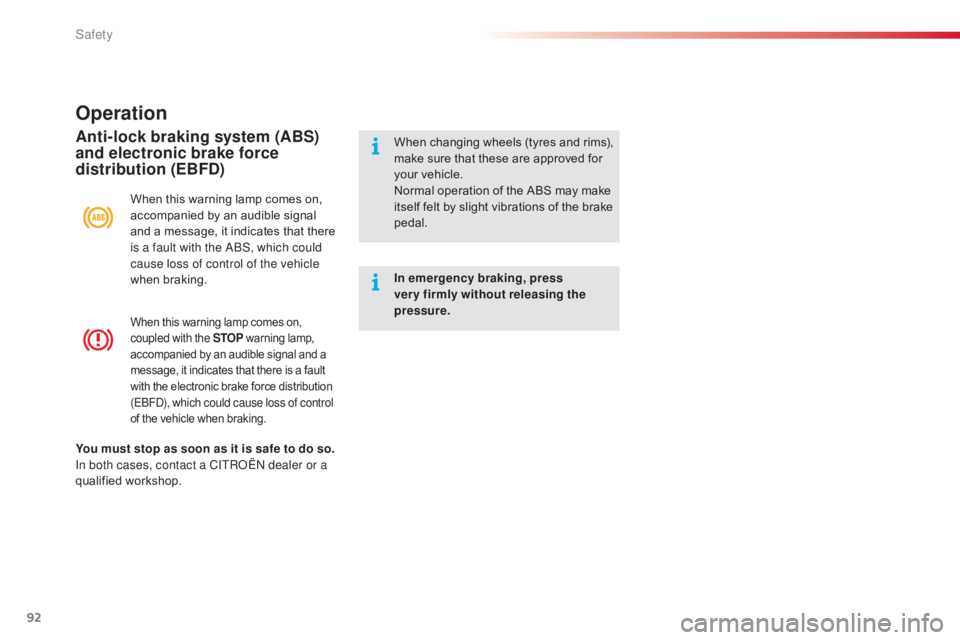
When this warning lamp comes on, coupled with the STOP w arning lam p, a
ccompanied by an audible signal and a
m
essage, it indicates that there is a fault
w
ith the electronic brake force distribution
(
EBFD), which could cause loss of control
of
the vehicle when braking.
Operation
When this warning lamp comes on, accompanied by an audible signal
a
nd a message, it indicates that there
i
s a fault with the ABS, which could
cause loss of control of the vehicle
when
b
raking.
Anti-lock braking system (ABS)
and electronic brake force
distribution (EBFD)When changing w heels ( tyres a nd r ims), m
ake sure that these are approved for
y
our vehicle.
Normal
operation of the ABS may make
i
tself felt by slight vibrations of the brake
ped
al.
In emergency braking, press
very firmly without releasing the
pressure.
You must stop as soon as it is safe to do so.
In both cases, contact a CITROËN dealer or a
qualified
w
orkshop.
Safety
Page 121 of 317

119
C4-cactus_en_Chap06_conduite_ed01-2016
A few driving recommendations
Observe the driving regulations at all times and remain vigilant whatever the traffic conditions.
Pay
close attention to the traffic and keep your
h
ands on the wheel so that you are ready to
react
at any time to any eventuality.
On
a long journey, a break every two hours is
s
trongly
re
commended.
In
difficult weather, drive smoothly, anticipate
t
he need to brake and increase the distance
f
rom other vehicles.
Driving on flooded
roads
We strongly advise against driving on flooded roads, as this could cause serious damage
t
o the engine or gearbox, as well as to the
e
lectrical systems of your vehicle.If
you are obliged to drive through water:
-
c
heck that the depth of water does not
e
xceed 15 cm, taking account of waves
t
hat might be generated by other users,
-
d
eactivate the Stop & Start system,
-
d
rive as slowly as possible without
stalling. In all cases, do not exceed 6 mph
(
10 km/h),
- d o not stop and do not switch off the
engine.
On
leaving the flooded road, as soon as
c
ircumstances allow, make several light brake
a
pplications to dry the brake discs and pads.
If in doubt on the state of your vehicle, contact
a
CITROËN dealer or a qualified workshop.
Important!
Never drive with the parking brake applied - Risk of overheating and
d
amage to the braking system!
Do
not park or run the engine when
s
tationary in areas where inflammable
s
ubstances and materials (dry grass,
d
ead leaves...) might come into
c
ontact with the hot exhaust system -
R
isk of fire!
Never leave a vehicle unsupervised
with
the engine running. If you have
t
o leave your vehicle with the engine
r
unning, apply the parking brake
a
nd put the gearbox into neutral or
p
osition
N or P,
depending on the type
o
f gearbox.
6
Driving
Page 122 of 317

120
C4-cactus_en_Chap06_conduite_ed01-2016
When towing
Distribution of loads
F Distribute the load in the trailer so that the heaviest items are as close as possible to
t
he axle and the nose weight approaches
t
he maximum permitted without
e
xceeding it.
Air density decreases with altitude, thus
reducing
engine per formance. Above
1 0
00 metres, the maximum towed load must
b
e reduced by 10 % for every 1 000 metres of
al
titude.
For
more information on weights (and the
t
owed loads which apply to your vehicle) refer
to
the corresponding section.
Side wind
F Take into account the increased sensitivity t
o side wind.
Cooling
Towing a trailer on a slope increases the temperature of the coolant.
As
the fan is electrically controlled, its cooling
c
apacity is not dependent on the engine speed.
F
T
o lower the engine speed, reduce your
s
peed.
The
maximum towed load on a long incline
d
epends on the gradient and the ambient
t
emperature.
In
all cases, keep a check on the coolant
t
emperature. F
I
f the warning lamp and the
S
TOP
warning lamp come on,
s
top the vehicle and switch off
the
engine as soon as possible.
Braking
Towing a trailer increases the braking distance.
T o avoid overheating of the brakes, the use of
e
ngine braking is recommended.
Ty r e s
F Check the tyre pressures of the towing v
ehicle and of the trailer, observing the
re
commended
p
ressures.
Lighting
F Check the electrical lighting and signalling o
n the trailer and the hadlamp beam height
o
f your vehicle.
For
more information on adjusting the
h
eadlamp beam height, refer to the
c
orresponding
s
ection.
The
rear parking sensors will be
d
eactivated automatically if a genuine
C
ITROËN towbar is used.
Driving
Page 126 of 317

124
C4-cactus_en_Chap06_conduite_ed01-2016
Parking brake
ApplicationRelease
When parking on a slope, direct your w
heels against the kerb, apply the
p
arking brake, engage a gear and
s
witch off the ignition.
When the vehicle is being driven, if this warning lamp and the STOP w arning lam p c
ome on, accompanied by an audible
s
ignal and a message in the screen, this
i
ndicates that the parking brake is still on or
h
as not been fully released.
F Pull the parking brake lever up to i
mmobilise your vehicle. F
P ull the parking brake lever up slightly, p
ress the release button, then lower the
lever
f
ully.
Driving
Page 134 of 317

132
C4-cactus_en_Chap06_conduite_ed01-2016
Stop & Start
Operation
Going into engine STOP
mode
The "ECO" warning lamp comes on i
n the instrument panel and the engine g
oes into standby automatically:
-
w
ith a manual gearbox , when stationary,
in neutral, and you release the clutch
pedal.
-
w
ith an electronic gearbox , when
stationary
or at speeds below 5 mph
(
8 km/h) (depending on version), in neutral
(
control on N )
or when you press the brake
ped
al. Never
refuel with the engine in STOP
m
ode; you must switch off the ignition.
For
your comfort, during parking
m
anoeuvres, STOP mode is not
a
vailable for a few seconds after
coming
out of reverse gear.
The
Stop & Start system does not affect
t
he the vehicle's other systems, such as
f
or example braking, power steering...
The
Stop
&
Start system
puts
the
engine
t
emporarily
into
standby
-
STOP
mode
-
during
s
tops
in
the
traffic
(red
lights,
traffic
jams,
or
o
ther...).
The
engine
restarts
automatically
-
S
TART
mode
-
as
soon
as
you
want
to
move
o
ff.
The
restart
takes
place
instantly,
quickly
a
nd
silently.
Per fect
for
urban
use,
the
Stop
&
Start
system
r
educes
fuel
consumption
and
exhaust
e
missions
as
well
as
the
noise
level
when
s
tationary.
Stop & Start time
counter
A cumulative time counter for periods i n STOP mode during a journey.
It
is
displayed in the trip computer (accessible
v
ia the " Driving assistance "
menu of the
t
ouch
screen tablet).
It
resets
to zero every time the ignition is
s
witched
on.
The
Stop
&
Start
system
requires
t
he use of a 12 V battery of special
technology
and
specification.
All
w
ork
on
this
type
of
battery
must
o
nly be done by a CITROËN dealer
or
a
qualified
workshop.
For
more
i
nformation
on
the
12
V
battery,
refer
to
t
he
corresponding
section.
Driving
Page 176 of 317
174
C4-cactus_en_Chap07_info-pratiques_ed01-2016
Brake wear depends on the style of driving, particularly in the case
o
f vehicles used in town, over short
distances.
It may be necessary to
Brake pads
For information on checking brake disc wear, contact a CITROËN dealer
or
a qualified workshop.
Brake disc wearOnly use products recommended by CITROËN or products of equivalent
q
uality
an
d
sp
ecification.
In
order to optimise the operation of
u
nits as important as those in the
b
raking system, CITROËN selects and
o
ffers very specific products.
After
washing the vehicle, dampness,
o
r in wintry conditions, ice can form
o
n the brake discs and pads: braking
e
fficiency may be reduced. Make light
b
rake applications to dry and defrost
t
he brakes.Manual gearbox
The gearbox does not require any maintenance (no oil change).
Refer
to the manufacturer's service
s
chedule for the checking interval for
t
his
c
omponent.
Electronic gearbox
The gearbox does not require any maintenance (no oil change).
Refer
to the manufacturer's service
s
chedule for details of the checking
i
nterval for this component.
Parking brake
If excessive travel or a loss of effectiveness of this system is
n
oticed, the parking brake must be
c
hecked, even between two services.
Checking
this system must be done by a
C
ITROËN dealer or a qualified workshop. To
avoid damaging the electrical units,
n
ever use a high pressure jet wash in
t
he engine compartment.
have
the
condition
of
the
brakes
checked,
even
b
etween
v
ehicle
s
ervices.
Unless
there
is
a
leak
in
the
circuit,
a
drop
in
t
he
brake
fluid
level
indicates
that
the
brake
p
ads
are
worn.
Practical information
Page 205 of 317
203
C4-cactus_en_Chap08_En-cas-de-panne_ed01-2016
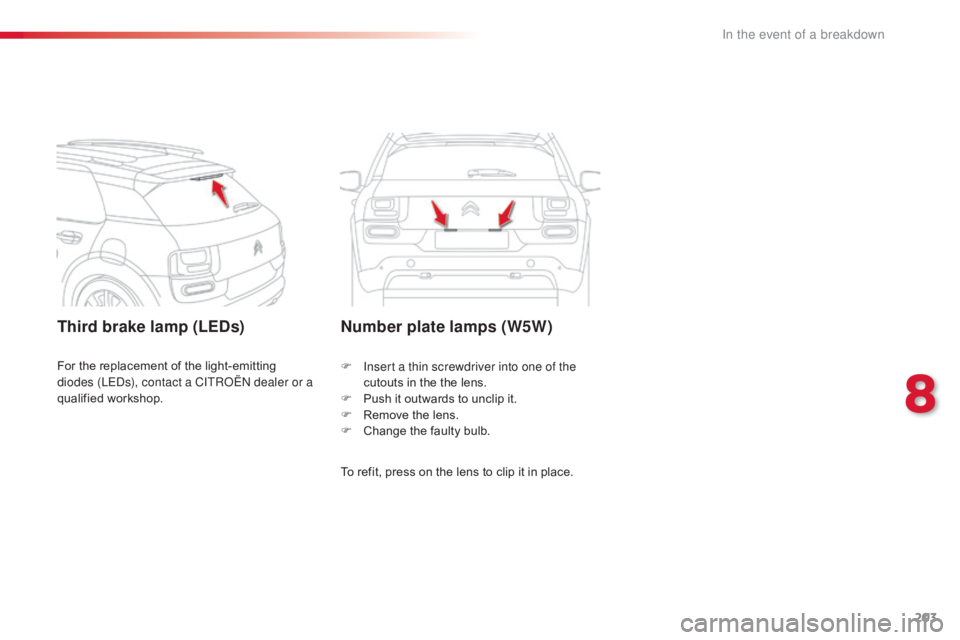
Third brake lamp (LEDs)Number plate lamps (W5W)
To refit, press on the lens to clip it in place.
F
I
nsert a thin screwdriver into one of the
cutouts in the the lens.
F
P
ush it outwards to unclip it.
F
R
emove the lens.
F
C
hange the faulty bulb.
For
the
replacement
of
the
light-emitting
d
iodes (LEDs), contact a CITROËN dealer or a
qualified
w
orkshop.
8
In the event of a breakdown