light CITROEN C4 2019 Owner's Manual
[x] Cancel search | Manufacturer: CITROEN, Model Year: 2019, Model line: C4, Model: CITROEN C4 2019Pages: 317, PDF Size: 9.31 MB
Page 85 of 317
83
C4-cactus_en_Chap04_Eclairage-et-visibilite_ed01-2016
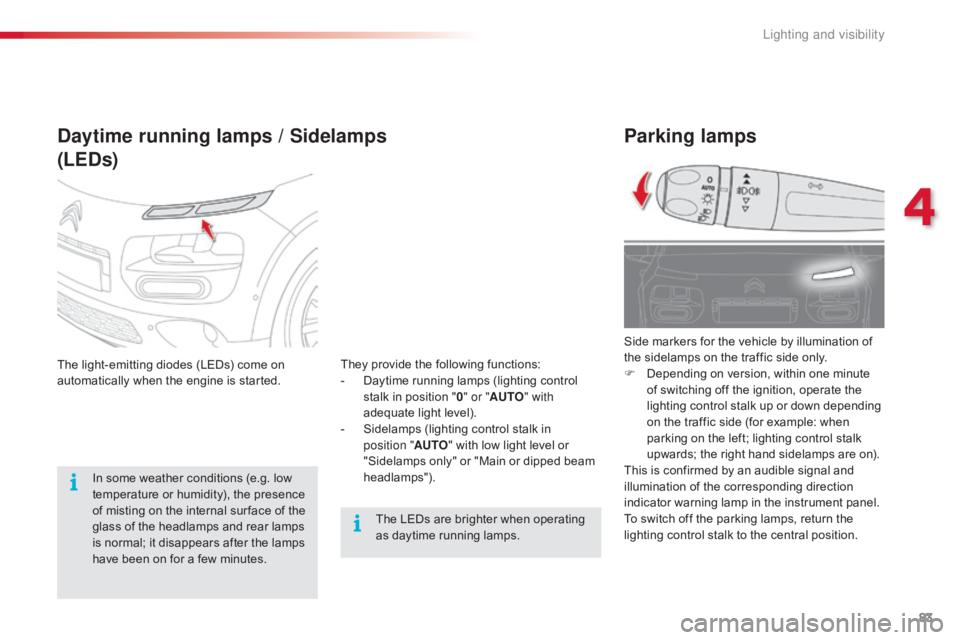
Parking lamps
Side markers for the vehicle by illumination of the sidelamps on the traffic side only.
F
D
epending on version, within one minute
o
f switching off the ignition, operate the
l
ighting control stalk up or down depending
o
n the traffic side (for example: when
p
arking on the left; lighting control stalk
u
pwards; the right hand sidelamps are on).
This
is confirmed by an audible signal and
i
llumination of the corresponding direction
i
ndicator warning lamp in the instrument panel.
To
switch off the parking lamps, return the
l
ighting control stalk to the central position.
Daytime running lamps / Sidelamps
(LEDs)
The light-emitting diodes (LEDs) come on automatically when the engine is started.
In
some weather conditions (e.g. low
t
emperature or humidity), the presence
o
f misting on the internal sur face of the
g
lass of the headlamps and rear lamps
i
s normal; it disappears after the lamps
h
ave been on for a few minutes.They
provide the following functions:
- D aytime running lamps (lighting control
s
talk in position "0 " or " AUTO " with
adequate
light level).
-
S
idelamps (lighting control stalk in
p
osition "AUTO"
with low light level or
"
Sidelamps only" or "Main or dipped beam
h
eadlamps").The
LEDs are brighter when operating
a
s daytime running lamps.
4
Lighting and visibility
Page 86 of 317
84
C4-cactus_en_Chap04_Eclairage-et-visibilite_ed01-2016
Switching on
F W ith the ignition off, "flash" the headlamps
u
sing the lighting stalk.
F
A
further "headlamp flash" switches the
f
unction off.
Switching off
The
manual guide-me-home lighting switches
o
ff automatically after a set time.
The
temporary illumination of the dipped beam
h
eadlamps after the vehicle's ignition has been
s
witched off makes the driver's exit easier
w
hen the light is poor.
Guide-me-home
lighting
Automatic
When the automatic illumination of headlamps i
s activated, if the ambient light level is
l
ow, the dipped beam headlamps come on
a
utomatically when switching off the ignition.
Activation
or deactivation of the system, as well
a
s the period for the guide-me-home lighting is
s
et in the touch screen tablet.
F
Sel
ect the "Driving assistance "
menu,
then "Vehicle settings ".
Manual
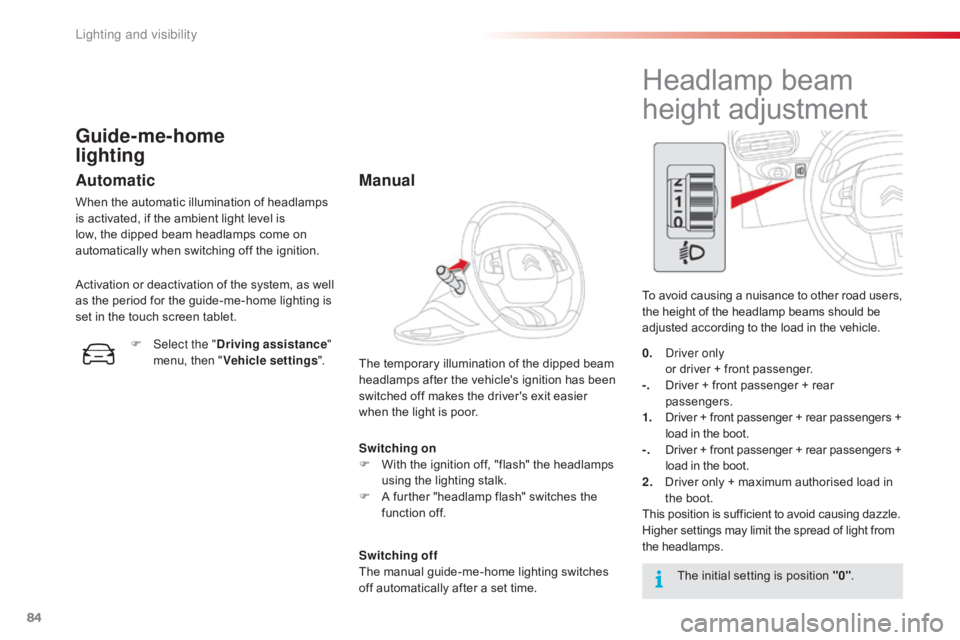
Headlamp beam
h
eight
ad
justment
To avoid causing a nuisance to other road users, t
he height of the headlamp beams should be a
djusted according to the load in the vehicle.
The
initial setting is position "0".
0.
D
river only
o
r driver + front passenger.
-.
D
river + front passenger + rear
p
assengers.
1.
D
river + front passenger + rear passengers +
l
oad in the boot.
-.
D
river + front passenger + rear passengers +
l
oad in the boot.
2.
D
river only + maximum authorised load in
t
he boot.
This
position is sufficient to avoid causing dazzle.
Higher
settings may limit the spread of light from
t
he
hea
dlamps.
Lighting and visibility
Page 87 of 317
85
C4-cactus_en_Chap04_Eclairage-et-visibilite_ed01-2016
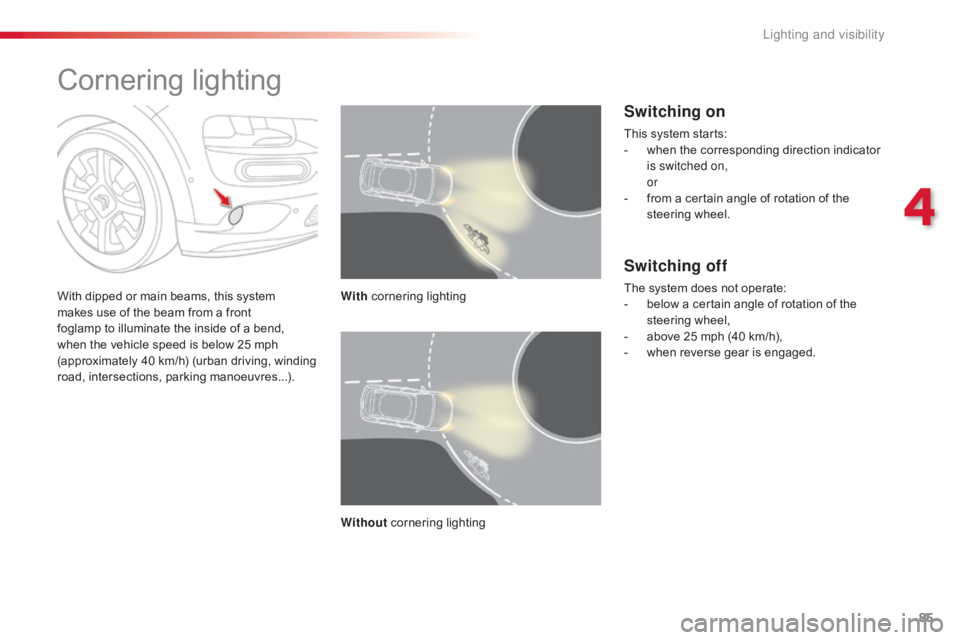
Cornering lighting
With dipped or main beams, this system makes use of the beam from a front
f
oglamp to illuminate the inside of a bend,
w
hen the vehicle speed is below 25 mph
(
approximately 40 km/h) (urban driving, winding
r
oad, intersections, parking manoeuvres...).With cornering l
ighting
Without cornering
l
ighting
Switching on
This system starts:
- w hen the corresponding direction indicator
i
s switched on,
or
-
f
rom a certain angle of rotation of the
s
teering
w
heel.
Switching off
The system does not operate:
- b elow a certain angle of rotation of the
s
teering
w
heel,
-
a
bove 25 mph (40 km/h),
-
w
hen reverse gear is engaged.
4
Lighting and visibility
Page 88 of 317
86
C4-cactus_en_Chap04_Eclairage-et-visibilite_ed01-2016
Wiper control stalk
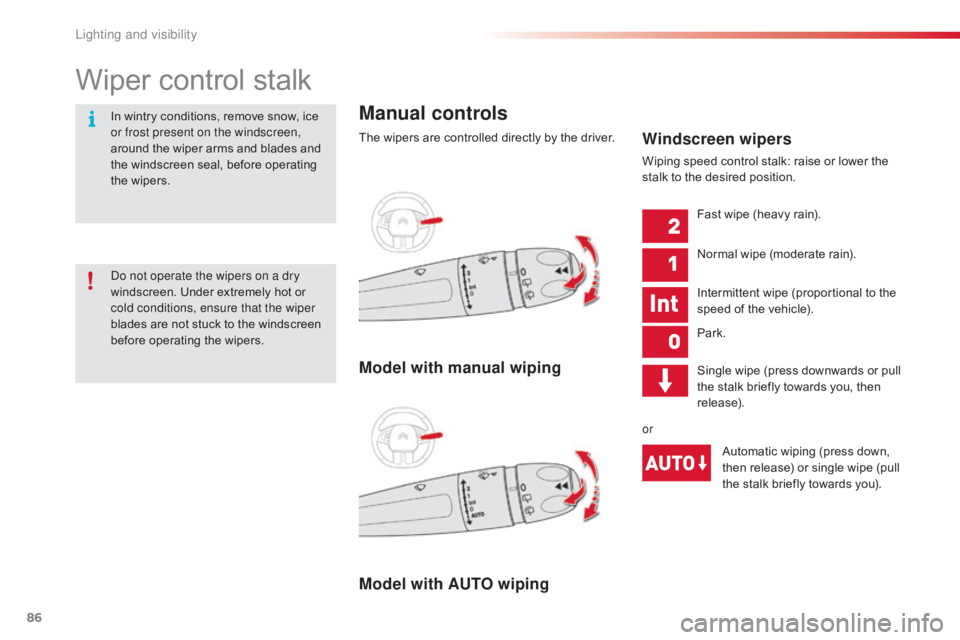
Manual controls
The wipers are controlled directly by the driver.
Model with AUTO wiping Model with manual wipingWindscreen wipers
Wiping speed control stalk: raise or lower the s
talk to the desired position.
Fast
wipe (heavy rain).
Normal
wipe (moderate rain).
Intermittent
wipe (proportional to the
s
peed of the vehicle).
Park.
Single
wipe (press downwards or pull
t
he stalk briefly towards you, then
r
elease).
or Automatic
wiping (press down,
t
hen release) or single wipe (pull
t
he stalk briefly towards you).
Do not operate the wipers on a dry
windscreen.
Under
extremely
hot
or
c
old conditions, ensure that the wiper
blades
are
not
stuck
to
the
windscreen
b
efore
operating
the
wipers.
In
wintry
conditions,
remove
snow,
ice
o
r frost present on the windscreen,
around
the
wiper
arms
and
blades
and
t
he
windscreen
seal,
before
operating
t
he
wipers.
Lighting and visibility
Page 89 of 317
87
C4-cactus_en_Chap04_Eclairage-et-visibilite_ed01-2016
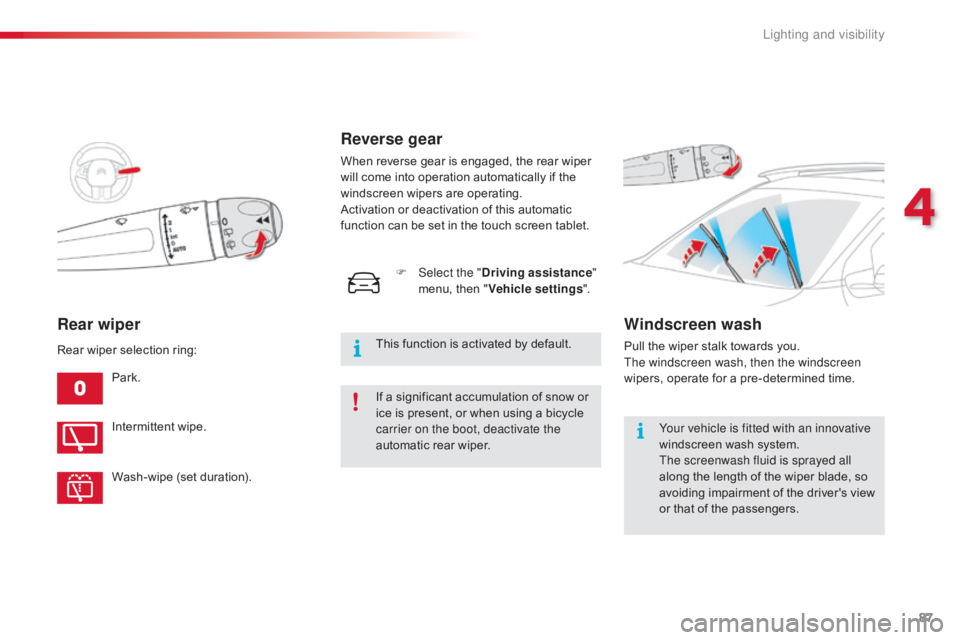
Rear wiper
Park.
Intermittent wipe.
Wash-wipe
(set duration).
Rear
wiper selection ring:
Reverse gear
When reverse gear is engaged, the rear wiper w
ill come into operation automatically if the
w
indscreen wipers are operating.
Activation
or deactivation of this automatic
f
unction can be set in the touch screen tablet.
Windscreen wash
Pull the wiper stalk towards you. The windscreen wash, then the windscreen
wipers,
operate for a pre-determined time.
Your vehicle is fitted with an innovative
windscreen
wash system.
The screenwash fluid is sprayed all
along
the length of the wiper blade, so
a
voiding impairment of the driver's view
o
r that of the passengers.
F
Sel
ect the "
Driving assistance "
menu,
then
"
Vehicle settings ".
This
function
is
activated
by
default.
If
a
significant
accumulation
of
snow
or
i
ce
is
present,
or
when
using
a
bicycle
c
arrier on the boot, deactivate the
automatic
rear
wiper.
4
Lighting and visibility
Page 90 of 317
88
C4-cactus_en_Chap04_Eclairage-et-visibilite_ed01-2016
Do not cover the rain sensor, linked with the sunshine sensor and located in the
centre of the windscreen behind the rear
view
mirror.
Switch
off the automatic rain sensitive
w
ipers when using an automatic car wash.
In winter, it is advisable to wait until the
windscreen
is completely clear of ice
b
efore activating the automatic rain
sen
sitive
w
ipers.
Operating fault
If a fault occurs with the automatic rain sensitive wipers, the wipers will operate in
intermittent
mode.
Have
it checked by CITROËN dealer or a
q
ualified
w
orkshop.
The
windscreen
wipers
operate
automatically,
w
ithout any action on the part of the driver, if
rain is detected (sensor behind the rear view
mirror),
adapting
their
speed
to
the
intensity
of
t
he
rainfall.
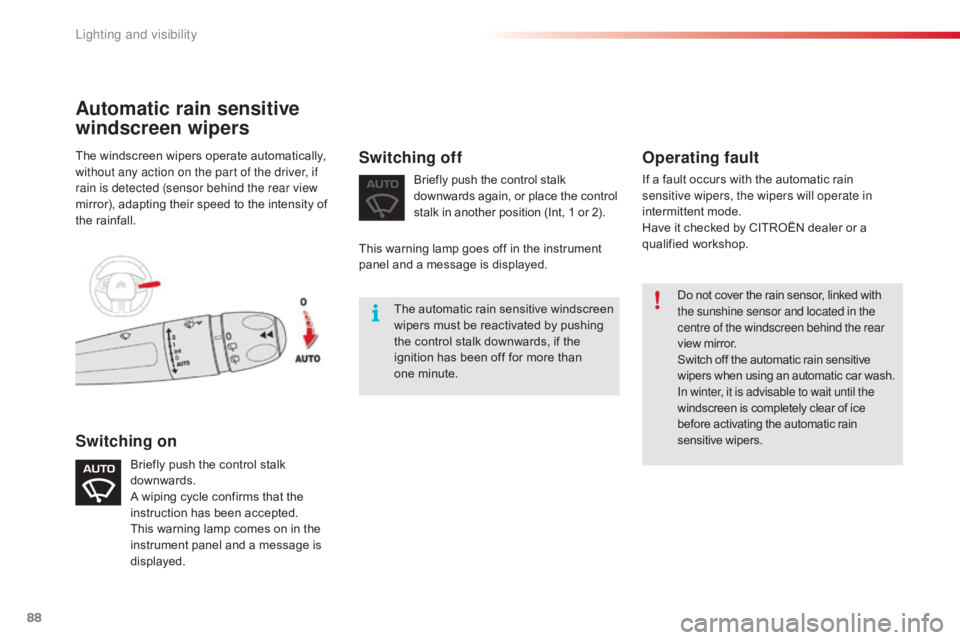
Switching on Switching off
The automatic r
ain sen sitive w indscreen w
ipers must be reactivated by pushing
t
he control stalk downwards, if the
i
gnition has been off for more than
o
ne minute.
Briefly
push
the
control
stalk
d
ownwards.
A
wiping
cycle
confirms
that
the
i
nstruction
has
been
accepted.
This
warning
lamp
comes
on
in
the
i
nstrument
panel
and
a
message
is
d
isplayed. Briefly
push the control stalk
d
ownwards again, or place the control
s
talk in another position (Int, 1 or 2).
Automatic rain sensitive
windscreen wipers
This warning lamp goes off in the instrument p
anel and a message is displayed.
Lighting and visibility
Page 91 of 317
89
C4-cactus_en_Chap04_Eclairage-et-visibilite_ed01-2016
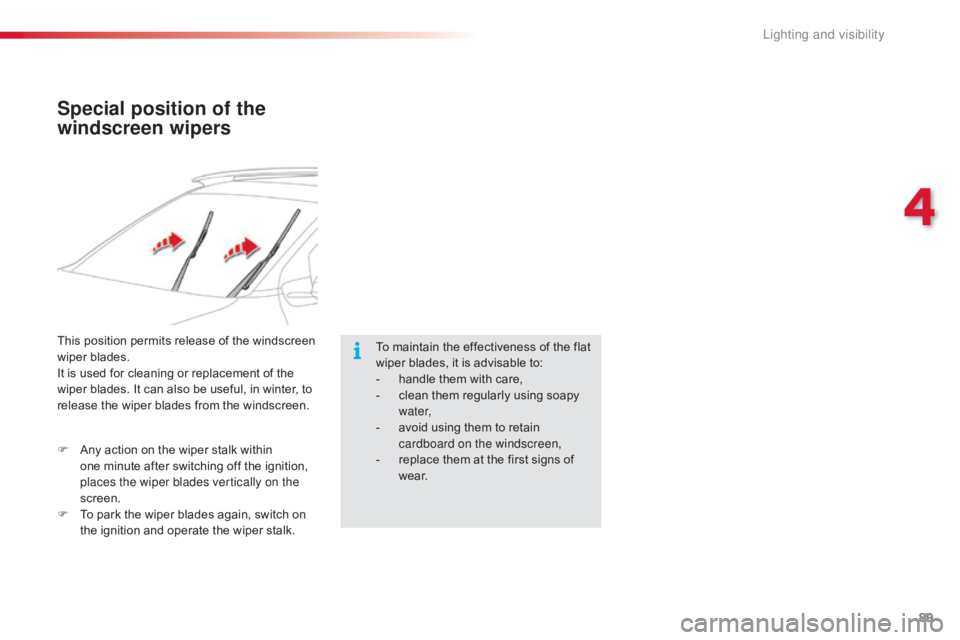
Special position of the
windscreen wipers
To maintain the effectiveness of the flat wiper blades, it is advisable to:
-
h
andle them with care,
-
c
lean them regularly using soapy
w
ater,
-
a
void using them to retain
c
ardboard on the windscreen,
-
r
eplace them at the first signs of
w
e a r.
This
position
permits
release
of
the
windscreen
w
iper
blades.
It
is
used
for
cleaning
or
replacement
of
the
w
iper
blades.
It
can
also
be
useful,
in
winter,
to
r
elease
the
wiper
blades
from
the
windscreen.
F
A
ny
action
on
the
wiper
stalk
within
o
ne minute
after
switching
off
the
ignition,
p
laces the wiper blades vertically on the
screen.
F
T
o
park
the
wiper
blades
again,
switch
on
t
he
ignition
and
operate
the
wiper
stalk.
4
Lighting and visibility
Page 94 of 317
92
C4-cactus_en_Chap05_securite_ed01-2016
When this warning lamp comes on, coupled with the STOP w arning lam p, a
ccompanied by an audible signal and a
m
essage, it indicates that there is a fault
w
ith the electronic brake force distribution
(
EBFD), which could cause loss of control
of
the vehicle when braking.
Operation
When this warning lamp comes on, accompanied by an audible signal
a
nd a message, it indicates that there
i
s a fault with the ABS, which could
cause loss of control of the vehicle
when
b
raking.
Anti-lock braking system (ABS)
and electronic brake force
distribution (EBFD)When changing w heels ( tyres a nd r ims), m
ake sure that these are approved for
y
our vehicle.
Normal
operation of the ABS may make
i
tself felt by slight vibrations of the brake
ped
al.
In emergency braking, press
very firmly without releasing the
pressure.
You must stop as soon as it is safe to do so.
In both cases, contact a CITROËN dealer or a
qualified
w
orkshop.
Safety
Page 100 of 317
98
C4-cactus_en_Chap05_securite_ed01-2016
The driver must ensure that passengers use the seat belts correctly and that they are all
fastened
before setting off.
Wherever you are seated in the vehicle,
always fasten your seat belt, even for short
journeys.
Do
not interchange the seat belt buckles as
t
hey will not fulfil their role fully.
The seat belts are fitted with an inertia reel
permitting
automatic adjustment of the
l
ength of the strap to your size. The seat belt
i
s stowed automatically when not in use.
Before and after use, ensure that the seat
belt
is reeled in correctly.
The
lower part of the strap must be
p
ositioned as low as possible on the pelvis.
The
upper part must be positioned in the
h
ollow of the shoulder.
The
inertia reels are fitted with an automatic
l
ocking device which comes into operation in
t
he event of a collision, emergency braking
o
r if the vehicle rolls over. You can release
t
he device by pulling the strap firmly and
t
hen releasing it so that it reels in slightly.Recommendations for
children
Use a suitable child seat if the passenger is less than 12 years old or shorter than one
and
a half metres.
Never
use the same seat belt to secure more
t
han one person.
Never
allow a child to travel on your lap.
For
more information on child seats, refer to
t
he corresponding section.
In
order
to
be
effective,
a
seat
belt
must:
-
b
e
tightened
as
close
to
the
body
as
p
ossible,
-
b
e
pulled
in
front
of
you
with
a
smooth
m
ovement,
checking
that
it
does
not
t
wist,
-
b
e used to restrain only one person,
-
n
ot
bear
any
trace
of
cuts
or
fraying,
-
n
ot
be
converted
or
modified
to
avoid
a
ffecting
it
s
p
erformance.
In the event of an impact
Depending on the nature and
seriousness of the impact , the
pretensioning
device may be deployed
b
efore and independently of the airbags.
D
eployment of the pretensioners is
a
ccompanied by a slight discharge of
h
armless smoke and a noise, due to the
a
ctivation of the pyrotechnic cartridge
i
ncorporated in the system.
In
all cases, the airbag warning lamp
comes
on.
Following
an impact, have the seat belts
s
ystem checked, and if necessary replaced,
b
y a CITROËN dealer or a qualified
w
orkshop.
In accordance with current safety
regulations,
for
all
repairs
on
your
vehicle's
s
eat
belts,
go
to
a
qualified
workshop
with
t
he
skills
and
equipment
needed,
which
a
C
ITROËN
dealer
is
able
to
provide.
Have
your
seat
belts
checked
regularly
by
a
CITROËN
dealer
or
a
qualified
workshop,
p
articularly
if
the
straps
show
signs
of
d
amage.
Clean the seat belt straps with soapy
water
or
a
textile
cleaning
product,
sold
by
C
ITROËN
dealers.
After
folding
or
moving
a
seat
or
rear
bench
s
eat, ensure that the seat belt is positioned
and
reeled
in
correctly.
Advice
Safety
Page 101 of 317
99
C4-cactus_en_Chap05_securite_ed01-2016
Airbags
General information
System designed to contribute towards improving the safety of the occupants (with
t
he exception of the rear centre passenger)
i
n the event of violent collisions. The airbags
s
upplement the action of the seat belts fitted
w
ith force limiters (all except the centre rear
p
assenger
b
elt).
If a collision occurs, the electronic detectors
record
and analyse the front and side impacts
s
ustained in the impact detection zones:
-
i
n the case of a serious impact, the airbags
a
re deployed instantly and contribute
towards better protection of the occupants
of
the vehicle (with the exception of the
r
ear centre passenger); immediately after
t
he impact, the airbags deflate rapidly so
t
hat they do not hinder visibility or the exit
o
f the occupants,
-
i
n the case of a minor or rear impact or in
c
ertain roll-over conditions, the airbags
m
ay not be deployed; the seat belt
a
lone contributes towards ensuring your
p
rotection in these situations. The airbags do not operate when the
ignition is switched off.
This
equipment will only deploy once.
I
f a second impact occurs (during the
s
ame or a subsequent accident), the
a
irbag will not be deployed again.Deployment
of one or more of the
a
irbags is accompanied by a slight
e
mission of smoke and a noise, due
t
o the activation of the pyrotechnic
cartridge
incorporated in the system.
This
smoke is not harmful, but sensitive
i
ndividuals may experience slight
ir
ritation.
The noise of detonation related to the
deployment
of one or more airbags may
r
esult in a slight loss of hearing for a
s
hort time.
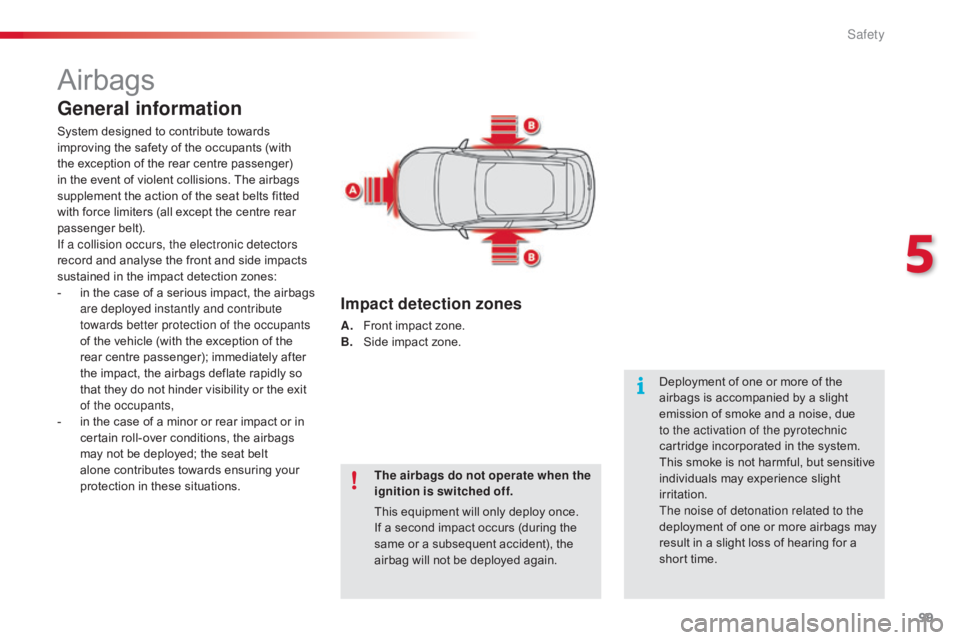
Impact detection zones
A. Front impact zone.
B. S ide impact zone.
5
Safety