ESP CITROEN C4 2019 Workshop Manual
[x] Cancel search | Manufacturer: CITROEN, Model Year: 2019, Model line: C4, Model: CITROEN C4 2019Pages: 317, PDF Size: 9.31 MB
Page 172 of 317
170
C4-cactus_en_Chap07_info-pratiques_ed01-2016
Checking levels
Take care when working under the bonnet, as certain areas of the engine
m
ay be extremely hot (risk of burns)
a
nd the cooling fan could start at any
t
ime (even with the ignition off).
Engine oil level
The check is carried out either when the ignition is switched on using the
o
il level indicator in the instrument
p
anel for vehicles so equipped, or
u
sing the dipstick.
Checking using the dipstick
Check all of these levels regularly, in line with the manufacturer's service schedule. Top them up if necessary, unless other wise indicated.
I f a level drops significantly, have the corresponding system checked by a CITROËN dealer or a qualified workshop.
If you find that the level is above the A
mark or
belo
w the B mark, do not star t the engine.
-
I
f the level is above the MAX
mark (risk
o
f damage to the engine), contact a
C
ITROËN dealer or a qualified workshop.
-
I
f the level is below the MIN
mark, you
m
ust top up the engine oil.
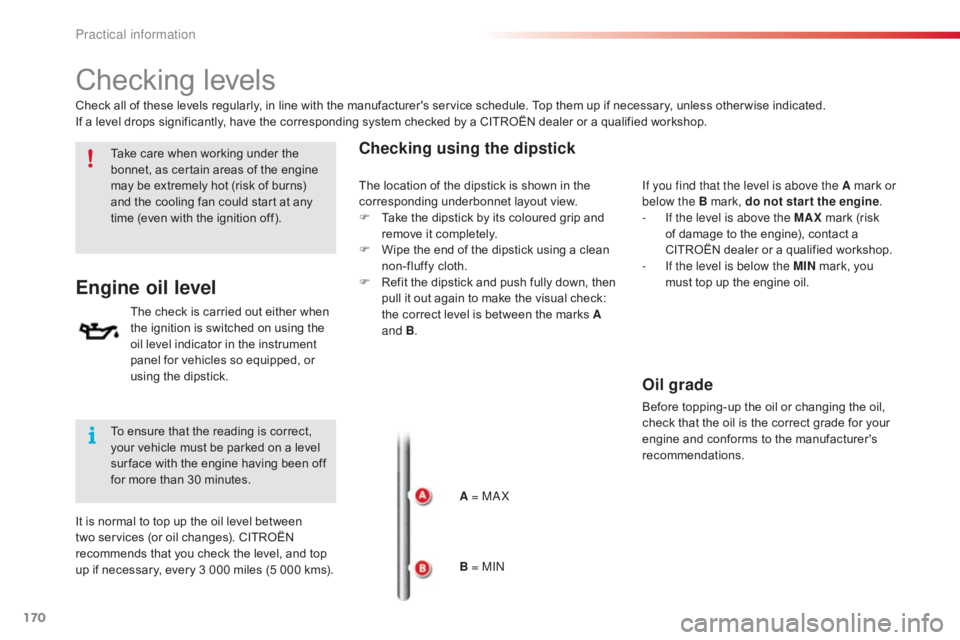
A = MA X
B = MIN
To
ensure that the reading is correct,
y
our vehicle must be parked on a level
s
ur face with the engine having been off
f
or more than 30 minutes.
It
is normal to top up the oil level between
t
wo services (or oil changes). CITROËN
r
ecommends that you check the level, and top
u
p if necessary, every 3 000 miles (5 000 kms).The
location of the dipstick is shown in the
c
orresponding underbonnet layout view.
F
T
ake the dipstick by its coloured grip and
r
emove it completely.
F
W
ipe the end of the dipstick using a clean
n
on-fluffy cloth.
F
R
efit the dipstick and push fully down, then
p
ull it out again to make the visual check:
t
he correct level is between the marks A
and B .
Oil grade
Before topping-up the oil or changing the oil, c
heck that the oil is the correct grade for your
e
ngine and conforms to the manufacturer's
r
ecommendations.
Practical information
Page 173 of 317
171
C4-cactus_en_Chap07_info-pratiques_ed01-2016
After topping-up the oil, the check when switching on the ignition with the oil
l
evel indicator in the instrument panel
i
s not valid during the 30 minutes after
t
opping up.
Topping-up the engine oil level
The location of the oil filler cap is shown in the
corresponding underbonnet layout view.
F
U
nscrew the oil filler cap to reveal the filler
aperture.
F
A
dd oil in small quantities, avoiding any
s
pills on engine components (risk of fire).
F
W
ait a few minutes before checking the
l
evel again using the dipstick.
F
A
dd more oil if necessary.
F
A
fter checking the level, carefully refit the
o
il filler cap and the dipstick in its tube.
Engine oil change
Refer to the manufacturer's service schedule for details of the interval for this operation.
In
order to maintain the reliability of the engine
a
nd emission control system, never use
a
dditives in the engine oil. The
brake fluid level should be close t
o the "MA X" mark. If it is not, check t
he brake pad wear.
Brake fluid level
Changing the fluid
Refer to the manufacturer's service schedule f
or details of the interval for this operation.
Fluid specification
The brake fluid must conform to the manufacturer's r ecommendations.
7
Practical information
Page 175 of 317
173
C4-cactus_en_Chap07_info-pratiques_ed01-2016
Checks
12 V battery
The battery does not require any maintenance.
H owever, check regularly that the terminals
a
re correctly tightened (versions without quick
r
elease terminals) and that the connections
a
re clean.Refer to the manufacturer's service schedule for details of the
replacement
intervals for these
c
omponents.
Air filter and passenger compartment filter
Replace the oil filter each time the e ngine oil is changed.
Refer
to the manufacturer's
s
ervice schedule for details of
the
replacement interval for this
c
omponent.
Oil filter
Unless other wise indicated, check these components in accordance with the manufacturer's service schedule and according to your engine.
O ther wise, have them checked by a CITROËN dealer or a qualified workshop.
Depending
on the environment (e.g. dusty
a
tmosphere) and the use of the vehicle
(e.g.
city driving), replace them twice as often
if necessary .
A
clogged passenger compartment filter may
h
ave an adverse effect on the per formance
o
f the air conditioning system and generate
u
ndesirable
o
dours.
Particle filter (Diesel)
The start of saturation of the
particle filter is indicated by the
fixed illumination of this warning
l
amp accompanied by a warning
m
essage.
As
soon
as
the traffic conditions permit,
r
egenerate
the filter by driving at a speed of at
l
east
40
mph (60 km/h) until the warning lamp
g
oes
off.
If
the
warning lamp stays on, this indicates a
l
ow
additive level.
Refer
to
the "Diesel additive level" section.
On a new vehicle, the first particle
filter
regeneration operations may be
a
ccompanied by a "burning" smell,
w
hich is per fectly normal.
Following
prolonged operation of the
v
ehicle at very low speed or at idle,
you
may, in exceptional circumstances,
n
otice the emission of water vapour at
t
he
exhaust on acceleration. This does
n
ot affect the behaviour of the vehicle
or
the environment.
When
carrying
out
any
operation
on
the
12
V
b
attery,
refer
to
the
corresponding
section
for
d
etails
of
the
precautions
to
be
taken
before
s
tarting
work.
Versions
equipped
with
Stop
&
Start
are
f
itted with a 12 V lead-acid battery of
specific
t
echnology
a
nd
s
pecification.
Its
replacement
should
be
carried
out
o
nly
by
a
CITROËN
dealer
or
a
qualified
w
orkshop.
7
Practical information
Page 177 of 317
175
C4-cactus_en_Chap07_info-pratiques_ed01-2016
AdBlue® additive and SCR system
f
or
BlueHDi Diesel engines
To assure respect for the environment and c
onformity with the new Euro 6 emissions
s
tandard, without adversely affecting the
p
er formance or fuel consumption of Diesel
e
ngines, CITROËN has taken the decision to
e
quip its vehicles with an effective system that
a
ssociates SCR (Selective Catalytic Reduction)
with
a particle filter (FAP) for the treatment of
e
xhaust gases.
Presentation of the SCR system
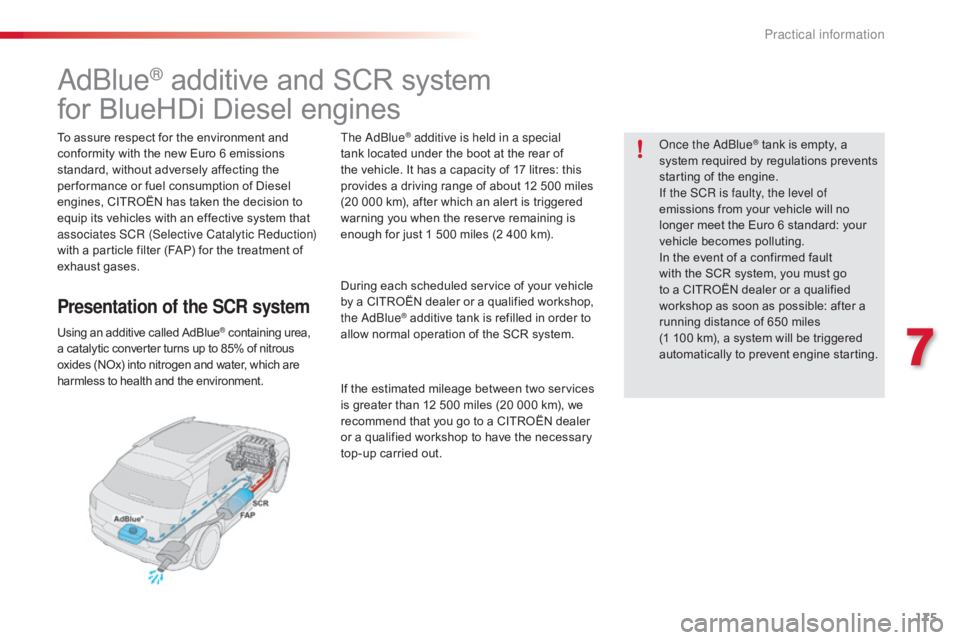
Using an additive called AdBlue® containing urea, a
catalytic
converter
turns
up
to
85% of nitrous o
xides
(NOx)
into
nitrogen
and
water, which are
h
armless
to
health
and
the
environment. Once the AdBlue
® tank is empty, a s
ystem
required
by regulations prevents
s
tarting
of
the
engine.
If the SCR is faulty, the level of
emissions
from
your vehicle will no
l
onger
meet
the
Euro 6 standard: your
v
ehicle
becomes
polluting.
In
the
event
of
a
confirmed fault
w
ith
the
SCR
system, you must go
t
o
a
CITROËN
dealer or a qualified
w
orkshop
as
soon as possible: after a
r
unning
distance
of 650 miles
(1
100
km),
a
system will be triggered
a
utomatically
to
prevent engine starting.
The AdBlue® additive is held in a special
tank
located
under the boot at the rear of
t
he
vehicle.
It has a capacity of 17 litres: this
p
rovides
a
driving range of about 12 500 miles
(
20
000
km),
after which an alert is triggered
w
arning
you
when the reserve remaining is
e
nough
for
just 1 500 miles (2 400 km).
During
each
scheduled service of your vehicle
b
y
a
CITROËN dealer or a qualified workshop,
t
he AdBlue
® additive tank is refilled in order to a
llow
normal operation of the SCR system.
If
the
estimated mileage between two services
i
s
greater
than 12 500 miles (20 000 km), we
r
ecommend
that you go to a CITROËN dealer
o
r
a
qualified workshop to have the necessary
t
op-up
carried out.
7
Practical information
Page 178 of 317
176
C4-cactus_en_Chap07_info-pratiques_ed01-2016
Range indicators
Once the AdBlue® tank is on reserve or after d
etection
of
a
fault with the SCR emissions
c
ontrol
system,
when the ignition is switched
o
n,
an
indicator
displays an estimate of the
d
istance
that
can
be covered, the range, before
e
ngine
starting
is
prevented.
In
the
event
of
simultaneous system fault and
l
ow AdBlue
® level, the shortest range figure is t
he
one
displayed. Range greater than 1 500 miles (2 400 km)
When
the ignition is switched on, no
i
nformation on range is displayed automatically
i
n the instrument panel.
The
engine start prevention system
r
equired by regulations is activated
a
utomatically once the AdBlue
® tank is e
m pt y.
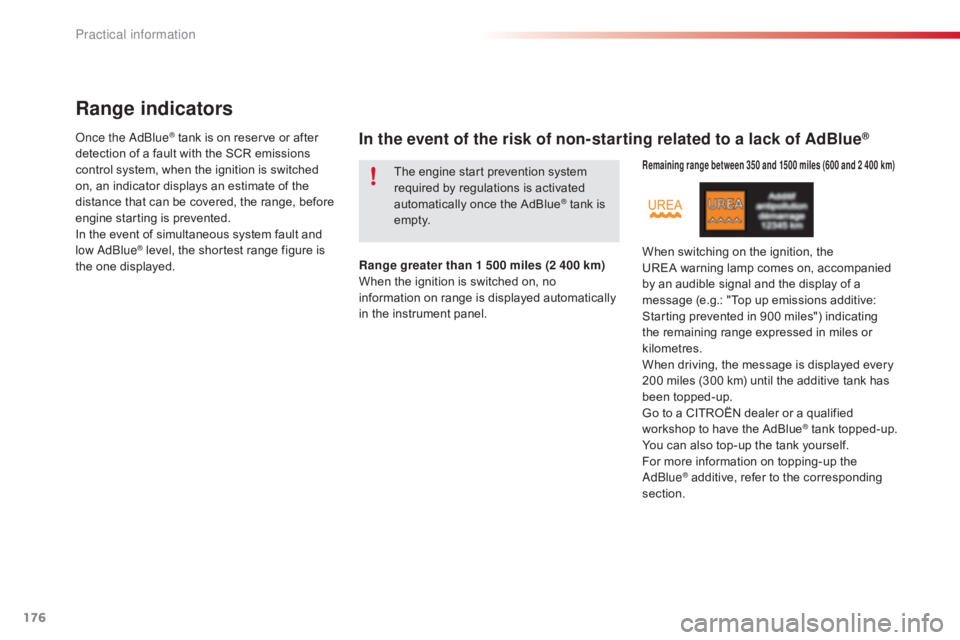
In the event of the risk of non-starting related to a lack of AdBlue®
Remaining range between 350 and 1500 miles (600 and 2 400 km)
When switching on the ignition, the U REA warning lamp comes on, accompanied
b
y an audible signal and the display of a
m
essage (e.g.: "Top up emissions additive:
S
tarting prevented in 900 miles") indicating
t
he remaining range expressed in miles or
k
ilometres.
When
driving, the message is displayed every
2
00 miles (300 km) until the additive tank has
be
en
t
opped-up.
Go
to a CITROËN dealer or a qualified
w
orkshop to have the AdBlue
® tank topped-up.
Y
ou
can
also
top-up
the
tank
yourself.
For
more
information
on
topping-up the
Ad
Blue
® additive, refer to the corresponding s
ection.
Practical information
Page 179 of 317
177
C4-cactus_en_Chap07_info-pratiques_ed01-2016
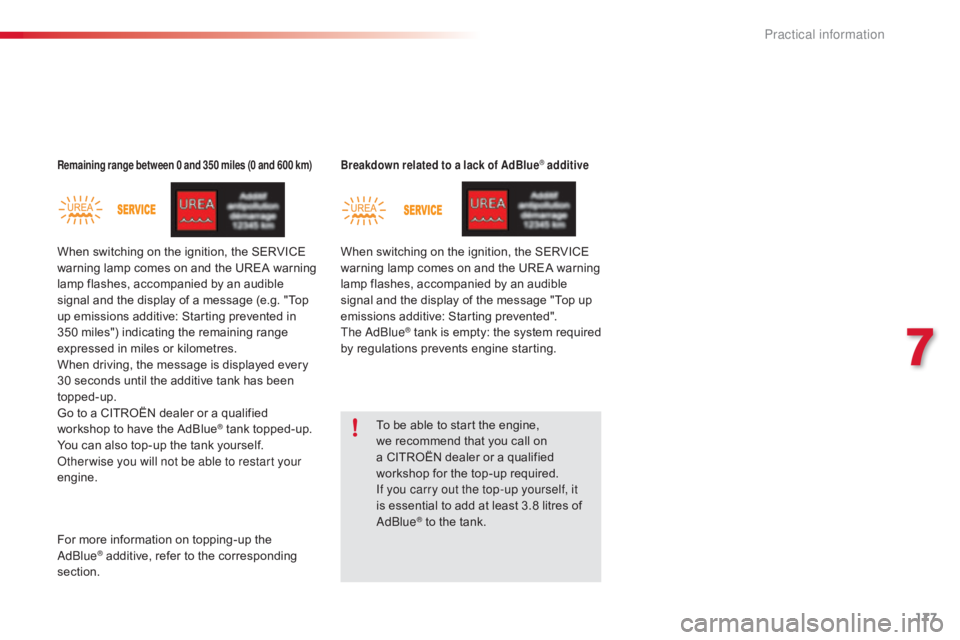
Remaining range between 0 and 350 miles (0 and 600 km)Breakdown related to a lack of AdBlue® additive
To be able to start the engine, we recommend that you call on
a
CITROËN dealer or a qualified
w
orkshop for the top-up required.
If you carry out the top-up yourself, it
is
essential to add at least 3.8 litres of
Ad
Blue
® to the tank.
W
hen
switching
on
the
ignition,
the
SERVICE
w
arning
lamp
comes
on
and
the
UREA
warning
l
amp
flashes,
accompanied
by
an
audible
s
ignal
and
the
display
of
a
message
(e.g.
"Top
u
p
emissions
additive:
Starting
prevented
in
3
50
miles")
indicating
the
remaining
range
e
xpressed
in
miles
or
kilometres.
When
driving,
the
message
is
displayed
every
3
0
seconds
until
the
additive
tank
has
been
t
opped-up.
Go
to
a
CITROËN
dealer
or
a
qualified
w
orkshop
to
have
the
AdBlue
® tank topped-up.
Y
ou
can
also
top-up
the
tank
yourself.
Other wise you will not be able to restart your
engine. When
switching on the ignition, the SERVICE
w
arning lamp comes on and the UREA warning
l
amp flashes, accompanied by an audible
s
ignal and the display of the message "Top up
e
missions additive: Starting prevented".
The AdBlue
® tank is empty: t he s ystem r equired b
y
regulations prevents engine starting.
For
more
information
on
topping-up
the
Ad
Blue
® additive, refer to the corresponding s
ection.
7
Practical information
Page 187 of 317
185
C4-cactus_en_Chap08_En-cas-de-panne_ed01-2016
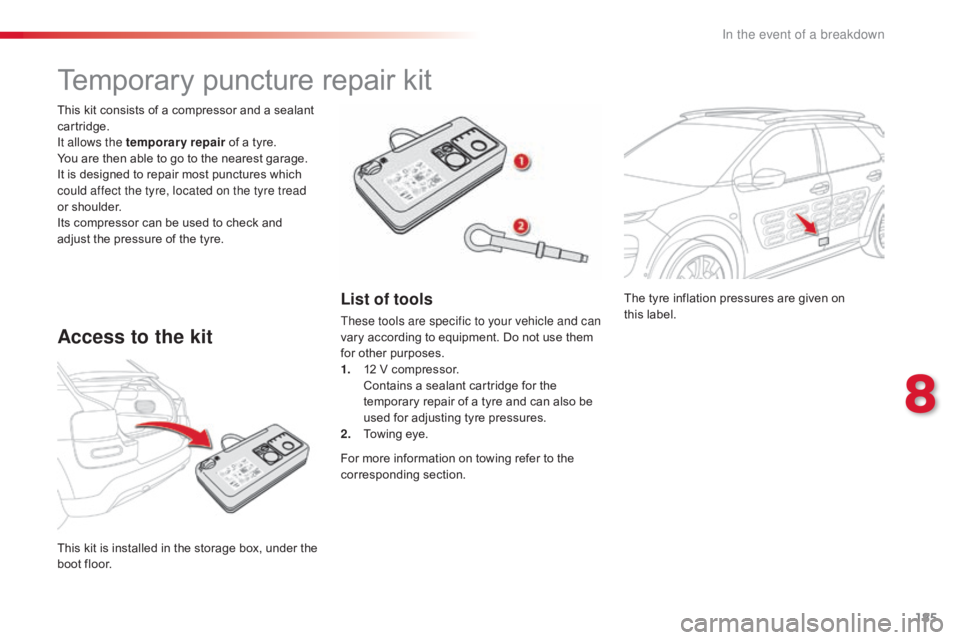
The tyre inflation pressures are given on this label.
This
k
it
i
s
i
nstalled
i
n
t
he
s
torage
b
ox,
u
nder
t
he
b
oot
floor.
This
kit
consists
of
a
compressor
and
a
sealant
c
artridge.
It allows the temporary repair
of
a
tyre.
You
are
then
able
to
go
to
the
nearest
garage.
It
is
designed
to
repair
most
punctures
which
c
ould affect the tyre, located on the tyre tread
or
shoulder.
Its
compressor
can
be
used
to
check
and
a
djust
the
pressure
of
the
tyre.
Temporary pu
ncture r epair k it
Access to the kit
List of tools
These tools are specific to your vehicle and can
vary
according to equipment. Do not use them
f
or other purposes.
1.
1
2 V compressor.
C
ontains a sealant cartridge for the
t
emporary repair of a tyre and can also be
u
sed for adjusting tyre pressures.
2.
T
owing eye.
For
more information on towing refer to the
c
orresponding
s
ection.
8
In the event of a breakdown
Page 190 of 317
188
C4-cactus_en_Chap08_En-cas-de-panne_ed01-2016
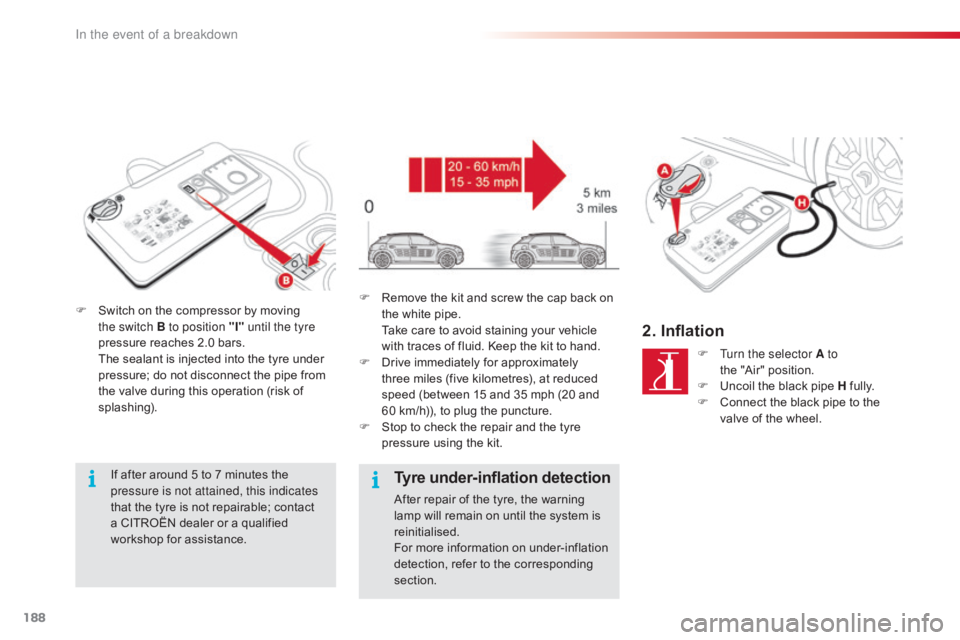
F Switch on the compressor by moving t
he switch B to position "I" until the tyre
pressure
reaches 2.0 bars.
T
he sealant is injected into the tyre under
p
ressure; do not disconnect the pipe from
t
he valve during this operation (risk of
sp
lashing).
If
after around 5 to 7 minutes the
p
ressure is not attained, this indicates
that
the tyre is not repairable; contact
a
CITROËN dealer or a qualified
w
orkshop for assistance. F
R emove the kit and screw the cap back on t
he white pipe.
T
ake care to avoid staining your vehicle
w
ith traces of fluid. Keep the kit to hand.
F
D
rive immediately for approximately
t
hree miles (five kilometres), at reduced
s
peed (between 15 and 35 mph (20 and
6
0 km/h)), to plug the puncture.
F
S
top to check the repair and the tyre
p
ressure using the kit.
Tyre under-inflation detection
After repair of the tyre, the warning lamp will remain on until the system is
r
einitialised.
For
more information on under-inflation
d
etection, refer to the corresponding
s
ection.
2. Inflation
F Turn the selector A to the "Air" position.
F
U
ncoil the black pipe H
f
ully.
F
C
onnect the black pipe to the
v
alve of the wheel.
In the event of a breakdown
Page 192 of 317
190
C4-cactus_en_Chap08_En-cas-de-panne_ed01-2016
Checking tyre pressures / inflating accessories
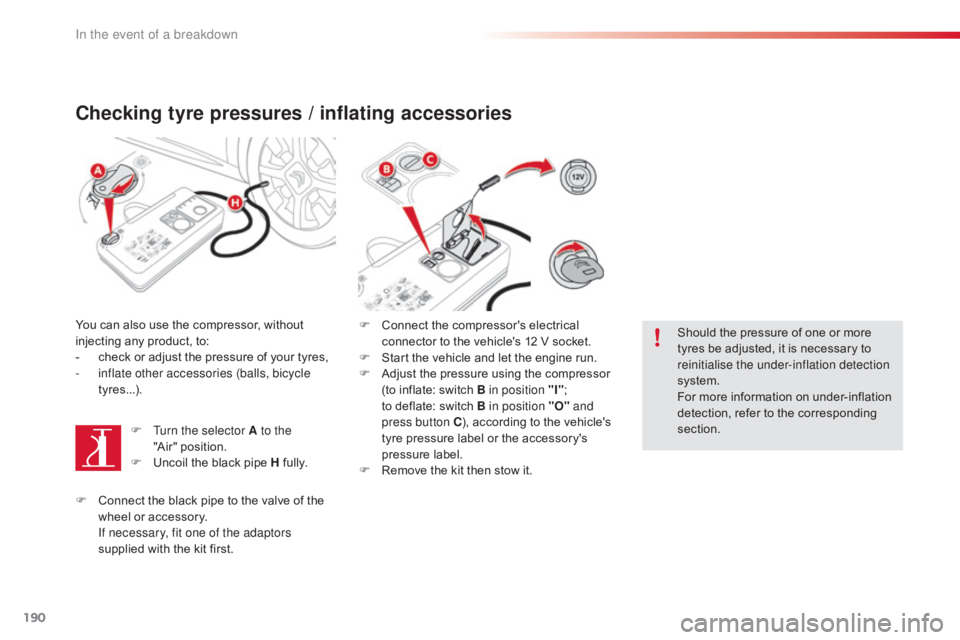
You can also use the compressor, without injecting any product, to:
-
c
heck or adjust the pressure of your tyres,
-
i
nflate other accessories (balls, bicycle
tyres...).
F
T
urn the selector A to the
"Air" position.
F
U
ncoil the black pipe H
f
ully.F
C onnect the compressor's electrical
c
onnector to the vehicle's 12 V socket.
F
S
tart the vehicle and let the engine run.
F
A
djust the pressure using the compressor
(
to inflate: switch B in position "I";
t
o deflate: switch B in position "O" and
press button C ),
according to the vehicle's
t
yre pressure label or the accessory's
p
ressure label.
F
R
emove the kit then stow it.Should
the pressure of one or more
t
yres be adjusted, it is necessary to
r
einitialise the under-inflation detection
system.
For
more information on under-inflation
d
etection, refer to the corresponding
s
ection.
F
C
onnect the black pipe to the valve of the
w
heel or accessory.
I
f necessary, fit one of the adaptors
supplied
with the kit first.
In the event of a breakdown
Page 193 of 317
191
C4-cactus_en_Chap08_En-cas-de-panne_ed01-2016
Spare wheel
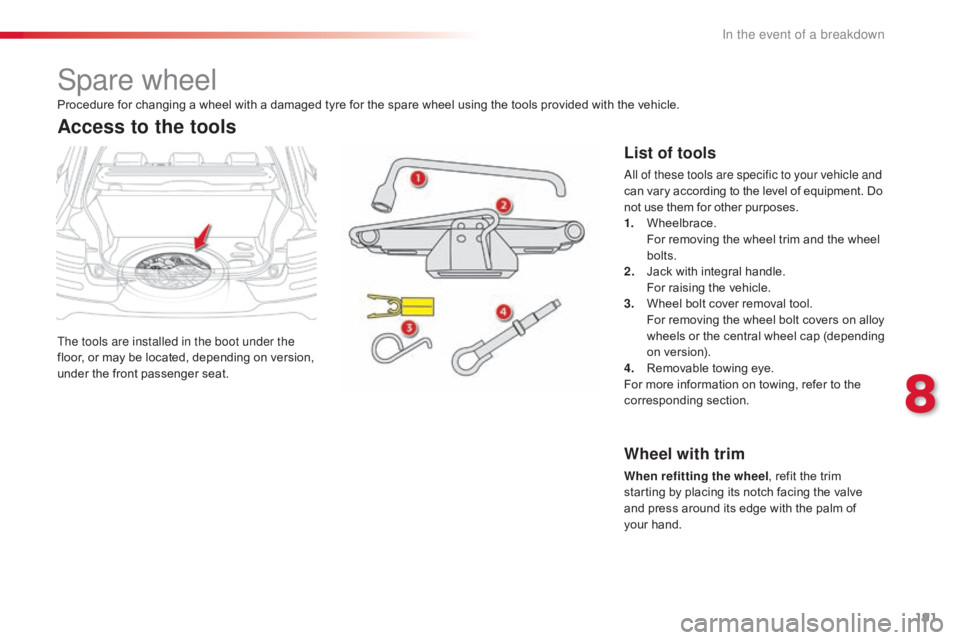
The tools are installed in the boot under the
floor, or may be located, depending on version,
u
nder
t
he
f
ront
p
assenger
sea
t.
Access to the tools
List of tools
All of these tools are specific to your vehicle and
can vary according to the level of equipment. Do n
ot use them for other purposes.
1.
W
heelbrace.
F
or removing the wheel trim and the wheel
bol
ts.
2.
J
ack with integral handle.
F
or raising the vehicle.
3.
W
heel bolt cover removal tool.
F
or removing the wheel bolt covers on alloy
w
heels
o
r
t
he
c
entral
w
heel
c
ap
(
depending
o
n version).
4.
R
emovable towing eye.
For
more information on towing, refer to the
c
orresponding
s
ection.
Procedure
for
changing
a
wheel
with
a
damaged
tyre
for
the
spare
wheel
using
the
tools
provided
with
the vehicle.
Wheel with trim
When refitting the wheel
, refit the trim s
tarting by placing its notch facing the valve
a
nd press around its edge with the palm of
y
our hand.
8
In the event of a breakdown