trailer CITROEN C4 2022 User Guide
[x] Cancel search | Manufacturer: CITROEN, Model Year: 2022, Model line: C4, Model: CITROEN C4 2022Pages: 292, PDF Size: 7.79 MB
Page 144 of 292
142
Driving
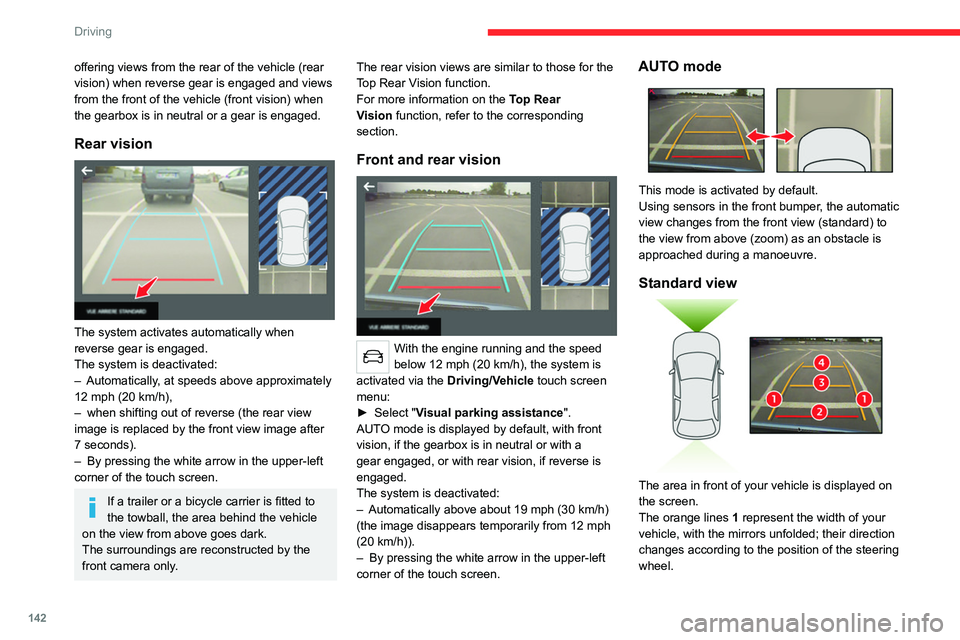
offering views from the rear of the vehicle (rear
vision) when reverse gear is engaged and views
from the front of the vehicle (front vision) when
the gearbox is in neutral or a gear is engaged.
Rear vision
The system activates automatically when
reverse gear is engaged.
The system is deactivated:
–
Automatically
, at speeds above approximately
12 mph (20
km/h),
–
when shifting out of reverse (the rear view
image is replaced by the front view image after
7 seconds).
–
By pressing the white arrow in the upper-left
corner of the touch screen.
If a trailer or a bicycle carrier is fitted to
the towball, the area behind the vehicle
on the view from above goes dark.
The surroundings are reconstructed by the
front camera only. The rear vision views are similar to those for the
Top Rear Vision function.
For more information on the
Top Rear
Vision
function, refer to the corresponding
section.
Front and rear vision
With the engine running and the speed
below 12 mph (20 km/h), the system is
activated via the Driving/Vehicle touch screen
menu:
►
Select "
Visual parking assistance".
AUTO mode is displayed by default, with front
vision, if the gearbox is in neutral or with a
gear engaged, or with rear vision, if reverse is
engaged.
The system is deactivated:
–
Automatically above about 19 mph (30
km/h)
(the image disappears temporarily from 12 mph
(20
km/h)).
–
By pressing the white arrow in the upper-left
corner of the touch screen.
AUTO mode
This mode is activated by default.
Using sensors in the front bumper, the automatic
view changes from the front view (standard) to
the view from above (zoom) as an obstacle is
approached during a manoeuvre.
Standard view
The area in front of your vehicle is displayed on
the screen.
The orange lines 1 represent the width of your
vehicle, with the mirrors unfolded; their direction
changes according to the position of the steering
wheel.
Page 166 of 292

164
Practical information
► If the vehicle is locked, unlock it.
The red indicator lamp in the flap goes out to
confirm that the charging nozzle is unlocked.
►
Within
30 seconds, remove the charging
nozzle.
The charging indicator lamp comes on in white.
With selective door unlocking activated,
press the unlocking button twice to
disconnect the charging nozzle.
When charging is complete, the green
charging indicator lamp in the flap goes
out after about 2 minutes.
Domestic charging, mode 2
The end of charging is confirmed when the green
CHARGE indicator lamp on the control unit and
the green charging indicator lamp in the flap
come on fixed.
►
Replace the protective cover on the charging
nozzle and close the charging flap.
►
Disconnect the control unit end of the
charging cable from the domestic socket.
Accelerated charging, mode 3
The end of charging is indicated by the charging
control unit and by the fixed lighting of the green
indicator lamp in the flap.
►
Hang up the nozzle on the charging unit and
close the charging flap.
Superfast charging, mode 4
The end of charging is indicated by the charger
and by the fixed lighting of the green indicator
lamp in the flap.
► You can also pause charging by
pressing this button in the flap (in mode 4
only).
►
Hang up the nozzle on the charger
.
►
Depending on version, replace the protective
cover on the lower section and close the
charging flap.
When the charging nozzle is
disconnected, a message on the
instrument panel indicates that charging is
complete, even if the charging nozzle was
disconnected before full charging was
completed.
Towing device
Load distribution
► Distribute the load in the trailer so that the
heaviest items are as close as possible to the
axle, and the nose weight approaches the
maximum permitted without exceeding it.
Air density decreases with altitude, thus reducing
engine performance.
The maximum towable load
must be reduced by 10% per 1,000
metres of
altitude.
Use genuine towing devices and wiring
harnesses approved by CITROËN. We
recommend having them fitted by a CITROËN
dealer or a qualified workshop.
If not fitted by a CITROËN dealer, they must
still be fitted in accordance with the vehicle
manufacturer's instructions.
Certain driving or manoeuvring aid functions
are automatically deactivated while an
approved towing system is in use.
Comply with the maximum authorised
towable weight, as indicated on your
vehicle's registration certificate, on the
manufacturer's label and in the Technical
data section of this guide.
If using accessories attached to the
towing device (e.g. bicycle carriers, tow
boxes):
–
Comply with the maximum authorised nose
weight.
–
Do not transport more than 4 conventional
bicycles or 2 electric bicycles.
When loading bicycles onto a bicycle carrier
on a towball, be sure to place the heaviest
bicycles as close as possible to the vehicle.
Observe the legislation in force in the
country where you are driving.
Electric motor
An electric vehicle cannot under any
circumstances be fitted with a towing device.
Page 167 of 292

165
Practical information
7It is therefore not possible to tow a trailer or
caravan.
Towing device with quickly detachable towball
Presentation
No tools are required to install or remove this
genuine towing device.
1. Carrier
2. Protective plug
3. Connection socket
4. Safety eye
5. Detachable towball
6. Locking/unlocking wheel
7. Security key lock
8. Label to note the key references
A. Locked position (the green marks are
opposite each other); the wheel is in contact
with the towball (no gap).
B. Unlocked position (red mark opposite the green mark); the wheel is no longer
in contact with the towball (gap of around
5
mm).
Affix the enclosed label in a clearly visible location, close to the carrier or in the
boot.
Trailers with LED lamps are not compatible with the wiring harness of this
device.
To ensure complete safety while driving with a Towing device , refer to the
corresponding section.
Before each use
Verify that the towball is correctly fitted,
checking the follow points:
–
The green mark on the wheel is in line with
the green mark on the towball.
–
The wheel is in contact with the towball
(position A
).
–
The security key lock is closed and the
key removed; the wheel can no longer be
operated.
–
The towball must not be able to move in
its carrier; test by attempting to shake it with
your hand.
If the towball is not locked, the trailer can
become detached - risk of an accident!
During use
Never release the locking system with a
trailer or load carrier on the towball.
Never exceed the maximum authorised
weight for the vehicle - the Gross Train
Weight or GTW.
Always comply with the maximum authorised
load on the towing device: if it is exceeded,
this device may become detached from the
vehicle - risk of an accident!
Before driving, check the headlamp height
adjustment and check that the lamps on the
trailer operate correctly.
For more information on Headlamp height
adjustment, refer to the corresponding
section.
Page 168 of 292

166
Practical information
After use
When travelling without a trailer or
load carrier, remove the towball and fit the
protective plug into the carrier, to provide
clear visibility of the number plate and/or its
lighting.
Fitting the towball
► Below the rear bumper , remove the protective
plug 2 from the carrier 1.
►
Insert the end of the towball
5 into the carrier
1 and push it upwards; it will lock into position
automatically.
► The wheel 6 rotates a quarter turn anti-
clockwise; take care to keep your hands clear!
► Check that the mechanism has correctly
locked into place (position A
).
►
Close the lock 7
using the key.
►
Remove the key
. The key cannot be removed
while the lock is open.
►
Clip the cap onto the lock.
► Remove the protective cover from the
towball.
►
Attach the trailer to the towball.
►
Attach the cable on the trailer to the safety
eye
4 on the carrier.
►
Lower the connection socket 3
to put it in
position.
►
Insert the trailer plug and rotate it by a
quarter turn to connect it to the connection
socket
3 on the carrier.
Removing the towball
► Grasp the trailer's plug, perform a quarter
turn and pull to disconnect it from the connection
socket
3 on the carrier.
►
Lift the connection socket
3 to the right to
stow it away.
►
Detach the trailer's safety cable from the
safety eye
4 on the carrier.
►
Unhitch the trailer from the towball.
►
Replace the protective cover over the towball.
Page 199 of 292

197
Technical data
9Engine technical data and
towed loads
Engines
The engine characteristics are given in the
vehicle's registration document, as well as in
sales brochures.
Only the values available at the time of
publication are presented in the tables.
Contact a CITROËN dealer or a qualified
workshop to obtain missing values.
The maximum power corresponds to the value type-approved on a test bed, under
conditions defined by European legislation
(Directive 1999/99/EC).
For more information, contact a CITROËN dealer
or a qualified workshop.
Weights and towed loads
The weights and towed loads relating to
the vehicle are indicated on the registration
document, as well as in sales brochures.
These values are also indicated on the
manufacturer's plate or label.
For more information, contact a CITROËN dealer
or a qualified workshop.
The GTW (Gross Train Weight) and towed load
values indicated are valid up to a maximum
altitude of 1,000 metres. The towed load value
must be reduced by 10% for each additional
1,000 metres of altitude.
The maximum authorised nose weight
corresponds to the weight permitted on the
towball.
When exterior temperatures are high, the
vehicle performance may be limited in
order to protect the engine. When the exterior
temperature is higher than 37°C, reduce the
towed weight.
Towing even with a lightly loaded vehicle can adversely affect its road holding.
Braking distances are increased when towing
a trailer.
When using a vehicle to tow, never exceed
a speed of 62 mph (100
km/h) (observe the
local legislation in force).
Page 200 of 292

198
Technical data
Engines and towed loads - Petrol
EnginesPureTech 100 S&S PureTech 130 S&S PureTech 130 S&S
Gearboxes BVM6
(Manual 6-speed) BVM6
(Manual 6-speed) EAT8
(Automatic 8-speed)
Codes EB2ADTD_B MB6 STTd
Euro 6.3/6.4 EB2ADTS MB6 STTd Euro
6.3/6.4 EB2ADTS ATN8 STTd
Euro 6.3/6.4
EB2ADTSI ATN8 STTd Euro 6.3/6.4
Model codes
C4: 1CLE...
C4 X: 1CLP... AHNEA DHNEA
AHNSAAHNSB DHNSB
Body styles C4C4 X C4C4C4 X
Cubic capacity (cc) 1,1991,1991,199
Max. power: EC standard (kW) 749696
Fuel UnleadedUnleadedUnleaded
Braked trailer (within the GTW limit) (kg)
on a 10% or 12% gradient 500* - 1,000 1,000
1,200500* - 1,200 1,200
Unbraked trailer (kg) 500* - 640 650660500* - 670 680
Maximum authorised nose weight (kg) 6140 616148
* Depending on country of sale
Page 201 of 292

199
Technical data
9EnginesPureTech 130PureTech 155
Gearboxes EAT8
(Automatic 8-speed) EAT8
(Automatic 8-speed)
Codes EB2ADTSM ATN8 Euro 6.1EB2ADTXM ATN8 Euro 6.1
Model codes
C4: 1CLE...
C4 X: 1CLP... AHNRD
DHNRD AHNJD
Body styles C4C4 X C4
Cubic capacity (cc) 1,1991,199
Max. power: EC standard (kW) 9611 4
Fuel UnleadedUnleaded
Braked trailer (within the GTW limit) (kg)
on a 10% or 12% gradient 500
500 500
Unbraked trailer (kg) 500500 500
Maximum authorised nose weight (kg) 6125 61
Page 202 of 292

200
Technical data
Engines and towed loads - Diesel
EnginesBlueHDi 130 S&S
Gearboxes EAT8
(Automatic 8-speed)
Codes DV5RC ATN8 STTd Euro 6.3/6.4
Model codes
C4: 1CLE...
C4 X: 1CLP... BYHZB
EYHZB
Body styles C4C4 X
Cubic capacity (cc) 1,499
Max. power: EC standard (kW) 96
Fuel Diesel
Braked trailer (within the GTW limit) (kg)
on a 10% or 12% gradient 500* - 1,200
500** - 1,200
Unbraked trailer (kg) 500* - 690500** - 695
Maximum authorised nose weight (kg) 6125** - 48
* Depending on country of sale
** Russia only
Page 203 of 292

201
Technical data
9Electric motor
Model codes:
C4: 1CLE...
C4 X: 1CLP...CZKXC
FZKXC
Braked trailer (within the GTW limit) (kg)
on a 10% or 12% gradient 0
Unbraked trailer (kg) 0
Maximum authorised nose weight (kg) 0
Electric motor
TechnologySynchronous with permanent magnets
Max. power : EC standard (kW)/(hp) 100/136
Traction battery
Technology Lithium-Ion
Installed capacity (kWh) 50
Domestic charging Mode 2
Alternating current (AC) voltage
Rating (A) 230 (single-phase)
8 or 16
Accelerated charging Mode 3
Alternating current (AC) voltage
Rating (A) 230 (single-phase or three-phase)
16 or 32
Superfast charging Mode 4
Direct current (DC) voltage 400
Page 278 of 292

276
Alphabetical index
Reversing lamps 189, 191
Roof bars
167–168
Roof, opening
43–44
Running out of fuel (Diesel)
180
S
Safety, children 83–89
Saturation of the particle filter (Diesel)
173
Screenwash
71
Screenwash, front
71
SCR (Selective Catalytic Reduction)
22, 175
Seat angle
46
Seat belts
79–81, 87
Seat belts, rear
80
Seats, electric
46
Seats, front
45–46
Seats, heated
47, 50–51
Seats, rear
49–50, 85
Selector, gear
101, 103
Sensors (warnings)
11 0
Serial number, vehicle
202
Servicing
19, 173, 175
Settings, equipment
11, 28–29
Settings, system
210, 223, 247
Sidelamps
66, 188–189
Silent vehicle warning sound (Electric)
75, 94
Smartphone
31, 60
Snow chains
108, 168
Socket, 12 V accessory
60
Socket, auxiliary
207, 242
Socket, Jack
242
Speakers 61
Speed limiter
113–116
Speed limit recognition
111 , 11 3
Speedometer
10, 111
Sport mode
105
Spotlamps, side
68
Stability control (ESC)
77
Starting a Diesel engine
152
Starting the engine
95, 98
Starting the vehicle
95–96, 103
Starting using another battery
97, 192
Station, radio
206, 215–216, 241, 262–263
Stay, engine bonnet
170
Steering mounted controls,
audio
204, 214, 228
Steering wheel (adjustment)
47
Stickers, customising
178
Stopping the vehicle
95–97, 103
Stop & Start
26, 52, 57, 106–107, 152, 169, 173, 194
Storage
59
Storage box
64
Storage wells
64
Sunshine sensor
51
Sun visor
59
Super-fast charging (Electric)
162–163, 201
Suspension
175
Switch, ignition
95–96
Switching off the engine
95, 98
Synchronising the remote control
39T
Tables of engines 201
Tank, fuel
152–153
Technical data
198, 200–201
Telephone
208–210, 218–220, 244–246, 260–261, 264–265
Temperature, coolant
21
Thermal comfort consumption indicator
(Electric)
24
Thermal comfort equipment
24
Time (setting)
210, 223, 248, 266
TMC (Traffic info)
235
Tool box
64
Tools
180–181
Topping-up AdBlue®
176
Top Rear Vision
140, 143
Top Tether (fixing)
87, 90–91
Total distance recorder
25
Touch screen
27–30, 58
Touch screen tablet
27, 60
Towball, quickly detachable
165–167
Towbar
164
Towbar with quickly detachable
towball
165–167
Towed loads
197–198, 200
Towing
194, 196
Towing another vehicle
194, 196
Towing the vehicle
194, 196
Traction battery (Electric)
23, 28, 30,
153, 155, 201
Traction control (ASR)
78
Traffic information (TMC)
235
Trailer
164