ECO mode Citroen C4 CACTUS 2016 1.G Owner's Manual
[x] Cancel search | Manufacturer: CITROEN, Model Year: 2016, Model line: C4 CACTUS, Model: Citroen C4 CACTUS 2016 1.GPages: 308, PDF Size: 7.96 MB
Page 5 of 308
.
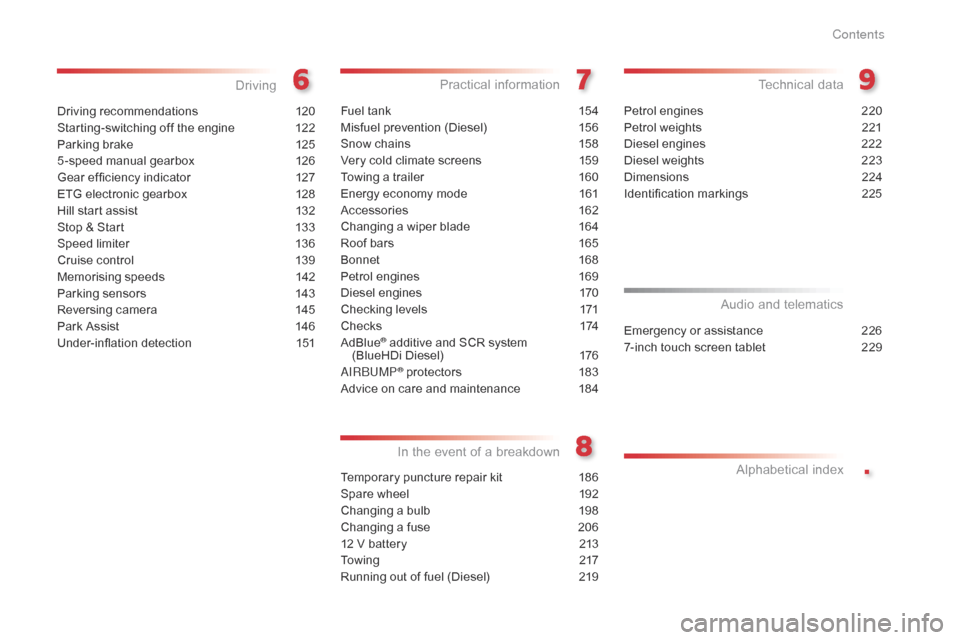
Driving recommendations 120
Starting-switching off the engine
1
22
Parking
brake
1
25
5 -speed
manual gearbox
1
26
Gear
ef ficiency indicator
1
27
ETG
electronic gearbox
1
28
Hill
start assist
1
32
Stop
& Start
1
33
Speed
limiter
1
36
Cruise
control
1
39
Memorising
speeds
1
42
Parking
sensors
1
43
Reversing
camera
1
45
Park
Assist
1
46
Under-inflation
d
etection
1
51
Driving
Fuel tank 154
Misfuel prevention (Diesel)
1
56
Snow
chains
1
58
Very
cold climate screens
1
59
Towing
a trailer
1
60
Energy
economy mode
1
61
Accessories
1
62
Changing
a wiper blade
1
64
Roof
bars
1
65
Bonnet
16
8
Petrol
engines
1
69
Diesel
engines
1
70
Checking
levels
1
71
C h e c k s
1
74
AdBlue
® additive and SCR system
(
BlueHDi Diesel) 1 76
AIRBUMP
® protectors 1 83
Advice
on
care and maintenance
1
84
Practical information
Temporary puncture repair kit 1 86
Spare wheel
1
92
Changing
a bulb
1
98
Changing
a fuse
2
06
12
V battery
2
13
To w i n g
2
17
Running
out of fuel (Diesel)
2
19
In the event o f a b reakdown
Petrol engines 2 20
Petrol weights
2
21
Diesel
engines
2
22
Diesel
weights
2
23
Dimensions
2
24
Identification
ma
rkings
2
25
Technical data
Emergency or assistance 2 26
7-inch touch screen tablet
2
29
Audio and telematics
Alphabetical
in
dex
Contents
Page 10 of 308

8
Running out of fuel, Diesel (priming pump) 2 19
AdBlue
® additive and SCR system (
BlueHDi Diesel) 1 76 -182
Maintenance - Technical data
Checking levels 1 71-173
- o il
-
b
rake fluid
-
c
oolant
-
s
creenwash fluid
-
a
dditive (Diesel with particle filter)
Checking
components
1
74-175
-
b
attery
-
a
ir / passenger compartment filter
-
o
il filter
-
p
article filter (Diesel)
-
b
rake pads / discs
Changing
bu
lbs
1
98-205
-
f
ront lamps
-
r
ear lamps
-
i
nterior
l
ighting Dimensions
2
24
Identification
ma
rkings
2
25
Petrol
weights
2
21
Diesel weights
2
23
Opening the bonnet
1
68
Under
the bonnet, petrol
1
69
Under
the bonnet, Diesel
1
70
Petrol
engines
2
20
Diesel
engines
2
22
12V
battery
2
13 -216
Load reduction, economy mode
1
61
Engine
c
ompartment
f
uses
2
06 -207, 211-212
Over view
Page 14 of 308
12
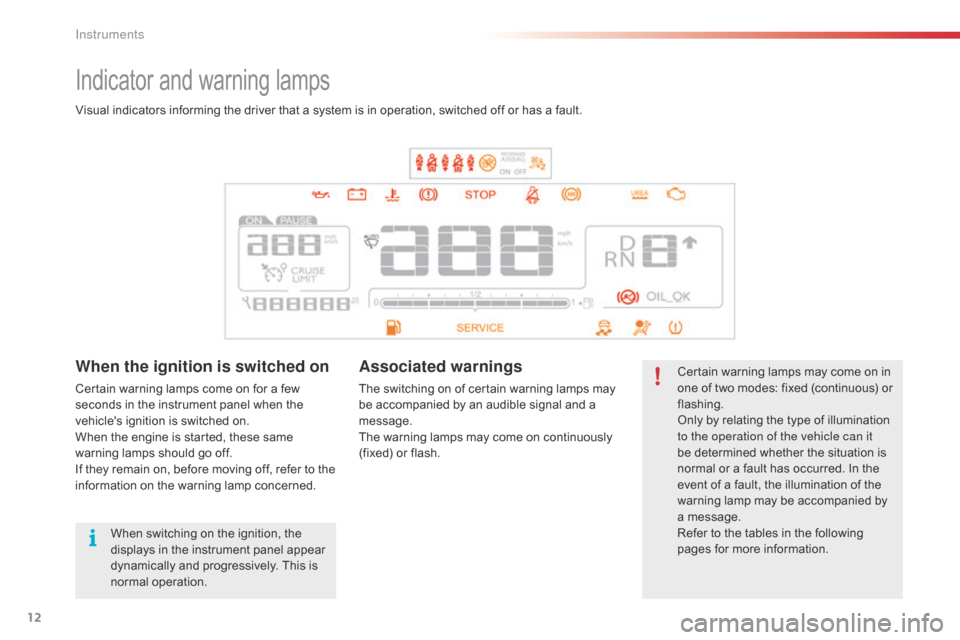
Indicator and warning lamps
Certain warning lamps may come on in one of two modes: fixed (continuous) or
f
lashing.
Only
by relating the type of illumination
t
o the operation of the vehicle can it
be
determined whether the situation is
n
ormal or a fault has occurred. In the
e
vent of a fault, the illumination of the
w
arning lamp may be accompanied by
a
message.
Refer
to the tables in the following
p
ages
f
or
m
ore
i
nformation.
Visual
indicators
informing
the
driver
that
a
system
is
in
operation,
switched
off
or
has
a
fault.When the ignition is switched on
Certain warning lamps come on for a few s
econds in the instrument panel when the
v
ehicle's ignition is switched on.
When
the engine is started, these same
w
arning lamps should go off.
If
they remain on, before moving off, refer to the
i
nformation on the warning lamp concerned.
Associated warnings
The switching on of certain warning lamps may be accompanied by an audible signal and a
m
essage.
The
warning lamps may come on continuously
(
fixed) or flash.
When
switching
on
the
ignition,
the
d
isplays
in
the
instrument
panel
appear
d
ynamically
and
progressively.
This
is
n
ormal
ope
ration.
Instruments
Page 17 of 308
15
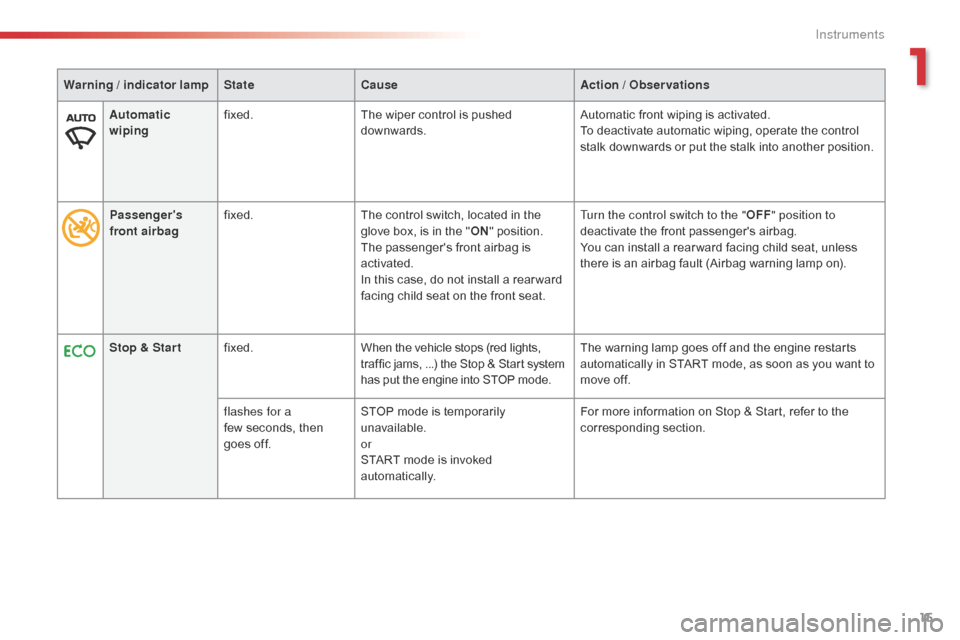
Automatic
wipingfixed.
The wiper control is pushed d
ownwards.Automatic
front wiping is activated.
To deactivate automatic wiping, operate the control
s
talk downwards or put the stalk into another position.
Stop & Star t fixed. When
the vehicle stops (red lights,
t
raffic jams, ...) the Stop & Start system
h
as put the engine into STOP mode.The
warning lamp goes off and the engine restarts
a
utomatically in START mode, as soon as you want to
m
ove off.
flashes for a
few seconds,
then
g
oes off.STOP
mode is temporarily
u
navailable.
or
START
mode is invoked
au
tomatically.For
more information on Stop & Start, refer to the
c
orresponding
s
ection.
Warning / indicator lamp
StateCause Action / Observations
Passenger's
front airbag fixed.
The
control switch, located in the
g
love box, is in the "ON "
position.
The
passenger's front airbag is
a
ctivated.
In
this case, do not install a rear ward
f
acing child seat on the front seat.Turn the control switch to the "
OFF" position to
deactivate
the front passenger's airbag.
You
can install a rear ward facing child seat, unless
t
here is an airbag fault (Airbag warning lamp on).
1
Instruments
Page 38 of 308
36
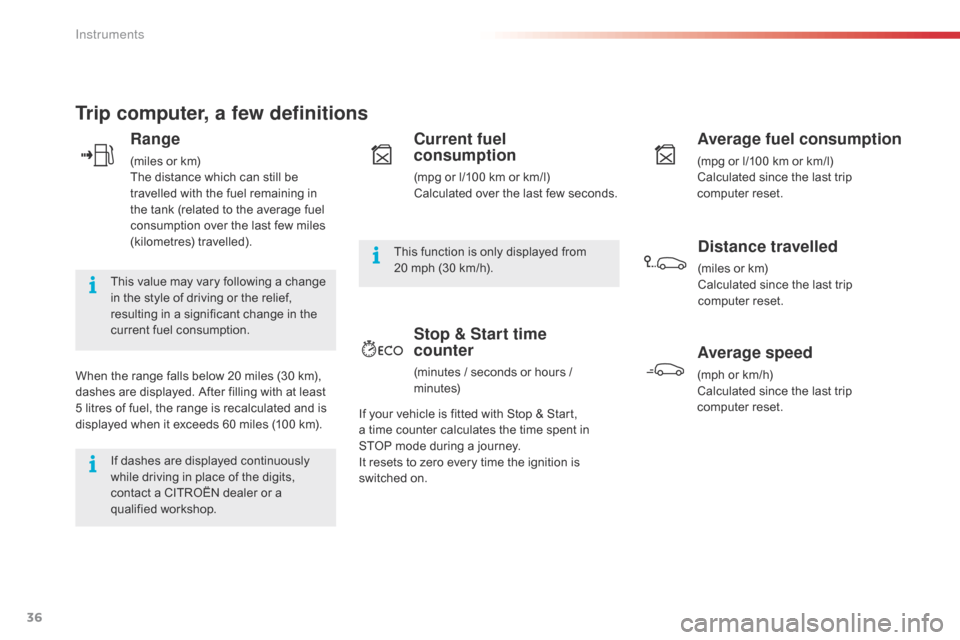
Trip computer, a few definitions
Range
(miles or km)
T he distance which can still be
t
ravelled with the fuel remaining in
t
he tank (related to the average fuel
c
onsumption over the last few miles
(
kilometres)
t
ravelled).
This
value may vary following a change
i
n
the style of driving or the relief,
r
esulting in a significant change in the
c
urrent fuel consumption.
When
the
range falls below 20 miles (30 km),
d
ashes
are displayed. After filling with at least
5
litres
of
fuel, the range is recalculated and is
d
isplayed
when it exceeds 60 miles (100 km).
If
dashes are displayed continuously
w
hile driving in place of the digits,
c
ontact a CITROËN dealer or a
q
ualified
w
orkshop. This
function is only displayed from
20
mph (30 km/h).
Current fuel
consumption
(mpg or l/100 km or km/l)
C alculated over the last few seconds.
Average fuel consumption
(mpg or l/100 km or km/l)
C alculated since the last trip
c
omputer
re
set.
Distance travelled
(miles or km)
C alculated since the last trip
c
omputer
re
set.
Average speed
(mph or km/h)
C alculated since the last trip
c
omputer
re
set.
Stop & Start time
counter
(minutes / seconds or hours / minutes)
If
your
vehicle is fitted with Stop & Start,
a t
ime
counter calculates the time spent in
S
TOP mode during a journey.
It
resets
to zero every time the ignition is
s
witched
on.
Instruments
Page 65 of 308
63
In cold weather with the engine cold, the air flow is increased gradually until
t
he system has warmed up, in order
t
o limit the delivery of cold air into the
p
assenger
c
ompartment.
On
entering the vehicle, if the interior
t
emperature is much colder or warmer
t
han the comfort value setting, there
i
s no need to alter the value displayed
i
n order to reach more quickly the
r
equired level of comfort. The system
c
ompensates automatically and
c
orrects the temperature difference as
q
uickly as possible.
This
setting
is
associated
with
AUTO
mode
o
nly.
However,
on
deactivation
of
AUTO
mode,
t
he
last
setting
used
remains
on.
Changing
the
setting
does
not
reactivate
AUTO
m
ode
if
deactivated.
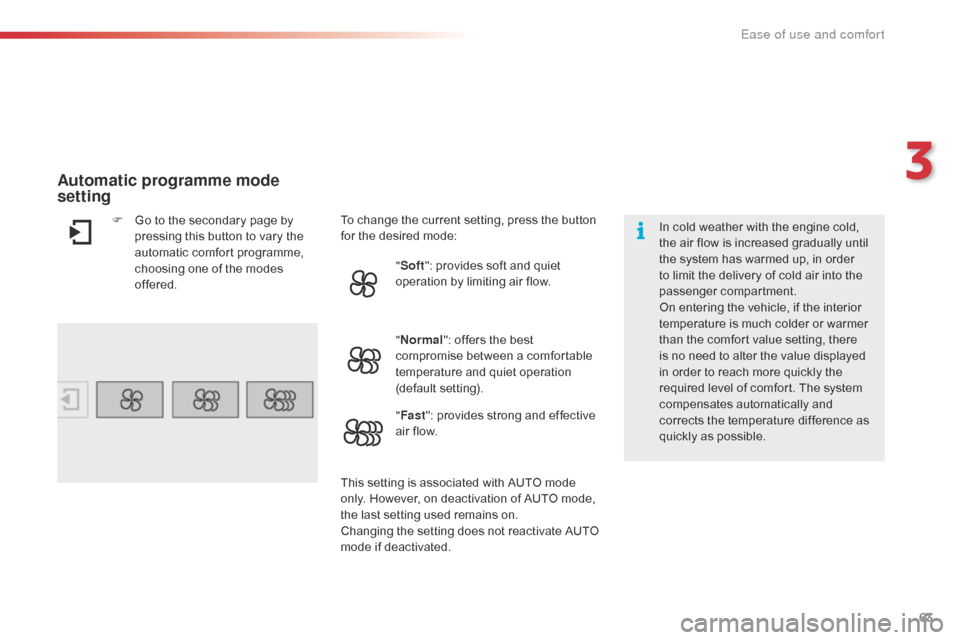
To
change
the
current
setting,
press
the
button
f
or
the
desired
mode:
" Soft ":
provides
soft
and
quiet
o
peration
by
limiting
air
flow.
" Normal ":
offers
the
best
c
ompromise
between
a
comfortable
t
emperature
and
quiet
operation
(
default
setting).
" Fast ":
provides
strong
and
effective
a
ir
flow.
Automatic programme mode
setting
F Go to the secondary page by p
ressing this button to vary the
a
utomatic comfort programme,
c
hoosing one of the modes
o
ffered.
3
Ease of use and comfort
Page 70 of 308
68
Courtesy lamp
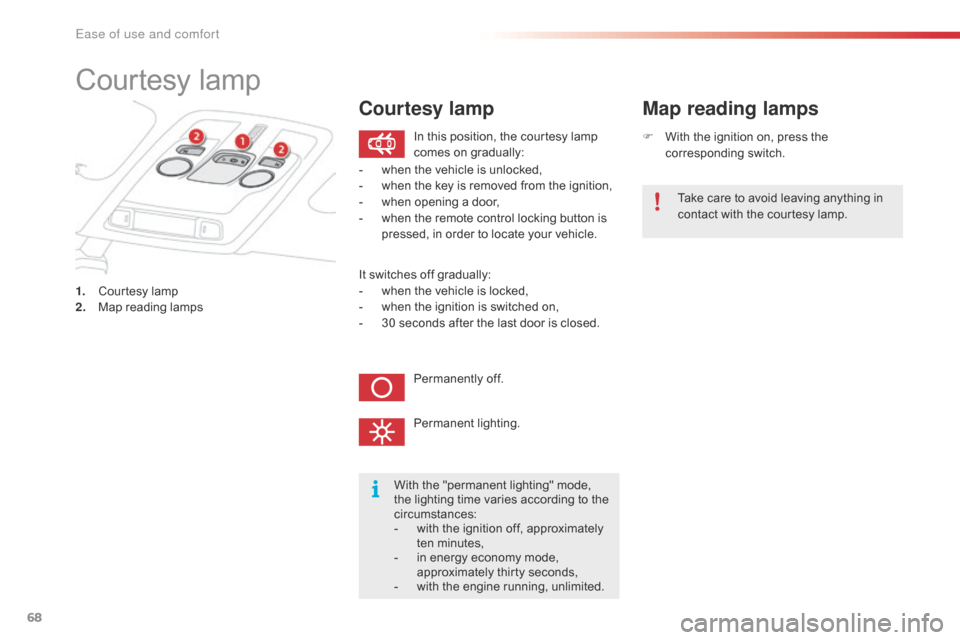
1. Courtesy lamp
2. M ap reading lamps F
W
ith the ignition on, press the
c
orresponding
s
witch.
Map reading lamps
With the "permanent lighting" mode, t
he lighting time varies according to the
c
ircumstances:
-
w
ith the ignition off, approximately
t
en
m
inutes,
-
i
n energy economy mode,
a
pproximately thirty seconds,
-
w
ith the engine running, unlimited.
In
this position, the courtesy lamp
c
omes on gradually:
Permanently off.
Permanent
l
ighting.
-
w
hen the vehicle is unlocked,
-
w
hen the key is removed from the ignition,
-
w
hen opening a door,
-
w
hen the remote control locking button is
p
ressed, in order to locate your vehicle.
Take care to avoid leaving anything in
c
ontact with the courtesy lamp.
Courtesy lamp
It switches off gradually:
- w hen the vehicle is locked,
-
w
hen the ignition is switched on,
-
3
0 seconds after the last door is closed.
Ease of use and comfort
Page 71 of 308
69
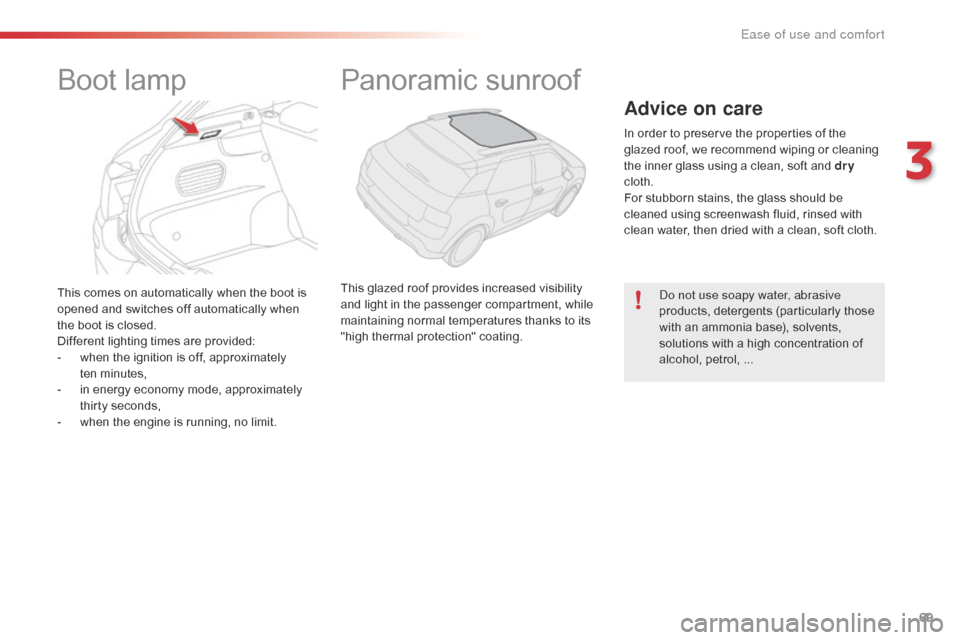
This comes on automatically when the boot is opened and switches off automatically when
t
he boot is closed.
Different
lighting times are provided:
-
w
hen the ignition is off, approximately
t
en minutes,
-
i
n energy economy mode, approximately
t
hirty seconds,
-
w
hen the engine is running, no limit.
Boot lampPanoramic s unroof
This glazed roof provides increased visibility a
nd light in the passenger compartment, while
m
aintaining normal temperatures thanks to its
"
high thermal protection" coating.
Advice on care
In order to preserve the properties of the glazed roof, we recommend wiping or cleaning
t
he inner glass using a clean, soft and dry
cloth.
For
stubborn stains, the glass should be
c
leaned using screenwash fluid, rinsed with
c
lean water, then dried with a clean, soft cloth.
Do not use soapy water, abrasive
products,
detergents (particularly those
w
ith an ammonia base), solvents,
s
olutions with a high concentration of
a
lcohol, petrol, ...
3
Ease of use and comfort
Page 83 of 308

81
Foglamp selection ring
The foglamps operate with dipped and main beam headlamps.
Front foglamps and rear
foglamp
When the headlamps switch off with automatic illumination of headlamps (AUTO model)
o
r when the dipped beam headlamps are
s
witched off manually, the foglamps and
si
delamps
re
main
o
n.
F
T
urn the ring rear wards to switch off
t
he foglamps, the sidelamps will then
s
witch off.
Rear foglamp only
F To switch it on, turn the ring for wards.
When the lighting is switched off automatically
(
with AUTO model), the foglamp and the dipped
b
eam headlamps will remain on.
F
T
o switch it off, turn the ring rear wards.Rotate
and release the ring:
F f or wards a first time to switch on the front
fo
glamps,
F
f
or wards a second time to switch on the
r
ear
fo
glamp,
F
r
ear wards a first time to switch off the rear
fo
glamp,
F
r
ear wards a second time to switch of the
f
ront fog lamps.
4
Lighting and visibility
Page 98 of 308
96
Driving advice
Your vehicle is designed principally to drive on tarmac roads but it allows you
t
o drive on other less passable terrain
o
ccasionally.
However,
it does not permit off-road
d
riving such as:
-
c
rossing and driving on terrain
w
hich could damage the underbody
o
r strip away components (fuel
p
ipe, fuel cooler...) due to obstacles
o
r stones in particular,
-
d
riving on terrain with steep
g
radients and poor grip,
-
c
rossing a stream.All terrain (mud, damp grass, ...)
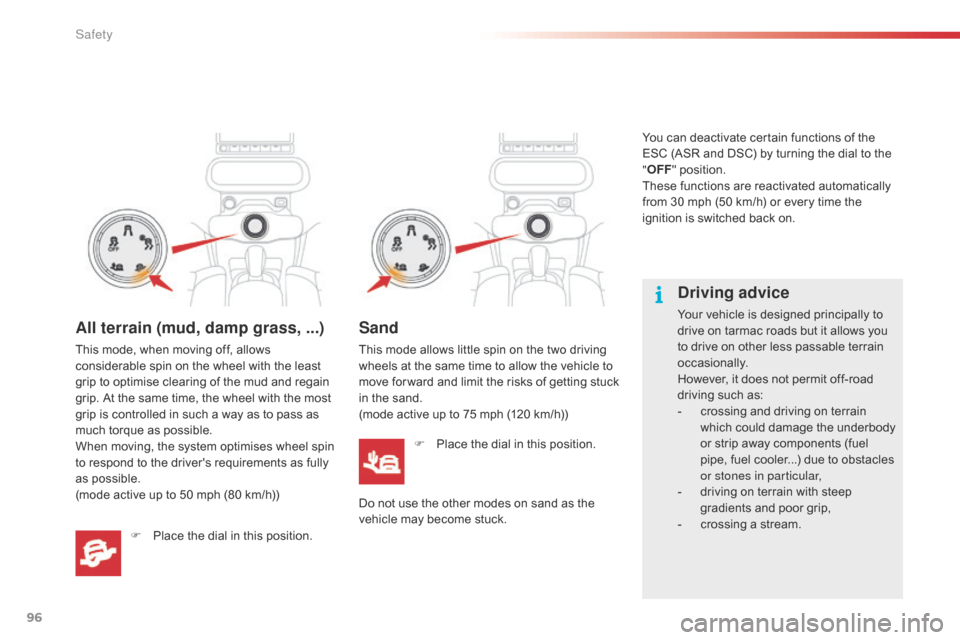
This mode, when moving off, allows considerable spin on the wheel with the least
g
rip to optimise clearing of the mud and regain
g
rip. At the same time, the wheel with the most
g
rip is controlled in such a way as to pass as
m
uch torque as possible.
When
moving, the system optimises wheel spin
t
o respond to the driver's requirements as fully
a
s possible.
(mode
active up to 50 mph (80 km/h))
F
P
lace the dial in this position.
Sand
This mode allows little spin on the two driving wheels at the same time to allow the vehicle to
m
ove for ward and limit the risks of getting stuck
i
n the sand.
(mode
active up to 75 mph (120 km/h))
F
P
lace the dial in this position.
Do
not use the other modes on sand as the
v
ehicle may become stuck. You
can deactivate certain functions of the
ES
C (ASR and DSC) by turning the dial to the
"
O
FF
" position.
These functions are reactivated automatically
f
rom 30 mph (50 km/h) or every time the
i
gnition is switched back on.
Safety